Secret Bit Transmission Using
a
Random
Deal of Cards
on
Hierarchical
Structures
Reina Yoshikawa
(吉川玲奈)and Yoshihide Igarashi
(五十嵐善英)Department
of
Computer Science,Gunma
University, Kiryu, Japan376-8515
$\mathrm{E}$
-mail:igarashi@comp.
$\mathrm{c}\mathrm{s}$.gunma-u.ac.jp
Abstract
We propose a problem how we transmit an information-theoretically secure bit using a
random deal of cardsamongplayersin hierarchical structuredgroupsandacomputationally
unlimitedeavesdropper. A player in the highest groupwants to send playersinlowergroups
a secret bit which is secure from the eavesdropper and some other players. We formalize
this problem, andwedesign a protocolforconstructing asecret key exchangespanning tree
on two-level hierarchicalgroups of players. Thenfor the protocolwe analyze the conditions
that thesecure bit transmission by the protocol is successful. We give a sufficient condition
that the protocol successfully workson the sizesofhandsofplayers and an eavesdropper.
key words: card games, hierarchical structured groups, $\mathrm{i}\mathrm{n}\mathrm{f}o$rmation theoretically-secure,
key exchange graphs, secret bit transmission,
1
Introduction
Suppose that there
are
$n$ playersanda
passive eavesdropper, Eve, whose computational poweris unlimited. The $n$ players
are
partitioned into hierarchicalgroups,
$G_{1},$ $\ldots;G_{h}$, where $G_{1}=$$\{P_{1,1}, \ldots , P_{1,k_{1}}\},$ $\ldots$, $G_{h}=\{P_{h,1}, \ldots , P_{h},, \ldots, {}_{1}P_{h,k}\}h$ and $|G_{i}|\geq 1$ for each$1\leq i\leq h$
.
Foreachpair of $i$ and$j(i\neq j),$ $G_{i}\cap G_{j}=\phi,$ and $\bigcup_{i=1}^{h}G_{i}$ is the set ofthe $n$ players (i.e., $n= \sum_{i=1}^{h}k_{i}$).
We
assume
that the hierarchy of thegroups
$G_{1},$$\ldots,$ $G_{h}$
is.in
the suffix order. That is,$G_{i}$ is
higher than$G_{j}$ in the hierarchy if$i<j$
.
Usinga
random deal of cardswe
constructa
spanningtree with node set $\bigcup_{i=1}^{h}G_{i}$ satisfying the followingconditions, where
a
node denotesa
player:(1) A pair of nodes directly connected by
an
edge of the spanning tree hasa
secret keyexchange.
(2) Foreach $1\leq j\leq h$, the subgraph of the spanning tree consisting ofthe nodes in $\bigcup_{i=1}^{j}G_{i}$
and their incident edges is
a
spanning tree ofthe nodes of$\bigcup_{i=1}^{j}G_{i}$.(3) If
a
pair of nodesare
connected byan
edge ofthe spanning tree, then both the nodes inthesame group,
or
theone
nodeisin $G_{i}$ and the other node is in $G_{i+1}$ forsome
$i$between1 and $h-1$
.
Once such
a
spanning tree is constructed, bit secret communication is possible $\mathrm{b}\mathrm{e}\mathrm{t}_{)}\mathrm{w}\mathrm{e}\mathrm{e}\mathrm{n}$a
pair of nodes directlyconnected by
an
edge ofthe spanningtree. In this paperwe
assume
thateven
if the two nodesare
connected byan
edge of the spanning tree. The subtree rooted ata
node in
group
$G_{i}$ isa
subtree rooted at the node of the spanning tree consisting of nodes notinany group higher than $G_{i}$
.
A player chooses asecret bit, andusing the suotree rooted at theplayer can sendthe secret bit to
a
player in the subtree in the following fashion. If player $P_{\dot{\epsilon},j}$wants to send
a
secret bit $r$to player$P_{i’,j’}$ alongan
edge $(P_{i},, {}_{j}P_{i,j}\prime\prime)$ of the subtree, $P_{i,j}$ computesthe exclusive-or$r\oplus r^{l}$ and sends it to $P_{i’,j’}$, where $r’$ is the secret exchange key between $P_{i,j}$
and $P_{ij’},$
.
ThenPit,
$j’$ obtains $r$ by computing $r\oplus r’\oplus r’=r$.
Repeating this methoda
playercan
send a secret bit to any node of the subtree rooted at the node of the player. This bittransmissionis information theoretically
secure
from not only Eve but also anynode not in thethe path of the bit transmission. When the number of the hierarchical groups of the players is
just 1, thisproblemis the same asthe secret key exchange using arandom deal of cards studied
in $[1][2][3][4]$
.
Constructing asecret key excllange spanning tree on the hierarchical structuredplayers satisfying the three conditions listed above is therefore
a more
general problem.2
Preliminary
Fischer and Wright proposed aprotocol called the smallest feasible protocol (SFP forshort) for
the one-bit secret key exchange [2]. Suppose that there
are
$n$playersanda
passive eavesdropperEve. Let each player $P_{i}$ hold $c_{i}$ cards and Eve hold $e$ cards. Then $P_{i}$ is said to be feasible if
$ci>1$, orif $h_{i}=1,$ $e=0$, and $h_{j}>1$
.for all $j\neq i$
.
We call$\xi=$ $(c_{1}, \ldots , c_{n}; e)$ the signature ofthe deal. The SFP is as follows [2]:
(1) Let $P$ be the feasible player holding the smallest hand. (Ties are broken in favor of the
lower-numberedplayer.)
(2) $P$choosesarandom card $x$ contained in her hand and
a
random cardnot in her hand andpropose $K=\{x, y\}$
as a
key set by asking”$\mathrm{D}\mathrm{o}\mathrm{e}‘ \mathrm{s}$ any player hold
a
card in $K$ ?(3) If another player $Q$holds$y$, she accepts $K$byannouncing that she holds
a
cardin $K$.
Thecards $x$ and$y$
are
discarded. Whichever $P$ and $Q$ holdsfewer cards $\mathrm{e}\mathrm{x}^{1}\mathrm{p}\mathrm{o}\mathrm{s}\mathrm{e}$ the remainingcards in her hand, which
are
discarded, and drops out of the protocol. The remainingplayers go back to step (1).
(4) If
none
of the players hold$y$, then $K$ is rejected. Inthis case, $x$ and $y$are
discarded, andthe players
go
back to step (1).Theexecution of the protocol continuesuntil either there
are
not enough cards left tocom-plete steps (1) and (2),
or
until onlyone
player is left. The firstcase
is thecase
where theprotocol fails, and the second
case
is the protocolis successful, i.e.,a
spanning tree of theplay-ers
is $\mathrm{c}\mathrm{o}\mathrm{n}8\mathrm{t}\mathrm{r}\mathrm{u}\mathrm{C}\mathrm{t}\mathrm{e}\mathrm{d}$, where each edge $(x, y)$ is the result by acceptingset $K=\{x, y\}$ in step (3)as an
opaque set for Eve (i.e., it is equally likely for Eve that $P$ holds $x$ and$Q$ holds $y$or
that$P$ holds $y$ and $Q$ holds $x$
.
Fischer andWrite showed the followingtheorem [2].Theorem 1 [2] Let$\xi=(c_{1}, \ldots, C_{n}; e)$ be the signature
of
the deal. Let $ci\geq 1$for
$1\leq i\leq n$,and $\max\{\dot{c}_{i}|1\leq i\leq n\}+\min\{c_{i}|1\leq i\leq n\}\geq n+e$
.
Then the $SFP$perfomls successfully theconstruction
of
a
spanning tree with the $n$ nodes$..w$here each
e.dge
joining two nodes representsthe two nodes sharing $a$ one-bit secretkey.
Thecondition $\max\{C_{i}|1\leq i\leq n\}+\min\{Ci|1\leq i\leq n\}\geq n+e$ provides
a
sufficient conditioncondition. For example, the signature $\xi=(3,3,2,1;1)$ has $\max\{c_{i}|1\leq i\leq n\}+\min\{c_{i}|1\leq$
$i\leq n\}=4<n+e=5$ , but the SFP succeeds
on
the signature. A necessary and sufficientcondition for the SFP to be successful
on
a
signaturewas
recently given by Mizuki et al. [6].However, the description ofthe necessary and sufficient condition is not simple, and the proof
for the conditionis
a
lengthycase
analysis, where thenecessary andsufficientcondition is givenin each of various
cases
[6]3
Protocols
for
Constructing
Key
Exchange
Spanning
bees
In the
case
where the number ofthe hierarchicalgroups
of the players is 1,a
secret one-bit keyexchange spanning tree with the nodes of the players
can
be constructed by the SFP. In thissection
we
givea
protocol called 2-levelprotocolfor constructinga
key exchange spanning treesatisfying the conditions given in Section 1 in the
case
where the number of the hierarchicalgroups is 2 (i.e., the
case
where the $n$ playersare
divided into two hierarchicalgroups
$G_{1}$ and$G_{2})$
.
The 2-level protocol partlyuses
a
modified SFP. Let $\{P_{1,1j}\ldots, P_{1,k_{1}}\}$ be the set of theplayers in $G_{1}$ and $\{P_{2,1}, \ldots , P_{2,k_{2}}\}$ be the set of the players in $G_{2}$. The current size of $P_{i,j^{\mathrm{S}}}$’
hand is denoted by $c_{i_{\dot{\theta}}}$ for each pair of
$i$ and $j(1\leq i\leq 2,1\leq j\leq k_{i})$, and the current size
of Eve’s hand is denoted by $e$
.
Each player $P_{i,j}$ hasa
tag, $T(i,j)$.
For each pair of$i$ and $j$$(1\leq i\leq 2,1\leq j\leq k_{i}),$ $T(i, j)$ is initially set to be $(i,j)$
.
A player $P_{i,j}$ is said to be $fea\mathit{8}ible$ if (1) ci,$j>1\text{ノ}$.
or
(2) $i=1,$ $c_{1,j}=1_{\backslash },$ $e=0$, for every other player $P_{1,t}(j\neq t)$ in$G_{1},$ $c_{1,t}\neq 1$, andfor every player$P_{2,t}$ in $G_{2},$ $T(2, t)=(1,1)$,
or
(3) $i=2,$ $c_{2,\mathrm{j}}=1,$ $e=0$, for everyplayer $P_{1,t}$ in$G_{1},$ $T(1, t)=(1,1)$, and for every other player $P_{2,t}(j\neq t)$ in $G_{2},$ $c_{2,t}\neq 1$
.
We
use
thelexicographical orderofthe indices of the players. That is, if$i<i’$,or
$i=i’$ and$i’<j’$, then $(i,j)<(i’,j’)$. The signature of the deal of the two hierarchical groups is denoted
by$\xi=(_{C_{1,1}}, \ldots, c_{1},k_{1} ; c2,1, \ldots, C_{2},k_{2}arrow ; e)$
.
2-level protocol:
(1) If there is
no
player with anon-emptyhand in $G_{1_{i}}$ and there isa
player in $G_{1}$or
$G_{2}$ withits tag value not equal to $(1, 1)$, then the protocolstops and fails. If$T(1, i)=(1,1)$ for all
$1\leq i\leq k_{1}$ then go to step (5). Let $P_{1,i}$ be the
feasible
playerholding the smallest hand in $G_{1}$.
(Tiesare
broken in favor of the lower ordered player.) Ifno player in $G_{1}$ is feasible,then the lowest ordered player holding
an
non-empty hand, say $P_{1,i}$, is chosen.(2) For $P_{1,i}$ chosen in (1), $P_{1,i}$ chooses
a
random card $x$ containedin herhand anda
randomcard $y$ not in her hand andproposes $K=\{x, y\}$
as a
key set by asking, ”Does anyplayerwith its tag value different from $T(1, i)$ hold a card in $K$ ? (If there
are no
cards not in$P_{1,i,y}$
can
bea
dummy card.)(3) If another player in $G_{1}$, say$P_{1,j}$, with its tag value different from$T(1, i)$ holds $y,\cdot$ then $P_{1,j}$
accepts $K$ by announcing that she holds
a
card in $K$. The cards, $x$ and $y$are
discarded,and for every $P_{1,t}$ such that $T(1, t)=T(1\text{ノ}.i)$
or
$T(1, t)=T(1,j),$ $T(1,t)$ is set to be$T(1, \min\{i,j\})$
.
A player holdingfewercardsexposestheremainingcards in her hand (i.e.,hereafter the player holds the empty hand). (Ties
are
broken by exposing the remainingcards inthe handofthe playerwith the larger index.) If
a
player in$G_{2j}$ say$P_{2,j}.$, holds $y$,then$P_{2,j}$ accepts$K$ by announcingthat she holds
a
card in $K_{i}$ then the cards $x$ and$y$are
$\mathrm{d}\mathrm{i}_{\mathrm{S}\mathrm{C}\mathrm{a}\mathrm{r}}\mathrm{d}\mathrm{e}\mathrm{d}_{i}$ and then $T(2,j)$ is set to be $(1, 1)$, and then $P_{2,j}$ exposes the remaining cards
inherhand (i.e., hereafter $P_{2,j}$ holds the empty hand). Allthe players go backto step (1)
(4) If
none
of the players accept $K=\{x,y\}$, then $x$ and $y$are
discarded, and then all theplayers go back to step (1) with the updated deal.
(5) If for all $1\leq i\leq k_{2j}T(2, i)=(1,1)$, then the protocol successfully stops. If there is
a
player with its tag value not equal to $(1, 1)$ in $G_{2}$ holding the empty hand, then theprotocol stops and fails. If there
are no
feasible players in $G_{2}$ but there isa
player in $G_{1}$holding a$\mathrm{n}\mathrm{o}\mathrm{n}- \mathrm{e}\mathrm{m}\mathrm{P}^{\mathrm{t}}\mathrm{y}$ hand, then let $P_{1,i}$ be such
a
player andgo
to step step (9). Let $P_{2,i}$be the
feasible
player holding the smallest hand in $G_{2}$.
(Tiesare
broken in favor ofthelower ordered player.)
(6) For $P_{2,i}$ chosen in (5), $P_{2,i}$ choose8
a
random card $x$ contained in her hand anda
randomcard $y$ not in her hand andproposes $K=\{x,y\}$
as a
key set by asking, ”Does any playerhold
a
card in $K$ ?(7) If
a
player in $G_{1}$ holds $y$, then the player accepts $K$ by announcing that she holdsa
card in K., then the cards $x$ and $y$ are $\mathrm{d}\mathrm{i}_{\mathrm{S}\mathrm{C}\mathrm{a}\mathrm{r}}\mathrm{d}\mathrm{e}\mathrm{d}_{j}$ then for every player
$P_{2,t}$ such that
$T(2,t)=T(2, i),$ $T(2,t)$ is set to be $(1, 1)$, and then $P_{2,i}$ expose theremainingcards in her
hand (i.e., hereafter $P_{2,i}$ holds the empty hand). If anotherplayer, say $P_{2,j}$, in $G_{2}$ holds
$y$, then $P_{2,j}$ accepts that she holds
a
card in $K$, then the cards $x$ and $y$are
$\mathrm{d}\mathrm{i}_{\mathrm{S}\mathrm{C}\mathrm{a}\mathrm{r}}\mathrm{d}\mathrm{e}\mathrm{d}_{j}$then for every $P_{2,t}$ such that $T(2,t)=T(2, i)$
or
$T(2,t)=T(2,j),$ $T(2, t)$ is set to be$\min\{T(2, i), T(2,j)\}$, and then a player holding a smaller hand among the two players
exposes the remaining cards (i.e., hereafter the player holds the empty hand.) (Ties
are
broken by exposing the remaining cards in the hand of the player with the largerindex.)
All the players go back to (5) with the updated deal.
(8) If
none
of the players accept $K=\{x, y\}$, then $x$ and $y$are
discarded, and then all theplayers go back to step (5) withtheupdated deal.
(9) Let$P_{1,i}$ bethe playerdefined in step (5) (i.e., the playerin$G_{1}$holding anon-emptyhand).
(Note that in this
case
everyplayer other than $P_{1,i}$ holds the emptyhand.) $P_{1,i}$ choosesa
random card $x\mathrm{c}\mathrm{o}\mathrm{n}\mathrm{t}\mathrm{a}\mathrm{i}\mathrm{n}\mathrm{e}^{\backslash }\mathrm{d}$ in her hand and
a
random card$y$ notin her hand and propose
$K=\{x, y\}$ as
a
key set byasking, ”Does any playerholda
card in $K$ ?(10) If another player, $8\mathrm{a}\mathrm{y}P_{2,j},$
$\mathrm{i}\mathrm{n}G^{\mathrm{v}_{2}}\overline{\sim}\sim$
holds $y$, then $P_{2_{\dot{d}}}$ accepts that she holds
a
card in $K$,thenthe cards$x$ and$y$
are
discarded,thenfor every $P_{2,t}$such that $T(2, t)=T(2,j),$$\tau(2, t)$isset to be $(1, 1)$, and then go back to step (5) with updated deal.
(11) Ifnone of the players accept $K=\{x, y\}$, then $x$ and $y$
are
discarded, and then all theplayers go back to step (5) with the updated deal.
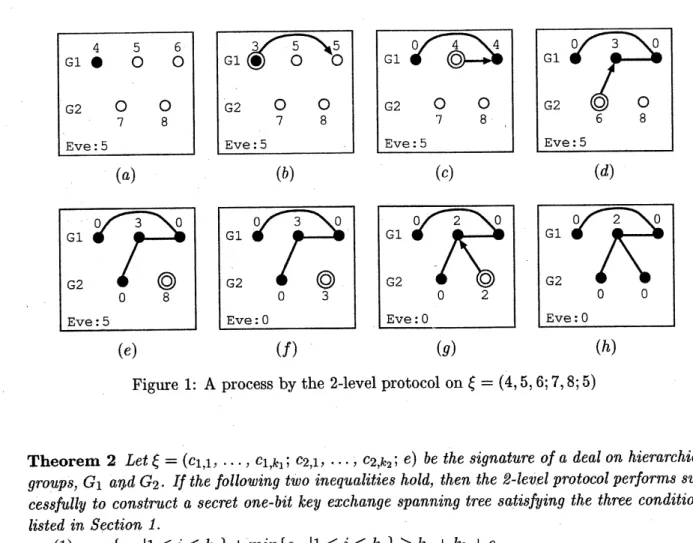
Example 1 Let$\xi=(4,5,6;7,8;5)$ be the $\mathit{8}ignature$
of
a
deal. We apply the 2-levelprotocol tothe deal. The initial signature $i\mathit{8}$ shown in Figure 1 $(a)$. The size
of
each hand is indicated bya number beside the $corre\mathit{8}ponding$ node in Figure 1. Goup $G_{1}$
consists
of
three player8. Theirinitialtag value8
are
$(1, 1)$, $(1, 2)$ and $(1, 3)$. Group$G_{2}consi\mathit{8}tS$of
twoplayers. Their initial tagvalues are $(2, 1)$ and $(2, 2)$
.
The processof
constructinga
secret key exchange spanning tree bythe 2-levelprotocol is
shown
in Figure 1. The constructionof
a $\mathit{8}ecret$ key exchange spanningtree proceeds
as
shown in $(a),$ $(b),$ $\ldots$, $(h)$of
Figure 1. Players with their tag value $(1, 1)$are
indicated by black circles. At each $\mathit{8}tage$
a
player with the double circle propose8a
key $\mathit{8}et$of
cards. A player who
announces a
$ca7d$ in the key set is indicated byan
incomingarrow.
$At$the end
of
proces8 shown in $(c)$, the tag valuesof
all the players in $G_{1}$are
(1.1). The proces8from
step $(\dot{\mathit{5}})$player indicated by the double circle during the $proce\mathit{8}S$ in $(e)$, Eve has
a
card in the key $\mathit{8}et$,and eventually the stage shown in $(f)$ reache8. At the stage shown in $(f)$, the $\mathit{8}econd$ playerin
$G_{1}ha\mathit{8}$ a card in the key set $propo\mathit{8}ed$ by the player indicated by the double circle in $G_{2}$. This
situation is $\mathit{8}hown$ in $(g)$, and eventually
we
obtaina
$\mathit{8}ecret$ key exchange $\mathit{8}panning$ tree. This$\mathit{8}panning$ tree
satisfies
the three condition8 listed in Section 1.$\mathrm{G}1\bullet 4$ $05$ $06$ $\mathrm{G}1\bullet r_{0}^{5\backslash 5}3\mathrm{O}$
G2 $\mathrm{O}$ $\mathrm{O}$ G2 $\mathrm{O}$ $\mathrm{O}$
G2 $\mathrm{O}$ $\mathrm{O}$
7 8 7 8 7 8
Eve:5 Eve:5 Eve: 5 Eve:5
$(a)$ $(b)$ $(c)$ $(d)$
Eve:5 Eve:$0$ Eve:$0$ Eve:$0$
$(e)$ $(f)$ $(g)$ $(h)$
Figure 1: A process bythe 2-level protocolon $\xi=(4,5,6;7,8;5)$
Theorem 2 Let$\xi=(c_{1,1}, \ldots, c_{1,k_{1}} ; c_{2,1}, \ldots, c_{2,k_{2}} ; e)$ be the signature
of
a dealon
hierarchicalgroups, $G_{1}$ arpd$c2$
.
If
the following two inequalitie8 hold, then the 2-level protocol perform8suc-cessfully to
construct a
secret one-bit key exchange spanning tree $\mathit{8}ati_{S}fying$the three condition8$li\mathit{8}ted$ in Section 1.
(1) $\max\{c_{1,i}|1\leq i\leq k_{1}\}+\min\{c_{1,i}|1\leq i\leq k_{1}\}\geq k_{1}+k_{2}+e$
(2) $\min\{c_{2,i},|1\leq i\leq k_{2}\}\geq e+k_{2}$
Proof.
For the process before step (5) of the 2-level protoc.ol, players in $G_{1}$ propose sets ofcards. For each proposed set$K=\{x, y\}$ before step (5),
one
of the following threecases occurs.
The first
case
is that both $x$ and $y$are
hold by players in $G_{1}$, the secondcase
is thatone
ofthe card8 is hold by a player in $G_{2}$, and the third
case
is thatone
of the cards is hold by Eve.Besides discarding the two cards in $K$ at each proposal, in the first
case,
exactlyone
player in$G_{1}$ exposesthe remaining cards and becomes
a
player with the empty hand, in the secondcase
the player in $G_{2}\mathrm{e}\mathrm{x}\mathrm{p}\mathrm{o}8\mathrm{e}\mathrm{s}$the remaining cards and becomes
a
player with the empty hand, andin the third case, the remaining cards
are
not exposed. We mightassume
that the behavior ofeach player in $G_{2}$ during the
process
before step (4) likes Eve ifthe set of the discarded cardsand the exposed cardsby
a
player in $G_{2}$ at each proposalbefore step (5) is consideredjustone
card. Therefore,
as
proved about SFPin [2], ifthe condition (1) in the theoremis satisfiedthenall the players in $G_{1}$
are
connected by key exchange edges ofa
spanning tree in $G_{1}$ beforesteP
(5).
When the protocol enters step (5),
a
player in $G_{2}$ has already connected witha
player inplayerin $G_{2}$ shouldbe connected with
a
player in $G_{1}$ ina
step after leaving step (4). For eachloop starting step (5), the number of different tag values ofplayers in $G_{2}$ is reduced by at least
one,
or a
player in $G_{2}$ is directly connected with a player in $G_{1}$, or the size of Eve’s hand isreduced by one. Even if there are no chances such a player in $G_{2}$ is connected with a player in
$G_{1}$ in step (7), there is such
a
chance in step (10). Note that step (9) andstep (10)are
preparedfor this purpose. From this observation
we can
saythat ifthe second condition holds then theall the players’ tag values eventually become $T(1,1)$ and
a
desired key exchange spanning treewith the set ofplayers onthe hierarchical structure is constructed. $\square$
4
Concluding Remarks
The condition given in Theorem 2 is a sufficient condition but the
converse
does not hold ingeneral. For $\mathrm{e}\mathrm{x}\mathrm{a}\mathrm{m}\mathrm{p}\mathrm{l}\mathrm{e}_{i}$ the signature $\xi=(3,3,2,1;1;\mathrm{o})$ does not satisfies (1) in Theorem $2_{i}$
but the 2-level protocolworks successfully
on
$\xi=(3,3,2,1:1;\mathrm{o})$ in anycase.
Ifwe
coulduse
the necessary and sufficient condition given in [6]
on
the sizes of the hands of the players andEve that the SFP works successfully, we might obtain a necessary and sufficient condition
or a
sufficientconditionstrongerthan the condition givenin Theorem 2. However, thenecessary and
sufficient condition given in [6] iscomplicated. We
are
askedto preparean
elegantnecessaryandsufficient condition
on a
signature in thecase
where the 2-levelprotocolworks successfully. Weare
alsointerested in designingan
efficientprotocolfor constructing goodshapedspanningtresssatisfying the conditions given in Section 1 on a general hierarchical structures of the players.
These problems would be worthy offurther investigation.
References
[1] M.J.Fischer, M.S.Paterson and C.Rackoff, “Secret bit transmission using
a
random deal ofcards”, DIMACS Series in Discrete Mathematics and Theoretical Computer Science., AMS,
vo1.2, $\mathrm{P}\mathrm{P}^{173-18}.1J^{\cdot}$ 1991.
[2] M.J.Fischer and R.N.Write, “Multiparty secret key exchangeusing
a
randomdeal of cards”,Proc. Crypto’91, Lecture Notes in Computer Science, Springer-Verlag, vol.$576_{J}\backslash$ pp.141-155,
1992.
[3] M.J.Fischer and R.N.Wright, “An application of game-theoretic techniques to
cryptogra-phy”, DIMACS Series in Discrete Mathematics and Theoretical Computer Science, AMS,
vol.$\dot{1}$
3, pp.99-118, 1993.
[4] M.J.Fischer and R.N.Write, “An efficient protocol for unconditional
secure
secret keyex-change”, Proc. 4th Annual Symposium
on
Discrete Algorithms, pp.475-483, 1993.[5] M.J.Fischer and $\mathrm{R}.\mathrm{N}.\mathrm{w}_{\mathrm{r}}\mathrm{i}\mathrm{t}\mathrm{e},$ ’‘Bounds on secret key exchange using random deal of cards”,
J. Cryptology, vol.9, pp.71-99, 1996.
[6] T.Mizuki, H.Shizuya and T.Nishizeki, “On dealingnecessaryandsufficientnumbersofcard8
to share