可積分系によるニューラルネットワークの学習の解析
Learning
in
neural
networks
and
an
integrable system
福水健次
理化学研究所
KenjiFukumizu
TheInstitute of Physical and Chemical Research (RIKEN)
$\mathrm{E}$-mail: [email protected]
Abstract
This paper investigates the dynamics of batch learning ofmultilayer neural
net-works inthe asymptoticcase where thenumber of training datais much larger than
the number of parameters. First, wepresent experimental resultson the behavior in
the steepest descent learningofmultilayer perceptrons and three-layer linear neural
networks. We see in these results that strong overtraining, which is the increase of generalizationerrorintraining,occursifthemodel hassurplushiddenunits to realize
the target function. Next, to analyzeovertraining from the theoreticalviewpoint, we
analyze the steepestdescent learning equation ofa three-layer linear neural network,
andtheoreticallyshowthatanetworkwithsurplushidden unitspresentsovertraining.
Fromthis theoreticalanalysis, we can seethat overtraining is not afeature observed
in the final stageoflearning, but it occurs in anintermediatetime interval.
1
Introduction
This paper discusses the dynamics of batch learning in neural networks. Multilayer
networks like multilayer perceptrons have been extensively used in many engineering
ap-plications, in hope that their nonlinear structure inspired by biological neural networks
shows a variety of advantages. However, nonlinearity
causes
weaknesses also. For thetraining of
a
neural network, for example, a numerical optimization method like theer-ror back-propagation (Rumelhart et al., 1986) must be used to find the optimal weight
and bias parameters. It is very important from the practical and theoretical viewpoints
to elucidate the dynamical behavior ofa network in training. Especially, the empirical
error, the objective function ofminimization, and the generalization error, the difference
between the target function and its estimate, are of much interest in many researches.
However, the property of such learning rules have not been clarified completely because of its complex nonlinearity.
In this paper, we focus on overtraining (Amari, 1996) as a typical behavior of learning
in multilayer networks. Overtraining is the increase of the generalization
error
aftersome
数理解析研究所講究録
IIIUU$\langle$$\mathrm{U}\mathrm{U}\mathrm{l}1\ovalbox{\tt\small REJECT} 1$ UI 1R1$a$UUII$J$
Figure 1: Overtraining in batchlearning. The empiricalerrordecreases during iterative training,
while the generalization increases aftersome time point.
time point in learning (Fig.1). Although the empirical error is a decreasing function
in principle, it does not
ensure
the decrease of the generalization error defined by onlyfinite number of training examples. Overtraining is not only oftheoretical interest but of
practical importance, because we should
use
an early stopping technique if overtrainingreally exists.
There has been a controversy about the existence of overtraining. Some practitioners
assert that overtraining often happens and propose early stopping methods. Amari et
al. (1996) analyze overtraining theoretically and conclude that the effect of overtraining
is much smaller than what is believed by practitioners. Their analysis is true if the
parameter approaches totheglobal minimum of the empiricalerrorfollowing the statistical
asymptotic theory (Crame’r, 1946). However, the usual asymptotic theory cannot be
applied in overrealizable cases, where the model has surplus hidden units to realize the
target function (Fukumizu, 1996; Fbkumizu, 1997). Possibility ofan overrealizable target
is acommonproperty ofmultilayer models, and theexistence of overtraining in suchcases
has still been anopen problem.
There have been other studies related to overtraining. Baldi and Chauvin (Baldi
&
Chauvin, 1991) theoretically analyze the generalization error of two-layer linear networks
estimating the identity function from noisy data. Although they show overtraining
phe-nomena
under several assumptions, their analysis is very limited in that the overtrainingcanbeobservedonlywhen the variance ofthenoise inthe trainingsampleis different from
that of the validation sample. In researches from the viewpoint of statistical mechanics,
overtraining is sometimes used for a different meaning. They observe the increase of the
of parameters, and call it overtraining.
The main purpose of this paper is to discuss overtraining of multilayer networks in
connection with overrealizability. We investigate two models: oneis multilayer perceptrons
with the sigmoidal activation function, and the other is linear neural networks, which we
introduce for the simplicityof analysis. Through experimental results of these models, we
can
conjecture that overtrainingoccurs
for overrealizable targets. We theoretically verifythis conjecture in linear neural networks.
This paper is organized
as
follows. Section II gives basic definitions and terminology.Section III shows experimental results concerning overtraining of multilayer perceptrons
and linear neural networks. In Section IV,
we
theoretically show the existence ofover-training in overrealizable cases oflinear neural networks. Section V includes concluding
remarks.
2
Preliminaries
2.1 Framework
of statistical
learningIn this section, wepresent basic definitions and terminologies used in thispaper. A
feed-forward neural network model
can
be defined by a parametric family of maps $\{f(x;\theta)\}$from $\mathbb{R}^{L}$
to $\mathbb{R}^{M}$, where
$x$ is
an
inputvector and 9 is a parametervector. The three-layernetwork model with $H$ hidden units is defined by
$f^{i}(_{X;} \theta)=j=1\sum Hw_{ij\varphi}(_{k=1}\sum^{L}u_{jkk}x+\zeta_{j})+\eta_{i}$, $(1\leq i\leq M)$ (1)
where $\theta=$ $(w_{11}, \ldots, w_{MH}, \eta_{1}, \ldots , \eta_{M}, u_{11}, \ldots, u_{HL}, \zeta_{1}, \ldots , \zeta_{H})$, and an activation
func-tion$\varphi(t)$ is afunction from$\mathbb{R}$to $\mathbb{R}$. We call athree-layer network a multilayerperceptron,
ifthe sigmoidal function
$\varphi(t)=\frac{1}{1+e^{-t}}$ (2)
is used for the activation function.
We use such a model for regression problems, assuming that
an
output of the targetsystem is observed with a measurement noise. A sample $(x, y)$ from the target system
satisfies
$y=f(X)+v$ , (3)
where$f(x)$ isthe target
function
whichisunknown to alearner, and$v$ is arandom vectorwith $0$ as its mean and $\sigma^{2}I_{M}$ as its variance-covariance matrix. We write $I_{M}$ for the
$M\cross M$ unit matrix. An input vector $x$ is generated randomly with its probability density
function $q(x)$, which is unknown to
a
learner. ’baining data $\{(x^{(\nu)}, y)(\nu)|\mathcal{U}=1, \ldots , N\}$are independent samplesfrom the joint distributionof$q(x)$ and $\mathrm{e}\mathrm{q}.(3)$
.
The parameter 9is estimated based on the training data without knowing $f(x)$ so that a neural network
can
givea
good estimate of the target function $f(x)$.We discuss the least square
error
(LSE) estimator. The objective of training is to findthe parameter that minimizes the following empirical error:
$\mathrm{E}_{emp}(\theta)\equiv\sum_{\nu=1}||yNf(\nu)-(X(\nu)\theta);||^{2}$
.
(4)Generally, it is very difficult to solve the LSE estimator analytically if the model is
non-linear. Some numerical optimization method is needed to obtain an approximation. One
widely-usedmethodis the steepest descent method, which iteratively updates the
param-eter vector 9 in the steepestdescent direction ofthe error surface definedby $\mathrm{E}_{emp}(\theta)$. The
learning rule is given by
$\theta(t+1)=\theta(t)-\beta\frac{\partial \mathrm{E}_{emp}(\mathit{9}(t))}{\partial\theta}$, (5)
where $\beta>0$is alearning constant. Inthis paper, we discuss only batch learning, inwhich
we calculate thegradient usingall thetraining data. There are manyresearches on online
learning, in which the parameter is always updated for a newlygenerated data (Heskes&
Kappen, 1991).
The performance of a network is often evaluated by the generalization error, which
represents the average
error
between the target function and its estimate. Moreprecisely,it is defined by
$\mathrm{E}_{gen}(\mathit{9})\equiv\int||f(x;\theta)-f(x)||2q(x)dX$
.
(6)It is easy to see
$\int\int||y-f(X;\mathit{9})||2p(y|X)q(X)dydx=M\sigma^{2}+\mathrm{E}_{gen}$, (7)
where$p(y|x)$ is the densityfunction of the conditional probability of$y$ given $x$
.
Sincetheempirical error divided by $N$ approaches to the left hand side of $\mathrm{e}\mathrm{q}.(7)$ when $N$ goes to
infinity, the rninimization of the empiricalerrorroughly approximates the minimizationof
the generalization error. However, they are not exactly the same, and the decrease of the
empiricalerrorduring learning does not ensurethe decrease of the generalization error. It
is extremely important to elucidate the dynamical behavior of the generalizationerror. A
curve
showing the $\mathrm{e}\mathrm{m}\mathrm{p}\mathrm{i}\mathrm{r}\mathrm{i}\mathrm{c}\mathrm{a}\mathrm{l}/\mathrm{g}\mathrm{e}\mathrm{n}\mathrm{e}\mathrm{r}\mathrm{a}\mathrm{l}\mathrm{i}\mathrm{z}\mathrm{a}\mathrm{t}\mathrm{i}\mathrm{o}\mathrm{n}$error as a function oftime is called a learningTarget Model
Figure 2: Illustration ofan overrealizable case.
In our theoretical discussion, we consider the
case
where $f(x)$ is perfectly realized bythe prepared model; that is, there is a true parameter $\theta_{0}$ such that $f(x;\mathit{9}0)=f(x)$
.
Assume that the model has $H$ hidden units. If the target function $f(x)$ is realized by
a network with a smaller number of hidden units than $H$, we call it overrealizable (see
Fig.2). Otherwise, we call it regular. We focus on the difference of dynamical behaviors
between these two cases.
2.2
Linear
neural networksWe introduce the three-layer linear neural network model
as
the simplest multilayermodelwhose theoretical analysis is possible. We must be very careful in discussing
exper-imentalresults onlearning ofa multilayer perceptron especially inan overrealizable case.
In such a case, around the global minimum there exists a high-dimensional subvariety on
which $\mathrm{E}_{emp}$ is very close to the minimum (Fukumizu, 1997). The convergence oflearning
is much slower than the convergence in regular
cases
because the gradient is very smallaroundthis subvariety. In addition, of course, learning with
a
gradient methodsuffers fromlocal minima, which is a common problem to all nonlinear models. We cannot exclude
their effects, and this often makes derived conclusions obscure. On the other hand, the
theoreticalanalysis oflinear neural networks ispossible (Baldi&Hornik, 1995; Fukumizu,
1997), and the dynamical behavior of the generalization
error
is analyzed in Section 4.A linear neural network has the identity function for the activation function. In this
paper, we do notusethebiasterms $\eta$and $\zeta$ in linear neural networksforsimplicity. Thus,
a linear neural network is defined by
$f(x;A, B)=BAx$ , (8)
where $A$ is a $H\cross L$ matrix and $B$ is a $M\cross H$ matrix. We assume $H\leq L$ and $H\leq M$
throughout this paper. Although the function $f(x;A, B)$ is linear, $\mathrm{h}\mathrm{o}\mathrm{m}$ the assumption
on
$H$, the model is not equal to the set of all the linear maps from $\mathbb{R}^{L}$to $\mathbb{R}^{M}$, but is the
set ofthe linear maps of rank no greater than $H$
.
Then, it is not equivalent to the usuallinear regression model $f(x;c)=Cx$ ($C$
:
$M\mathrm{x}L$ matrix). In this sense, the three-layerlinear neural network model is the simplest multilayer model.
3
Learning
curves–experimental
study-In this section, we experimentally investigate the generalizationerror ofmultilayer
per-ceptrons and linear neural networks to
see
their actual behaviors, emphasizing onover-training.
The steepest descent method $(\mathrm{e}\mathrm{q}.(5))$ in multilayer perceptron leads the well-known
error back-propagation rule (Rumelhart, 1986), which is given by
$w_{ij}(t+1)$ $=$ $w_{ij}(t)+ \beta\sum_{\nu}N=1i\delta^{(\nu)}(t)s_{j}^{(}(\nu)t)$,
$\eta_{i}(t+1)$ $=$ $\eta_{i}(t)+\beta\sum^{N}\nu=1\delta^{()}i\nu(t)$,
$u_{jk()}t+1$ $=$ $u_{jk}(t)+ \beta\sum^{N}\nu=1^{\sum w_{ij}\delta_{i}}i=M1(\nu)(t)_{S_{j}}(\nu)(t)(1-S(\nu)(jt))Xk(\nu)$,
$\zeta_{j}(t+1)$ $=$ $\zeta_{j(t)+\beta\sum\sum_{i1}}\nu=N1M=wij\delta_{i}(\nu)(t)_{S_{j}}(\nu)(t)(1-s_{j}(\nu)(t))$, (9)
where
$\delta_{i}^{(\nu)}(t)=yi(\nu)-f_{i}(X)(\nu;\mathit{9}(t))$, $s_{j}^{(\nu)}(t)=s( \sum_{k=1}^{L(}u_{j}k(t)X_{k}+\zeta j(\nu)t))$ . (10)
Toavoid the problems discussedinSection2.2 asmuchas possible,we adoptthe following
configuration in our experiments. Themodel in usehas 1 input unit, 2 hidden units, and
1 output unit. For a fixed set of training examples, 30 different values are tried for an
initial parameter vector. We select the trial that gives the leastempiricalerrorafter500000
iterations. Figure3 shows theaverage ofgeneralizationerrors over 30different simulations
changing the set of trainingdata. It shows clear overtraining in the overrealizable
case.
Onthe other hand, the learning curve in the regular
case
shows no meaningful overtraining.It isknownthat the LSE estimator of the linear neural network model can be analytically
solvable (Baldi&Hornik, 1995). Although it is practically absurd, of course, to use the
steepest descent method, our interest is not only the optimal estimator but the dynamics
Figure 3: Average learning curves of MLP. The input samples are independent samples from
$N(\mathrm{O}, 4)$, and the output samples include the observation noise subject to $N(\mathrm{O}, 10^{-4})$. The total
number oftraining data is 100. The constant zero function is used for the overrealizable target
function, and$f(x)=s(x+1)+s(x-1)$ is usedfor theregular target. The dottedline shows the
theoretical expectation ofthegeneralizationerror ofthe LSEestimator when the target function
is regularand the usual asymptotic theory is applicable.
here. For the training data of
a
linear neural network, we use the notations;$X=$
, $\mathrm{Y}=$ . (11)The empirical
error can
bewritten by$\mathrm{E}_{emp}=\mathrm{b}[(\mathrm{Y}-xA\tau B^{\tau})T(Y-XATB\tau)]$. (12)
The learning rule ofa linear neural network is given by
$\{$
$A(t+1)$ $=A(t)+\beta\{B^{T}Y^{\tau\tau}X-BBAX^{\tau}X\}$,
$B(t+1)$ $=B(t)+\beta\{\mathrm{Y}\tau XAT-BAx\tau xAT\}$
.
(13)It is also known that all the critical points but the global minimum of $\mathrm{E}_{emp}$ are saddle
points (Baldi&Hornik, 1995). Therefore, ifwe theoretically consider
a
continuous-timelearning equation, it converges to the global minimum for almost all initial conditions.
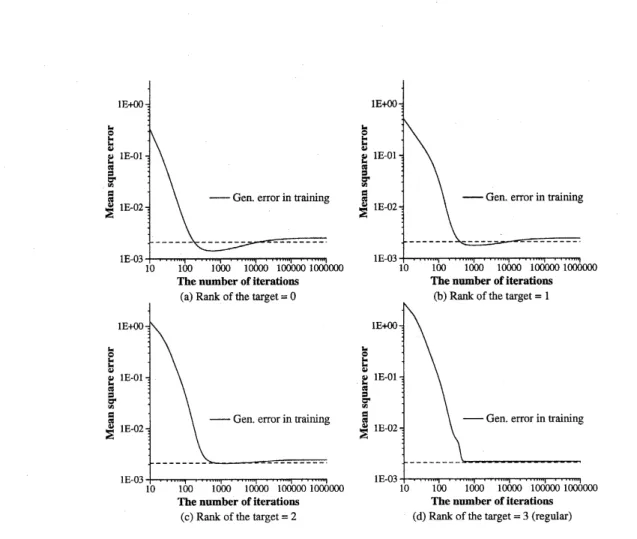
Figure 4 shows the average of learning
curves
for 100 simulations with various trainingdata from the
same
probability. The number of input units, hidden units, and outputunits of the model are 5, 3, and 5 respectively. All the overrealizable cases show clear
overtraining. while the regular case does not show meaningful overtraining. We can also
see that overtraining is stronger when the rank of the target is smaller.
Figure4: Averagelearningcurvesoflinearneural networks. The input samplesareindependent
samplesfrom$N(0, I_{5})$, and the output samples includethe observation noisesubject to$N(0,10^{-2})$.
Thetotal numberoftrainingdatais 100. The dottedline shows the theoretical expectation ofthe
generalizationerrorof theLSEestimator for the regular target.
From these results, we can conjecture that there isan essential difference in the
dynam-ics of learning between regular and overrealizable cases, and overtraining is a universal
property of the latter
cases.
Ifwe use
a good stopping criterion, the multilayer networksmay have an advantage over conventional linear models, in that the degrade of the
gen-eralization errorby redundant parameters is not socritical as conventional linear models.
Such overtraining in overrealizable
cases
has not been explained theoretically yet. In thenext section,
we
theoretically verify the result in linear neural networks by obtaining the4
Solvable
dynamics of learning
in linear
neural networks
To verify the existence of overtraining in linear neural networks,weanalyzethe
continuous-time differential equation instead of the discrete-continuous-time learning rule. Although the behavior
ofthe continuousoneand thediscrete
one are
not identical, they showverysimilarqualita-tive behaviors in computer simulations. We further approximate the differential equation
to derive a solvable
one.
This approximation alsoaffects the solution quantitatively.How-ever, we can
see
in experiments that similar the original one and the approximatedone
show similar properties in their learning curves, and we can show the existence of
over-training in overrealizable cases.
4.1
Solution
of.
learning dynamicsInthe rest of the paper,
we
put the following assumptions;(a) $H\leq L=M$,
(b) $f(x)=B0A0X$,
(c) $\mathrm{E}[xx^{T}]=\tau^{2}I_{L}$,
(d) $A(0)A(0)^{\tau}=B(0)^{\tau_{B(}}\mathrm{o})$,
(e) The rank of$A(\mathrm{O})$ (or, equivalently under (d), the rankof$B(\mathrm{O})$ ) is $H$
.
Under theseassumptions, $A^{T}$ and$B$ are $L\cross H$matrixes. Theparameterizationofalinear
neural networkhas$H^{2}$ dimensional redundancy by the multiplication of$H\cross H$nonsingular
matrix from the left of$A$ and its inverse from the right of$B$. The initial condition (d)
does not restrict possible initialization, since it reduces this redundancy with $\frac{1}{2}H(H+1)$
restrictions. The assumption (e) is important in the following discussion. If the rank of
$A(\mathrm{O})$ (or $B(\mathrm{O})$) is less than $H$, the final state of the variables changes, while we do not
discuss it in this paper.
If
we
divide the output as$\mathrm{Y}=XA_{00}^{\tau_{B^{\tau}V}}+$, (14)
the differential equation of the steepest descent learning is given by
$\{$
$\lrcorner\dot{4}$
$=\beta(B\tau B_{0}A_{0}X\tau x+B^{T}V\tau x-B\tau BAX\tau x)$,
$\dot{B}$
$=\beta(B_{00}Ax^{T\tau}xA+V^{T}XA^{\tau}-BAX^{T}XA\tau)$
.
(15)This is a nonlinear differential equation which has the terms of the third order. Let
$Z_{O}:= \frac{1}{\sigma}V^{\tau}X(XTx)^{-1}/2$
.
It is easy to see that $Z_{O}$ is independent of$X$, and that all theelements of$Z_{O}$
are
mutually independent and subject to $N(\mathrm{O}, 1)$.
We decompose$X^{T}X$ as$X^{T}X=\tau^{2}NI_{L}+\tau^{2\sqrt{N}z_{I}}$, (16)
31
where the off-diagonal elements of$Z_{I}$ aresubject to$N(\mathrm{O}, 1)$ andthe diagonal elements
are
subject to $N(0,2)$ if$N$ goes to infinity. Let
$F=B_{0}A_{0}+ \frac{1}{\sqrt{N}}(B_{0}A_{0}Z_{I}+\frac{\sigma}{\tau}Z_{O})$. (17)
We neglect the order $O(\sqrt{N})$ in the nonlinear terms to derive a solvable equation, and
approximate $\mathrm{e}\mathrm{q}.(15)$ by $\{$ $I\dot{4}$ $=\beta\tau^{2}NBTF-\beta \mathcal{T}2NB^{T}BA$, $\dot{B}$ $=\beta\tau^{2\tau}NFA-\beta_{\mathcal{T}N}2BAA^{\tau}$
.
(18)$\mathrm{E}\mathrm{q}.(18)$ is a good approximation of the original$\mathrm{e}\mathrm{q}.(15)$ if$N$ is very large.
We further put an assumption:
(f) The rank of$B(0)+FA(0)^{T}$ is $H$.
This assumption is a technical one, which is used to prove overtraining. The assumption
(f) is almost always satisfied if the initial condition is independent of$F$
.
We have $AA^{T}=B^{T}B$ because of the fact $\frac{d}{dt}(AA^{T})=\frac{d}{dt}(B^{T}B)$ andthe assumption (d).
Ifwe introduce $2L\cross H$ matrix
$R=$
, (19) then, $R$ satisfies the differential equation$\frac{dR}{dt}=\beta\tau^{2}NSR-\frac{\beta\tau^{2}N}{2}RR^{T}R$, where
$S=$
. (20)This is very sinilar to Oja’s learning equation (Oja, 1989; Yanet al., 1994), orthe
general-ized Rayleigh quotient (Helmke&Moore, 1994), whichis knownto beasolvable nonlinear
differential equation (Yan et al., 1994).
Thekey fact to solve $\mathrm{e}\mathrm{q}.(20)$ is to derivethe differential equation on $RR^{T}$:
$\frac{d}{dt}(RR^{T})=\beta\tau^{2}NsRR^{\tau}+\beta_{\mathcal{T}^{2}N}RR\tau s-\beta \mathcal{T}^{2T}N(RR)2$
.
(21)This is
a
matrix Riccati differential equation and well-known to be solvable. We have thefollowing
Theorem 1. Assume that the rank
of
$R(\mathrm{O})$ isfull.
Then, the Riccatidifferential
equation(21) has a unique solution
for
all $t\geq 0$, and the solution is given by$R(t)R^{T}(t)=e^{\beta\tau^{2}N}Rst( \mathrm{o})[I_{H}+\frac{1}{2}R(\mathrm{o})T\{e^{\beta_{\mathcal{T}^{2}N}t}S-1\beta \mathcal{T}NSt-se-1\}S2R(\mathrm{o})]^{-1}R(0)^{T\beta t}e\tau N2S$
.
(22)For the proof, see Sasagawa (1982) and Yanet al. (1994). Using this theorem,
we
easilyobtain the following theorem in the
same
manner asYan et al. (1994, Theorem 2.1).Theorem 2. Assume that the rank
of
$R(\mathrm{O})$ isfull.
Then, thedifferential
equation (20)has a unique solution
for
all$t\geq 0$, and the solution is expressed as$R(t)$ $=$ $e^{\beta_{\mathcal{T}^{2}}NS}tR( \mathrm{o})[I_{H}+\frac{1}{2}R(0)^{\tau}\{e\tau\beta 2Ns_{S^{-}}t1\beta\tau^{2}Nst-se-1\}R(0)]^{-\frac{1}{2}}U(t)$, (23)
where $U(t)$ is a $H\cross H$ orthogonal matrix.
4.2
Dynamical behavior of the generalizationerror
In this subsection, we write $M(l\cross n;\mathbb{R})$ for the set of real $l\cross n$ matrixes. Using the
assumption (c), the generalization error is written as
$\mathrm{E}_{gen}=\tau^{2}\mathrm{b}[(BA-B0A_{0})(BA-B0^{A_{0})^{\tau}}]$. (24)
It is easyto see that the derivative of$\mathrm{E}_{gen}$ is
$\frac{d}{dt}\mathrm{E}_{gen}=\beta\tau^{4}N$
{Tr
$[(F-BA)A^{\tau}A(BA-B_{0^{A0}})^{\tau}]+\mathrm{n}[BB^{\tau_{()(}T}F-BABA-B0^{A_{0})}]$}
(25)
Note that a transform of the input or output vectors by an orthogonal matrix does not
change the generalization error. Therefore, using the singular value decomposition of
$B_{0^{A}0_{)}}$
we
canassume
without loss of generality that $B_{0}A_{0}$ is diagonal;$B_{0}A_{0=}$
,$\Lambda^{(0)}=$
, (26)where $r$ is the rank of $B_{0}A_{0}$, and $\lambda_{1}^{(0)}\geq\cdots\geq\lambda_{r}^{(0)}>0$ are the singular values of $B_{0}A_{0}$
.
The rank $r$ is equal to or less than $H$
.
The target function is overrealizable ifandonly if $r<H$.We employ the singular value decomposition of$F$,
$F=W\Lambda U^{T}$
.
(27)In this equation, $U$ and $W$ are $L$ dimensional orthogonal matrixes, and
$\Lambda=$
, (28)where $\lambda_{1}\geq\lambda_{2}\geq\cdots\lambda_{L}\geq 0$
are
the singular values of$F$. Weassume
that $\lambda_{1}>\lambda_{2}>\cdots>$$\lambda_{L}>0$. This is satisfied almost surely because of the stochastic noise in$F$
.
We write, forsimplicity,
$F=B_{0}A_{0}+\mathcal{E}Z$, (29)
where $\epsilon=\frac{1}{\sqrt{N}}$
.
We further put anassumption:(g) $\lambda_{r}^{(0)}>>\epsilon$and $1\gg\epsilon$
.
The above assumption asserts that the number of data is large enough to discriminate between $\lambda_{r}^{(0)}$
and the stochastic deviation from zero. We say $a$ is of the constant order if
$a>>\epsilon$.
It is known that a small perturbation of a matrix
causes
a perturbation of the sameorder to the singular values (see Bartia, 1997, Section III, for example). The diagonal
matrix A is decomposed as
$\Lambda=$
,
(30) where$\Lambda_{1}==$
, (31)$\epsilon\tilde{\Lambda}_{2}==$
, (32)$\epsilon\tilde{\Lambda}_{3}==$ .
(33)Note that the normalized singular values $\overline{\lambda}_{j}(r+1\leq j\leq L)$
are
of the constant order.The purpose of this subsection is to show that
$\frac{d}{dt}\mathrm{E}_{gen}>0$ (34)
if$r<H$ (overrealizable) and$t$ satisfies
If this is proved, it
means
the existence of overtraining in overrealizablecases.
Beforeenteringinto the details, we give an intuitive description of what happens in the learning
process ofanetwork (Fukumizu, 1998). The final state of the solution can be written by
$W\Lambda^{\frac{1}{2}}\Lambda^{\frac{1}{2}}U^{T}$
.
(36)This can be considered as the projection of A to the first $H$ eigenspaces. We can deduce
from $\mathrm{e}\mathrm{q}.(22)$ that the solution isalso approximately considered tobe
a
projection of A toa
$H$ dimensional subspace, which converges to $I_{H}$ exponentially. An important point isthat the convergence speed of the first $r$ components and the rest are different if$r<H$
.
Theorder of the former is roughly$o(e^{-aNt})$ and the latter is $o(e^{-b\sqrt{N}t})$for
some
constant$a$ and $b$
.
When the slow dynamics of the latter is the leading factor, the subspace of theprojectionis approximately
$\Pi=(_{0}^{I_{r}}0$ $o(e^{-})I_{Hr)}\mathrm{o}-\sqrt{N}t$ . (37)
It is easy to
see
the shrinkage of the components corresponding to $H-r$ redundantpa-rameters in the projection$\Lambda^{-\frac{1}{2}}\Pi(\Pi\tau\Pi)-1_{\Pi}\tau_{\Lambda^{-}}\frac{1}{2}$. Thissuppresses theeffect of stochastic
noise and makes a betterestimation than the final one.
Let
us
start the theoretical verification with the singular valuedecompositionsto simplify$\mathrm{e}\mathrm{q}.(25)$. We have
$S=\Phi\Phi^{T}$ , (38)
where $\Phi=\frac{1}{\sqrt{2}}(_{W-W}^{UU})$
.
From the assumption (d), the singular value decomposition of$R(\mathrm{O})$ has the following form;
$R(0)=\Theta J\Gamma G^{\tau}$, (39)
where
$\Theta=$
,$J=$
, and$\Gamma=$
.
(40)The matrixes $P,$ $Q$ and $G$ are $L,$ $L$, and $H$ dimensional orthogonal matrixes respectively.
Because of the assumption (e), $\Gamma$ is invertible. Using these decompositions, $RR^{T}$ can be
rewritten as
$RR^{T}=\Phi(e^{\beta\tau_{0}^{2}N}0\Lambda te^{-\beta N\Lambda}\tau^{2}t)\Phi^{T}\Theta J$
$\cross[\Gamma^{-2}+\frac{1}{2}J\tau\ominus\tau_{\Phi\{}-\}\Phi^{T}\ominus J]^{-1}$
$\mathrm{x}J^{T}\ominus T\Phi(e^{\beta\tau_{0}^{2}}0N\Lambda te^{-\beta_{\mathcal{T}N}}2\Lambda t)\Phi^{T}$
.
(41)Let $C=(U^{T}P+W^{T}Q)$ and$D=(U^{\tau_{P-W}\tau}Q)$
.
Decompose these two matrixes as$C=$
,$D=$
,
(42)where $C_{H},$$D_{H}\in M(H\cross H;\mathbb{R})$, and $C_{3},$$D_{3}\in M((L-H)\cross H;\mathbb{R})$
.
Then, we have$\Phi^{T}\Theta J=\frac{1}{\sqrt{2}}$
, (43)where$\Lambda_{H}=(_{0}^{\Lambda_{1}}\Lambda_{2}0)$
.
Since$B(0)+FA(0)^{T}=Q(_{\mathit{0}}^{\mathrm{r}})G^{T}+W\Lambda U\tau P(_{\mathit{0}}\Gamma)c^{\tau_{7}}$ theassump-tion (f)
assures
that $C_{H}$ is invertible. If we introduce$K=$
(44)$\mathrm{e}\mathrm{q}.(41)$ canbe rewritten as
$RR^{T}=2\Phi(_{0}^{\Lambda^{\frac{1}{2}}}$ $\sqrt{-1}\Lambda^{\frac{1}{2}\mathrm{I}^{K}\Psi}0-1KT(_{0}^{\Lambda^{\frac{1}{2}}}$ $\sqrt{-1}\Lambda^{\frac{1}{2})}0\Phi^{T}$, (45)
where
$\Psi=K^{\tau_{K+\Lambda}\frac{1}{H2}\beta N\Lambda_{H}}e^{-}\tau 2tC_{H}^{\tau}\Gamma-2CHe-\beta\tau^{2}N\Lambda H{}^{t}\Lambda^{\frac{1}{H2}}$
$+e^{-2\beta_{\mathcal{T}^{2}N}H}+ \Lambda t\Lambda e-\beta \mathcal{T}N2\Lambda_{H}{}^{t}C\frac{1}{H2}-1Tc3\tau\Lambda-1\mathit{0}3C_{H}-1\beta\tau N2\Lambda H{}^{t}\Lambda H3\frac{1}{H2}e^{-}$
$- \Lambda^{\frac{1}{H2}}e-\beta_{\mathcal{T}}2N\Lambda_{H}tC_{H}-1T-1-D^{\tau_{\Lambda D_{H}C_{H}{}^{t}\Lambda}}HH\frac{1}{H2}1-e\beta\tau^{2}N\Lambda H$
Note that $K\Psi^{-1}K^{T}$ is exponentially close to the orthogonal projection onto the subspace
spanned bythe.first $H$ components.
In the matrix $K$, the $(H+1, H)$-component has the slowest order in the convergence,
and the order is $\exp\{-\beta\tau^{2\sqrt{N}-}(\tilde{\lambda}H\tilde{\lambda}H+1)t\}$
.
Hereafter,we assume
that there is a timeinterval such that the value of this component is very small but sufficiently larger than $\epsilon$;
that is,
$\epsilon<<\exp\{-\beta_{\mathcal{T}}2\sqrt{N}(\tilde{\lambda}_{H}-\tilde{\lambda}H+1)t\}<<1$
.
(47)This is equivalent to the condition of $\mathrm{e}\mathrm{q}.(35)$. We consider the main part of $K\Psi^{-1}K^{T}$,
neglecting terms offaster convergence.
The matrix $K$
can
befurther decomposedas
$K==$
, (48)where$K_{21},$$K_{41}\in M((L-H)\cross r;\mathbb{R}),$ $K_{22},$$K_{42}\in M((L-H)\cross(H-r)),$$K_{31}\in M(H\mathrm{x}r;\mathbb{R})$,
and $K_{32}\in M(H\cross(H-r))$. The convergence of$K_{21},$ $K_{3}$, and $K_{41}$ is equal to or faster
than the order of$\exp\{-\beta_{\mathcal{T}N}2(\lambda r-\epsilon\tilde{\lambda}r+1)t\}$. We further assume that
$\exp\{-\beta\tau^{2}N(\lambda r-\epsilon\tilde{\lambda}_{r}+1)t\}<<\epsilon^{\frac{3}{2}}\exp\{-2\beta\tau 2_{\sqrt{N}()t}\tilde{\lambda}_{H}-\tilde{\lambda}H+1\}$ (49)
holds in the interval of$\mathrm{e}\mathrm{q}.(47)$. This assumption is naturally satisfied under the condition
of$\mathrm{e}\mathrm{q}.(35)$ if$N$ is sufficiently large, since it is equivalent to
$t>> \frac{\frac{3}{2}\log^{\sqrt{N}}}{\beta_{\mathcal{T}^{2}N}\{\lambda r+\frac{1}{\sqrt{N}}(\tilde{\lambda}H-\tilde{\lambda}r+1+\tilde{\lambda}_{H+1})\}}$. (50)
Hereafter, we $\mathrm{u}\mathrm{s}\mathrm{e}\sim \mathrm{f}\mathrm{o}\mathrm{r}$ an approximation up to the leading order of each component in
matrixes. Then, the solution can be rewritten as
$RR^{T}$ $2\Phi(_{0}^{\Lambda^{\frac{1}{2}}}$ $\sqrt{-1}\Lambda^{\frac{1}{2})\tau_{K)K^{T}}}0K(I_{H}-K22(_{0}^{\Lambda^{\frac{1}{2}}}$ $\sqrt{-1}\Lambda^{\frac{1}{2})}0\Phi^{T}$
$2\Phi\Phi^{T}$
.
(51)Therefore, we obtain
$A^{T}.A$ $U\Lambda^{\frac{1}{2}}\Lambda^{\frac{1}{2}}U^{T}$, $BA$ $W\Lambda^{\frac{1}{2}}\Lambda^{\frac{1}{2}}U^{T}$
,
$BB^{T}$ $W\Lambda^{\frac{1}{2}}\Lambda^{\frac{1}{2}}W^{T}$
.
(52)Now, we are in a position to prove overtraining. The first term in the right hand side of$\mathrm{e}\mathrm{q}.(25)$ is written as
Tr$[(F-BA)A\tau A(BA-B0A\mathrm{o})T]$
$\sim \mathrm{h}[\Lambda^{\frac{1}{2}}\Lambda\Lambda^{\frac{1}{2}}$
$\cross\{\Lambda^{\frac{1}{2}}\Lambda^{\frac{1}{2}}-W^{T}B_{0}A0U\}]$ . (53)
Lemma 1 in Appendix and furtherdecompositionof$K_{2}$ and $K_{4}$ show
Tr$[(F-BA)A\tau A(BA-B_{0}A0)^{\tau}]$
$\sim \mathrm{b}[(_{-\epsilon’\tilde{\Lambda}^{\frac{12}{32}}K_{2}}^{\Lambda^{\frac{1}{\tilde{\Lambda}12}}}\epsilon^{\frac{1}{2}\frac{1}{\underline 2,1\sim 2}}K\tau_{2}K_{2}1\frac{3}{12}K21TK_{21}\Lambda^{\frac{3}{\Lambda 12}}1\Lambda\frac{3}{12}$ $\epsilon^{2}\overline{\Lambda}^{\frac{1}{22}}(KK\tilde{\Lambda}--\epsilon^{2}\tilde{\Lambda}^{\frac{2T1}{\mathrm{s}^{2}}}K\epsilon_{222}^{\frac{3}{2}}\Lambda^{\frac{1}{12}\tau_{12}}22\tilde{\Lambda}^{\frac{32}{22}}+\epsilon^{2}\tilde{\Lambda}^{\frac{3}{\mathrm{s}^{2}}}K2K2\tilde{\Lambda}^{\frac{3}{\tilde{\Lambda}22}}K2\tau K22\tilde{\Lambda}\frac{1}{22}23K22\tilde{\Lambda}^{\frac{)1}{22}} \epsilon^{2}\overline{\Lambda}^{\frac{1}{32}}(-222+K_{22})T\tau\overline{\Lambda}\epsilon^{\frac{3}{2}\Lambda}\epsilon_{K\tilde{\Lambda}_{22}}2\tilde{\Lambda}^{\frac{\frac{1}{112}}{22}}K\tau K_{2}2\tilde{\Lambda}K222K_{2}\tau\tilde{\Lambda}\frac{\frac{1}{212}}{3K2}2\tau_{K\tilde{\Lambda}_{3}}K\tilde{\Lambda}2K2\tau 1222\tilde{\Lambda}222\frac{1}{\mathrm{s}^{2}})$
$\cross(_{\epsilon^{\frac{1}{2}}\tilde{\Lambda}^{\frac{1}{32}}}-\epsilon^{\frac{1}{2}}\overline{\Lambda}^{\frac{1}{22}}K_{222}^{\tau_{2}}K)KO(\epsilon\Lambda\frac{1}{12}+1\Lambda\frac{11}{12}+O(\in)O(\Xi) \epsilon\tilde{\Lambda}_{2^{-\mathcal{E}}}\tilde{\Lambda}\frac{1}{22}K\tau K_{22}-\epsilon^{\frac{1}{2}}\Lambda^{\frac{1}{12}}K\tau_{12}K\Xi\tilde{\Lambda}^{\frac{1}{32}}K_{2}2\tilde{\Lambda}\frac{1}{22}+O^{+}(\epsilon 2)22222\tilde{\Lambda}\frac{1}{\tilde{\Lambda}22}\frac{1}{22}+o_{(}o(\epsilon)\mathcal{E})$ $\epsilon\tilde{\Lambda}^{\frac{1}{32}}K_{2}2K6^{\frac{1}{2}\frac{1}{12}}\epsilon\tilde{\Lambda}\frac{\Lambda 1}{22}KT2K_{2}22\tau\frac{1}{32}\tilde{\Lambda}^{\frac{\tilde{\Lambda 1}}{32}}O(\epsilon)2)_{(54)}1\tau\tilde{\Lambda}\frac{+1}{32}2++o(\Xi O(\in))2]$ .
The leading order is $\epsilon^{3}\exp\{-2\beta\tau\sqrt{N}2(\tilde{\lambda}_{H}-\tilde{\lambda}_{H+1})t\}$. Note that the order $O(\epsilon^{4})\cross$
$\exp\{-\beta_{\mathcal{T}}2\sqrt{N}(\tilde{\lambda}H-\tilde{\lambda}H+1)t\}$, appeared in $(3, 2)$ $\cross(2,3)$ part in $\mathrm{e}\mathrm{q}.(54)$, is smaller under
the condition of $\mathrm{e}\mathrm{q}.(47)$, and the order $o(\epsilon^{\frac{3}{2}})\cross K_{21}$, appeared in the $(3, 1)$ $\cross(1,3)$ part,
is also smaller under the assumption of$\mathrm{e}\mathrm{q}.(49)$. Thus, the main part is included in
Tr$[ \epsilon^{3}\tilde{\Lambda}^{\frac{1}{22}}K_{22}\tau K22\tilde{\Lambda}\frac{5}{22}-\mathit{6}3\tilde{\Lambda}^{\frac{1}{22}}K2T\tilde{\Lambda}_{3}2K22\overline{\Lambda}^{\frac{3}{22}}-\epsilon^{32}\tilde{\Lambda}^{\frac{1}{32}}K_{22}\tilde{\Lambda}_{2}K^{\tau_{2}}2\tilde{\Lambda}\frac{1}{32}\in^{3}+\tilde{\Lambda}^{\frac{3}{32}}K22\tilde{\Lambda}2K2\tau_{2}\tilde{\Lambda}\frac{1}{32}]$
$= \in^{3}\sum_{i=1j}^{L-H}\sum_{1=}\overline{\lambda}r+j(\tilde{\lambda}r+i-\tilde{\lambda}H+i)^{2}\mathrm{t}(K_{2}H-r)2ij\}^{2}$
.
(55)All the terms in $\mathrm{e}\mathrm{q}.(55)$ are positive, and this proves the trace is strictly positive. It
can
Thus, we obtain
$\frac{d}{dt}\mathrm{E}_{gen}>0$ (56)
ifthe target is overrealizable and $t$ is in the interval of$\mathrm{e}\mathrm{q}.(35)$.
From the above discussion,
we
can see
that overtraining occurs inan
intermediatein-terval, while overtraining of the
average
learningcurve
in Fig.4seems
to continue to theend. If
we
look at each trial forone
set of training data,we
find thatsome
learningcurves
slightly decreases after showing overtraining. However, the effect of the decreaseis very small, and the global figure of the curve is determined by the initial decrease and
overtraining. It is also easy to
see
theoreticallythat this final decrease or increase is verysmall because it is caused by $o(e^{-aNt})$ terms.
5
Conclusion
We showed that strong overtraining is $0\dot{\mathrm{b}}$
served in batch learning of multilayer neural
networks when the target is overrealizable. According to the experimental results on
multilayer perceptronsand linearneuralnetworks,this overtrainingseemsto beauniversal
property of multilayer models. We theoretically analyzed the batch training of linear
neuralnetworks, showed the existence of overtraining in an intermediatetime interval in
overrealizable cases.
Although the theoretical analysis in this paper is only on the linear neural network
model, it is very suggestive to the phenomena of overtraining, which is observed in many
application ofmultilayer neural networks. It will be extremely important to clarify this
overtraining phenomena theoretically also in other models.
References
[1] Amari, S., Murata, N., &M\"uller, K. R. (1996). Statistical theory of overtraining
-is cross-validation asymptotically effective? In D. S. Touretzky, M. C. Mozer,
&M.
E. Hasselmo (Eds.), Advances in NeuralInformation
Processing Systems 8,(pp.176-182). Cambridge, MA: MIT Press.
[2] Baldi, P.
&Chauvin,
Y. (1991) Temporal evolution of generalization during learningin linear networks. Neural Computation, 3, 589-603.
[3] Baldi, P. F.
&Hornik,
K. (1995). Learning in linear neural networks: a survey. IEEETrans. Neural Networks, 6(4), 837-858.
[4] Bartia, R. (1997). Matrix Analysi8, New York: Springer-Verlag.
[5] Cram\’er, H. (1946). Mathematical method
of
statistics, (pp.497-506). Princeton, NJ: Princeton University Press.[6] Fukumizu, K. (1996). A regularity condition of the information matrixofa multilayer
perceptron network. Neural Networks, 9(5),
871-879.
[7] Fukumizu, K. (1997). Special statistical properties of neural network learning. In Proc.
1997InternationalSymposium onNonlinear Theory and Its Applications (NOLTA’97), (pp.747-750).
[8] Fukumizu, K. (1998). Effect of Batch Learning in Multilayer Neural Networks. In Proc.
5th International
Conference
on NeuralInformation
Processing (ICONIP’98),(pp.67-70).
[9] Helmke, U.
&Moore,
J. B. (1994). Optimization and Dynamical Systems. London: Springer-Verlag.[10] Heskes, T. M. &Kappen, B. (1991). Learning process in neural networks. Physical
Review A, 44(4), 2718-2726.
[11] Oja, E. (1989). Asimplifiedneuronmodelas aprincipal component analyzer. J. Math.
Noiol., 15, 267-273.
[12] Rumelhart, D. E., Hinton, G. E.
&Williams,
R. J. (1986). Learning internalrep-resentations by error propagation. In D.E. Rumelhart, J.L. McClelland,
&the
PDPResearch Group (Eds.),Parallel distributedprocessing, Vol.1 (pp.318-362). Cambridge,
MA: MIT Press.
[13] Sasagawa, T. (1982). On the finite escape phenomena for matrix Riccati equations.
In IEEE Trans. Automatic Control, 27(4), 977-979.
[14] Yan, W., Helmke, U.
&Moore,
J. B. (1994). Globalanalysis of Oja’s flow for neuralnetworks. IEEE Trans. Neural Networks, 5(5), 674-683.
Appendix
A
Perturbation
of singular value decomposition
We prove the following
Lemma 1. Let$Z$ be a $L\cross L$ matrix, and $C_{0}$ be a $L\cross L$ matrix
of
the $f_{or}m_{f}$.where $C^{(0)}i\mathit{8}$
a
$r\cross r$ matrix. For a sufficiently small positive number$\epsilon$,we
define
$C_{\epsilon}$ $:=$$C_{0}+\epsilon Z$
.
Let$C_{\epsilon}=W\Sigma_{\epsilon}U^{T}$ (58)
be the singular value decomposition
of
$C_{\in}$, where $W$ and $U$ are orthogonal matrixes and$\Sigma_{\epsilon}$ is a diagonal matrix which has the singular values
of
$C_{\epsilon}$.
Then, the matrix $W^{T}C_{0}U$has the following form;
$W^{T}C0U=$
. (59)Proof.
It is known (Bartia, 1997, Section III) that $\Sigma_{\epsilon}$ has the form;$\Sigma_{\epsilon}=$
,
(60)where$\Sigma^{(0)}$ is
thediagonal matrix of the singular values of$C^{(0)}$
.
For a$L\cross L$ matrix$A$,we
write $A=(_{A_{21}A_{22}}^{A_{1}}1A12)$, where $A_{11}$ is a $r\cross r$ matrix. Then, the upper-left block of$\mathrm{e}\mathrm{q}.(58)$
leads
$W_{11}^{T}(\Sigma^{(}0)+O(\epsilon))U_{11}+W_{21}^{T}O(\mathcal{E})U21=C^{(0)}+\epsilon Z_{11}$ . (61)
Thisshows that $W_{\underline{1}1}$ and $U_{11}$
are
of the constant order and$W_{11}^{T}\Sigma^{(}0)U11=C(0)+o(\mathcal{E})$
.
(62)We know that $W_{11}$ and $U_{11}$
are
invertible for a small $\epsilon$. From the upper-right block of$\mathrm{e}\mathrm{q}.(58)$, we have
$W_{11}^{T}(\Sigma^{(}0)+O(\epsilon))U_{12}+W_{21}^{T}O(\epsilon)U_{2}2=\epsilon Z12$
.
(63)Therefore, $U_{12}$ must be of the order $O(\epsilon)$
.
Likewise, $W_{12}=O(\epsilon)$.
Now the assertion isstraightforward. $\square$