Unfortunately, this patient developed local and pleural recur-rences with left pleural effusion 6 months after resection of the colonic graft cancer. Disease - free survival was 6 months, postop-erative survival was 17 months and overall survival was 21 months.
DISCUSSION
A colonic graft for esophageal reconstruction is done in
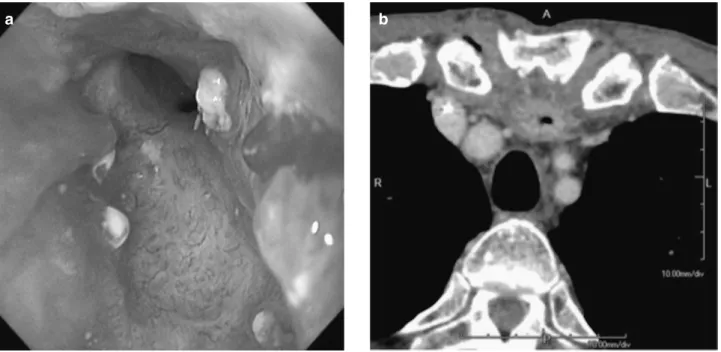
approxi-mately 5% of cases according to the Comprehensive Registry of Esophageal Cancer in Japan, Japan Esophageal Society. It is suspected that a colonic graft was used for disproportionate length and capacity of conduit and in this case in a previous hospital. The patient noticed improvement of his dysphagia by gastric conduit reconstruction ; however, he mentioned that the amount of oral intake and reflux had been better with the colonic graft. A neoplasm arising in the colon segment used for esophageal reconstruction is rare. Therefore, standard treatment has not been established, Fig. 1a An endoscopic finding prior to chemotherapy
Fig. 1b A severe stenotic slice of the esophago - colonic anastomosis prior to chemotherapy
Fig. 2a An endoscopic finding after chemotherapy
Fig. 2b A severe stenotic slice of the esophago - colonic anastomosis after chemotherapy
a
b
a
b
and it is necessary to choose a treatment on an individual-case basis. Long - term exposure of gastric acid content or bile also could cause development of the neoplasm in the colonic graft (11). The colon used for reconstruction should be examined prior to the reconstruction surgery to determine whether neoplasms or polyps exist there ; furthermore, if any colonic diverticular or malignancy is identified, the colon should not be used for esophageal recon-struction (12).
Even though we prefer to do minimally invasive treatment, neoadjuvant chemotherapy followed by total resection of the colonic graft and lymph node dissection was performed in this case without any physical restrictions. There was an alternative strategy available in this case, such as partial colectomy with free jejunum graft reconstruction under sternal split incision. However, we considered the difficulties of microvascular anastomosis and re-covery if jejunum - colonic anastomotic leakage occurred in this retrosternal route. It was also difficult to divide the adhesion of this colonic graft and change the route from a retrosternal to an ante -thoracic one. Although chemotherapy shrunk the size of the tumor, postoperative left recurrent nerve palsy due to tumor in-volvement could not be avoided. Surgery without preoperative chemotherapy also could be applicable for this case, because neoadjuvant chemotherapy is still a controversial approach in colorectal cancer (13). Overall survival was limited to 21 months in this case. Early local recurrence, depression of performance status after recurrence and difficulty in administration of standard chemo-therapies afterward resulted in poor survival.
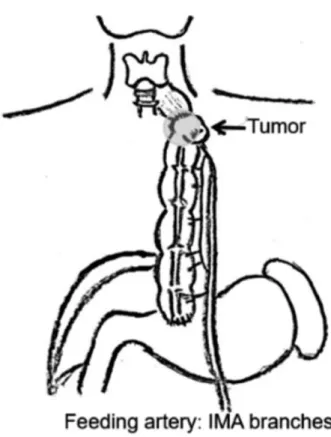
Including this case, most of the patients diagnosed with cancer of the colonic graft had symptoms. The number of patients diag-nosed with cancer of an esophageal colonic graft is limited (1-11), as shown in Table 1. Our patient had chronic dysphagia after esophagectomy. Therefore, it was difficult for him to sense the new Fig. 3 Schema of the tumor location
Resection of the cervical esophagus and the total colonic graft with median sternotomy
Table 1 Reported cases of adenocarcinoma with a colonic graft (1968- 2018)
Authors Year Age/genderReason for
esophagectomy Duration*Complaint Treatment Reconstruction Location Size Goldsmith HS1)1968 48/F Esophageal
cancer 2y Follow- up Partial resedtion Cologastrostomy
The end of colon inter-position 40 mm Haerr RW3) 1987 72/M Esophageal
cancer 9y
Abdomen
discnfort Chemoradiotherapy
-Proximal to the distal anastomotic site -Houghton AD4)1989 64/M Benign
stenosis 20y Dysphagia
Total resection of the
colon graft Gastric tube - -Lee SJ5) 1994 75/F Laryngeal
cancer 20y Dysphagia
Total resection of the
colon graft Free jejunum - -Altorjay A6) 1995 70/M Esophagitis 5y Dysphagia Partial resection Roux- en- Y - -Liau CT7) 2004 79/M Esophageal
cancer 30y Dysphagia Chemotherapy - - -Bando H2) 2010 80/M Esophageal
cancer 14y Follow- up
Endoscopic
submucosal dissection - - 20 mm Shersher DD8)2011 60/M Benign
stenosis 40y Dysphagia
Total resection of the
colon graft Gatric tube
25 cm distance from the incisors, 1 cm distal to the anastomosis
31 mm
Aryal MR9) 2013 60/M Benign
stenosis 30y Dysphagia Chemotherapy
-45 cm from the incisor tooth 40 mm Grunner S11) 2013 59/F Benign
stenosis 55y Dysphagia Partial resection Roux- en- Y
Anastomotic site of the colon and the remnant stomach
35 mm
Yamamoto M10)2015 83/M Esophageal cancer 14y
Medical
check- up Partial resection Gastric tube
45 cm from the incisor tooth 45 mm Our case 2015 70/M Sever reflux
esophagitis 20y Dysphagia
Total resection of the
colon graft Gastric tube
18 cm from the incisor tooth 15 mm Duration*, years after esophagectomy
symptoms caused by obstruction from the cancerous lesion. He had not undergone any examinations since his 60s. Most cases undergo partial resection and end - to - end anastomosis (1, 6, 10, 11). Additionally, Roux - enY (12) or free jejunum (5) reconstruction has been reported. Total resection of the colonic graft such as in our case was rare. Some cases are treated by chemotherapy (9). In these cases, achieving a balance between curability and invasiveness is challenging, and preservation of the colonic graft and its blood supply are difficult in advanced colon cancer patients. Thinking of our case, not only regular medical examination for colon cancer but also investigation of dysphasia after esophageal reconstruction is thought to be important for early diagnosis. Furthermore, possibility of dysphasia by other diseases except for postoperative anasto-motic stenosis needs to be informed to the patient.
In conclusion, we reported a case of locally advanced colon cancer arising on the oral wedge of anastomosis in the retrosternal colonic graft 20 years after esophagectomy and reconstruction. Total resection of the colon graft and reconstruction using a gastric tube through a retrosternal route was performed after neoadjuvant chemotherapy. This report should be informative in terms of making decisions from an initial reconstruction to follow - up and choosing a therapeutic strategy for colonic graft cancer in the future.
ABBREVIATIONS
CT : Computed Tomography ; mFOLFOX : modified FOLFOX6 ; l - LV : L - leucovorin ; 5 - FU : 5 - fluorouracil ; L - OHP : oxaliplatin ; p : pathological ; c : clinical ; T : depth of tumor invasion ; N : extent of lymph node metastasis ; M : other distant metastasis ; f Stage : final Stage.
DECLARATIONS
Ethics approval and consent for publication
The present study was conducted in accordance with the ethical standards of our institution.
Consent for publication
All presentations in this manuscript were granted consent to publication from the family of the patient.
Competing interest
The authors declare that they have no competing interests. Authors’ contribution
HT and TY analyzed and interpreted the patient’s data and examination findings. TN, MG, SI, DM and TI are surgeons who performed treatments for this patient. The manuscript was prepared by HT under the supervision of TY, AT, TT and HT. All authors read and approved the final manuscript.
ACKNOWLEDGEMENT
The authors would like to express their appreciation to Hisanori Uehara M.D., Yoshimi Bando M.D., Akiko Yoneda M.D., Shunsuke Watanabe M.D., and their colleagues of the Division of Pathology, Tokushima University Hospital, Tokushima, Japan for their assis-tance with the histopathological diagnoses.
AUTHORS’INFORMATION
1
Department of Thoracic, Endocrine Surgery and Oncology, Tokushima University Graduate School, 3- 18- 15, Kuramoto- cho, Tokushima, 770- 8503, Japan.2Department of General Surgery, JA
Kochi Kouseiren, 526- 1, Aza- nakano, Myouken, Nangoku, Kochi, 783- 8509, Japan
ENDNOTES
All queries should be forwarded to the author for correspon-dence at the address above.
REFERENCES
1! Goldsmith HS, Beattie Jr. EJ : Malignant villous tumor in a colon bypass. Ann Surg 167 : 98 - 100, 1968
2! Bando H, Ikematsu H, Fu KI, Oono Y, Kojima T, Minashi K, Minashi K, Yano T, Matsuda T, Saito Y, Kaneko K, Ohtsuet K : A laterally spreading tumor in a colonic interposition treated by endoscopic submucosal dissection. World J Gastroenterol 16 : 392 - 4, 2010
3! Haerr RW, Higgins EM, Seymore CH, El-Mahdi AM : Adeno-carcinoma arising in a colonic interposition following resection of squamous cell esophageal cancer. Cancer 60 : 2304- 7, 1987 4! Houghton AD, Jourdan M, McColl I : Dukes A carcinoma after
colonic interposition for oesophageal stricture. Gut 30 : 880- 1, 1989
5! Lee SJ, Koay CB, Thompson H, Nicolaides AR, Das Gupta AR : Adenocarcinoma arising in an oesophageal colonic interposi-tion graft. J Laryngol Otol 108 : 80 - 3, 1994
6! Altorjay A, Kiss J, Vörös A, Szanto I, Bohak A : Malignant tumor developed in colon-esophagus. Hepato-gastroenterology 42 : 797 - 9, 1995
7! Liau CT, Hsueh S, Yeow KM : Primary adenocarcinoma arising in esophageal colon interposition : report of a case. Hepato -gastroenterology 51 : 748 - 9, 2004
8! Shersher DD, Hong E, Warren W, Penfield Faber L, Liptay MJ : Adenocarcinoma in a 40 - Year - Old Colonic Interposition Treated With Ivor Lewis Esophagectomy and Esophagogastric Anastomosis. Ann Thorac Surg 92 : e113 - 4, 2011
9! Aryal MR, Mainali NR, Jalota L, Altomare JF : Advanced adeno-carcinoma in a colonic interposition segment. BMJ Case Reports. 2013 ; 2013 : bcr2013009749. doi : 10.1136/bcr 2013 -009749.
10!Yamamoto M, Yamasaki M, Sakai D, Makino T, Miyazaki Y, Takahashi T, Kurokawa Y, Nakajima K, Takiguchi S, Mori M, Doki Y: A Case of Colon Cancer That Developed in the Subcutaneously Reconstructed colon after Esophagectomy for Thoracic Esophageal Cancer : Jpn J Cancer Chemother 42 : 2230 - 2, 2015
11!Grunner S, Gilshtein H, Kakiashvili E, Kluger Y : Adenocarci-noma in Colonic Interposition. Case Rep Oncol 6 : 186 - 8, 2013 12!Fritscher-Ravens A, Sriram PV, Thonke F, Jaeckle S, Maydeo
A, Soehendra N : Synchronous adenocarcinoma in the trans-posed colonic conduit after esophagectomy for squamous cell cancer : endoscopic palliative resection while awaiting surgery Gastrointest Endosc 50 : 852 - 4, 1999
13!Walker AS, Zwintscher NP, Johnson EK, Maykel JA, Stojadinovic A, Nissan A, Avital I, Brucher BL, Steele SR : Future directions for monitoring treatment response in colorectal cancer J Cancer 5 : 44 - 57, 2014