
1HWZRUN&RGHU2SWLPL]DWLRQIRU 3HHUWR3HHU&RQWHQW'LVWULEXWLRQ
33
ࢥࣥࢸࣥࢶ㓄ಙࡢࡓࡵࡢࢿࢵࢺ࣮࣡ࢡࢥ࣮ࢲࡢ᭱㐺
6HSWHPEHU
4XRF'LQK 1*8<(1
1HWZRUN&RGHU2SWLPL]DWLRQIRU 3HHUWR3HHU&RQWHQW'LVWULEXWLRQ
33
ࢥࣥࢸࣥࢶ㓄ಙࡢࡓࡵࡢࢿࢵࢺ࣮࣡ࢡࢥ࣮ࢲࡢ᭱㐺
6HSWHPEHU
*UDGXDWH6FKRRORI*OREDO,QIRUPDWLRQDQG7HOHFRPPXQLFDWLRQ6WXGLHV :DVHGD8QLYHUVLW\
'LVWULEXWHG&RPSXWLQJ6\VWHPV,,
4XRF'LQK 1*8<(1
Abstract
We study the use of network coding to speed up content distribution in peer-to- peer (P2P) networks. Our goal is to get the underlying reason for network coding’s improved performance in P2P content distribution and to optimize resource con- sumption of network coding.
In contrast with the current store-and-forward routing model, network coding allows network nodes to code, i.e. generating new information from what they have received, and after that, forward the coded information into the network. Each time a node wants to send data, it has to, for example, linearly combine currently available data by a series of numerical multiplications and additions, consuming a certain amount of computational resources.
Network coding, though having been shown to achieve maximum multicast throughput, incurs an expensive cost: practically every node in the network has to code and they code excessively whenever there are incoming requests. A large portion of that huge consumed computational resource, as we find out, can be saved with almost no impact on the optimal performance of network coding. We optimize network coding’s resource consumption in the two following aspects: (1) we eliminate unnecessary coding by allowing only selectedimportantnetwork nodes to encode; and (2) we further save computational resources at each network encoder by figuring out exactly how much it should encode.
Short distribution time, i.e. the time required to distribute content to all re- ceivers, can be achieved by placing coders at just a subset of carefully chosen peers.
Peer-to-peer systems, in addition, tend to be heterogeneous in which some peers, such as hand-held devices, would not have the required capacity to encode. We therefore envision a hybrid network coding P2P system where some peers encode to improve distribution time and other peers, due to limited computational ca- pacity or due to some system-wide optimization, do not encode. We begin the dissertation by devising the protocols and data selection algorithm needed to effi-
ciently realize such a hybrid network coding system. Our protocols greatly simplify network operations. They allow peers, being network coders or not, to commu- nicate seamlessly using the same protocol to talk with each other. Our proposed data selection algorithm let peers choose the most updated data to download first which results in noticeable improvement in distribution time. The proposed pro- tocols and data selection algorithm boost the effectiveness of network coding in shortening distribution time which we evaluate by simulations.
To optimize network coder placement, first of all, we observe analytically that in pure P2P content distribution networks without network coding, a considerable amount of data is sent multiple times from one peer to another when there are mul- tiple paths connecting those two particular peers. The duplicated data consume bandwidth on the paths, and therefore, result in sub-optimal delivery through- put to downstream peers on those paths. Network coding, on the other hand, when applied at upstream peers, eliminates information duplication on paths to downstream peers, which results in more efficient content distribution.
Based on the insight obtained from our analysis, we then propose network coder placement algorithms to deploy network coders at selective locations in a given net- work topology. Our algorithms achieve comparable distribution time as network coding, yet substantially reduces the number of encoders compared to a full net- work coding solution in which all peers have to encode. Our placement methods put encoders at critical network positions to eliminate information duplication the most, thus, effectively shorten distribution time with just a portion of encoders. In other words, we optimize resource consumption by removing unnecessary or less important network coders.
We propose in total three algorithms to place network coders inside a P2P content distribution network. The first algorithm elaborately figures the delay in finish time a given upstream node causes to its downstream nodes due to dupli- cation, and then, places network coders at nodes which cause the most delay in
finish time. By doing so, we can effectively accelerate content delivery from nodes which create the most duplication, thus shorten distribution time. Our first place- ment algorithm, which we call minimal delay placement, although can determine accurately how much distribution time can be shortened by placing a coder at a given network node, has the trade-off of rather high computation complexity.
With a target to reduce the complexity, the two latter algorithms are based on network centrality, a concept borrowed from social network studies, to quickly pin- point network nodes which stand on more paths and wider paths to other nodes, the characteristics which we show to correlate with the level of duplication, for network coder placement.
Performance evaluation in wide varieties of network topologies by simulations confirms the effectiveness of our proposed network coder placements which could achieve comparable distribution time as full network coding with just a portion of network coders. Evidently, a significant number of network coders can be saved while still realizing short distribution time almost the same as a full network coding solution.
Having optimized network coder placement over the whole network, we then direct our attention to each individual network coder itself. Each time a network coder generates new information from available information, it puts a piece of re- dundant information into the network which helps accelerate content distribution towards downstream nodes. However, excessive redundancy is not necessary to achieve short distribution time. Since the encoding process consumes computa- tional resources of the coder it is important to figure the right level of redundancy, just enough to eliminate duplication, each network coder should generate. Assum- ing only a constraint number of selected peers can encode, i.e. become network coders, we next optimize the redundancy network coding generates, i.e. how much a particular encoder should encode. Given the network topology, we analytically figure out the redundancy ratio at each encoder to achieve shortest distribution
time and verify the result by simulations.
We believe our studies, which offer insights into the way network coding im- proves content distribution and optimize its resource consumption and implemen- tation, will contribute to the understanding of the subject and promote a wider deployment of network coding as a method to speed up content distribution.
We conclude the dissertation with a promising outlook for extending our re- sults to facilitate content distribution in information-centric networking, an active research field which is anticipated to build our future networks.
Acknowledgements
First of all, I would like to thank professors, staff, and fellow students in GITS, Waseda University for their support during my doctorate study.
I would like to express my thanks to my dissertation committee, Prof.
Nakazato, Prof. Tanaka, Prof. Tsuda, and Prof. Sato, whose comments and advice have helped improve this dissertation.
I also very much appreciate Dr. Gkantsidis’s discussion about one of his work on network coding for peer-to-peer content distribution which has motivated the research herein.
I gratefully acknowledge financial support from MEXT Scholarship throughout the course of my PhD research and support from JSPS KAKENHI Grant Number (24500098).
I am deeply indebted to my adviser, Prof. Nakazato, for his guidance. His encouragement of new ideas has excited me to do my research. And I am grateful to my adviser’s proactive support on several occasions as well as the friendly, yet earnest, research atmosphere he created in our lab.
To my parents.
Contents
Abstract . . . iii
Acknowledgements . . . vii
List of Tables . . . xii
List of Figures . . . xiii
List of Algorithms . . . xvi
1 Introduction 1 1.1 Contribution . . . 2
1.2 Network Coding for Peer-to-Peer Content Distribution . . . 3
1.3 Related Work on Network Coding Optimization . . . 7
1.4 Dissertation Organization . . . 10
2 System Model 13 2.1 Network Coding Peer-to-Peer Content Distribution . . . 13
2.2 Network Topology . . . 16
3 Protocols and Data Selection Algorithm 17 3.1 Ordinary Network Coding Peer-to-Peer System . . . 19
3.2 Proposed Information Exchange Protocol . . . 21
3.2.1 Block Format . . . 21
3.2.2 Pre-code Protocol . . . 22
3.2.3 Post-code Protocol . . . 25
3.3 Block Selection Problem . . . 26
3.3.1 Duplication Problem with Current Rarest-first Block Selection 27
3.3.2 Proposed Block Selection Algorithm . . . 31
3.4 Network Coder Assignment . . . 32
3.5 Performance Evaluation . . . 33
3.5.1 Clustered Topologies . . . 34
3.5.2 Small-world Network Topologies . . . 35
3.6 Conclusion . . . 40
4 Minimal Delay Coder Placement 42 4.1 Network Coder Placement Problem . . . 43
4.2 Multi-path Delivery Duplication Analysis . . . 45
4.2.1 Two Receiver Duplication . . . 46
4.2.2 Multiple Receiver Duplication . . . 52
4.2.3 Delay in Finish Time of Downstream Peers . . . 52
4.2.4 The Effect of Network Coding . . . 53
4.2.5 Numerical Experiments . . . 55
4.3 Delay Computation and Placement Algorithm . . . 56
4.4 Performance Evaluation . . . 59
4.4.1 Simulation Settings . . . 59
4.4.2 Performance Compared with Optimal Placement . . . 60
4.4.3 Performance in Moderate Bottlenecked Topologies . . . 61
4.4.4 Performance in Highly Bottlenecked Topologies . . . 62
4.5 Discussion . . . 65
5 Centrality-based Coder Placement 67 5.1 Correlation of Duplication with Consisting Flows . . . 68
5.2 Coding at Network Centrality . . . 72
5.3 Betweenness Centrality Placement . . . 74
5.4 Flow Centrality Placement . . . 74
5.5 Performance Evaluation . . . 77
5.5.1 Performance in Moderate Bottlenecked Topologies . . . 78
5.5.2 Performance in Highly Bottlenecked Topologies . . . 81
5.5.3 Performance with Different Centrality Thresholds . . . 83
5.6 Discussion . . . 85
6 Coding Redundancy Ratio 87 6.1 Redundancy Ratio at a Network Coder . . . 87
6.2 Problem Formulation . . . 88
6.3 Redundancy Ratio Analysis . . . 90
6.3.1 Encoder at the Source . . . 90
6.3.2 Encoder at an Intermediate Peer . . . 92
6.4 Redundancy Ratio Computation . . . 95
6.5 Performance Evaluation . . . 97
6.6 Discussion . . . 101
7 Conclusion and Future Work 102 7.1 Concluding Remarks . . . 102
7.2 Future Work . . . 104
Bibliography 107
List of Academic Achievements 113
List of Tables
4.1 Duplication Analysis Notations . . . 44 4.2 Finish Time Comparison in a 50-node Network. . . 60 6.1 Redundancy Ratio Analysis Notations . . . 89
List of Figures
1.1 Network Coding in a Butterfly Network . . . 4
1.2 Random Linear Network Coding . . . 5
1.3 A Network Coder Is Placed at an Intermediate Peer . . . 6
1.4 Dissertation Organization . . . 10
2.1 Illustration of P2P Content Distribution System. . . 14
3.1 Ordinary Protocol Used in Network Coding P2P Systems. . . 20
3.2 Notification and Data Block Formats. . . 23
3.3 Pre-code Protocol. . . 24
3.4 Post-code Protocol. . . 25
3.5 Block Duplication - Example 1, Illustration 1. . . 28
3.6 Block Duplication - Example 1, Illustration 2. . . 28
3.7 Block Duplication - Example 1, Illustration 3. . . 29
3.8 Block Duplication - Example 2, Illustration 1. . . 29
3.9 Block Duplication - Example 2, Illustration 2. . . 30
3.10 Block Duplication - Example 2, Illustration 3. . . 30
3.11 Block Duplication - Example 2, Illustration 4. . . 31
3.12 A Two-cluster Topology Used for Simulation. . . 34
3.13 Average Finish Time in a Clustered Topology. . . 34
3.14 A Small-world Network Topology Used for Simulation. . . 36
3.15 Finish Time using Betweenness Centrality Placement. . . 37
3.16 Finish Time using Degree-based Placement. . . 37
3.17 Finish Time When Encoders Are Placed At Random. . . 38 3.18 Finish Time Improvement using Betweenness Centrality Placement. 39 3.19 Finish Time Improvement using Degree-based Placement. . . 39 3.20 Finish Time Improvement When Encoders Are Placed At Random. 40 4.1 Illustration of Maxflow on a Butterfly Network. . . 45 4.2 A Partial Graph of One Upstream Node with Its Two Downstream
Neighbors. . . 46 4.3 Snapshot of Data Blocks Downloaded by Node 1 and Node 2 . . . . 48 4.4 The Number of Duplicated Blocks at Node 2 . . . 50 4.5 Multiple Receiving Nodes Are Represented by Two Virtual Nodes . 51 4.6 Data Blocks Downloaded by Node 1 and Node 2 When NodeiEncodes. 53 4.7 Block Duplication with Different Bandwidth Settings . . . 55 4.8 Duplication Rate with Different Bandwidth Settings . . . 56 4.9 Delay in Finish Time with Different Bandwidth Settings . . . 56 4.10 Maximum Finish Time of Min-delay Placement in Moderate Bot-
tlenecked Topologies . . . 61 4.11 Average Finish Time of Min-delay Placement in Moderate Bottle-
necked Topologies . . . 62 4.12 Maximum Finish Time of Min-delay Placement in Highly Bottle-
necked Topologies . . . 63 4.13 Average Finish Time of Min-delay Placement in Highly Bottle-
necked Topologies . . . 63 4.14 Maximum Finish Time Comparison Varying the Number of Coders 64 4.15 Average Finish Time Comparison Varying the Number of Coders . 64 5.1 A Partial Graph with Two Paths. . . 69 5.2 Correlation of Duplication with Flow Size and Number of Flows. . . 71
5.3 Average Finish Time Compared with Network Coding in Moderate Bottlenecked Topologies . . . 78 5.4 Maximum Finish Time Compared with Network Coding in Moder-
ate Bottlenecked Topologies . . . 78 5.5 Average Finish Time of Centrality-based Placements Varying Num-
ber of Encoders . . . 80 5.6 Maximum Finish Time of Centrality-based Placements Varying
Number of Encoders . . . 80 5.7 Average Finish Time Compared with Network Coding in Highly
Bottlenecked Topologies . . . 81 5.8 Maximum Finish Time Compared with Network Coding in Highly
Bottlenecked Topologies . . . 81 5.9 Average Finish Time of Centrality-based Placements Varying Num-
ber of Encoders . . . 82 5.10 Maximum Finish Time of Centrality-based Placements Varying
Number of Encoders . . . 83 5.11 Average Finish Time and Number of Coders Varying Betweenness
Centrality Threshold. . . 84 5.12 Average Finish Time and Number of Coders Varying Flow Central-
ity Threshold. . . 84 6.1 A Topology Where the Source Has Two Neighbors. . . 90 6.2 Encoder Is Placed at Intermediate Peeri Which Has Two Neighbors. 93 6.3 Illustration of Redundancy Ratio Functionei(t). . . 95 6.4 Maximum Finish Time using 250 Encoders. . . 98 6.5 Average Finish Time using 250 Encoders. . . 98 6.6 Maximum Finish Time using 5000 Encoders (Full Network Coding). 99 6.7 Average Finish Time using 5000 Encoders (Full Network Coding). . 100
List of Algorithms
3.1 Proposed Block Selection Algorithm . . . 31
4.1 Minimal Delay Placement Algorithm . . . 58
5.1 Multi-path Coder Placement Algorithm . . . 72
5.2 Centrality-based Coder Placement Algorithm . . . 73
5.3 Flow Centrality Computation . . . 76
6.1 Redundancy Ratio Computation . . . 96
Chapter 1 Introduction
Network coding [1] has recently drawn much research attention owing to its ability to achieve theoretically maximum throughput in multicasting data. By allowing content to be combined at intermediate nodes while being forwarded in the net- work, the multicast throughput is shown to approach that of the individual max- imum throughput to each receiver as if it can utilize the whole network resources [2]. The benefit of network coding, however, is unclear in practical settings such as peer-to-peer content distribution, where non-coding solutions perform reasonably well [3, 4].
We study the use of network coding in peer-to-peer (P2P) content distribution to shorten distribution time. Although peers in P2P networks can readily be turned into network coders1, questions remain about how we can effectively deploy them. Requiring all peers to code, though may achieve shortest distribution time, is inefficient in terms of computational resources since coding consumes the peer’s resources. Our motivation is to get insights into network coding and answer the questions (1) what conditions make network coding good performance, and (2) do we need to code everywhere and all the time to achieve that performance.
That issue is especially important in practical scenarios when a large content
1The termscoders andencoders are used interchangeably.
is distributed or when peers get involved in distributing multiple files as in those cases encoding process consumes huge resources. Reducing computational resource consumption at each peer helps speed up that particular peer’s download progress, which also likely accelerates other peers who are downloading from it.
1.1 Contribution
Our contributions are as follows.
1. We identify the underlying condition for network coding to be effective com- pared with no coding. When there are multiple delivery paths from an up- stream peer to a downstream peer, coding at the upstream peer will eliminate content duplication to the downstream peer and accelerate its downloading speed. We make an analysis of the duplication incurred in ordinary non- coding P2P content distribution, which serves as the foundation for our pro- posed network coder optimization.
2. We propose novel coder placement algorithms to reduce the number of net- work coders. Based on the insight about how network coding improves perfor- mance, given a constraint number of network coders, we propose algorithms to locate key network nodes to place the given number of coders in order to shorten distribution time the most.
3. We figure how much an encoder should optimally encode to achieve short distribution time. The redundancy each network coder generates helps ac- celerate content distribution to its downstream peers. Too high redundancy, however, consumes the encoder’s resource unnecessarily. Too low redun- dancy, on the other hand, will be ineffective. We analyze the exact level of redundancy at each network coder to achieve shortest distribution time.
4. We devise the protocols and data selection algorithm to support P2P con- tent distribution systems where network coding is partially enabled at se- lected nodes. Our protocols and algorithm simplify operation and improve performance of the P2P content distribution network.
1.2 Network Coding for Peer-to-Peer Content Distribution
Peer-to-peer content distribution is a scalable solution to distribute content, i.e.
a file, from a source to all receivers which, unlike the server-client model, also contribute their available bandwidth to help delivery the file. One of the most popular P2P systems, BitTorrent [5], uses parallel downloads to accelerate down- load speed. The file is divided into equal-sizeblocks, i.e. chunks, pieces, which peers send and receive in parallel, utilizing both available upload and download band- width. Each newly joining peer connects to a set of random existing peers, such that to construct a mesh overlay network with random topologies. Furthermore, rarest blocks are chosen first by receiving peers to quickly disseminate the whole file into the system. To encourage peers to contribute uploading bandwidth to the system, a peer uploads to, i.e.unchokes, a certain number of neighboring peers at a time, which provide the uploading peer the best downloading rates. Rarest first block selection and unchoking are shown to be the reasons underlying BitTorrent excellent performance [3].
Network coding, due to Ahlswede et al. [1], is a method to maximize multicast throughput. Using linear network coding [2, 6], a network coding scheme where encoders generate new data by linearly combining the data they currently have, the multicast throughput to each receiver is shown to asymptotically approach its maximum to that individual receiver as if it can utilize all available network resources by itself. Network coding has been adopted in several research contexts
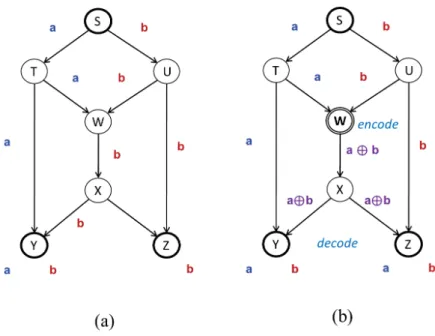
Figure 1.1: Assuming the capacity of every link is 1 bit/s, when noteW codes, the throughput to each of receivers Y and Z is maximum at 2 bit/s.
such as network coding in wireless networks [7, 8, 9], physical layer network coding [10], transport-layer network coding [11], network coding for distributed storage systems [12, 13], network coding for P2P content distribution [14, 15, 16] and P2P streaming [17, 18, 19], and network coding in information-centric networks [20].
Interested readers are referred to [21, 22, 23, 24, 25] for comprehensive discussions on network coding.
Figure 1.1 illustrates the benefit of network coding in abutterfly network where two bita and b are multicasted from the source S to two receivers Y and Z. The capacity of each link is 1 bit/s. Without network coding a total of only 3 bits can be sent to the two receivers in one unit time, i.e. the average throughput to each receiver is 1.5 bit/s (Figure 1.1(a)). When node W is allowed to encode (Figure 1.1(b)),W combines the two bitsaandbit has received using, for example, XOR to produce a new coded bit a⊕b, and after that, sends the coded bit to node X. The result is that, after decoding, each receiver can retrieve 2 bits per one unit time which is the maximum throughput from the source to it.
Widely deployed in practical systems, random linear network coding (RLNC)
Figure 1.2: Random linear network coding coder creates new encoded blocks from the original blocks using random coefficients. The multiplication and addition are taken place in a finite field, e.g. GF(28).
[26, 27] works in a distributed manner under which encoders, independently and randomly, make a linear combination of available data using random coefficients to generate new coded data. RLNC has been deployed with BitTorrent to speed up content distribution in Avalanche system[14, 15, 16, 28].
Avalanche allows all peers to generate new encoded blocks from what they have received, i.e. become network coders, before sending to other peers.2 If the file consists ofK blocks, using RLNC, anencoding vector ofK coefficients is attached to each data block to specify how that coded block is generated from theK original blocks. Suppose we have a coded block C0 with encoding vector (c01, c02, ..., c0K), andK original blocks,B1,B2, ...,BK. That meansC0 =c01B1+c02B2+...+c0KBK. The coefficients, multiplications, and additions are taken place in a finite field, e.g.
GF(28). Figure 1.2 illustrates 5 new coded blocks are created from 5 original blocks of the file, each original block contains a character from the word “HELLO”.
Now suppose encoder i, having received 2 blocks C1 and C2, wants to make a new encoded block to send to a neighboring peer (Figure 1.3). The RLNC
2We call the peers which are allowed to encodenetwork coder orencoder to distinguish them from original non-encoding peers.
Figure 1.3: Avalanche [14] requires all peers encode. In this figure, peer i is combining the two blocksC1 and C2 it has downloaded to make new coded blocks C using random coefficients a1 and a2.
encoderiwill pick up two random coefficientsa1 anda2 and generate a new coded block C: C = a1C1 +a2C2, which results in an encoded block with encoding vector (a1c11+a2c21, a1c12+a2c22, ..., a1c1K+a2c2K). The coded blockC together with K coefficients above is sent to the requesting peer. At the receiving peer, all encoding vectors are stored in a decoding matrix with corresponding coded data blocks. After a peer collects K independent coded blocks, i.e. the K associated encoding vectors form a full-rank matrix, it can decode to get theK original blocks by solving the set of K linear equations.
Experimental evidence in [14] confirms that Avalanche has remarkably im- proved performance compared with ordinary BitTorrent file distribution, especially in clustered topologies where there is limited bandwidth between sets of peers. One interesting observation is that substantial performance gain is evident even when only the source is allowed to code, i.e.source coding. Nevertheless, the paper omits concrete explanation for what underlies network codings good performance, and, more interestingly what we can expect if a constrained number of peers are allowed to encode. In [29, 30], source coding is also applied to improve BitTorrent without
incurring encoding at intermediate peers. Those results suggest full-scale network coding where all nodes are required to code might be more than what we need to achieve such performance.
There is, however, a disparity in the understandings of network coding benefit in practical P2P systems. Chiu et al. in [4] give an analysis on star network topologies and find no advantage in applying network coding in the P2P content distribution system. With real experiment results, Legout et al. [3] show that the rarest first algorithm used in BitTorrent guarantees close to ideal diversity of blocks among peers and that replacing rarest first with source coding and network coding cannot be justified. Experimental evidence in [14], on the other hand, confirms that network coding can significantly improve BitTorrent file distribution. Standing in the middle, results in [29, 30] support source coding [31, 32], i.e. coding only at the source, as a method to improve BitTorrent performance.
We go forward to fill the gap by quantitatively identifying conditions which justify the use of network coding in P2P content distribution. Given that insight, we furthermore propose methods to optimize network coding deployment in such environment.
Before going to the main parts of this dissertation, we review related work on optimization for network coding.
1.3 Related Work on Network Coding Optimization
Recently, there are many research efforts to optimize network coding in multicast settings.
Closely related to our work, Kim et al. [33] use an evolutionary approach to determine a minimal set of nodes where coding is required to achieve the maximum multicast rate. Their method, though can manipulate a large space of solutions,
is based on a genetic algorithm, which barely offers any insight into how network coding improves performance. Bhattad et al. [34] decomposed a multicast solution into flows to subsets of receivers and construct a linear programming problem for minimal network coding. Their approach is applicable only in multicast networks with a small number of receivers since the complexity grows exponentially with the number of receivers.
Lun et al. [35] present methods for computing subgraphs over which network coding is deployed. Their primary concern is to minimize the cost associated with bandwidth utilization on network links. Moreover, the model assumes full network coding deployment to achieve maximum multicast rate which is not suitable in case only a subset of network nodes are allowed to code. Recently, Martalo et al.
[36] figure network coding complexity, i.e. the minimal number of coding nodes, and its relation to the multicast capacity and the number of receivers in random network topologies. Their evaluation, however, is limited to the case of acyclic networks which is not applicable in P2P overlay networks where circles and loops prevail.
Fragouli et al. [37, 38] partition the network into subgraphs where the same information flows and propose to place encoders at nodes on the borders of the subgraphs where multiple flows merge. The method is hard to applied in P2P content distribution where virtually all peers are intermediate nodes who receive from multiple neighboring peers. Their model is also limited to the case of 2 sources [38] which cannot be applied in P2P content distribution when the file size is larger than 2 blocks.
P2P networks usually consist of a large number of peers and the network topologies inherently contain cycles. Current approaches minimizing the num- ber of coders whose complexity grows exponentially with the number of nodes[34]
and which assume direct acyclic graphs [38] are thus impractical in such networks.
Langberg et al. in [39] give upper bounds of the number of encoders needed to
achieve maximum multicast throughput. They, in addition, prove that determining the minimum number of encoders required for maximum multicast throughput is an NP-hard problem.
In another direction, Small and Li [40], Niu and Li [41], and Crisostomo et al.
[42] demonstrate that network coding efficiency largely depends on the P2P net- work topologies. More recently, Maheshwar et al. [43] likewise study network coding in a combination network topology and show that the coding advantage, i.e. improving multicast throughput, and the cost advantage, i.e. reducing multi- cast cost, are upper-bounded by a constant. Their goal, unlike ours, is to iden- tify network coding performance compared with non-coding in various topology configurations, e.g. by changing the randomness and sparsity of the network [40].
Justifying the benefit of network coding over the whole topology is in itself a rough estimate. Within a topology, there might be some areas which benefit from coding and others which do not. In our study, we instead take a closer look into a given topology to pinpoint locations which need network coding, and then, make use of that knowledge to place coders inside the network. To the best of our knowledge, this is the first work which explicitly identifies conditions under which network coding can speed up data distribution in a detailed scale.
Cleju et al. in [44] propose coder placement algorithms to minimize streaming delay in a push-based, sender-driven overlay network. The intermediate nodes in their system, however, are not interested in the content and only act as helpers to the system and their problem is limited to direct acyclic network topologies. In our system, all peers are receivers who actively select which parts of the content they want to download. We also do not impose any constraint on the topologies which practically are random meshes where one peer connects to others at random.
Maymounkov et al. [31, 45], Champel et al. [46], and Silva et al. [47] devise network coding methods to achieve better computational efficiency. Our solution, nevertheless, will further save computational resources by reducing the number of
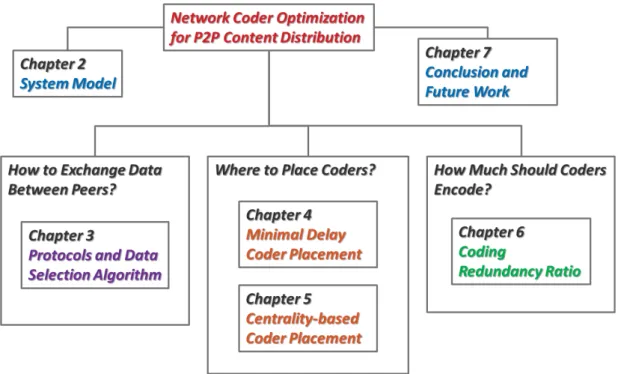
Figure 1.4: Dissertation organization. The main parts of the dissertation are cen- tered around three questions: (1) how to exchange data between peers (Chapter 3), (2) where to place coders (Chapter 4 and Chapter 5), and (3) how much should coders encode (Chapter 6).
encoders and the number of encoding operations at each encoder.
Interesting enough, both the first work on network coding [1] and the first work where network coding was applied to P2P content distribution [14] have briefly illustrated the problem we solve in this dissertation: the multi-path duplication problem inherent to content distribution. We differ from them, yet motivated by them, in that we make a full analysis of where the duplication happens and degrades performance the most in order to place network coders there. In addition, we figure how much a network coder should encode to eliminate such duplication.
1.4 Dissertation Organization
The remaining parts of this dissertation are organized in 6 following chapters (Fig- ure 1.4).
• Chapter 2describes our system model with the assumptions we have made
about the system.
• Chapter 3 proposes the communication protocols and data selection algo- rithm required for a partly network coding-enabled P2P content distribution system to operate efficiently. We envision a P2P system where some peers encode to improve content distribution time and other peers, due to some system-wide optimization or resource limitation, do not encode. Such a sys- tem gives rise to a design problem which has never happened in both pure non-coding and full network coding-enabled P2P systems. We identify the problem and propose our protocols and algorithm to address it.
• Chapter 4 begins with our network coder placement problem statement which is the main focus of the dissertation. Given a network topology, the question we would like to answer is where to place a given number of network coders inside the network to shorten distribution time the most. We then makes an elaborate analysis of data duplication in ordinary non-coding P2P content distribution in an effort to understand how network coding improves performance. The analysis forms the basis for our network coder placement to reduce number of network coders. We first analyze the duplicated data on a simple 2-receiver graph based on a probability model. The result is then extended to general topologies with multiple receivers. Taking advantages of the analysis result, we propose a novel network coder placement algorithm named minimal delay placement. Given a network topology, minimal delay placement algorithm places coders at nodes which cause the most delay to other nodes due to duplication. Our algorithm effectively eliminates unnec- essary network coders, thus, reducing the number of coders with almost no impact on the performance of the system.
• Chapter 5presents our centrality-based coder placements. We target place- ment algorithms with lower complexity and good performance. By observing
the correlation of data duplication in a content distribution network with the characteristics of the delivery paths, we proposed two placement methods.
The first exploits betweenness centrality [48] characteristics of each network nodes: encoders are placed at high betweenness centrality nodes, i.e. nodes which stand on more shortest paths from the source to other nodes in the network. The second algorithm uses flow centrality [49], a variant of be- tweenness centrality which takes network flows into account, as an indicator to place network coders.
• Chapter 6optimizesredundancy ratio at each network coder, i.e. how much the coder should encode. We figure the right redundancy level an encoder should generate in order to achieve shortest distribution time based on the network topology. The result is a saving in encoder’s computational re- sources while still realizing good performance. Redundancy ratio optimiza- tion, together with our network coder placements, further reduces resource consumption of network coding.
• Chapter 7finally concludes the dissertation with an outlook for future work to continue the research we have presented. We discuss the improvements needed to strengthen results of this dissertation and point in one promising direction to extend the results of our study to the recent information-centric networking research trend.
Chapter 2
System Model
2.1 Network Coding Peer-to-Peer Content Distribution
We consider a peer-to-peer content distribution problem from one source to many peers where each peer maintains overlay links to some other peers at random, i.e.
itsneighbors, over which data are transferred (Figure 2.1).
A file exists at a single source and is distributed to all peers which, at the beginning, do not have any part of the file. The file is divided intoK equalblocks1, the same as in [5], which are exchanged between neighboring peers over the overlay links connecting them. Peers may download several blocks in parallel from many neighbors at the same time. Parallel download accelerates the downloading speed of each peer. A peer not only downloads blocks from its neighbors but also uploads blocks it has to them, contributing its own upload bandwidth resources. As soon as a peer finishes downloading a block, it can immediately act as a server of that block and upload the block to its neighbors if there are requests for it. A peer finishes when it has collected all blocks of the file.
1Other BitTorrent-like systems might use the termschunk or piece. In this dissertation, we useblocks to mean equal parts of the file.
Figure 2.1: A file is distributed from the sourceS to all peers over a mesh overlay network. The file is divided into K equal blocks which are downloaded in parallel by peers. Network coders are placed at solid nodes to accelerate content delivery.
As in BitTorrent systems [5, 14], block exchange between peers complies with two rules:
1. rarest-first block selection at the receiving peer: a receiving peer chooses rarest blocks within its neighborhood to download first, and
2. an incentive scheme at the sending peer: a sending peer uploads blocks re- ciprocally to the neighboring peers who are also sending data to it.
Rarest-first block selection at the receiving peers works as follows. Peers keep collecting information about which blocks have been downloaded by its neighbors and how many neighbors possess a given block. Based on that information, a peer can decide which blocks are the rarest in the neighborhood. Whenever a peer has available bandwidth to download, it chooses a number of rarest blocks within its neighborhood and requests each block from the corresponding neighbor.2 Depend-
2At the beginning of a content distribution session, since there are not many blocks available
ing on its available upload bandwidth and the incentive scheme, the neighbor will permit the download or not. If a peer fails to request a block from a neighbor, it tries with other neighbors who also have the block it interests in. If that also fails, the peer will pick up the next rarest block as a substitute.
The incentive scheme at the sending peer is to ensure fairness in the system: a peer not only downloads, i.e. consumes resource of other peers, but also uploads, i.e. contributes it own resources. In our system, a sending peer prefers to upload to neighboring peers who are also sending data to it. If the peer still has available bandwidth resources, it will also upload to other neighbors who are not sending data to it. That kind of mutual exchange incentive scheme has previously used in [14].
We assume an altruistic system where peers stay and forward blocks even after they have finished downloading. The source does also stay in the system until all peers finish.
When network coding is enabled at a peer, the peer, which we then callnetwork coder or encoder, generates new encoded blocks from what it has received before sending to other peers. Encoders in our system uses random linear network coding [26] described in Section 1.2 to generate new coded blocks to send to its neighboring peers. A peer finishes when it collects enough coded and/or original blocks for decoding. When there are network coders deployed in the system, all peers which have received coded blocks, however, are required to decode to recover the original file.
among peers, in stead of using rarest-first selection, a peer can choose random blocks in the neighborhood to download.
2.2 Network Topology
Peers in the P2P network form a directed overlay topology, i.e. directed graph G = {V, E} where V is the set of peers, or nodes, and E is the set of directed overlay links between peers. A path, without circles or loops, from node i to node j is a sequence of nodes starting from i and terminating at j in which two adjacent nodes are connected by a link.
A flow on a path from nodeito nodej is a mapping: E →R+which conforms to the two following constraints.
1. Capacity constraint: the flow along a link is not greater than the link capac- ity.
2. Flow conservation: the total flow coming to a node is equal to the total flow going out of a node except for the source (node i) and the sink (node j).
The value of a flow represents the total amount of flow passing from the source to the sink. A maximum flow or maxflow is a flow with maximum value.
Since our main target is to isolate the feature of network coding that makes good performance, we make two following assumptions.
1. We assume complete knowledge of the overlay topology and bandwidth ca- pacity of each overlay link.
2. We assume a static scenario, i.e. there is no change in both the physical topology and the overlay topology during a content distribution session.
Those assumptions allow us to capture the essence of network coding for short- ening distribution time. The insight obtained from this static, centralized case is critically important for future work which investigates the dynamic and distributed scenarios.
Chapter 3
Protocols and Data Selection Algorithm
Network coding [1, 2], which allows content to be coded at intermediate nodes while being forwarded in the network, has been shown to achieve significantly shorter distribution time in peer-to-peer (P2P) content distribution [14, 15, 16].
It is, however, too expensive and in many cases impossible to require encoding at every peer. Recent work has demonstrated that encoding is only needed at a subset of carefully chosen peers [44, 50, 51], and in some particular instances, only at the source [29, 30], to achieve comparable performance to network coding.
Many other studies have focused on minimizing the number of required network coders to achieve optimal multicast throughput [33, 34, 39].
P2P networks in reality, on the other hand, usually consist of heterogeneous peers with quite different capabilities. More powerful peers can be ready for net- work coding-enabled operations, yet such jobs are beyond the capacity of resource- limited peers like hand-held and mobile devices. A successful network coding so- lution to optimize P2P network performance, therefore, cannot impose encoding at every network node.
Interested in using network coding to shorten distribution time in P2P network,
we envision a P2P system where encoding is applied at some peers while other peers, due to resource limitation or due to optimization reasons, might not code.
The system, which we call a hybrid network coding P2P system, gives rise to a design problem which has never happened before. In pure BitTorrent P2P system [5], the source and all peers exchange pieces, i.e. blocks, of the file using rarest-block selection to quickly disseminate the file into the system. A peer chooses the rarest blocks in the neighborhood to download first. In full network coding-enabled P2P, all peers code. Before downloading from a neighbor, a peer communicates with the neighbor to determine if it can provide with new data. In the hybrid network coding system, when some peers encode and others do not, there are mixtures of coded and non-coded blocks in the neighborhood for each peer to choose from.
The questions are how to communicate in an environment where coders and non-coding peers coexist, and which data should a peer select from such a mixture of coded and non-coded data given that we would like to preserve the efficiency and simplicity of BitTorrent P2P system.
In this chapter, we design our hybrid network coding P2P system.
1. We devise information exchange protocols which allow peers in a hybrid network coding system to communicate seamlessly with its neighboring peers whether they are coding-enabled or non-encoding ones. Our design, backward-compatible to BitTorrent, requires only an addition of one field in the meta-exchange messages.
2. We propose a block-selection algorithm for the partly network encoding- enabled system to operate efficiently. Our block-selection algorithm, an ex- tension from BitTorrent’s rarest-first selection, is derived from extensive ob- servations of the way network coded data benefit content distribution.
Our design and algorithm noticeably improve system performance in terms of distribution time compared with current network coding P2P systems.
3.1 Ordinary Network Coding Peer-to-Peer System
Network coding [1, 2, 26], which allows intermediate nodes to encode, have been applied to BitTorrent in order to shorten distribution time [14, 16]. Whenever there is an opportunity to transmit, a peer combines all blocks it has to make new coded blocks and sends to the requesting peer.
For full-scale network coding P2P where all peers encode, [14, 52] proposes a mechanism by which before downloading from a neighbor, a peer checks if the neighbor can provide it with meaningful blocks, i.e. blocks which are linearly in- dependent from the set of blocks it has received. We call that atry-and-download approach which, compared to BitTorrent, requires a major update in the way peers exchange metadata (Figure 3.1):
1. a peer sends a request message to its neighbor,
2. the neighbor replies either with a newly generated encoding vector or with itsdecoding matrix,1 and
3. requesting peer downloads a newly coded block from the neighbor if the encoding vector or the neighbors decoding matrix is independent from its own decoding matrix.
Try-and-download is synchronous in the sense that a peer has to be in synch with its neighbors by continuously checking if they can provide it with new data.
Moreover, a receiving peer cannot know in advance exactly which and how many blocks it is going to receive from each neighbor to make a better choice. Such knowledge will help the receiving peers to decide which blocks are most valuable to it. In full-scale network coding systems where peers are somehow homogeneous
1Please refer to Section 1.2 for an explanation ofencoding vector anddecoding matrix.
Figure 3.1: In current network coding P2P systems [14, 52] requests and replies are synchronous. The requesting peer regularly checks with each of its neighbors if it can download new independent blocks from them. If there are such blocks, the peer then requests and downloads them from the corresponding neighbors.
in terms of computational resources to encode, try-and-download is feasible, yet with a protocol overhead. Within a hybrid network coding P2P system, how- ever, it is not necessarily that all peers can code. In such a scenario, requiring a resource-limited peer to frequently compare its own decoding matrix with decoding matrices of its neighbors is beyond its capacity. We need a simple, yet effective, way to do that which every peer, encoding-enabled or not, can do. To facilitate hybrid network coding P2P systems where encoding and non-encoding nodes mix together, we depart from try-and-download approach to introduce an extension to BitTorrent metadata exchange. We furthermore propose a block selection algo- rithm to improve distribution time. Our proposed solution is backward-compatible with BitTorrent and virtually requires no more protocol overhead than pure Bit- Torrent, yet the performance improvement is noticeable compared with original network coding P2P systems.
3.2 Proposed Information Exchange Protocol
In pure BitTorrent without network coding, there are two phases to distribute blocks. These two phases interlace and take place asynchronously.
• Notification phase: after downloading a block, the downloading peer notifies its neighbors about the block it has just downloaded.
• Selection phase: whenever bandwidth is available for downloading, a peer, based on the information it has about which blocks are available in the neigh- borhood, chooses one block to download using a block selection algorithm.
The download, then, can proceed if the downloading peer is currently un- chocked by its neighbor who has the chosen block and the neighbor has enough bandwidth to sustain such download. If that fails, the peer can re- peat this process to choose another block. This phase stops when the peer runs out of bandwidth or has no more blocks to choose from.
In the following subsections, we concentrate on the protocols used to commu- nicate between peers and the format of the exchanged metadata. We discuss the block selection algorithm in detail in the next section. BitTorrent unchocking al- gorithm is one topic in itself to handle fairness and free-rider issues and is not discussed in this section. We instead assume peers in our system are altruistic and willing to contribute their bandwidth.
3.2.1 Block Format
To identify data blocks, each block is associated with one uniqueblock-id. However, one extension is needed to support network coding. Unlike non-coding systems in which the assignment is done only by the source where all the blocks originate, in network coding P2P systems, that assignment is done where the block is created or originated: both at the source and at all the encoders. To assist our block selection algorithm, in one content distribution session, the block-id is generated
in increasing order: a new block-id generated by a particular encoder is greater than all previous block-ids generated by that encoder.
With network coding, an encoding vector is attached to each coded block as de- scribed in Section 1.2. We propose an additionalencoder-id field (Figure 3.2) which stores the identification of the encoder who generated the coded block. Encoder-id will be used in our block selection algorithm later on.
For each block, the metadata exchanged between neighbors in a notification message, thus, consists of three fields: block-id, its encoder-id, and its encoding vector (Figure 3.2(a)). The data block consists of block-id, encoder-id, and the data payload (Figure 3.2(b)). If the notification or data block is a non-coded one, itsencoding vector and encoder-id can be omitted.
Having defined the block formats, we next present details of two communication protocols, either of which can be used in the hybrid network coding system.
• Pre-code protocol: encoding vectors of coded blocks are generated in the notification phase when encoders notify their neighbor about newly coded blocks.
• Post-code protocol: encoding vector for a given coded block is generated in the selection phase, just before the block is downloaded.
We discuss the pros and cons of those two protocols subsequently.
3.2.2 Pre-code Protocol
Without the assumption that every peer can code, we propose a simple adaptation to BitTorrent metadata exchange mechanism. To facilitate coding, in our system, if a peer is an encoder, for each newly downloaded block, the peer notifies each of its neighbors with metadata of one newly encoded block. The newly encoded block is different from one neighbor to another neighbor. We note that to save computational resources, only the metadata, i.e.encoder-id,block-id, and the newly
Figure 3.2: Notification and data block formats with the newly proposedencoder-id field.
generatedencoding vector of the encoded block (Figure 3.2(a)), are notified to the neighbors in a notification message. Only when a neighbor decides to choose and request the notified coded block is the actual data of that block encoded. For an ordinary non-encoding peer, the metadata exchange is the same as in BitTorrent:
the peer notifies its neighbors of the block it has just received. The communication protocol is illustrated in Figure 3.3. Since the system is a hybrid network coding, notifications (message 1) and data blocks (message 3) transferred between peers can be either encoded or original ones.
One might argue to usetry-and-download here, but that will make the operation more complicated because each peer has to implement two protocols: one for encoding-enabled neighbors, one for ordinary neighbors. With our approach, all a peer has to do is to choose from candidate blocks one particular block to download based on the metadata it received in notification phase, which is the same as what happens in a pure BitTorrent system.
When a peer receives notification of a newly encoded block by a neighbor, i.e. message 1 in Figure 3.3, the peer stores that block in a candidate list if the block is independent from all blocks it has downloaded. Otherwise, it ignores the notification. Unlike encoding-enabled peers, non-encoding peers do not encode but
Figure 3.3: Pre-code protocol peers used to communicate. There are two asyn- chronous phases: notification phase and selection phase. This protocol is an ex- tension from BitTorrent: the notification messages and data blocks have an addi- tional encoder-id. Encoding vectors are also attached to the notification messages as described in Section 1.2.
forward what they have received: a mixture of coded and non-coded blocks. As in BitTorrent, when receiving notification from a non-encoding neighbor, a peer will update the count of that block, i.e. at how many neighbors the block exists.
When a peer can download, it selects a block using a selection algorithm and sends a request for the chosen block to the corresponding neighbor (message 2). If the request is accepted, the neighbor will upload the data block to the requesting peer (message 3).
Coding generates a large number of coded blocks, usually larger than the num- ber of original blocks, of which many blocks are redundant. As a peer continuously downloads new blocks, some blocks in its candidate list might become dependent on what it has downloaded. Each peer is therefore required to check and discard candidate blocks which are dependent on what has been downloaded.
Figure 3.4: Using post-code protocol, the encoding vector is generated not in the notification phase but just before the requested block is sent to the receiving peer.
3.2.3 Post-code Protocol
As we mentioned before, notification phase and selection phase are asynchronous.
That is, after peer A notifies an encoded block in message 1, some amount of time passes before peer B requests that encoded block in message 2. The elapsed time can arbitrarily be long if, for example, peer B decides to download several blocks from other neighbors before choosing the encoded block from peer A. In the meantime, peer A might receive some new blocks. Using pre-code protocol, that new information is not included in the encoded block since the way the block is generated, i.e. its encoding vector, was fixed at the notification time.
Encoders combine the blocks they currently have to make new coded blocks.
If we can delay the act of encoding just before the coded blocks are downloaded, we can provide the receiving peers with the most updated information. Based on the above observation, we proposed an alternative protocol, namely post-code protocol, which is illustrated in Figure 3.4.
The differences of the post-code protocol from pre-code protocol are as follows.
• Encoding vector is not included in the notification message, i.e.message 1 in Figure 3.4. Only encoder-id and block-id are notified to the neighbor (peer B) each time peer A downloads a new block. As stated before, encoder-id is the ID of peer A andblock-id is an increasing number generated by peer A.
• The encoder (peer A) actually generates theencoding vector and sends to the receiving peer in the selection phase (message 3) just before the actual coded data (message 5). The receiving peer (peer B) needs to check if thatencoding vector is independent from its own decoding matrix before requesting the encoded block (message 4).
Post-code protocol has the advantage of producing fresher coded blocks which expectedly accelerate content distribution. The limitation, however, is that it requires more protocol overhead: in total 5 messages for each downloaded block compared with 3 messages in case of pre-code protocol.
3.3 Block Selection Problem
In this section, we describe in detail the block selection problem associated with hybrid network coding systems and propose our solution for it. The proposed block selection, which can be used with either of the two protocols we present in the last section, completes our proposal for an efficient, high-performance P2P content distribution with network coding. We begin by describing the duplication problem in such a system using the original rarest-first block selection.
3.3.1 Duplication Problem with Current Rarest-first Block Selection
The block selection algorithm used by BitTorrent is rarest-first by which peers choose the rarest block in the neighborhood to download first.2 If there are sev- eral rarest blocks, a random one is selected from those rarest blocks. Rarest-first selection is not enough because of two reasons.
1. Encoders combine more information in the neighborhood. When there is limited available bandwidth, for example when a bottleneck exists, non-coded blocks and coded blocks cannot be given the same attention. Coded blocks from the encoders should be preferred because they contain, in a sense, more information and can accelerate content distribution through the bottleneck.
2. Coded blocks are not equally important. Each coded block even though is always unique, i.e. rare, in the sense that almost always no two coded blocks are identical, the level of importance of each coded block is different.
Coded blocks are created progressively from all the blocks an encoder has downloaded. In the beginning, as there are only a few blocks to encode, the coded blocks created then contain within them only the information from that few blocks. The more blocks an encoder has, the more data are combined to create new coded blocks. Because of that, only at the source or when an encoder has downloaded the full file, are the coded blocks equally important. In other cases, the most recently coded blocks likely contain more information.
To make it clear, we illustrate the problem in two following examples.
2In the beginning of the distribution section when peers have no blocks to exchange with others, BitTorrent uses random block selection by which peers choose a random block in the neighborhood to download. Nevertheless, after a peer has acquired some blocks, it switches to rarest block selection.
Figure 3.5: Node E and F receive notification from node A, G, and H about the candidate blocks the two nodes can down-load. Of whichB1 andB2 are non-coded blocks from node G and H; A1–A4 are newly encoded blocks from encoder A.
Figure 3.6: With original rarest-first selection, there is a probability 1/8 that node E and F choose the same block B1 or B2. The result is that node T can only download one new block while its bandwidth allows two blocks.
Example 1(Figure 3.5–3.7) illustrates a partial overlay topology with 6 nodes:
A, G, H, E, F, T of which A is the only encoder. Nodes A, G, H each has two blocks B1 and B2. Encoder A has notified node E, F with 4 blocks A1–A4, each node with two newly coded blocks. Nodes G, H have notified E, F with blocks B1 and B2. The count of each block in the neighborhood is given in the tables (Figure 3.5). Suppose due to bottlenecks, E and F, each can only download one new block. If E and F select blocks using original rarest-first algorithm, there is 1/8 chance that both will download the same block B1 or B2 which results in
Figure 3.7: If coded blocks from encoder A are preferred, node E and F can always download independent blocks. As a result, node T can utilize all its bandwidth to download 2 new independent blocks.
Figure 3.8: Encoder A, having 2 blocks B1 and B2, notifies node E and node F with newly encoded blocks A1–A4.
node T can only download one new block while its available bandwidth allows two (Figure 3.6). In Figure 3.7, if E and F prefer coded blocks from encoder A over other blocks, T can always download two new blocks.
Example 2 (Figure 3.8–3.11) considers a partial overlay topology in which an encoder A is delivering coded blocks to non-coding nodes E, F, and T. At the beginning, A has two blocks B1 and B2, and notifies E and F of 4 newly encoded blocks: A1–A4, two blocks for each node (Figure 3.8). Node E and node F then each can download one block, e.g. A1 and A2 due to bandwidth limit. In the
Figure 3.9: Encoder A, after downloading 2 new blocks B3 and B4, notifies node E and node F with blocks A5–A8 encoded from all 4 blocksB1–B4.
Figure 3.10: With original rarest-first selection, there is a probability 1/9 that node E chooses block A3 and node F chooses block A4. The result is node T can only download 2 independent blocks A1 and A2 in 2 units of time. Blocks A3 and A4 in node E and node F are not useful to node T because they are dependent on A1 and A2.
meantime, A downloads two more blocks: B3 and B4, and sends new notifications about blocksA5–A8 to E and F (Figure 3.9). If E and F select blocks using rarest- first, there is 1/9 chance that E choosesA3 and F choosesA4 which results in peer T being only able to obtain 2 independent blocks in 2 units of time (Figure 3.10).
In contrast, T can download 4 new blocks if E and F prefer new encoded blocks over old ones (Figure 3.11).
Figure 3.11: If the newest blocks are preferred, the 4 blocks downloaded by node E and node F are independent, which means node T can download in total 4 independent blocks in 2 units of time.
Algorithm 3.1:Proposed Block Selection Algorithm
Input: SetC of candidate blocks and function count(Ci) ∀Ci∈C specifying how many times each block exists in the neighborhood of peer A. Result: One block for peer A to download
1 Sort blocks in ascending order of their occurrence count(·);
2 Make a listL1 of all blocksCi with the lowest count(Ci) ;
3 Make a listL2 of all blocksCi∈L1 which are encoded by a neighbor of peer A in random order: Ci.encoder id≡encoder B’s ID∀B, B is a neighbor ofA;
4 Exchange blocks in L2 so that blocks from the same encoder are in descending order of their block id;
5 Make a listL3 of all blocksCi∈L1\L2 in random order;
6 if L2=∅then
7 return the first block inL2;
8 end
9 else
10 return the first block inL3;
11 end
The problem therefore is: given a mixture of coded and non-coded blocks in the neighborhood, which blocks should a peer choose to download.
3.3.2 Proposed Block Selection Algorithm
Our proposed algorithm is given in Algorithm 3.1. It works seamlessly in all types of networks: pure non-coding, full-scale network coding, and hybrid network coding. We extend the original rarest-first selection (line 2) to give preference to
coded blocks from immediate neighbors over other ones (line 3). Also, from the same encoding neighbor, newer coded blocks (with larger block-id) are preferred over older ones (line 4). In doing so, we allow valuable newly encoded blocks in the neighborhood to be quickly disseminated while preserving the power of rarest- first in distributing new information. Our algorithm improvement is generally significant. Without it, newly coded blocks, virtually with more information, are arbitrarily blocked in the network because neighboring peers may choose not to download them.
3.4 Network Coder Assignment
Given that in the hybrid network coding P2P content distribution, only some peers encode, the questions are which peers will become network coder and who is responsible for assigning them.
In our view, peers at key locations of the network can selectively be assigned as network coders as we have discussed in detail in Chapter 4 and Chapter 5. This approach, however, requires a centralized server to compute and assign coders.
Practically, in P2P systems such as BitTorrent [5, 14, 53], we can allow trackers to do that task since the trackers know which peers currently join the torrents.
Network coders can also be assigned in a distributed manner without any cen- tralized server by using, for example, degree information [54]. Given a threshold, peers with degrees higher than the given value will become encoders. Degree- based placement performance, however, is not as good as the proposed placement methods in Chapter 4 and Chapter 5.
In scenarios where computational resources are limited, we can approximately predict the amount of required resources based on which a peer can determine, by itself, to become an encoder if it meets the resource requirements. Such an encoder assignment does not need a centralized server either.
![Figure 1.3: Avalanche [14] requires all peers encode. In this figure, peer i is combining the two blocks C 1 and C 2 it has downloaded to make new coded blocks C using random coefficients a 1 and a 2 .](https://thumb-ap.123doks.com/thumbv2/123deta/9851126.1897864/22.892.285.672.98.419/figure-avalanche-requires-encode-figure-combining-downloaded-coefficients.webp)
![Figure 3.1: In current network coding P2P systems [14, 52] requests and replies are synchronous](https://thumb-ap.123doks.com/thumbv2/123deta/9851126.1897864/36.892.262.676.100.514/figure-current-network-coding-systems-requests-replies-synchronous.webp)


