博物館等の収蔵空間 おける汚染ガスの簡易 特定法とその除去の構築
Storage Spaces in Museums and Libraries: Designing Simple Alternative Methods for the Source Determination and Mitigation of Gaseous Pollutants
アルセ ヒュットマン イメ
Arce ütt a e
1. Introduction
“Preventive conservation” refers to the attempt of
mitigating the inevitable damage that occurs to stored cultural objects in museums, libraries and the like by controlling the environmental conditions and implementing countermeasures for predictable damage sources.
The damage causes that are considered for preventive conservation vary, but the nine common agents of deterioration factors according to ICOM are: 1-direct physical forces 2-thieves, vandals, and displacers 3-fire 4-water 5-pests 6-contaminants 7-radiation 8-incorrect temperature 9-incorrect relative humidity.1
Museums and libraries should deal with these main factors to ensure the preservation of their collections. However, not all institutions have the necessary staff and budget to do this. This is especially the case in small museums and libraries, as well as in museums and libraries in developing countries. With limited resources, some damage factors tend to be prioritized. For example, simple and cost-effective alternative methods have been developed to aid in the control of temperature and relative humidity.2
Since contaminants and their detrimental effects are not directly perceived, they are not usually the priority for small museums and libraries.
However, gaseous pollutants are a serious threat to cultural heritage, and as pollution increases and new materials are introduced, there is a need to revise the effects of pollutants today up to the smallest library or museum.
Various countermeasures have been designed to tackle contaminants in museums. They are divided into detection and mitigation methods.
However, Museums and libraries with little resources (both professional and economic) cannot easily acquire
and apply these methods.
The purpose of this research is to help preserve cultural heritage by investigating gaseous pollutants in museum and library spaces as well as by developing pollutant detection and mitigation methods for local and small museum and library spaces.
2. The environmental Conditions of Costa Rican Museums
As a case study of museums in developing countries, the environmental conditions of Costa Rican museums and their storage rooms was evaluated.
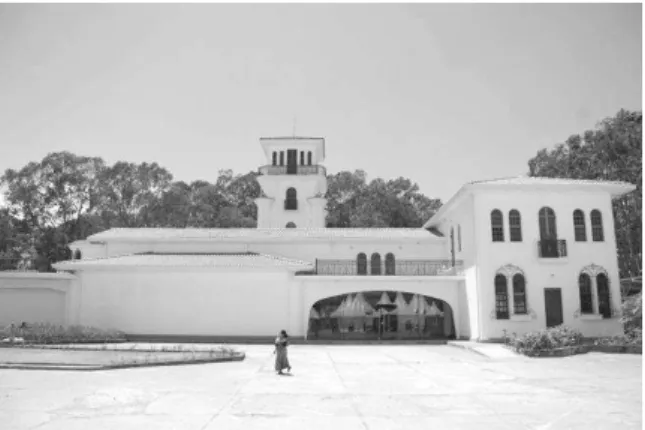
Temperature and relative humidity, visible and UV-radiation as well as gaseous pollutants were measured in the Costa Rican National Museum and the Costa Rican Art Museum (figures 1 and 2).
The measurements were performed in two phases (phase 1 from March 19th to April 2nd 2012 and phase 2 from August 21st to September 5th 2013).
Figure 2 Costa Rican Art Museum
The measurement places for the Costa Rican National Museum were 1-the Museum Hall, 2-the Textile Storage Room and 3-the Painting and Sculpture Storage Room. For the Costa Rican Art Museum they were 1-Outside, 2-the Golden Hall(second floor), 3- the Storage Room, 4-the Museum Hall (first floor) and 5-Drawer#26 in the storage room.
From the gathered data it was observed that in general, the temperature conditions in these two museums are relatively stable, ranging averages from 20°C to 24°C. Humidity, however, was high, averaging 65-75% for all measured places and reaching very extreme minimum and maximum levels. Both museums have been making efforts to install air conditioning in the storage rooms, but it is questionable whether conditions actually improve, since short-term fluctuations are heavier and there have been reports of air conditioning failures.
Visible light and UV-radiation were only measured in the Costa Rican National Museum Hall and in the Costa Rican Art Museum Storage Room. They were considered high for the Costa Rican Art Museum Storage Room, considering that it is not an exhibition space and that certain pigments and materials can be very sensitive. However, further research on light and UV radiation is needed in this area.
Gaseous Pollutants were measured in the Costa Rican Art Museum only, using pH-strips, passive dositubes and detection tubes.
It was found that while the storage room is generally alkaline and has ammonia, the museum in the first floor is neutral-alkaline and in the second highly acidic. The windows of the second floor of the museum remain open for the day, allowing pollutants from the
street in front of the museum to enter.
Hydrogen sulphide, acetic acid, ammonia and nitrogen dioxide passive dositubes were used. The results of the found specific pollutant amounts measured with passive dositubes in the Costa Rican Art Museum are shown in table 1.
Table 1 Passive Dositube results
Passive Dositubes 2012
Gas Museum Hall Storage Room
Ammonia Amount 0.04 ppm 0.08 ppm
NO2 Amount 0.00652 to 0.01 -
All dositubes were places March 19th 2012
The "-" Sign signifies that these measurements were not
Passive Dositubes 2013
Gas Storage Room Drawer # 26
Ammonia Amount 0.1 ppm 0.03 ppm
All dositubes were placed September 2nd 2013
The presence of nitrogen dioxide was discovered, but levels do not surpass the recommended standards3.
However, ammonia gas almost doubles these standards. While the presence of ammonia gas in the Costa Rican Art Museum was confirmed, the source of this pollutant can only be supposed. Concrete, persons, some sealants and paints are known ammonia gas sources.4
3. Gaseous Pollutant Source Determination for the Safe of the Central Library of the University of Tsukuba
While the Central Library of the University of Tsukuba holds books, journals, magazines, etc., it also counts with a rare books collection that includes works from various different eras. This collection is stored in a safe located in the first floor.
Former investigations had shown high amounts of organic acids and ammonia there. While the organic acids decreased with the use of chemical adsorption sheets(based on activated carbon), the ammonia levels remained high.
This led to an investigation aimed to detect the source of ammonia gases, divided into two surveys (first survey from October 2012 to December 2012 and second survey from January 2013 to February 2013). A method to select probable pollutants sources was developed, called the "Targeted Pollutant Source Detection Method". It would not only involve the material of the objects, but their history and context as well.
Figure 3 The safe at the Central Library
In a preliminary investigation, the overall presence of ammonia in the safe was confirmed, and no organic acids were detected. The contrary happened inside of the box of document ル 218-21: ammonia was not detected but organic acids were. This indicated that within a microspace "sub-microspaces" with completely different characteristics could exist.
For these specific investigations, each selected material was separated from its corresponding box or cover for sampling.
The materials were placed in gas-barrier-bags. Then, nitrogen gas was inserted with a pump and the bags were left for two weeks to allow off-gassing.
Next, air samples were taken using ultra pure-water impingers and Tenax® tubes that were subsequently sent to the Nippon Muki Company for analysis. The impinger samples were analysed with Ion Chromatography (IC) while the Tenax® tubes were analysed with Mass Spectrometry-Gas Chromatography (GC-MS).
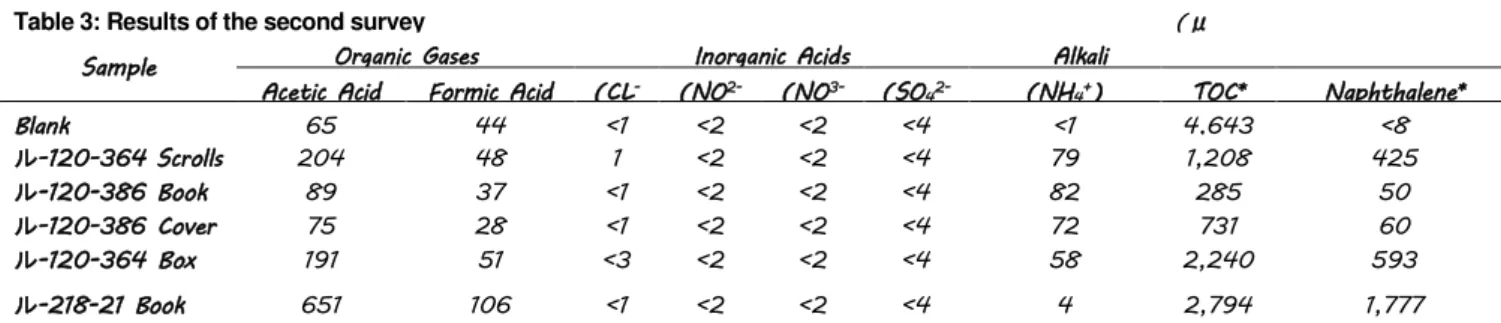
Off-gassing can be measured with other methods such as the "Gasbag-Gastube Method" that is described in part 4. The "Targeted Pollutant Source Detection Method" only intends to aid in the selection of materials for sampling. Tables 2 and 3 show the results of both surveys.
For the first survey, the previously mentioned ル218-21 was selected for sampling. ル120-352 was also selected as it was a book that contained various pigments. As ル 218-21 showed extremely high amounts of acetic acid (over four times the recommended levels), this material was wrapped in an ammonia chemical adsorption sheet and placed in a gas-barrier-bag as a tentative countermeasure.
Table 2: Results of the first survey
(μg/m3)
Sample Organic Gases Inorganic Acids Alkali
Acetic Acid Formic Acid (CL- (NO2- (NO3- (SO
42- (NH4+) TOC* Naphthalene*
Blank 28 6 <1 <2 <2 <2 5 900 <6
ル-120-352 Book 50 <6 <1 <2 <2 <2 96 49 40
ル-120-352 Cover 41 <6 <1 <2 <2 <2 102 91 55
ル-218-21 Book 1,250 124 <1 <2 <2 <2 6 5,609 5,464
ル-218-21 Box 235 37 <1 <2 <2 <2 72 1,964 1,827
*based on toluene calibration
Table 3: Results of the second survey (μ
Sample Organic Gases Inorganic Acids Alkali
Acetic Acid Formic Acid (CL- (NO2- (NO3- (SO
42- (NH4+) TOC* Naphthalene*
Blank 65 44 <1 <2 <2 <4 <1 4,643 <8
ル-120-364 Scrolls 204 48 1 <2 <2 <4 79 1,208 425
ル-120-386 Book 89 37 <1 <2 <2 <4 82 285 50
ル-120-386 Cover 75 28 <1 <2 <2 <4 72 731 60
ル-120-364 Box 191 51 <3 <2 <2 <4 58 2,240 593
ル-218-21 Book 651 106 <1 <2 <2 <4 4 2,794 1,777
The fact that not the box, which was new and made out of wood, but that the book was the main source of acetic acid was remarkable. Wood is a known acetic acid source.5 The book is in very good condition. The
possibility that it had adsorbed the acetic acid was considered.
For the second survey, ル218-21 was analysed again, showing that acetic acid off-gassing decreased to almost half the original values. ル 120-364 was chosen for sampling because it was heavily deteriorated. ル218-386 was analysed as it had very similar characteristics to ル 120-352, except that it had not been restored. Leads on the off-gassing of restoration material were expected but not acquired.
This method is useful when looking for the source of a contaminant detected after a general air pollution investigation.
It is based on the following five steps:
1) Once the presence of the pollutant is confirmed, consider the possibility of sub-microspaces with different characteristics and analyse them apart.
Check boxes, packages, etc.
2) Perform an inventory of the objects considering the following factors: 1- Material the objects and their respective covers/boxes are made of 2- Date of each object and its box or cover 3-General appearance of the objects (deterioration state, smell, etc.) 4-Storage History (when the object entered the collection) 5- Restoration History. Besides checking the records, perform visual observation 6- Any additional information of the staff 3) With the gathered information, look for probable contaminant sources. Separate the objects from their containers (boxes or covers) when considering sources. Also, consider the possibility of adsorption.
4) Separate the materials using Gas-barrier-bags. Always prepare a blank when performing analysis. Analysis of the
pollutant can be done in different ways. For these particular experiments, GC-MS and IC was used. The
“Gasbag-Gastube Method” that is explained in chapter 4 can also be used, as well as any other analysis method available.
Each microspace can be different, conditioning the needs and effectiveness of this method. The main contribution of it, however, is to not only consider the material, but all the information regarding the stored collections, including storage and restoration history.
From these investigations the source of ammonia gas was not determined. However, important leads were provided. Also, it was understood that the possibility that a material might adsorb contaminants to desorb them later on has to be taken into account. Not only the material an object is made of is a determining factor.
The possibility of "sub-microspaces" within microspaces with completely different characteristics was discovered as well.
4. Designing an alternative Methodology for determining the Presence of Gaseous Pollutants and finding Alternative sorbents
The study cases of Costa Rican museums and the Central Library of the University of Tsukuba show that gaseous pollutants still exist in museum and library spaces. In order to help small and local museums and libraries to deal with gaseous pollutants, their sources and mitigation methods, an alternative gaseous pollutant detection method using gas-barrier-bags and detection tubes, called
the “Gasbag-Gastube Method” was designed.
fibres) may have greater sorption capacities than other material6. Understanding the sorption characteristics of
paper material may aid local or small museums and libraries that are in need of accessible sorbents but cannot afford them or get to them.
Second, there was a need to understand the sorption ability of cultural assets made out of paper. There was an indication that assets such as ル 218-21 could adsorb acetic acid. Thus, even though a material does not naturally off-gas a contaminant, it could adsorb and desorb it.
Understanding the gas sorption phenomena that may occur in an exhibition or storage space can improve the preservation of movable heritage.
Fabriano Rosaspina, Filter Paper, Kozoshi and Usuyoshi were the four types of paper chosen for these experiments. A quarter of the medium-sized Japanese print standard was selected as the target size, which was roughly rounded to 130x100 mm. An extra set of samples was deteriorated with a Xenon instrument to compare new and deteriorated paper sorption rates, considering that cultural assets have usually undergone some deterioration. Ammonia was selected as the pollutant gas, as it was found both in the Costa Rican Museum of Art Storage Room and in the Rare Books Collection safe of the University of Tsukuba. Central Library.
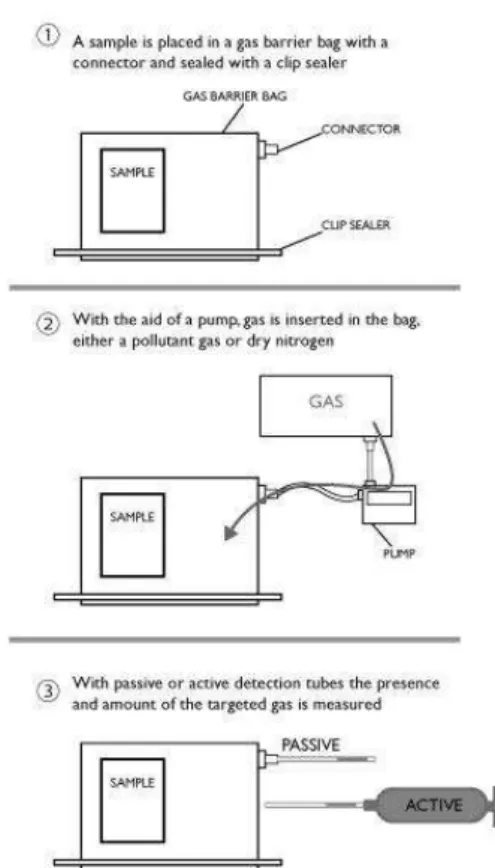
The “Gasbag-Gastube Method” uses gas-barrier-bags and gas detection tubes to determine the presence and amount of pollutants of targeted objects or material. Figure 4 shows an overview of the method:
ᬅThe sample is placed in a gas-barrier-bag.
ᬆNitrogen gas or pollutant gas is inserted according to the experiment needs (nitrogen gas for off-gassing or desorption and pollutant gas for adsorption experiments) ᬇ The amount of the targeted gas can be read at the desired time with a diffusion tube or a detection tube.
This method can be used with other materials and gases besides paper and ammonia gas. It can also be used to see if a specific object or a part of it is off-gassing pollutants in small and local museums. There is a need to further research on the possibility of using regular air instead of nitrogen as well as an alternative gas insertion method instead of a pump, possibly another gas-barrier bag.
Figure 4 Gasbag-Gastube Method
The paper and ammonia experiments were divided as follows:
1- Adsorption 1 (2013.8.13-2013.8.14)
The adsorption rates of the four paper types were measured.
2-Adsorption 2 (2013.10.22-2013.10.23) and its Re-adsorption (2013.10.24-2013.10.25)
The adsorption rates of the four types of paper were measured. After this, ammonia gas was reinserted to saturate the samples.
3-Desorption (2013.11.1-2013.12.6)
The used samples were placed in gas-barrier-bags and filled with nitrogen gas for desorption. Only two samples were chosen.
Figure 5 The results of the adsorption 2 experiment
A blank was always used when performing these experiments to check if the gasbags themselves adsorbed ammonia gas and to subtract any extra-adsorbed gas from the final results
The “Gasbag-Gastube Method” provided reliable data on adsorption rates. The different paper types showed different adsorption rates and velocities. Figure 5 shows the results of the adsorption 2 experiments. The different adsorption rates can be observed there.
Ammonia concentrations were measured after determined amounts of time. While the concentration of ammonia gas in the blank bag decreased somewhat, it did more so in the bag containing usuyoshi paper. Fabriano, Filter and Kozo samples showed even greater adsorption capabilities.
Desorption was only tested with kozo and fabriano, and no more than 1 ppm was desorbed.
This means that after paper adsorbs ammonia gas, it does not easilt desorb it. Damaged kozo and fabriano samples had much higher and faster adsorption rates than new ones. This means that a cultural object containing paper material can adsorb more ammonia than new paper material.
Overall, the effectiveness of the “Gasbag-Gastube
Method” was proven, as was the capability of paper
material of adsorbing gaseous pollutants without desorbing them.
5. Conclusions
Two methods were presented in this research: The
“Targeted Pollutant Source Detection Method” was proposed to determine the source of gaseous pollutants in microenvironments, such as cabinets, safes, etc. The
“Gasbag-Gastube Method” was presented as an
alternative method
to easily detect the presence and amount of a contaminant. This method was tested with four types of paper, and it was determined that paper does have adsorbing capabilities, although further research is necessary to understand whether paper material can actually be used. Practical application of these methods in museum and library spaces are the next steps for this research.
1 “Care and Preservation of Collections”. In: Running a Museum: A
Practical Handbook, Michalsky, S., ICOM – International Council of Museums (publ.), p.52, 2004
2 "ࠕClimate Controls in a Historic House Museum in the Tropics: A
Case Study of Collection Care and Human Comfortࠖ, Maekawa S. In International Preservation News 54, pp. 11-16, 2011
3ࠕTools for consevation: Monitoring for Gaseous Pollutants in Museum
Environmentsࠖ, Grzywacz, C.M., California:Getty Publications, p.109, 2006
4ࠕKey Airborne Pollutantsࠖ Tétreault, J. In: Airborne Pollutants in
Museums, Galleries, and Archives: Risk Assessment, Control Strategies, and Preservation Management. p. 8, 2003
5
ࠕ
Volatile organic compounds from wood and their influences onmuseum artifact materials I. Differences in wood species and analyses of causal substances of deteriorationࠖOikawa T. et al. In: Journal of Wood Science 52 pp 363-369, 2005
6 ࠕIndoor air quality: solutions and strategiesࠖ, (Hays et al, New York: