Second Language Acquisition: Learning Vocabulary
Aya Takahashi
Introduction
Acquiring vocabulary is one of the most important things when learning a second language (L2). It is not too much to say that knowledge of L2 vocabulary is more important than that of L2 grammar. If learners know a sufficient amount of vocabulary, they are able to read, write, listen and speak the L2 more easily. However, learning vocabulary is not so interesting for some learners. I was bored learning vocabulary when I was in high school because I was not good at memorizing vocabulary. However, I had to learn as many English words as possible to take university entrance examinations. My teacher in high school recommended that I memorize vocabulary in sentences. He said it was the best way to learn vocabulary, but it was not very effective for me. I also felt that there were too many words to learn and the words I learned using this method were difficult to retain.
I also wondered whether there were any interesting and effective ways of learning vocabulary. I thought that, if I were able to enjoy learning vocabulary, I might get to like English very much. In this paper, I would like to focus on word learning and compare two methods for learning words.
A lot of vocabulary learning studies have been conducted over the last few decades. Two methods that have been shown to be effective are the keyword method (Atkinson 1975) , in which learners create acoustic and imagery links between L2 words and their first language (L1) translation equivalents, and visual imagery (Oxford & Crookall 1990), in which learners create a visual image link between L2 words and their first language (L1) translation equivalents.
東京女子大学言語文化研究( )21(2012)pp.34‑48
Previous research Keyword method
Atkinson (1975) developed the keyword method, which is based on acoustic and imagery links between L2 words and its first language (L1) translations. The keyword method consists of two stages of learning vocabulary. In the first stage, the subject forms a mental image that interacts with a keyword and the L1 translation of an L2 word. For example, if native English speakers want to memorize the Spanish word , they can use the word as the keyword. Since the Spanish word means , they can imagine, for example, a lovely duck hiding its head under an overturned flower pot.
Previous research has shown the keyword method is superior to other vocabulary learning methods. Sagarra & Alba (2006) investigated the effects of three L2 vocabulary learning methods during the early stages of Spanish acquisition. The purpose of their study was to find out whether deeper processing of learning vocabulary produces better retrieval than shallow processing. They compared rote memorization, semantic mapping, and the keyword method. Rote memorization is a vocabulary learning technique for associating L2 words and their L1 translations through repetition. With semantic mapping, the subjects draw a mind map of the semantic associations of the target words. The subjects in their study were 778 third‑semester L2 learners of Spanish at a large U.S. university. All were native speakers of English and had no previous experience of the three learning methods. They were asked to learn 24 Spanish words with their English translations. The target words were assigned to three sets of eight words and the subjects learned each set using one of the three methods. Immediate posttests were given at the end of study and three weeks later.
The results showed that the keyword method was the most effective treatment on both the immediate and the delayed posttests. Rote memorization was also found to be more effective than semantic mapping.
Avila & Sadoski (1996) explored the keyword method for learning English vocabulary using Spanish keywords. The subjects were 63 limited English proficiency (LEP) fifth grade Hispanic students. There were 10 English target words that the subjects did not know. The subjects were randomly assigned to one of two groups: the
Keyword Group and the Control Group. The Keyword Group received a booklet containing English target words, Spanish keywords, Spanish translations of the English words and pictures related to the Spanish keywords. The group was also given an explanation how to memorize the words using the keyword method. The Control Group received a booklet containing only English target words and their Spanish translations and was told to do their best to learn them.
Their experiment ran over three days. On the first day, both groups were given explanations about what they should do and three practice words to learn. On the second day, they were introduced to the ten target words accompanied by a teacher explanation of what to do (Keyword Group) or the teacher saying the target word and its Spanish translation (Control Group). On the third day, the procedures used on the second day were repeated and, after that, the subjects were given 15 minutes to study the words individually.
Some of the subjects in both the Keyword Group and the Control Group had a cued recall test and a sentence completion test immediately after the study period, and the others took the tests one week later. The cued recall test asked the subject to write the Spanish translations of the English words. The sentence completion test asked them to write the appropriate English words in blanks of sentences. In the sentence completion test, an English word list was provided and the subjects were allowed to refer to them.
The results from the immediate cued recall test showed that the Keyword Group was able to recall about 25% more of the target words than the Control Group. The Keyword Group also performed better on both the immediate and delayed sentence complete tests. That is, the Keyword Group yielded better recall and comprehension than the Control Group. This study clearly indicates that superiority of the keyword method over the other methods.
Pressley, Levin, Hall, Miller & Berry (1980) investigated how the keyword method influenced L2 vocabulary acquisition. The subjects were sixth grade students at a public middle school and a parochial school in the US Middle West. They were randomly distributed across six conditions; keyword condition, keyword + repetition condition, keyword ‑ no strategy control condition, keyword ‑ repetition control condition, no keyword ‑ no strategy control condition, and no keyword ‑ repetition
control condition. All the subjects were asked to learn 24 Spanish nouns. The 24 nouns had concrete English translations and concrete keywords.
The subjects were asked to learn the target words using 24 vocabulary cards. The subjects in the keyword and keyword + repetition conditions used cards which had the Spanish words, their English translations and the keywords. The subjects in the four control conditions used cards with only the Spanish words and their translations. When they studied the target words with keywords in the first stage, they used cards with the words and keywords.
The subjects in the keyword conditions were taught how to use the keyword method and how to construct interactive images of the target words. The subjects in the keyword + repetition condition were told to use the two processes. They were asked to first use the keyword method, and next, repeat the Spanish words and their translations in their minds. The subjects in the keyword‑repetition control condition and the no keyword‑repetition control condition were required to repeat the target words many times. The subjects in the keyword‑no strategy control condition and the no keyword‑no strategy control condition were told that they should try hard to remember the target words. Half of the 24 words were learned with forward recall, i.e. the subjects were given the Spanish words and recalled their English translations.
The other 12 words were learned with backward recall, i.e. the subjects were given the English translations and recalled the Spanish words.
The students in the keyword conditions were tested until they were able to remember all of the keywords. As the subjects in the no keyword‑no strategy control condition and the no keyword‑no repetition control condition did not use a keyword, they were given additional time to learn the target words. After that, the subjects did a review to complete the previous learning. Following the learning stage, the subjects had forward and backward recall tests. The forward recall test was an oral test in which the subjects were given the 12 Spanish words and told to give their English translations. The backward recall test was an oral and written test in which the subjects were given the English translations and had to provide the target words.
The results showed that, although there was no difference between the methods for backward recall, the keyword method led to better forward recall. Also, the overall
scores of the subjects in the keyword condition and the keyword + repetition condition were superior to those in the control conditions.
Beaton, Gruneberg & Ellis (1995) investigated one native English speaker's recall of Italian vocabulary learned using the keyword method after ten years. The purpose of the study was to find out if vocabulary learned quickly using the keyword method can be recalled several years later. Their subject had studied Italian for about ten hours.
He studied 350 Italian words and was able to memorize them almost perfectly. After he stopped studying Italian and had no opportunities to use the words he had learned. Ten years later, he took three recall tests to find out how much Italian he could remember.
In the first recall test, he was asked to write the Italian equivalents of 312 English words. Before the second, he was allowed to study a vocabulary list for ten minutes before taking the test. Before the third, he spent 1.5 hours studying the vocabulary again using the keyword method and some basic grammar before attempting to recall the Italian words.
On the first recall test, without a review of the words, the subject recalled over half the words (51.9%) when minor spelling errors were allowed. After studying the word list for 10 minutes, he recalled 76.3% of the words. After studying the words again using the keyword method, he recalled 99.4% of the words. These results show that the keyword method is effective not only for short term retention but also for long term retention and that it is a good way of learning large amounts of vocabulary.
Visual Imagery
Oxford & Crookall (1990) state that visual imagery is a good way of learning L2 vocabulary. Visual imagery creates links between a picture and L1 and L2 words and helps learners organize information. Learning with visual imagery also involves various parts of the brain, which helps learners memorize words more effectively than just trying to memorize the words alone. Oxford & Crookall also claim that, although it tends to be thought that only concrete words can be learned with visual imagery, abstract words can also be learned. Learners are able to remember abstract words by associating them with a visual symbol or a picture of a concrete object For example, if learners want to remember the abstract word , they could use a picture of a skull
and crossbones.
Plass, Chun, Mayer and Leutner (1998) investigated the visual and verbal learning preferences of L2 learners. The subjects were 103 second‑year students taking German language courses at a university in California. They were non‑native speakers of German and spoke English fluently. The subjects read a 762‑word German language story presented by a computer program. Eighty two of the words were marked and if the subjects clicked on them, they could choose to see one or more kinds of information about the words: a translation, picture or video. The translation option presented the word spoken by a German native speaker and a written translation in English. The picture option presented the word spoken by a German native speaker and a picture related to the meaning of the word. The video option presented the word spoken by a German native speaker and short video related to the meaning of the word.
The subjects could look them up whenever they wished and view as many of the options as they wished.
The experiment was run over two days. On the first day, the subjects were asked to read the multimedia story and look the marked words up if they wanted to. On the second day, the subjects all took the same vocabulary and comprehension posttest.
The result of the posttests showed that when both visual and verbal information were looked up, the subjects learned more L1 equivalents of the German words than when only one type of information was looked up or when no information was looked up.
Looking up one type of information also led the subjects to learn more than when no information was looked up. Thus, it is more effective to learn vocabulary with visual information in addition to the traditional way of learning vocabulary with verbal information. It also showed that there was a relationship between the subjects first choice and learning success. Those whose first chose to see the verbal option were more successful learning using verbal cues. Subjects who first chose the visual option were able to remember more using visual cues. This suggests that it may also be important to give learners options about the ways they want to learn.
Research questions
The purpose of this study is to investigate the effectiveness of vocabulary learning
with a variation of the keyword method, the Pun Method, and with visual imagery, the Picture Method, and compare their effectiveness. The research question was: Which method, the Pun Method or the Picture Method is more effective?
Subjects And Methods Subjects
The subjects were 77 first‑year students in the Department of Mathematics at Tokyo Woman's Christian University and were all female. Students in the Department of Mathematics were chosen as they tend to have lower English proficiency than students in other departments and were therefore less likely to know the words used in this study.
Instrument and Procedure
Initially 30 English words were selected for the study from Fujii (2007). Twenty four were nouns and six were verbs. The words were randomly assigned to two equally‑sized groups (12 nouns and three verbs), A and B, and the order of the words in the lists randomized. Pun and Picture Method versions of each list were prepared, giving four study lists: Pun A, Picture A, Pun B and Picture B.
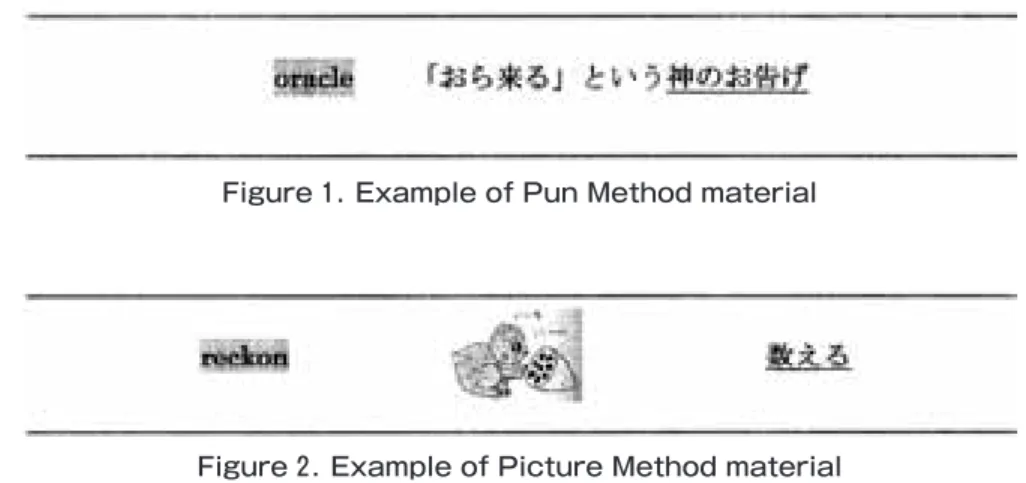
An example of the Pun learning materials is shown in Figure 1. In order to learn the English word oracle, the subjects memorize the Japanese sentence,「おら来ると言
う神のお告げ」( ).
The Japanese equivalent of oracle, お告げ ( ), was underlined. The pronuncia- tion of oracle and おら来る ( ) are similar, so acoustic and imagery links can be created between L1 and L2 words. An example of the Picture learning materials is shown in Figure 2. Each target word was accompanied by a related picture(visual imagery) and the Japanese translation equivalent of the target word. The assumption is that learners will use the pictures to help them to learn the vocabulary.
In a pilot study, the vocabulary learning experiment consisted of two sessions. The subjects were four senior students in the Department of Languages of the same university as the subjects in the main study. In each session, the subjects were required to memorize 15 words in five minutes using two of the word lists. After each
session, the subjects were asked to write the Japanese translations of the target words on the test sheet. The design was counterbalanced so that Student 1 studied Pun A followed by Picture B, Student 2 Picture A followed by Pun B, Student 3 Pun B followed by Picture A and Picture B followed by Pun A.
Figure 1. Example of Pun Method material
Figure 2. Example of Picture Method material
Based on the results of the pilot study, three small changes were made to the vocabulary learning test. First, words that subjects reported already knowing were replaced with more difficult words. Second, the number of learning sessions, the time limit and the number of the target words which the subjects were required to memorize were changed. In the pilot study, the subjects were asked to memorize 15 target words in five minutes. However, they were able to memorize most of the target words, indicating that learning 15 words in five minutes might not be too challenging and might produce a ceiling effect. In order to avoid this problem, the third change was to combine the two learning sessions, one for each learning method, by merging the learning materials. The final change was to reduce the total study time to five minutes, which meant that the subjects were required to memorize 30 words in five minutes.
The study was carried out in three English regular classes. The students were randomly assigned to one of four groups. There were 19 students in Group 1, 20 in Group 2, 19 in Group 3, and 19 in Group 4. Each group studied a different version of the
learning materials. The subjects studied their word list for five minutes and then attempted to write down the Japanese translations of the English words studied.
Data Analysis
Descriptive statistics were calculated. An ANOVA was performed on the subject data and an ANCOVA of the word difficulty data. The ANCOVA used the length of the word in letters as a covariate in order to control for the effects of word length, which was shown by Willis and Ohashi (2012) to be related to the difficulty of learning and retaining words over time.
Results
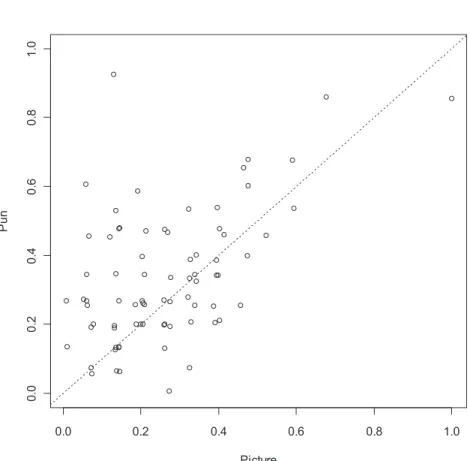
Table 1 shows the descriptive statistics for the subjects and Table 2 the results of a repeated measures ANOVA. The subjects learned 33.8% of the target words when they used the Pun Method and 26.2% when they used the Picture method. The ANOVA shows that this difference is statistically significant. In other words, the Pun Method is clearly superior overall. In addition, there is also a moderate, but statistically significant, correlation between the subjects performance learning with puns and pictures (r = 0.510, df = 75, p = .000), indicating that some learners are simply better at memorization than others, irrespective of learning method.
There is also evidence that some learners may learn better with the Picture Method. Figure 3 shows a scatter plot of Pun Method vs Picture Method data on the recall tests by subject, i.e. each point represents a subject. Points above the diagonal represent subjects who did better with the Pun Method, and points below it subjects who learned more with the Picture Method. Consistent with the ANOVA results, there are more points above the diagonal, but a minority of learners (below the diagonal) go against this general trend.
Table 1. Descriptive statistics for memorisation type by subject (n=77)
Type mean sd
picture 0.262 0.172
pun 0.338 0.193
Table 2. Repeated measures ANOVA on subjects (n=77)
Df Sum Sq Mean Sq F value Pr(> F)
Type 1 0.218 0.218 13.183 0.001
Residuals 76 1.259 0.017
0.00.20.40.60.81.0
Pun
0.0 0.2 0.4
Picture
0.6 0.8 1.0
Figure 3. Plot of proportion of words that subjects learned with puns vs pictures (n=77)
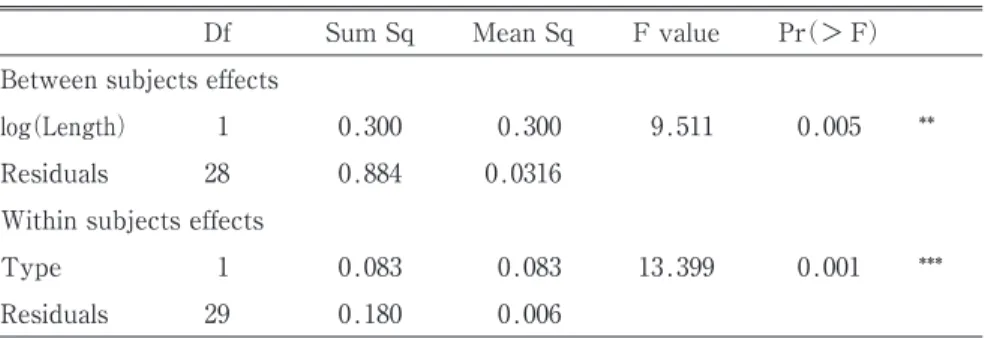
Table 3 shows the descriptive statistics for the word and Table 4 the results of a repeated measures ANCOVA. When learned with the Pun Method, 33.7% of the words, compared with 26.3% when learned with the Picture Method. The ANCOVA showed that this difference was statistically different. It also showed, supporting the findings of Willis & Ohashi (2012) , that longer words are more difficult to learn, irrespective of learning method.
Table 3. Descriptive statistics for memorisation type by word (n=30)
Type mean sd
picture 0.263 0.161
pun 0.337 0.146
Table 4. Repeated measures ANCOVA on words with Length as a covariate (n=30)
Df Sum Sq Mean Sq F value Pr(> F)
Between subjects effects
log(Length) 1 0.300 0.300 9.511 0.005 **
Residuals 28 0.884 0.0316
Within subjects effects
Type 1 0.083 0.083 13.399 0.001 ***
Residuals 29 0.180 0.006
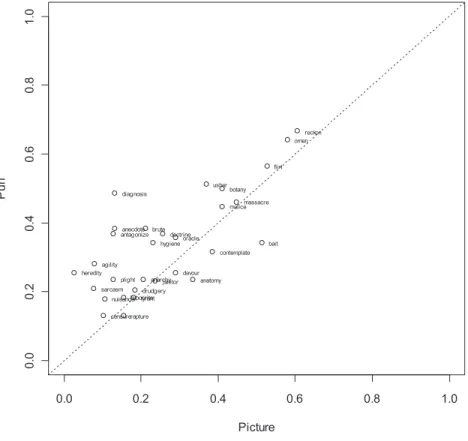
There is also evidence that some words might be more easily learnt with the Picture Method, most noticeably . Figure 4 shows a plot of the item facility using the two memorization techniques. Each point represents one of the target words. The value on they‑axis represents the item facility of the words learned using the Pun Method, and the value on the x‑axis the item facility of the words learned using the Picture Method. Points above the diagonal are target words which were learned better using the Pun Method, and points below the diagonal are target words learned better with the Picture Method.
0.0 0.2 0.4 0.6 0.8 1.0
0.00.20.40.60.81.0
Picture
Pun
diagnosis
contemplate
tyrant agility
antagonize
hypocrite
massacre
rapture drudgery
botany flirt
anecdote
malice
omen
doctrine
reckon
usher
sarcasm brute
hygiene
censure nuisance
plight anarchyjanitor oracle
devour
bait
heredity
anatomy
Figure 4. Plot of item facilities of words learned with puns vs pictures (n=30)
Discussion
In this study, I compared the effects of the Pun (keyword) Method and the Picture (visual imagery) Method on immediate retention of the English vocabulary. The results showed that both the Pun Method and the Picture Method were both effective for vocabulary learning, but overall the subjects learned more target words using the Pun Method than the Picture Method. That means the Pun Method is superior to the Picture Method. The study also showed that word length was a factor in vocabulary memorization difficulty, with longer words being more difficult to memorize than shorter ones.
However, while the Pun Method is clearly superior to the Picture Method overall, some learners did not perform in the same way as the others, and did better with the Picture Method. There was also clear evidence that learners who are good at learning with the Pun Method also tend to be good at learning vocabulary with the Picture Method and those who are not so good with it are also not so good with the Picture Method. In other words some learners are simply better than others at memorizing vocabulary.
A closer analysis of error patterns revealed a possible problem with the Pun Method. It seemed that some subjects confused the target word and the pun. For example, some learners learning the word using the Pun Method:「お面にニキビ
の兆し」 ( ) as a pun. The
Japanese meaning of omen is 兆 し ( ), but some subjects confused ニ キ ビ (pimples) with 兆し(omen) and answered ニキビ(pimples) on the test. In order to avoid this problem, it would be helpful if puns which have less possibility of misunderstanding could be made.
Also, it is likely that there are a lot of words that are difficult to make good puns for. The Pun Method needs acoustic and imagery links between the foreign word and its Ll translation, but it is sometimes difficult to make their links with puns, and there may be some words that are not suitable for the Pun Method. In this research, words which were easy to make puns for were selected as target words and the quality of the puns generally seem to be good, but it is important to take into account the possibility that there are some words which are not suitable for the Pun Method.
Conclusions
I should now mention the limitations of this study and make some suggestions for further research. Firstly, all the subjects of this study were freshman students in the Department of Mathematics at TWCU, and their L2 proficiency was relatively low.
Therefore, the results demonstrated that the Pun Method is superior for elementary‑
level L2 learners, but if the subjects were advanced L2 learners, the results might be different. However, in spite of the relatively low level of the learners, there were no safeguards against some of the words being known to some of the subjects before the
study. Indeed, it is possible that some were. Future research would benefit from more care in this regards. Secondly, the subjects were asked to use two learning methods in the same session. If they had been asked to use only one method in a session, the results might have been different. It might be useful to carry out research with the subjects learning in two sessions: one for the Pun Method and the other for the Picture Method.
Future research should also investigate the long term retention of vocabulary with the Pun Method and the Picture Method. This study focused on short term retention and showed that the Pun Method is superior to the Picture Method in short term retention. In addition, future research should ask learners to generate their own puns.
This may be a challenging task but it may help learners retain more words than using ready prepared material.
References
Atkinson, R. C. (1975). Mnemotechnics in second‑language learning.
, 821‑828.
Avila, E. & Sadoski, M. (1996). Exploring new application ofthe keyword method to acquire English vocabulary. , 379‑395.
Beaton, A., Gruneberg, M. & Ellis, N. (1995). Retention of foreign vocabulary learned using the keyword method: a ten‑year follow‑up. , 112‑120.
Fujii, H. (2007). (3th ed.). Tokyo: Ecole Sesame.
Oxford, R. & Crookall, D. (1990). Vocabulary learning: a critical analysis of techniques.
. 9‑30.
Plass, J.L., Chun, D.M., Mayer, R.E., & Leutner, D. (1998) . Supporting visual and verbal learning preferences in a Second‑language multimedia learning environment.
, 25‑36.
Pressley, M., Levin, J. R., Hall, J. W., Miller, G.E., & Berry, J.K (1980). The keyword method and foreign word acquisition. . 163‑173.
R Development Core Team (2011). R: A language and environment for statistical computing.
[Computer Software] Vienna: R Foundation for Statistical Computing. URL http:
//www.R‑project.org/.
Sagarra, Nuria. & Alba, Matthew. (2006). The key is in the keyword: L2 vocabulary learning methods with beginning learners of Spanish. , 228‑243.
Willis, M. and Ohashi, Y. (2012) . A Model of L2 Vocabulary Learning and Retention.
. 40, 125‑137.
要 旨
第二言語を学ぶ上で、語彙習得は最も重要な要素の一つで、ある。第二言語の語彙の知識は、
文法の知識より重要であると言っても過言ではない。しかしながら、学習者の中には語彙習得 にあまり興味を示さない者もいる。そのような学習者が楽しんで取り組める、興味深く且つ効 果的な語彙習得法がないものかと考えた。
この論文では、ダジャレを用いた語彙の学習法(パンメソッド)と、絵を用いた語彙の学習法(ピ クチャーメソッド)の効果について調査した。調査では、単語学習プリントを使用し、単語テス トを行った。
この結果、パンメソッドとピクチャーメソッドの両方が、語彙習得に効果的であるということ が明らかになった。しかし、被験者は概してパンメソッドでより多くの目標語彙を習得したた め、パンメソッドはピクチャーメソッドよりも優れた学習法であると言える。
また、パンメソッドを用いて学習することが得意な学習者は、ピクチャーメソッドを用いて学 習することも得意な傾向にあることが明らかになった。同様に、パンメソッドが不得意な学習 者は、ピクチャーメソッドも不得意な傾向にあった。このことから、学習者の中には、学習法に 関わらず単に語彙学習が得意な者もいたと言える。
これら つ以外にも優れた学習法はたくさんある。学習者の好みや単語の特徴に合った学習
法を選ぶことが重要である。