The Split Intransitivity Hierarchy in Second
Language Acquisition of English:An
Experimental Investigation
著者
ゴ レイレイ
号
27
学位授与機関
Tohoku University
Doctoral Dissertation Abstract
The Split Intransitivity Hierarchy in Second
Language Acquisition of English:
An Experimental Investigation
(第二言語としての英語習得における自動
詞階層--実証研究--)
Tohoku University
Graduate School of International Cultural Studies
International Graduate Program in Language Sciences
Wu Lili
Supervisor: Professor Naoyuki Ono
Sub-supervisor: Professor Daiko Takahashi
Chapter 1 Introduction
It is widely assumed that native language (L1) acquisition is constrained by built-in universal linguistic principles, known as Universal Grammar (UG) (Chomsky, 1981; Pinker, 1984, 1994; White, 2003). While it is assumed that UG constrains children’s L1 acquisition so that children tend to acquire their L1 with relative ease and rapidity, it is hotly debated whether there is still an access to UG in non-native language (L2) acquisition (Rothman & Slabakova, 2018; White, 2003). More specifically, the question of whether UG constrains non-native grammars, also referred to as interlanguage grammars, has been investigated and much debated since the early 1980s (White, 1989). Some claim that interlanguage grammars are wild (Goodluck, 1991; Klein, 1995), while other argue that interlanguage grammars are “restricted properties found in the L1 and/or the L2, and/or natural languages in general” (White, 2003, p. 43).
The present study looks at the nature of interlanguage grammars by investigating L2 acquisition of intransitive verbs. According to the Unaccusative Hypothesis (Perlmutter, 1978), intransitive verbs can be further classified into unaccusatives (UAs) and unergatives (UEs) based on their different syntactic and semantic properties. The UA-UE distinction is also referred to as split intransitivity. Syntactically, the single argument of UAs is an internal argument base-generated in the complement position, like the object of transitive verbs, while the single argument of UEs is an external argument base-generated in the specifier position, like the subject of transitive verbs. Semantically, intransitive verbs are organized in the Split Intransitivity Hierarchy (SIH), defined primarily by aspectual notions (telicity/atelicity), and secondarily by the degree of agentivity (Sorace, 2000, 2004, 2011). Telicity is a primary feature of UAs, with verbs denoting telic change at the core of unaccusativity, while agentivity is a fundamental feature of UEs, with verbs denoting ‘agentive atelic non motional activity’ at the core of unergativity.
Although the UA-UE distinction is universal, different languages tend to encode the distinction in language-specific diagnostics. Previous studies have demonstrated that L2 learners of Italian and French, when asked to judge the acceptability of auxiliary selection, are not only sensitive to the UA-UE distinction, but also to the core-peripheral distinction represented by the SIH (Sorace, 1993a, 1993b, 1995, 1996). Compared with Romance and
other Germanic languages with auxiliary selection, English is a language without auxiliary selection but presents many other syntactic diagnostics for split intransitivity. Although Baker (2018) suggests that the SIH is also plausible to capture the gradience of English split intransitivity, there is a lack of studies to investigate if it is possible for Mandarin learners, whose L1 does not have an overt morphological marker for the UA-UE distinction, to acquire the subtle properties of the core-peripheral distinction at the lexicon-syntax interface. Furthermore, previous studies also find that L2 learners of English regardless of L1 backgrounds have problems with UAs and tend to overgeneralize the passive morphology to UAs to indicate the syntactic movement from the underlying object position to the subject position (Balcom, 1997; Oshita, 2001). However, it remains controversial if the overpassivization tendency of intransitive verbs is subject to the prediction by the SIH (Hirakawa, 2006; Yusa, 2003).
The present study aims to address to what extent the core-peripheral distinction for split intransitivity is cross-linguistically consistent and to what degree direct access to an aspectual and thematic hierarchy at the syntax-lexicon interface is possible. Besides, the present study examines if the overpassivization tendency of intransitive verbs is subject to the prediction by the SIH. Finally, this study also investigates the nature of interlanguage grammars.
With regarding to the research gaps and in light of the research purposes, two general research questions are put forward:
1. Do Mandarin-speaking L2 learners of English rely on semantic evidence in acquiring the syntax of split intransitivity?
2. Do telicity and animacy play a role in influencing Mandarin-speaking L2 learners’ tendency to overpassivize intransitive verbs?
To answer the two questions, I first review the theoretical approaches to split intransitivity, and then introduce two syntactic diagnostics tested in the present study, and summarize previous L2 acquisition studies on split intransitivity in Chapter 2. Chapter 3 deals with the first research question and presents the methodology and results of the experiment aiming to examine if L2 acquisition of the two diagnostics is lexically constrained by the SIH. Chapter 4 explores the second research question, describes the methodology and the results of experiment aiming to investigate the role of the SIH in the overpassivization tendency of
intransitive verbs. Chapter 6 concludes the whole dissertation.
Chapter 2 Review of Related Literature
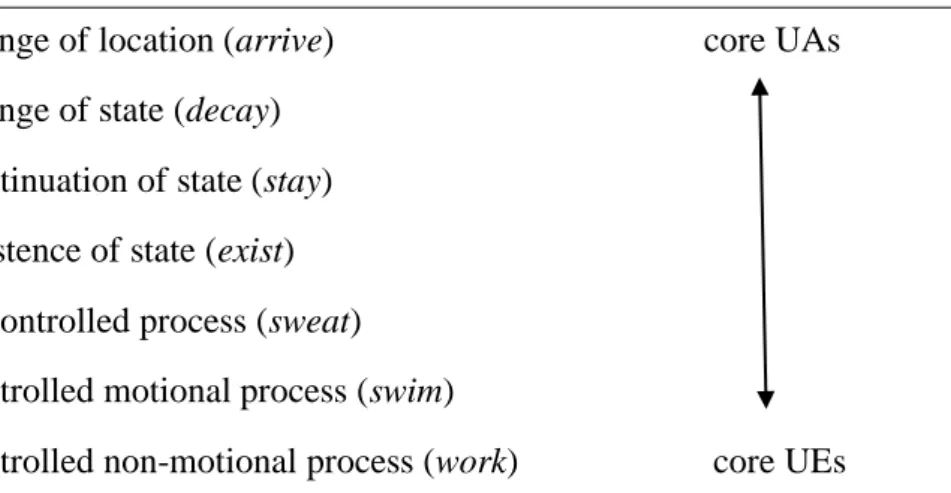
Split intransitivity is syntactically encoded and semantically determined. However, the existence of “unaccusative mismatches”, which means “cases in which there seems to be an imperfect match between the verbs expected to be selected on semantic or syntactic grounds as UAs or UEs by various diagnostics and the verbs actually selected by those diagnostics” (Levin & Rappaport Hovav, 1995, p. 4), indicates that it is difficult to fit many verbs unambiguously into one class or the other. Similar mismatches can also be found in auxiliary-selection languages where BE is prototypically associated with UAs and HAVE with UEs in perfective aspect and complex past tense. To capture the systematic differences in auxiliary selection, both cross-linguistically and language-internally, Sorace (2000) proposes an Auxiliary Selection Hierarchy (ASH) for monadic verbs to select the auxiliaries BE or HAVE. The ASH ranks verbs based on telicity and agentivity, which can distinguish core verbs from more peripheral ones. Core UAs at one end of the hierarchy are most consistent in selecting BE and core UEs at the other end are most consistent in selecting HAVE. Intermediate verbs are those in the middle that may be associated with either or both depending on the language. As the ASH is found in languages with or without auxiliary-selection, Sorace (2004, 2011) argues that the ASH should be reclassified into the SIH because this model of gradience tends to be cross-linguistically universal as illustrated in Figure 1(adapted from Sorace, 2011, p. 69).
Figure 1. The Split Intransitivity Hierarchy (SIH)
change of location (arrive) core UAs change of state (decay)
continuation of state (stay) existence of state (exist) uncontrolled process (sweat) controlled motional process (swim)
controlled non-motional process (work) core UEs
encoding the distinction syntactically. Therefore, intransitive verbs can be identified as either UAs or UEs through language-specific diagnostics of split intransitivity. In English, Prenominal Past Participles (PPPs) and the for hours constructions are claimed to be the syntactic diagnostics of split intransitivity (Alexiadou et al., 2004; Schoorlemmer, 2004). The availability of PPPs and the for hours constructions as indicators of the SIH holds in English, but not in Mandarin. Specifically, core UAs are mostly compatible with PPPs, but not with the
for hours constructions in English, whereas in Mandarin, the UA-UE distinction does not
manifest in either the V-DE construction or with durative time adverbials, as both UAs and UEs are possible with these two constructions.
Previous studies on typologically different languages have provided much evidence for the core-peripheral distinction (Bard et al, 2010; Sorace & Shomura, 2001; Vernice & Sorace, 2018). In other words, native speakers as well as L2 learners are conditioned by the SIH in acquiring auxiliary selection or other syntactic diagnostics of split intransitivity. However, there is a lack of studies to investigate if it is possible for Mandarin learners, whose L1 does not have an overt morphological marker for the UA-UE distinction, to acquire the subtle properties of the core-peripheral distinction at the lexicon-syntax interface in English.
Previous studies also found that there are many factors influencing L2 learners’ tendency to overpassivize intransitive verbs, including syntactic (The Postverbal NP Movement Hypothesis and the Transitivization Hypothesis), semantic (animacy, telicity), and discourse factors (causation types). They find that L2 learners treat UAs as passives (Balcom, 1997), and tend to passivize UAs in externally caused events more frequently than UAs in internally caused events (Chung, 2014; Ju, 2002). They also indicate that UAs with inanimate subjects are more likely to be passivized than UAs with animate subjects. Nevertheless, they differ as to whether the overpassivization tendency of intransitive verbs is subject to the prediction by the SIH. Yusa (2003) claims that Japanese L2 learners’ sensitivity to the ungrammaticality of passive UAs and UEs conform to the SIH, and they incorrectly accept BE for core UAs more often than atelic UAs and UEs. Hirakawa (2006), on the contrary, argues that the results obtained in her experiment appear to be inconsistent with the SIH. The reason lying behind the conflicting results might be due to the task designs, both of which did not manipulate causation types and animacy types, and learners in their studies were not matched at the
proficiency level. Therefore, it is necessary to investigate the role of the SIH in predicting the overpassivization tendency of intransitive verbs with these variables strictly controlled.
Chapter 3 Acquiring the Core-Peripheral Distinction in English Split Intransitivity
This chapter aims to answer the first research question which addresses to what extent the L2 acquisition of PPPs and the for hours constructions is lexically constrained by the SIH. This question can be further divided into the following three research questions.
1. Are Mandarin-speaking L2 learners of English sensitive to the syntactic UA-UE distinction?
2. Are Mandarin-speaking L2 learners of English sensitive to the semantic core-peripheral distinction?
3. Do core verbs have primacy in L2 acquisition of English split intransitivity compared to peripheral ones?
30 native speakers of English and 85 Mandarin learners of English, all university students at the time, took part in this study. Following Chung (2014), I classified L2 participants into different levels of proficiency by having them take a proficiency test (Quick placement test [QPT], 2001). This resulted in two groups, an upper intermediate level learner group and an advanced level learner group. Following Baker (2018), an acceptability judgment task was used in the study to evaluate sentence acceptability. A 5-point Likert scale was chosen instead of a 3-option approach for the sake of capturing the gradient acceptance of certain verbs in the two diagnostics of split intransitivity.
In order to test whether L2 learners could acquire the syntactic distinction as well as the semantic core-peripheral distinction in the two diagnostics, two experiment templates were created, as listed in Table 1. One more template was added as a control structure for the for
hours construction. The for hours constructions take the form of NP for hours/for minutes/for years V, while the control structure takes the form of NP-V order. The reason to add a control
structure is twofold. Firstly, it was added to make sure that L2 learners’ judgements on the for
hours constructions are not influenced by the (un)acceptability of the sentences themselves.
Also, it was added to examine whether L2 learners of the upper intermediate and advanced level still have problems in acquiring UA verbs in grammatical NP-V order as previous
studies reported (Oshita, 2001).
Table 1 Templates used in the experiment
All the selected intransitive verbs, as shown in Table 2, were evenly divided by intransitive type (16 UAs and 16 UEs) and by the SIH type: half of each type being core verbs, and the other half being non-core. Following Baker (2018), the verbs in the for hours sentences were mainly presented in the past tense, for the inherent telicity of some verbs can be overridden in certain contexts. I checked the frequency with which they were used in the present and past tense with the English Lexicon Project Web Site, to ensure that none were used predominantly in one tense or the other, which could potentially skew the results. An ANOVA test showed that the lexical frequency of the core and peripheral verb classes of each intransitive type was not significantly different; (F (3, 31) = .136, p = .938 and F (3, 31) = 2.028, p = .133, respectively.
Table 2 Intransitive verbs used in the experiment
Core UA verbs arrive, decay, depart, disappear, escape, appear, arise, fall
Peripheral/non-core UA verbs stay, stand, seem, remain, exist, continue, persist, sit
Peripheral/non-core UE verbs spin, run, tremble, dance, walk, swim, jump, slide
Core UE verbs travel, sing, cry, chat, wait, paly, shout, work
The findings obtained in the experiment demonstrate that intermediate and advanced Mandarin learners exhibit sensitivity to the UA-UE distinction in the L2 acquisition of the syntax of split intransitivity, which provides an affirmative answer to the first research question. The mean correct response rates for UAs in PPPs are significantly higher than those for UEs in PPPs. Given that nouns that can be pre-modified by past participles are subjects of UAs or objects of transitive verbs, the results indicate that L2 learners in the present study treat the subjects of UAs as internal arguments, and the subjects of UEs as external arguments. Furthermore, the findings also indicate that Mandarin speakers distinguish UAs and UEs in
Diagnostics Template used in the experiment
Prenominal past participles (PPPs) The PPPs NP VP
The for hours constructions NP V for hours /for days PP
the for hours constructions. Their judgments on UAs and UEs in the construction are significantly different, suggesting that they are sensitive to the aspectual feature of telicity, which is assumed to be the primary feature that distinguishes UAs from UEs.
Secondly, the findings of this study indicate that Mandarin L2 learners display sensitivity to the core-peripheral distinction in a manner similar to native speakers of English. Native speakers, as predicted, show a stronger preference to core UAs in PPPs, while they indicate a less determinate judgment on peripheral UAs but a clear rejection of PPPs with UEs in general. L2 learners are less determinate in their judgments of PPPs with peripheral UAs and UEs in general, but do accept PPPs with core UAs more readily than those with UEs. Further evidence for the core-peripheral distinction can be gained from the results concerning the for
hours constructions. Native speakers tend to reject the for hours constructions with core UAs
because telic verbs are incompatible with time duration adverbials. They accepted peripheral UAs because most of the stative verbs tested in the study are compatible with the for hours constructions. Mandarin L2 learners tend to exhibit the same gradience in their judgments as native speakers do, which correlates with the results of the PPPs.
Finally, the results of this study find that Mandarin learners are conditioned by the SIH in their acquisition of PPPs, starting with core UAs and gradually spreading to the peripheral UAs. They exhibited native-like judgments of PPPs with core UAs, but differed significantly from native speakers in their judgments on peripheral UAs. Core UAs, therefore, have primacy in L2 acquisition of English split intransitivity, as predicted by the SIH. As to the for
hours constructions, native English speakers tested in this study were more willing to accept
UEs and atelic peripheral UAs, as expected. Mandarin learners exhibited a similar pattern in judgments on core and non-core UAs, and no significant difference was found between native speakers and L2 learners in their judgments on the UA subtype. However, though L2 learners have exhibited native level judgments on both core and peripheral UAs, the results of this study also found that peripheral UAs are acquired earlier than the core ones in the for hours constructions, which is contradictory to what the SIH predicts. The unexpected result concerning the for hours constructions might be owing to a lack of negative evidence in L2 input.
Chapter 4 Telicity and Animacy Effects on the Overpassivization Tendency of Intransitive Verbs
Chapter 4 explores the second research question and examines if the overpassivization tendency of intransitive verbs is subject to the prediction by the SIH. The role of telicity and animacy effects on the overpassivization tendency of intransitive verbs has been explored through the following three research questions.
1. Are core telic UAs more likely to be passivized than peripheral atelic UAs? 2. Are core UEs more affected by the animacy of the verb argument than peripheral
UEs?
3. Are core UEs least likely to be passivized among all the verb types?
A total of 90 participants took part in the experiment. As in the first experiment, L2 participants took the QPT and were classified in three groups ranging from lower-intermediate to advanced level learner group. I select the forced-choice task for the experiment to control the causation type of the priming sentence and the animacy of the verbal argument in the target sentence. All the participants were asked to read a pair of sentences comprising a priming sentence setting up the context for the event (internally caused or externally caused), as in (1a), and a target sentence, as in (1b). The target sentence was presented in either active or passive form and the subject of the target sentence is either animate or inanimate. L2 learners were asked to choose the grammatical form for the target sentence.
(1) a. The cage is too big.
b. The rabbit (escaped/was escaped) easily.
A total of 24 verbs were evenly divided by their intransitive type (12 UAs and 12 UEs) and the SIH type: half of those intransitive type verbs were core, and the other half non-core. I also checked the frequency of the selected verbs in the present as well as the past tense, to ensure that none were used predominantly in one tense or the other. The verbs selected in the present study are given in Table 3. In addition, to make sure that every participant knows the correct usage of passive forms, 20 transitive verbs were selected to create 20 test items in which the passive voice was preferred. The distractors served as a pretest to examine L2 learners’ knowledge on passive rules. Only data from those participants with four errors (out of 20 items) or less were included for the final analyses.
Table 3 Intransitive Verbs Used in the Experiment
Core UA verbs arrive, die, vanish, disappear, emerge, appear
Peripheral/non-core UA verbs stay, stand, seem, remain, exist, sit
Peripheral/non-core UE verbs cough, sneeze, tremble, swim, run, sleep
Core UE verbs paly, work, sing, cry, shout, laugh
Following Chung (2014), the results are reported in terms of the correct response rate. Firstly, the results indicate that the overpassivization tendency of core and non-core UAs depends greatly on causation types, animacy types and proficiency. Intermediate learners are more likely to passivize UAs in externally caused events than in internally caused events. They also tend to passivize UAs with inanimate subjects more frequently than UAs with animate subjects. Core UAs are more likely to be passivized than non-core ones only in externally caused events when the subject is inanimate. It is easier to conceptualize an initiator or a causer for core telic UAs than for non-core statives because core UAs encode a high degree of dynamicity than non-core ones. Advanced learners did not passivize core and non-core UAs regardless of causation types and animacy types.
Secondly, the findings demonstrate that the overpassivization tendency of core and peripheral UEs varies with animacy types and proficiency. L2 learners did not have much difficulty with UEs with animate subjects. However, they are prone to passivize UEs with inanimate subjects. Core UEs are affected by animacy types to a greater extent than non-core ones. For intermediate learners, core UEs with animate subjects are less likely to be passivized than non-core ones, while core UEs with inanimate subjects are more likely to be passivized than non-core ones. Advanced learners did not have any problems with UEs with animate subjects, but they still tended to passivize UEs with inanimate subjects more frequently than UEs with animate subjects. Furthermore, animacy types are found to affect UEs to a greater degree than UAs. Advanced learners stop passivizing UAs with inanimate subjects, whereas they are still likely to passivize UEs with inanimate subjects.
Finally, the findings also suggest that core UEs are not always least likely to be passivized among all the verb types. Previous studies predict that L2 learners tend to have problems with UAs but not with UEs. They are not expected to overgeneralize the passive
morphology to UEs because the argument of UEs is originated in the subject position. Peripheral UEs are found to cause problems for L2 learners since peripheral UEs can also be classified as UAs (Hirakawa, 2006). As predicted by the SIH, they might group non-core UEs as UAs so they are likely to passivize non-core UEs. However, the findings also indicate that core UEs with inanimate subjects cause problems to L2 learners. Intermediate learners tend to passivize core UEs more frequently than non-core UEs and UAs when used with inanimate subjects. The results are consistent with the prediction by the SIH, which claims that agentivity is a fundamental feature of UEs. Core UEs denoting agentive events show a stronger preference with animate subjects than less agentive UEs and non-agentive UAs.
Chapter 5 Conclusion
The major findings of the whole dissertation are summarized in this chapter. Relevant issues concerning split intransitivity, the overpassivization tendency of intransitive verbs and L2 acquisition are also discussed. The findings in Chapter 3 confirm that the SIH tends to be cross-linguistically consistent in languages with or without auxiliary selection. Mandarin-speaking L2 learners seems to rely on the semantic evidence in acquiring the syntax of English split intransitivity, and they tend to acquire core verbs first and gradually spread to peripheral ones in PPPs. The experimental results provide further support for the cross-linguistic plausibility of the SIH to split intransitive patterns. The findings in Chapter 4 demonstrate that the overpassivization tendency of intransitive verbs is subject to the prediction by the SIH in that causation types affect the overpassivization tendency of UAs but not UEs, and animacy types affect the overpassivization tendency of UEs to a greater extent than UAs. The findings in the present study provides further evidence for the constraints of UG on interlanguage grammars. That is, the results suggest that the L2 acquisition of split intransitivity is lexically constrained, and that the developmental pattern of the syntax of the split intransitivity is conditioned by the SIH. The present findings present further evidence for direct access to semantic universals when the core-peripheral distinction cannot be accounted for by either L1 transfer or L2 input alone. As the present study is mainly based on Mandarin-speaking learners and only two diagnostics of split intransitivity, future work concerning L2 learners from different L1 backgrounds and more diagnostics is suggested.
別 記 様 式 博在-Ⅶ-2-②-A
論 文 審 査 の 結 果 の 要 旨
学 位 の 種 類 博 士 ( 国 際 文 化 ) 氏 名 Wu Lili
学 位 論 文 の 題 名
The Split Intransitivity Hierarchy in Second Language Acquisition of English: An Experimental Investigation
論 文 審 査 担 当 者 氏 名 ( 主 査 ) 小 野 尚 之 , 高 橋 大 厚 , 中 本 武 志 論 文 審 査 の 結 果 の 要 旨 ( 1,000 字 内 外 ) 本 論 文 は 、 統 語 論 と 意 味 論 の イ ン タ ー フ ェ イ ス に お い て 長 ら く 問 題 に な っ て き た 非 対 格 性 の 仮 説 に つ い て 、 第 2 言語習得の観点から検証を行ったものである。非対格性の仮説と は 、 自 動 詞 が 非 対 格 自 動 詞 と 非 能 格 自 動 詞 の 2 種類に分かれるというもので、表層的には 区 別 の で き な い 自 動 詞 の 構 造 を 言 語 使 用 者 が ど の よ う に 区 別 し 、 ま た そ の そ の 区 別 を ど の よ う に 習 得 す る の か と い う こ と が 問 題 と な っ て い る 。 こ の 研 究 で は 、 こ の 問 題 を 第 2 言語
習 得 の 文 脈 で 取 り 上 げ た 「 分 離 自 動 詞 の 階 層 (Split Intransitivity Hierarchy)」に焦点を
当 て 、 非 対 格 性 の 仮 説 が 第 2 言語習得において効果を持つかどうかを実験によって明らか に し た 。 論 文 は 5 章から成り、第 1 章は、上記の仮説とそれをめぐる議論の紹介、そして検証す べ き 研 究 課 題 を あ げ て い る 。 第 2 章は、特に言語習得との関連で仮説の持つ意味と先行研 究 の 議 論 を ま と め て い る 。 第 3 章は、第 1 の実験について、第 4 章は第 2 の実験について 述 べ て い る 。 第 5 章は、全体のまとめと本研究の意義について述べている。本論文で中心 と な る の は 、 第 3 章と第 4 章であるが、第 3 章では分離自動詞の階層から予測される、中 核 的 動 詞 と 周 辺 的 動 詞 の 区 別 に 言 語 学 習 者 が 反 応 す る か を 調 べ た 。 ま た 、 第 4 章では、受 動 文 の 過 剰 生 成 に 完 了 性 や 有 生 性 と い っ た 意 味 的 要 因 が 影 響 す る か を 調 べ た 。 そ れ ら の 実 験 か ら 、 中 国 語 を 母 語 と す る 英 語 学 習 者 は 、 母 語 か ら は 予 測 で き な い 英 語 の 階 層 性 を 習 得 し て い る こ と を 明 ら か に し た 。 こ の こ と か ら 、 分 離 自 動 詞 の 階 層 性 は 、 母 語 と 同 様 第 2 言 語 に お い て も 効 果 が あ る と 結 論 づ け て い る 。 審 査 委 員 会 で は 、 本 論 文 が 先 行 研 究 に 基 づ い て 適 切 な 研 究 課 題 を 設 定 し 、 英 語 学 習 者 を 対 象 に し た 実 証 実 験 に よ っ て そ の 課 題 を 明 ら か に し て い る 点 を 高 く 評 価 し た 。 先 行 研 究 を 踏 ま え た 分 析 結 果 の 議 論 は 説 得 力 が あ り 、 従 前 の 研 究 で は 十 分 明 ら か に な っ て い な か っ た 点 に 本 論 文 独 自 の 提 案 が な さ れ て い る と 認 め ら れ る 。 一 部 、 語 用 論 的 要 因 と 意 味 的 要 因 を ど の よ う に 切 り 分 け る か と い う 点 に 曖 昧 さ が 残 る こ と が 指 摘 さ れ た が 、 最 終 試 験 で は そ の 点 に つ い て 妥 当 な 答 え が 得 ら れ た と 認 め る 。 以 上 の こ と か ら 、 本 論 文 は 、 執 筆 者 が 自 立 し て 研 究 活 動 を 行 う に 必 要 な 高 度 の 研 究 能 力 と 学 識 を 有 す る こ と を 示 し て い る と 認 め ら れ る の で 、 博 士 ( 国 際 文 化 ) の 学 位 論 文 と し て 合 格 と す る 。