with English Word Tests
著者 Kodama Keita, Shirahata Tomohiko journal or
publication title
教科開発学論集 = Studies in subject development
volume 8
page range 29‑38
year 2020‑03‑31
出版者 愛知教育大学大学院・静岡大学大学院教育学研究科
共同教科開発学専攻
URL http://doi.org/10.14945/00027215
Optimizing Second Language Vocabulary Learning with English Word Tests
Keita KODAMA
1, Tomohiko SHIRAHATA
21Cooperative Doctoral Course in Subject Development in the Graduate School of Education, Aichi University of Education of Education & Shizuoka University
2Academic Institute College of Education, Shizuoka University
ABSTRACT
Some researchers claim that English word tests given by teachers in the classrooms are not an effective way to enhance students’ vocabulary (e.g., Segawa, 2016; Takeda, Ikegashira, & Saito, 2008, among others). However, only a small number of studies have been conducted so far to clarify the effectiveness of the English word test (Barcroft, 2007; Karpicke & Roediger, 2008).
Thus, further research with empirical data is necessary to establish whether word tests are really useless for second language (L2) learners, in particular, for Japanese learners of English (JLEs).
The purpose of this study is to claim that the word test is effective for JLEs to increase their vocabulary. In order to examine the effectiveness, the present study adopted the word repetition method along with spaced learning. The authors conducted an experiment on 30 university JLEs.
Participants in the Experimental Group received a treatment in which they took the same coverage of the same English word test once a week 6 times, whereas the Control Group did not receive any treatment.
The results showed that the Experimental Group improved vocabulary size significantly and still maintained a high-level performance after 10 weeks. That is, the test score of the Experimental Group at the delayed posttest was still higher than that of the pretest. Thus, this study supports the claim that giving a word test repetitively to L2 learners can be a useful learning method to increase and maintain their vocabulary.
Keywords
explicit vocabulary learning, English word test, spaced word learning
1. INTRODUCTION
This study looks to demonstrate the effect of word test on the learning of English as a foreign/second language (L2) in Japan. English word test, so called ‘tango tesuto’ in Japanese, is one of the most popular methods to build L2 learners’ vocabulary size. It is used quite pervasively in L2 classrooms (Mochizuki, Aizawa, & Tono, 2003). Researchers such as Barcroft (2007) and Karpicke & Roediger (2008) insist on the importance of taking a word test in the classroom. They claim that taking a word test itself reinforces memory and enhances vocabulary learning.
On the other hand, there is criticism to the
effectiveness of the L2 word test. According to Segawa (2016), some L2 learners have unfavorable attitudes toward English word tests because they do not think that it is effective for vocabulary development. It is probably because memorizing L2 words with their translation is too simple, mechanical, uninteresting and boring for the learners. Takeda, Ikegashira & Saito (2008) lament by saying that some teachers think that L2 learners just memorize new words immediately before the word test and forget most of them soon after the test.
As for the teaching of new L2 words, Mochizuki, Aizawa & Tono (2003) suggest that it is important to have L2 learners review new
words by duplicating the coverage of word test and by giving the same test repetitively in order to enhance the long-term retention. Sökmen (1997) claims that reencountering of new words is one of the most essential pedagogical issues in explicit teaching of new words for L2 learners:
It is highly unlikely that an L2 students will be able to grasp even one meaning of a word in one encounter…but as the students meet the word through a variety of activities and in different contexts, a more accurate understanding of its meaning and use will develop (p. 154).
Saragi, Nation & Meister (1978) and Rott (1999) mention the difficulty of learning new words. They state that more than 6 encounters for a word is necessary for L2 learners to retain the word. In other words, one of the problems of L2 word learning can be accounted for by the limited number of encounters with a word and any lack of review on the word in the classroom.
It is thus possible to say that giving L2 word tests repetitively to L2 learners can promote effective word learning for them: The learners must study words outside of class time, which means that they can encounter a word over six times.
However, despite the popular use of word tests in English education in Japan, little has been done to examine the effectiveness of the tests with empirical data. Thus, it is necessary to clarify if these word tests are effective for L2 learners, in particular for JLEs. If they are effective, we should claim its valuableness. On the contrary, if it is not effective, we should abandon giving the L2 word test to students.
This study empirically examines whether the word test is useful by using Japanese university students (university JLEs) as participants of the experiment. The data obtained from the experimental group will be compared to those from the control group to see how much of an effect the treatment has on the experimental group.
The organization of this paper is as follows:
Following Introduction, Section 2 reviews the
background of the study. Section 3 describes the details of the experiment. Section 4 presents the results and discussions. Finally, our conclusion is shown in Section 5.
2. BACKGROUND
2.1. Process of L2 Vocabulary Learning
Let us first describe how L2 learners process L2 vocabulary. Hatch & Brown (1995) proposed a model that proceeded L2 vocabulary learning.
They state that there are five essential steps in vocabulary learning: (i) encountering new words, (ii) getting the word form, (iii) getting the word meaning, (iv) consolidating word form and meaning in memory, (v) using the word.
According to Hatch & Brown (1995), for step one, L2 learners have many opportunities to encounter new words through a number of sources such as from reading and listening materials as well as from input by teachers. The learners may go through this step either incidentally or intentionally.
In step two, learners recognize forms and get an initial image of the new words both from morphological and auditory elements. Then, L2 learners make mental effort to understand the meaning of the words. In step three, they may use a dictionary, and ask teachers or peers to confirm their meanings. After that, L2 learners make a strong connection between the form and the meaning of the new word in their memory.
They then, they use the target words in step five.
As Mochizuki, Aizawa & Tono (2003) point out, the fourth step is crucial for storing the new words, suggesting that the L2 word test can be one of the most useful activities to review the new words for retaining and retrieving them from memory in this step. Studies which empirically demonstrate that incorporating a test factor in learning improves memory and leads to retention of vocabulary include those by Barcroft (2007) and Karpicke & Roediger (2008).
The five essential steps in vocabulary learning proposed by Hatch & Brown (1995) encapsulate the general phases of how L2 learners go about learning vocabulary in incremental steps. They conclude that “If learners or teachers can do
anything to move words through any of the steps, the overall result should be more vocabulary learned.” (p. 373). If we follow this statement, it is necessary to take account of the process of helping L2 learners to learn new words through repetitive word instructions and activities in an effective way in the L2 classroom.
2.2. Repetition of Vocabulary
As mentioned in the previous section, the number of encounters with a word is one of the factors that should affect vocabulary learning.
Nation (2013) claims that repetition of word learning is essential although it is difficult to determine a particular number of repetitions for the full acquisition of the vocabulary. Mochizuki, Aizawa & Tono (2003) point out that there is little possibility that a newly learned word may appear several times later in the textbooks.
Therefore, JLEs cannot expect to learn the new words just incidentally through reading textbooks if they do not have explicit word instruction.
Then, what is important is to consider how JLEs should encounter new words repeatedly.
Bloom & Shuell (1981) and Dempster (1987) insist on the effectiveness of ‘spaced repetition’.
The ‘massed repetition,’ on the other hand, refers to spending a certain period of time continuously repeating a word, whereas the spaced repetition means spreading out the repetition intermittently.
It is assumed that in current learning situations reported by Segawa (2016) and Takeda, Ikegashira & Saito (2008) may fall into the former category, cramming new words overnight before the word test without reencountering them with appropriate reviews in the classroom after the test.
Generally, people tend to forget newly learned information soon after the initial learning. The classic case study of Ebbinghaus’
forgetting curve describes the attrition rate of how quickly individuals forget meaningless non-words within a month when there is no attempt to retain it.
This seems true in the case of L2 word acquisition. Kamioka (1982) investigates the memorization and forgetting rate of English
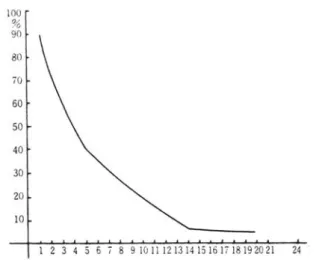
words with Japanese high school students. In this experiment he tested the memorization of the meanings of 10 English words, and measured the attrition rate at the interval of 1-3, 4-7, and 14-20 days. As can be seen in Figure 1, the results showed a steep decrease from the initial stage to the last. The retention rate went down from 90% to 60% after 3 days, 30% after 7 days, 5% after 14 days, and most words were lost after 20 days.
Figure 1. English words retention curve.
Adapted from Kamioka (1982).
With this in mind, the findings from the aforementioned research demonstrate that the spaced repetition results in superior long-term effect, as opposed to the massed repetition. By using JLEs, for example, Nakata (2015) compares the effect of the spaced repetition with that of the massed repetition. The participants were assigned to translate English words into Japanese. The spaced group completed the task which was spaced out every other 6 minutes during 3 sessions whereas the massed group completed the task without leaving any space.
The result shows that the spaced group performed better than the massed group both for the immediate posttest, which was conducted right after the task, and for the one-week delayed posttest: The spaced group obtained scores more than twice as high as those of the massed group.
L2 word learning using the spaced repetition may enable learners to retrieve the words for which they previously learned from L2 learners’
long-term memory, promoting better retention
than the learning by massed repetition.
Compared with the spaced repetition task, the massed repetition task does not involve this retrieval process. Moreover, with spaced repetition, learning with a large group of words seems to provide more spacing between words rather than with a small group of words, which in turn leads to greater retrieval of the new words in an effective way.
In short, first of all, L2 learners need a number of encounters with new words in order to learn the words efficiently. Secondly, repetitive word learning with the spaced task may promote the retention of vocabulary, committing information to long-term memory. However, there are few empirical studies that have investigated the effects, which incorporate these factors in utilizing L2 word test in the classroom.
Taken together, the current study will use the spaced word learning with the repetition method and try to clarify its effectiveness.
3. EXPERIMENT 3.1. Research Assumptions
Our research assumptions are that (a) testing the same words repetitively at a weekly interval can improve the L2 vocabulary learning for university JLEs, and (b) the words learned by the spaced repetition method can be retained at least for a certain period of time, in this case, for ten weeks.
3.2. Participants
The experiment was conducted in Japan with 30 university JLEs between September 14th, 2018 and January 21st, 2019. Participants in this experiment were first-year university students who were all non-English majors enrolled in general English classes. They were regarded as being intermediate-level English learners in terms of the general English language test scores conducted by the university which they attended.
The participants were divided into two groups:
the Experimental Group (n=15) and the Control Group (n=15). The Experimental Group read a textbook written in English and were instructed to prepare and take the English word test during reading lessons, whereas the Control Group did
not read the text or take the English word test.
They received their regular English lessons every week, which did not specifically focus on the learning of new vocabulary.
3.3. Materials and Lesson Procedure
The textbook used in this experiment was
“The Great Gatsby”. It is one of the graded reader series published by Pearson, which is deemed to be CEFR B2 level and includes 2300 headwords. The English word test is a multiple-choice task, asking the participants to choose the most appropriate meaning of a target word from a set of four choices written in Japanese (See Appendix A).
The treatment of this experiment is as follows (See also Table 1). At first, participants were given a list of 110 target words selected from the textbook, “The Great Gatsby”. The participants were then asked to look up the meaning of each word in their dictionary and write down the meaning in Japanese at home as an assigned task.
The teacher announced beforehand that they would have a weekly English word test from the list given. He also explained to them about the coverage of each test for which, a total of 110 target words from the list would be divided into first half (A) and second half (B), consisting of 55 words each.
The English word test used in this experiment were given out to the participants repetitively in the sequence of A-B-B-A-A-B by leaving one week between them for six weeks consecutively. The English word test was carried out at the beginning of each lesson. After the test, peer-scoring took place where each pair took turns to read aloud the sentences with the answers that they had chosen.
The answers were then orally presented by the teacher, providing the appropriate meaning in Japanese and the correct pronunciation of each word for every session. The test papers were collected each time after students had marked their answers. They completed six in-class English word test in total.
3.4. Data Collection
Pretest, immediate posttest and delayed posttest were administered respectively. Each test consisted of 110 English target words. The participants were asked to write down the meaning of an English word in Japanese (See Appendix B). The target words to be instructed were selected from the pilot study conducted in the first semester of the year. One of the authors asked 26 non-English major university students who did not participate in this experiment to complete English words to Japanese equivalents.
The test consisted of 200 English words which were all in “The Great Gatsby.”
Then, words for which 50% or more of the students answered correctly in this pilot test were excluded from the word test. As a result, 110 words were selected as target words for the word test. The procedures of the pretest, the immediate posttest and the delayed posttest are presented in Table 1. On Week 1, the participants took the pretest. The treatment session started from Week 3 and lasted to Week 8: once a week for 6 weeks. Then on Week 9, the participants took the immediate posttest. After ten weeks from the last treatment, that is, on Week 18, they took the delayed posttest.
Table 1
The Procedures of Pretest, Immediate posttest and Delayed posttest.
Week Experimental Group Control Group
1 Pretest Pretest
2 Given a list of 110
target words Regular lessons 3-8 Treatment (English
word test)
Regular lessons 9 Immediate posttest Immediate
posttest
9-18 Regular lessons Regular lessons 18 Delayed posttest Delayed posttest
3.5. Data analysis
All the word test scores obtained from the experiment were analyzed with two-way mixed design analysis of variance (ANOVA), which was conducted on Groups (Experimental and Control) as independent variables and Tests (the pretest, the immediate posttest, and the delayed posttest) as dependent variables. In addition,
Greenhouse-Geisser correction was used for violation of the sphericity assumption.
4. RESULTS AND DISSCUSSION
Let us first discuss the results of the pretest, the immediate posttest and the delayed posttest.
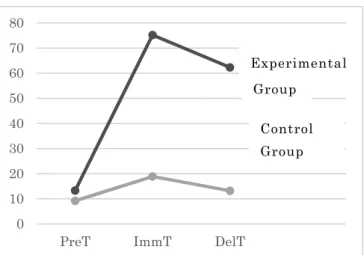
Table 2 and Figure 2 show the results of the experiment. In particular, Table 2 shows the mean scores, percentage of correct answers (%) and standard deviations (SDs) of the three tests for the Experimental Group and the Control Group.
Table 2
Results of the word tests
ExpG (n=15) ContG (n=15) M % SD M % SD PreT 13.3 12.0 7.2 9.2 8.3 9.2 ImmT 75.2 68.3 11.4 18.9 17.1 13.0 DelT 62.3 56.6 15.1 13.2 12.0 8.0 Note. ExpG=Experimental Group, ContG= Control Group; PreT=Pretest, ImmT= Immediate posttest, DelT=Delayed posttest.
Note. PreT= pretest, Immt=immediate posttest, DelT= delayed posttest
Figure 2. Results of the word tests
Results of a two-way ANOVA (Group:
Experimental and Control × Tests: Pretest, Immediate posttest and delayed posttest) indicated that the main effect between Groups was statistically significant (F(1,28) = 124.06, p<.001, MSe = 242.05,
η
p2 = 0.81). The main effects between Tests was statistically significant (F(2.56)=209.74, p<.001, MSe=49.43,η
p2 =0.88). Then the interaction of Tests and 010 20 30 40 50 60 70 80
PreT ImmT DelT
Experimental Group
Control Group
Groups was found to be significant (F(2,56) = 121.43, p<.001, MSe = 49.43,
η
p2= 0.81).The results of the Experimental Group are as follows. The mean score for the pretest was 13.3, that for the immediate posttest was 75.2 and that for delayed posttest was 62.3. Compared with the pretest, the mean score increased by 61.9 points in the immediate posttest. The percentage of the correct answers progressed from 12.0% on the pretest to 68.3% on the immediate posttest while that for the delayed posttest decreased with 56.6% from the immediate posttest with 68.3%.
The simple main effect between (Groups:
Experimental, Control × Test: pretest, immediate posttest, delayed posttest) shows that the differences of the mean scores among the pretest, the immediate posttest and the delayed posttest for the Experimental Group were statistically significant (F (1.47, 20.6) = 275.02, p<.001, MSe = 79.14,
η
p2= 0.95).
Multiple comparison based on Holm’s method indicates that the mean scores of the immediate posttest were significantly higher than the pretest (p<.001), and also the immediate posttest is significantly higher than the delayed posttest. The delayed posttest was significantly higher than that of the pretest (p<.001).
As for the results of the Control Group, the mean score for the pretest was 9.2, that for the immediate posttest was 18.9, and that for the delayed posttest was 13.2 respectively. The mean score increased by 9.7 in the immediate posttest as compared with the pretest. The result of the simple main effect between Groups and Tests shows that the differences of mean scores among the three tests for the Control Group were also statistically significant (F (2,28) = 8.83, p<.01, MSe = 40.64, ηp2 = 0.38).
Multiple comparisons based on Holm’s method indicates that the mean score of the immediate posttest was statistically higher than that of the pretest (p<.001). No difference is observed between the immediate posttest and the delayed posttest (p=0.08). These results indicate that the Control Group also improved, but the gains were quite small in extent when compared with the Experimental Group. We can surmise that the improvement was attributed to repeated
exposure to the test materials, or it was likely that the participants in the Control Group looked up the meaning of the words by themselves after the pretest.
Now let us compare the results of the three tests of the Experimental Group with those of the Control Group. The interaction of Tests and Groups was significant ( F (2, 56) = 121.43, p
< .001, MSe =49.43, ηp2 = 0.81 ). Thus, the simple main effect of Tests (pretest, immediate posttest, and delayed posttest) in each level of Groups (Experimental and Control) and the simple main effect of Groups in each level of Groups have been conducted.
The simple main effect of the pretest between the Experimental and the Control Group was not significant (F (1,28) = 3.07, p=.09 ns, MSe = 41.70, ηp2 = 0,090). These results indicate that the mean scores for the Experimental and the Control Groups show no statistical differences at the pretest.
On the other hand, the simple main effect of the immediate posttest between the Experimental and the Control Group was statistically significant (F (1,28) = 157.18, p<.001, MSe = 151.42, ηp2 = 0.84). This result indicates that the mean score for the Experimental Group is statistically higher with 75.2 than that of the Control Group with 18.9 at the immediate posttest. There is a 56.3 difference between the two groups at the immediate posttest.
Moreover, the simple main effect of the delayed posttest between the Experimental and the Control Groups was statistically significant (F (1,28) = 147.77, p<.001, MSe = 147.77, ηp2 = 0.81). This result indicates that the mean score for the Experimental Group is statistically higher with 62.3 than that of the Control Group with 13.2. There is a 49.1 difference between the two groups at the delayed posttest.
As we predicted, the Experimental Group’s mean scores in the immediate posttest and the delayed posttest showed improvement, and a substantial amount of gains from the pretest with mean scores from 13.3 (pretest) to 75.2 (immediate posttest) and 62.3 (delayed posttest) respectively.
These results indicate that our first research
assumption, that was, testing the same words items repetitively at weekly intervals can improve the vocabulary learning for university JLEs, has been verified. Thus, we have confirmed that the use of English word test consecutively with some interval can be a useful activity to develop learners’ vocabulary.
As for our second research question, that words learned repeatedly with the spaced learning method can be retained at least for a certain period of time, this too has also been supported: The results show that the score of the delayed posttest were statistically higher than that of the pretest. The score of the delayed posttest was statistically lower than that of the immediate posttest.
To summarize, the results indicate that the mean scores for the Experimental Group were statistically higher than those of the Control Group at the immediate posttest and the delayed posttest with a better chance of retention over 10 weeks after the final treatment. Contrary to what some researchers (Segawa, 2016; Takeda, Ikegashira & Saito, 2008, among others) believe, the L2 word test does indeed have an impact on learners’ vocabulary improvement. Here again, our research assumptions have been confirmed in comparison to the Control Group.
Our second research assumption has been verified, in that the results of the delayed posttest still show a high mean score of 62.3 (56.7%), which is more than 50% out of the 110 target words. When we check this percentage against Kamioka’s (1982) retention curve shown in Figure 1, the effect of spaced repetition of learning words seems to have eased the rate of memory decay at least for ten weeks. The findings are similar to the results obtained by Bloom & Shuell (1981) and Dempster (1987).
Overall, the findings suggest that the treatment provided in this experiment had a positive impact on L2 vocabulary learning in an efficient way. In addition, the findings may provide a new way to optimize the L2 vocabulary learning in the classroom by duplicating the coverage of the test and giving the same test repetitively with some interval.
5. CONCLUSIONS
In this study, we examined the effect of utilizing the L2 English word test on university JLEs’ vocabulary improvement and retention. In response to the critical view against the effectiveness of the word test for JLEs, we affirm that repetition of the word test with spaced instruction is a useful teaching method for JLEs to improve their vocabulary size.
Thus, we would like to suggest that giving the same test coverages repetitively at certain intervals can help JLEs gain new words and enhance long-term retention at least for 10 weeks.
We also suggest a new insight into the way to optimize the use of L2 word test in the English language classroom.
It should be noted that as we did not have any other experimental group in this experiment, it may be argued that the effect shown in this experiment was ascribed to the consequences of the way in which we employed the treatment.
Therefore, further research is needed with other experimental groups under similar conditions to compare these results.
REFERECES
Barcroft, J. (2007). Effects of opportunities for word retrieval during second language vocabulary learning. Language Learning, 57, 35-56.
Bloom, K. C., & Shuell, T. J. (1981). Effects of massed and distributed practice on the learning and retention of second language vocabulary. Journal of Educational Research, 74, 4. 245-8.
Dempster, F. N. (1987). Effects of variable encoding and spaced presentation on vocabulary learning. Journal of Educational Psychology, 79, 2, 162-70.
Hatch, E., & Brown. (1995). Vocabulary, Semantics, and Language Learning:
Cambridge: Cambridge University Press.
Kamioka, M. (1982). Eitango ha gakushu sareta ato, donoyouni wasurerarete ikuka [How do learners forget vocabulary after learning?].
The English Teachers’ Magazine. 31, 8.
42-47.
Karpicke, J. D., & Roediger, H. L. (2008). The
critical importance of retrieval for learning.
Science, 319, 966-968.
Mochizuki, M., Aizawa, K., & Tono, Y. (2003).
Eigo goishidou no shidoumanyuaru [Instructional Manual for English Vocabulary]. Tokyo: Taishukan.
Nakata, T. (2015). Effects of expanding and equal spacing on second language vocabulary learning: Does gradually increasing spacing increase vocabulary learning? Studies in Second Language Acquisition, 37, 677-711.
Nation, I. P. S. (2013). Learning vocabulary in another language. Cambridge: Cambridge University Press.
Rott, S. (1999). The effect of exposure frequency on intermediate language learners’
incidental vocabulary acquisition and retention through reading. Studies of Second Language Acquisition, 21, 589-619.
Saragi, T., Nation, I. S. P., & Meister, G. F.
(1978). Vocabulary learning and reading.
System, 6, 2, 228-43.
Segawa, N. (2016). Survey on students’
attitude regarding English vocabulary learning. Bulletin of the Kisarazu Technical College, 49, 63-72.
Sökmen, A. J. (1997). Current trends in teaching second language vocabulary. In N.
Schmitt & M. McCarthy (Eds.), Vocabulary, Description, Acquisition and Pedagogy (pp.
237-257). Cambridge: Cambridge University Press.
Takeda, S., Ikegashira, A., & Saito, M. (2008).
A study of remedial education utilizing English word tests. Remedial Educational Study, 3, 2. 68-74.
APPENDIX A: The English word test (A) 太 字 部 分 の 意 味 を 最 も よ く 表 し て い る 選 択 肢 を ①
~ ④ か ら 選 び 丸 を つ け な さ い 。
1. He decided to stay and carry on his father's business.
① 運 ぶ ② 続 け る ③ 実 行 す る ④ 行 う 2. They are supposed to help teachers.
① を 提 案 す る ② の た め に ③ と 思 う
④ す る こ と に な っ て い る
3. She felt restless all day long.
① 安 ら ぐ ② 休 み が な い ③ 落 ち 着 か な い ④ 疲 れ た 4. Chicago is the principal city of the Middle West.
① 中 心 地 ② 西 中 央 ③ 中 西 部 ④ 中 部 西 5.The global bond market, 78 trillion.
① 株 式 ② 絆 ③ 契 約 ④ 事 業 6. I got a temporary contract at the firm.
① 映 画 ② 農 場 ③ 会 社 ④ 工 場 7. I watched helplessly as he was drowning.
① 非 協 力 的 ② 救 い の な い ③ 役 に 立 た な い
④ ど う す る こ と も で き な い
8. We'll go east as the pathfinder said.
① 税 関 局 ② 観 光 協 会 ③ 案 内 係 ④ 先 導 者 9. Right then I felt a sudden burst of joy and
optimism.
① 一 気 に ② 破 裂 す る ③ ゆ っ く り と ④ 知 ら な い 間 に 10. Let's unfold the map on the table and discuss
it.
① 折 り た た む ② 広 げ る ③ 丸 め る ④ 配 る 11. I met him in Tokyo by chance.
① 故 意 に ② 運 よ く ③ 偶 然 ④ 機 会 12. It is not required by any standard but is
available on a few other systems.
① 基 本 的 に ② い か な る 基 準 で も ③ ル ー ル に 従 っ て
④ 約 束 に 従 っ て
13. Tom is a distant relative of mine.
① 遠 距 離 恋 愛 ② 距 離 の あ る 関 係 ③ 婚 約 者
④ 遠 縁 の 親 戚
14. There were holes here and there.
① こ こ と あ そ こ ② こ こ と そ こ ③ あ ち こ ち
④ こ っ ち も あ っ ち も
15. Sat on a dark porch from dusk till dawn.
① 袋 ② 財 布 ③ 玄 関 ④ 長 椅 子 16. She was in a bad temper.
① 悪 い 気 候 ② 悪 天 候 ③ 無 礼 な 態 度 ④ 不 機 嫌 17. His parents approve of the engagement.
① の 向 上 ② 証 明 す る ③ 認 め る ④ 達 成 す る 18. And the warmth of her body and the tears
rolling down her rosy cheeks, and I started to cry.
① 丸 い ② 膨 ら ん だ ③ バ ラ 色 の ④ 真 っ 赤 な
19. The U.S. Government made an attempt to open Japan's doors.
① 試 み た ② 脅 し た ③ 交 渉 し た ④ 説 得 し た 20. The butler told me I should leave my coat
on.
① 競 争 相 手 ② 調 理 師 ③ 判 事 ④ 執 事 21. She looks pale as if she were ill.
① 青 白 い ② 体 調 不 良 ③ 悪 び れ て ④ 赤 面 し て 22. Is using fingers uncivilized?
① 非 民 主 的 ② 国 外 の ③ 野 蛮 な ④ 未 発 達 23. The country's civilization has advanced.
① 民 主 化 ② 市 民 権 ③ 文 化 ④ 文 明
24. Several races live together in America.
① 競 争 ② 組 織 ③ 人 種 ④ 異 文 化 25. Lean forward at the waist.
① 身 を 乗 り 出 す ② 倒 れ る ③ 意 欲 的 に ④ 予 習 す る 26. He knows an insincerity when he hears one.
① 無 礼 ② 不 誠 実 ③ 悪 口 ④ 不 快 27. He was engaged to my niece.
① 婚 約 し た ② 従 事 し た ③ 約 束 し た ④ 努 力 し た 28. He has the intention of doing with much
effort at university.
① 強 調 す る ② 言 及 す る ③ 意 図 が あ る ④ 計 画 す る 29. Stretch out one's hand in front of the eyes.
① 体 を 動 か す ② 伸 ば す ③ 開 く ④ 動 き 回 る 30. I felt my hands tremble.
① 痺 れ る ② ひ ど い 状 態 ③ 震 え る ④ 汗 を か く 31. Please remove the ashes from the stove.
① 埃 ② 油 ③ 燃 料 ④ 灰
32. Looking at the pile of laundry, I sighed.
① 山 ほ ど の ② 無 数 の ③ 巨 大 な ④ 膨 大 な 33. He identified the wreck of the Titanic.
① 一 部 ② 残 骸 ③ 財 宝 ④ 遺 品
34. Thickish Udon is produced in and around that area.
① 味 わ い の あ る ② 変 わ っ た ③ 太 め の ④ 固 い 35. We need to slip out of here before they
notice us.
① 転 が り 出 る ② 飛 び 出 す ③ 追 い 出 さ れ る
④ 抜 け 出 す
36. Her clothes were out of place at a formal party.
① 外 出 向 き ② 部 屋 着 ③ 場 違 い ④ 似 合 っ て い る 37. Don’t interrupt me again.
① 苛 立 た せ る ② 指 図 す る ③ 文 句 を 言 う
④ 邪 魔 を す る
38. I remarked on the beauty of the landscape.
① 述 べ る ② 把 握 す る ③ 注 目 す る ④ 驚 く 39. You might check the Website of the manufacturer or inquire via email.
① 必 要 と す る ② 吸 収 す る ③ 尋 ね る ④ 特 筆 す る 40. The students listened eagerly during his
speech.
① 簡 単 に ② 退 屈 そ う に ③ 熱 心 に ④ 喜 ん で 41. The climate of this town is mild, so the
temperature rises to thirty degrees, even in midsummer.
① 真 夏 ② 梅 雨 ③ 初 夏 ④ 夏 至
42. He was the admiration of his classmates.
① 承 認 ② 称 賛 ③ 統 制 ④ 管 理 43. My throat hurts when I swallow.
① ツ バ メ ② 白 鳥 ③ 許 す ④ 飲 み 込 む
44. She has an extraordinary ability in music.
① 巨 大 な ② 普 通 な ③ 非 凡 な ④ 異 常 な 45. To see the sunrise from a mountaintop is a
delight.
① 喜 び ② 輝 き ③ 詳 細 ④ 暗 い 46. Mary was scornful of Tom.
① 利 口 な ② 親 切 な ③ 横 柄 な ④ 意 地 悪 な 47. His room is untidy.
① 広 い ② 狭 い ③ 整 然 と し た ④ 乱 雑 な 48. Let us examine what occurs in this case.
① 観 察 す る ② 試 験 を す る ③ 試 行 す る ④ 議 論 す る 49. I am Finnish, but I speak also Swedish.
① 終 了 す る ② 完 了 す る ③ フ ィ ン ラ ン ド 人
④ フ ィ ン ラ ン ド 語
50. Tom shouldn't say such rude things to Mary.
① お ろ そ か な ② 失 礼 な ③ 行 儀 の 悪 い ④ 不 適 切 な 51. All of the money in the cupboard was
stolen.
① 金 庫 ② 容 器 ③ 食 卓 ④ 戸 棚 52. Happiness isn't just having many
possessions.
① 株 ② 夢 ③ 所 有 物 ④ 貯 金
53. Please do not talk about that topic at children’s presence.
① プ レ ゼ ン ト ② い る 前 で ③ 存 在 す る こ と
④ 出 席 し て い る
54. I can see the surface of the Sound.
① 音 楽 ② 海 峡 ③ ミ ュ ー ジ カ ル ④ 海 岸 線 55. Despite all his fame, he is not happy.
① 名 声 ② 女 性 ③ 噂 ④ 誇 り
APPENDIX B:
Pretest, immediate posttest, and delayed posttest Translate the following words into Japanese.
1. rude 2. thickish 3. uncivilized 4. nonsense 5. Finnish 6. by chance 7. form the habit of 8. unfold
9. to make an attempt, 10. bond business 11. to put off 12. tremble 13. go ahead 14. to invent 15. helplessly 16. stiffly 17. bootlegger 18. Admiration, 19. worth
20. graveyard 21. to inquire 22. to murder 23. insincerity 24. grave 25. restless
26. scornful 27. annoyance 28. the case is closed 29. to remark 30. to lean forward 31. ashes 32. civilization 33. sort out 34. illegal 35. payments 36. narrow one’s eyes
37. mean look 38. enemy 39. bother 40. purchase 41. calculation: 42. advertise 43. contentedness 44. pretend 45. mistrust 46. hillside 47. arrest 48. circulate 49. terrible 50. breathless 51. meal 52. harmlessly 53. far too much 54. series of 55. rubbish 56. midday 57. persuade 58. deputy 59. authority 60. gaff 61. significant
62. thoroughly 63. alternate 64. be swept off 65. pinned to the ground 66. verdict 67. patiently 68. ridiculous 69. imply 70. unlike
71. further 72. set off 73. unexpected 74. enormous 75. go right through 76. coastguard 77. widow 78. emptiness 79. method 80. concern 81. blame 82. repeat to someone 83. straightforward 84. charged with 85. pull in 86. horn 87. stare out 88. sigh 89. shame on you 90. in measured tone 91. calmly 92. inquire 93. hatred 94. pause 95. juror 96. briefly
97. neat. 98. jury 99. debate 100. occur to 101. admire 102. row 103. buried
104. unfold 105. unwilling 106. waterside 107. avoid 108.thick 109.crack 110. chambers