Acta Med. Nagasaki 36:170-175
Atomic Bomb Radiation and Adult T-cell Leukemia
Michito ICHIMARU 1,2) and Toranosuke ISHIMARU 2)
1) Departmeny of Internal Medicine, Atomic Disease Institute, Nagasaki University
School of Medicine, Nagasaki
2) Department of Epidemiology and Statistics. Radiation Effects Research Foundtion,
Hiroshima
Received for publication, June 6, 1991
ABSTRACT : There has been many atomic bomb survivors in Nagasaki which is also one of the endemic areas of adult T-cell leukemia (ATL). ATL is known as virus (HTLV-I) induced leukemia. Thirty-seven cases of ATL were found among the atomic bomb survivors during the period from 1950 to 1983 by reviewing their blood samples.
Seventeen cases of them were developed from the cohort study samples of Radiation Effect Research Foundation (RERF). The radiation effect for the incidence of ATL was calculated using this cohort samples. Increased risk of ATL among the atomic bomb surviors could not be found in this study.
INTRODUCTION
Nagasaki is a city which has a history of exposure to the atomic bombing as well as a high incidence adult T-cell leukemia. There are still about 70,000 survivors of the Nagasaki atomic bombing. It is well known that the incidence of leukemia has incereased as a result of exposure to the atomic bomb radiation", while ATL is a leukemic disease caused by a virus, HTLV-I (human T-cell lymphotropic virus type I)2'. Moreover, the infection of local residents with the virus does not seem to be a recent phenomnon ; it has been suggested that it was present more 1,000 years ago. According to an epidemiological investigation, 5-10% of the adults of the Nagasaki region are carriers of HTLV-I3'.
It is of grest interest medically to investigate how individuals are affected when two specific carcinogenic factors, that is, exposure to the atomic bombing and infection with HTLV -I, act on an individual. Therefore, we examined patients with ATL selected from atomic bomb
survivors. Our findings did not suggest that the incidence of ATL was significantly higher in
atomic bomb survivor than in controls. Howe- ver, it seems that we are not the only ones who have an interest in the combination of these two carcinogenic factors. We have received inquires
about our investigation several times. For this reason, we decided that it is necessary to report the results of the present study, even though they are negative.
SUBJECTS AND METHOD
The Department of Internal Medicine, Atomic Disease Institute, Nagasaki University School of
Medicine and the Radiation Effects Research Foundation (RERF) have carried out a collabo- rative study on leukemia, leukemic malignant lymphoma and associated diseases occurring in and outside Nagasaki City since around 1950.
The diseases were detected by conducting a
leukemia registration program, confirming diag-
nosis by obtaining blood samples and carrying
out a continuous investigation concerning the
occurrence of these diseases in the atomic bomb
survivors.
In order to identify ATL cases among atomic bomb survivors based on the registry data, one of the aurthors of this report, M. Ichimaru, reexamined blood samples from the register- ed cases. ATL was confirmed by conducting morphogical observation of the leukemia cells and by studying the clinical charts. Since most of the cases were from the past, data concerning anti-HTLV-I antibody was unavailable except for a few recent cases.
In order to analyze the relationship between atomic radiation dose and the incidence of ATL, we examined the 30,761 atomic bomb survivors in the RERF extended life span study cohort for whom dose estimates were available, and we evaluated the results statistically.
The atomic bomb radiation dose estimates eatablised in 1965 (T-65D) were used". Although the radiation dose in Hiroshima and Nagasaki has been reconsidered on an extensive scale in recent years and a new dosimetry system, DS86'', is now in use, the Nagasaki dose es- timates do not differ widely between T-65 and DS86. Therefore, the T-65 doses were used for
convenience in out study.
RESULTS
In the study period ending December, 1983, 37 patients suspected to have ATL were found among the atomic survivors in Nagasaki as a result of the examination of blood samples from all the cases with leukemia and leukemic ma- lignant lymphoma.
1. The relationship between ATL and exposure to the atomic bombing in the 37 ATL cases.
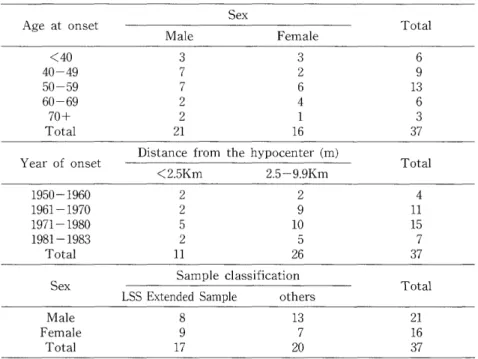
Table 1 shows the distribution of the 37 ATL cases by sex, age, the period of onset by distance from hypocenter and sample classification by sex to determine whether or not these 37 cases belong to the FERF fixed cohort. The ratio of male to female was 3: 2, and 35% of the cases were in their 50 years, cleary reflecting the char- acteristics of age structure of ATL. Looking at the distribution by distance from the hypo- center, 11 cases were proximal survivors (less than 2.5Km), and 26 distal survivors. For both proximal and distal survivors, the number of
Table 1. Distribution of ATL cases in a-bomb survivors in Nagasaki by sex, age, distance and sample classification, as of Dec. 1983
Sex
Age at onset
Male Female Total
<40 3 3 6
40-49 7 2 9
50-59 7 6 13
60-69 2 4 6
70+ 2 1 3
Total 21 16 37
Distance from the hypocenter (m)
Year of onset Total
<2.5Km 2.5-9.9Km
1950-1960 2 2 4
1961-1970 2 9 11
1971-1980 5 10 15
1981-1983 2 5 7
Total 11 26 37
Sample classification
Sex Total
LSS Extended Sample others
Male 8 13 21
Female 9 7 16
Total 17 20 37
LSS : life span study
Table 2. Crude incidence rate of ATL in a-bomb survivors in LSS extended sample in Nagasaki, 1950-1983
T65DR total dose (rad)
Items Total
0 1-49 50-99 100+
Oct. 1950-Dec. 1960
Person years (PY) 149018 109107 14261 27104 299490
Case 0 2 0 2 4
Rate (10-s) 0.0 1.8 0.0 7.4 1.3
Jan. 1961-Dec. 1970
PY 129023 95522 12713 24304 261562
Case 5 2 0 0 7
Rate (10"5) 3.9 2.1 0.0 0.0 2.7
Jan. 1971-Dec. 1983
PY 144764 108009 14327 27766 294866
Case 2 4 0 0 6
Rate (10-') 1.4 3.7 0.0 0.0 2.0
Oct. 1950-Dec. 1983 (total period)
PY 422804 312638 41301 79175 855918
Case 7 8 0 2 17
Rate (10-5) 1.7 2.6 0.0 2.5 2.0
Note : Excluding unknown dose
Table 3. Summary of regression analysis and analysis of dose effect for ATL incidence
in a-bomb survivors in LSS extended
sample in Nagasaki, 1950-1983 1. Relative risk model
As = Aos (1+/31D)
Strata = Sex, 3 age ATB group (0-19, 20-39, 40+) D = 4 dose group (0, 1-49, 50-99, 100+)
Parameter
Name Esitimates S. E.
Dose 6/30 0.3229E-3 0.3057E-2
Test of dose effect : X2 = 0.01 N. S.
[1]
2. Relative risk model with multiplicative risk function (Loglinear model)
A = e#o+f4,Sex+flzlog•ageATB+flaDose
Parameter
Name Estimates S. E.
Constant (fio) -13.26 1.166
Sex (91) 0.3612 0.4880
Log Age ATB (,82) 0.7444 0.3403
Dose 03) 0.4728E-3 0.2778E-2
Test of dose effect : X2 = 0.028 N. S.
[1]
3. Additive model
A = eRo+R,Sex+,Bzlog•ageATB+, 3Dose Parameter
Name Estimates S. E.
Constant (,3) -13.35 1.221
Sex 01) 0.3915 0.4989
Log Age ATB (/32) 0.7636 0.3511
Dose (/33) 0.1600E-7 0.6321E-7
Test of dose effect : X2 = 0.080 N. S.
[1]
ATL cases tends to increase in recent years.
The 17 cases of these 37 cases belongimg to the RERF fixed cohort (LSS extended sample) were used to examine the relationship between atomic bomb radiation exposure and incidence of ATL.
2. Incidence rates of ATL in the fixed cohort.
Table 2 shows the annual crude incidence rates of ATL (per 100,000) by three periods and
by dose. Looking at the rates in the three periods, the number of cases shows a decrease, but the 2 cases with relatively high dose (more than 1Gy) were from the period between 1950
and 1960.
Table 3 shows a summary of the regression
Appendix List of ATL cases in Nagasaki a-bomb survivors until Dec. 1983
M. F. # Sex Onset Distance LSS extended
Age Month -- Year (m) Sample
008-237 F 52 9 '67 5887 -
009-812 M 56 9 '58 1152 Yes
014-489 F 56 4 - '79 2525 Yes
015-885 M 54 8 - '69 3056 -
017-420 F 29 12 - '57 2600 Yes
017-551 M 54 2 '68 4137 Yes
019-286 F 57 1 -- '77 2712 Yes
021-326 F 65 11 - '79 3209 -
029-711 M 51 1 - '61 3591 Yes
030-702 M 56 5 - '76 5027 -
032-402 F 58 6 - '80 2049 Yes
047-441 M 58 3 - '72 2882 -
050-624 M 42 7 - '75 3845 -
056-535 M 76 8 - '68 3186 Yes
066-168 M 63 2 - '82 3651 -
066-560 M 49 11 - '83 3178 Yes
085-466 M 25 8 - '55 2537 Yes
089-804 F 55 6 - '68 1761 Yes
089--834 F 29 7 - '56 1311 Yes
092-313 F 37 4 - '73 2394 Yes
097-494 F 75 11 - '80 3201 -
100-852 F 46 12 - '77 4680 -
102-764 M 57 10 - '68 3812 Yes
106-227 M 69 10 - '65 4699 Yes
137-854 F 65 9 - '67 2817 Yes
165-217 F 69 8 - '74 0682 Yes
623-599 M 41 2 - '76 8502 -
624-773 M 40 11 - '83 2000* -
662-918 F 50 12 - '79 2193 -
733-778 M 31 7 - '62 5152 -
748-969 M 38 5 - '68 4438 -
761-454 F 46 7 - '75 1563 -
774-167 M 47 5 - '80 8492 -
776-735 M 46 7 - '81 2500* -
777-368 M 47 3 - '82 5000*1* -
778-261 F 65 1 - '82 4000* -
780-734 M 70 4 - '81 1500* -
Distance information from Dept. of Hematology Nagasaki Medical School.
M. F. # : Master file number of RERF
analysis of dose effects on three statistic models using all the cases divided into three age groups (0-19, 20-39, 40+) to determine whether or not exposure to the atomic bombing affects the incidence of ATL. According to our results, no significant differences in dose effect were found in any of the three modeles. We concluded that exposure to atomic bomb radiation does not appear to have had an effect on the incidence of ATL.
DISCUSSION
It has been found that the incidence of
leukemia increased in proportion to the radia-
tion dose among atomic bomb survivors in
Hiroshima and Nagasaki. Although it is clear
that exposure to the atomic bombing affected
the incidence, the biological mechanism link-
ing exposure to radiation to the incidence of
leukemia has not been elucidated.
Leukemia occurred in only a very limited number of atomic survivors even when they had been exposed to the same amount of radiation.
This suggests that several factors in addition to the aberration of cells due to the exposure to radiation are involved in the onset of leukemia. Little has been known about these factors. However, the existence of a virus that activates genes has been cited as a possible factor. Nagasaki underwent the explosion of a plutonium atomic bomb and is also a densely infected area of HTLV-I, which is suspected as a cause of ATL. It seemed important to investigate the incidence of cancer when two influential carcinogenic factors, that is, exposure to radiation and infection with a carcinogenic virus, coexist in the same population. From this point of view, we studied the relation between radiation exposure and ATL in atomic bomb survivors. In our study, however, there was no evidence that atomic survivors have a higher incidence of ATL due to the exposure to ra- diation. The following are problems involved in this study.
First, ATL was diagnosed by morphological observation of aberrant cells in blood samples.
Although our diagnosis are not absolutely certain, it seems quite possible to diagnose old cases with rather high reliability considering the characteristics of aberrant cells, because ATL cells show distinct morphological features and anti-HTLV-I antibody was positive in 100% of the ATL cases diagnosed by cell morphology in Nagasaki". Lymphoma-type ATL was not detected in this study because aberrant cells hardly appear in the peripheral blood. In the past it was probably considered to be malignant lymphoma. Considering the fact that there was no evidence of a marked increase of malignant lymphoma among the Nagasaki atomic bomb survivors'', it is unlikely that only this type of ATL increased. The relatively small number of ATL cases found between 1950 and 1960 is possibly due to the fact that we started our leukemia registration program in 1959.
Studies equally as deteiled as our investiga- tion of leukemia seemed to support the conclu- sion that there is no increase of ATL cases in proportion to the amount of radiation dose.
That is, the combined influence of atomic ra-