Analysis of Cooperativity in Metallic Glass Forming Liquids
Masaru Aniya
1, a, and Masahiro Ikeda
2, b1Department of Physics, Graduate School of Science and Technology, Kumamoto University, Kumamoto 860-8555, Japan
2Course of General Education, Natural Science, Applied Physics, Fukui National College of Technology, Geshi-cho, Sabae, Fukui 916-8507, Japan
Keywords: Fragility, Cooperativity, Supercooled Liquids, Bulk Metallic Glasses.
Abstract. The relation between fragility and cooperativity of atomic motion in bulk metallic glass forming liquids is studied based on the bond strength-coordination number fluctuation model. The model describes the temperature dependence of the viscosity in terms of the mean values of the bond strength, coordination number and their fluctuations of the structural units that form the melt.
According to the model, the cooperativity increases with the increase of fragility. The model estimates that the magnitude of the cooperativity N
Bextends approximately from 7 to 60 structural units, depending on the material. The temperature dependence of N
Bfor different metallic glass forming systems reveals that N
Bincreases with the decrease of temperature. The relation between N
Band diffusivity of atoms is discussed briefly.
Introduction
Recently, much attention has been devoted to understand the mechanism of glass transition and structural relaxation in supercooled liquids. By decreasing the temperature of the melt, the glass-formation process takes place, which is accompanied by a drastic increase of the viscosity and structural relaxation time. The process is also accompanied by a growth of the size of the heterogeneity that develops in the supercooled liquid. The temperature dependence of the viscosity or relaxation time can be characterized by using the concept of fragility, which quantifies the degree of deviation from the Arrhenius behavior. Concerning the relation between fragility, cooperativity of atomic motions and heterogeneity, some studies have been done [1-5]. In particular, the correlation length of the heterogeneity and the number of molecules involved on it has been evaluated using different approaches [6-8]. These studies indicate that no consensus exists regarding the relation between fragility and cooperativity. Some studies indicate that the cooperativity increases with the fragility in accord with our intuitive expectation. Others state that no clear correlation exists. These situations indicate the need of further studies from different points of views. Recently, we have started a study directed to elucidate the above relation [9]. The present paper is a continuation of such program.
Multicomponent bulk metallic glasses have unique properties such as extraordinary high strength,
low ductility, high hardness, excellent corrosion resistance and high thermal stability of their
supercooled liquids. To exploit the excellent properties of bulk metallic glasses, a good understanding
on fundamental materials properties is indispensable. For instance, the problem of shear bands
discussed widely in the processing of glassy metallic alloys [10-12] is intimately related with the
subject of the present paper. In the following, the cooperativity and fragility of metallic glass forming
supercooled liquids is investigated by the bond strength-coordination number fluctuation (BSCNF)
model proposed and developed in our group [13-17].
The Bond Strength-Coordination Number Fluctuation Model
The BSCNF model was introduced based on the physical picture that the viscous flow of the melt occurs by breaking or twisting the bonds between the structural units [13]. According to this model, the temperature dependence of the viscosity is described in terms of the mean bond strength E
0, the mean coordination number Z
0, and their fluctuations, ∆E, ∆Z , of the structural units that form the melt.
) 1 2ln(
1 1
) 1 1 ) ( 1 2ln(
ln 1
ln 0 2 2
2
0
Bx Bx
C B B Cx
Cx Tg
−
− −
− −
+ −
+
=
η
η η
η
, (1)
where
2 22 2( ) ) (
Tg
R Z B ∆E ∆
=
,
RTg
Z C=E0 0
and
T T x= g
.
Here, T
gis the glass transition temperature and R is the gas constant. η
0 and ηTgare the values of the viscosities at high temperature limit and at T
g, respectively. The fragility index m is obtained from Eq.
(1) as
) 1 ln(10)(
) 1 2ln(
ln 1 2 )
/ d(
dlog 0
B
B C
B T
m T
Tg
g Tg −
+ −
+
−
=
= η
η
η
. (2)
Applications of the above Eqs. (1) and (2) to various materials have revealed that highly interconnected network glass forming materials or strong systems such as SiO
2are characterized by large value of C and small value of B. On the other hand, fragile systems such as ZrF
4-BaF
2-LaF
3-AlF
3(ZBLA) are characterized by small value of C and large value of B [14]. The values of B and C are obtained by fitting Eq. (1) to the experimental data of viscosity. It should be noted that the expressions of the viscosity and fragility given above are written in terms of the parameters B and C which have clear physical meanings as defined in Eq. (1). Theoretically, it has been shown that the parameters B and C are interrelated as [16].
+ −
+
+
= − ln(1 )
2 ln 1
) 1 ( 2
) 1 ( 2
2 0 B
B
C B Tg
η η γ
γ
γ
, (3)
where
0 0
/ / Z Z
E E
∆
= ∆
γ
.
It is worth to note that in the case where the condition |∆E|/E
0=|∆Z|/Z0is satisfied, that is when the ratio between the fluctuations of energy and coordination number becomes equal, Eq. (1) follows closely the behavior of the Vogel-Fulcher-Tammann (VFT) equation widely used in the literature [16, 17].
A quantity defined as N
B=
Eη/(E
0Z0), where E
ηis the activation energy for viscous flow has been
introduced in the framework of the BSCNF model [14]. This quantity has been interpreted to give the
number of structural units involved in the viscous flow. In other words, this quantity describes the
cooperativity of molecular motions involved in the structural relaxation. In terms of the parameters B
and C, N
Bis written as
C B
B C
B N
Tg
B (1 )
) 1 2ln(
ln 1 2
0
−
+ −
+
−
= η
η
. (4)
By comparing Eq. (2) and Eq. (4), we note that the cooperativity is related with the fragility.
Relation between fragility and cooperativity
Many studies were devoted to understand the relation between fragility and cooperativity [6, 18].
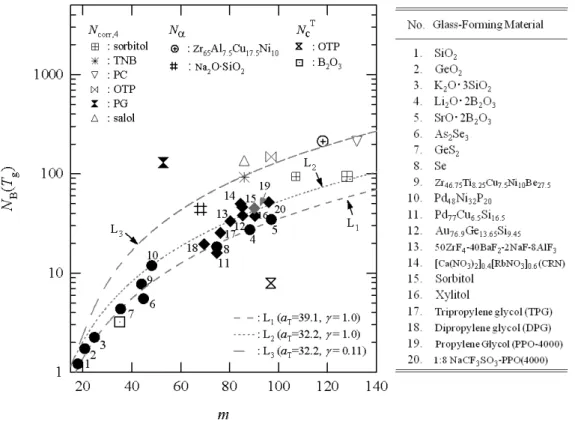
Fig. 1 shows the relation between N
Band m for different materials evaluated based on the BSCNF model. The numbers of correlated units evaluated by other approaches such as those based on the Donth formula, N
α[6], the four-point correlation functions, N
corr,4[7], and the thermodynamic cooperativity discussed by Wang, N
cT[8] are shown for comparison. The lines (L
1-L
3) describe the curves calculated with different values of γ and a
T= ln(η
Tg/η
0). It is noted that a large number of data points follow the line L
1. Fig. 1 indicates that N
Bincreases with m. The values of N
Bextend from few to about 60 structural units, depending on the value of m. It seems that the estimations N
αand N
cTfollow the theoretical trend predicted by the BSCNF model, whereas the estimation N
corr,4follows a different trend. According to the last estimation, the cooperativity does not depend or depends only weakly on m.
Fig. 1. Relation between N
Bat
T=
Tgand the fragility index m. The numbers of correlated units evaluated by other approaches, N
α[6],
Ncorr,4[7], and N
cT[8] are also shown. The lines (L
1-L
3) describe the curves calculated with different values of γ and a
T= ln(η
Tg/η
0).
To the best of our knowledge, information concerning the number of atoms or size of the regions
that move cooperatively in the viscous flow in metallic systems is limited. From this point of view, the
BSCNF model is useful, because, once having the values of B and C, we can estimate easily the values
of m and N
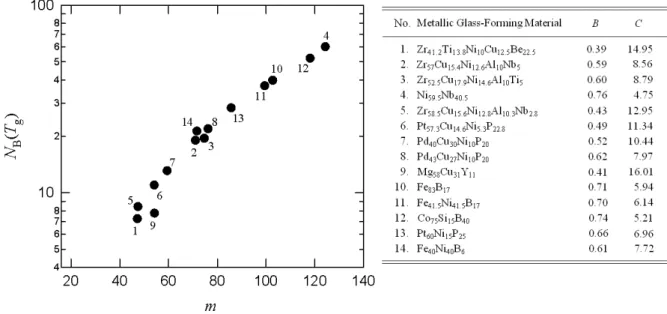
B. An example is shown in Fig. 2.
Fig. 2. Relation between N
Band m at T = T
gin metallic glass forming systems. In the table, the values of B and C for each compound are given. The parameters for the compounds No. 10–14 were obtained from the analysis of relaxation time. Experimental data are taken from [19-22].
Temperature dependence of the cooperativity
The results shown in Fig. 2 were obtained at T = T
g. The temperature evolution of N
Bis a topic of considerable interest, because it reflects the development of interconnection of structural units in the glass formation process. In Fig. 3, the N
B(T) in metallic glass forming systems is shown. The temperature dependence were obtained from N
B(T) =
Eη(Τ)/(E
0Z0), that is, from the temperature dependence of the activation energy of the viscous flow. As expected intuitively, we note that N
B(T) increases with the decrease of temperature. In some systems such as Ni
59.5Nb
40.5, a large change of
NB(T) is discernible.
Fig. 3. Temperature dependence of the cooperativity N
Bin metallic glass forming systems. The
compounds are the same to those given in Fig. 2.
Cooperativity and fractional Stokes-Einstein relation
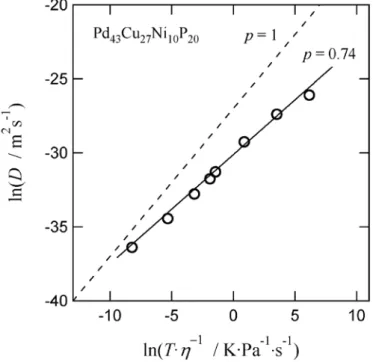
The results shown in the previous section indicate that considerable number of atoms move cooperatively in the structural relaxation process. This observation prompts us to investigate how the diffusion is involved in the collective motion. The subject relates with the Stokes-Einstein (SE) relation. Recent studies have revealed that the SE relation is violated, particularly, in the proximity of the glass transition temperature [23-25]. In these cases, the fractional Stokes-Einstein (FSE) relation given by
T p
D
∝
η