• 検索結果がありません。

Viscosity of Metallic Glass Forming Liquids: Analysis Based on Bond Strength-Coordination Number Fluctuations

N/A
N/A
Protected

Academic year: 2021

シェア "Viscosity of Metallic Glass Forming Liquids: Analysis Based on Bond Strength-Coordination Number Fluctuations "

Copied!
6
0
0

読み込み中.... (全文を見る)

全文

(1)

Viscosity of Metallic Glass Forming Liquids: Analysis Based on Bond Strength-Coordination Number Fluctuations

Masaru Aniya 1, a and Masahiro Ikeda 1,b

1 Department of Physics, Graduate School of Science and Technology, Kumamoto University, Kumamoto 860-8555, Japan

Keywords: Viscosity, Fragility, Metallic Glass Forming Liquids, Bond Strength-Coordination Number Fluctuation Model.

Abstract. A model that describes the viscous behavior in terms of the mean values of the bond strength, the coordination number, and their fluctuations of the structural units that form the melt has been proposed by one of the authors. In the present study, the viscous behavior of several metallic glass forming systems are analyzed by using the model. From the analysis, microscopic information such as the number of bonds that must be broken to observe the viscous flow is obtained. It is also shown that when the magnitudes of energy and coordination number fluctuations are equal, the behavior of the viscosity described by our model corresponds perfectly to the behavior described by the Vogel-Fulcher-Tammann (VFT) equation.

Introduction

In recent years, multicomponent bulk metallic glasses have attracted considerable interest [1-6]. In contrast to traditional amorphous metals, these new alloys have low critical cooling rates and fully amorphous samples with one side dimension as large as 1 cm can be produced by conventional cooling processes. The bulk metallic glasses are characterized by the high thermal stability of their supercooled liquids, which permit the study of thermophysical properties in the supercooled liquid state in addition to the amorphous solids [7-9]. In order to use efficiently the unique properties of bulk metallic glasses such as extraordinary high strength, low ductility, high hardness, excellent corrosion resistance, etc., a good understanding of fundamental materials properties is indispensable. In the present study, the viscous behavior of several metallic glass forming systems are analyzed by using a model for the viscosity proposed by one of the authors [10]. From the analysis, microscopic information such as the number of bonds that must be broken to observe the viscous flow is obtained.

It will be also shown that under certain condition, the behavior of the viscosity described by our model corresponds perfectly to the behavior described by the well known Vogel-Fulcher-Tammann (VFT) equation. Furthermore, the bulk metallic glass forming materials will be characterized by studying the trend in the temperature dependence of the viscosity among oxides, chalcogenides and polymeric glass forming liquids.

Model and Results

The temperature dependence of the viscosity for various glass forming materials is conventionally

characterized by the so-called Angell’s plot [11]. By plotting the logarithm of the viscosity  as a

function of the reduced inverse temperature T g /T , where T g is the glass transition temperature, curves

with different degrees of non-Arrhenius behavior may be systematized. The degree of deviation from

the Arrhenius behavior is called fragility. For highly polymerized network glass formers such as SiO 2 ,

nearly straight lines in ln vs T  g /T plot are observed. These types of materials exhibit small values

of fragility and are called strong systems. On the other hand, for systems with non-directional

interatomic or intermolecular bonds such as ionic or organic liquids, strong deviations from the

Arrhenius behavior are observed. These types of materials exhibit large values of fragility and are

called fragile systems.

(2)

The concept of fragility has been used widely and has played a fundamental role in understanding the relaxation behavior of supercooled liquids. However, the microscopic mechanism responsible for the degree of fragility is still not well understood. Some years ago, one of the authors has derived an expression for the fragility based on a simple model of the melt [10]. According to the model, the fragility is determined by the relaxation of structural units that form the melt and is described in terms of the bond strength, the coordination number and their fluctuations of the structural units.

The glass forming melt is formed by an agglomeration of structural units. As the temperature of the system is lowered, the viscosity of the melt increases and at the glass transition temperature T g , the spatial distribution of the structural units is frozen. In our model, each structural unit is bound to other structural units by a certain bond strength which is denoted as

E E

E0   , (1) where E 0 is the average value and ΔE is its fluctuation. Each structural unit is surrounded by a certain number of other structural units. The coordination number of the structural units is denoted as

Z Z

Z0   , (2) where Z 0 is the average value and ΔZ is its fluctuation. According to the model, the viscous flow occurs when the structural units move from one position to another by breaking the bonds connecting the structural units. Based on this picture, the temperature dependence of the viscosity has been described as

 

2

2 0

2

0

1 2 ln 1 1

) 1 1 1 (

2 ln ln 1

ln Bx

Bx

C B B Cx

Cx Tg

 



 



 

  

 

 

   

 

 

 

 

 

 , (3)

where

2 2

2

2 ( )

) (

T g

R Z

B   E  ,

RT g

Z

CE 0 0 , and T

xT g . (4)

Here, R is the gas constant.  Tg and  0 are the viscosities at the glass transition temperature and at the high temperature limit, respectively. For their values, the usual values  Tg  10 12 Pa·s and

5 0  10

 Pa·s were adopted [11]. Note that the expression of the viscosity given above is written in terms of physically intuitive quantities B, C, and x . C gives the total bond strength of the structural unit and B gives its fluctuation. By using Eq. 3, the fragility index is calculated as

) 1 ( 3 . 2

) 1 2 ln(

ln 1 2 )

/ (

lim Log 0

B

B C

B T T d m d

Tg

T g

T

g

 

 

    

 

 

 

 . (5)

In previous reports [9,10,12,13], there were shown that by choosing appropriately the values of B

and C, the model reproduces quite well the temperature dependence of the viscosity of many kind of

materials that includes oxides, chalcogenides, polymeric and metallic systems. The model provides

also a clear picture to understand the viscous flow. For instance, by using the fitted values of B and C,

(3)

Fig. 1. The behavior of m and N B in the B and C plane. The values of B and C determined for several compounds are also shown. The painted zone indicates the empirical relation found between B and C.

The thick line represents the behavior of Eq. (7).

information on the number of bonds that must be broken to observe the viscous flow has been extracted [9]. It is written as

C B

B C

B N

Tg

B ( 1 )

) 1 2 ln(

ln 1 2

0

 

 

   

 

 

 

. (6)

The behavior of N B is shown in Fig. 1 together with the behavior of the fragility index m. The painted zone indicates the empirical correlation found between B and C [9]. The values of B and C obtained for some materials are also shown. We can recognize that bulk metallic glass forming liquids considered here have intermediate values of fragility index that extend from about 30 to 55 and that the values of N B extend from about 3 to 20 structural units. It should be noted that N B

increases with the increase of m. This behavior indicates that large numbers of structural units are involved in the viscous flow of a fragile system. This observation is in harmony with the concept of Cooperatively Rearranging Region in the theory of Adam and Gibbs [14]. Concerning the relationship between B and C, a theoretical expression has been derived from the model [12,13]. It is written as

 

 

    

 

  ln( 1 )

2 ln 1

) 1 ( 2

) 1 ( 2

2 0 B

B

C B Tg

 ,

0 0

/ /

Z Z

E E

 

 . (7)

The behavior of this expression for the case of   1 is shown in Fig. 1 by a thick line. Eq. (7) is of

particular interest because, it reproduces exactly the behavior of the viscosity described by the well

known Vogel-Fulcher-Tammann (VFT) equation [12,15]. Examples of such correspondences are

illustrated in Fig. 2, where the temperature dependences of the viscosity and relaxation time

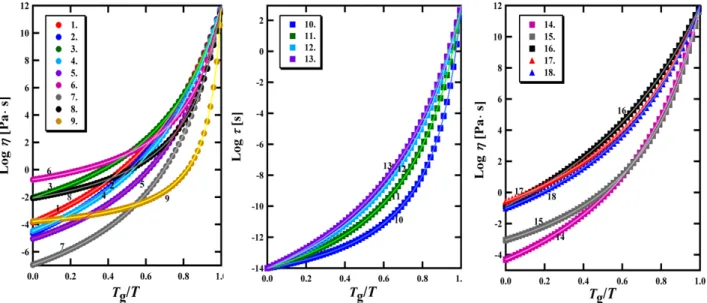
calculated by the two models are compared. The numbers in the figure indicate the systems that are

given in Table 1. The symbols in the table are the usual quantities used in the VFT equation,

(4)

0

ln 0

ln T T

B VFT

 

 

 , (8)

where B VFT and T 0 are the two VFT parameters which are usually used as fitting parameters and  0 is the viscosity at the high temperature limit. The perfect correspondence between our model and the VFT equation has been also confirmed for the case of oxide glass forming liquids [12].

Fig. 2. Normalized temperature dependence of the viscosity and relaxation time in some bulk metallic glass forming systems calculated by the Bond Strength-Coordination Number Fluctuation Model (full lines) and by the VFT equation (symbols). The relaxation time is calculated by    / G , where G is the shear modulus at high frequency. The numbers indicate the systems given in Table 1.

Table 1. VFT parameters B VFT , T 0 , glass transition temperature T g , fragility index m and the parameters of our model B and C, for some metallic glass forming systems. Materials data are taken from [16-18].

From Table 1, we note that the values of ln(  Tg /  0 ) are not constant. This is in contrast with the usual representation of the temperature dependence of the viscosity in the Angell’s plot, where it is fixed at ln(  Tg /  0 )  39 . 1 [11]. Due to this difference, not all the systems tabulated in Table 1

7848 381 596 44.0 36.51 (0.409, 13.1) 5827 259 411 45.0 38.34 (0.372, 14.1) 5333 401 566 48.2 32.32 (0.503, 9.3) 7705 412 615 49.9 37.96 (0.449, 12.4) 4828 340 463 64.2 39.25 (0.540, 10.3) 3137 506 613 73.0 29.32 (0.683, 5.0) 6852 463 620 74.9 43.64 (0.559, 10.9) 1523 238 285 85.4 32.41 (0.699, 5.2) 1345 498 535 228.2 36.34 (0.868 2.4) 4861 784 908 124.1 39.10 (0.748, 5.2) 7370 670 858 77.3 39.10 (0.611, 8.4) 9692 591 839 57.5 39.10 (0.496, 11.5) 11039 581 863 51.9 39.10 (0.454, 12.7) 7059 390 578 50.1 37.55 (0.456, 12.1) 6000 500 673 58.6 34.68 (0.553, 8.8) 6657 241 466 26.7 29.65 (0.268, 14.2) 5027 286 459 33.3 28.97 (0.387, 10.9) 5517 307 491 34.7 29.98 (0.391, 11.2) No. Material B VFT [K] T 0 [K] T g [K] m ln(η T g /η T

0

) (B, C)

Zr

46.75

Ti

8.25

Cu

7.5

Ni

10

Be

27.5

Mg

65

Cu

25

Y

10

Pd

48

Ni

32

P

20

Zr

41.2

Ti

13.8

Cu

12.5

Ni

10

Be

22.5

Pt

60

Ni

15

P

25

Pd

77.5

Cu

6

Si

16.5

Pd

77

Cu

6.5

Si

16.5

Au

76.9

Ge

13.65

Si

9.45

Al

85

Ni

8

Ce

7

Ni

65

Nb

35

Ni

60

Nb

35

Sn

5

Ni

57

Fe

3

Nb

35

Sn

5

Ni

60

(Nb

40

Ta

60

)

34

Sn

6

Pd

40

Ni

40

P

20

Cu

47

Ti

34

Zr

11

Ni

8

La

55

Al

25

Ni

5

Cu

10

Co

5

La

55

Al

25

Ni

5

Cu

15

La

55

Al

25

Ni

20

1.

2.

3.

4.

5.

6.

7.

8.

9.

10.

11.

12.

13.

14.

15.

16.

17.

18.

(5)

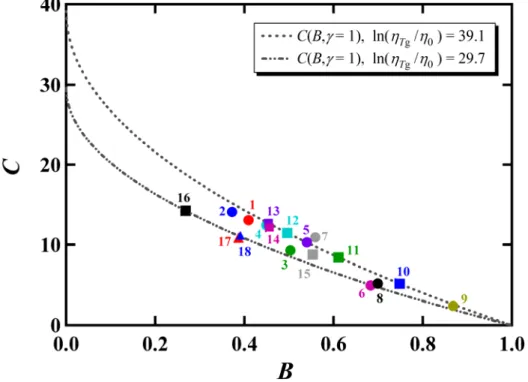
collapse on a single curve. This situation is illustrated in Fig. 3. Note that all the data are located between the two boundary curves determined by ln(  Tg /  0 )  39 . 1 and 29.7.

According to our model, the observation that most systems have values of B and C around the thick line in Fig. 1, indicates that the degree of energy fluctuation and the coordination number fluctuation are almost the same. Deviations from the   1 line indicate that the magnitudes of such fluctuations are different. It is known that a single VFT equation can not reproduce the viscosity data when the temperature range is wide enough [19]. Our Bond Strength-Coordination Number Fluctuation Model fits the experimental data better than the VFT relation. Physically, this is possible by relaxing the condition   1 .

Fig. 3. The values of the parameters B and C determined for the metallic glass forming systems tabulated in Table 1. The two curves are drawn by using different values of ln(  Tg /  0 ) .

Summary

The viscosity of the liquids increases drastically when the temperature is lowered and approaches the glass transition temperature. At the microscopic scale, the constituent elements of a glass are considered to form certain types of clusters or structural units. Such structural units are bound to other structural units by certain bond strength by retaining its spatial random connectivity. Within the glass, the thermally activated viscous flow occurs by bond-breaking and bond-switching. Based on this picture, a model for the temperature dependence of the viscosity has been proposed by one of the authors. The model describes the viscosity behavior in terms of the mean values of the bond strength, the coordination number, and their fluctuations of the structural units that form the melt.

In the present study, the viscous behavior of several metallic glass forming systems are analyzed

by using the above mentioned model. From the analysis, microscopic information such as the number

of bonds that must be broken to observe the viscous flow has been obtained. It has been shown that

this quantity increases with the increase in the fragility and is intimately related with the magnitude of

the cooperatively rearranging region in the theory of Adam and Gibbs. It has been also shown that

when the magnitude of bond strength energy and coordination number fluctuations between the

structural units are the same, the behavior of the viscosity described by our model corresponds

(6)

perfectly to the behavior described by the phenomenological VFT equation. This finding is expected to provide a microscopic physical interpretation to the parameters used in the VFT equation. By studying the materials trend in the temperature dependence of the viscosity that includes oxides, chalcogenides, polymers and metallic glass forming liquids, it was shown that metallic systems have intermediate values of fragility.

Acknowledgements

This work was supported in part by a Grant-in-Aid for Scientific Research on Priority Area,

“Materials Science of Bulk Metallic Glasses (428)” from the Ministry of Education, Culture, Sports, Science and Technology of Japan.

References

[1] A. Inoue, K. Ohtera, K. Kita and T. Masumoto: Jpn. J. Appl. Phys. Vol. 27 (1988), p. L2248.

[2] A. Peker and W.L. Johnson: Appl. Phys. Lett. Vol. 63 (1993), p. 2342.

[3] W. H. Wang, C. Dong and C. H. Shek: Mater. Sci. Eng. R Vol. 44 (2004), p.45.

[4] M. Miller and P. Liaw, editors, Bulk Metallic Glasses (Springer, USA 2008).

[5] Y. Takigawa, J. Kobota, S.W. Chung, H. Tsuda and K. Higashi: Mater. Trans. Vol. 48 (2007), p. 1580.

[6] S. Mechler, G. Schumacher, I. Zizak, M.P. Macht and N. Wanderka: Appl. Phys. Lett. Vol. 91 (2007), p. 021907.

[7] Y. Kawamura and A. Inoue: Appl. Phys. Lett. Vol. 77 (2000), p. 1114.

[8] G. J. Fan and H.J. Fecht: J. Chem. Phys. Vol. 116 (2002), p. 5002.

[9] M. Aniya and T. Shinkawa: Mater. Trans. Vol. 48 (2007), p. 1793.

[10] M. Aniya: J. Therm. Anal. Cal. Vol. 69 (2002), p. 971.

[11] C. A. Angell: J. Phys. Chem. Solids Vol. 49 (1988), p. 863.

[12] M. Ikeda and M. Aniya, in: Solid State Ionics, edited by B.V.R. Chowdari et al. / Macmillan India (2008), p. 409.

[13] M. Ikeda and M. Aniya: Solid State Ionics, in press.

[14] G. Adam and J.H. Gibbs: J. Chem. Phys. Vol. 43 (1965), p. 139.

[15] H. Vogel: Phys. Z. Vol. 22 (1921), p. 645. / G.S. Fulcher: J. Amer. Ceram. Soc. Vol. 8 (1925), p.

339. / G. Tammann and H. Hesse: Z. Anorg. Allg. Chem. Vol. 156 (1926), p. 245.

[16] Y. Zhao, X. Bian, K. Yin, J. Zhou, J. Zhang and X. Hou: Physica B Vol. 349 (2004), p. 327.

[17] L. Shadowspeaker and R. Busch: Appl. Phys. Lett. Vol. 85 (2004), p. 2508.

[18] H. Tanaka: J. Non-Cryst. Solids Vol. 351 (2005), p. 678.

[19] K. L. Ngai: J. Non-Cryst. Solids Vol. 275 (2000), p. 7.

Fig. 2. Normalized temperature dependence of the viscosity and relaxation time in some bulk metallic  glass forming systems calculated by the Bond Strength-Coordination Number Fluctuation Model  (full lines) and by the VFT equation (symbols)
Fig. 3. The values of the parameters B and C determined for the metallic glass forming systems  tabulated in Table 1

参照

関連したドキュメント

If condition (2) holds then no line intersects all the segments AB, BC, DE, EA (if such line exists then it also intersects the segment CD by condition (2) which is impossible due

One reason for the existence of the current work is to produce a tool for resolving this conjecture (as Herglotz’ mean curvature variation formula can be used to give a simple proof

It is suggested by our method that most of the quadratic algebras for all St¨ ackel equivalence classes of 3D second order quantum superintegrable systems on conformally flat

[11] Karsai J., On the asymptotic behaviour of solution of second order linear differential equations with small damping, Acta Math. 61

In particular, we consider a reverse Lee decomposition for the deformation gra- dient and we choose an appropriate state space in which one of the variables, characterizing the

Then it follows immediately from a suitable version of “Hensel’s Lemma” [cf., e.g., the argument of [4], Lemma 2.1] that S may be obtained, as the notation suggests, as the m A

Our method of proof can also be used to recover the rational homotopy of L K(2) S 0 as well as the chromatic splitting conjecture at primes p > 3 [16]; we only need to use the

We study the classical invariant theory of the B´ ezoutiant R(A, B) of a pair of binary forms A, B.. We also describe a ‘generic reduc- tion formula’ which recovers B from R(A, B)