• 検索結果がありません。

A study on the correlation between fragility and cooperativity in wide class of glass-forming substances

N/A
N/A
Protected

Academic year: 2021

シェア "A study on the correlation between fragility and cooperativity in wide class of glass-forming substances "

Copied!
6
0
0

読み込み中.... (全文を見る)

全文

(1)

A study on the correlation between fragility and cooperativity in wide class of glass-forming substances

Masaru Aniya a, *, Masahiro Ikeda b

a Department of Physics, Graduate School of Science and Technology, Kumamoto University, Kumamoto 860-8555, Japan

b Course of General Education, Natural Science, Applied Physics, Fukui National College of Technology, Sabae 916-8507, Japan

Abstract

The understanding of the cooperativity and heterogeneity in various kinds of glass forming liquids is a hot topic. In the present paper, the relationship between the cooperativity and the fragility has been studied based on the bond strength- coordination number fluctuation model. The model describes the temperature dependence of the viscosity of many kinds of glass forming liquids in terms of the mean values of the bond strength, coordination number and their fluctuations of the structural units that form the melt. According to the model, the cooperativity increases with the increase of fragility.

The model indicates that the length scale of the cooperativity region in typical fragile systems is about 1 to 3 nm.

Keywords: fragility; cooperativity; viscosity; supercooled liquids; glass forming materials, bond stregth-coordination number fluctuation model

1. Introduction

The clarification of the mechanism of glass transition and structural relaxation in supercooled liquids is one of the most challenging subjects in condensed matter physics (Debenedetti and Stillinger, 2001; Dyre et al., 2009). By decreasing the temperature of the melt, the glass-formation process takes place, which is accompanied by a drastic increase of the viscosity and structural relaxation times. The process is also accompanied by a growth of the size of the heterogeneity that develops in the supercooled liquid. The temperature dependence of the viscosity or relaxation time of various glass forming materials can be characterized by using the concept of fragility, which quantifies the degree of deviation from the Arrhenius

* Corresponding author.

E-mail address:

(2)

behavior (Angell, 1991). A natural question that arises is then, on the relation between the fragility and the cooperativity of atomic motions in the structural relaxation. Related with this subject, much studies have been done to understand the cooperativity and heterogeneity of various kinds of glass forming liquids (Kivelson and Tarjus, 2008; Donth, 2002; Schröter, 2006; Saiter et al., 2007; Haruyama et al., 2010; Rouxel, 2011). In particular, the correlation length of the heterogeneity and the number of molecules involved on it have been evaluated using different approaches (Dalle-Ferrier et al., 2007; Hempel et al, 2000; Wang, 2012). These studies indicate that no consensus exists regarding the relation between fragility and cooperativity. Some studies indicate that the cooperativity increases with the fragility in accord with our intuitive expectation.

Others state that no clear correlation exists. These situations indicate that further studies performed from different points of views are necessary. In the present paper, the cooperativity and fragility of various classes of supercooled liquids is investigated by the bond strength-coordination number fluctuation (BSCNF) model proposed and developed in our group (Aniya, 2002; Ikeda and Aniya, 2010).

2. The Bond Strength-Coordination Number Fluctuation Model

The BSCNF model was introduced based on the physical picture that the viscous flow of the melt occurs by breaking or twisting the bonds between the structural units (Aniya, 2002). According to this model, the temperature dependence of the viscosity is described in terms of the mean bond strength E 0 , the mean coordination number Z 0 , and their fluctuations, ∆E, ∆Z, of the structural units that form the melt. It is expressed as

) 1 2 ln(

1 1

) 1 1 ) ( 1 2 ln(

ln 1

ln 0 2 2

2

0

Bx Bx

C B B Cx

Cx Tg

− −

 

 

 − −



 



 

   + −

 

 + 

 =

 

 η

η η

η , (1)

where

2 2

2 2 ( ) ) (

T g

R Z B = ∆ E ∆ ,

RT g

Z C = E 0 0 and

T x = T g .

Here, T g is the glass transition temperature and R is the gas constant.

_

η 0 and η Tg are the values of the viscosities at high temperature limit and at T g , respectively. Recently, it has been shown that in the case where the condition |∆E|/E 0 = |∆Z|/Z 0 is satisfied, Eq. (1) follows closely the behavior of the Vogel-Fulcher- Tammann (VFT) equation widely used in the literature (Ikeda and Aniya, 2010). The fragility index m is obtained from Eq. (1) as

) 1 ln(10)(

) 1 2 ln(

ln 1 2 )

/ d(

dlog 0

B

B C

B T

m T

T g

g Tg

 

 

   + −

 

 + 

 =

 

 

=  η

η

η . (2)

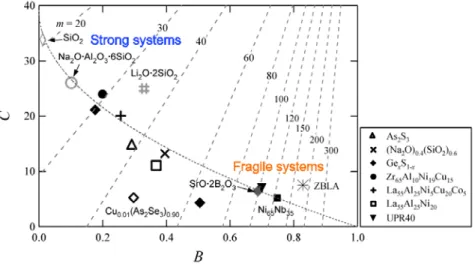
Applications of the above Eqs. (1) and (2) to various materials reveals a very interesting behavior. As

shown in Fig. 1, highly interconnected network glass forming materials or strong systems such as SiO 2 are

characterized by large value of C and small value of B. On the other hand, fragile systems such as ZrF 4 -BaF 2 -

LaF 3 -AlF 3 (ZBLA) are characterized by small value of C and large value of B (Aniya and Ikeda, 2010). The

values of B and C are obtained by fitting Eq. (1) to the experimental data of viscosity. It should be noted that

(3)

the expressions of the viscosity and fragility given above are written in terms of the parameters B and C which have clear physical meanings as defined in Eq. (1). The mapping of different compounds in the B-C plane suggests that a relation could exist between the parameters B and C. Indeed, the following analytical expression that connects the two parameters was found (Ikeda and Aniya, 2010).

 

 

   + −

 

 +

+

= − ln( 1 )

2 ln 1

) 1 ( 2

) 1 ( 2

2 0 B

B

C B Tg

η η γ

γ

γ , (3)

where

0 0

/ / Z Z

E E

= ∆

γ .

As noted above, the VFT like behavior is obtained when γ =1, that is when the ratio between the fluctuations of energy and coordination number becomes equal.

Fig. 1. Mapping of different glass-forming materials in the B-C plane. The broken lines indicate the fragility index constant line calculated by Eq. (2). The dotted curve shows the behavior of Eq. (3) when γ =1. UPR40 represents unsaturated polyester resin with styrene content of 40% W/W.

In a previous paper, a quantity defined as N B = E η /(E 0 Z 0 ), where E η is the activation energy for viscous flow was introduced (Aniya and Shinkawa, 2007). This quantity has been interpreted to give the number of structural units involved in the viscous flow. In other words, this quantity describes the cooperativity of molecular motions involved in the structural relaxation. In terms of the parameters of the BSCNF model, the cooperativity is written as

C B

B C

B N

Tg

B ( 1 )

) 1 2 ln(

ln 1 2

0

 

 

  + −

  + 

= η

η

. (4)

(4)

3. Relation between Fragility and Cooperativity 3.1. Results from the BSCNF model

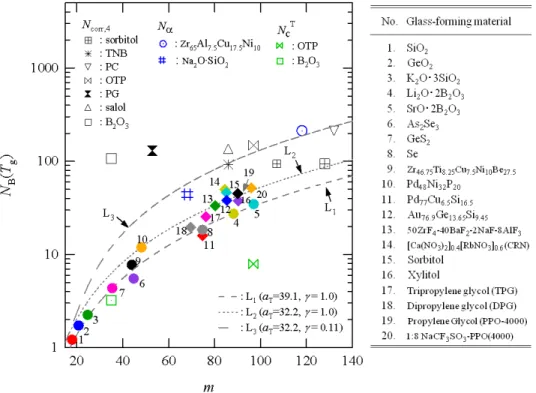
Many studies were devoted to understand the relation between fragility and cooperativity (Hempel et al., 2000; Hong et al, 2011).The BSCNF model indicates that these quantities are interrelated as is apparent from Eqs. (2) and (4). Fig. 2 shows the relation between N B and m for different materials evaluated at T = T g . For comparison, the numbers of correlated units evaluated by other approaches are also shown. For instance, values evaluated through the Donth formula, N α (Hempel et al., 2000), the four-point correlation functions, N corr, 4 (Capaccioli, 2008), and the thermodynamic cooperativity discussed by Wang, N c T (Wang, 2012) are shown. The lines (L 1 -L 3 ) describe the curves calculated with different values of γ and a T = ln( η Tg / η 0 ). It is noted that a large number of data points follow the line L 1 . The value of a T = 39.1 for this line corresponds to that calculated using the usual values η Tg = 10 12 Pa·s and η 0 = 10 -5 Pa·s. Fig. 2 indicates that N B increases with m. The values of N B extend from few to about 50 structural units, depending on the value of m. It seems that the estimations indicated by N α and N c T follow the theoretical trend predicted by the BSCNF model. The estimation indicated by N corr,4 follows a different trend. According to this estimation, the cooperativity does not depend or depends only weakly on m. The comparison shown in Fig.2 indicates that the magnitude of the cooperativity depends on the model used. Roughly it follow the order N corr,4 ( ≃ const) > N α > N B (BSCNF) >

N c T .

Fig. 2. Relation between N B at T = T g and the fragility index m. The numbers of correlated units evaluated by other approaches, N α

(Hempel et al., 2000), N corr, 4 (Capaccioli et al., 2008), and N c T (Wang, 2012) are also shown. The lines (L 1 -L 3 ) describe the curves

calculated with different values of γ and a T = ln(η Tg /η 0 ). For sorbitol, two different values of the fragility index m are presented, m = 128

(Capaccioli et al., 2008) and m = 107 (Wang et al., 2006).

(5)

The estimation of N B according to the BSCNF model, as well as the estimation N α and N c T , indicate that the cooperativity increases with the fragility. This observation is in contrast with the statement by (Hong et al., 2011), in which no clear correlation between fragility and cooperativity was detected. Meanwhile, (Hempel et al., 2000) observed a clear correlation between fragility and cooperativity. These differences could be due to the different techniques of measurements used there, light scattering and differential scanning calorimetry, respectively.

3.2. Cooperativity volume and fragility

As noted above, (Hong et al., 2011) have questioned the existence of the correlation between the length scale of cooperativity and the fragility. In this section, such a relation is investigated based on the BSCNF model. By assuming a spherical shape for the region of cooperativity, the cooperative volume can be written as V B = N B V 1 = (4π/3) ξ B 3 , where ξ B is the radius of the spherical region and V 1 is the volume of one structural unit, which is evaluated by V 1 = M/(N A ρ ). Here, M is the molar mass, N A is the Avogadro’s number and ρ is the mass density. In Fig. 3(a) the relation between the radius ξ B and the fragility index m is shown. We can see that there is a rough trend between these two quantities. Fig. 3(b) shows the relation between the correlation length evaluated from boson peak analysis ξ BP and m. As reported by (Hong et al., 2011) no clear correlation is discernible. However, a comparison between Figs. 3(a) and 3(b) indicates that no decisive conclusion could be given concerning the relation between cooperativity and fragility. On the other hand, it is gratifying to note that both analyses give almost the same values for the length scale of the cooperative region. As an extension of the present study, it will be interesting to investigate the influence of the shape of the region of cooperativity on the value of ξ B .

Fig. 3. (a) Relation between the radius ξ B of cooperativity calculated by the BSCNF model and the fragility index m. (b) Relation between

the correlation length ξ BP evaluated from boson peak analysis and m (Hong et al., 2011). The acronyms represent ortho-terphenyl (OTP),

propylene glycol (PG), poly(vinyl acetate) (PVAc) and polydimethylsiloxane (PDMS).

(6)

4. Conclusion

The BSCNF model describes the temperature dependence of the viscosity of many kinds of glass forming liquids in terms of the mean values of the bond strength, coordination number and their fluctuations of the structural units that form the melt. Based on the model, analytical expressions for the fragility and number of structural units involved in the thermally activated viscous flow or cooperativity has been derived. This is an advantage of the model, because it permits to understand what is the controlling factor operating in the complex dynamics of supercooled liquids. According to the model, the cooperativity increases with the increase of fragility. That is, these quantities are interrelated and originate from the connection and disruption processes between the structural units. Comparisons with other estimations of cooperativity such as the Donth formula, the thermodynamic cooperativity discussed by Wang, and the four-point correlation functions, indicate that the first two models are in accord with our result whereas the third one is not. Our model indicates that the radius of the cooperativity region in typical fragile systems is about 1 to 3 nm. This estimation agrees with the result of light scattering experiments.

References

Debenedetti, P. G., Stillinger, F. H., 2001. Supercooled liquids and the glass transition, Nature 410, p. 259.

Dyre, J. C., Hechsher, T., Niss, K., 2009. A brief critique of the Adam-Gibbs entropy model, Journal of Non-Crystalline Solids 355, p.

624.

Angell, C. A., 1991. Relaxation in liquids, polymers and plastic crystals - strong / fragile patterns and problems, Journal of Non- Crystalline Solids 131-133, p. 13.

Kivelson, S. A., Tarjus, G., 2008. In search of a theory of supercooled liquids, Nature Materials 7, p. 831.

Donth, E., 2002. Dynamic or configurational approach to the glass transition?, Journal of Non-Crystalline Solids 307-310, p. 364.

Schröter, K., 2006. Characteristic length of glass transition heterogeneity from calorimetry, Journal of Non-Crystalline Solids 352, p.

3249.

Saiter, A., Delpouve, N., Dargent, E., Saiter, J. M., 2007. Cooperative rearranging region size determination by temperature modulated DSC in semi-crystalline poly(L-lactide acid), European Polymer Journal 43, p. 4675.

Haruyama, O., Nakayama, Y., Wada, R., Tokunaga, H., Okada, J., Ishikawa, T., Yokoyama, Y., 2010. Volume and enthalpy relaxation in Zr 55 Cu 30 Ni 5 Al 10 bulk metallic glass, Acta Materialia 58, p. 1829.

Rouxel, T., 2011. Thermodynamics of viscous flow and elasticity of glass forming liquids in the glass transition range, The Journal of Chemical Physics 135, p. 184501.

Dalle-Ferrier, C., Thibierge, C., Alba-Simionesco, C., Berthier, L., Biroli, G., Bouchaud, J.-P., Ladieu, F., L’Hôte, D., Tarjus, G., 2007.

Spatial correlations in the dynamics of glassforming liquids: Experimental determination of their temperature dependence, Physical Review E 76, p. 041510.

Hempel, E., Hempel, G., Hensel, A., Schick, C., Donth, E., 2000. Characteristic length of dynamic glass transition near T g for a wide assortment of glass-forming substances, The Journal of Physical Chemistry B 104, p. 2460.

Wang, L., 2012. Extracting energy and structure properties of glass-forming liquids from structural relaxation time, Journal of Physics:

Condensed Matter 24, p. 155103.

Aniya, M., 2002. A model for the fragility of the melts, Journal of Thermal Analysis and Calorimetry 69, p. 971.

Ikeda, M., Aniya, M., 2010. Bond strength-coordination number fluctuation model of viscosity: an alternative model for the Vogel- Fulcher-Tammann equation and an application to bulk metallic glass forming liquids, Materials 3, p. 5246.

Aniya, M., Ikeda, M., 2010. Bond strength-coordination number fluctuations and the fragility of some ion-conducting oxide and chalcogenide glass-forming liquids, Ionics 16, p. 7.

Aniya, M., Shinkawa, T., 2007. A model for the fragility of metallic glass forming liquids, Materials Transactions 48, p.1793.

Hong, L., Novikov, V. N., Sokolov, A. P., 2011. Is there a connection between fragility of glass forming systems and dynamic heterogeneity/cooperativity?, Journal of Non-Crystalline Solids 357, p. 351.

Capaccioli, S., Ruocco, G., Zamponi, F., 2008. Dynamically correlated regions and configurational entropy in supercooled liquids, The Journal of Physical Chemistry B 112, p. 10652.

Wang, L.-M., Angell, C. A., Richert, R., 2006. Fragility and thermodynamics in nonpolymeric glass-forming liquids, The Journal of

Chemical Physics 125, 074505.

Fig. 1. Mapping of different  glass-forming materials in the B-C  plane. The broken lines indicate the fragility index constant line  calculated  by Eq
Fig.  2.  Relation  between  N B   at  T  =  T g   and the fragility index m.  The  numbers of correlated units evaluated by other approaches, N α (Hempel et al., 2000),  N corr, 4   (Capaccioli  et al., 2008), and N c T   (Wang, 2012)  are  also shown

参照

関連したドキュメント

If condition (2) holds then no line intersects all the segments AB, BC, DE, EA (if such line exists then it also intersects the segment CD by condition (2) which is impossible due

The inclusion of the cell shedding mechanism leads to modification of the boundary conditions employed in the model of Ward and King (199910) and it will be

One reason for the existence of the current work is to produce a tool for resolving this conjecture (as Herglotz’ mean curvature variation formula can be used to give a simple proof

It is suggested by our method that most of the quadratic algebras for all St¨ ackel equivalence classes of 3D second order quantum superintegrable systems on conformally flat

Related to this, we examine the modular theory for positive projections from a von Neumann algebra onto a Jordan image of another von Neumann alge- bra, and use such projections

Answering a question of de la Harpe and Bridson in the Kourovka Notebook, we build the explicit embeddings of the additive group of rational numbers Q in a finitely generated group

Then it follows immediately from a suitable version of “Hensel’s Lemma” [cf., e.g., the argument of [4], Lemma 2.1] that S may be obtained, as the notation suggests, as the m A

In our previous paper [Ban1], we explicitly calculated the p-adic polylogarithm sheaf on the projective line minus three points, and calculated its specializa- tions to the d-th