The Impact of Built Environment on Residents' Health from the Perspective of Physical
Activity
著者 趙 立珍
著者別表示 ZHAO LIZHEN journal or
publication title
博士論文要旨Abstract 学位授与番号 13301甲第1928号
学位名 博士(工学)
学位授与年月日 2020‑09‑28
URL http://hdl.handle.net/2297/00061362
Dissertation Abstract
The Impact of Built Environment on Residents' Health from the Perspective of Physical Activity
Kanazawa University
Graduate School of Natural Science and Technology Division of Environmental Design
Student ID NO: 1724052011 Name: ZHAO LIZHEN
Supervisor: Professor SHEN ZHENJIANG
Abstract
This doctoral thesis focuses on the interaction between the daily health behavior of residents and the built environment at the community scale. What are the impact factors of built environment on public health and how it affects residents' health.
This dissertation took Fuzhou City of Fujian Province in China as the research object. The research data came from open network data and social survey data. First of all, the dissertation used physical activity as the intermediary factor, and used the method of multiple regression equation to study the built environment factors that affected the traffic walking and leisure walking. Then, the study further discussed the impact of the subjective perception of the built environment on the physical activity of residents, as well as the influence path of the built environment on the physical activity of residents. Third, the study took the self-rated health of residents as the dependent variable and the community built environment, subjective perception, social environment as the independent variables to explore the impact of these built environment related factors on residents' health. Finally, through the method of building structural model, this dissertation discussed the influence path of built environment based on physical activity on residents' health. In the whole research process, the different influencing factors and paths of the built environment on the health of male and female were also discussed.
Key Words: Built Environment, Physical Activity, Health, Community Safety, Social Capital, Multiple Regression Analysis, Structural Equation Model
1. Introduction
Rapid urbanization had made great contribution to the development of the world economy, and also brought various "urban diseases" to human beings, which seriously threaten the health of urban residents. Non-communicable chronic diseases have replaced acute infectious diseases and become the primary threat to urban public health(WHO, 2009). According to the World Health Statistics 2017 released by the World Health Organization, non-communicable diseases caused 41 million deaths every year, accounting for 71% of the global total(WHO, 2017). Health has become a major issue affecting future economic and social development.
In order to cope with the severe challenges brought by the rapid urbanization process to human health, and to better solve the urban problems and comprehensively improve the health level of people, the World Health Organization(WHO) put forward the new concept of "Healthy City" in 1984. In 1986, American Journal of health promotion put forward the concept of health promotion. In 1995, the Western Pacific Region Office of the WHO pointed out that health promotion means that individuals, together with their families, communities and countries, take measures to encourage healthy behaviors and enhance people's ability to improve and deal with their own health problems. After 2000, the research on the relationship between built environment and health has become a hot topic in the world.
According to the data of China Health and Health Commission, in 2019, 88% of the total deaths were caused by chronic non communicable diseases such as cardiovascular and cerebrovascular diseases, cancer, chronic respiratory diseases and diabetes. At the same time, about 173 million residents in China had mental health problems(Xiang et al, 2012). All of these pose severe challenges to urban health, which the Chinese government attaches great importance to. In October 2016, the Chinese government issued the “ ‘Healthy China 2030’ plan outline”. Healthy China and Healthy City had become national strategies. The organic combination of urban planning and health fields' respective professional advantages is conducive to jointly coping with chronic diseases and health problems in urban development. As one of the important factors to promote physical activity and health of the public, the built environment is an important entry point for urban planning to actively intervene in health (Lu and Tan, 2015).
Taking Fuzhou, Fujian Province, China as an example, the PhD research aims to the relationship between the built environment of urban communities and residents' health and its influence mechanism based on the perspective of residents' spatiotemporal behavior in micro spatial scale. Through this study, we try to achieve the following goals:
1. Establish the quantitative relationship between building environment and individual health behavior, and find out the building environment factors that affect residents' activity behavior and health.
2. Based on the structural equation model, this dissertation constructs the theoretical relationship between the built environment and health of residents from six aspects: health, physical activity, built environment, social capital, community safety and individual characteristics.
3. Analyze the difference of the impact of the built environment factors on the behavior and health of male and female residents, identify the main factors affecting the physical activities and health of male and female residents in the built environment and the influence path.
The dissertation is divided into seven parts. In the second part, we introduced the research area and data sources. In the third part, we studied the impact of built environment on residents' walking activities. In the fourth part, we introduced the environment perception factors to study the influence path of the subjective and objective factors of the built environment on the moderate to vigorous physical activity. In the fifth part, we discussed the impact of built environment on self-rated health. In the sixth part, structural equation model method was used to construct the theoretical relationship between the built environment and residents' health from the aspects of community built environment, social capital, physical activity, physical health and mental health, and to explored its internal influence mechanism. In the seventh part, we conclude the research conclusions and pointed out future research.
2. Research Approach
The study area was Fuzhou. Fuzhou is located in East China, East Fujian, lower reaches of Minjiang River and coastal areas, across the sea from Taiwan. It is the political, cultural, scientific, educational and transportation center of Fujian Province, and an important city in Southeast China. It is a typical estuarine basin surrounded by mountains and rivers, with beautiful natural scenery. Fuzhou City covers a total area of 1786 square kilometers, of which the built-up area is 357 square kilometers.
Fuzhou's central city has a permanent population of 4 million.
The data of this study included social survey and open network data. The social survey data mainly came from the questionnaire survey conducted in the central urban area of Fuzhou from June to August 2017. This questionnaire adopted the way of network research. The questionnaire included personal information, community facilities, community communication, community satisfaction, physical activity, safety perception, physical health and mental health. The built environment elements
take the 500m space around the sample as the research scope. Public services and public transport facilities spatial interest point data was the data of Fuzhou City in 2017 downloaded from a map web site. These data included the geographical location of business facilities, catering facilities, life service facilities, sports and fitness facilities, green space facilities, and of bus stops.
3. The impact of the built environment on the walking activities
The purpose of this chapter is to study the relationship between built environment and physical activity. A large number of scientific evidences proved that lack of physical activity was an important risk factor for chronic non communicable diseases besides unhealthy diet, smoking and drinking. It was the fourth major cause of chronic non communicable diseases (including heart disease, stroke, diabetes and cancer) in the world. Three million people lose their lives every year (Bull, 2011).
According to the research of UK Health Department (2004), physical activity had significant effect on health from two aspects of prevention and treatment. Therefore, how to promote people's physical activity and encourage people to actively participate in physical activity had become the priority strategy of health promotion in most countries. Walking is one of the most basic forms of physical activity to promote people's health. So the research takes walking as the research object, and subdivided into traffic walking activity and leisure walking activity.
In this part, two explained variables are the traffic walking activity and the leisure walking activity. The walking activity data was collected in the form of hours by using the length of walking time per week described by residents themselves. The explanatory variable is the objective characteristic element of built environment, and the objective evaluation method of GIS and the subjective evaluation method of interviewees are used. The permanent population density and the facility POI density were selected for the built environment density. The degree of mixing is quantified by the Herchmann-Hefndale coefficient of land-use properties. The main road network density and branch road density are used to reflect the road shape design. The proportion of the number of commercial facilities, living service facilities, catering facilities, green space facilities and sports facilities in the investigator's buffer zone to the total number of POI facilities reflects the accessibility of the facilities. The distance to public transport is observed by the number of POIs at bus stops within the investigator's buffer zone. The study also selected individual travel mode, sports facilities richness, community life satisfaction and community safety. Individual characteristic variables include age, gender, education, marital status, monthly income, love of sports.
The results of multiple regression models show that the built environment had an influence on the traffic walking activities and leisure walking activities. The comprehensive layout of urban land use and the increase of commercial facilities, living service facilities and catering facilities can promote the traffic walking activities of residents. The direct factors of the influence of the built environment on leisure walking activities included function mix, branch density and the accessibility of sports facilities. The community with mixed functions and convenient sports facilities were more conducive to promoting residents' leisure walking activities.
However, the density of the city was too dense for the residents to carry out leisure physical activities. Community safety, community life satisfaction and other social environmental factors affected the leisure walking activities. Individual characteristics had no effect on traffic walking activities, but had significant effect on leisure physical activities. The influence of the built environment on male's and female's walking activities was quite different. For traffic walking activities, male and female had opposite effects on function mixing, facility accessibility and travel mode. There were significant differences in the influence of road density, education and monthly income. For leisure walking activities, there were opposite effects on population density, accessibility of green space facilities and monthly income. There were significant differences in POI density, land use mixedness, facility accessibility, life satisfaction, age and marriage.
4. The influence path of objective characteristics and subjective perception of built environment on moderate to vigorous physical activity
This part still focused on the relationship between the built environment and physical activity. Compared with low-intensity physical activity, moderate to vigorous physical activity has significant health benefits for human body (Colley et al., 2013). In the study of built environment, we included the subjective perception of built environment, explore the influence of environmental subjective perception on physical activity and the path between the objective characteristics and subjective perception of built environment.
The explained variable was moderate to vigorous physical activity, calculated as the length of time in a week. The subjective perception variables of built environment include environmental density perception, environmental quality perception, environmental facilities perception and security perception. First, the influence of subjective perception of built environment on moderate to vigorous physical activity was studied by multiple regression analysis. The results showed that the subjective
density of POI, the subjective convenience of sports facilities and commercial facilities, the beauty of the environment, and the community safety were all conducive to promote the residents to carry out moderate to vigorous physical activity in the community. However, the environment cleanliness had a restraining effect.
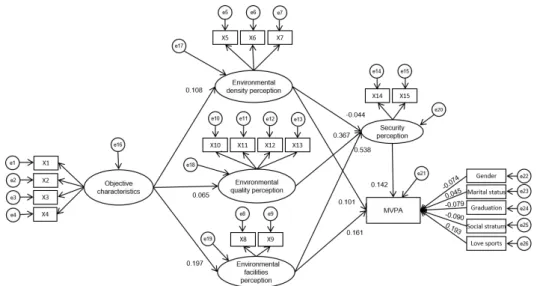
Then, by building the structural equation model, we explored the influence path among the five potential variables: the objective characteristics of the built environment, the perception of environmental density, the perception of environmental quality, the perception of environmental facilities and the perception of environmental security.The analysis framework is shown in Figure 1.
Figure 1 Structural equation model analysis framework
The results showed that the subjective perception and safety perception had intermediary effect in the influence path of built environment on moderate to vigorous physical activity. There were two directions of influence path. One direction was that the built environment affected the moderate to vigorous physical activity through the perception of environmental density and environmental facilities. The other direction was that the built environment affected community safety through environmental density perception, environmental facility perception and environmental quality perception, and then affected moderate to vigorous physical activity. The influence path is shown in Figure 2.
Figure 2 Standardized path of structural equation model
Finally, we made a comparative analysis of the influence path of objective characteristics and subjective perception of the built environment on the moderate to vigorous physical activity between male and female. For male, the objective characteristics of the built environment had less influence on subjective perception.
The built environment had a direct influence on moderate to vigorous physical activity and community safety. For female, the objective characteristics of the built environment had an influence on subjective perception, but not directly on moderate to vigorous physical activity. The intermediary role of community safety was significant.
5. The impact of built environment on residents' self-rated health
In the previous chapters, we studied the influence of built environment and physical activity to study the influence of built environment and health. This chapter used self-rated health as a health research indicator to reflect the health status of residents. Previous studies had shown that compact built environment, i.e. high density, high mixing, high connectivity, proximity to destinations and bus stops, can effectively reduce the risk of overweight and obesity (Bodea et al., 2009), improve self-rated health (Ermagun and Levinson, 2017; Liu et al., 2017), and to some extent, reveal the quality of life (Bird and Fremont, 1991).
This research adopted the method of multiple regression equation. The study used self-rated health as the explained variable. Explanatory variables included built environmental characteristics, environmental perception and social environment. The elements of environmental perception included the perception of walking environment, the perception of environmental facilities and the richness of sports facilities. Social environment perception included community safety, community attachment and community management. Five models were established to observe the relationship between variables. Model 1 analyzed the influence of built environment on residents' self-rated health. In model 2, based on the built environment, individual travel mode, moderate to vigorous physical activity and sports loving degree were increased, and analyze whether the built environment has changed the influence on self-rated health after the factors of individual physical activity are increased. In model 3, subjective perception factors of built environment were added, including walking environment satisfaction, environment facility perception and sports facility richness perception. To study the influence of subjective and objective characteristics of built environment on self-rated health. Model 4 added social environment elements, including community safety perception, community life belonging perception and
community management perception. To study the influence of built environment and social environment on self-rated health. Model 5 increased the number of chronic disease categories as explanatory variables to study the influence of built environment and social environment on self-rated health after chronic disease control.
The results showed that the built environment had a certain influence on the self-rated health of residents. The influence of built environment on self-rated health was only reflected in land use mixedness, accessibility of living facilities and sports facilities. Compared with the influence of the built environment to physical activity, the influence factors were less. The direct influence of the objective characteristic of the built environment on self-rated health was not very significant. However, the influence of built environment on self-rated health was relatively stable and not affected by other factors such as social environment. Land use mixedness had no effect on both male and female. Catering facilities and road density had an influence on male, but not on female.
The subjective perception of built environment had a significant influence on residents' self-rated health, mainly in two aspects: environmental quality perception and environmental facility perception. Once social environment factors were added, the correlation of subjective perception was significantly reduced, or even showed no correlation. After controlling the number of individual chronic diseases, the influence of subjective perception of the built environment had been improved. Subjective perception of built environment had no effect on female's self-rated health. Only environmental facilities perception had a significant positive correlation with self-rated health of male.
Social environment had an important influence on residents' self-rated health.
Community attachment had the most significant influence. Increasing the frequency of communication and deepening the level of communication, and improving community attachment can help to improve the health of residents. The influencing factors of the second level were community security and community management level awareness. Community safety was the basic demand of residents for leisure physical activities (Alfonzo, 2005) . It was generally believed that a good community built environment was conducive to residents' communication, monitoring, and enhancing the sense of community security. The level of community management was conducive to the maintenance of the built environment and the promotion of residents' communication through the organization of community activities, so as to enhance residents' community attachment and promote residents' health. Community security and community attachment also had significant positive correlation with male and female.
As far as individual characteristics are concerned, the degree of love for sports and the time of leisure physical activity had a significant influence on residents' self-rated health. The influence of mental state on residents' self-rated health was very stable, not affected by other factors, and showed a significant positive correlation.
Education was not related to self-rated health of residents, which was different from the research on the influence of physical activity. The variables of gender, age, marital status, social class and working status had no stable effect on the self-rated health of residents, and were obviously affected by the added variables. The biggest difference between male and female lay in the influence of education and social stratum. These two variables were negatively correlated with male, but positively correlated with female.
6. The influence path of community environment on health of residents
In this part, structural equation model was used to study the relationship between built environment, social environment, physical health and mental health. The mediating effects of community safety and physical activity were considered in the model. Using the planning concept of Smart Growth, New Urbanism and Compact Development, western scholars believed that changing the built environment can effectively promote residents to adopt non motorized travel modes, actively participate in physical activities, increase neighborhood exchanges and social capital, and promote physical and mental health (Ewing et al., 2014).
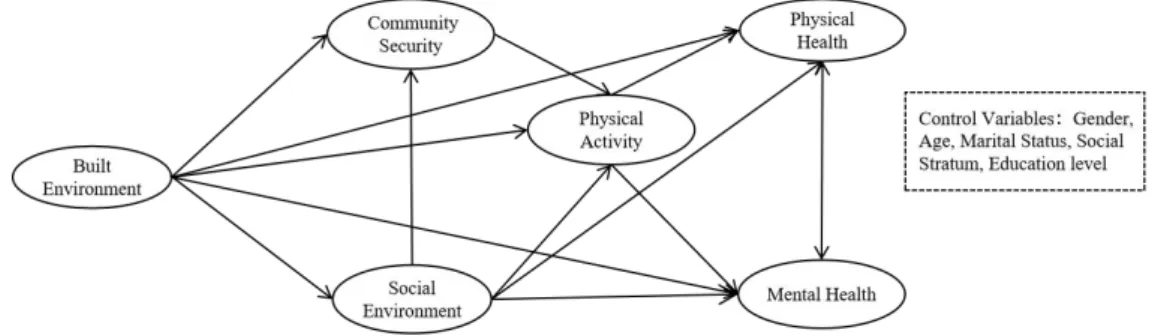
This part used the research hypothesis to propose the analysis framework as shown in Figure 3.
Figure 3 Research analysis framework
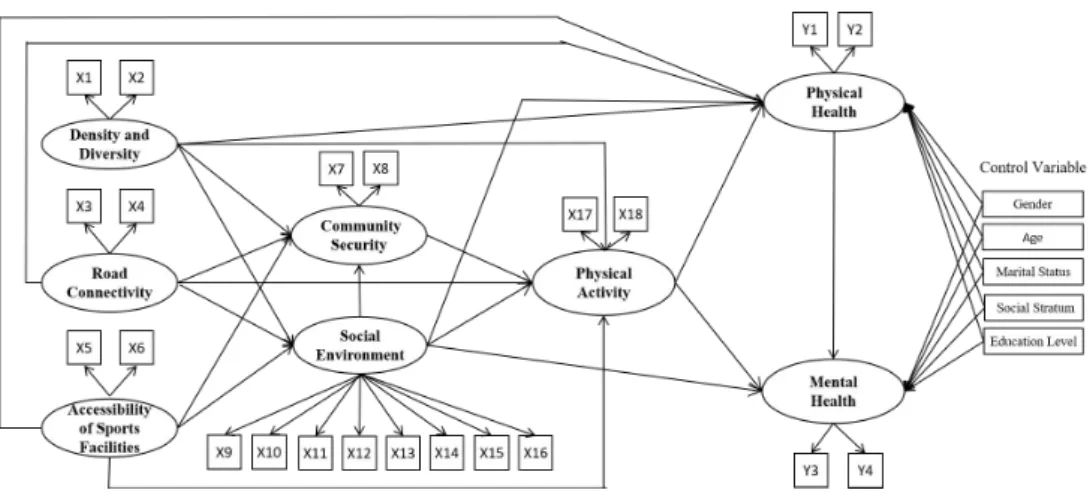
According to the research framework, Amoss software was used to build the structural model equation. The structural model equation is shown in Figure 4
Figure 4 Structural equation model setting
The results showed that density and diversity, road connectivity and sports facilities accessibility can directly affect the physical health of residents. But at the same time, these factors will also affect the physical and mental health of residents through the intermediary role of social environment, community safety and physical activity. The intermediary role of community security was obvious. The built environment can directly affect the community safety perception, and it can also affect the community safety perception through the influence on the social environment. Physical activity, as an intermediary factor, played an important role in the influence of community environment on residents' health. The density and diversity of the built environment directly affected physical activity. The built environment can also indirectly affect physical activity through social environment and community safety. Physical activity not only promoted the physical health of residents, but also benefited the mental health of residents. For male, the influence path of the built environment on health was quite different. Density and diversity had no direct or indirect effects on male health. Road connectivity and sports facility accessibility can affect physical activity through community safety, and then affect physical and mental health of male. Road connectivity and sports facilities accessibility can also directly affect physical health through the role of social environment. Social environment had no influence on male community safety perception and mental health. For female, the influence path of the built environment on health was similar to that of the all sample. As far as the individual characteristics of all samples were concerned, gender and age had an influence on physical and mental health. Marital status had an influence on physical health, and social stratum had an influence on mental health. For male, social stratum and education had an influence on physical and mental health, while age only had an influence on physical health. For female, marriage and education had an influence on their physical and
mental health, while social stratum only had an influence on their physical health.
7. Conclusions and future research
In this dissertation, the multiple regression model and structural equation model were used to analyze the influence path of community built environment on residents' health. The research was based on the open network data and social survey data of Fuzhou City, using SPSS and Amos software, and based on the community scale.
First of all, the built environment had an influence on the traffic walking activity and leisure walking activity. Improving mixed use of land and increasing commercial facilities, living service facilities and catering facilities can promote the traffic walking activity. The community with high facilities density, convenient sports facilities and green park are more conducive to promoting residents' leisure walking activity. The built environment acted on moderate to vigorous physical activity through subjective perception and community safety. Second, built environment, subjective perception and social environment had an influence on residents' self-rated health. Building environment factors can directly affect the health of residents, but also through community security, social capital affect physical activity, and then affect health. Third, there were significant differences between male and female in the impact mechanism of built environment. Land use mix can promote female's traffic walking, and the accessibility of facilities can promote female's leisure walking. The influence of subjective perception and community safety was more obvious for female.
The influence path of built environment on health is complex. Due to various reasons, there were still deficiencies in PhD research. In future research, I will further conduct more accurate research on some built environment factors.
$2(I X V ƦŨɼǦƱǼƝƎǵʢȰʥ
>%yT}l~:4x502u#
ÁÓg¸áåÞ˗0˦˦»˘˦0˦ð%äãàhî˦˦˦˦Ýl×gçé3o˦˦¯˙ßÙ1-˦˦°%˦1-˚x½hæ3¾˛˜êÔÆ˝˦¿Ð˦
¼ÑñèÕÍÌÛ˦«ÎëÖïìò˦
ʣƐɳļʐJSHċʳǟ ˌDƂǂťıˀ_ʴĦʘŜeƏW` ʩ
(& yTP&r #$ M E h6> BQ
^1
A\p[tW q)w)=
XM,ȑĮƩCɻǕƆʪ þUTǜ 9ŮƃDŽǡŝʞȪ PȻÿ Ɏ4ȏǷȽQFʊ:Džȃʟɖɍ˞ ŗʌKƢǠȋǴʖ ɏƴŪȥZdžī˂=ǗɞBĵɁńɨǰĿɆƸȔ¦Çüõö÷ǬɭȦ:ĂƤȹ˃
ĀLJŷˏĭ 6ƼǯȺɐÜā Ȑɚ¬ƥȡ,sǢ˄ ©²˟*ǞąøĶ9Čʵʫśnj Ȃ4˕œĊv'˦ ȼWɠʶĸ Ŵǀʍƺ¨ˠyˡzȁʗ{ Iˉ tǘ]ȄʉkɯDZŤƄĻ ȷȟɢɑ5P
ǓƖɂžǖɗʦʄʚƇšųĘĥǧƊ<ľƾ®¹"³¡Ľ<ùúƋNj ģŢˎÅ´
ɺȀɇǻȯʷǪɈɲɱ±+İǥȊNJɿȵĎĚØǎ ʬʠǛȮÚ!ȗƿˈƘǭ ɟğěˍJSHǤ˓\NBŚĆņLʝʸŊŀĉf7ɡ ȸŁƹƵŲƫǒĹ ʆ^ŌˢˣªĔÄ'ŏĞĜuūƞ˦ȿŦȩƟɬYķɛďŖʀůȕƁȴȒ[Ǚɝ ȇ;ɰǶɶˇʧ ŻŰfQşŞƲ
ɹǽňʇĐ¢ˤȢżưʭDzʮłaƔÈ£ ĕ ǑƳʯǮǝɦƜµəįʎˑGȳDEţLjʛˆAɒă= ȧǍaʑƻƠ º¤˦Ŏ
Ȍŋ|!mƚɮɵȣR;ɣ\NʾĢĝʁűȖE[Ȩȓħljʜ>ƈIJˁ]ȅ ȘʹVƌȚA˒ ȍĬô}ʏKơT bɀGȤŭ ɓƛȶĠǁ ɴĺƮƑʂb ɅŶĪL_ʼnƉijiIǺʰȎŠėĄe8ÉÊ¥Ő§˅ʈŔĨǏʅ^ƕɘʺ˖ǐ ŵǃʒȱĖ˔ ʻŅɥȝƽcɔũȬɪĤUȫ!ɫYóč+Ǩdýʱ ŬRZǚȆșțɃŃdzVƶpiíŽ
XM
@ ǸŹƙƪȭʼĩ ȲCɾOˊɜɄȜ7ɕŘʲǾɸɽƯƍɊ ?r"À¶đ>źɧ 6ƭ ĒőŒŕ8cd?ġĈř ʽƀʃǫȞē*Ɨʙŧƅ·ɉ@ǔFɷȠǿȈO~˥nɋ5Ň ǹƣƒ ʔĴȾɌǣǩćːȉʡ ʤƷƧ`˦j˦ƓƨʕˋęſƬʿʨ A\p[ #$ ( @~ , 0 ] ō 0]
O!>% +9G>
>%yT.-qyT {'Jj*nf mw
û mwe~mwUc /ÃÒ.â2/ÏË2.mw /Ym w~g k
& >%yTA\<3
M E ~BQ1 s 1 ^
h7>BQ ~"\ SO a N i8>oQ ~)\ SO Ÿɤ
h6?CQ ~)\ ÛSO ɩʓʋ
h6>DQ ~)\ zH `ZR
|b;>1vSO ~)\ SO Fd
1
_
L
2
K