Stability Testing of Drug Substances Approved by the Japanese Government in 2 0 1 5
Hiroaki NAGAOKA1)*, Atsushi KUWAHARA1), Tomohiro KISHI1), Yuya DEGUCHI1), Hiromi TAKANO OHMURO2)
and Megumi HAMANO NAGAOKA1)
(1)Department of Pharmacy, Faculty of Pharmaceutical Sciences, Nagasaki International University, 2)Department of Pharmacy,
Faculty of Pharmaceutical Sciences, Musashino University,
*To whom correspondence should be addressed)
2 0 1 5年に承認された医療用原薬の安定性試験
長 岡 寛 明
1)*,桑 原 淳
1),岸 智 裕
1), 出 口 雄 也
1), 大 室 弘 美
2),長岡(浜野)恵
1)(1)長崎国際大学 薬学部 薬学科、2)武蔵野大学 薬学部、*連絡対応者)
要 旨
2015年に日本で承認された新医療用原薬に対し、安定性試験の現状を調査した。我々は、2015年に安
定性試験の記述がある47の新医療用原薬を特定した。 長期保存試験としては、27原薬が25±2℃/60±
5%相対湿度(RH)または30±2℃/65±5%RH の条件下で、8
原薬が5±3℃で、1
原薬が-18℃
で、5
原薬が-20±5℃で、1
原薬が-65℃で、2
原薬が-70℃で、2
原薬が黒塗りのため不明であり、
1
原薬は半減期が短いため実施されなかった。光安定性試験では、22原薬が安定で、14原薬が光不安定
であり、10原薬は記載がなく、1
原薬は実施されなかった。光安定性試験で不安定であった原薬は、す
べて遮光保存とされた。これらのことから、2015年に承認された新医療用原薬は、ICH ガイドラインに
従って、適切に設定されていることがわかった。
キーワード
安定性試験、新医療用原薬、長期保存試験、加速試験、光安定性試験、ICHガイドライン
Abstract
To investigate the current status of stability testing in Japan, we identified 47 new drug substances that had undergone stability testing in 2015. Among these, 27 were tested at 25±2℃/60
±5% relative humidity(RH)or at 30±2℃/65±5% RH, 8 were tested at 5±3℃, 1 was tested at
-18℃, 5 were tested at -20±5℃, 1 was tested at -65℃, 2 were tested at -70℃, 2 were unknown because they were long-term testing items were left blank, and 1 was not enforced due to its short half life. . Photostability testing revealed 22 new drug substances that were optically stable and 14 that were optically unstable, and whereas 10 new drug substances lacked a description and 1 was not tested. New drug substances that were unstable in photostability testing were stored in darkness. The present data show adequate performance of new drug substances that were approved according to the ICH guidelines in Japan in 2015.
Key words
accelerated testing, ICH guideline, long-term testing, new drug substance, photostability testing, stability testing
Introduction
Stability test results are an essential re- quirement for New Drug Applications. Ac- cordingly, this requirement is discussed in the International Council on Harmonisation of Technical Requirements for Registration of Pharmaceuticals for Human Use(ICH),1) and revisions of the guidelines for stability testing have been performed several times.
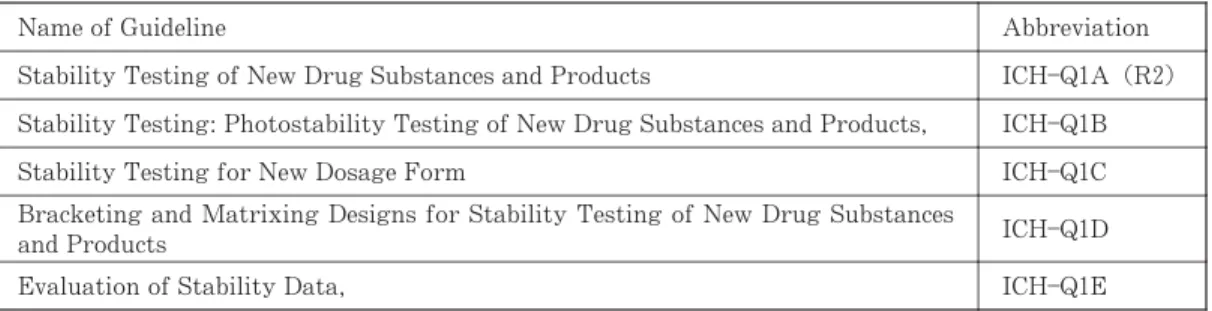
The guidelines for stability testing of new drug substances are listed in Table 1 and com- prise the following:
ICHQ1A(R2)states that the stability data package for new drug substances and drug products is sufficient for registration within the European Union, Japan, and the United States.1)
ICHQ1B states that the intrinsic photo- stability characteristics of new drug sub- stances and products should be evaluated to demonstrate that light exposure does not cause unacceptable changes.2)
ICHQ1C is an annex to the ICHQ1A
(R2)and recommends stability items to be submitted with new dosage forms by the origi- nal applicant, after the original submission for a new drug substance or product.3)
ICHQ1D provides recommendations con- cerning the application of bracketing and ma- trixing in stability studies.4)
ICHQ1E provides recommendations on how to use stability data that is generated in accordance with the principles detailed in ICH Q1A(R2), and those can be used to inform
re-test periods and shelf lives in applications for registration.5) Additionally, this guideline describes when and how extrapolation can be used to inform a re-test periods for drug sub- stances, and to determine the shelf life of drug products that extend beyond the period cov- ered by“available data from the stability stud- ies under long-term storage condition.”5)
According to ICHQ1A(R2), New Drug Applications require long term and accelera- tion studies to be included among stability tests.
Herein, we analyzed and discussed stabil- ity testing data for drug substances that were approved by the Japanese government in 2015.
MATERIALS AND METHODS
We surveyed drugs that were approved from January to December 2015. Informa- tion was retrieved from data summaries
(Module 2 of Common Technical Document
(CTD)in the present system)that were sub- mitted bas New Drug Applications, and from approval documents that describe specifica- tions and test methods for drug substances.
This information, especially from the quality section, is not all publicly available, although
Table 1 Guidelines for stability testing of new drug substances
Abbreviation Name of Guideline
ICHQ1A(R2)
Stability Testing of New Drug Substances and Products
ICHQ1B Stability Testing: Photostability Testing of New Drug Substances and Products,
ICHQ1C Stability Testing for New Dosage Form
ICHQ1D Bracketing and Matrixing Designs for Stability Testing of New Drug Substances
and Products
ICHQ1E Evaluation of Stability Data,
Module 2 of the CTD and review reports are available on the internet.6) Therefore, we do not disclose individual substance’ names herein.
RESULTS AND DISCUSSION
Classification of Approved Drugs by Stability Testing
A total of 107 review reports were re- trieved for 115 drug substances that were ap- proved from January to December 2015, and those excluded antiseptics for medical devices, in vivo diagnostics, and generic drugs.
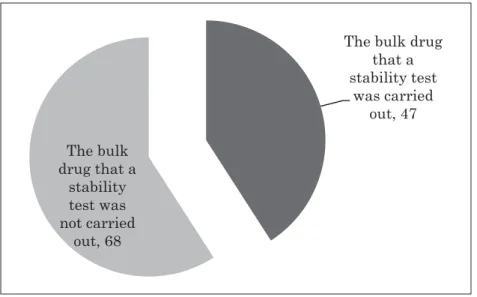
Initially, we classified drugs according to whether they had been subjected to stability test and among 115 drug substances 47 drugs had stability testing and 68 did not(Fig. 1).
The 68 bulk drug substances that had not been subjected to stability testing were drugs with new administration routes, new indica- tions, or new dosages, and were not tested for stability according to the approval matter par- tial change application, which does not de- mand stability testing.
Whereas, 47 of 115 new drug substances
(41%)had stability testing data, this rate of stability testing was 10% less than in 2014.7)
Hence, further analyses were performed the 47 new drug substances with stability test- ing data.
Long-term Testing
According to ICHQ1A(R2),1) long-term testing for general new drug substances is per- formed at 25±2℃/60±5% relative humidity
(RH)or 30±2℃/65±5% RH. However, for drug substances that are intended to be stored in a refrigerator, long-term testing is per- formed at 5±3℃, and for drug substances that are intended to be stored in a freezer, long- term testing is performed at -20±5℃. Ad- ditionally, long-term testing for drug sub- stances that are intended for storage at -20℃
is performed on a case-by-case basis.
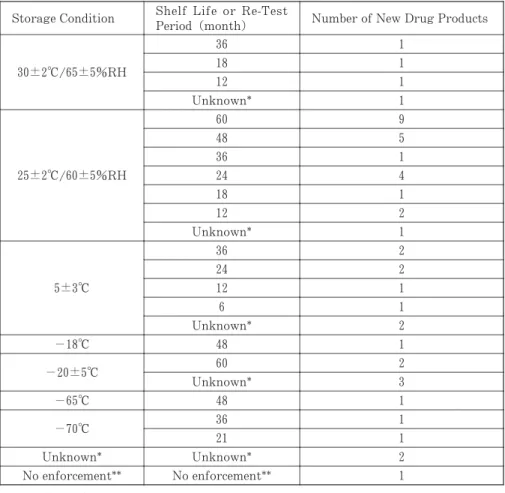
Long-term testing was performed at 25±
2℃/60±5%RH or 30±2℃/65±5%RH for 27 new drug substances, at 5±3℃ for 8, at -18℃
for 1, at -20±5℃ for 5, at -65℃ for 1, at - 70℃ for 2, and at unknown temperatures for
Fig. 1 Classification of New Drug Substances according to whether they were subjected to stability testing
2, for which the data was concealed(Table 2). One substance was not subjected to long term testing because its half life was too short.
Among the 47 new drug substances, 23, 6, 1, 2, 4 and 1 had shelf lives or re-test peri-
ods of > 36, 24, 21, 1, 12, 6 months, respective- ly, and 9 had unknown shelf lives or re-test pe- riods(Table 2).
Moreover, 13 new drug substances that were scrutinized according to ICHQ1E5 had postponed expiration dates(Fig. 2).
Extrapolation to extend the retest period or shelf life beyond the period covered by long- term data can be proposed in the application,
particularly if no significant change is ob- served under accelerated conditions. Specifi- cally, the proposed retest period or shelf life can doubled at most, but should not be more increased than 12 months beyond the period covered by long-term data. As for Q1E appli- cation items, a long-term test of 1224 months was performed, and we consider the shelf lives or re-test periods of these new drug sub- stances adequate.
Similarly long-term testing data indicates that the shelf lives or re-test periods of new drug substances are set and evaluated ade- quately.
Table 2 Specific storage temperatures and conservation period in long-term testing Number of New Drug Products Shelf Life or Re-Test
Period(month)
Storage Condition
1 36
30±2℃/65±5%RH 18 1
1 12
1 Unknown*
9 60
25±2℃/60±5%RH
5 48
1 36
4 24
1 18
2 12
1 Unknown*
2 36
5±3℃
2 24
1 12
1 6
2 Unknown*
1 48
-18℃
2 60
-20±5℃
3 Unknown*
1 48
-65℃
1 36
-70℃ 21 1
2 Unknown*
Unknown*
1 No enforcement**
No enforcement**
*: Blank entries are recorded as unknown.
**: Long-term testing was not performed because the half life was too short.
Accelerated Testing
According to ICHQ1A(R2),1) acceler- ated testing for general new drug substances is performed at 40±2℃/75±5% RH. For drug substances that are intended for storage in a refrigerator, accelerated testing is per- formed at 25±2℃/60±5%RH.
We found that accelerated testing was per- formed at 40±2℃/75±5% RH for 27, at 25±
2℃/60±5% RH for 7, at 6℃ for 1, at 5℃ for 2 new drug substances, and the temperatures for 3 substances were concealed and were not listed for 7 substances.
Accelerated testing was performing for 6 months at 40℃ for all but one substance, which was tested for 12 months. In addition, the duration of accelerated testing was con- cealed for one substance. All other sub- stances were stable in accelerated tests.
Among accelerated tests that performed at 25℃, one was performed for 12 months and
the others performed for 6 months. One of sub- stance, a genetic recombination, did not sat- isfy the specification of 6 months.
New drug substances that were subjected to acceleration testing at 6℃ for 6 months reportedly had remarkable resolution. In contrast, new drug substances that were subjected to accelerated testing at 5℃ for 6 months were stable.
Three new drug substances that were tested at unknown temperatures included a ge- netic recombination and 2 vaccines. Because accelerated testing information is subjected to intellectual property laws, we were unable to show them.
Seven new drug substances with no re- ported accelerated testing included a genetic re- combination, extracts, a radioactive isotope, a vaccine, and drug master file registration products. According to ICHQ1A(R2),1)
new drug substances that are stored in a Fig. 2 Numbers of ICHQ1E applications
freezer do not require accelerated testing.
Hence, these new drug substances do not have accelerated testing data.
Collectively, the results of accelerated testing indicate, that shelf lives or re-test pe- riods of new drug substances are set and evalu- ated adequately.
Photostability Testing
According to ICHQ1B,2)photostability testing of drug substances comprises forced degradation testing and confirmatory test- ing. The purpose of forced degradation test- ing is to evaluate overall photostability of the material for methods development purposes, and/or to elucidate degradation pathways.
Hence, a variety of exposure conditions are used in forced degradation studies, sometimes producing decomposition products that are un- likely to be formed under the conditions used for confirmatory studies. This information
facilitates the development and validation of analytical methods, and confirmatory studies are conducted to inform packaging and labeling.
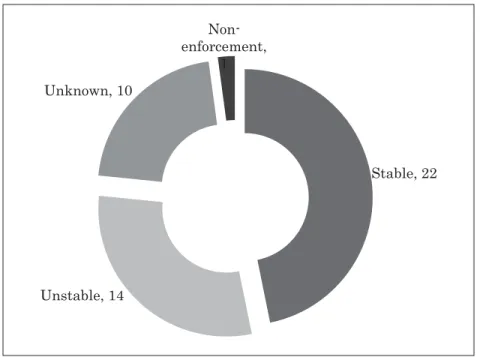
Twenty-two new drug substances were optically stable and 14 were unstable. Al- though 10substances did not have photostabil- ity data, we assume that photostability test- ing was performed(Fig. 3). Because most new drug substances are preserved under shaded condition, we conclude that the storage conditions are appropriate.
In conclusion, the present review included 47 new drug substances that were approved in Japan in 2015 according to ICH guidelines, and all performed adequately.
ACKNOWLEDGMENTS
This work was supported by Individual Re- search Grants of the Nagasaki International Univer- sity. This paper includes the authors’ private
Fig. 3 Itemization of photostability testing
statements. No official support or endorsement by the Pharmaceuticals and Medical Devices Agency is intended, nor should be inferred.
Conflict of Interest
The authors declare no conflict of interest.
REFERENCES
1) Harmonisation of Technical Requirements for Registration of Pharmaceuticals for Human Use Harmonised Tripartite Guideline, Stability testing of New Drug Substances and Products Q1A(R2). Step 5. ICH. Available at URL:
http://www.pmda.go.jp/files/000156241.pdf.
2) Harmonisation of Technical Requirements for Registration of Pharmaceuticals for Human Use Harmonised Tripartite Guideline, Stability:
photostability testing of new drug substances and products. Step 5. ICH. Available at URL:
http://www.pmda.go.jp/files/000156436.pdf.
3) Harmonisation of Technical Requirements for Registration of Pharmaceuticals for Human Use Harmonised Tripartite Guideline, Stability testing for new dosage forms. Step 5. ICH.
Available at URL: http://www.pmda.go.jp/
files/000156930.pdf.
4) Harmonisation of Technical Requirements for Registration of Pharmaceuticals for Human Use Harmonised Tripartite Guideline, Bracketing and matrixing designs for stability testing of new drug substances and products. Step 5.
ICH. Available at URL: http://www.pmda.go.
jp/files/000156892.pdf.
5) Harmonisation of Technical Requirements for Registration of Pharmaceuticals for Human Use Harmonised Tripartite Guideline, Evaluation for stability data. Step 5. ICH. Available at URL:
http://www.pmda.go.jp/files/000156239.pdf.
6) Pharmaceuticals and Medical Devices Agency Information for approved drugs in Japan, Available at URL: http://www.pmda.go.jp/
PmdaSearch/iyakuSearch/
7) H. Nagaoka, T. Ohtsubo, T. Kishi, Y. Deguchi, M. H. Nagaoka, H. Ohmuro and. Stability Testing of Drug Substances Approved by the Japanese Government in 2014. Nagasaki Inter- national Review(Accept)