Introduction
Eighteen new and interesting taxa from a taxo- nomic viewpoint have been found during the course of a floristic investigation of vascular plants of Suzaki, Shimoda City, Izu Peninsula. In this paper, 12 new varieties, 4 new forms, a new hybrid and a new rank are reported as a continua- tion of a previous paper (Konta et al., 2005).
These taxa are as follows. Arisaema urashima H. Hara var. gigantum Konta, Akebia trifoliata (Thunb.) Koidz. var. litoralis Konta & Katsuya- ma, Viburnum dilatatum Thunb. ex Murray var.
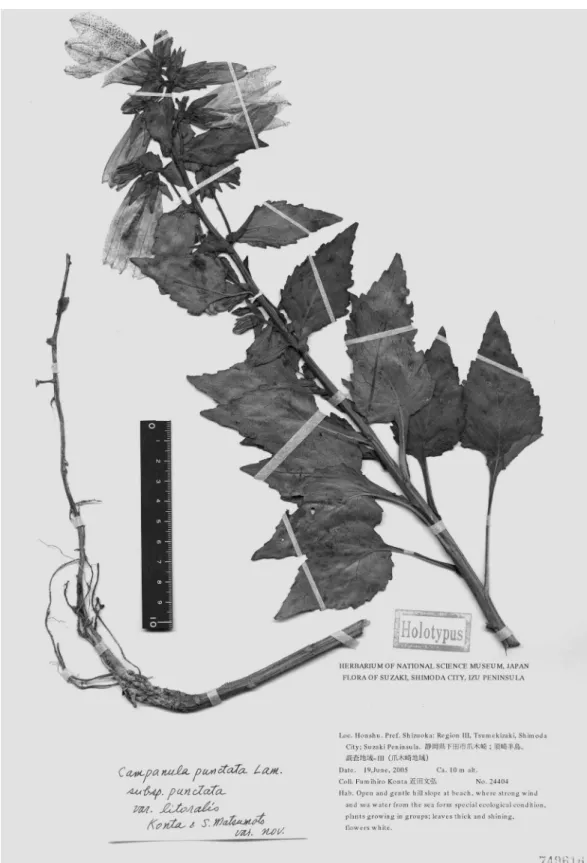
litorale Konta & Katsuyama, Lysimachia clethroides Duby var. crassifoliosa Konta, Cam- panula punctata Lam. subsp. punctata var. litoralis Konta & S. Matsumoto, Campanula
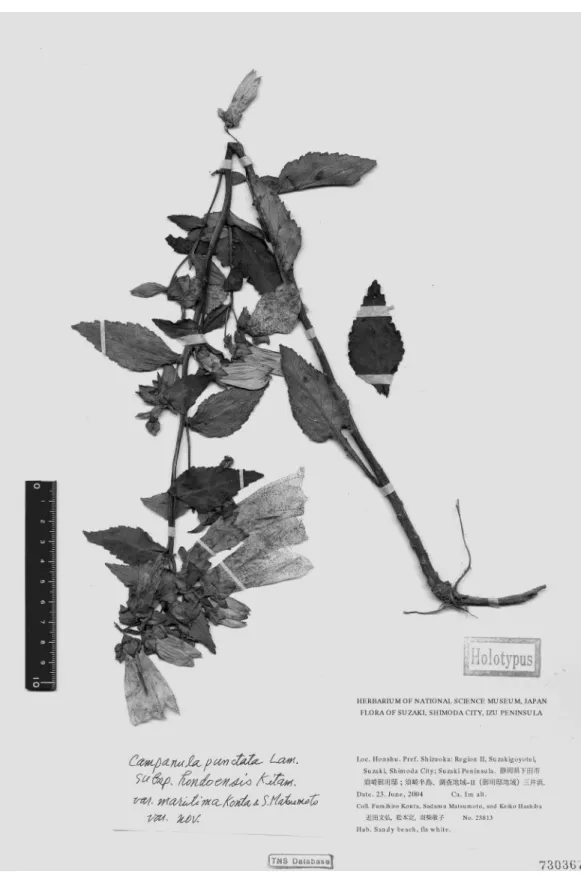
puctata Lam. subsp. hondoensis Kitam. var. mar- itima Konta & S. Matsumoto, Atractylodes japonica Koidz. ex Kitam. var. coriacea
Konta&
Katsuyama, Salvia japonica Thunb. var. crassifo- lia Konta & S. Matsumoto, Viola sieboldii Maxim. var. litoralis Konta & Katsuyama, Cirsi- um japonicum DC. var. maritima Konta & Kat- suyama, Scilla scilloides (Lindl.) Druce var.
litoralis Konta, Hovenia dulcis var, crassifolia Konta, Euphorbia lasiocaula Boiss. var. mariti- ma (Hurus.) S. Matsumoto & Konta, Callicarpa japonica Thunb. var. luxurians Rehder forma albiflos Konta, Allium shoenoprasum L. var.
idzuense (H. Hara) H. Hara forma purpurea Konta, Lycoris sanguinea Maxim. forma palensf- los Konta, Vincetoxicum izuense forma chloran- tum Katsuyama & Konta, and Hemerocallis fal-
New Infraspecific Taxa and a Hybrid of Vascular Plants from Suzaki, Shimoda City, Central Japan
Fumihiro Konta
1, Sadamu Matsumoto
2, and Teruo Katsuyama
31Department of Botany, National Science Museum, Amakubo 4–1–1,Tsukuba 305–0005 Japan
E-mail: [email protected]
2Tsukuba Botanic Garden, National Science Museum, Amakubo 4–1–1, Tsukuba, 305–0005 Japan
3Kanagawa Prefectural Museum of Natural History, 499, Iryuda, Odawara, Kanagawa, 250–0031 Japan
Abstract Sixteen new infraspecific taxa of vascular plants and a hybrid as well as a new rank are described from Suzaki, Shimoda City, Izu Peninsula in this paper; Arisaema urashimaH.Hara var.
gigantumKonta, Akebia trifoliata(Thunb.) Koidz. var. litoralisKonta & Katsuyama, Viburnum di- latatum Thunb. ex Murray var. litorale Konta & Katsuyama, Lysimachia clethroides Duby var.
crassifoliosaKonta, Campanula punctataLam. subsp. punctatavar. litoralisKonta & S. Matsumo- to, Campanula puctata Lam. subsp. hondoensisKitam. var. maritima Konta & S. Matsumoto, Atractylodes japonicaKoidz. ex Kitam. var. coriaceaKonta & Katsuyama, Salvia japonicaThunb.
var. crassifoliaKonta & S. Matsumoto, Viola sieboldiiMaxim. var. litoralisKonta & Katsuyama, Cirsium japonicumDC. var. maritima Konta & Katsuyama, Scilla scilloides(Lindl.) Druce var.
litoralisKonta, Hovenia dulcisvar. crassifoliaKonta, Euphorbia lasiocaulaBoiss. var. maritima (Hurs.) S. Matsumoto & Konta Callicarpa japonicaThunb. var. luxuriansRehder forma albiflos Konta, Allium shoenoprasum L. var. idzuense (H.Hara) H.Hara forma purpureaKonta, Lycoris sanguineaMaxim. forma palensflosKonta, Vincetoxicum izuenseforma chlorantumKatsuyama &
Konta, and HemerocallisfallaxlittoreaKonta & S. Matsumoto.
Key words : Suzaki, vascular plants, new infraspecific taxa, new hybrid.
Bull. Natn. Sci. Mus., Tokyo, Ser. B, 31(4), pp. 133–159, December 22, 2005
laxlittorea Konta & S. Matsumoto.
Materials and Methods
Materials were collected throughout Suzaki Peninsula, Shimoda City, Shizuoka, including the Suzaki Imperial Villa, which is situated on the eastern coast of Suzaki Peninsula. Most herbari- um specimens of flowering plants were collected in their blooming or fruiting seasons. These spec- imens are preserved in TNS.
Description
1. Arisaema urashima H. Hara var. gigantum Konta variety nov.
Affinis Arisaemati urashimate var. urashimate, sed lamina valde giganto et lucido et coriaceo di- versus.
Habit. Tuber depressed-globose, 9 cm in di- ameter, 6 cm in height, with 11 small lateral tu- bers on the upper part; leaf solitary, leaf sheath 20 cm long, the petiole terete, nearly erect, 65 cm long, 2.2 cm in diameter at the base, the leaflets 17 with one deeply split into a large lobe and a small one, oblong to oblanceolate, acuminate, the biggest one 33 cm long, 13 cm wide, coriaceous, 0.2 mm thick, deep green, and concave along veins on the adaxial side, lustrous, pale green on the abaxial one; peduncle 15 cm long, the fruit- ing spadix club shaped, 5.5 cm long 4.5 cm in di- ameter with young fruits.
Habitat. Growing in groups on the floor of mixed forest of evergreen and deciduous trees, ca. 3–5 m in height, on the top of a small hill pro- truding into the sea, 20 m above the sea level, where strong sunlight through canopy of the trees and warm temperature prevailing throughout the year.
Type. Japan. Honshu. Shizuoka: Suzaki, Shi- moda City, Suzaki Peninsula; Tsumeki-zaki, F.
Konta, 24477, I–VII (Holotype is composed of 7 sheets designated by I–VII Roman numerals fol- lowing the collection number, TNS, Fig. 1, Fig.
8-1). F. Konta, 24342 (Paratype, TNS).
Japanese name. Oh-urashimaso.
Notes. Var. gigantum is characterized by dis- tinctively large and thick, lustrous leaves. The size of the largest leaflet of the typical variety is distributed within 18 cm long and 3.5 cm wide, the length of the petiole is distributed within 40 cm long, and the size of the tuber is distributed within 6 cm in diameter.
2. Akebia trifoliata (Thunb.) Koidz. var.
litoralis Konta & Katsuyama var. nov.
Affinis Akebiae trifoliatae var. litorali, sed folium valde magnifica et coriacea et lucida di- versus.
Habit. and habitat. Glabrous woody climber climbing up to the top of thicket or trees near the sea shore and cover them; leaves trifoliolate, leaflets very big on the upper part of vine cover- ing surface of thicket or canopy of trees, ovate to narrowly ovate, 10–13 cm long, 10–12 cm wide, entire, coriaceous, 0.33–0.35 mm thick, deep green, concave along veins, and lustrous on the adaxial surface, margin abaxially recurved.
Type. Japan. Honshu. Shizuoka: Suzaki, Shi- moda City, Suzaki Peninsula; Tsumeki-zaki, F.
Konta, 24492 (TNS, Fig. 2). F. Konta, 24484 (Isotype, TNS).
Japanese name. Hama-mitsuba-akebi.
Notes. This new variety grows sunny place near the sea shore. Leaves grow 2–3 times bigger than the typical variety and thicker with lustrous surface (Fig. 8-2).
3. Viburnum dilatatum Thunb. ex Murray var. litorale Konta & Katsuyama var. nov.
Affinis Viburno dilatato variety dilatato, sed lamina minusculo, luceo, crasso et paucihirto di- versus.
Habit. Deciduous small shrub-like tree;
leaves elliptic to obovate, 3.5–9.0 cm long, 1.5–
6.0 cm wide, on the previous year’s branch, lin- ear-oblong, 7.0–9.5 cm long, 2.5–3.5 cm wide, on the hornotinous branch, coriaceous, lustrous, concave along veins, and dark green on the adax- ial side, pale green and glandular dotted on the abaxial one, low hair density on the both sides;
inflorescence 3–7(10) cm across, corolla 4–5
New Infraspecific Taxa and a Hybrid of Vascular Plants from Suzaki 135
Fig. 1. Holotype of Arisaema urashimavar. gigantum.
Fig. 2. Holotype of Akebia trifoliatavar. litoralis.
New Infraspecific Taxa and a Hybrid of Vascular Plants from Suzaki 137
Fig. 3. Holotype of Viburnum dilatatumvar. litorale.
lobed, 4–6 mm in diameter, white, fragrant, sta- mens longer than corolla-lobes.
Habitat. Thickets on hill slopes near the sea shore. Holotype is in the dense mixed thickets of evergreen and deciduous trees of 2–4 m in height in open valley facing the sea, where strong winds usually blow hard from the sea to the top of the valley. Specially strong winds by the typhoons in autumn in 2004 blew out almost leaves of the de- ciduous trees including this new plant.
Type. Japan. Honshu. Shizuoka: Suzaki, Shi- moda City, Suzaki Peninsula; Tsumekizaki, F.Konta, 24304-a (Holotype, TNS, Fig. 3, Fig. 8- 3). F.Konta 24304-b, (Isotype; TNS). F.Konta 23940, 24298, 24309, The Suzaki Imperial Villa., Sotoura, F.Konta 24324 (Paratypus, TNS).
Japanese name. Sonare-gamazumi.
Notes. This new variety has taxonomic char- acteristics, which share linear-oblong leaves on the hornotinous branch with forma heterophyl- lum (Nakai) Sugimoto, and smaller leaves with forma microphyllum (Nakai) Sugimoto. This new variety is considered to be a littoral type of Viburnum dilatatum with characteristics of leaves of coriaceous, lustrous and dark green on the adaxial side, almost glabrous condition, all of which show adaptation one. Larger leaves of this new variety than those of forma microphyllum seems also to show adaptation characteristic.
4. Lysimachia clethroides Duby var. crassifo- liosa Konta var. nov.
Affinis Lysimachiae clethroidi forma clethroidi, sed lamina crassa et ovali diversus.
Habit. Stems erect, 35–80 cm high, terete, pubescent; leaves oblong to oblong-lanceolate or ovate, 4–13 cm long, 2–6 cm wide, acuminate to attenuate-acuminate at apex, acuminate to short stipe at base, entire, sometimes reflexed to the abaxial side, coriaceous, 0.3 mm thick, densely pubescent on both sides, pubescences on the adaxial side thicker, 0.3–0.5 mm long, more densely on veins, those on the abaxial side thin- ner, and longer, 0.7–10.0 mm long.
Habitat. Growing in groups on weedy road- side bank and hill continuing form the bank,
where strong winds often blow from the sea.
Type. Japan. Honshu. Shizuoka: Suzaki, Shi- moda City, Suzaki Peninsula; The Imperial Villa, F.Konta, 24430-a (Holotype, TNS, Fig. 4, Fig.
8-4). F.Konta, 24430-b,c,d (Isotypes, TNS).
F.Konta, 24395-a,b,s,d (Paratypes, TNS).
Japanese name. Isokaze-okatorano-o
5. Campanula punctata Lam. subsp. puncta- ta var. litoralis Konta & S. Matsumoto var.
nov.
— Campanula punctata Lam. forma lucida Sugimoto, in Pl. Izu. 181 (1962) nom. nud.
Affinis Campanulae punctatae subsp. punc- tatae var. punctatae, sed lamina coriacea et luci- da et litorali distributionali diversus.
Habit. Stems erect, 30–80 cm high, terete, pubescent; cauline leaves ovate to triangular, 4–9 cm long, 2–4 cm wide, acuminate, irregularly ob- tuse-toothed, coriaceous, lustrous, deep green, and concave along veins on the adaxial side, thinly pubescent on both sides, long petiolated on the lower cauline, sessile on the upper one, calyx segments deltoid-lanceolate with a reflexed ap- pendage in the sinus; corolla white, with dark spots.
Habitat. Growing in groups on open and weedy place near the sea shore.
Type. Japan. Honshu. Shizuoka: Suzaki, Shi- moda City, Suzaki Peninsula; Tsumekizaki, F.Konta 24404-a (Holotype, TNS, Fig. 5, Fig. 8- 5). F.Konta 24404-b (Isotype, TNS).
Japanese name. Hama-hotarubukuro.
Notes. Sugimoto noted that forma lucida is a type of plants growing at beach with thick and lustrous leaves. We observed a great number of the same plants growing on hill slopes near the sea shore of Suzaki and recognized them var.
litoralis because of the reason that they share both morphological and geographical features.
6. Campanula puctata Lam. subsp. hondoen- sis Kitam. var. maritima Konta & S. Matsumo- to var. nov.
— Campanula punctata Lam. subsp. hondoen-
sis Kitam. forma hatsushimensis Sugimoto, in Pl.
New Infraspecific Taxa and a Hybrid of Vascular Plants from Suzaki 139
Fig. 4. Holotype of Lysimachia clethroidesvar. crassifoliosa.
Fig. 5. Holotype of Campanula puctatasubsp. punctatavar. litoralis.
New Infraspecific Taxa and a Hybrid of Vascular Plants from Suzaki 141
Fig. 6. Holotype of Campanula puctatasubsp. hondoensisvar. maritima.
Izu. 181 (1962) nom. nud.
Affinis Campanulae punctatae subsp. hon- doensi var. hondoensi, sed lamina coriacea et lu- cida et litorali distributionali diversus.
Habit. and habitat. Leaves lustrous and con- cave along veins on the adaxial side; calyx seg- ments without a reflexed appendage in the sinus- es; corolla white with dark spots; several groups of plants of this forma growing on sandy beach in the Imperial Villa, 1 m above the sea level.
Type. Japan. Honshu. Shizuoka: Suzaki, Shi- moda City, Suzaki Peninsula; The Imperial Villa, F. Konta et al. 23813 (Holotype, TNS, Fig. 6, Fig. 8-6).
Japanese name. Sonare-yamahotarubukuro.
Notes. Sugimoto noted that many individuals of this type of plants with lustrous leaves were observed in Hatsushima Island, a small island in Atami City in Shizuoka Prefecture. We con- firmed this type of plants near beach of Suzaki.
7. Atractylodes japonica Koidz. ex Kitam.
var. coriacea Konta & Katsuyama var. nov.
Affinis Atractylodi japonicae var. japonicae, sed folio coriacea et lucida diversus.
Habit. and habitat. Perennial herb; stem erect, 30–70 cm in height, hard, rather woody, hairy; radicasl leaves withering before anthesis, the cauline firmly coriaceous, long petiolate, ob- long to pinnately 3–6 sected, 5–12 cm long, short spinulos on margin, glabrous, lustrous, and con- cave along veins on the adaxial side, hirtellous and tomentose on the abaxial; rather dry and weedy roadside bank, where strong winds from the sea often blow up.
Type. Japan. Honshu. Shizuoka: Suzaki, Shi- moda City, Suzaki Peninsula; The Imperial Villa, F.Konta 24369-a (Holotype, TNS, Fig. 7, Fig. 8- 7). F.Konta 24369-b (Isolotype, TNS). F.Konta 23274 (Paratype, TNS).
Japanese name. Hama-okera.
Notes. This new variety is distinctive in the thick and lustrous leaves.
8. Salvia japonica Thunb. var. crassifolia Konta & S. Matsumoto var. nov.
Affinis Salviae japonicae var. japonicae, sed folio crassa et lucida diversus.
Habit. and habitat. Perennial herb, stem erect 40–70 cm in height; stem hirsute, leaves simple or once or twice pinnate, opposite, serrate at margin, coriaceous, almost glabrous with short hairs on veins, and concave along veins on the adaxial side, pubescent on the abaxial; flowers purple; sunny and weedy place near beach or on hills near the sea shore.
Type. Japan. Honshu. Shizuoka: Suzaki, Shi- moda City, Suzaki Peninsula; Tsumekizaki, F.Konta 24459 (Holotype, TNS , Fig. 9, Fig. 15- 1).
Japanese name. Sonare-akinotamuraso.
Notes. This new variety is distinctive in the thick leaves.
9. Viola sieboldii Maxim. var. litoralis Konta
& Katsuyama var. nov.
Affinis Viola sieboldo var. sieboldo, sed folio crassa et lucida adaxiali et purpurascenti abaxiali diversus.
Habit. and habitat. Small herb, leaves ovate to ovate-cordate, 1.0–4.0 cm long, 0.7–3.0 cm wide, obtuse, cordate at base, depressed-toothed, coriaceous, lustrous and deep green with thin short, white hairs at margin on the adaxial, pur- plish on the abaxial side; flowers white with pur- ple stripes inside. Muddy bank in evergreen for- est or roadside bank, in light shade, near the seashore, ca. 10–40 m above the sea level.
Type. Japan. Honshu. Shizuoka: Suzaki, Shi- moda City, Suzaki Peninsula; Tsumekizaki, F.Konta 24250 (Holotype, TNS, Fig. 10, Fig. 15- 2), F.Konta 22799 (Paratype, TNS).
Japanese name. Sonare-fumotosumire.
10. Cirsium japonicum DC. var. maritimum Konta & Katsuyama var. nov.
Affinis Cirsiuo japonico var. horrido, sed folio coriaceo et lucido et bractea involucrali breviseto diversus.
Habit. Stems erect, 40–80 cm high, terete,
New Infraspecific Taxa and a Hybrid of Vascular Plants from Suzaki 143
Fig. 7. Holotype of Atractylodes japonicavar. coriacea.
Fig. 8. Habit of new varieties. 1. Holotype of Arisaema urashimavar. gigantum. 2. Akebia trifoliatavar. litori- colashowing leaves lustrous and concave above. 3. Viburnum dilatatumvar. litoraleshowing lustrous dark green leaves, concave lamina along veins, 4. Holotype of Lysimachia clethroidesvar. crassifoliosashowing thick pubescent leaves. 5. Holotype of Campanula puctatasubsp. punctatavar. litoralisshowing lustrous leaves. 6. Campanula puctatasubsp. hondoensisvar. litoralis, which grow at beach showing lustrous leaves.
7. Holotype of Atractylodes japonicavar. coriaceashowing thick leaves.
New Infraspecific Taxa and a Hybrid of Vascular Plants from Suzaki 145
Fig. 9. Holotype of Salvia japonicavar. crassifolia.
Fig. 10. Holotype of Viola sieboldiivar. litoralis.
pubescent; radical leaves ovate-oblong, 15–30 cm long, pinnately cleft to toothed, long spines at margin, 4–7 mm long, mid cauline leaves ovate to oblong, pinnately cleft 8–20 cm long, acuminate, coriaceous, lustrous and deep green or fresh green on the adaxial side, thinly pubescent on both sides, long spines at margin, 4–7 mm long (Fig. 15-3); spines on the tip of involcure bracts short, 2–4 mm long, corolla purple.
Habitat. Growing at open and weedy place near the sea shore.
Type. Japan. Honshu. Shizuoka: Suzaki, Shi- moda City, Suzaki Peninsula; Tsumekizaki, F.Konta 24294 (Holotype, TNS, Fig. 11). F.Konta 22651, 23805, Katsuyama et al. 30528009 (Paratypes, TNS).
Japanese name. Shiokaze-noazami.
11. Scilla scilloides (Lindl.) Druce var.
litoralis Konta var. nov.
Affinis Scillae scilloidi var. scilloidi, sed lami- na ampla et crassa diversus.
Habit. and habitat. Bulbs ovoid-globose, 3.5–5.0 cm long, 2.0–3.5 cm wide, leaves linear 2–4 in number, 5.0–22.0 cm long, 5.0–13.0 mm wide, 0.45–0.85 mm thick, smooth, flowers rose- purple, open and grassy place by beach, where is exposed by strong sunlight and winds from the sea.
Type. Japan. Honshu. Shizuoka: Suzaki, Shi- moda City, Suzaki Peninsula; Tsumekizaki, F.Konta 24507 (Holotype, TNS, Fig. 12, Fig. 15- 4). F.Konta 23911, 23938 (Paratypes, TNS ).
Japanese name. Hama-tsurubo.
12. Hovenia dulcis Thunb. var. crassifolia Konta var. nov.
Affinis Hovenia dulci var. dulci, sed folio cras- sa et lucida diversus.
Habit. Deciduous tree, leaves ovate, 5–16 cm long, 5–10 cm wide, short acuminate, rounded at base, coriaceus, 0.25–0.33 mm thick, deep green, lustrous, almost glabrous, and concave along veins on the adaxial side, pale green with brown hairs along vein on the abaxial side, flowers yel- lowish white.
Type. Japan. Honshu. Shizuoka: Suzaki, Shi- moda City, Suzaki Peninsula; Kakisaki, F.Konta 24448 (Holotype, TNS, Fig. 13, Fig. 15-5).
Japanese name. Atsuba-kenponashi.
Notes. Holotype is a tree, 8 m in height, 18 cm in trunk diameter growing in thickets by road near the sea, on hill slope at 30 m above the sea level. This species is rarely distributed in lower elevations of Izu Peninsula.
13. Euphorbia lasiocaula Boiss. var. maritima (Hurus.) S.Matsumoto & Konta stat. nov.
Euphorbia lasiocaula Boiss. var. lasiocaula f.
maritima (Hurus.) T. Kuros. et H. Ohashi in J.
Jap. Bot. 69: 273 (1994).
— Galarhoeus lasiocaulus (Boiss.) Hurusawa var. lasiocaulus f. maritimus Hurusawa in J. Fac.
Sci. Univ. Tokyo III, 6: 264 (1954).
Affinis Euphorbiae lasiocaulae var. lasio- caulae, sed caule florenti curto ca. 30 cm et basi repenti et lamina crasso diversus.
Japanese name. Hama-takatodai.
Notes. Several plants transplanted from the seashore of Suzaki to the Tsukuba Botanical Garden of The National Science Museum, Tokyo have kept their taxonomic features above cited through years. It is, therefore, concluded that populations being distributed at the seashore of Suzaki have both geographical and genetic varia- tions which suggest more distinct taxonomic po- sition.
14. Callicarpa japonica Thunb. var. luxurians Rehder forma albiflos Konta forma nov.
Affinis Callicarpae japonicae var. luxurianti forma luxurianti, sed flore alba diversus.
Habit. and habitat. Deciduous tree, 3 m in height; leaves opposite, petioles 2–3 cm long, blades oblong, acuminate, serrate, coriaceous, al- most glabrous on the adaxial side, with small stellate hairs on the abaxial side; cymes 5–7 cm in diameter, more than 250 flowers per a cyme, corolla white; edge of dense thickets near beach.
Type. Japan. Honshu. Shizuoka: Suzaki, Shi- moda City, Suzaki Peninsula; Tsumekizaki, F.Konta et al. 24428-a (Holotype, TNS, Fig. 14,
New Infraspecific Taxa and a Hybrid of Vascular Plants from Suzaki 147
Fig. 11. Holotype of Cirsium japonicumvar. maritima.
New Infraspecific Taxa and a Hybrid of Vascular Plants from Suzaki 149
Fig. 12. Holotype of Scilla scilloidesvar. litoralis.
Fig. 13. Holotype of Hovenia dulcisvar. crassifolia.
New Infraspecific Taxa and a Hybrid of Vascular Plants from Suzaki 151
Fig. 14. Holotype of Callicarpa japonicavar. luxuriansforma albiflos.
Fig. 15. Habit of new taxa and counterparts 1. Holotype of Salvia japonicavar. crassifoliashowing thick dark green leaves with concave surface along veins on the adaxial side. 2. Viola sieboldiivar. litoralisshowing lus- trous leaves. 3. Holotype of Cirsium japonicumvar. maritimashowing long spines on margin of leaves. 4.
Holotype of Scilla scilloidesvar. litoralisshowing thick and wide leaves. 5. Holotype of Hovenia dulcisvar.
crassifoliashowing thick dark green leaves with concave parts along veins. 6. Holotype of Callicarpa japoni- ca var. luxurians forma albiflosshowing white flowers. 7. Flowers of Callicarpa japonica var. luxurians forma luxuriansshowing pink flowers of common plants.
New Infraspecific Taxa and a Hybrid of Vascular Plants from Suzaki 153
Fig. 16. Holotype of Allium shoenoprasumvar. idzuenseforma purpuratum.
Fig. 17. Holotype of Lycoris sanguineaforma palensiflos.
New Infraspecific Taxa and a Hybrid of Vascular Plants from Suzaki 155
Fig. 18. Holotype of Vincetoxicum izuenseforma chlorantum.
Fig. 19. Holotype of Hemerocallisfallaxlittorea.
New Infraspecific Taxa and a Hybrid of Vascular Plants from Suzaki 157
Fig. 20. Habit of new taxa and counterparts. 1. Flower of holotype of Lycoris sanguineaforma palensiflos. 2.
Flower of Lycoris sanguinea forma sanguinea. 3. Flower of Allium shoenoprasum var. idzuense forma idzuense. 4. Flower of Allium shoenoprasumvar. idzuenseforma purpuratum. 5. Flower of Hemerocallis cit- rinavar. vespertina. 6. Flower of Hemerocallis fulvavar. littorea. 7. A flower of holotype of Hemerocallis fallaxlittorea. 8. Another flower type of Hemerocallisfallaxlittorea(S. Matsumoto 208165).
Fig. 15-6). F.Konta et al. 24428-a, b (Isolotype, TNS).
Japanese name. Shirobana-oh-murasakishik- ibu.
Notes. This new forma is only distinctive in the color of flowers (Fig. 15-7).
15. Allium shoenoprasum L. var. idzuense (H.
Hara) H. Hara forma purpuratum Konta forma nov.
Allium shoenoprasum L. var. idzuense (H.
Hara) H. Hara, in J. Jpn. Bot. 55: 214 (1980) — Allium idzuense H. Hara, in J. Jpn. Bot. 49: 1 (1974).
Affinis Allio shoenopraso var. idzuensi forma idzuensi, sed corolla purpurato diversus.
Type. Japan. Honshu. Shizuoka: Suzaki, Shi- moda City, Suzaki Peninsula; Tsumekizaki, F.Konta 24438 (Holotype, TNS, Fig. 16).
Japanese name. Izu-asatsuki.
Notes. H. Hara (1980) made a combination of Allium shoenoprasum var. idzuense, based on the type of Allium idzuense, which is character- ized by whitish flowers as well as leafless scape being separated from a tuft of leaves, looser um- bels, and less pointed tepals. The type was col- lected at the sea shore in The Suzaki Imperial Villa. H. Hara (1980) noted ‘Having observed a large number of individuals at the type locality, I noticed that the flowering scape arises mostly from the center of leaves and the flowers are pur- plish pink, and considered that it is better to treate the plant as a southern variety of A.
shoenoprasum L.’ A large number of individuals were observed by Konta at more than 10 places along the sea shore of Suzaki Peninsula in addi- tion of The Suzaki Imperial Villa, and only two plants with white flowers were recognized on the small rock protruded from the sea which is called Tsumeki Island (Fig. 20-3). Konta considers that these white flowered plants should be distin- guished as a forma level and called Shirobana- izu-asatsuki in Japanese. He checked carefully holotype and confirmed that all flowers in three inflorescences were strictly white color in younger stage of flowering. It is concluded that a
scientific name of Allium shoenoprasum var.
idzuense forma idzuense should be given to white flowered plants including the holotype. On the other hand, Allium shoenoprasum var. idzuense forma purpuratum is given to the common plants with purplish pink flowers under Japanese name, Izu-asatsuki (Fig. 20-4).
16. Lycoris sanguinea Maxim. forma palensf- los Konta forma nov.
Affinis Lycoridi sanguinae forma sanguinae, sed flore palescenti et rosea diversus.
Type. Japan. Honshu. Shizuoka: Suzaki, Shi- moda City, Suzaki Peninsula; F.Konta 24513 (Holotype, TNS, Fig. 17, Fig. 20-1).
Japanese name. Usuiro-kitsunenokamisori.
Notes. Lycoris sanguinea forma albiflora Honda was reported from Shikoku with white flowers. Forma palensflora is characterized by pale pink flower. Only two plants were recog- nized in a community with about 50 individuals (Fig. 20-2) growing in groups by path at moist place in light shade in a gorge, ca. 5 m above the sea level.
17. Vincetoxicum izuense T.Yamashiro forma chloranthus Katsuyama & Konta forma nov.
Affinis Vincetoxico izuensi forma izuensi, sed flore chlorantho diversus.
Type. Japan. Honshu. Shizuoka: Suzaki, Shi- moda City, Suzaki Peninsula; The Imperial Villa, S 12749 (Holotype, TNS, Fig. 18).
Japanese name. Midori-izukamomezuru.
18. Hemerocallis fallaxlittoralis Konta & S.
Matsumoto nothosp. nov.
Affinis Hemerocallidi citrinae var. vesperiti- nae, sed flore diuruna et aurantiaca diversus. Hy- brida Hemerocallis citrina var. vesperitina (Fig.
20-5) et H. fulva var. littorea (Fig. 20-6).
Type. Japan. Honshu. Shizuoka: Suzaki, Shi- moda City, Suzaki Peninsula; Tsumekizaki, F.Konta 28390 (Holotype, TNS, Fig. 19), S.Mats- umoto 208164, 208165, F.Konta 24483 (Paratypes, TNS).
Japanese name. Usugi-hamakanzo.
Notes. Holotype and paratypes (Fig. 20) grow togather with parent plants at open hill slope facing the sea, 40 m above the sea level.
This hybrid has flowering in the daytime, flowers have more yellow color than H. fulva var.
littorea, though degree of yellow is variable.
S.Matsumoto 208164 has yellowish flowers, but 208165 orange.
References
Konta, F., S. Matsumoto & T. Katsuyama, 2005. New and interesting taxa of vascular plants from Suzaki, Shimo- da City, Central Japan. Bull. Natn. Sci. Mus., Tokyo, Ser. B., 31: 19–33.
Hara, H. 1980. Comments on the East Asiatic plants (7).
J. Jpn. Bot., 55: 17–22.
New Infraspecific Taxa and a Hybrid of Vascular Plants from Suzaki 159