Clinicopathologic Characteristics and Prognosis of Advanced Gastric Cancer
Simulating Early Gastric Cancer
Hiroaki Saito, Kozo Miyatani, Seigo Takaya, Tomoyuki Matsunaga, Yoji Fukumoto, Tomohiro Osaki, Toshiro Wakatsuki and Masahide Ikeguchi
Division of Surgical Oncology, Department of Surgery, School of Medicine, Tottori University Faculty of Medicine, Yonago 683-8504, Japan
ABSTRACT
Background Although the clinicopathologic features and prognosis of Borrmann type advanced gastric cancer has been well characterized, those of advanced gastric cancer simulating early gastric cancer (AGC simulating EGC) still remains unclear.
Methods We reviewed 1985 gastric cancer patients who had undergone gastrectomy at our hospital to deter-mine the clinicopathologic characteristics, susceptible sites for lymph node metastasis, and prognosis of AGC simulating EGC in comparison with Borrmann type ad-vanced gastric cancer.
Results Among 102 patients with AGC simulating EGC, 100 patients (98%) had tumors with depressed type appearance. The frequencies of serosal invasion, lymph node metastasis, lymphatic vessel invasion, blood vessel invasion, and liver metastasis were significantly lower in AGC simulating EGC than in Borrmann type tumors. The prognosis of AGC simulating EGC was sig-nificantly better than that of the Borrmann type tumors. Multivariate analysis indicated that the gross appearance was an independent prognostic factor. In patients with AGC simulating EGC which invaded to the the muscu-laris propria (MP), most lymph node metastasis was re-stricted with the perigastric lymph nodes (1st-titer lymph nodes) and lymph node metastasis to 2nd-titer lymph nodes was only observed at station 8a.
Conclusion AGC simulating EGC is less advanced in comparison with Borrmann type advanced gastric can-cer. Based on the results of susceptible sites for lymph node metastasis in the current study, limited lymph node dissection could be indicated for AGC simulating EGC whose depth of invasion is MP.
Key words gastric cancer; gross appearance; lymph node dissection; prognosis
Gastric cancer is one of the most common cancers in Asia and its mortality still ranks second among all can-cer deaths worldwide.1 In Japan, gastrectomy with D2
lymph node dissection is performed safely and is widely accepted as a standard treatment for locally advanced
Corresponding author: Hiroaki Saito, MD [email protected]
Received 2013 June 24 Accepted 2013 July 30
Abbreviations: AGC simulating EGC, advanced gastric cancer simulating early gastric cancer; I-type, infiltrative type; JCGC, Japanese Classification of Gastric Cancer; L-type, localized type; LAG, laparoscopy-assisted gastrectomy; MP, muscularis propria; SE, serosa; SS, subserosa
gastric cancer.2, 3 On the other hand, Japanese gastric
cancer treatment guidelines recommend gastrectomy with limited lymph node dissection as a curative treat-ment for early gastric cancers,4 since lower incidence of
lymph node metastasis is expected in early gastric can-cer.5, 6, 7, 8 The accurate diagnosis of tumor depth prior to
surgery is important since surgeons must decide on the treatment strategy based on the preoperative findings. However, the accuracy of preoperative diagnosis of early gastric cancer is limited and has been reported as 92.4% to 95.4%.9, 10 This finding suggests that substantial
num-bers of patients who were clinically diagnosed early gastric cancer are actually advanced gastric cancer and might require D2 lymph node dissection as a curative treatment. Theoretically, additional surgery to achieve D2 lymph node dissection is required for patients with clinically early but pathologically advanced gastric cancer following gastrectomy with limited lymph node dissection. However, the feasibility of this additional sur-gery has not been investigated thus far.
The gross type of gastric cancer is classified into 6 types, 0 to 5, according to the Japanese Classification of Gastric Cancer (JCGC).11 Types 1, 2, 3 and 4 are based
on the Borrmann classification. Most advanced gastric cancers show Borrmann type appearance while most early gastric cancers show type 0 appearance. However, it was reported that some advanced cancers show type 0 appearance like early gastric cancer, namely advanced gastric cancer simulating early gastric cancer (AGC simulating EGC).12 The clinicopathologic features and
prognosis of Borrmann type advanced gastric cancer, especially Borrmann type 4 gastric cancer, has been well characterized thus far.13, 14, 15 However, the
clini-copathologic features and prognosis of AGC simulat-ing EGC still remain unclear thus far. Of importance
is that AGC simulating EGC is likely to be clinically diagnosed as early gastric cancer prior to operation. As a result, limited lymph node dissection might be performed for those patients, which might be an insuffi-cient treatment according to the Japanese gastric cancer treatment guidelines. On the other hand, there might be a difference in the 5-year survival rate and clinicopatho-logical characteristics, including susceptible site and the incidence of the lymph node metastasis, between AGC simulating EGC and Borrmann type advanced gastric cancer. Moreover, if AGC simulating EGC is associated with lower incidence of lymph node metastasis and bet-ter prognosis, gastrectomy with limited lymph node dis-section may provide a suitable curative treatment option. In the present study, we investigated the clinicopatho-logical characteristics and long-term survival outcome of AGC simulating EGC and Borrmann type advanced gastric cancer. Furthermore, the susceptible sites for lymph node metastasis in AGC simulating EGC were also evaluated to clarify whether limited lymph node dissection could be indicated in these patients.
MATERIALS AND METHODS Patients
This study examined 1985 consecutive gastric adeno-carcinoma patients, 1266 male and 719 female, who had
undergone gastrectomy at our institution between Janu-ary 1975 and December 2000. Ages ranged between 20 and 93 years with an average age of 62 years. The clinicopathological findings were determined according to JCGC.11 All had undergone distal partial gastrectomy,
proximal partial gastrectomy or total gastrectomy with regional lymph node dissection to group 1 (D1), group 2 (D2) or group 3 (D3).
At the time of analysis, the median follow-up for 1074 survivors was 108 months. Of the 911 deaths, 560 were related to recurrence of gastric cancer, 57 were due to another malignancy and 279 were due to another dis-ease or accident. The cause of death was unknown in 15 patients.
AGC simulating EGC was defined as advanced gas-tric cancer with early gasgas-tric cancer-like gross appear-ance (type 0). According to JCGC, the endoscopic classi-fication is as follows: elevated type, I (protruded) and IIa (superficial elevated); flat type, IIb; or depressed type, IIc (superficial depressed) and III (excavated). There are also mixed types of tumor, such as IIc + III, IIa + IIc, etc. The first designation indicates the dominant macro-scopic type in the description of a mixed type of tumor. When the elevated lesion had a depressed area, as in the IIa + IIc type, we classified it as a depressed type tumor in the present study.
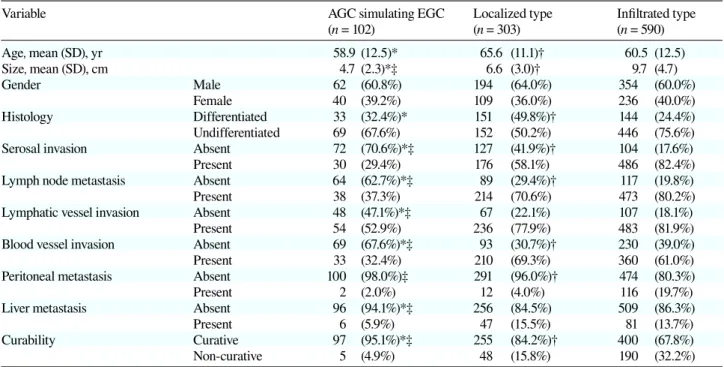
Table 1. Clinicopathologic characteristics of AGCs according to gross type appearance
Variable AGC simulating EGC Localized type Infiltrated type
(n = 102) (n = 303) (n = 590) Age, mean (SD), yr 58.9 (12.5)* 65.6 (11.1)† 60.5 (12.5) Size, mean (SD), cm 4.7 (2.3)*‡ 6.6 (3.0)† 9.7 (4.7) Gender Male 62 (60.8%) 194 (64.0%) 354 (60.0%) Female 40 (39.2%) 109 (36.0%) 236 (40.0%) Histology Differentiated 33 (32.4%)* 151 (49.8%)† 144 (24.4%) Undifferentiated 69 (67.6%) 152 (50.2%) 446 (75.6%)
Serosal invasion Absent 72 (70.6%)*‡ 127 (41.9%)† 104 (17.6%)
Present 30 (29.4%) 176 (58.1%) 486 (82.4%)
Lymph node metastasis Absent 64 (62.7%)*‡ 89 (29.4%)† 117 (19.8%)
Present 38 (37.3%) 214 (70.6%) 473 (80.2%)
Lymphatic vessel invasion Absent 48 (47.1%)*‡ 67 (22.1%) 107 (18.1%)
Present 54 (52.9%) 236 (77.9%) 483 (81.9%)
Blood vessel invasion Absent 69 (67.6%)*‡ 93 (30.7%)† 230 (39.0%)
Present 33 (32.4%) 210 (69.3%) 360 (61.0%)
Peritoneal metastasis Absent 100 (98.0%)‡ 291 (96.0%)† 474 (80.3%)
Present 2 (2.0%) 12 (4.0%) 116 (19.7%)
Liver metastasis Absent 96 (94.1%)*‡ 256 (84.5%) 509 (86.3%)
Present 6 (5.9%) 47 (15.5%) 81 (13.7%)
Curability Curative 97 (95.1%)*‡ 255 (84.2%)† 400 (67.8%)
Non-curative 5 (4.9%) 48 (15.8%) 190 (32.2%)
AGC simulating ECG, advanced gastric cancer simulating early gastric cancer; differentiated, papillary or tubular adenocarcinoma; un-differentiated, poorly differentiated or mucinous adenocarcinoma, or signet-ring cell carcinoma.
* AGC simulating EGC versus localized type; P < 0.05. † Infiltrated type versus localized type; P < 0.05. ‡ AGC simulating EGC versus infiltrated type; P < 0.05.
Statistical analysis
The significance of the differences among the means was determined by the Mann-Whitney U test. Survival curves were calculated according to the Kaplan-Meier method. Survival data shown in the current study were for cancer-specific survival. To this end, deaths not from gastric cancer were considered as lost to follow-up as of time of death. Differences between survival curves were examined with the log rank test. Multivariate analysis of prognostic factors related to survival was performed us-ing the Cox proportional hazards model and a step-wise procedure. The accepted level of significance was P < 0.05. Stat View software (Abacus Concepts, Berkeley, CA) was used for all statistical analyses.
RESULTS
There were 102 patients (9.4%) with AGC simulating EGC, 30 patients (2.8%) with Borrmann type 1, 273 patients (25.3%) with Borrmann type 2, 396 patients (36.6%) with Borrmann type 3 and 194 patients (17.9%) with Borrmann type 4 tumors. Borrmann type 1 and 2 tumors were considered localized type (L-type) and Borrmann type 3 and 4 were considered infiltrative type (I-type) in the analysis. Among 102 patients with AGC simulating EGC, IIa was observed in 2 patients, IIa + IIc in 10 patients, IIc in 74 patients and IIc + III in 16 patients, indicating that 100 patients (98%) with AGC simulating EGC showed depressed type tumors.
Table 1 shows the correlation between gross appear-ance and clinicopathologic factors. Patients with AGC simulating EGC were significantly younger than those with L-type tumors. The tumor size of AGC simulating EGC was significantly smaller than that of L-type and I-type tumors. Undifferentiated carcinoma was more
Fig. 1. The 5-year survival rates in early gastric cancer with inva-sion to SM, AGC simulating EGC, L-type and I-type tumors, re-spectively. The prognosis of AGC simulating EGC is significantly better than that of L-type and I-type, and significantly worse than that of early gastric cancer with invasion to SM. AGC simulating EGC, advanced gastric cancer simulating early gastric cancer; I-type, infiltrative type; L-I-type, localized type; SM, submucosa.
Table 2. Association of various factors with survival determined by the Cox proportional hazards model and a stepwise procedure
Prognostic factor P value Hazard ratio 95% CI
Age* 0.0013 1.013 1.005–1.021
Tumor size* 0.0004 1.036 1.016–1.056
Depth of invasion (t2–t4)† < 0.0001 1.484 1.261–1.748
Lymph node metastasis (n0–n3)‡ < 0.0001 1.460 1.340–1.591
Lymphatic vessel invasion (ly0–ly3)§ 0.0108 1.118 1.026–1.218
Peritoneal metastasis (absent or present) < 0.0001 1.332 1.186–1.496
Liver metastasis (absent or present) < 0.0001 1.446 1.263–1.656
Curability (curative or noncurative) < 0.0001 0.358 0.278–0.460
Gross appearance AGC simulating EGC (versus I-type) 0.0014 0.437 0.263–0.727
L-type (versus I-type) 0.0007 0.677 0.540–0.849
AGC simulating EGC, advanced gastric cancer simulating early gastric cancer; CI, confidence interval; I-type, infiltrative type; L-type, localized type.
*Continuous variable.
†t2, tumor has invaded the muscularis propria or the subserosa; t3, penetrating the serosa; t4, invading adjacent organs. ‡n0, no regional lymph node metastasis; n1, n2 and n3, metastasis in groups 1, 2 and 3 lymph nodes, respectively. §Lymphatic invasion: ly0–ly3, grade of lymphatic vessel invasion.
frequently observed in AGC simulating EGC than in L-type tumors. The frequency of serosal invasion, lymph node metastasis, lymphatic vessel invasion, blood vessel invasion and liver metastasis were significantly lower in AGC simulating EGC than in L-type and I-type tumors. Peritoneal metastasis was less frequently observed in AGC simulating EGC than in I-type tumors. Moreover, a curative operation could be performed more frequently in patients with AGC simulating EGC than in those with L-type and I-type tumors.
The 5-year survival rates were 87.8%, 60.7% and 32.4% in AGC simulating EGC, L-type and I-type tumors, respectively (Fig. 1). The prognosis of AGC
simulating EGC was significantly better than that of L-type and I-L-type. There were 448 early gastric cancer patients with invasion to the submucosa during the same period. The 5-year survival rate of these patients was 97.9%, which was significantly better than that of AGC simulating EGC (Fig. 1). To determine whether AGC simulating EGC is an independent prognostic factor in advanced gastric cancer, multivariate analysis using Cox proportional hazard model and a stepwise procedure was applied. Multivariate analysis indicated that the gross appearance was an independent prognostic factor as well as age, tumor size, depth of invasion, lymph node metastasis, lymphatic vessel invasion, peritoneal metas-tasis, liver metastasis and curability (Table 2).
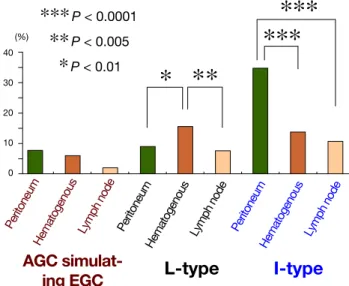
With regard to the mode of recurrence, peritoneal recurrence (7.8%) was the most frequent site, followed by hematogenous (5.9%) and lymph node recurrence (1.7%) in patients with AGC simulating EGC (Fig. 2). Peritoneal recurrence (34.7%) occurred significantly more than hematogenous (13.7%) or lymph node recur-rence (10.5%) in patients with I-type advanced cancer. On the other hand, hematogenous recurrence (15.5%) occurred significantly more than peritoneal (8.9%) or lymph node recurrence (7.6%) in patients with L-type advanced cancer.
Figure 3 shows the frequency of lymph node me-tastasis of AGC simulating EGC according to the depth of invasion. In patients with tumors which invade the muscularis propria (MP), most lymph node metastasis was restricted with the perigastric lymph nodes (1st-titer lymph nodes) and lymph node metastasis to 2nd-titer lymph nodes was only observed at station 8a. On the other hand, lymph node metastasis to 2nd-titer lymph nodes was observed at stations 9, 11 and 12a as well as station 8a in patients with tumor that invaded the subse-rosa (SS) or penetrated the sesubse-rosa (SE).
Fig. 3. The frequency of lymph node metastasis at each lymph node station according to the depth of invasion. In patients with MP tumors, most lymph node metastasis was restricted with the perigastric lymph nodes (1st-titer lymph nodes) and lymph node metastasis to 2nd-titer lymph nodes was only observed at station 8a. On the other hand, lymph node metastasis to 2nd-titer lymph nodes was observed at stations 9, 11 and 12a as well as station 8a in patients with SS and SE tumors. MP, muscularis propria; SE, se-rosa; SS, subserosa.
Fig. 2. The site of recurrence in each type of tumor. Peritoneal recurrence is the most frequent site, followed by hematogenous and lymph node sites in patients with either AGC simulating EGC or I-type tumors. On the other hand, hematogenous recurrence is the most frequent site, followed by peritoneal or lymph node recurrence in patients with L-type tumors. AGC simulating EGC, advanced gastric cancer simulating early gastric cancer; I-type, infiltrative type; L-type, localized type.
DISCUSSION
The classification of advanced gastric cancer into 4 gross morphological types by Borrmann in 192616 is presently
accepted by many surgeons throughout the world.17 This
reflects unique characteristics of each type of tumor in gastric cancer. For instance, Borrmann type 4 gastric cancer can be characterized by a high incidence of poor-ly differentiated tumor and peritoneal metastasis, and extremely poor prognosis.14, 15 Chen et al. reported that
Borrmann type 1 gastric cancer could be characterized by its presence in the upper stomach, a high incidence of
intestinal type, a less advanced stage and good progno-sis.13
In the present study, we demonstrated that the fre-quencies of serosal invasion, lymph node metastasis, lymphatic vessel invasion, blood vessel invasion and liver metastasis were significantly lower in AGC simu-lating EGC than in L-type and I-type tumors. Peritoneal metastasis was less frequently observed in AGC simulat-ing EGC than in I-type tumors. Furthermore, the prog-nosis of AGC simulating EGC was significantly better than that of L-type and I-type tumors. These results indicate that AGC simulating EGC is less advanced in comparison with Borrmann type advanced gastric can-cer. On the other hand, the dominant histological type of AGC simulating EGC was undifferentiated type, which is consistent with a previous report.12 With regard to the
site of recurrence, peritoneal recurrence was the most frequent site, followed by hematogenous and lymph node sites in patients with AGC simulating EGC. This trend was similar to I-type AGC although the recur-rence rate was lower in AGC simulating EGC than in I-type AGC. Therefore, AGC simulating EGC has similar clinicopathologic characters to I-type AGC, indicating the possibility that AGC simulating EGC might progress to I-type AGC.
With regard to the differences in biological charac-ter, Ichiyoshi et al. demonstrated that the incidence of p53 overexpression in Borrmann type cancer was higher than that in AGC simulating EGC in gastric cancer in-vading the MP. They also demonstrated that the prolif-erating activity measured by MIB-1 labeling percentage was higher in Borrmann type cancer than in AGC simu-lating EGC.18 These results indicate that Borrmann type
cancer and AGC simulating EGC are distinct in their inherent biological nature.
The extent of lymph node dissection is different depending on the depth of invasion according to the Japanese gastric cancer treatment guidelines.4 In fact,
lymph node dissection of group 1 and group 2 nodes (D2) has been a standard procedure for advanced gastric cancer in Japan. On the other hand, lesser lymph node dissection is carried out for early gastric cancer patients to reduce postgastrectomy disorders, because only a few patients have lymph node metastasis. Furthermore, laparoscopy-assisted gastrectomy (LAG) has increas-ingly been performed as a minimally invasive surgical treatment option for the treatment of early gastric cancer in Japan.19 The treatment strategy must be decided based
on the preoperative findings. The problem is that the ac-curacy of preoperative diagnosis of early gastric cancer is limited. Although intraoperative findings indicating signs of advanced gastric cancer are often helpful in
changing treatment strategies, it is generally difficult to distinguish pT1 and pT2 gastric cancer, particularly dur-ing laparoscopic surgery in which manipulation of the tumor is limited. As a result, we occasionally encounter a situation in which the results of a pathological exami-nation of a resected specimen indicate T2 advanced gas-tric cancer, despite a clinical diagnosis of T1 gasgas-tric can-cer. Of importance is that AGC simulating EGC can be understaged endoscopically and by gross examination, indicating that LAG with limited lymph node dissection might be performed for those patients. Theoretically, additional surgery to achieve D2 lymph node dissection is required for those patients, followed by gastrectomy with limited lymph node dissection. In patients with MP tumors, however, most lymph node metastasis was re-stricted with the perigastric lymph nodes (1st-titer lymph nodes) and lymph node metastasis to 2nd-titer lymph nodes was only observed at station 8a in the present study. On the other hand, lymph node metastasis to 2nd-titer lymph nodes was observed at stations 9, 11 and 12a as well as station 8a in patients with SS and SE tumors. Considering better prognosis of AGC simulating EGC than that of Borrmann type advanced gastric cancer and results of susceptible sites for lymph node metastasis, limited lymph node dissection could be indicated for AGC simulating EGC whose depth of invasion is MP. In conclusion, AGC simulating EGC is less advanced than Borrmann type advanced gastric cancer. Based on the results of susceptible sites for lymph node metastasis in the present study, limited lymph node dissection could be indicated for AGC simulating EGC whose depth of invasion is MP.
The authors declare no conflict of interest. REfERENCES
1 Parkin DM, Bray F, Ferlay J, Pisani P. Global cancer statistics, 2002. CA Cancer J Clin. 2005;55:74-108. PMID: 15761078. 2 Kodera Y, Schwarz RE, Nakao A. Extended lymph node
dissection in gastric carcinoma: where do we stand after the Dutch and British randomized trials? J Am Coll Surg. 2002;195:855-64. PMID: 12495318.
3 Maruyama K, Okabayashi K, Kinoshita T. Progress in gastric cancer surgery in Japan and its limits of radicality. World J Surg. 1987;11:418-25. PMID: 3630186.
4 Japanese Gastric Cancer Association. Japanese gastric cancer treatment guidelines 2010 (ver. 3). Gastric Cancer 2011;14:113-23. PMID: 21573742.
5 Gotoda T, Yanagisawa A, Sasako M, Ono H, Nakanishi Y, Shimoda T, et al. Incidence of lymph node metastasis from early gastric cancer: estimation with a large number of cases at two large centers. Gastric Cancer. 2000;3:219-25. PMID: 11984739.
6 Nakajima T. Gastric cancer treatment guidelines in Japan. Gastric Cancer. 2002;5:1-5. PMID: 12021853.
7 Seto Y, Shimoyama S, Kitayama J, Mafune K, Kaminishi M, Aikou T, et al. Lymph node metastasis and preoperative diagnosis of depth of invasion in early gastric cancer. Gastric Cancer. 2001;4:34-8. PMID: 11706625.
8 Yamao T, Shirao K, Ono H, Kondo H, Saito D, Yamaguchi H, et al. Risk factors for lymph node metastasis from intramuco-sal gastric carcinoma. Cancer. 1996;77:602-6. PMID: 8616749. 9 Sano T, Okuyama Y, Kobori O, Shimizu T, Morioka Y. Early
gastric cancer. Endoscopic diagnosis of depth of invasion. Dig Dis Sci. 1990;35:1340-4. PMID: 2226095.
10 Yanai H, Matsumoto Y, Harada T, Nishiaki M, Tokiyama H, Shigemitsu T, et al. Endoscopic ultrasonography and endosco-py for staging depth of invasion in early gastric cancer: a pilot study. Gastrointest Endosc. 1997;46:212-6. PMID: 9378206. 11 Japanese Gastric Cancer Association. Japanese Classification
of Gastric Carcinoma: 3rd English edition. Gastric Cancer. 2011;14:101-12. PMID: 21573743.
12 Mori M, Adachi Y, Nakamura K, Kuroiwa S, Enjoji M, Sugimachi K. Advanced gastric carcinoma simulating early gastric carcinoma. Cancer. 1990;65:1033-40. PMID: 2297652. 13 Chen JH, Wu CW, Lo SS, Li AF, Hsieh MC, Shen KH, et al.
Lymph node metastasis as a single predictor in patients with Borrmann type I gastric cancer. Hepatogastroenterology. 2007;54:981-4. PMID: 17591108.
14 Kim DY, Kim HR, Kim YJ, Kim S. Clinicopathological fea-tures of patients with Borrmann type IV gastric carcinoma. ANZ J Surg. 2002;72:739-42. PMID: 12534387.
15 Kitamura K, Beppu R, Anai H, Ikejiri K, Yakabe S, Sugimachi K, et al. Clinicopathologic study of patients with Borrmann type IV gastric carcinoma. J Surg Oncol. 1995;58:112-7. PMID: 7844980.
16 Borrmann R. Geschwülste Des Magens und Des Duodenums. Vol. I. Berlin: Springer; 1926.
17 Borchard F. Classification of gastric carcinoma. Hepatogastro-enterology. 1990;223-32. PMID: 2187787.
18 Ichiyoshi Y, Tomoda M, Tomisaki S, Oda S, Ohno S, Maehara Y, et al. Macroscopic appearance and biological character of gastric cancer invading the muscularis propria. Hepatogastro-enterology. 1996;43:553-9. PMID: 8799394.
19 Shiraishi N, Yasuda K, Kitano S. Laparoscopic gastrectomy with lymph node dissection for gastric cancer. Gastric Cancer. 2006;9:167-76. PMID: 16952034.