B12
Shake Table Test to Evaluate the Dynamic Friction Coefficient
Between a Steel Base Plate and Mortar Base
〇 Jason McCormick, Takuya Nagae, Masahiro Ikenaga, Hiroshi Aburano, Mika Katsuo, Pengcheng Zhang, Masayoshi Nakashima
1. Introduction
Steel and mortar are present in a large majority of non-residential building structures. Often, both of these materials are in contact with each other such as at a column base or where the floor slab is supported by the beams. During an earthquake, these materials may slide with respect to each other making it necessary to understand this dynamic behavior in order to be able to better quantify the extent of the movement from both a displacement and energy dissipation standpoint.
For this reason, a shake table test is undertaken to study the dynamic friction coefficient between steel and mortar. This work is a continuation of a previous study looking at the static fiction coefficient between these materials. The results provide a means of evaluating systems in the future where the bearing surface between steel and mortar are present.
2. Test Setup and Loading Scheme
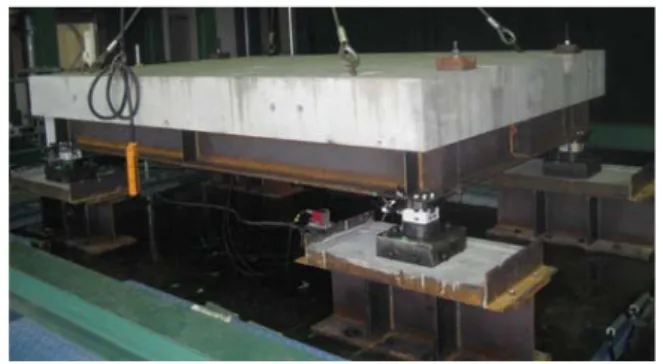
A shake table was used to study the dynamic friction coefficient between steel and mortar. Two frames were considered: a rigid concrete mass (Fig. 1) and a flexible frame where the layers are connected by
rubber isolation bearings. By using the flexible frame, larger velocities were able to be imparted to the specimen.
The loading scheme consisted of a sine wave input with frequencies of 1 Hz, 2 Hz, and 5 Hz. The acceleration magnitude of the sine wave was increased with each subsequent test at a given frequency.
3. Test Results
The tests results showed that the specimens undergo a back and forth movement with an overall progressive movement in one particular direction. As the loading continues, the relative displacement reaches a steady-state behavior. The ratio of shear force to axial force is plotted with respect to relative displacement in Fig. 2 for the rigid specimen. In general, the friction coefficient remained constant with continued cycling.
4. Conclusions
After several cycles, the behavior of the specimens reached steady-state. Given the consistency of the friction behavior, future seismic protection systems based on the friction behavior between steel and mortar may be feasible.
Fig. 1: Rigid frame specimen on the shake table
Rigid Specimen - 2Hz - 700 gal
Relative Displacement (mm) -4 -2 0 2 4 6 8 10 12 14 Sh ear F o rc e/Axi a l F o rce -1.0 -0.8 -0.6 -0.4 -0.2 0.0 0.2 0.4 0.6 0.8 1.0