P37
Study on Landslide Dam Failure
〇 Ripendra Awal, Hajime Nakagawa , Yasuyuki Baba, Raj Hari Sharma and Naoki Ito
Landslides and debris flows due to heavy rains or earthquakes may block a river flow and create landslide dam naturally. Landslide dams may fail by erosion due to overtopping, abrupt collapse of the dam body or progressive failure. The peak discharge produced by abrupt collapse of the dam is very high compared with other types of failure so the present study is focused on the failure of landslide dam caused by sudden sliding. However, in-depth knowledge of the mechanism of the dam failure by sudden sliding and measured data are still lacking. A simulation model of the dam failure processes will therefore be useful.
The main objective of this study is to predict the failure of landslide dam due to sudden sliding
through flume experiments and numerical
simulation. A stability model coupled with a seepage flow model was used to determine moisture movement in the dam body, time to failure and geometry of failure surface.
The model of the dam failure due to sliding consists of two models. The seepage flow model calculates pore water pressure and moisture content inside the dam body. The model of slope stability calculates the factor of safety and the geometry of
critical slip surface according to pore water pressure and moisture movement in the dam body.
Numerical simulation and flume experiments were performed to investigate the mechanism of landslide dam failure due to sliding for two cases. Water level of reservoir was kept constant in case I; where as steady discharge was supplied in case II. A high constant water level or gradual rise of water level in the reservoir causes water to penetrate into the dam body and it increases both pore water pressures and weight of the dam body. Sliding of the dam body occurs when the mobilized shear stress which is increased by the weight increase of the dam body becomes larger than resisting shear stress which is decreased by the increase of the pore water pressures.
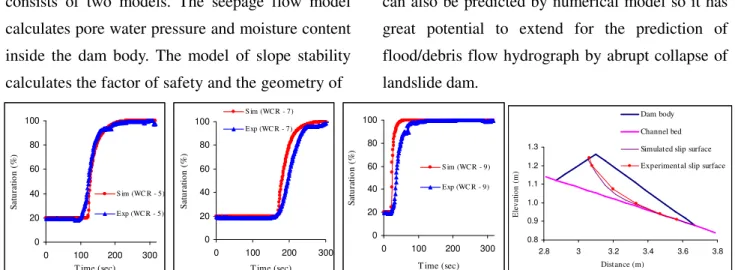
Comparison result of numerical simulation and experimental measurement is quite close in terms of movement of moisture in the dam body, predicted critical slip surface and time to failure of the dam body as shown in Fig. 1 and Fig. 2. The failure time can also be predicted by numerical model so it has great potential to extend for the prediction of flood/debris flow hydrograph by abrupt collapse of
landslide dam. 0 20 40 60 80 100 0 100 200 300 T ime (sec) S a tu ra ti o n ( % ) S im (WC R - 9) Exp (WC R - 9) 0 20 40 60 80 100 0 100 200 300 T ime (sec) S a tu ra ti o n ( % ) S im (WC R - 7) Exp (WC R - 7) 0 20 40 60 80 100 0 100 200 300 T ime (sec) S a tu ra ti o n ( % ) S im (WC R - 5) Exp (WC R - 5) 0.8 0.9 1.0 1.1 1.2 1.3 2.8 3 3.2 3.4 3.6 3.8 Distance (m) E le v a ti o n ( m ) Dam body Channel bed
Simulated slip surface
Experimental slip surface
Fig.1 Simulated and experimental results of water content profile for steady discharge in
reservoir (WCR – 5, 7 and 9)
Fig. 2 Comparison of simulated and