D03
On the Pre-failure Shear Behavior of Clayey Soil Taken from a Rainfall-induced Landslide
〇Chengrui CHANG, Gonghui WANG
Introduction
Landslides are significant natural hazard that cause substantial economic loss and extensive loss of life. Triggering in landslides occurs as a result of highly dynamic processes and the hydrological state has a profound influence on the stability of the slopes. For rainfall-induced landslides, the increase of pore water pressure as a result of rainfall infiltration progressively reduces the normal effective stress of the slope materials acting on a potential shear surface and the shear resistance decreases as the inter-particle friction is reduced by the buoyancy force. Saito (1965) first proposed a linear trend when the inverse velocity before failure is plotted against time which has made a significant contribution to the understanding and monitoring of landslides (Voight, 1988, 1989; Fukozono, 1990). Many studies focusing on the deformation and pore water pressure noted that the rate of strain was initially small but showed a very rapid increase towards failure (Anderson & Sitar, 1995; Zhu & Anderson, 1998; Dai et al, 1999; Ng & Petley, 2009). This progressive failure is at the stage when strain rate exponentially increases just before the final collapse. Fukuzono (1985) found that the increment of the logarithm of velocity of surface displacement is proportional to the logarithm of acceleration of it. However, the underlying processes and mechanisms during the development of instability remain unclear.
Methods and Results
The aim of this study is to investigate experimentally the nature of the interactions between
the pore pressure variation and the development of the
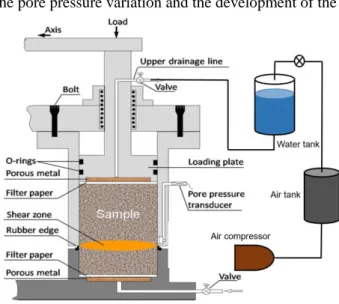
Fig. 1 Pore-pressure control system
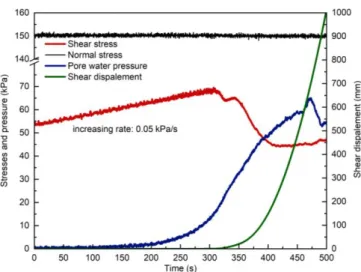
displacement in pre-failure stage. All the soil samples were taken from the Kinogawa landslide, which was induced by the heavy rainfall accompanying the No. 21 Typhoon on Oct. 22rd, 2017 in Wakayama Prefecture. Subsequently, two different series of tests were undertaken under the combined condition of predefined normal stress and shear stress simulating consolidated nature slope in the ring shear apparatus. One series of test is the pore-pressure-controlled test, which uses a serially connected air tank and water tank to increase the pore water pressure (PWP) in the shear box of ring shear apparatus (Fig. 1). This series of tests aims at simulating the effect of decreasing the effective stress state whilst holding constant shear stress to reproduce a slope undergoing heavy rainfall (Fig. 2). The pore water pressure was increased deliberately, and then the valve of shear box was closed as rapid displacement was detected. Such a
procedure has been repeated until the shear resistance dropped, which indicates the shear failure. The shear-stress-controlled series is aiming to investigate the shear displacement pattern with gently cumulative increase in shear stress under undrained condition, which involves an increase of the shear stress in a flattened gradient after consolidation (Fig 3). Both series of tests are conducted in three kinds of consolidated conditions to examine the correlation of velocity and acceleration.
Fig. 2 Test data in pore-pressure-controlled test
Fig. 3 Test data in shear-stress-controlled test
Discussion and conclusions
In pore-pressure-controlled tests, the displacement shows a creep-like pattern before failure (Fig. 4). During the whole test, several periods of constant
velocity had been identified. We also found that shear swelling occurred in the drained shear test, therefore, we inferred that the possible infiltration of water into the shear zone may enable the continuous increase of pore water pressure, so that the shear resistance will be lowered to initiate the accelerating movement. We also found that “stick-slip” behavior occurred in the shear tests, and we inferred that this behavior plays a key role in initiation of the “slip” event.
Fig. 4 Kinetic features due to the increase of pore water pressure
It is reported by some researchers that in some cases, landslides can also be triggered even though the pore water pressure was decreasing. The role of increasing pore water pressure in the initiation of the tertiary acceleration will be key for us to understand the creep behavior, and further tests and detailed examination on this issue will be continued.