Bull Inst. Oceanic Res. & Develop. Tokai Univ. (2015), 36, 1-7
1) 東海大学創造科学技術研究機構(東海大学海洋研究所気付) 〒 424-8610 静岡県静岡市清水区折戸 3-20-1
Tokai University Institute of Innovative Science and Technology, c/o Institute of Oceanic Research and Development, Tokai University, 3-20-1, Orido, Shimizu-ku, Shizuoka-shi, Shizuoka 424-8610, Japan
2) 日本学術振興会 〒 102-0083 東京都千代田区麹町 5-3-1
Japan Society for the Promotion of Science, 5-3-1, Kojimachi, Chiyoda-ku, Tokyo 102-0083, Japan 3) 御蔵島観光協会 〒 100-1301 東京都御蔵島村
Mikura Island Tourist Information Center, Mikurajima-mura, Tokyo 100-1301, Japan *) Correspnding author : [email protected]
(2015 年 2 月 6 日受付/ 2015 年 2 月 19 日受理) Received, 2/6/2015, Accepted, 2/19/2015
設置型音響ブイによる御蔵島周辺海域に棲息するミナミハンドウ
イルカ(
Tursiops aduncus
)の夜間の分布について
─研 報─
Detection of the Nighttime Distribution of Indo-Pacific
Bottle-nose Dolphins (Tursiops aduncus) around Mikura Island with
Stationed Acoustic Buoys
森阪
匡通
1,*),酒井
麻衣
1,2),小木
万布
3)Tadamichi Morisaka
1,*), Mai Sakai
1,2)and Kazunobu Kogi
3)Abstract
Knowledge for the distribution pattern of an animal species is fundamental for our understanding and conservation of the animal. Since researchers cannot conduct visual surveys during night, the night-time distribution pattern of the dolphins which can hunt prey in a dark condition is difficult to study. Here we describe the detection of the nighttime distribution of Indo-Pacific bottlenose dolphins around Mikura Island with custom-made stationed acoustic buoys.
Knowledge for the distribution pattern of an animal species is fundamental for our understand-ing and conservation of the animal (e.g., Mota-Var-gas and Rojas-Soto 2012). Numerous studies have revealed the finely detailed distribution patterns of single species of odontocetes, or toothed whales,
with the use of boats, planes, and the other forms of transportation (e.g., Kogi et al. 2004; Karczmar-ski et al. 2005; Shirakihara et al. 2007). However, these types of visual surveys cannot be conducted in dark conditions, such as nighttime. Odontocetes search for and hunt prey during the night with
their excellent echolocation abilities. In addition, several odontocetes, including spinner dolphins, are known to rest in shallower water near islands around noon (e.g., Norris et al. 1994). This sug-gests that by using visual surveys researchers have only studied the resting range of these ani-mals and have not examined their feeding and/or social ranges. Thus, studies of the nighttime distri-bution of odontocetes are important for an under-standing of their entire home range.
Acoustic monitoring is one of the methods for the distribution study of odontocetes in dark condi-tions when visual surveys do not work well. Since odontocetes almost continuously produce echoloca-tion sounds as a substituecholoca-tion for visual ability (Akamatsu et al. 2005), researchers rarely miss the location of odontocetes when they are within several hundred meters, depending on the condi-tions. By using acoustic monitoring methods, one can detect more efficiently single individuals than by using visual method (Akamatsu et al. 2008).
The Indo-Pacific bottlenose dolphin (Tursiops
aduncus) is a small odontocete (adult size: 2.7 m in
length, 230 kg in weight) found in shallow coastal waters from around South Africa, through the In-dian Ocean, to southeast Asia and Australia (Jef-ferson et al. 2008). Around a small oceanic island, Mikura Island (Japan), almost all of the Indo-Pacif-ic bottlenose dolphins have been identified by their natural markings with underwater video-identification research since 1994. About 160 indi-viduals have been identified around Mikura Island (Kogi et al. 2004). Throughout the year, these indi-viduals inhabit the area around Mikura Island, and they are typically found within around 200 m of the shore and less than 20 m deep (Morisaka, per-sonal observation). This, however, has been ob-served only in the daytime, and the nighttime dis-tributions of the population has not yet been reported. In addition, the nighttime distribution studies of this species at other sites have not been performed. Here, we describe the detection of the nighttime distribution of dolphins around Mikura Island with custom-made stationed acoustic buoys.
Materials and Methods
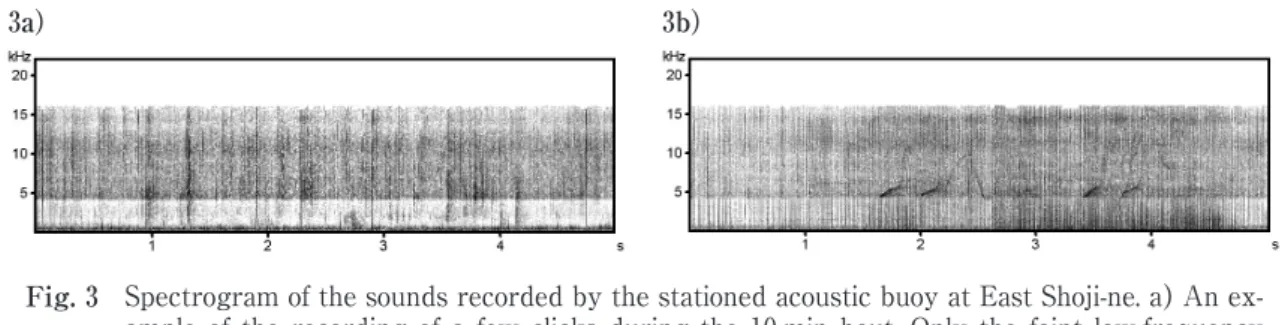
The study site was the shallow water around Mikura Island, Tokyo, Japan (Fig. 1), and the study subjects were Indo-Pacific bottlenose dol-phins. Three types of custom-made stationed acoustic buoys were used. Table. 1 lists the equip-ment used with each stationed acoustic buoy. The overall frequency responses of these systems ranged from about 1 to 16 kHz. A recorder and an amplifier were housed in a plastic food container anchored onto Styrofoam, which made the system water resistant. A hydrophone that went through the Styrofoam was located about 3 m below the water surface. The system was deployed with about 60 m of rope and an anchor (Fig. 2) at the location (around 200 m of the shore and 20 m deep) where the dolphins are usually sighted in the daytime. We deployed the systems before sun-set and retrieved them after sunrise. Sunsun-set oc-curred at 18 :43, and sunrise ococ-curred around 4:41-42 for the study period. The recorded sounds were first converted into spectrograms with Avi-soft-SASLab Pro version 4.0 software (Avisoft Bio-acoustics, Glienicke, Germany) with a frequency resolution of 93 Hz and a time resolution of 5.3 ms with a Hamming window. Tonal sounds (whistles), echolocation clicks, and burst pulses were checked visually and acoustically with the Avisoft-SASLab Pro software. A whistle is a tonal sound with a narrow band lasting from milliseconds to a few seconds with frequency modulations, while clicks are short pulse sounds with a broadband frequen-cy (see Morisaka 2009). Burst-pulse sounds are al-so pulses, but the inter-pulse intervals are very short (<10 ms; Lammers et al. 2004). The number of whistles was counted for a period of 10 min, and the relative amount of clicks (many/few/none) was determined. Due to the high ambient noise level, it was difficult to count the number of clicks.
None indicated that no clicks were detected during
the 10-min bout either visually or acoustically. Few meant a few weak clicks detected mainly by the hearing of the sound, but it was difficult to create
Fig. 1 The location of Mikura Island and the sound recording sites around the Island.
Fig. 2 A picture of a stationed acoustic buoy
(B2) deployed with a rope and anchor.
Table. 1 Equipments for four stationed acoustic buoy
Buoy
number Hydrophone & Amplifier Recorder Storage (memory capacity) Recording type frequencySampling
B1 OKI Whalephone Roland Edirol R-1 Compact Flash (2GB) mp3 44.1 kHz
B2 OKI Whalephone II Sony Hi-MD MZ-RH10 Hi-MD (1GB) ATRAC3plus 32 kHz
B3 OKI Whalephone Roland Edirol R-1 Compact Flash (2GB) mp3 44.1 kHz
Fig. 3 Spectrogram of the sounds recorded by the stationed acoustic buoy at East Shoji-ne. a) An
ex-ample of the recording of a few clicks during the 10-min bout. Only the faint low-frequency components of several clicks were heard from 3.0 s to 3.3 s. b) An example of many clicks dur-ing the 10-min bout. Many clicks were heard and visually detected. Whistles (Frequency mod-ulation tonal sounds) are observed from 1.7 s to 4.2 s in the spectrogram.
3a) 3b)
Table. 2 Day, time, recording duration, location and depth of the recordings using stationed acoustic
buoys Recording
Day Time de-ployed RecordingDuration Buoy # N. L.E. L. Location name Depth (m) 2005/7/14 17:00 3:49:05 B4 139'37''33'53'' Ebi-Iso 16.8 17:17 ─ B1 139'37''33'51'' East Moto-ne 20 17:31 ─ B2 139'36''33'51'' Kawaguchi-Taki 14.4 17:51 ─ B3 139'34''33'53'' Borosawa-Taki 15.3 2005/7/16 17:34 5:43:27 B1 139'34''33'54'' East Shoji-ne 20.6 17:45 16:40:00 B2 139'34''33'53'' Kita-goshi 22 18:07 5:45:43 B3 139'34''33'53'' South Shira-taki 22 18:21 3:53:21 B4 139'34''33'53'' Mitsu-ana 15.3
Results
Four stationed acoustic buoys were deployed on July 14th and 16th, 2005. Figure 1 shows the sites where the buoys were deployed. Table. 2 shows the time of buoy deployment, the recording durations, the buoys that were used, and the loca-tions and depths of the recording sites. We missed the July 14th recordings from the B1, B2, and B3 buoys due to human error. We could not deploy buoys in the southern part of the island because a spectrogram due to the ambient noise (Fig. 3a).
Many signified many clicks detected visually and
acoustically (Fig. 3b). The rating of Many was used even if there was only one brief period of many clicks during the 10-min period. Burst-pulse sounds with rapid pulse repetitions following in-creasing echolocation clicks were also checked, be-cause such burst-pulse sounds have been suggest-ed to have a relation with fesuggest-eding (e.g., Akamatsu et al. 2010).
Fig. 4 The results of the sounds recorded at the five different locations. a) Recording on July 14th at Ebi-Iso. b) Recordings from July 16th at East Shoji-ne, Kita-goshi, South Shira-taki, and Mitsu-ana. The points and lines indicate the number of whistles per 10-min bout, and the bars indi-cate the relative number of clicks per 10-min bout. A full bar length means Many, a half bar means Few, and no bar means None.
4a)
4b)
of rough seas on July 16th. The total recording time (11 h, 51 min, and 36 s) included 2,246 whistles and clicks with about 65 ten-min bouts. Figure.4 shows the recorded whistles and clicks at each
site. Several burst-pulse sounds with rapid pulse repetitions following increasing echolocation clicks were heard from all four sites, except for Mitsu-ana.
cies. Examinations of the stomach contents of In-do-Pacific bottlenose dolphins around Zanzibar support the possibility that these dolphins feed at shallower depths (Amir et al. 2005). The stomach contents from two stranded dolphins around Mi-kura Island contained mostly epipelagic fish and cephalopods, such as flying fish (Cypselurus agoo) and Japanese flying squid (Todarodes pacificus) (Kakuda et al. 2002). These data support our data. We have rarely observed feeding behavior around the Island during the daytime surveys conducted from 2000 to 2014. This observation implies that nighttime feeding but not daytime feeding might be the main form of feeding for them.
Despite the few sampling days, the present study is the first report on the nighttime distribu-tion and feeding activity of Indo-Pacific bottlenose dolphins. Further research with stationed acoustic buoy systems is needed to show the detailed nighttime movement patterns and feeding places of these dolphins. Such data will elucidate the en-tire picture of the nighttime ecology of Indo-Pacif-ic bottlenose dolphins, whIndo-Pacif-ich is important for the conservation of the population.
Acknowledgments: This research was funded by a grant from the Inui Tasuke Scientific Foun-dation to TM and JSPS KAKENHI Grant Number 23220006 to TM. We are grateful to Masahiko Fu-rusawa, Yoshinori Hirose, and the local people of Mikura Island.
References
Akamatsu, T., D. Wang, K. Wang., S. Li, and S. Dong. (2010) Scanning sonar of rolling porpoises during prey capture dives, The Journal of Experimental Biology, 213, 146-152. Akamatsu, T., D. Wang, K. Wang., S. Li, S. Dong, X. Zhao, J.
Bar-low, B. S. Stewart, and M. Richlen. (2008) Estimation of the detection probability for Yangtze finless porpoises
(Neopho-caena phocaenoides asiaeorientalis) with a passive acoustic method, Journal of the Acoustical Society of America, 123, 4403-4411.
Akamatsu, T., D. Wang, K. Wang, and Y. Naito. (2005) Biosonar behaviour of free-ranging porpoises, Proceedings of the Roy-al Society of London B: BiologicRoy-al Sciences, 272, 797-801.
Discussion
Indo-Pacific bottlenose dolphins around the Mikura Islands are usually found within 200 m of the coastline of the island and in shallow water within a depth of 20 m during the day. Although we recorded for only 2 nights, the data clearly showed that the dolphins (at least several individ-uals) were found in a similar habitat (near the coastline and in shallower water) during the night. Especially at Kita-goshi, the site of the longest re-cording, 43 of the 60 ten-minute bouts recorded between sunset and sunrise had some sounds, sug-gesting that the dolphins stayed there about 70% of the time during the nighttime. Since our sta-tioned acoustic buoys only covered about half of the circumference of the Island, the percentage (70 %) was sufficiently high. Thus, we conclude that at night several individuals of the population were found in a habitat similar to their daytime one. In addition, these findings suggested that sev-eral individuals of the population very much de-pend on the water around Mikura Island. As eco-logical state of this region is critical for the dolphin, their population would be greatly lowered by deterioration of their habitat environment.
Burst-pulse sounds with rapid pulse repeti-tions following increasing echolocation clicks were heard from all four recording locations, except for Mitsu-ana. This suggested that dolphins around Mikura Island feed on prey marine animals (fish, squid, etc.) during the night near the island and in shallow water where dolphins are found during the day. Several small delphinids, such as spinner dolphins (Stenella longirostris; Benoit-Bird and Au 2003), pantropical spotted dolphins (S. attenuata; Baird et al. 2001), bottlenose dolphins (Tursiops
truncatus; Klatsky et al. 2007), and dusky dolphins
(Lagenorhynchus obscurus; Benoit-Bird et al. 2004),
are thought to feed on animals associated with the deep-scattering layer, which rises up toward the surface from deeper water at night. Indo-Pacific bottlenose dolphins may differ from those species in terms of their feeding places and/or prey
spe-Amir, O. A., P. Berggren, S. G. M. Ndaro, and N. S. Jiddawi. (2005) Feeding ecology of the Indo-Pacific bottlenose dolphin
(Tursi-ops aduncus) incidentally caught in the gillnet fisheries off Zanzibar, Tanzania, Estuarine, Coastal and Shelf Science, 63, 429-437.
Baird, R. W., A. D. Ligon, S. K. Hooker, and A. M. Gorgone. (2001) Subsurface and nighttime behaviour of pantropical spotted dolphins in Hawai I, Canadian Journal of Zoology, 79, 988-996. Benoit-Bird, K. J. and W. W. L. Au. (2003) Prey dynamics affect
foraging by a pelagic predator (Stenella longirostris) over a range of spatial and temporal scales, Behavioral Ecology and Sociobiology, 53, 364-373.
Benoit-Bird, K. J., B. Würsig, and C. J. McFadden. (2004) Dusky dolphin (Lagenorhynchus obscurus) foraging in two different habitats: Active acoustic detection of dolphins and their prey, Marine Mammal Science, 20, 215-231.
Jefferson, T. A., M. A. Webber, and R. L. Pitman. (2008) Marine Mammals of the World. A Comprehensive Guide to their Identification. Academic Press, London, 573 pp.
Kakuda, T., Y. Tajima, K. Arai., K. Kogi., T. Hishii, and T. K. Ya-mada (2002) On the resident bottlenose dolphins from Mi-kura water, Memoirs of the National Science Museum, 38, 255-272.
Karczmarski, L., B. Würsig, G. Gailey, K .W. Larson, and C. Vanderlip. (2005) Spinner dolphins in a remote Hawaiian atoll: social grouping and population structure, Behavioral Ecology, 16, 675-685. 和文要旨 動物の分布パターンを知ることは,その動物そのものを知り,保全を考えるうえで最も基礎的な情報と なる. しかしながらイルカのように暗闇でも採餌できる種の夜間の分布パターンを知ることは,研究者が 目視調査を行うことができないために難しい. 本研究において,自作の設置型音響ブイを用いて,御蔵島 周辺海域に棲息するミナミハンドウイルカの夜間の分布を調べたので報告する.
Klatsky, L. J., R. S. Wells, and J. C. Sweeney. (2007) Offshore bot-tlenose dolphins (Tursiops truncatus): Movement and dive be-havior near the Bermuda Pedestal, Journal of Mammalogy, 88, 59-66.
Kogi, K., T. Hishii, A. Imamura, T. Iwatani, and K. M. Dudzinski. (2004) Demographic parameters of Indo-Pacific bottlenose dolphins (Tursiops aduncus) around Mikura Island, Japan, Ma-rine Mammal Science, 20, 510-526.
Lammers, M. O., W. W. L. Au, R. Aubauer, and P. E. Nachtigall. (2004) A comparative analysis of the pulsed emissions of free-ranging Hawaiian spinner dolphins (Stenella longirostris). In: Thomas, J. A., C. F. Moss and M. Vater. eds., Echoloca-tion in Bats and Dolphins. 414-419. The University of Chica-go Press, ChicaChica-go.
Morisaka, T. 2009. Acoustic communication by dolphins and its constraints. Honyurui Kagaku [Mammalian Scinence] 49: 121-127 (in Japanese).
Mota-Vargas, C. and O. R. Rojas-Soto. (2012) The importance of defining the geographic distribution of species for conserva-tion: The case of the Bearded Wood-Partridge, Journal for Nature Conservation, 20, 10-17.
Norris, K. S., B. Würsig, R. S. Wells, and M. Würsig. (1994) The Hawaiian Spinner Dolphin. University of California Press, Berkeley. 431 pp.
Shirakihara, K., M. Shirakihara, and Y. Yamamoto. (2007) Distri-bution and abundance of finless porpoise in the Inland Sea of Japan, Marine Biology, 150, 1025-1032.