Geochemistry of Paleosols Formed under Oxic and Anoxic
Conditions in Babeldaob Island, Palau
Munetomo NEDACHI 1-1, Kammen M. TAKTAI2), Yoko NEDACHI3'
Abstract
Two different types ofpaleosols (latente vs. kaolimte types), developed on Eocene volcanic rocks in the Babeldaob Island, Palau, were examined in order to understand the behaviors of elements during soil formation under different redox conditions.
Latente type paleosol on the Aimiliki volcanic rock was formed under ordinal atmospheric (oxic) condition. Si, Al, Mg, V, Fe, Mn, Cu, Co, Ni, Zn and Ge were leached out from the upper zone. It is noticeable that Fe is dissolved even under oxic condition. REEs increase slightly with advancing weathering. Th and U typically increase. Other elements show rather complicate pattern. On the other hand, kaohmte type paleosol on agglomerate and tuff of the Babeldaob volcamcs might develop under anoxic condition, because the overlying lignite formation has absorbed the atmospheric oxygen from penetrating meteoric water. Many elements generally decrease upward, with the enrichment in the middle section. It is suggested that these elements have moved downward during the weathering. The most mobile elements such as K, Mg and Rb decrease uniformly upward in the section.
From the behaviors of relatively immobile elements, low pH as well as high P02 conditions were predicted for the latente type paleosol developed on the Aiminki volcamcs, and slightly higher pH as well as lower P02 conditions for the kaohmte type paleosol on the Babeldaob volcamcs. The Palauan data are compared with the Paleozoic and Precambnan paleosols reported previously. The comparison supports the suggestion made from the Pronto paleosol(NEDACHl et ah, 1998) that the atmosphere at the Archean-Proterozoic boundary era was already oxic.
keywords :paleosol, geochemistry, Palau, latente type, kaohmtetype.
Introduction
Soils develop in direct contact with the atmosphere, and weathering is a chemical reaction between meteoric water equilibrated with atmospheric gases, and rocks. Therefore, the soil chemistry is strongly affected by the atmospheric compounds such as carbon dioxide and oxygen gases. Paleosols have attracted attentions to many researchers to understand the an-cient Earth s environment, because the mineralogy and chemistry of paleosol were shaped in larger part by the contemporaneous atmosphere (Holland, 1984). Especially, the loss or re-tention of Fe from paleosols has been used as a guide for the paleo atmospheric oxygen level (e.g., Holland, 1984). Because ancient paleosols have been modified to various degree by various processes (diagenesis, metamorphism, and hydrothermal alteration) during their long history, however, it has been disputed as to whether the loss of Fe has occurred by anoxic weathenng, by dissolution by organic acid, or by hydrothermal leaching (Ohmoto, 1996). Hence, the recent soils and young paleosols provide valuable information on the behaviors of vanous elements dunng soil formation. In this study, two contrasting types (latente and
ka-1) Faculty of Science, Kagosmma University, Kagoshima 890-0065, Japan.
2) Division of Conservation and Entomology, Bureau of National Resources and Development, Ministry of Resources and Development, Republic of Belau.
olinite types) of young paleosols developed on Paleogene volcanic rocks were studied. Palau (Republic ofBelau) is situated in the tropical zone and is composed of many islands. which construct a volcanic island arc between the Pacific and Philippine plates. Each island is enclosed with lagoons and reefs. Soils and paleosols are observed everywhere. Among them, relatively older weathering profiles were selected for this study. Weathering profiles of the
kaolinite-montmonllonite type have often developed beneath the sediments in damp ground areas of Miocene age. As the overlying sediment contains many thin lignite beds, weathering might have proceeded under a reduced condition. A latente type paleosol is also studied to compare the elemental behaviors during weathering under different redox conditions. The compansons are expected to provide useful information in interpreting much older paleosol data, especially in attempt to put constraints on the atmospheric oxygen level during Precam-bnan.
Geological Outline of Babeldaob Island
Babeldaob Island, Palau, is compnsed mainly of the volcanic rocks, lagoon sediments and coral reef. The volcanic rocks of Babeldaob Island erupted during Eocene and Oligocene, and debilitated at late Oligocene (Tayama, 1952). The volcanic rocks occur as lava, agglomerate, volcanic breccia, tuff breccia and tuff, with the composition of olivine basalt, hornblende-beanng two-pyroxene andesite and clinopyroxene hornblende dacite. These volca山c rocks are grouped into three formations; the Babeldaob volcamcs (early Eocene), Aimiriki volcamcs (late Eocene) and Almonagui volcamcs (Oligocene) (Tayama and SfflMAKURA, 1 937 ; Tayama.
1952). The SIO2 contents of the volcanic rocks vary widely from 47% to 67%.
There are two types ofvolcanism; olivine tholeiite series and calc-alkaline series. Nedachi et al., (1996) descnbed the trace element geochemistry of the volcanic rocks, and suggested
that the volcanism was similar to those of the other island arc systems in the West Pacific
region, especially that of the Mariana island arc system (Tatsumi et ah, 1983). The Palauan
volcamsm is characterized by the coexisting of two rock series, back-arc and front-arc series, in spite of the limited space and time. The pa仕erns of the Babeldaob volca山cs are similar to those in the back arc side of other island arc systems (Tatsumi et al., 1983; Yoshida et al.. 1995). On the other hand, the Aiminki agglomerate is similar to those in the volca山c fro仙 zone. Associated with these volcanisms, a small scale Zn-Au mineralization is observed in the southeastern end of Babeldaob Island. Miller et al. (1 987) pointed out that hydrothermal alteration in and near the veins was of neutral pH and potassic type. Nedachi et al. (1996), from a fluid inclusion study, predicted the temperatures of about 320 C and the depth of about1 km for the conditions of hydrothermal mineralization, and suggested that the main uplift movement was finished in Neogene.
The Galdog bed is found between the Babeldaob and Aimiriki volcamcs in the northern area of Babeldaob Island. The Airai formation (Miocene) is scattered along the coastal line. The
formation contains many thin lignite beds, which suggest that the formation has developed in
damp grounds changed from lagoonal conditions in Miocene.
Weathenng profiles of volcanic rocks are observed everywhere in Babeldaob Island. There
are two types ofpaleosol. Latente type weathenng is well recognized everywhere, and kaolin-ite-montmonllonite type weathenng is only beneath the Airai formation. The kaohnite type paleosol beneath the lignite formation changes gradually to the latente type paleosol in the areas not overlain by lignite formation. Among many paleosols ln Babeldaob Island, two places shown in Fig. 1 were selected for this work.
Pleistocene 匡ヨ Palau limestone
Miocene 詔Airai lignite bearing bed
Oligocene Almonogul volcanic rocks
国Aimiriki volcanic rocks
Eocene 団Galdog beds
[コBabeldaob volcanic rocks
Sampling Sites
The samples, Al to A18, were collected from the southern end of Babeldaob Island. Along the road, a steep road-cut exposes a clear profile of weathering. As shown inFig. 2, the paleosols have developed on the Aiminki volca山c rocks, and are overlain by a rece山terrace deposit. The zonal arrangement, from the onion structure of fresh andesitic basalt, through yellowish colored layer, to reddish brown colored layer and to black colored paleosol is easily recog-nized on the section. All the layers without the crust of onion structure are almost unconsoli-dated. The upper part of the section is slightly eroded out and changed to modern soil. The boundary between the modern soil and paleosol is obscure. The fresh rock is an agglomerate
with basaltic to andesitic composition, and co山ains olivine, clinopyroxene, o仙opyroxene
and plagioclase, with miner amounts of magnetite, apatite and others. According to X-ray
diffraction analyses, Mg-chlorite, lllinite, feldspar, epidote and other minerals are recognized
in the paleosol near the fresh rock side, and kaolinite, carbonate, rutile, goetrnte, hematite and others are detected from the middle to upper parts of the paleosol. The mineral assemblage suggests that the weathenng has proceeded under oxic environment. The cliff is almost verti-cal, and the distance from the terrace almost corresponds to the depth from the paleo-surface. The samples were collected along two traversed lines on the wall.
匡≡喜≡団 Terrace gravel Aiminki volcanic rocks
E璽圏 Dark brown colored soi d園 Reddish brown colored soil [二二H Pale brown colored soil
Concentric weathering of onion Structure
Fig 2. Schematic cross section of the paleosols on theAimiriki volcanic rocks ofEoceneAge, Babeldaob Island, Palau. Open and solid circles represent the location of the samples of which major, and maj or and trace elements were analyzed, respectively.
Another sampling site is located 10 km north of the first sampling site, where the samples, Bl to BIO, were collected. A sketch of the sampling site is shown in Fig. 3. An agglomerate and tuff of the Babeldaob volcamcs were weathered to form a paleosol. The Airai formation of
く W
Babeldaob Volcanic rocks (Eocene) E;這]∃ Kaolinitized tuff
匿ヨKaolinitized agglomerate
匡≡≡≡国Kaolinitized agglomerate exuded hematite
監盃l Kaolinitized agglomerate with reddish clots
Fig 3. Schematic cross section of the paleosols on the Babeldaob volcanic rocks ofEoceneAge, overlain by the lignite bearing Airai formation ofMiocene Age, Babeldaob Island, Palau. Open and solid
circles represent the location of the samples of which major, and major and trace elements were analyzed, re spectively.
lignite-clay alternation overlies the volca山cs and paleosol.
Kaolinite has dominantly formed in the paleosol. Ilhnite, quartz, rutile, hematite and others are also detected in the paleosol. Smectite is found in some of the sample. In spite of the intense mineralogical change, the original texture of phenocryst and other rock texture have clearly remained. The evidences suggest that the paleosol did not rework, and that both the tuff and agglomerate were weathered in situ. It might be betterto call as saprohth. The paleosol is strongly removed the color as a whole, but shows spotted hematite red at the lower part. The hematite reddish color decreases toward the paleo-surface, and in the middle part of the out-crop, another hematite shows an irregular banded texture. The upper 200cm of the section is compnsed mostly of homogeneous white colored kaolirute. The texture gradually disappears to be completely homogeneous at the top (about 20cm) of the section.
The age of the Airai formation is Miocene. There are three possible stages of weathering: 1) before deposition of the Airai formation under atmospheric (oxic) condition, 2) during and/or after the deposition of the Airai formation under anoxic condition, and 3 ) modern weathering. The land utilization by modern human suggests that the modern weathering might be only hematitization. The geological evidence suggests that the weathering proceeded at the stage of deposition of the Airai formation or much later. The existence of lignite in the Airai formation shows that the weathering has proceeded under anoxic environment (Stumm and Morgan.
198 1). The bedding of the lignite formation is slightly dipping toward south, and surface de-clines toward west. The parent fresh rock can not be observed in this section. The closest outcrop offreshrock is 1.3 km north fromthe sampling site (Fig. 1). The samples, Bll to B13, collected from this outcrop, are regarded as parent rocks of the kaohnite type paleosol. The
fresh rock is basaltic andesite of calc-alkaline rock series, and the main rock-forming minerals are plagioclase, clinopyroxene and orthopyroxene. Sometimes olivine or hornblende is
ob-served. Magnetite, llmenite and apatite are included as minor minerals.
Residual Elements in the Paleosols
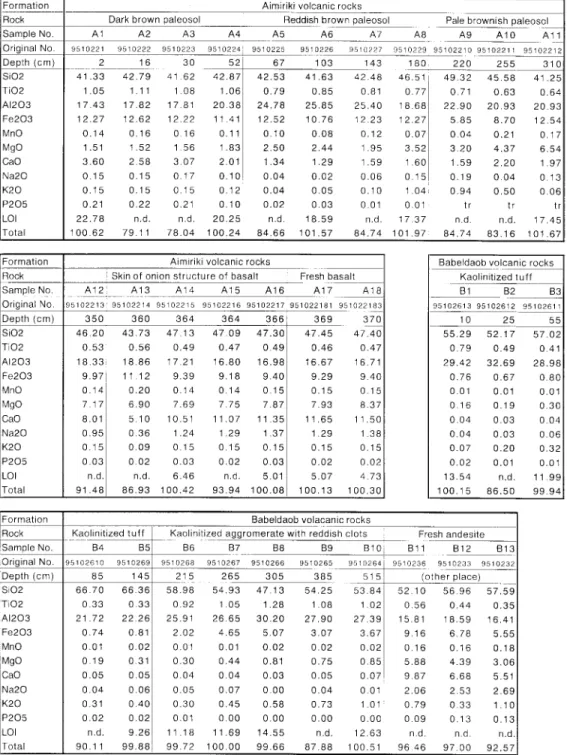
The compositions of major and trace elements were obtained, using X-ray fluorescence method, ICP mass spectrometry and other methods. The results are shown in Tables 1 and 2. The changes of concentratios of major elements during weathering are shown in Fig. 4. The chemical behaviors roughly coincide with the microscopic observation and X-ray diffraction data. For example, the chemical profile of the latente type paleosol differs from that of the kaolinite type paleosol. The chemical profile of major elements such as the decreases of MgO. Na20 and CaO coincides to the decomposition of major minerals such as plagioclase and pyroxene. In the section of kaolinite type paleosol, the chemical discontinuity corresponds to the boundary of tuff and agglomerate.
蝣予
20 40 60 0.2 0.4 0.6 0.8 1.0 1.2 10 ( m o ) u } d a □ 20 30 40・∴・ ・
-300 10 12 0 10 12 0-=--0-匂⊃Parent Babe daob vo namerocks
0 1 2
● __ -0.0 0.2 0.4 0.6 0.8 1.0 0.0 0.1 0.2 0.3
Oxide(wt'
Fig 4. Vanation of the contents of major element of the paleosols from Palau. Open and solid circles represent the paleosols on the Aimmki volcanic rocks and on the Babeldaob volcanic rocks, re-spectively. The bar represents the deviation among three fresh samples.
Table 1. Compositions of major elements of the paleosols from Palau (wt%) F o r m a tio n A im in k i v o lc a ∩ c ro c k s R o c k D a 「k b r0 W n p a le o s o l R e d d is h b r0 W n p a le o s o l P a le b 「○w n is h p a le o s o l S a m p le N o A 2 A 3 A 4 A 5 A 6 A 8 A 9 A 1 0 O r ig in a l N o . 至 9 5 1 0 2 2 6 9 5 1 0 2 2 7 9 5 1 0 2 2 9 9 5 1 0 2 2 1 0 9 5 1 0 2 2 1 1 9 5 1 0 2 2 1 2 D e p th c m 2 1 6 3 0 5 2 6 7 1 0 3 2 2 0 3 1 0 S i○ 2 4 1 ▼ 4 2 .7 9 4 1 .6 2 4 2 ▼ 4 2 .4 8 4 6 .5 1 … 4 9 .3 2 4 5 .5 8 4 1 .2 5 T i0 2 1 .0 5 ー 1 .0 6 0 .7 9 0 .8 5 0 .8 1 0 .7 7 0 .7 1 ▲6 3 0 .6 4 A I2 0 3 1 7 .8 2 1 7 . 8 1 2 0 .3 8 2 4 . 7 8 2 5 .8 5 2 5 .4 0 1 8 .6 8 2 2 .9 0 2 0 .9 3 F e 2 0 3 1 2 .2 7 1 2 .6 2 1 2 .2 2 1 1 .4 1 1 2 ▼5 2 1 0 .7 6 1 2 .2 3 1 2 .2 7 5 .8 5 ▲7 0 1 2 .5 4 M n 0 0 .1 4 0 .1 6 0 ,1 6 0 .l l 0 . 1 0 0 .0 8 0 . 1 2 0 .0 7 0 .2 1 M g O 1 .8 3 2 .5 0 2 .4 4 1 .9 5 3 .5 2 3 .2 0 4 .3 7 C a ロ 3 .6 0 2 .0 1 1 .3 4 1 .2 9 1 .6 0 1 .5 9 2 .2 0 N a 2 0 0 .1 5 0 .1 0 0 .0 4 0 .0 2 0 .1 5 0 .1 9 0 .0 4 0 .1 3 ト.蝣蝣o 0 .1 5 ▼1 5 0 . 1 5 0 .1 2 0 .0 4 0 .0 5 0 .9 4 0 .5 0 0 .0 6 P 2 0 5 0 .2 1 0 .2 2 0 .2 1 0 .1 0 0 .0 2 0 .0 3 0 .0 1 r tr t「 し〇 一 2 2 .7 8 ∩.d . n .d . 2 0 .2 5 n .d . 1 8 .5 9 ∩▲d . 1 7 .3 7 ∩▼d ■ ∩▼d . 1 7 .4 5 T o ta 1 0 0 .6 2 7 9 .1 1 7 8 .0 4 1 0 0 .2 4 8 4 .6 6 1 0 1 .5 7 ▲7 4 1 0 1 . 9 7 8 4 .7 4 8 3 .1 6 1 0 1 6 7 F 0 「m a t io n A im in k i v o lc a n ic r o c k s R o o k S k in o f o n io n s t ru c t u r e o f b a s a lt F re s h b a s a lt S a m p le N o , A 1 2 A 1 3 A 1 4 A 1 5 A 1 6 A 1 7 A 1 8 O rig in a l N o 9 5 1 0 2 2 1 3 9 5 1 〔12 2 1 4 9 5 10 2 2 1 5 9 5 1 0 2 2 1 6 9 5 10 2 2 1 7 9 5 1 0 2 2 1 8 1 9 5 1 0 2 2 1 8 3 D e p th ( c m ) 3 5 0 3 6 0 3 6 4 3 6 4 3 6 6 3 6 9 S iO 2 4 6 .2 0 4 3 .7 3 4 7 . 1 3 4 7 .0 9 4 7 .3 0 4 7 .4 5 4 7 .4 0 T 10 2 0 .5 3 0 .5 6 0 .4 9 0 .4 7 0 .4 9 0 .4 6 0 .4 7 A -2 0 3 1 8 .3 3 : 1 8 .8 6 1 7 .2 1 1 6 .8 0 1 6 .9 8 1 6 .6 7 1 6 一7 1 F e 2 0 3 9 .9 7 l l .1 2 9 .3 9 9 .1 8 9 .4 0 9 .2 9 9 4 0 M n O 0 .1 4 0 .1 5 0 . 1 5 0 .1 5 M g 0 7 .1 7 7 .6 9 7 .7 5 7 .8 7 7 .9 3 8 一3 7 C a O 8 .0 1 5 ー1 0 1 0 .5 1 1 1 .0 7 1 1 .3 5 l l .6 5 1 1 .5 0 N a 2 0 0 .9 5 1 .3 7 1 ー2 9 1 .3 8 K 2 ○ 0 .1 5 0 ◆0 9 0 . 1 5 0 .1 5 0 .1 5 0 .1 5 0 .1 5 P 2 0 5 0 .0 3 0 . 0 2 0 .0 3 0 .0 2 0 .0 3 0 .0 2 0 .0 2 L O ■ n ;1 . ∩■d ▼ 6 .4 6 ∩.d . 5 .0 1 5 .0 7 4 .7 3 T o t a 9 1 .4 8 8 6 .9 3 1 0 0 .4 2 9 3 .9 4 1 0 0 ▼0 8 1 0 0 .1 3 1 0 0 .3 0
Babeldaob volcanlC rocks Kaolinitized tuff BI B2 B3 10 25 55.29 52.17 0.79 0.49 29,42 32.69 28.98 0.76 0.67 0.80 0.01 0.16 0.19 0.04 0.03 0.03 .06 0.20 0.02 0.01 ,01 13.54 ∩.d. 11.99 100.15 86.50 99.94 F0 「m a tio n B a b e d ao b V o a ca n iC 「o cks
R o ck K a o initiz e d tu †f K a o hn itize d ag g ro m e ra te w ith re dd ish clo ts 「e sh a ∩d e site S a m p le N o . B 4 B 5 B 6 B 7 B 9 B 10 B 1 1 B 1 2 B 1 3 ○「ig ina ■N O ■ 95 10 2G8 9 51026 7 9510 266 95 10236 95 1023 3 95 1023 2 D e p th c m 8 5 1 4 5 3 0 5 3 8 5 (oth 昌r p lac e ) S iO 2 6 6 .7 0 6 6 .3 6 5 8 :ら占 5 4 .9 3 4 7 .1 3 5 3 .8 4 5 2 .10 5 6 .9 6 5 7 .さす T i0 2 0 .3 3 0 ,3 3 1 .0 5 -2 8 1 .0 8 ー0 2 0 .5 6 ▲4 4 0 ▼3 5 A I2 0 3 2 1 .7 2 2 2 .2 6 2 5 .9 1 2 6 .6 5 3 0 .2 0 2 7 .9 0 1 5 .8 1 1 8 .5 9 1 6 .4 1 Fe 2 0 3 0 .7 4 0 .8 1 3 .0 7 3 .6 7 .7 8 5 .5 5 M nO 0 .0 1 0 .0 2 0 .0 1 0 .0 1 0 .0 2 0 .0 2 0 .1 8 M g0 0 .1 9 0 .3 1 0 .3 0 0 .4 4 0 .8 1 0 .8 5 4 .3 9 ◆0 6 C aO 0 .0 5 0 .0 5 0 .0 4 ▼0 3 0 .0 5 0 .0 7 9 .8 7 6 .6 8 5 .5 1 N a 2 0 0 .0 4 0 .0 6 0 .0 5 0 .0 7 0 .0 0 0 .0 4 0 .0 1 2 .0 6 2 .5 3 2 .6 9 K 2 ○ 0 .3 1 0 .4 0 0 .4 5 0 .5 8 0 .7 3 1 .0 1 0 .3 3 1 .1 0 P 2 0 5 0 .0 2 0 .0 2 0 .0 0 0 .0 0 0 .0 0 0 .0 9 0 .1 3 0 .1 3 し〇一 ∩.d . 9 .2 6 l l .1 8 1 1 .6 9 14 .5 5 n .d . 12 .6 3 n .d . n.d . n .d . T ota 9 9 .8 8 9 9 .7 2 1 0 0 .0 0 9 9 .6 6 8 7 .8 8 1 0 0 .5 1 9 6 4 6 9 7 .0 0 9 2 .5 7
( u
i d
d )
t i
e r
e d
u i
o j
i s
j o
s o
s r
e d
s m
l O
s j
u s
u i
s t
O S
O B
I 1
1 0
S U
O T
J T
S O
d u
i O
U 7
9 W
I
6 9 8 1 E 8 0 L トー くつ1- ぐつ N 卜ー Ln 卜ー N 卜、 ⊂3 CT> C工I O)勺 寸(エ) LO 卜_ N N ⊂) N ⊂〕 N ⊂) ∼ C) 「 ⊂) ・▼ q〇 ▼ T- トー m くつ CO t- IT) CO CO PJ トー ⊂)勺r m in U) w ・▼ トー N ⊂) N ⊂) N ⊂⊃ ▼- ⊂〉 en n ir r\ ⊂) [蝣 蝣^^Ei^ES 1 l 嗣 L 7 1- ^t-in cm冨E;忘吊;ニE持
T- ⊂) N ⊂) 0) ▼- ⊂) I Z 0 8 8 0 M 盲 X 6 0 6 Z c u o O S L 卜 N 0 ト 9 . L S ヱ U O L o i u b o i o a q o e p i e q e g S エ U O L C ) モ b o i o a i ) 三 」 I W I W 9 a t 皿 u 9 1 9 9 Z 9 S 2 亡rl⊂〉 Ln 「- t- IT) O) Cエ) CD CO 寸 m m 勺r en t- co m
∽「「寸C0-Ol r曽Sjy-害in 蝣wr 9 . i NN 9S OC 8 寸 . ∽ 6 S L 誠] ∽「 06
: :∴
l (Dl「- CD OO ⊂) の(工) (工) (∫)勺 ト-=;寸話S3虫ご㌫co「T-? 一 g i 0 . I ∽ . ト C 「 0 6 0 6 E 0 Ll ト「O S . L 寸 . L -i- en -i-r一 -m i L LL? 卜ヽ m oi^ OJ CD 1- ⊂)ー ⊂) '- ⊂⊃ ▼- ⊂⊃ i- en co -I- Ln ⊂) (:0 トー Ln 寸 トー ul CO C¥J 卜・ OJ <J> LO CM 寸 ⊂) n ⊂)くつ〔⊃ ⊂) 1- ⊂) N ⊂) ON 9C 寸C トS 61 SN rC rつ く=) ▼一 寸 Ln ⊂⊃ N qr co cm ⊂) u) ul CO 勺 て! ▼一 ト一 m て1 CM CO '▼ ⊂) 7- ⊂)の ⊂) N ⊂) ▼ ▼ 寸 OI T- 1- 0)トー m ∼ ⊂)勺 LD 勺(- CD in 寸* Gi CO (D C¥J O> OJ ⊂⊃ ▼- ⊂) m ⊂⊃ 【▼つ ⊂) I J 弼 6 0 0 S , I 1 0 1 ㍗ O f . L 90Z 寸.6L SO 0 SO 0 L I L I O ' l C O ・I- O) ⊂) Cn トー T- ・'一 m ⊂) ,- く工) 〔⊃ 0) N 寸 LO ⊂)寸 co c¥j r\ 勺 勺・ ∼ ⊂) N ⊂3 C¥J -i- ⊂) ⊂) ⊂) ▼- ⊂〉 ▼- ⊂) O) N トー CO 卜ヽ CO 寸 N トー t- m co 卜・ T cO 勺(- en co トー N (工)寸 N T-⊂) N T-⊂) N T-⊂) T-⊂) T-⊂) T-⊂) ・†- T-⊂) I- T-⊂) CO CO CD CO 〔つ 二z in 10 cp CO CO m ⊂) (8 (⊃ N 寸・r 0) ⊂) 卜r O ⊂3oiサr 〔つ寸○(ヮco Nト寸N N m r ⊂) ⊂⊃ ・I- ⊂) N ⊂) N ▼- ⊂) ⊂) ⊂⊃ ・†- ⊂) ▼- ⊂⊃ 二 g . 0 M I X LN r L「 鎚 H サ 誠古山 8 L ∞L f r O 1 9 9 c < , t l i . e t -9 6 N 6 9 C SS L r < 弼qt 6 . ∼ の「 Z 7 A N O L 9 0 L 6t F , ト へ 9 O f r r = 9V co m c⊃ in co en ⊂) ⊂) ▼- CO 勺 :こI 一・ ・・ .qi- i- oj m en ⊂⊃ (工) co en q 勺
<<oc¥J等喪Eo'ト「1-^^丁\」 ▼ ⊂^ ID Iエ〉 qr cd cエl てI (∫) o) in <Ln昌吉宗ru卜「,-mN 0 Z Z 6 5 8 」00 寸0.0 ト一 m LD くつ N ⊂) 「- ▼- CO i- CM ▼-oo en n to O)勺r co cm トー 寸 寸 N ⊂) N く⊃ N ⊂) ⊂) ⊂⊃ ⊂) T- ⊂) T- ⊂⊃ m (エ) 03 ⊂) N くD cO rつ ∝) cm en en O ト の Lr) ○ くり CO N 卜 寸 CO i-T N ⊂) N ー ⊂) ⊂) ⊂) i-T ⊂) i-T- ⊂) ⊂) (=)トー ⊂) ⊂)くつ CO 寸 CO トー csi en "耳 m蝣蝣- ,,; I-- O CO r ⊂) く=) ⊂) CO i- CO (つ Ln CO CO tD トー トー T- く工) ▼一 寸 o o 蝣m-m 寸 ▼ ⊂) ⊂) ⊂3 -i- -i- CO ∼ L」> a) cn co c¥j c¥j co cn ト一 m in -: r- t一 蝣 m 寸 鮎 ‖- X きく[蝣ォ蝣ォ蝣( N (工) 0) 勺 CO ⊂) ⊂3 CD CO ⊂⊃ oj en"<-6"! r-:m m 跳 誠 snサ; ⊂⊃ Lo in oo co ⊂) (エ)くつ N (工) く£) 「一 m 寸 ⊂) 【り 寸(工) 03 N ⊂)の T- ⊂) T- ⊂) N ⊂⊃ T- C〕 0) (こ)くつ ⊂⊃ [0 寸 ⊂⊃ Ln 寸 03 LO (エ〉 く亡) Ln ∼ 【▼つ 卜_ (工〉 ⊂〕 N ⊂) CYつ1- ⊂) ▼- ⊂⊃ N ⊂) N ⊂) (工) CM -i- ⊂) CO O)卜_ 卜ー ▼- ⊂⊃ CO トー ⊂)くエ) Ln n T一 トー CM Cつ 〔⊃ LO N ⊂) ・ー〔つ の ⊂⊃ N ⊂) CT)寸 N (エ5 CD CO CO CO の ー en -r- ⊂) (∫) Ln 勺■ Cl ト一 寸 ぐ? ⊂⊃ くO N ⊂) ・「 ⊂⊃ CYl ⊂) N ⊂) F?寸 CO (エ) 「- ⊂〉 て】I- rt 0)nトー?oj r m m '- ⊂)勺 ⊂⊃ N ⊂) N ⊂⊃ ・- Ll「 寸 LD 0) ・i- CO サ丁 <nin cd耳^J-^O TI M ⊂) (8 ⊂〉 r 〔⊃ en il一 言記S3軍:ニS3㍍ ▼ く:⊃ 勺 ⊂⊃ N ∼ ・I-▼ トー ⊂〉 (り ⊂) N ・I-▼- くD ∽寸の".*O Nト N ⊂)勺 ⊂) N ⊂) N ⊂) く工) 01 〔○ く工) Ln m (8 ⊂) cO寸U寸 蝣q en c¥j N ⊂) (D ⊂) ▼- (⊃ cO -†一 m トー en o) in co q (エ) 'I Ln寸Io pj q cdlo (り〔⊃ ト- ⊂) T- ⊂⊃ 寸 ▼-CO 勺r t- oi co co ⊂) Ln O卜O)in oi-n to 寸 ⊂⊃ CO ⊂) ・l- ⊂)寸 T ∽ 0 0 E Q -0 6 0 0 L 1 0 L l 土 8 ' f r 寸 I 2 ' E C U 6 0 0 t > 0 0 0ト O Lの 0 8L 0 OZ 0 6 E ' I . 9 f r ' l g;完詔等三三ご3 1- ⊂) ⊂〕 ⊂) CO ⊂) ⊂) ∴'・・Tl 二 ▼- ⊂) ⊂) ⊂)トー ⊂) ⊂) OJ ⊂⊃ en rヽ N (O CO CM 寸 C¥J CD O 蝣 O CM CO ・,- ⊂) ⊂) ⊂) r (⊃ ⊂)一 ,- r- rn re⊃ L√) L`つ1- N CO CO C¥J OJ T-寸T-・, ⊂⊃ T ⊂〉 r ⊂) ⊂) N ・Ir- -i- CO CM C∠) CO て1- en OJ M ⊂) ⊂〉 ⊂) cr)寸 OJ ⊂) ⊂) N ⊂) ⊂) T-▼- トー en co co co in 蝣 o n (M o - 蝣 oj ト TI N ⊂⊃ ▼- ⊂)くり ⊂) ⊂D CO m r、- Ln トー LO CO ⊂⊃ ⊂) CO CO CO OJ " CM ト 0) [dKU H^M W& 事弓 C9S O N I e i d u J E Q u o i j e u j j o -j f │ H ㌧JTJ e9 UN コU 一Z r -J LU > 蝣 j c .・ 二 二 二、
Dunng weathenng, some eleme山s have been removed from and others have remained in the original rock. Then from the concentration expressed in wt%, we can notjudge whether the element has remained, has been added from other place, or has been removed. Usually the normalization by the concentration of the immobile element is adapted to evaluate true grain and loss. Al, Ti, and Cr have been commonly treated as immobile elements during weathering. Zr, Nb and Hi are proposed as more immobile elements, and the ratios among those elements were also used to identify the original rocks of paleosol (Brimhall and Dietrich, 1987). Zr was used as an element for normalization in this study. The similar tendencies were obtained if Hi and Nb are used. Zr-normalized contents of the paleosols are plotted in Figs. 5 to 7 forthe Aimiliki volcanics, and in Figs. 8 to 10 for the Babeldaob volcamcs.
Chemical Profile of the Latente Type Paleosols
Figs. 5 to 7 show the vanation of Zr-normalized values of each element in the latente type paleosols developed on the agglomerate of the Aiminki volcarucs.
Zr-normalized Si, Al, Mg, V, Fe, Mn, Cu, Co, Ni, Zn and Ge values decrease uniformly toward the unconformity. It is noticeable that Fe and Al are dissolved even under an oxic condition. Fe may have dissolved as Fe3+ irons.
Some elements do not show smooth trends through the section. Phosphorus decreases and increases toward the unconformity. The main P-beanng mineral in the parent rock is apatite. The decrease of phosphorus in the lower part of the section is related with the dissolution of apatite, but the P enrichment in the upper part might be due to biological activity. As there is no crystalline phase, phosphorus is probably adsorbed into clay minerals. K, Rb and Cs show rather complicate pattern. They are high in the middle part of the section. These elements decrease at early stage of weathering (the lower part of the section, around 300 cm from paleosol
su血ce), increase at仙e middle stage (around 200 cm from the su血ce), decrease again, and
increase near the surface of the paleosol. The decrease at early stage of weathering suggest that the enrichments of alkali elements at the middle stage is not by in situ chemical reaction, but that the alkali elements were added from the upper zones or from the overlying terrace (Hol-land, 1984). These additions may not have been limited only to middle part, and the weaker enrichments are also recognized at near the top of the section. The enrichments near the top of
the paleosol are recognized more easily on the light alkali elements (Na and K) than hea咋 alkali elements (Rb and Cs). The similar enrichments are recognized in the alkali earth ele-me山s; Ca and Sr. On the other hand, the eleme山s of III and IV groups in the penodic table such as Nb and Hi, do not change through the section.
Fig. 7 shows the variation ofREEs, Th and U, which increase toward the paleo-surface. It is said that uranium is dissolved and leached out from the parent rock under oxic environment. because U6+ is mobile. The enriched uranium might be interpreted by the addition from other place or overlying terrace at the stage later than that of weathering. The environment might change to anoxic, when the soil was migrated and was not supplied the atmospheric oxygen gas, which was completely consumed in the overlying formation. Other interpretation is the
Aiminki (laterite type)
(
W
3
)
I
│
}
d
8
凸
a)-0- Si/Zr
Al/Zr
.」コー P/Zr C)一十 Mg/Zr
→⊃- Ca/Zr
ロー Sr/Zr
+ Ba/Zr
100 10000Metal/Zr
Fig 5. Variation of Zr-normalized contents of Si, Al, P, alkali and alkali earth elements of the paleosols on the Aimmki volcanic rocks.
Aiminki (laterite type)
.001 .1 10(
∈
d
)
m
d
a
凸
a)+ Ti/Zr
O- ∨/Zr
+ Nb/Zr
Hf/Zr
・ Ta/Zr
︰ii'.'蝣i蝣
i.<)i>-叫¥¥¥¥
.1 1 10 100 1000 10000
C) .-ゝ- Cu/Zr Zn/Zr+ Ga/Zr
一一¶- Ge/Zr .01 10 100Metal/Zr
Fig 6. Vanation of Zr-normahzed contents of elements of the III and IV groups and transitional elements ofthe paleosols on the Aimmki volcanic rocks.
Aiminki (latente type)
.001 .01 .1(
w
o
)
エ
T
d
a
凸
.001 .01 .1r j
i
-J r
*
j r
∵ I
N ,
'
j │
'
, j
i
l j
I
O
D
-2
W
E
G
T
c o
W
H H
b)
Dy/Zr
+ Ho/Zr
.・ユ Er/Zrー Tm/Zr
- Yb/Zr
Lu/Zr
.001 .01 .1Metal/Zr
Fig 7. Variation ofZr-normalized contents ofREEs, Th and U of the paleosols on the Aiminki volcanic rocks.
Babeldaob (kaolimte type)
(
L
U
O
)
I
│
}
d
8
凸
a)0- Si/Zr
ー Aト/Zr 一一一」ニー P/Zr 100 10000b)
Na/Zr
-▲- K/Zr や Rb/Zr .「△- Cs/Zr .1 10 100 1000 600 -C)0- Mg/Zr
ー Ca/Zr
.一一- a- Sr/Zr+ Ba/Zr
.01 .1 10 100 1000
Metal/Zr
Fig 8. Variation ofZr-normalized contents of Si, Al, P, alkali and alkali earth elements of the paleosols on the Babeldaob volcanic rocks.
Babeldaob (kaohnite type)
j^l^E^^^^^^E^V^B^^^^^p^^^B
300﹄
︻
■
B㌔
M
Hf/Zr
- Ta/Zr
10 100 1000(
∈
3
)
L
Q
C
1
8
凸
Parent rock (Bll-B13) 0 。 1 ㌔ \ 1 ヒ b) ⊃- Fe/Zr 」トー Mn/Zr ムー Cr/Zr 一一一▲- Co/ZrNi/Zr
10 100 1000
Bl BIO C)→ト Cu/Zr
Zn/Zr
ー Ga/Zr
-.- Ge/Zr
Parent rock (Bll-B13 -m-A 10 100Metal/Zr
1000Fig 9. Variation of Zr-normalized contents of elements of the III and IV groups and transitional elements of the paleosols on the Aimiriki volcanic rocks.
Babeldaob (kaolinite type)
.01 .1 10(
w
o
)
i
^
d
e
凸
600-Parent rock (BlトB13) Lも・二一 ->-0-.1 1 300 1oQDllb
BIOParent rock
(Bll-B13) 1Metal/Zr
訓
ォ
ー
*
か
こ
La/Zr
Ce/Zr
Pr/Zr
Nd/Zr
Sm/Zr
Eu/Zr
Gd/Zr
Tb/Zr
ドn r
-j , T
r r '
DHE T
「 r Z Z ′ / ′ -/ b u Y LFig 10. Vanation ofZr-normahzed contents ofREEs, Th and U of the paleosols on theAimiriki volcanic rocks.
formation of insoluble carbonate, such as UO2(C(J3). UO2(C(J3) is produced through the reaction ofU6+ with HC03 from overlying coral limestone, and is rather stable under oxic e nviro nment.
Kaohnite Type Paleosols Overlain by Lignite Deposits
Geochemistry of the paleosols on the Babeldaob volcanic rocks overlain by the Airai forma-tion is rather complex. As shown in Fig. 9, Zr-normalized Nb and Hi are almost constant through the paleosol section, including the parent rock. But Zr-normalized Ti and Ga in the upper part of the section are distinctly lower than those of the lower part. The upper part onginates in tuff, and the lower part in agglomerate. The profiles suggest that Ti and Zr have remained unchanged through weathering, and that the Ti/Zr ratios are fixed to the original compositions of both the rock which differ with each other.
Zr-normalized values of many other elements decrease toward the top of the paleosol sec-tion through a discontinuous jump. The distance of the discontinuous zone from the unconformity depends on the kind of element.
Fe decreases with advancing weathering, and jump off at the boundary from agglomerate to
tuff with advancing weathering. Mn and Ni also decrease with advancing weathering, but
jump up at the boundary from agglomerate to tuff.
The values of Si, Al, Co, Zn, Cu, Ge, REEs, Ca, Sr and Ba also show similar tendency, but the positions of maximum values are beneath the boundary between tuff and agglomerate. These elements may have been dissolved from the upper part, and re-precipitated in the slightly lower part.
Phosphorus decreases from the parent rock to the lower part of paleosol, and increases toward the unconformity. As mentioned in the another section, the P-ennchment may be caused by biological activity.
Fig. 10 shows the vanations ofREEs, which decrease toward the top with the maximum values in the middle section. The LREEs profiles have the maximum values at 145 to 2 15 cm. Th and U are almost constant during weathering. As U4+ and Th are immobile under reduced environment, the profile well coincides with the existence of overlying lignite. In this case, the pattern would be similar to those of Hi, Nb and Ta.
Discussion
Some elements are easily dissolved and transported from rocks by low temperature water, and are precipitated again at the places of different chemical environment. The present study shows that these phenomena are frequently observed in young paleosol. Ohmoto (1996) com-pared the solubility of minerals comprised of rather immobile elements, showing that the solu-bihty of SIO2, Al(OH)3, Fe2O3, Fe(OH)3, and TIO2 depends on pH as shown in Fig. ll. Al-though silica is less soluble at the pH below 9, SIO2 is more mobile compared to Ti, Al and Fe
0 -2 喜一4 くつ)
2-6
-8 -10 12pH
(after Ohmoto, 1996Fig 1 1. Thermodynamic solubilities ofFe, Al and Si compounds.
compounds under neutral condition. Al(OH)3 is almost insoluble under neutral conditions, and Fe(OH)3 and TIO2 are less soluble thanAl(OH)3 under neutral or alkaline condition. However Al(OH)3 is soluble more than SIO2 under the pH less than 3.5, and Fe(OH)3 might be also soluble more strongly under the pH less than 2.0. The dependency of solubility on pH affects the behavior of each element through weathering.
The geochemical profiles of each paleosol are compared together, using the content
normal-lzed by Zr and also normalized by the parent rock; (Metal/Zr)s /(Metal/Zr)p. Where, the
sub-scnpts, s and p, represent sample and parent rock. Before discussion, the features shown in Fig. 1 1 are qualitatively expressed using (Metal/Zr)s/(Metal/Zr)p, assuming that Zr is com-pletely insoluble. Fig. 12 is a model of behavior of Ti, Al, Fe and Si during weathering. The solubility of chemical compounds of Ti, Al and Fe3+ increase with decreasing pH(-6). Under same acid solution, TIO2 is most insoluble and AI2O3 is most soluble among TIO2, Fe(OH)3 and AI2O3. In addition, as there are ferrous and ferric, the solubility of iron compounds is affected by P02. A set of chemical trends of Si, Ti, Fe and Al should suggest the environmentd
(
」
Z
/
I
B
J
9
三
)
\
S
(
L
Z
/
i
e
i
a
∑
)
forAl
pH-6.
A
y
pH2.玩
l * . - 山 ▼ ・ I . M l 二 I l l low P02 (neutral)(Si/Zr)s/(Si/Zr)p
of weathenng. For example, the environment of neutral and low P02 can be expected, if both the (Al/Zr)s/(Al/Zr)p and (Ti/Zr)s/(Ti/Zr)p decrease ge山Iy with decreasing仙e (Si/Zr)s/(Si/ Zr)p, but the (Fe/Zr)s/(Fe/Zr)p decrease more steeply than (Al/Zr)s/(Al/Zr)p with decreasing rSi/Zr)S/rSi/Zr)p. 0 5 0 d ( 」 N \ 一 < ) \ S ( 」 N \ 一 < ) d ( 」 Z / 9 d ) \ S ( L Z / 3 d ) d ( J Z / ! l ) / s ( J Z / ! l ) 0.5 1.0 1.5 (Si/Zr)s/(Si/Zr)p
-く)- Aiminki laterite type
Babeldaob kaolinite type 三 Pronto, Canada -△・・-- Blind River, Canada 一蝣蝣-- Front Range, USA
0.0 0.5 1.0 1.5
(Si/Zr)s/(Si/Zr)p
Fig 13. Comparisons of the variation ofZr-normalized values of Al, Fe and Ti versus Si, which are normalized by Zr and by parent rock.
The results ofvanous paleosols are shown in Fig. 13. In the figure, lines represent the regression line estimated statistically. Although the deviations from the regression lines are rather large, some features and differences can be recognized. The(Al/Zr)s/(Al/Zr)p,肝e/Zr)s/
(Fe/Zr)p and (Ti/Zr)s/(Ti/Zr)p ratios generally decrease with decreasing (Si/Zr)s/(Si/Zr)p ratio (with advancing the weathering), but the decreasing manners slightly differ with each other.
The field evidence in Palau shows that the latente type weathering on the Aimiriki volcanic rocks has proceeded under ordinal atmospheric condition (oxic condition). On the other hand, The kaolinite type weathenng on the Babeldaob volcamcs has advanced under anoxic condi-tions. The overlying lignite bed may have played a role offilter to reduce the surface water when 02-saturated meteoric water penetrated through the ground. The difference of the envi-ronment affect the decreasing rate of (Fe/Zr)s/(Fe/Zr)p. The (Fe/Zr)s/(Fe/Zr)p for the latente type is slightly lower than that for the kaohnite type. The (Al/Zr)s/(Al/Zr)p ratios of the latente
type are higher than that of the kaohnite type when the (Si/Zr)s/(Si/Zr)p ratios are higher than -0.5, but become much lower when the (Si/Zr)s/(Si/Zr)p ratio decreases below -0.5. On the other hand, the (Ti/Zr)s/(Ti/Zr)p ratios of the latente type decrease slightly, but those of the kaolinite type are almost constant or slightly increase with decreasing the (Si/Zr)s/(Si/Zr)p ratios. The profiles suggest the low pH condition for latente type and near neutral condition for the kaolinite type. Hence, the conditions for the latente type weathering on the Aimiriki volcanic rocks might be of lower pH as well as higher P02, and that for the kaolinite type weathering on the Babeldaob volcanics overlain by lignite might be of near neutral as well as lower P02. The further mineralogical study should be obtained to confirm the weathering fea-ture under different type.
The data of other paleosols of different ages are also plotted in Fig. 13 for comparison. The data are from Permian paleosol on granodionte (Condie et al., 1 995) and Precambrian paleosols on the Archean granite at Pronto and on the Archean greenstone at Elliot Lake, Ontario, Canada (Nedachi et al., 1998). These parent rocks are chemically and physically different from those in present study, and the absolute contents of constitutions affect their own behaviors as dis-cussed by Holland (1984). The chemical profiles of the paleosols on the Archean granite from Pronto, Ontario, Canada, are very similar to those of the latente type weathering. Condie et al.(1995) analyzed in detail the behaviors of REEs in the paleosol formed under high P02 conditions in the Front Range, USA. The Al, Fe, Ti, Si, and Zr behaviors in this paleosol (Fig. 12) suggest a neutral pH condition. However, the very large variation of (Fe/Zr)s/(Fe/Zr)p ratios suggest some Fe addition during weathering.
In contrast, on the paleosols on greenstone at the Blind River area, the (Al/Zr)s/(Al/Zr)p and (Ti/Zr)s/(Ti/Zr)p are almost consta山dunng weathenng, but (Fe/Zr)s/(Fe/Zr)p decreases wi仙 advancing weathering. Considering that ferrous mineral is more soluble than ferric mineral, the weathenng condition on the Archean greenstone could be estimated to be almost same or slightly higher pH condition and same P02 condition with that of the kaohnite type paleosol in Palau. The reason of low P02 might be same with that of the kaohnite type paleosol in Palau. As P-ennchment is observed in the paleosol on the Archean greenstone, and as is observed some bio-activity might produce anoxic conditions there. However, attention should be paid to the wide deviations of data.
Conclusions
Behavior of various elements in two different types of paleosols on Eocene volcanic rocks at Babeldaob Island, Palau, was examined and compared with those of the old age.
In the latente type paleosols on the Aiminki volcanics, many elements were leached out from the upper zone. It is noticeable that Fe is dissolved even under oxic condition. REEs, Th and U typically increase with advancing weathering. Some alkali elements are leached out from the upper paleosols, and re-precipitated in the middle part.
In the kaolinite type paleosol on agglomerate and tuff of the Babeldaob volcanics, the ratios among Ti, Zr, Nb, Hi and Ta are almost constant, but differ between tuff and aggromerate.
Zr-normalized values of many elements decrease toward the unconformity while jumping to maxi-mum values at the middle part. The maximaxi-mum Zr-normalized values of Si, Al, Co, Zn, Cu, Ge, Ba, Ca, Sr and REEs are recognized at slightly below the boundary between tuff and agglom-erate. It is suggested that these eleme山s have moved downward dunng soil formation. The contents of more mobile elements, such as K, Mg and Rb decrease uniformly toward top of the section. The chemical profile of paleosol strongly depends on the pH conditions as well as on the oxygen partial pressure.
From the diagrams of (Al/Zr)s/(Al/Zr)p,肝e/Zr)s/i昨e/Zr)p and (Ti/Zr)s/(Ti/Zr)p ratios against (Si/Zr)s/(Si/Zr)p, low pH as well as high P02 conditions were estimated for the latente type paleosol developed on the Aiminki volcamcs, and slightly high (but less than neutral) as well as low P02 conditions for the kaolinite type paleosol on the Babeldaob volcanics. The data from the Precambnan paleosols were compared, and it suggests that the atmosphere of the Archean-Proterozoic boundary era contained rather high oxygen.
Referen ces
Birmhall, G.H. and Dietrich, W.E. 1 987. Constitutive mass balance relations between chemical
composition, volume, density, porosity, and strain in metasomatic hydrothermal systems: results on weathenng and pedogenesis. Geochim. Cosmochim. Acta, 5 1, 567-587. Condie, K.C., Dengate, J. and Cullers, R.L. 1995. Behavior of rare earth elements in apaleoweathenng profile on granodionte in the Front Range, Colorado, USA. Geochim. Cosmochim. Acta, 59, 279-294.
Holland, H.D. 1984. The chemical evolution of the atmosphere and oceans: Pnnston Univer-sity Press, 582p.
Maynard, J.B. 1992. Chemistry of modern soils as a guide to interpreting Precambnan
Paleosols. J. Geol., 100, 279-289.
Miller, W.R., Ryutuba, J.J., Arnold, M.A. and Vercouutere, T.L. 1987. Mineral Resource
investigation of the Rois Malk area, Republic of Palau. Open-File Report USGS, 87-198:
128p.
Nedachi, Y, Benett, G., Nedachi, M. and H. Ohmoto, H. 1996. Weathering of Metabasalt at
the Archean-Proterozoic Boundary, Elliot Lake, Ontario, Canada. Abs. Joint Ann. Meeting.
C-28.
Nedachi, Y, Nedachi, M. and H. Ohmoto, H. 1998. Geochemical study ofpaleosol on the
granite 2.5 Ga, at Pronto, Ontario, Canada.Rep. Kagoshima Imm. Heart Coll., No.28,
85-蝣)8
Nedachi, M, Taktai, K.M., Nedachi, Y, Yamanouchi, H. and Matsumura, K. 1996. Zn-Au
mineralization and volcanism of Babeldaob Island, Palau (Belau). Occas. Paper Kagoshima
Umv. Research Center South Pacific, 32, 24-29.
Nesbitt, H.W. and Young, G.M. 1989. Formation and diagenesis ofweathenng profiles. J.
Geol., 97, 129-147.
oxygen and terrestrial biota. Geology, 24, 1135-1138.
Retallack, G., Grandstaff, D. and Kimberley, M. 1984. The promise and problems of Pre-cambnan paleosols. Episodes, 7, 8-12.
Stumm,W. and Morgan, JJ. 1981. Aquatic Chemistry, JohnWiley & Sons, New York, 780p. Tatsumi, Y, Sakuyama, M., Fukuyama, H. and Kushiro, I. 1983. Generation of arc basalt
magmas and thermal struction of the mantle wedge in subduction zones. J. Geophys. Res., 5815-5825.
Tayama, R. 1952. 0n the lignite in the Babeldaob island, Palau (In Japanese). Bull. Hydrogr. Office, Il, pp292
TAMa, R. and Shimakura, M. 1937. Coral reefs inNan-yo islands (In Japanese). Geol. Soc.
Japan Jour., 44, 526-528
YosfflDA, T, Ohguchi, T and Abe, T, 1995. Structure and evolution of source area of the Ceno-zoic volcanic rocks in Northeast Honshu arc, Japan. Mem. Geol. Soc. Japan, 44, 263-308.