Sales via the Internet
著者
Ishitsuka Nobutaka, Ogane Chikako, Niita
Noriyuki, Fuyuki Katsuhito
journal or
publication title
JOURNAL OF FARM MANAGEMENT ECONOMICS
volume
51
page range
1-22
year
2020-02-29
*
Graduate School of Agricultural Science, Tohoku University **
Former student, Graduate School of Agricultural Science, Tohoku University
Rice Sales by Farmers, Individually and in Groups:
A Survey of Farmers Engaging in Direct Sales via the Internet
Nobutaka ISHITSUKA*, Chikako OGANE*, Noriyuki NIITA** and Katsuhito FUYUKI*
Contents 1. Introduction
1) Background and Objectives 2) Previous Studies
2. Preliminary Survey
1) Survey Targets and Method 2) Results
3. Survey
1) Survey Targets and Method 2) Results
3) Discussion
4. Conclusions and Research Limitations 1) Conclusions
2) Research Limitations
1.Introduction
1) Background and Objectives
1.1 Legislation and Government Support
The purpose of this study is to clarify the circumstances of the formation of individuals and groups among rice farmers who are engaged in direct sales of rice to consumers through the Internet (hereafter Internet Direct Sales, IDS). A summary of Japanese government policy developments concerning rice is first necessary in order to understand the essential background of the research object.
In 1995, the Foodstuff Control Act (Shokuryou Kanri Hou: 食糧管理法) was abolished. A new law replacing it came into force in 1994: the Law for Stabilization of Supply-Demand and Price of Staple Food (Shuyou Shokuryou No Jukyu Oyobi Kakaku
No Antei Ni Kansuru Houritsu, known as Kyuu Shokuryou Hou: 主要食糧の需給及び
価格の安定に関する法律, 通称 旧食糧法; hereafter the Staple Food Act). Under the Staple Food Act, the national distribution network for rice was categorised into two types under government control: institutionally marketed rice (Keikaku Ryuutsuu Mai: 計画流 通米; hereafter IMR) and freely marketed rice (Keikakugai Ryuutsuu Mai: 計画外流通 米; hereafter FMR).
However, in response to a decrease in the OMR/IMR share of total rice production (Table 1), the Staple Food Act was revised in 2004 (Kaisei Shokuryou Hou: 改正食糧 法), and the OMR/IMR system was virtually abolished1. Since 2018, the government has
played no part in rice production adjustment. The government will continue to announce the supply and demand outlook for rice but this is not a legally binding system, merely information, and there will be no more direct government subsidies, which was one of the merits of complying with rice production adjustments. Therefore, some impact on the sales strategies of farmers is expected2. Especially in recent years, rice farmers have attempted to improve their profitability by devising sales channels for rice, the price of which has reached a plateau.
1.2 Social Trends: Influence of the Internet
During the development and reorganization of the system for distributing rice over the last two decades, the Internet has become popular with the general public, and the e-commerce market for agricultural products (hereafter “eC market”) has grown3. According to the Minitry of Economy, Trade and Industry (2019, p.49), the eC market size for food, beverages, and alcoholic beverages as of 2018 was 1,691.9 billion yen, but the eC conversion rate has remained at about 2.64%. Nevertheless, continuous expansion of the eC market is expected because the number of people using the convenience of the Internet is likely to grow with the increase in double-income households. Especially for rice sales, as reported by the Japan Co-operative Alliance (2019), the following three answers are listed as the top reasons for using online sales to purchase rice: 1) “No need to carry heavy rice” (82.4%); 2) “Because you can choose various types of rice” (33.0%); and 3) “Because you can purchase rice of various prices” (29.9%). The same research also clarifies the online sales platforms that have been used to purchase rice. Rakuten Market (楽天市場) is the most popular (49.0%), followed by Yahoo! Japan (22.6%) and Amazon Japan (21.8%). This shows that many consumers use major online sales platforms rather than individual on-line “Rice farm shops” (3.8%), which as a category were ranked ninth overall as of 2018. Thus, it is important to have an overview of the sales strategies of farmers who are selling their rice directly online using their own individual website (hereafter “farm web site”) and to grasp the trends of suppliers.
1.3 Sales of Rice by Groups and Individuals
An underlying theoretical framework was proposed by Kanazawa (1982, p.270-272). From the dual structure theory of agricultural management, agricultural production activities are central, accompanied by technical management aspects and private economic aspects. Farmers are regarded as willing to collaborate in production and sales, but try to be independent in terms of personal management. Nevertheless, as Takahashi (2014) pointed out, this applies only to rice farming management prior to the 1980s and did not involve the agricultural market, which drastically changed between 1990 and 2010. Thus, channels for sales in recent years require a fresh analysis, particularly with regard to IDS.
Therefore, the present paper analyses an overview of rice farm management by those who have engaged in IDS under the circumstance that the social environment of rice farmers has changed significantly due to the recent reorganization of rice sales and distribution. Group collaboration concerning the relatively new sales channel (IDS) is discussed from the point of view of current and future issues arising from the formation of individual sales and sales by groups of rice farmers engaged in IDS. According to Oxford English Dictionary, ʻgroupʼ means a number of people who work together or share certain beliefs. In this study, a group is defined in two situations: as a number of farmers based on local community for collaboration in production and sales, or as a number of regular customers served by a farmer who is selling rice by IDS.
2) Previous Studies
Sugiyama et al. (2001) stated that forging trusting relationships with consumers is the most critical factor for farmers when working on IDS of agricultural products. They also highlighted the significance of acquiring information about the Internet user experience and the extent of support from JA and local governments. Saito and Hiraizumi (2003) explained that insufficient product differentiation and inappropriate presentation of information, deviating from consumer needs, coincided with the poor performance of IDS. Yoshioka (2004) found that difficulties in finding information on the Internet hinder stabilization of IDS and require farmers to improve their efforts to resolve these difficulties. However, he drew attention to the fact that interactions amongst consumers and farmers can be promoted through this sales medium. In summary, several studies were conducted in the first half of the 2000s4, and since then
there have been many papers on the activities of farmers using IDS or issues concerning the technique of IDS.
Table1. Annual Fluctuations in Shipments by Nationwide Shipping Organizations, Farmer Direct Sales and Farmer Rice Gifts
Year Production (Mt)1
Production
Index IMR (Mt) PDI (Mt) FMR (Mt) Events
1989 1,035 101 679 157 199 1990 1,050 103 683 149 218 1991 960 95 599 145 216 1992 1,057 101 648 138 271 1993 783 74 406 133 244 Complete GATT UR negotiation,Rice riot of 1993 1994 1,198 109 739 129 330
1995 1,075 102 631 127 317 Foodstuff Control Act abolished & Staple Food Act established. Start of MA rice import
1996 1,034 105 577 125 332
1997 1,003 102 553 112 338
1998 896 98 465 106 325
1999 918 101 472 102 344 The start of rice
tariffication
2000 949 104 482 97 370
2001 906 103 446 92 367
2002 889 101 433 87 368
2003 779 90 324 83 372 Abolishment of the
orderly market rice (2004)
1Units are millions of tonnes of brown rice. FMR, freely marketed rice; PDI, privately distributed rice
(production volume minus IMR sales). The source of PDI figures is the Survey of Producers Inventory for Rice etc. inventory (Seisansha no beikoku zaiko tou chousa:生産者の米穀在庫等調
査; MAFF, 2019). Source: Organization to Support the Secure Provision of Rice (Beikoku Antei Kyoukyu Kakuho Shien Kikou: 米穀安定供給確保支援機構) (data obtained on line; publication date not stated). URL: https://www.komenet.jp/archivedb03/755.html (08/11/2019)
Table2. Consumer rice sources by percentage. 2014 2015 2016 2017 2018 Department Stores 1.2 1.8 1.5 1.4 1.4 Supermarkets 48.7 48.1 49.7 49.4 52.7 Drugstores 4.1 3.7 3.7 4.3 4.8 Discount Stores 2.4 2.5 2.8 3.1 2.8 Convenience Stores 0.2 0.2 0.5 0.3 0.2 CO-OP 8.2 7.8 8.1 6.9 6.5 A-COOP* 1.5 1.0 1.5 1.6 1.2 Rice Stores 3.5 3.7 2.7 2.8 2.7 Farmers Market 2.0 1.5 1.8 2.0 2.2
Buy directly from farmer 6.7 5.2 6.2 7.1 6.0
Internet Shops 8.7 9.7 9.6 10.0 9.8
Obtained free from relatives or acquaintances
19.5 20.3 17.2 16.2 14.8
Other 2.6 2.6 3.2 2.5 2.3
*A-COOP. Agricultural co-operative management system operated by JA (Japan Agricultural Cooperatives). Source: Organization to Support the Secure Provision of Rice (Beikoku Antei Kyoukyu Kakuho Shien Kikou: 米穀安定供給確保支援機
構; 2019). URL: https://www.komenet.jp/archivedb03/755.html (08/11/2019)
2. Preliminary Survey
1) Survey Targets and Method
Tables 3 and 4 are summaries of the results of surveys used to analyse the management scale and sales of farmer selling rice by IDS. The survey targeted all 126 rice farmers present on the links site “Rice-information.com” (Okome Jouhou Dotto
Komu, お米情報ドットコム URL: http://okome-info.com/ ) and who have their own
IDS web site. An e-mail message containing the URL of the online questionnaire form was sent to each manager, either directly if the e-mail address was listed on the web site or via an email inquiry form on the web site. Sending started on June 1, 2018. The contents of the questions are personal attributes (age, gender, and the region in which the
farm is situated), area or rice paddy fields, employment labor situation and issues, the reason for starting IDS, the year of starting IDS, the IDS share of total sales, SNS use, and problems concerning IDS. By July 20, 2018, the response deadline, 22 responses were received, of which 20 were valid (15.87% valid response rate).
2) Results
The mean age of respondents was 51 years, which is relatively young5. The minimum rice-paddy acreage is less than 1 ha, and the maximum is 80 ha, with a mean of 22 ha6. The main issues regarding workforce are “no successors” (five responses),
“labour shortage” (three responses) and issues related to labour management, such as “cannot take vacation time”, “adjustment of employment during agricultural on- and off -seasons” (four responses). Amongst management units where the acreage is a single digit, “nothing special” or “lack of successor” is a primary concern. The latter is not a current problem, but a worry for future prospects. At least one employed laborer laborer is present in management units above an acreage of 17 ha.
The result of sales (Table 3) shows that IDS account for less than 30% of total sales in most management units. Although total production itself is proportional to the rice acreage, there is no such tendency in rice supply to IDS, yet farmers identify it as one of the sales channels. There are various reasons behind why they start IDS. Some farmers regard it as a way to grow their business, such as "expanding sales channels" (F4, F5, F12) or "increase profitability" (F1, F9, F13).Others just "wanted to sell directly" (F2, F6, F7).
The most common issues for IDS are “inquiries responses” and order management (12 cases). “Farm web-site operation” and “rice shipping” were the second most common issues (9 cases), and the third is “packing” (7 cases). These issues are common among almost all farmers, regardless of farm size or the scale of IDS.
F a rm e rs A g e 1 Y e a r R e g io n 2 S c a le (h a ) N u m b e r o f e m p lo y e e s P ro d u c ti o n a n d l a b o r is s u e s To ta l R ic e s a le s b y I D S ID S % Y e a r R e a s o n f o r s ta rt in g P ro b le m s t o b e s o lv e d F1 70s 60 S a n y o <1 0 N o s u c c e s s o r 0 .6 <1 10% 10 To i n c re a s e p ro fi ta b il it y I, O , S , W F2 50s 37 To h o k u 9 0 ― 10 <1 10% 10 F o r d ir e c t s a le I, O , W * F 3 30s 6 K in k i 20 1 N o h o li d a y 10 <1 < 1 0 % 6 F o r p ro v is io n o f in fo rm a ti o n W * F 4 60s 10 To h o k u 25 3 -5 N o s u c c e s s o r 40 <1 10% 7 To e xp a n d s a le s c h a n n e ls I, O , P , S , W F5 40s 12 To u za n 35 1 L a b o r s h o rt a g e 45 <1 10% < 1 To e xp a n d s a le s c h a n n e ls O F6 60s 40 To h o k u 3 .5 0 ― 1 1 100% 11 F o r d ir e c t s a le I, O , P , S , W F7 60s 6 S h ik o k u 2 .2 0 F in d a s u c c e s s o r a s s o o n a s p o s s ib le 2 1 50% 7 F o r d ir e c t s a le S F8 40s 5 To u za n 5 0 N o s u c c e s s o r 15 1 7% 5 To a c h ie v e n a ti o n w id e s e ll in g I, O , P , S * F 9 40s 10 H o k u ri k u 30 3 -5 L a b o r s h o rt a g e 70 1 1% 3 To i n c re a s e p ro fi ta b il it y N F 1 0 60s 7 K it a k a n to 1 .5 0 ― 7 .5 1 .5 20% 7 S ix th i n d u s tr ia li za ti o n I, P F 1 1 50s 25 To h o k u 7 0 N o s u c c e s s o r 8 1 .5 19% 17 A d d in g o f v a lu e O , S , W * F 1 2 30s 4 K it a k y u s h u 3 0 M a k e a p ro fi t o n s la c k s e a s o n 6 2 33% 15 To e xp a n d s a le s c h a n n e ls P, S, W F 1 3 40s 2 M in a m ik a n to 6 0 Te a m u p w it h y o u n g 10 3 30% 5 To i n c re a s e p ro fi ta b il it y I, O , P , S , W F 1 4 50s 11 S a n -i n 17 1 L o w l a b o r p ro d u c ti v it y 25 3 12% 7 R e la te d t o f o rm e r jo b I, P , W * F 1 5 20s 7 K it a k y u s h u 25 2 N o h o li d a y 80 3 4% 5 To u s e e ff e c ti v e ly W E B s it e I, O * F 1 6 50s 30 H o k u ri k u 80 1 0 o r m o re N o s u c c e s s o r 200 5 3% 8 R e c o m m e n d a ti o n f ro m tr a d e r O * F 1 7 60s 45 H o k u ri k u 43 3 -5 L a b o r s h o rt a g e 70 10 14% 15 S im p li fi c a ti o n o f w o rk I F 1 8 40s 25 To u za n 40 3 -5 C o n tr o l la b o r in p u t b e tw e e n b u s y a n d s la c k s e a s o n 90 30 33% 10 To k e e p m a n a g e m e n t s ta b il it y I, O * F 1 9 50s 12 K in k i 48 3 -5 ― 70 40 57% 12 A d d in g o f v a lu e N * F 2 0 60s 40 To h o k u 25 1 Te a m u p w it h y o u n g s te rs 50 45 90% 15 To b e o p e n a ll d a y I, O , S P e rs o n a l d a te M a n a g e m e n t d a te In te rn e t D ir e c t S a le s ( ID S ) S a le s ( m il li o n y e n ) Ta ble 3 . S u mm ary of P re li mi na ry R ese arc h 1 F ar m er s a g e as o f J ul y 2 0, 2 01 8; 2 Jap ane se r egi o nal n am es ; *I n co rp or at ed m an ag em ent u ni t. ( K it aka nt o, n or th er n K an to; M in am ika nt o, s ou th er n K an to) . K ey t o a bb re vi at io ns : I , i nq ui ry r esp o ns es ; O , or d er m ana g em ent ; P, p acki n g w or k; S , shi p pi n g w o rk; W, w eb si te m an ag em ent ; N , n ot hi n g i n par ti cul ar .
3. Survey
1) Survey Targets and Method
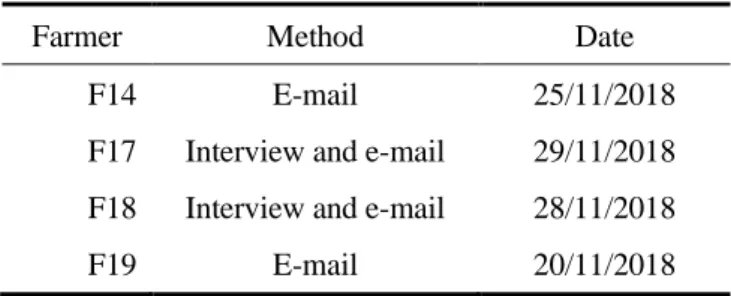
A second survey was conducted on four of the farmers who responded to the preliminary survey (Table 5) and had answered that they would co-operate with additional surveys. The reason to accept them is that F17, F18 and F19 have similar farmland scale and total rice sales, but the ratio of IDS sales varies by 20% points each. It is necessary to confirm the strategy of the reason why the ratio of IDS sales was different while the farming scales are similar. Since F14 is smaller scales than F17-F19, if F14 intends to expand IDS, its strategy should be clarified. The contents of the survey which was by face-to-face interview included questions regarding product differentiation, management balance between ‘repeater’ and ‘new’ customers, and the reasons for starting IDS. Also, the survey included questions about the relationship with the local community to which each of the interviewees belongs, such as (1) changes in the local community to which they belong from the start of IDS to the present, or (2) the current situation of neighboring farmers and farmland liquidity.
Table 4. List of Interviewees
Farmer Method Date
F14 E-mail 25/11/2018
F17 Interview and e-mail 29/11/2018 F18 Interview and e-mail 28/11/2018
F19 E-mail 20/11/2018
2) Results
A summary of the survey results is shown in Table 5. Details of the survey results for each of the four farmers follows.
(1) Case 1: F14
F14 is a family farmer with an unincorporated business. When he was hospitalized because of overwork in his previous job, his elderly parents, who were farming in his hometown, revealed that they were thinking of scaling down management. Furthermore, it was also a time when the government was focusing on agriculture, so he felt there was a business opportunity in future agriculture and decided to start farming by himself.
Ingenuity is required in production because product differentiation works through reduction of agricultural chemicals and fertilizers. However, certification systems, such as that for organic JAS, are not considered to improve profits from the viewpoint of risk and labour cost, so F14 is not considering introduction of such a system at this time. Also, because F14 is located in a mountainous area, the water is of good quality, and the daily temperature difference is large, so the conditions are beneficial for rice farming. Therefore, he can succeed in product differentiation by producing high quality, tasty rice, taking geographical advantages of his geographical area7.
F14 is working on the idea that IDS is one of the methods that can appeal directly to the features of the production area and technical ideas (such as reducing agricultural chemicals and fertilizer and suppressing oxidation by using vacuum packaging). F14 is working on cultivation using low quantities of pesticide and fertilizer because organic farming increases risks and labour costs. In this way, F14 can set a lower price than for organically grown rice, the strategy being to target middle-class consumers. F14 also sells his product to the restaurant industry, but there are both merits and demerits; a significant volume of business is possible, yet the product will be sold on credit in most cases. Therefore, it is sensitive to market prices and entails risk in collecting funds. With IDS, however, he can set the price himself and obtain a stable income compared with other sales channels.
The future sales policy of F14 is to maintain customers. He does not intend to put any particular effort into acquiring new customers because, even if the number of consumers increases rapidly, the stock quantity is limited. However, the increase in logistics costs due to increases in shipping costs must be passed on to retail prices, and the response cannot be predicted. The acquisition of new customers is mainly by word-of-mouth, and a direct-mail advertising is also sent inside the prefecture. Recently, there has been an increase in the number of cases of fraud, and complaints associated with them. However, those who are attracted by word-of-mouth tend to be genuine customers.
(2) Case 2: F17
F17 is a family farmer with a limited liability company who graduated from a two-year college, specialising in agriculture and started up his own company in 1975. He participated in a study group for farmers in the prefecture and learned how to use a computer and to handle accounts management software. The rapid spread of the Internet
at the time let him start using such technology, and he also believed it would help to simplify invoice management. He made various efforts to secure customers but exposure to the media, in particular, has had a substantial advertising effect. F10 has been picked up by local programs, so the number of customers in the prefecture has increased naturally.
F17 gained understanding from the head of the agricultural cooperative and a local counselor through consultation when starting IDS. Yet his management method was somehow misunderstood by local farmers who recently started farming. He believes “there is no problem since I sell high-priced rice that does not compete with the rice shipped to the JA. He also noted, however, that some other varieties are shipped to JA, and other businesses are used as necessary by the cooperatives, so he built a good relationship with the cooperatives. F17 has other sales channels apart from IDS and JA. For instance, there is a rice shop in the neighborhood that buys his surplus rice on request.
F17 said that he has a strong commitment to different varieties and cultivation methods, so he is flexible enough to meet the demands of customers to some extent. F17 cultivates three varieties rice and applies three types of cultivation by non-agricultural chemicals, low input agricultural chemicals or conventional cultivation. However, if there are demands for a particular cultivation method or taste (for example, “Will you do organic farming?” “Can you make sweet rice?” “Can you make it cheaper?”), he does not accept them himself but introduces other farmers who can serve such needs. F17 was very enthusiastic when he realized that his product is particularly prevalent when the locations of customers were mapped out based on the proposal of a study group who contacted him more than ten years ago. The area was known as a district where competitive high schools are located, and he considered that since he is dealing with those who have a relatively have higher income and commercial wisdom, we should market the rice as high quality and consequently at a higher price. The primary consideration of his future sales policy is to use customers who are purchasing stably, and not to focus on attracting new customers. The only concern F17 has is that he might have to increase the price of his product in reflecting a rise in transportation costs due to the recent shortage of drivers. F17 showed a positive reaction to increasing the cultivation area, but in addition to his own business there are two corporate management bodies in the neighborhood, and there is keen competition for farmland.
(3) Case 3: F18
F18 is a family farmer and his business is not incorporated. In 1994, after graduating from university, he started up as an independent self-employed farmer. F18 felt the need to improve sales channels due to the abolition of the Foodstuff Control Act and the declining trend of rice prices, and from around 1996, he started working on direct sales by phone and fax, mainly processing orders from relatives and close friends. After a while, the customer base expanded because of introduction of his business to the public via the media. In order to improve the efficiency of the service, F18 embarked on IDS.
When starting IDS, F18 was concerned with the decreasing amount of shipments to JA in the area where he lives since some of his rice is shipped not to JA but IDS customers. Fortunately, as with case of F17, the JA president at the time allowed him to continue the business and encouraged him. Since then, F18 use JA services as necessary. F18 is cultivating on one cultivar by low input of pesticide and fertilizer.
In the early phase of IDS, F18 thought that good taste alone would be enough for the product to appeal to customers. However, consumers advised him to increase the appeal by providing more information about his products and winning honors from competitions, such as presenting his rice to the Niiname-sai festival (新嘗祭)8. Then F18
realised that it was possible to objectively show “deliciousness” and “reliable quality” by the appeal of his achievements.
F18 still accepts phone-based and fax-based orders, so labour costs for telephone support have not been eliminated even though the introduction of IDS has reduced the amount of work. Also, as the wake-up time changes according to the number of orders, the amount of work fluctuates vigorously depends on the number of orders. Thus it is difficult to leave such complicated work to employed workers, and F18 is currently dealing with it by himself. He commented, “I wish I could visit the rice paddies more often”. Since F18’s wife will start work in the business from 2019, the amount of time he spends on work, from order reception to shipping, is expected to be reduced.
Consolidation of farmland has been generally achieved, and since there are two relatively large corporate management bodies in the vicinity, no further consolidation or accumulation of farmland is expected. However, F18 is willing to increase production. (4) Case 4: F19
F19 is an agricultural producer cooperative corporation comprising more than 30 farms. The establishment of web site was in the early 2000s, and its original purpose was
for use as a reception for a study tour. In 2006, the IDS business was launched on this web site with the intention of selling the cooperative's products with added value. It was proposed by a farmer in the corporation who had had experience of IDS in his previous job. Around 2014, F19 expanded its sales channel to Amazon co.jp (hereafter Amazon), which has become the central sales spot selling the rice very quickly. The reason for starting sales on Amazon is that they discovered that only major wholesalers and ZEN-NOH (National Federation of Agricultural Cooperative Associations: 全農) had opened online stores on Amazon and they considered that this is a business opportunity for farmers such as themselves who deal with direct sales. F19 is cultivating on one cultivar by low input of pesticide and fertilizer.
About 20% of the rice sold each month is expected to be for new customers but actually it is most rice is sold to regular customers. In the future, sales will continue to maintain a regular customer base, and little attention has been paid to attracting new customers. The reason for that is to prevent selling out of stock and to make it easier to adjust the balance between supply and demand by estimating the sales volume. Also, F19 is striving to secure inventory for repeaters. Amazon does not allow the exchange of e-mail directly with buyers, so F19 accepts questions and complaints via their website instead. F19 tries to do this adequately to gain the trust of customers.
F19 is still acquiring farmland due to the aging and retirement of neighboring farmers, and some rice fields are 3-4 km away. In order not to reduce productivity, it is inevitable to take measures such as tightening underwriting conditions for farmland management.
Table5. Summary of Survey Results
F14 F17 F18 F19
Style Family farm, N Family farm, I Family farm, N
Agricultural Producers’ Cooperative Corporation Total area of
rice fields 17ha 43ha 40ha 48ha
Year of starting IDS 2011 1999 2008 2006 Percentage of IDS 12% 14% 33% 57% Shipping to JA (40-60%) M.F. (<20%) F.M. (<20%) IDS (<20%) JA (<20%) M.F. (<20%) F.M. (20-40%) IDS (20-40%) M.F. (20-40%) IDS (20-40%) Others (20-40%) JA (20-40%) M.F. (<20%) IDS (60-80%) Others (<20%) IDS Chanel Own HP Own HP (main1)
Rakuten Market Yahoo! Shopping Own HP (main1) Amazon Rakuten Market Yahoo! Shopping Own HP Amazon(main1) Rakuten Market Yahoo! Shopping Rice for IDS
Price2 per 5kg (Cultivar, Product type)3 3,600 yen (4, 4) 3,800 yen (3, 6) 4,000 yen (1, 1) 2,800 yen (1, 1) SNS Blog, FB Blog, FB, Insta,
Tw, Blog
Blog, FB, Insta, Tw
Blog
Farmland
concentration - Almost complete Almost complete Still gathering Farmland
aggregation - No problem No problem
Not good, some paddy fields are
3-4km away Intention to expand production area - Wants to expand, but lender is no longer in the area
Wants to expand, but lender is no longer in the area
Nothing definite, but has to consider it Future policy of IDS keep regular customers keep regular customers keep regular customers keep regular customers Reason Production, and
stock quantity control Production, and stock quantity control Production, and stock quantity control Production, and stock quantity control
Others Reports in the
media and receiving awards
are the most effective.
Reports in the media and receiving awards
are the most effective. Source: Authors
1Main selling web site; 2Average price on own HP; 3Both are the 5kg product.
Key to abbreviations. “-“,no answer; M.F., Manufacturing or Food survice industry; F.M., Farmers market (not owner shop); FB, Facebook; I, incorporated; N, not incorporated; Tw, Twitter; Insta, Instagram.
3) Discussion
3.1 Formation of external groups by reviews
F18
Relatives Acquaintance A ① Begin sales to
friends and relatives
②Referral via a reliable acquaintance ③Purchasing based on a reliable source, reducing scam risk
Open reviews on web site F18 Customer A
Visitor Visitor Visitor ①Sale between F18
and A establishes trust
②Access to web site
③ Sales to visitor based on trusted review
Social relatives Economic relatives
Figure 1. The Process by which Farmer F2 Obtained New Customers by Review Figure 1 is a conceptual diagram of the word-of-mouth effect. The reason for focussing on F18 is that this farm does not ship rice to JA, so sales are separated from the local distribution system. F18 began selling directly to relatives and friends (social relationships). In other words, after social trust was already built, trust in the product was built through a successful sale. By providing information (word-of-mouth) to acquaintance A (an acquaintance of a relative), it was possible to advertise with relatively high reliability and appeal. If acquaintance A’s willingness to purchase is stimulated by this word-of-mouth, an economic relationship through purchasing will be established between F18 and acquaintance A as a new customer. This will eventually expand in the form of a tree diagram or stop expanding, but the important point is that the customer base expands through direct communication. The right side of Fig. 1 is a diagram of the relationship-building process through indirect communication, where sales are made following reviews posted as “customer feedback” on the website, such that word-of-mouth spreads to web site viewers.
Of course, there are still word-of-mouth developments through direct communication. It is true that consumers send information directly from their SNS account to “friends” but are not face-to-face, so they are also indirect, that is, information diffusion through intermediate communication is equally influential. In other words, Fig. 1 depicts two steps of customer flow; one is that farmers can adjust word-of-mouth influence by managing reviews on their web site, then such a managed group of people forms a new customer base.
F18 F18
Local Virtual
Resource M aintenance and M anagement F18 uses JA business except shipping.
JA
Public agency
○…Buyer □…Neighbor
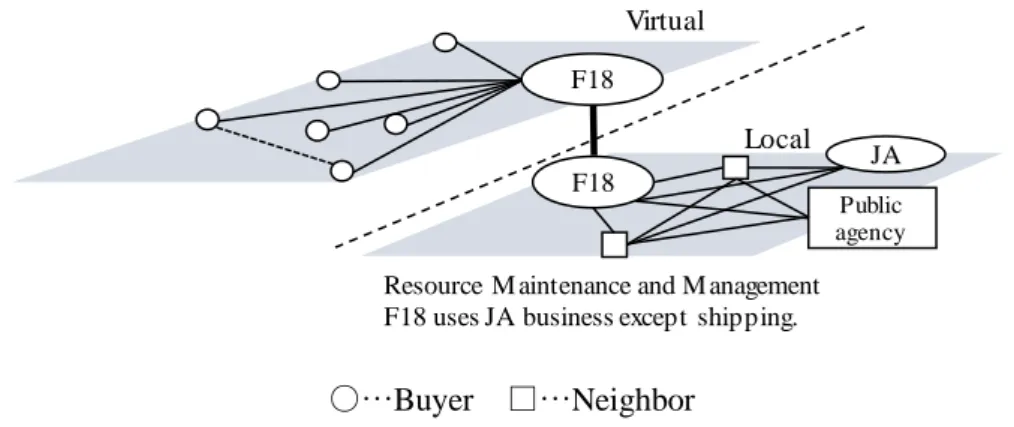
Figure 2. Virtual and Local Groups Formed by Farmer F18
Fig. 2 is an expanded interpretation of Fig. 1. This figure shows that grouping occurs in two scenarios around F18. Rice used to be shipped to JA, and the sales destination was distributed around the country, but farmers were not involved with sales. Relationship building was restricted mainly to the local community since their business was restricted to a local base. However, the development of IDS has led to the establishment of online-based relationships with consumers nationwide. In other words, a virtual group9 is formed. Traditionally, the formation of groups has been confirmed
through production (joint use of machines, joint purchase of materials, or resource management) and sales (joint shipments and joint sales). However, some sales activities have currently shifted to the virtual state through IDS and have grown and differentiated from within the local community. It could be said that the individual (F18) that had been confined to the local community exists as a new individual on the Internet, included as an IDS member.
Of course, in order to “build relationships” and “form groups”, it is necessary for a shift to take place from new customers (initially attracted by present customers’ word-of-mouth) to repeaters. To maintain this online-based group, it is necessary to advertise products of added high value and to post the farmer’s updates (described above, at the beginning of the Discussion, as the second point). These activities bring about the problems concerning labour force allocation (described above as the first point).
Based on F18, Figs. 1 and 2 demonstrate an example of a sales scenario which becomes separated from the local community. At the same time, it should be re-emphasized that IDS do not necessarily dilute the relationship with the local community. Indeed, if farmers start IDS, the shipment of rice to JA will decrease, and it
might be considered somehow controversial and aggressive by conventional farmers. However, what is common to F18 and F17 is that the co-operative chief encouraged him at the meeting, saying, “I do not mind you leaving the system, but I want you to use our business scheme as much as possible.”
There is no doubt that the transaction volume of JA has decreased, but as a result, both routes of management have increased in total sales and rice acreage through running IDS and IDS farmers have grown to become the leading players in their local community. One of the reasons for their success may be that JA was not trapped by the immediate sales volume and recognized the direction in which F17 and F18 (both union members) were aiming. As the number of farmers in local communities continues to decline, the existence of a central management body in regional resource management is indispensable, and support from local organizations is essential in order not to leave all the supporting work to them. The maintenance of such a good relationship that has existed for a long time is also crucial for advancing farmland accumulation, which is indispensable for the growth of individuals, that is, for the increase of production by expanding the production scale10.
The changes of sales channels and the formation of virtual groups do not mean cutting off relationships with the local community, since farmers continue to produce rice in their local area. No IDS can be established, in other words, if farmers forget to maintain a mutual relationship within their local area and maintain their group consciousness to protect the land and the local community.
3.2 Major points arising from interviews with rice farmers using IDS
Analysis based on the answers received on interviewing the above four farmers produced the following three significant points. Firstly, farmers who engage in IDS have to focus on working as sellers rather than producers. They have a number of sales channels, and IDS is just one of them. Their tasks include not only accepting orders for IDS or shipping preparation work, but also maintaining other sales channels by negotiation. In order to concentrate on such tasks as sellers, they leave the production scene to employed workers. It seems there is an intention to focus such labour on the production scene since the management body is also responsible for training future farmers.
Secondly, IDS is conducted mainly for management improvement, but there must be additional value in order to maintain the superiority of IDS. To do so, farmers put great importance on emphasizing their achievements and uniqueness by advertising the winning of awards or showing products that utilize local symbols11. Web sites, SNS or
blogs12, therefore, are not only used as a sales platform, but also as platforms for posting
events from the day-to-day running of the farm, which is useful in building trust with consumers. In addition to the differentiation of varieties by selection and cultivation method, it is considered effective to devise a sales place such as F19 to exhibit on Amazon.
Thirdly, all management entities place importance on maintaining fixed customers rather than securing new customers. As a method, members of F14, F17, and F18 are encouraged to register as a member at the first purchase, and members are given exclusive benefits and points when purchasing. These hints are derived from customer requests and opinions from cooperating consultants. Relationships with others in sales activities tend to be outside the local community; that is, there is a tendency to form external groups. Also, three of the four farmers (F14, F17, and F18) agreed that word-of-mouth has a substantial effect on securing new customers.
As described above, it is suggested to strengthen the relationship between farmers and regular customer by group cohesiveness because of setting services such as sending information through farmers' SNS, posting word-of-mouth of buyers, and registering benefits and discounting through member registration.
4. Conclusion and Research Limitations
1) Conclusion
The research reported here was a preliminary survey to clarify the circumstances of new kinds of rice farmer individuals and groups engaged in IDS. This survey of 20 homes and four management units found that, in proceeding with IDS, managers focus on focus daily on sales and provision of online information. In order to maintain a customer base, continuous information sharing on the website (effort as seller), and provision of additional value on their product (effort as producer) are required. When IDS customers are considered as a group, they are outside the production area, although individuals and groups are formed initially in the context of a local-based community. However, production cannot be established by refusing a relationship with the local area,
and farmers must continue to maintain good relationships with related organizations such as JA and other farmers. The IDS group has been born, but it has not replaced the traditional local group.
2) Research Limitations
In this study, the organization and conditions in the production areas of the four farms subjected to a more detailed survey are in quite different locations. For this reason, further investigations are necessary, including on understanding of the actual situation of competition within the production area, which may limit production conditions and the agricultural organization. In addition, it will be necessary to investigate the trend of new intermediate consultant organizations involved in online sales. Finally, it is also important to verify whether the relationship building process in sales through mail order sites such as Amazon is different from through farmers' websites and SNS.
Acknowledgement
We are deeply grateful to all farmers, especially interviewees, who took time from their busy schedules to co-operate with the survey reported here.
Notes
1) The above arrangement is based on Iwasaki (2012). In addition, direct sales from rice farmers to consumers have been approved since 1987 under the national government’s Special System for Rice Cultivation (特別栽培米制度).
2) Ando (2019). See Kobari (2018) for policy developments related to rice since 2002, and Fuyuki (2018) for the arrangement and prospects of government policies related to recent agricultural administration, agricultural cooperatives, and rice policy reforms. 3) In the narrow definition, the eC (electronic Commerce) market is the activity of
trading goods and service over the Internet. Orders are processed on the Internet, but payment and delivery can be done offline (Ministry of Economy, Trade and Industry, 2019, p.16).
4) Jiang et al. (2019) and Hiraizumi and Saito (2019) clarified consumer purchasing motivation and changes in commercial awareness as the latest results of online direct sales. Suenaga (2019) reports on the distribution channel selection factors of e-C marker for fruit and vegetable producers.
5) The mean age of Japanese farmers in 2015 was 66.1 years (according to the 2015 Census of Agriculture and Forestry).
6)As of 2015, the mean farmland area per farmhouse in Japan, excluding Hokkaido, is 1.1ha (the area of cultivated rice fields divided by the number of management bodies with rice fields). The reason for excluding Hokkaido is that it is significantly larger than other prefectures.
7)The taste quality is evaluated by experts from the Japan Grain Inspection Association by tasting the tested local varieties using Koshihikari blended rice from multiple localities as the reference rice. The evaluation is expressed in five levels, where the middle level (A’) is roughly equivalent to the standard rice. The top grade is ‘special A’; better than standard is ‘A’; slightly inferior is ‘B’’ and inferior is ‘B’.
8) Niiname-sai is the annual festival at the Imperial Palace held in November each year to celebrate the harvest.
9) In this way, F18 said there are no network or groups to share IDS know-how with other farmers who sell online. Because IDS has a powerful individuality, there is no guarantee that the sales promotion methods effective for one particular management body can be applied to other regions. Indeed, many farmers quit such businesses before achieving success.
10) Isaka (2017) criticized the fact that most farmland transactions are established through a non-anonymous relationship-with-trust in rural societies, indicating that credibility is a major key to forming a farmland market within a rural society.
11)The former was pointed out by F17 and F18. F19 had already established his rice as a local brand in the production area, rather than establishing a brand just for the sake of IDS. The rice cultivation technology managed by F19 began as an effort to protect wild animals regarded as local symbols (although, to maintain anonymity, we refrain from giving any further details). In other words, effort by the region as a whole is the main factor.
12) However, F17 and F18 mentioned “SNS fatigue”, because it takes time to manage SNS and is a source of stress. Moreover, inconveniences such as replying to comments, searching for blog posts during the off-season, and suspecting ideological beliefs by pressing the high evaluation buttons for other people's posts were raised as worries. For this reason, they are considering some SNS accounts to be just blog update notifications.
References
Ando, M. (2019) “Chapter 1. Development of Rice Production Adjustment Policy and its Future Prospects” In Taniguchi, N., & Ando, M. (Eds.), [Big change of rice production
adjustment policy: Precursor of change and future prospect], Tokyo: Agriculture and
Forestry Statistics Publishing, 21-39. [available in Japanese: 安藤光義(2019)「米の 生産調整政策の転換と日本農業の行方」谷口信和(編集代表)・安藤光義(編集 担当)『米生産調整の大転換 ―変化の予兆と今度の展望―』農林統計出版.] Fuyuki, K. (2018) “ [Restructuring of Agricultural Cooperatives and Rice Distribution Systems
under the Recent Agricultural Policy Reform in Japan” Agricultural marketing journal of
Japan, 26(4), 40-47. [available in Japanese: 冬木勝仁(2018)「農政・農協改革と米
市場・流通再編」『農業市場研究』]
Hiraizumi, K. & Saito, J. (2019) “Changes in Consumers’ Behaviours and Consciousness in Online Shopping of Agricultural Products: Comparison between Research Results of 2006 and 2018” [FY2019 Summary of the Annual Meeting of the Agricultural
Economics Society of Japan], 189. [available in Japanese: 平泉光一・斎藤順(2019) 「農産物のインターネット購入における消費者の行動と意識の変化 ―2006 年 と 2018 年の調査結果の比較―」『農業経済研究』]
Isaka, Y. (2017) “Classification of Farmland Transaction Mechanisms and the Actual Situation of Non-market Transactions” Journal of Rural Economics, 89(1), 32-49. [available in Japanese: 井坂友美(2017)「農地取引メカニズムの諸類型と非市場的取引の実態」 『農業経済研究』] https://doi.org/10.11472/nokei.89.32
Iwasaki, K. (2012) “Chapter 3. Rice Distribution System” In Fujishima, K. et al., (Eds.), [New Edition A Theory of Food and Agricultural Product Distribution].” Tokyo: Tsukuba Shobo, 32-50. [available in Japanese: 岩崎邦彦(2012)「第 3 章 米の流通システム」 藤島廣二・安部新一・宮部和幸・岩崎邦彦『新版 食料・農産物流通論』筑波書 房.]
Japan Co-operative Alliance. (2019) “The Survey Results Regarding Consumption behaviour on Agricultural and Livestock Products” [available in Japanese: 日本協同組合連携機構 (2019)「農畜産物の消費行動に関する調査結果 ―2018 年度調査―」] . Retrieved from: https://www.japan.coop/wp/wp-content/uploads/2019/04/190408_01.pdf
Jiang, X., Hiraizumi, K., & Saito, J. (2019) “Consumers’ Incentives for Purchasing Agricultural Products through Online Shopping Depends on the Website” [FY2019 Summary of the Annual Meeting of the Agricultural Economics Society of Japan]”, 188. [available in Japanese: JIANG XINYU・平泉光一・斎藤順(2019)「農産物のネット購入におけ るサイト種類別の消費者の購買動機」『2019 年度日本農業経済学会大会報告要旨』]
Kanazawa, N. (1982) The Lecture of Farm Management, Tokyo: Yokendo. [avairable in Japanese: 金沢夏樹(1982)『農業経営学講義』]
Kobari, M. (2018) “Changes in Japan’s rice policies: looking back on 15 years since the Principle and Outline of Rice Policy Reform in 2002”. Retrieved from:
https://www.nochuri.co.jp/english/pdf/rpt_20181227.pdf
Saitou, A., & Hiraizumi, K. (2003) “Analysis of Factors of Sales Depression in Farmers' Direct Marketing Using the Internet” Journal of rural problem, 39(1), 12-23.
[available in Japanese: 斎藤順・平泉光一(2003)「農産物のインターネット生産 者直販における売上不振とその要因 ―インターネット調査による米販売の実 証分析―」『農林業問題研究』] https://doi.org/10.7310/arfe1965.39.12
Suenaga, C. (2019) “Distribution Channel Selection Factors for Producers of Fruits and Vegetable Who Use E-commerce”, [FY2019 Summary of the Annual Meeting of the Agricultural Economics Society of Japan], 219. [available in Japanese: 末永千絵(2019) 「E コマースを利用する青果物生産者の流通チャネル選択要因」『2019 年度日本 農業経済学会大会報告要旨』]
Sugiyama, S., Kurihara, S., & Ohe, Y. (2001) “Evaluating Effects of Internet Commerce on Farm Products” Journal of rural economics. Special issue, Proceedings of annual Conference
of the Agricultural Economics Society of Japan, 2001, 107-112. [available in Japanese:
杉山幸子・栗原伸一・大江靖雄(2001)「インターネットを利用した農産物産直 の効果と経営者意識」『日本農業経済学会論文集 2001』]
Takahashi, M. (2014) Activities by Industrialist in Japan Agriculture: Development for Farmers’
Management Studies Based on the Tobata Theory and Kanazawa Theory, Tokyo:
Agriculture and Forestry Statistics Publishing. [available in Japanese: 高橋正郎(2014) 『日本農業における企業者活動 東畑・金沢理論をふまえた農業経営学の展開』 農林統計出版 ]
Yoshioka, T. (2004) “A study on the Internet Mail-order about Selling Agricultural Products”
Agricultural Economic Studies, (26), 85-91. [available in Japanese:吉岡徹(2004)「農