Topics: Recent topics in public health in Japan 2019
Current issues in long-term care policy and research:
Toward the promotion of evidence-based policy
Hideki Masui, Masaaki Otaga, Yoko Moriyama, Takuya Matsushige
Department of Health and Welfare Services, National Institute of Public Health
Abstract
In Japan, the number of users of the long-term care system has been rapidly increasing, leading to in-creasing expenditure on benefits; this situation has become an issue from the perspective of the sustainabil-ity of the system. In addition, regional disparities in the long-term care cost per person and support for fam-ily caregivers are also a challenge. In responding to these issues, it is necessary to promote policies based on evidence, improve the quality and productivity of long-term care services, and expand various services in the community through public participation.
This study aimed to summarize the current status and issues concerning long-term care policies, and in-troduce the Comprehensive Service for Preventive Care and Daily Life Support for developing diverse care services provided by local citizens and promoting mutual aid in local communities, with the key concepts of “public participation” and “local resources.” Meanwhile, as a trend toward the promotion of evidence-based policy, we discussed an outcome evaluation of long-term care services and an evaluation of the efforts of local governments to support self-reliance and prevent the deterioration of health of the older adults. We reviewed empirical analyses with data and scientific evaluation on long-term care services or their deliver-ing system from various viewpoints, that is, health services research in long-term care. In short, this work clarified the current issues in long-term care policy and research.
As regional disparities become more apparent in Japanese society, the prospect of maintaining a nation-wide uniform service system needs to be examined, and the concept of “equity,” revisited. In addition, long-term care service contents will vary dramatically. It will be necessary to break one-way and fixed relation-ship between the carer and the cared. Multi-disciplinary coordination that includes residents will become more important. To respond appropriately to these issues, scientific evidence-based practice is indispens-able where the views and quality of life of patients and the public must be fully considered.
keywords: long-term care policy, comprehensive service for preventive care and daily life support, public
participation, evidence, outcome evaluation, health services research
(accepted for publication, 29th January 2019)
< Review >
Corresponding author: Hideki Masui 2-3-6 Minami, Wako, Saitama 351-0197, Japan. E-mail: [email protected]
I
.Introduction
Owing to the rapid aging of the population and declining birthrate in Japan, sustainability of its long-term care insur-ance (LTCI) system has become a problem. According to population projections (estimated in 2017) by the National Institute of Population and Social Security Research, the
population of those aged 75 years and over, comprising a segment with a high rate of being certificated as requiring long-term care, has rapidly increased since 2000 when the LTCI system was established. It will increase precipitously until 2025, when all of the baby boomers will turn 75 years old, accounting for 18% of the population, or 21.8 million (Figure 1). Meanwhile, the number of the elderly suffering
from dementia is also expected to increase from 4.62 mil-lion in 2012 (approximately 1 out of 7 people aged 65 years or over) to approximately 7 million in 2025 (approximately 1 out of 5)[1].
Meanwhile, the population of those aged 40 years or older, who shoulder the burden of insurance premiums, has been increasing since 2000, but is expected to decrease af-ter 2023 (Figure 2). In addition, the working age population, composed of the core of long-term care workers, is
expect-ed to decrease consistently as well.
As such, while the number of the elderly and the cost of long-term care services have increased in Japan, the popu-lation of the younger generations who bear such expenses or work as care staff has decreased. To ensure the sustain-ability of the LTCI system and to satisfy the various needs of the elderly, the following are necessary: (1) improve the quality and productivity of long-term care services by im-plementing scientifically proven care methods; (2) enhance the integrated community care system by analyzing regional issues based on data by municipality and other units; and (3) promote the establishment of a system for mutual support in local communities by allowing various entities, such as residents and NGOs, to participate in activities and provide a variety of services according to the actual situation of the region.
This study first aimed to summarize the current status and issues concerning long-term care policies and the recent revision of the LTCI law, and then introduce the comprehensive service for preventive care and daily life support, the key concepts of which are “public participa-tion” and “local resources.” Second, as a trend toward the promotion of evidence-based policy, we discussed the re-cently introduced outcome evaluation of LTCI services, im-plementation of national-level performance assessment, and trends in health service research regarding long-term care. In short, this research sought to clarify the current issues in long-term care policy and research toward the promotion of evidence-based policy.
II
.Current Status and issues concerning the
LTCI system
1. Benefits and costs of the LTCI system
The LTCI system was established in 2000. As shown in Table 1, the number of insured persons aged 65 years or over has increased 1.6 times compared with the time of es-tablishment of the system. The number of persons certifi-cated as requiring long-term care (or support) has increased more than three times[2]. Thus, the LTCI system has been established as an indispensable item for the older adults in Japan who need care.
A survey of long-term care benefits expenses from 2002 to 2018 showed that the total number of recipients per year increased gradually. Per-capita benefits showed a similar trend, but declined temporarily in 2006 owing to the expan-sion of the framework for persons requiring support (Figure 3). These trends are undesirable in view of the sustainabil-ity of the nursing care insurance system. The government is attempting to curb the natural increase in the total cost of LTCI attributed to the aging of the population by promoting
Figure 1 Trends in population among those aged 75 years and older in Japan
Figure 2 Trends of population of those aged 40 years and older in Japan
appropriate services and supporting the independence of service users.
As with the total cost of LTCI, the national medical costs for people aged 65 years or older are also increasing. In other words, for the sustainability of both medical and LTCI systems, measures for preventing diseases and conditions that require long-term care are needed.
In 2008, the preventive health services for elderly were divided into insurance services under the medical insurance system for the elderly aged 75 years or over, as stipulated by the Law for Securing Medical Care for the Elderly, and care prevention services under the LTCI system.
Discus-sions are currently underway in the country on the integra-tion of the two.
2. Eliminating regional disparities
According to a report submitted by a working group in the Cabinet Secretariat on February 29, 2017, the long-term care cost per insured person and percentage of those who received certification for long-term care need vary considerably by prefecture, even adjusting for age (Table 2). Such disparities need to be corrected from the viewpoint of improving service fairness.
3. Use of LTCI system to expand the scope of support
In other countries, family care allowances and family caregivers have an impact on benefits, but in Japan, the amount of time spent caring for a person is replaced by time used for the benefit category. The premise of this practice is that the Japanese LTCI system is an insurance benefit for accidents involving a person in need of long-term care, and the system is designed such that the amount of benefits for the person in need of long-term care by the family does not directly affect the amount of benefits.
However, in considering the ratio of the main caregivers of households with persons requiring long-term care from before the establishment of the LTCI system to that after the establishment of the system, the ratio of employers has increased since the establishment of the LTCI system, but the percentage of the households in which family members such as spouses and children provide care has not
de-Table 1 Number of insured and certified persons
LTCI system users April 2000 to April 2018 (Increase) Number of insured persons aged 65 years or over (Category No.
1, insured persons) 21.65 to 34.92 million (1.6 times) Number of persons certified as requiring long-term care (or
support) 2.18 to 6.44 million (3.0 times) Source: Health and Welfare Bureau for the Elderly, Ministry of Health, Labour and Welfare, Current issues and future role of the public long-term care insurance system (in Japanese), https://www.mhlw. go.jp/file/06-Seisakujouhou-12300000-Roukenkyoku/0000213177.pdf (Accessed November 28, 2018)
145 150 155 160 165 170 175 2,000 3,000 4,000 5,000 6,000 7,000 130 135 140 0 1,000 (thousand yen) Number of recipients per year Number of users of long‐term care benefits (ten thousand individuals)
Created by the author based on the results of the survey on long-term care benefit expenses
Figure 3 Yearly changes in the number of users of long-term care benefits and cost per person
Table 2 Regional differences between cost of long-term care and certification rate per first insured person (after adjusting for age) in 2014
Long-term care cost per insured person (after adjusting for age)
Percentage of persons who have received certification of needed long-term care (after adjusting for age)
Facility
services Home care Service total Care level 2 or less Care level 3 or higher total National average
Lowest value prefecture Highest value prefecture
13.1 11.6 12.7 14.3 12.9 19.2 27.4 24.5 31.9 11.7 8 15.2 6.3 6.2 7.2 18 14.2 22.4 Data source: Cabinet Secretariat, Expert Committee on the Promotion of Reform by Utilizing Medical and Long-Term Care Information Analysis and Examination Working Group (February 29, 2017), Submitted Material 1.
creased significantly (Table 3).
Under such circumstances, a project to promote the coordination of consultation support and support in the re-gion was established in 2006 as a rere-gional support project (Chiiki-Sien-Jigyo) designed with financial resources for the LTCI system. In addition to individual benefits, such as LTCI services, local governments, as insurers, are required to establish systems to support people in need of long-term care across their region. Moreover, they need to address the requirement for further enhancement of support for family caregivers.
III
.Recent revisions to the LTCI Law
1. Revisions in 2015
The Medical Care Act and the LTCI Law were revised and enforced in 2015[3]. The purpose was to establish an efficient and high-quality medical care providing system, and to ensure that medical and long-term care services are provided comprehensively in the community through the establishment of the integrated community care system.
The revision of the LTCI Law included the improvement of community-based support services and transfer of pre-vention services (home-visit and day services) from LTCI benefits to community-based support services.
Specifically, the following projects were established in community-based support services, implemented by munic-ipalities, to ensure that integrated community care systems were built in every local community (The integrated com-munity care system provides medical care, long-term care, prevention, livelihood support, and housing services.): (1) Promotion of collaboration between home medical and long-term care services, such as the establishment of a system for providing home medical and long-term care services 24
hours a day; (2) promotion of policies for dementia, such as the establishment of initial intensive support teams; (3) extension of community care conferences; and (4) introduc-tion of the Comprehensive Service for Preventive Care and Daily Life Support, as mentioned later in section IV.
2. Revisions in 2018
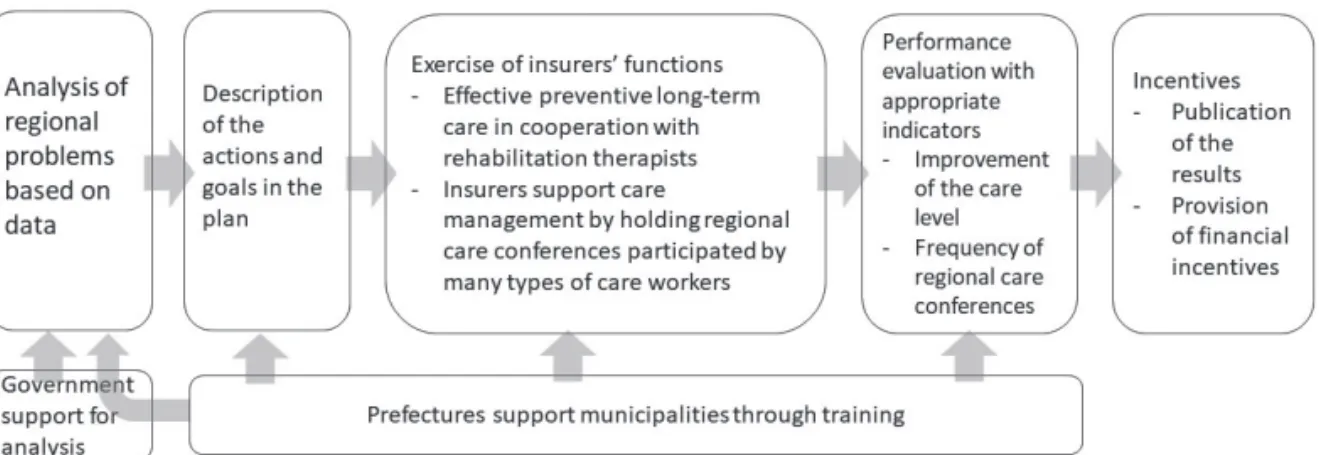
The LTCI Law was revised and implemented in 2018 to promote the integrated community care system and ensure the financial sustainability of the LTCI system[4]. The revised law stipulates that municipalities, which are insurers of LTCI, have to exercise their insurers’ functions as a means to support self-reliance and prevent the dete-rioration of the elderly. Prefectures should support munic-ipalities’ activities. Prefectures and municipalities have to implement the following the Plan-Do-Check-Action (PDCA) cycle based on appropriate data analysis (Figure 4).
1) Prefectures and municipalities analyze the data provided by the government and then describe the content and target of their efforts in the LTCI business (or support) plan.
2) Municipalities exercise insurers functions and imple-ment preventive measures for the elderly.
3) Prefectures and municipalities self-evaluate perfor-mance based on appropriate indicators.
4) The government provides financial incentives (grants) to highly evaluated prefectures and municipalities. As a part of this PDCA cycle, local governments should evaluate various efforts using indices set by the central government, as mentioned later in section V.
In the budget for fiscal year (FY) 2018, the Japanese gov-ernment appropriated funds for the project of constructing scientific long-term care databases, which provide support for self-reliance and prevention of aggravation[5].
Com-Table 3 Aging changes in the relationship between persons requiring long-term care and main caregivers (created by the author based on data from the basic survey of people s living conditions )
1998 2001 2004 2007 2010 2013 2016
Total 100 100 100 100 100 100 100
(Cohabitant) (86.6) (71.1) (66.1) (60.0) (64.1) (61.6) (58.7)
Spouse 29.9 25.9 24.7 25 25.7 26.2 25.2
Child 20.4 19.9 18.8 17.9 20.9 21.8 21.8
Spouse of the child 28.9 22.5 20.3 14.3 15.2 11.2 9.7
Parents 4.6 0.4 0.6 0.3 0.3 0.5 0.6
Other relatives 2.9 2.3 1.7 2.5 2 1.8 1.3
Separated family member, etc 4.7 7.5 8.7 10.7 9.8 9.6 12.2
Employer 9.3 13.6 12 13.3 14.8 13
Others 8.7 2.5 6 0.6 0.7 1 1
pared with the medical sector, efforts in the structuring and standardization of long-term care service data based on evidence are insufficient in the long-term care sector; data on the specific contents of long-term care services provided for the elderly in Japan are limited. For this rea-son, the government plans to construct databases to collect and analyze the condition of the elderly and the content of long-term care services provided, to realize long-term care with scientifically confirmed effects of services. As shown in Figure 5, the LTCI comprehensive database will start providing data to third parties in FY 2018. The government is currently building the VISIT (monitoring & eValuation for rehabIlitation ServIces for long-Term care) and CHASE (Care, HeAlth Status & Events) databases.
IV
.Introduction of the comprehensive
ser-vice for preventive care and daily life
support
The LTCI and community-based integrated care systems have been developed with the key concepts of “public
par-ticipation” and “local resources.” As a specific measure, a new clause has been added to the LTCI Law that shows the introduction of the comprehensive service for preventive care and daily life support (hereinafter, “comprehensive service”).
The comprehensive service was launched for develop-ing diverse care services for the elderly, provided by local citizens, and for promoting mutual aid in local communities in accordance with regional contexts where municipal gov-ernments are expected to take initiative. The comprehen-sive service is designed to enable effective and efficient support for those who need daily life support. The LTCI Law provides the categorizations of service users based on their service needs, which are, from light to heavy needs, “Requiring support 1,” “Requiring support 2,” “Requiring long-term care 1,” “Requiring long-term care 2,” “Requiring long-term care 3,” “Requiring long-term care 4,” and “Re-quiring long-term care 5.” The comprehensive service aims at prevention and its intended users are those categorized as “Requiring support 1” and “Requiring support 2.” The three years from 2015 to 2017 comprised the transition period; all municipalities were required to complete the im-plementation of the comprehensive service by May 2018.
The introduction of the comprehensive service has shifted existing in-home and facility preventive services adhering to nationally uniform standards into a new service system of preventive care and daily life support in which municipal governments serve as organizer of the service provision. By this shift, it is expected that a more diverse service system can be developed, tailored to the circum-stances of each region. Considering the wide variety of regional disparities between urban and rural areas in Japan (e.g., public transportation network, population aging rate, climate, and community solidarity), the establishment of a service system that corresponds to the local situation will
Figure 4 Conducting the Plan-Do-Check-Action cycle
enable the choice of flexible services. Local residents will be able to contribute to the service provision as well.
In 2015, the Ministry of Health, Labour and Welfare published “Guideline for the appropriate and effective im-plementation of the comprehensive service of preventive care and daily life support.” This guideline highlighted the importance of the close cooperation between municipal governments and their local citizens in the implementation of the comprehensive service toward promoting the con-tribution of the latter to it [6]. The guideline also indicated that many of those in their 60s and 70s are not in a state of “Requiring support” or “Requiring long-term care,” and that increasing opportunities for these people to participate in local activities can lead to care prevention for the elderly. Moreover, the guideline stated that a higher number of the elderly taking part in the support of the elderly who need support in the community could lead to better community cohesion.
One of the aims of the comprehensive service is cost effi-ciency. Regarding this point, the guideline sates as follows.
In recent years, there has been a significant growth in facility preventive services in some municipalities. It is expected that the implemen-tation of the comprehensive service improves the cost-effectiveness of the elderly care by using the newly established project for the development of life support system and prompting the estab-lishment of the system for the comprehensive service. (Ministry of Health, Labour and Welfare 2018:15) (English translation by Matsushige)
As the comprehensive service has only been implement-ed recently, the evaluation of cost efficiency is a task ahead. It is anticipated that regional disparities in cost efficiency will emerge because the maintenance of the service system depends on the competence of each municipality.
The comprehensive service has four types of service option: existing “in-home care service” and “facility pre-ventive service”; service “A,” which are services provided by operators designated or commissioned by the municipal government; service “B,” which are support activities conducted by local residents with municipal subsidies; and service “C,” which are preventive services of short-term concentration provided by health professionals. For in-home preventive service and facility preventive services, services A, B, and C are provided.
As noted above, the key concepts in the comprehensive service are “public participation” and “local resources”; service “B” is the one that manifests these concepts. For example, tasks such as “housecleaning” and “removing fur-niture” that had not been allowed in the scheme of existing “in-home preventive service” became possible with the
implementation of the Comprehensive Service, achieved through utilizing local residents’ activities. The means through which municipal governments develop the overall service system that utilizes local resources, will then be scrutinized.
V
.Outcome evaluation and implementation
of national-level process (performance)
assessment
1. Outcome evaluation
Article 1 of the LTCI Law stipulates that the purpose of LTCI is to provide benefits pertaining to health, medical, and welfare services necessary for the elderly in need of long-term care to lead independent lives while maintaining dignity. For this reason, the quality of LTCI services needs to be evaluated to determine whether they are appropriate for their purpose.
Based on the model proposed by Donabedan[7], the evaluation of structures and processes has been introduced since the establishment of the LTCI system. For outcome evaluation, incentives for maintaining and improving the level of care needs have been established in the evaluation of preventive care services introduced in the 2006 revi-sion. However, scholars have expressed concern regarding the possibility of “cream skimming,” which refers to the selection of the elderly whose outcomes are expected to improve[8]. The most recent revision in 2018 introduced an outcome measure for day-care services to evaluate im-provement in activities of daily living in persons requiring long-term care who had used services for more than six months.
As mentioned above, outcome assessment is being intro-duced to the LTCI system. There are four issues for further promotion, and the system should be improved taking these issues into consideration.
1) As regards long-term care services, it is difficult to obtain consensus on the setting of evaluation items because the judgment of what constitutes an outcome evaluation item depends on differences in social and cul-tural values, individual views on life, and beliefs. 2) It is difficult to set the evaluation point because the
elderly often repeatedly deteriorate and improve their physical and mental functions, and the judgment can be completely different depending on the point of evalua-tion.
3) Higher outcomes may be obtained owing to the impact of the efforts of the establishment as well as factors beyond its responsibilities (e.g., the efforts of family members and individuals), and these outcomes do not necessarily reflect the quality of the establishment’s
services.
4) Many users of in-home services use a combination of various services, and it is difficult to determine which services among the provided long-term care services are effective, even if indicators, such as the degree of long-term care need and degree of independence, im-prove.
2. Implementation of national-level process (perfor-mance) assessment
With the revision of the LTCI Law in 2018, two national evaluation systems were launched. One is an evaluation of the efforts of municipalities and prefectures to support self-reliance and prevent the deterioration of the care insur-ance system for the elderly. In this evaluation, financial in-centives (Insurer Function Promotion Grants) are provided depending on the results.
In the evaluation of these efforts, the contents deemed important among the duties to be performed by municipali-ties and prefectures for the support of self-reliance and pre-vention of aggravation, etc. are extracted in accordance with the LTCI Law and related notifications, and the evaluation indices are set. The structure of these indicators is shown in Table 4. Most of these are process evaluation items, but there are also outcome items on the degree of improvement in a user’s mental and physical condition through service provision, calculated from a national database.
This index is used to calculate financial incentives. Using this index, prefectural governments can grasp the extent of their efforts, whereas municipalities can compare their ef-forts with other municipalities from the same perspective.
The other evaluation system, called business evaluation, aims to strengthen the functions of regional comprehensive support centers nationwide. Municipalities are obliged to take necessary measures, such as revising their manage-ment policies every fiscal year, by evaluating centers based on the self-evaluation of Community Support Centers. Using this assessment, the Community Support Center is expected to make its own business improvements.
3. Future issues related to evaluation
Many issues remain and should be addressed in assessing outcomes for the nursing care insurance system. The na-tional process assessment has been initiated only recently. The government and researchers need to study the use of evaluation results and then present them to municipalities nationwide.
Future issues regarding evaluation include the need to refine the process of continuous improvement of service quality through the PDCA cycle as an evaluation method that is understood and accepted by service users and pro-viders, as well as the need to develop various measures to improve quality other than financial incentives. Further-more, it is necessary to establish evaluation methods on a regional basis as well as on an individual business unit basis.
VI
.Health Services Research in Long-term
care
Empirical analyses of data and scientific evaluation of long-term care services or their delivering system should
Table 4 Structure of municipal evaluation indicators for insurer function promotion grants
Category Numberof items
Ⅰ Establishment of a system to strengthen insurers' functions by utilizing the plan-do-check-action cycle 8 Ⅱ Promotion of measures that contribute to support for self-reliance and prevention of aggravation 46
1 Community-based services 4
2 Long-term care support specialists and long-term care service providers 2
3 Community support center 15
4 Cooperration in medical and nursing care 7
5 Comprehensive support for dementia 4
6 Preventive care and daily life support 8
7 Development of life support system 4
8 Status of maintenance and improvement of condition of need for long-term care 2 Ⅲ Promotion of measures that contribute to the stabilization of long-term care insurance management 3
1. Appropriate long-term care benefits 2
2. Securing human resources for long-term care 1
be conducted to improve LTCI system; that is, health ser-vices research in long-term care should be conducted. As mentioned in section III-2, the Japanese government has started to develop a system and the databases that would collect the data necessary for the scientific analysis of long-term care.
Currently, for health services research in long-term care, available data in Japan include the following nationwide data: LTCI Claims Data, Comprehensive Survey of Living Conditions; municipal data: collated data of the Health In-surance Claims Data, LTCI Claims Data, and information on Certification of Needed Long-Term Care by city, needs survey for the formulation of LTCI plan; and some cohort data. LTCI Claims Data have the advantage of being in elec-tronic form from the start, compared with Health Insurance Claims Data. More detailed analysis can be conducted by matching with other data such as Vital Statistics. Mean-while, as mentioned in section V, the kinds of outcomes that should be evaluated in long-term care are under discussion. We have to evaluate quality of life of care recipients in long-term care, unlike cure or mortality in medical treatment. In studies that evaluated outcomes in long-term care [9-16], such elements as transition of care need level, stay-at-home duration for care, and expenditure of long-term care have been used as outcomes. Some of them have investigated community-based services[9-11] or situations in facilities related to transition in care-need level[12]. Among many kinds of home and community-based services, users of services are also less likely than non-users to be institu-tionalized[13,14]. However, the relationship between use of services and transition of care need level or stay-at-home duration differ according to care-need level. Those studies have suggested the importance of considering the kind of care service to provide, timing of service provision, and the state of the older adult involved. As with the case of region-al differences in long-term care cost or certification rate by prefecture, mentioned in section II-2, there are disparities in stay-at-home durations as well[15]. The factors relat-ed to expenditure have been also analyzrelat-ed in a previous study[16]. Moreover, a recent trend worldwide is the need to use outcomes that can evaluate the quality of life (QOL) of care recipients. A measure called the Adult Social Care Outcomes tool (ASCOT), which can measure social care-re-lated QOL (SCRQoL) of care recipients or caregivers, was developed in the UK[17-19]. The UK’s health system reg-ularly evaluates SCRQoL nationwide using this measure. Japan has been able to use this measure for outcomes be-cause the Japanese version of the Four-Level Self-Comple-tion QuesSelf-Comple-tionnaire (SCT4)[20] and SCT4 for carers, which is a part of ASCOT, were developed.
Home care has been promoted in Japan and in many
oth-er countries. Family caregivoth-ers are indispensable for home care; therefore, the evaluation of the QOL of family care-givers is also necessary. Previous studies have reported on the burden of care, poor physical and mental health, high mortality rates, lack of consultation with health checkups, and low happiness of caregivers[21-25]. The LTCI system, initiated in 2000, aimed to promote the socialization of care under the slogan “from care by family to care by society.” However, its services were targeted primarily at care re-cipients, as can be seen from the fact that the certification of needed long-term care is judged by only the situation of care recipients (e.g., age and physical and mental condi-tion) with no consideration of the family situation. Previous studies have considered the caregiver’s burden or health in using LTCI services, and results have been mixed[26-29]. Appropriate support, suggested by data analysis, should be provided not only for care recipients but also for caregivers. Thus, it is desirable to evaluate caregivers periodically, as in the UK, particularly their QOL.
Finally, in Japan, data are rather difficult to collect. In certain countries, data are easily obtained online under specific conditions, such as for researchers. The Japanese government started providing collated data of LTCI Claims and of Certification of Needed Long-Term Care in 2018, and started to study adding Health Insurance Claims Data into the LTCI comprehensive data described above. Such data that can obtain information on both medical and long-term care can be a very useful database that is not in the world. Moreover, it is also necessary to eliminate procedure com-plications in obtaining data. Thus, the LTCI system should be implemented based on scientific evidence confirmed by health services research.
VII
.Concluding Remarks
Japanese society is facing the inevitable scenario of its population declining rapidly, after the current phase of su-per aging. In this situation, the question of whether or not existing views related to long-term care and long-term care services, which have long been self-evident in post-war so-ciety, will continue to be valid amid environmental changes. For one, regional disparities in various aspects will be-come increasingly apparent. In this situation, the following problem emerges and needs to be examined in a multifacet-ed way: how meaningful would it be to maintain a uniform nationwide service system. Welfare services has been traditionally predicated on the premise of equity. However, when building a system that incorporates community par-ticipation and considers regional characteristics, sustaining a homogeneous service system is no longer realistic. In this respect, it will be necessary to revisit the concept of
“equi-ty” in a more multifaceted manner.
There are several focal points in considering the future of long-term care. First, those who require long-term care and service contents will vary dramatically. The relation-ship between the carer and the cared will also diversify increasingly such that it will be necessary to break one-way, fixed relationships in favor of a more variable one. When the participation of local residents expands, it is anticipated that multi-disciplinary coordination, including residents, will become more important, and that the issue of fostering the ability of coordination will be more critical than ever. To respond appropriately to these issues, scientific evi-dence-based practice is indispensable where the views and QOL of patients and the public must be fully considered.
Conflicts of interest: None
References
[1] 厚生労働省老健局総務課.介護保険制度の現状と課 題.週刊社会保障.2018;72(2985):88.
Health and Welfare Bureau for the Elderly, Ministry of Health, Labour and Welfare. [Current issues and challenges of the long-term care insurance system.] Shukan syakai hosho. 2018;72(2985):88. (in Japanese) [2] 厚生労働省老健局総務課.公的介護保険制度の現
状と今後の役割.https://www.mhlw.go.jp/file/06-Sei-sakujouhou-12300000-Roukenkyoku/0000213177.pdf (accessed 2018-11-28)
Health and Welfare Bureau for the Elderly, Ministry of Health, Labour and Welfare. [Current issues and future role of the public long-term care insurance system.] (in Japanese) https://www.mhlw.go.jp/file/06-Seisaku-jouhou-12300000-Roukenkyoku/0000213177.pdf (ac-cessed 2018-11-28) [3] 厚生労働省老健局総務課.介護保険制度の改正 に つ い て.https://www.mhlw.go.jp/file/05-Shingikai- 10901000-Kenkoukyoku-Soumuka/0000052458_1.pdf (accessed 2018-11-28)
Health and Welfare Bureau for the Elderly, Ministry of Health, Labour and Welfare. [Revision of the Long-Term Care Insurance System.] (in Japanese) https:// www.mhlw.go.jp/file/05-Shingikai-10901000-Kenkou-kyoku-Soumuka/0000052458_1.pdf (accessed 2018-11-28) [4] 厚生労働省老健局総務課.地域包括ケアシステム の強化のための介護保険等の一部を改正する法律 案 の ポ イ ン ト.https://www.mhlw.go.jp/file/05-Shin-gikai-12301000-Roukenkyoku-Soumuka/0000154663. pdf (accessed 2018-11-28)
Health and Welfare Bureau for the Elderly, Ministry of
Health, Labour and Welfare. [Documents of National Conference of the Directors of the Long-Term Care Insurance Division.] (in Japanese) https://www.mhlw. go.jp/file/05-Shingikai-12301000-Roukenkyoku-Sou-muka/0000154663.pdf (accessed 2018-11-28) [5] 厚生労働省社会保障審議会介護保険部会.資料1 介 護分野の最近の動向等について.平成30年7月26日. https://www.mhlw.go.jp/content/12601000/000338521. pdf (accessed 2018-11-28)
Health and Welfare Bureau for the Elderly, Ministry of Health, Labour and Welfare. [Recent topics in long-term care policy.] (in Japanese) https://www.mhlw.go.jp/con-tent/12601000/000338521.pdf (accessed 2018-11-28) [6] 厚生労働省老健局.「介護予防・日常生活支援総合 事業のガイドラインについて」の一部改正について. https://www.mhlw.go.jp/file/06-Seisakujouhou -12300000-Roukenkyoku/0000205730.pdf (accessed 2018-11-28)
Health and welfare Bureau for the Elderly Ministry of Health, Labor and Welfare. [Guidelines for the appropri-ate and effective implementation of the comprehensive service of prevention care and daily life support.] (in Japanese) https://www.mhlw.go.jp/file/06-Seisakujouhou- 12300000-Roukenkyoku/0000205730.pdf (accessed 2018-11-28)
[7] Donabedian A. The quality of care: how can it be as-sessed? JAMA. 1988;260(12):1743-1748.
[8] 筒井孝子.ケアの質評価:国際的な到達点と日本の 今後.社会保障研究.2016;1(1):129-147.
Tsutsui T. [Quality assessment of care: Current achievements in an international context and the future direction of Japan.] Journal of Social Security Research Shakai Hosho Kenkyu 2016;1(1):129-147. (in Japanese) [9] Koike S, Furui Y. Long-term care-service use and
increases in care-need level among home-based el-derly people in a Japanese urban area. Health Policy. 2013;110:94-100.
[10] Olivares-Tirado P, Tamiya N, Kashiwagi M. Effect of in-home and community-based services on the func-tional status of elderly in the long-term care insurance system inJapan. BMC Health Serv Res. 2012;12(239). doi:10.1186/1472-6963-12-239
[11] Kato G, Tamiya N, Kashiwagi M, Sato M, Takahashi H. Relationship between home care service use and changes in the care needs level of Japanese elderly. BMC Geriatrics. 2009;9(58). doi:10.1186/1471-2318-9-58
[12] Jin X, Tamiya N, Jeon B, Kawamura A, Takahashi H, Noguchi H. Resident and facility characteristics asso-ciated with care-need level deterioration in long-term care welfare facilities in Japan. Geriatr Gerontol Int.
2018;18:758-766.
[13] Tomita N, Yoshimura K, Ikegami N. Impact of home and community-based services on hospitalisation and institutionalisation among individuals eligible for long-term care insurance in Japan. BMC Health Serv Res. 2010;10(345). doi:10.1186/1472-6963-10-345
[14] Moriyama Y, Tamiya N, Kawamura A, Myers TD, No-guchi H, Takahashi H. Effect of short-stay service use on stay-at-home duration for elderly with certified care needs: Analysis of long-term care insurance claims data in Japan. PLOS ONE. 2018;13(8):e0203112. doi:10.1371/journal.pone.0203112
[15] 植嶋大晃,高橋秀人,野口晴子,川村顕,松本吉央, 森山葉子,他.地域包括ケアシステムの評価指標と しての在宅期間̶8年間の全国介護レセプトデータ による検討̶.厚生の指標.2017;64(153):8-18. Ueshima H, Takahashi H, Noguchi H, Kawamura A, Matsumoto Y, Moriyama Y, Tamiya N. [Chiiki houkatsu kea shisutemu no hyouka sihyo toshiteno zaitakukikan -8nenkan no zenkoku kaigo reseputo de-ta niyoru ken-to-]. Kosei no shihyo. 2017;64(15):8-18. (in Japanese) [16] Olivares-Tirado P, Tamiya N. Kashiwagi M, Kashiwagi
K. Predictors of the highest long-term care expendi-tures in Japan. BMC Health Serv Res. 2011;11:103. doi:10.1186/1472-6963-11-103
[17] Personal Social Services Research Unit, University of Kent. Adult Social Care Outcome Toolkit. http://www. pssru.ac.uk/ascot/ (accessed 2018-11-28)
[18] Malley J, Towers A, Netten A, et al. An assessment of the construct validity of the ASCOT measure of social care-related quality of life with older people. Health and Quality of Life Outcomes. 2012;10(1):21. doi:10.1186/1477-7525-10-21
[19] Van Leeuwen KM, Bosmans JE, Jansen AP, et al. Com-paring Measurement Properties of the EQ-5D-3L, ICECAP-O, and ASCOT in Frail Older Adults. Value in Health 2015;18:35-43.
[20] 森川美絵,中村裕美,森山葉子,白岩健.社会的 ケ ア 関 連QOL尺 度the Adult Social Care Outcomes Toolkit (ASCOT)の日本語翻訳:言語的妥当性の検 討.保健医療科学.2018;67(3):313-321.
Morikawa M, Nakamura H, Moriyama Y, Shiroiwa T. [Japanese translation of the Adult Social Care Out-comes Toolkit (ASCOT) as social care related quality
of life measures: focus on the linguistic validation.] J. Natl. Inst. Public Health. 2018;67(3):313-321. (in Japa-nese)
[21] Arai Y, Washio M. Burden Felt by Family Caring for the Elderly Members Needing Care in Southern Japan. Aging Mental Health. 1999;19(2):101-109.
[22] Miyawaki A, Tomio J, Kobayashi Y, Takahashi H, No-guchi H, Tamiya N. Impact of long-hours family care-giving on non-fatal coronary heart disease risk in mid-dle-aged people: Results from a longitudinal nationwide survey in Japan. Geriatr Gerontol Int. 2017:17(11). doi: 10.1111/ggi.13061.
[23] Schulz R, Pamela V, Gail MW. Psychiatric and Physical Morbidity Effects of Caregiving. Journal of Gerontolo-gy. 1990;45:181-191.
[24] Sugiyama T, Tamiya N, Watanabe T, Wakui T, Shibaya-ma T, MoriyaShibaya-ma Y, YaShibaya-maoka Y, Noguchi H. Association of care recipients’ care-need level with family caregiv-er participation in health check-ups in Japan. Gcaregiv-eriatr Gerontol Int. 2018;18(1):26-32. doi: 10.1111/ggi.13131 [25] Moriyama Y, Tamiya N, Kawachi N, Miyairi M. What
Makes Super-Aged Nations Happier? Exploring Crit-ical Factors of Happiness Among Middle-Aged Men and Women in Japan. 2018; World Med Health Policy. 2018;10(1):83-98.
[26] Arai Y, Kumamoto K. Caregiver Burden Not ‘Worse’ After New Public Long-Term Care (LTC) Insurance Scheme Took Over in Japan. International Journal of Geriatric Psychiatry. 2004;19(12):1205-1206.
[27] Kumamoto K, Arai Y, Zarit SH. Use of Home Care Services Effectively Reduces Feelings of Burden Among Family Caregivers of Disabled Elderly in Japan: Preliminary Results. International Journal of Geriatric Psychiatry. 2006;21(2):163-170.
[28] Tamiya N, Noguchi H, Nishi A, Reich MR, Ikegami N, Hashimoto H, et al. Population Ageing and Wellbeing: Lessons From Japan’s Long-Term Care Insurance Poli-cy. Lancet. 2011;378(9797):1183-1192.
[29] Umegaki H, Yanagawa M, Nonogaki Z, Nakashima H, Kuauya M, Endo H. Burden Reduction of Caregivers for Users of Care Services Provided by the Public Long-Term Care Insurance System in Japan. Archives of Gelontology and Geriatrics. 2014;58(1):130-133.