第 巻 第 号 抜 刷
年 月 発 行
The effect of fiscal deficit on growth-maximizing
tax rate under a declining and aging population
in an endogenous growth model
tax rate under a declining and aging population
in an endogenous growth model
Mitsuru Ueshina
.
INTRODUCTION
One of the most serious problems facing advanced countries is public debt accumulation. For example, in , the ratio of gross debt to GDP for the United States and Japan was % and %, and the average ratio for Euro area countries was %). Further the public debt is expected to accumulate in the
United States and Japan, and many researchers have therefore expressed concerns regarding the effects of public debt and fiscal deficit on economic growth. Most theoretical and empirical studies show that excess public debt accumulation adversely affects economic growth.
For example, Checherita and Rother( )and Baum et al.( )use data for Euro area countries and empirically show an inverted U-shaped relationship between economic growth rate and the debt-GDP ratio. Saint-Paul( ), on the other hand, theoretically analyzes the effects of debt-GDP ratio on economic growth in an endogenous growth model and concludes that an increase in the ratio decreases the economic growth rate through the crowding-out of private investment. In general, public debt is issued for productive public investment because the
resultant public capital benefits not only the current but also the future generation).
Nevertheless, many other studies have shown that excess public debt hinders economic growth in the long run, even when considering public investment that promotes economic growth).
In addition to fiscal issues, we focus on the decreasing birth rate and increasing aging population in advanced countries. In terms of aging population, the old-age dependency ratio in G countries increased from to is expected to continue growing in the future. Drawing on Blanchard( )and Yaari( ), Tamai( )constructs a Futagami et al.-type( )endogenous growth model with public capital and a finite horizon. Tamai( )clarifies that the growth-maximizing income tax rate is lower than the elasticity of public capital to output, which maximizes economic growth in an infinite horizon model such as Futagami et al.’s( ). Furthermore, in his model, the expansion of the aging population increases the growth-maximizing income tax rate, implying the need for a larger government in the case of a growing aging population. Yakita( a)adopts a similar framework for a two-period OLG model and shows that, to maximize economic growth, a government must increase the tax rate in line with its aging population. However, these studies assume a balanced budget, that is, a tax-financed public investment, and do not consider the effect of a budget deficit. In recent years, such productive expenditures have been financed by fiscal deficit rather than tax revenue given the benefits obtained across generations. Therefore, it is important to consider debt-financed public investment to more realistically determine the effects of aging. Recently, Kamiguchi and Tamai( ) constructed an endogenous growth model with debt-financed public capital and individuals within
)In recent years, social security expenses have also been financed by fiscal deficit given the shortage of tax revenue.
)See, for example, Greiner and Semmler( ), Futagami et al.( ), Minea and Villieu ( ), Greiner( ).
finite horizons, as in Blanchard( ), and show that both the growth-maximizing tax rate and the welfare-maximizing tax rate increase with an extension of life expectancy). When a tax rate is determined through majority voting, in addition,
they show that the ratio of public debt-to-GDP increases with population aging. This result is consistent with empirical evidence shown by Pan and Wang( ), that an increase in the old-age dependency ratio raises the ratio of public debt to GDP in Euro area countries.
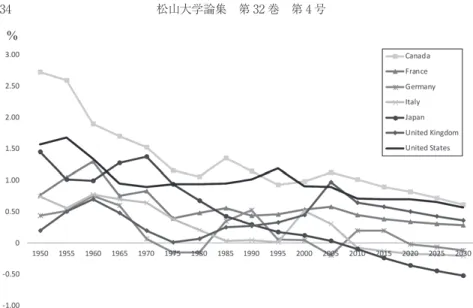
Another serious problem in many countries is the declining rates of birth and population growth. Figures and clearly show that the population growth rate continues to decrease in G countries owing to the declining birth rate. Referencing Yakita( b), Bokan et al.( )investigate the relationship between a growth maximizing debt-GDP ratio and the population growth rate under the golden rule of public finance(GRPF). As per the GRPF, the government can issue public debt to finance only productive expenditures, where a certain proportion of public investment is financed by public debt, while the remaining is funded by tax revenue in our model. On the other hand, Bokan et al.( )assume an extreme condition as a special case of the GRPF, that is, public investment is fully financed by fiscal deficit. Therefore, it remains to be determined if the growth-maximizing debt-GDP ratio(or tax rate)increases when fiscal deficit expands.
This study constructs an endogenous growth model with public capital and debt to examine the effect of fiscal deficit on important variables, such as public capital accumulation and long-run economic growth rate, and mutual dependence among budget deficit, declining birth rate and life expectancy under the GRPF. We draw on Tamai( ), who constructs an endogenous growth model with public capital and finite lives assumption, and incorporate the role of public debt in our basic
)They also show that a growth-maximizing tax rate is not consistent with a welfare-maximizing tax rate, implying that the results of Barro( )do not hold in their model.
Figure : Changes and estimates in the population growth rate
model. Although Kamiguchi and Tamai( )also consider the issue of aging population with debt-financed public investment under the GRPF, they assume that public investment is fully financed by fiscal deficit as in Bokan et al.( ). Therefore, we can analyze the effects of a fiscal deficit when life expectancy increases, and compares the results with those of the public debt models in Minea and Villieu( ) and Greiner( ), who consider an infinite horizon. In addition, we expend the present model to population growth to distinguish between the effects of expanding life expectancy and declining birth rate. In terms of finite lives assumption, Tamai( )follows Blanchard’s( )standard model, implicitly assuming that the extension of life expectancy causes a consistently declining birth rate to maintain the population growth rate at zero. Considering that, in reality, a declining birth rate is large enough to decrease the population growth rate, it is important to clarify the net effects. Therefore, we focus on the effects of not only an aging population but also falling birth rate that leads to declining population growth. In sum, there are two broad differences between our model and models from previous studies conducted. First, public investment is partly financed by public debt, so that the effect of an increase in ratio of fiscal deficit to public investment(i. e., the effect of an expanding fiscal deficit), may be analyzed. Second, the population size changes depending on the birth rate and life expectancy. These two characteristics generalize previous studies that analyze mutual dependence among fiscal deficit, declining birth rate and life expectancy.
Our model offers the following main results. In comparison with infinite horizon models in Minea and Villieu( )and Greiner( ), which show the negative effects of fiscal deficit, we demonstrate that an increase in fiscal deficit has complex effects on public capital accumulation and economic growth. As for the growth-maximizing income tax rate, we numerically explain that an extension of life expectancy increases the tax rate, while an increase in fiscal deficit decreases it.
This result suggests that the government should not necessarily increase the income tax rate under an expanding fiscal deficit and life expectancy ; this finding does not differ from those for a balanced budget rule(BBR), wherein a government does not issue public debt. Furthermore, we indicate that the extension of life expectancy reduces the debt-GDP ratio, while a declining birth rate increases it. We also show that the effects of a declining population growth rate disappear when a majority of public investment is financed by fiscal deficit, implying that the effects of the extension of life expectancy, rather than those of a declining birth rate, are important. This suggests that, in this case, a declining birth rate does not affect the growth-maximizing tax rate and debt ratio, which is in line with the results of Bokan et al.( ), who demonstrate that the growth-maximizing debt-GDP ratio does not depend on the population growth rate in the absence of a subsidy for childrearing time. Our results imply that changes in the population growth rate can affect the growth-maximizing debt-GDP ratio under the GRPF as long as a part of public investment is financed by tax revenue.
The remainder of this paper is organized as follows. Section presents the basic model. Section confirms the dynamic system and balanced growth path of the model. Section conducts a comparative analysis and numerical simulation. Section extends this model to analyze a declining birth rate. Section concludes the paper.
.
BASIC MODEL
We consider an endogenous growth model with public capital and public debt. In this section, our model focuses on whether government issues public debt. We also elucidate how our model differs from that of Tamai( ).
..Individuals
Following Blanchard( ), we consider a representative individual who faces a constant mortality rate, θ, which is identical for all individuals. We assume that the birth rate is also a constant, θ, such that the size of population "*always equals
for any time t : "*##
!$ *
$'!$&*!&'&&#"!
Each individual inelastically supplies θ units labor. We compute the expected life time of individuals as follows :
#!$*$'!$*&*# "
$!
Therefore, we regard a decrease inθ as the extension of life expectancy.
An individual born at time s maximizes the following expected utility at time t : !*#&)"*'#!*#
* $
#$%)"&& '
( )'!%&!*& '&&## * $
#$%)"&& '
( )'! $"%& '&!*& '&&"( )
where%&)"*'is the individual consumption of generation s at time t, ρ is the rate of time preference, and !*is the expectation operator. In this model, we consider the possibility that individuals with assets(or debt)suddenly exit the economy because they always face a certain death rate. Thus, we also assume the existence of a perfect insurance market. The rate of return of an individual’s assets at time t is the sum of the interest rate(&*'and premium rate θ : (&*'"$.
Each individual is subject to a budget constraint as follows :
$%&)"&'#&"!#'((&&'"$)$&)"&'"'&&'! "!%&)"&'" ( ) where $&)"&'and '&&'denote total assets and wage income at time t for an individual born at time s and #%&!""'is the constant income tax rate. We
assume that newly born individuals do not have assets : %&,",'#!. Solving the optimization of the individual, we obtain
&&,"&& '
&,"&& '# "!#& '+&&'!#$!%" ( ) $#%
&, %(
!&"!#'#-&*+&.'"$+'.%&,"&'#!! ( )
( ) is the transversality condition. To obtain a consumption function for an individual born at time s, we solve the differential equation( )and calculate the result, given equation( )and( ):
&&,"-'#&%"$'%&,"-'")&-'! "" ( ) where)&-'is the human wealth :
)&-'$&"!#'$
-%
'&-'(!#-&&"!#'*+&.'"$+'&! ( )
We also assume that the capital letter of each variable represents the aggregate amount in the economy, for example, $&-'$$!%-*&,"-'$(!$&-!,'',. Thus, when
we apply this definition formula to( ),( ), and( ), the aggregate variables are denoted as follows :
"&-'#&%"$'!&-'"#&-'* +" ( a) !&&-'#&"!#'*+&-'!&-'"'&-'+!#$!&-'!"&-'" ( b) #&&-'#&"!#'*+&-'"$+#&-'!'&-'( )! ( c) Differentiating( a)with respect to t and using( b)and( c), we obtain
"&&-'
..Firms
Following Glomm and Ravikumar( )and Greiner and Semmler( ), we assume the aggregate production function$%(&with congestion effects regarding public capital as follows :
$%(&"$"%(&"!#'%%(&#%(&(#!
( ) where ξ, "%(&, %%(&, #$%!!"&, and #%(&%""&are the technology parameter, private capital stock, per capita public capital stock provided by the government, elasticity of public capital to output, and labor input that equals population size, respectively). Dividing both sides of( )by#%(&, we obtain
*%(&"$&%(&"!#%%(&#!
( ) where *%(& and &%(& are per capita output and per capita private capital, respectively : *%(&#$%(&"#%(&and &%(&#"%(&"#%(&. Under perfect competition, the interest rate and wage income are given by
'%(&"%"!#&$)%(&#!
( a) %%(&"#$)%(&#!"%%(&!
( b) where)%(&#!%(&""%(&, and !%(&is aggregate public capital.
)Although( )indicates a production function with a congestion effect, it is consistent with the standard Cobb-Douglas production function with public capital, as in Futagami et al.( ), because we do not assume population growth in this section. If we consider positive population growth, the production function ensures a consistent balanced growth path, where each per capita variable(i. e., production, private capital, and public capital)increases at the same rate in the long run. For the case of population growth, see Section .
..Government
A government levies a tax on income and issues bonds to finance government expenditure). In addition, the government invests on public capital and makes the
interest payments on public debt as expenditure. Therefore, the government budget constraint is
"#%'&#&%'&"%'&"##%'&!#)&%'&"$*!%'&"&%'&%%'&' (" ( ) where "%'& and ##%'& are total government debt and public investment. Furthermore, we assume that the government follows the GRPF, that is, the government issues bonds only to finance productive expenditure such as public investment. Since public investment on public capital benefits not only the current but also the future generation, under this rule, all generations face a cost burden. In Japan, for example, a majority of public investment is financed by fiscal deficit. Following Minea and Villieu( )and Greiner( ), we formulate this rule as
"#%'&#%##%'&" ( )
where %$)!""&is the debt-financed ratio. Note that %#! implies that the government always maintains a balanced budget, that is, the long-run results of %#!are consistent with those of Tamai( ).
.
EQUILIBRIUM
The equilibrium condition for the asset market is
!%'&#$%'&""%'&! ( )
)Tamai( )analyzes two types of tax rates : tax on output or income. Since the latter is more realistic, we focus on the income tax rate.
From( b),( c),( a),( b),( ), and( ), we also obtain the equilibrium condition of a goods market :
%&)'$!&)'"$"&)'"#"&)'! ( )
..Dynamic system
To describe the dynamic system for this model, we derive the growth rate for each economic variable. First, substituting( a)and( )into( )gives us
%'%!"&)'
!&)'$&!!&'&!!$')*&)'$!&'!(!'&("''!"&&)'!(&)'"" ( ) where (&)'%!&)'#$&)' and &&)'%"&)'#$&)'. Dividing ( ) by $&)', the growth rate for private capital is
%$%$"&)'
$&)'$)*&)'$!(&)'!##&)'"&)'*&)'! ( ) From( )and( ), we obtain
%#%#"&)'
#&)'$ &! !!$( & '!!&& '&)&')+*)&'
$"&'!"&)( &')
!!*
& '*)&' ! ( )
Finally, the growth rate for public debt is simply derived by dividing( )by"&)' as follows :
%"%""&)'
"&)'$*##&)'"&)'*&)'&&)'! ( )
..Balanced growth path
Here, we consider the balanced growth path(BGP)in which all variables in this economy grow at a constant rate, %!$%#$%$$%"$%#. Then,( )−( )
can be rewritten as $!#$%"!%&%"!#&('##!%&!'!&%'"&&""% # &# ! "" ( a) $$#$('##!&#!$##'#" ( b) $##$'%!%"!#&%"!%&% #(('##"%&%""%#& %"!)&'# " ( c) $"#$)$##' # %#! ( d)
Note that all growth rates for aggregate variables have per capita growth rates because we do not assume population growth in this section.
( b)and( d)imply
%#$)'#" ( a)
&#$('##!%""'#&$
##! ( b)
When we use( a)and( b)to confirm the existence of BGP,( a)and( c) reduce to
%"!%&%"!#&('##$
%('##!""%&
'#"%"!)&&%'"&&"")' #
&%'#&"%"!)&'"%&" ( )
where&%'#&comprises '#and other exogenous parameters from the abovementioned algebraic calculation. Let us define the left- and right-hand sides of( )as Λ%'#&
and Ω%'#&, respectively. Accordingly, Figure shows that Λ%'#&slopes upward, while Ω%'#&is a discontinuous function at &%'#&$!and slopes downward. As
Proposition . For ($!, there is a unique and stable BGP in the region where "#"!. For (%&!!"', under plausible parameters, there is a unique and stable
BGP in the region "#"!(for the proof, see Appendix.).
.
CHARACTERISTICS OF THE STEADY STATE
To gain more detailed insight, we focus on the BGP, denoted as !# in Figure . First, we conduct comparative statics analysis on the income tax rate, life expectancy, and debt finance ratio. Second, we derive the growth-maximizing income tax rate and then perform a numerical exercise that demonstrates how the tax rate should be changed in line with an expanding life expectancy and fiscal deficit.
"&##'$! #!$ #&##' !# $&##' &"!(''"%& # ## $&##' Figure : Existence of BGP
..Comparative statics analysis
We mainly analyze the effect on the ratio of public capital to private capital, ##. To obtain the effect of income tax rate on public capital ratio, we differentiate##with respect to the income tax rateλ in( ), obtaining)
Ω Λ Ω Λ !## !%%! * &##' *% !* &# #' *% * &##' *## !* &# #' *## &#!'" ( ) where Ω Λ * &##' *% !* &# #' *% %(##$!""&##"&&'"&'&"")# #'&""##' "&##'# $(##$!""&"!$')(##$"& ##"&) ! "&#!'!
Therefore, an increase in the income tax rate raises the public capital ratio. This result is the same as those in Tamai( ) and Greiner( ). It eases the government budget constraint such that available resources for public investment increase. In addition, this result is used when deriving the growth-maximizing income tax rate in subsection ..
Next, we show the effects of an extending life expectancy on the public capital ratio, ##. Following the same method described above, we obtain the effect of life expectancy as follows : Ω Λ Ω Λ !## !&%! * &##' *& !* &# #' *& * &##' *## !* &# #' *## &#!'" ( )
where Ω Λ * %$#& *& !* %$ #& *& $%$"#"""&%'"&&%"")$ #& #%$#&# !$"#")""")$#" % &
"%"!)&%'"#&&%"")$#%$#& #&%#!&!
This shows that the extension of life expectancy reduces the public capital ratio. It directly affects individuals and the government). First, an extension of life
expectancy reduces government tax revenue, and thus, less available resources disrupt public investment. In addition, it reduces individuals’ marginal propensity to consume to prepare for future consumption. Further, it boosts private investment, which in turn accumulates private capital stock. These direct effects reduce public capital and raise private capital, lowering the ratio of public to private capital. Although greater private investment raises production, which has a stimulating effect on public investment because it raises tax revenue, the public capital ratio declines because the direct effects exceed the indirect effects, as seen in( ).
We consider the effects of fiscal deficit on the public capital ratio and economic growth rate. By differentiating$#with respect toψ, we obtain
"$# ") 㾷 !) &%'"&&!㾷 %"!)&'###" ( ) where !㾷 !) #%&)#$##" " $#"%#")& # $"#%($#$!" 㾷'%"!%&%"!$&%#)#")""&"%"!%&%$)!"&!#)#(($#$!"
)Although this result is the same as that in Tamai( ), note that it includes the effect of not only an extension of life expectancy but also a declining birth rate.
"#&#$"!$%$"!#%%"##"#"&$""&%$"!#%""!&!$$""$&%'%"##""!
Note that Z can become negative depending on the parameters. If !"!, an increase in fiscal deficit reduces the public capital ratio. The result for( )differs from that of an infinite horizon model, such as those of Minea and Villieu( ) and Greiner( ). The effects of fiscal deficit on"#are roughly categorized into
two. First, an increase in fiscal deficit reduces "#as fiscal deficit is a resource for public investment ; however it disturbs public investment through higher interest payment on public debt in the long-run. This similar to the effects presented by Minea and Villieu( )and Greiner( ). Second, an increase in fiscal deficit can have a positive effect on"#. It increases public debt accumulation, leading to a rise in individual assets. Therefore, public capital can increase to raise tax revenue through premium rate θ on total assets. Z in equation( )implies the second effect. Given( )and the result of an infinite horizon model, public investment financed by fiscal deficit reduces private capital in the long-run since the effect weakens if life expectancy is sufficiently high that is, θ is sufficiently low. Therefore, we obtain the same result of Greiner( )regarding the effect on "#in
the case.
Proposition . Assume that life expectancy is sufficiently high, that is, θ is sufficiently low. Then an increase in fiscal deficit reduces the ratio of public capital to private capital, "#, in the long run.
This suggests that debt-financed public investment, rather than tax-financed investment, is undesirable in developed countries where life expectancy continues to increase).
..Numerical simulation
In this section, we perform a numerical simulation to derive the growth-maximizing tax rate and analyze the effect of life expectancy and fiscal deficit on the tax rate. When we differentiate the growth rate of public capital( c)with respect toλ, we obtain "#!# "$ $!) " ##%'##""%&"( %"!"&'#' #""%($ $#
###'%"!"&'###"%("(%"!(&%"!$#&"'##"
! ""#"$!#
( )
where$#is the growth-maximizing income tax rate. From( ), we can explicitly derive the income tax rate $#, although it has a complex form. ) Thus, we
numerically compute the tax rate for a varying life expectancy and debt-finance ratio. As for the parameter values, we choose them on the basis of previous studies. Following Mourmouras and Lee( ), we set the effective time preference to %"&$ . , which comprises %$ . and &$ . . While some studies set the elasticity of output to public capital to a relatively high value, "$ ., we adopt"$ . , which is more commonly used in the literature(e. g., Greiner and Semmler, ; Mourmouras and Lee, ; Greiner, ), and find that our results remain unchanged even if we adopt"$ .. Finally, the debt-finance ratio
)Futagami et al. ( )construct an endogenous growth model with public capital and debt under the Maastricht Treaty and present similar implications. Although they assume an infinite horizon model, they indicate that a rise in public debt increases the economic growth rate in the low-growth steady state but decreases it in the high-growth steady state.
)In our model, an inverted U-shaped relationship exists between the debt-to-GDP ratio and economic growth rate, due to the presence of a unique tax rate that maximizes the economic growth rate, and an increase in tax rate raises the ratio of public debt to GDP through public capital accumulation as in equation( a)and( ). Therefore, this result is consistent with the empirical evidence shown by Checherita-Westphal and Rother( ).
ψ can take various values depending on the assumed countries. In Japan, which is
an extreme example, public investment is entirely financed by fiscal deficit, "# , whereas the government in Germany follows the BBR, "" . ) Therefore, we
consider various values of the debt-finance ratio as follows : "" ., "" ., "" ..
Figure depicts the long-term relationship between the economic growth rate and income tax rate for "" ., ., .. For "" ., ., ., the growth-maximizing tax rate !! is .%, .%, and .%, respectively. Table presents a combination of the debt-finance ratio and the growth-maximizing tax rate, implying that the growth-maximizing tax rate tends to decrease as the debt-finance ratio rises. This result considerably differs from that of an infinite horizon model,
)According to OECD( )the ratio of general government deficit to GDP of Germany became positive in . On the other hand, the public finance balance of Japan continues to be in the red.
which shows that the growth-maximizing tax rate is equal to the elasticity of output to public capital. ) The intuition underpinning this result is as follows. An
increase in fiscal deficit accumulates public debt, which affects the optimal income tax rate. Increased public debt raises tax revenue because the government taxes insurance premiums gained from individuals’ assets and this reduces the optimal income tax rate. In this case, the government must reduce the income tax rate to maximize the economic growth rate since public capital is large relative to private capital.
Next, we analyze the effects of an extension of life expectancy. Except for life expectancy and the debt-finance ratio, we use the same values as those in the above simulation. We set the debt-finance ratio to $" .. Figure illustrates the relationship between the economic growth rate and income tax rate for different values of life expectancy. For #" . , . , . , the growth-maximizing tax rate"!is .%, .%, and .%, respectively. Furthermore, Table shows the growth-maximizing tax rates for θ from . to . in . increments and implies that an extension of life expectancy raises the growth-maximizing tax rate. Therefore, we obtain the same result as that in Tamai( ). The mechanism behind this is as follows : an extension of life expectancy reduces tax revenue because the government taxes insurance premiums. The reduction in tax revenue lowers public investment, in turn reducing the ratio of public capital to private capital. Thus, the government must raise the tax rate to continue maximizing the
)Ueshina and Nakamura( )show an inverted U-shaped relationship between the economic growth rate and tax rate, whose absolute maximum is"!"!.
ψ . . . . .
"! .% .% .% .% .% .%
Table : Debt-finance ratio and growth-maximizing tax rate and aging population in an endogenous growth model
economic growth rate because the ratio of public to private capital is below the optimal level.
Tamai( )and Yakita( a)conclude that the size of the government should be large for an increasingly aging population under the BBR. However, an increase in life expectancy does not necessarily raise the growth-maximizing tax rate if the fiscal deficit also increases simultaneously. This ambiguous result occurs because an increase in life expectancy and a rising fiscal deficit exert opposite effects on the growth-maximizing tax rate. In Japan, however, if public investment is entirely financed by fiscal deficit, that is, "" , the influence of life expectancy
θ . . . . .
!! .% .% .% .% .%
Figure : Economic growth and income tax rate forθ = . , . , .
persists over time. As has been discussed in the context of countries with high public debt, governments must now consider fiscal consolidation. This suggests that the government must further raise the tax rate to deal with an aging population.
.EXTENSION
In this section, we incorporate population growth into the basic model. We distinguish birth rate and death rate to analyze the effects of a declining birth rate.
..Declining population growth
Following Buiter( ), we consider a positive population growth ). We
denote birth rate and mortality rate as β and θ, respectively. Then, we regard population growth rate n as ,"%!& and assume positive population growth : %$&$!. Furthermore, we also assume that the size of the initial population is unity : &!"". Each individual inelastically supplies one unit of labor. Therefore,
the size of total labor for any time t is given by %."%)!&.!
!$ .
)%-(-"),.!
As for the GRPF, we rewrite( )as follows :
(#"'*#%.&" ( )
where(%.&#"%.&#%%.&and *%.&##%.&#%%.&. In addition, we define other per capita variables such as +%.&#$%.&#%%.&and '%.&#!%.&#%%.&. Note that an individual’s expected utility and budget constraint do not change and, thus,( )is the individual Euler equation.
)Weil( )also considers positive population growth but assumes that individuals do not exit the economy.
Based on the definition of per capita variables, rewriting dynamic systems ( )−( )in per capita form gives us
&!%##&)'
#&)'$&"!''&"!$'**&)'$!'(!)!%&)"('"""&)'!(&)'"" ( ) &&%&#&)'
&&)'$**&)'$!(&)'!% #&)'
%&)'*&)'!' ""*&)'( )" ( ) &%%%#&)'
%&)'$ '!&"!$'&"!''"&)'( )**&)'
$"'("""&)'( ) &"!+'*&)' !' *&)'!"&)'&"!+'*&)'( )" ( ) &$%$#&)' $&)'$+% #&)'
%&)'*&)'"&)'! ( )
Now, we consider the BGP : &##$&&#$&%#$&$#$&#. Accordingly,( ) can be
rewritten as &"!''&"!$'**#$"&"!+''$ '**#$!""'( *#"&"!+'&)"('&("''""+* # (&*#'"&"!+')"'(" ( )
where we again define the left- and right-hand sides of( )as Λ&*#'and Ω&*#',
respectively. As for the existence and stability of the BGP, we obtain the same results for Proposition . ) From( ), differentiating the ratio of public to private
capital with respect to birth rate and life expectancy, respectively, we obtain
Ω Λ Ω Λ $*# $%$! , &*#' ,% !, &* #' ,% , &*#' ,*# !, &* #' ,*# &#!'" ( )
Ω Λ Ω Λ $)# $(%! + &)#' +( !+ &) #' +( + &)#' +)# !+ &) #' +)# &$!'" ( ) where Ω Λ + &)#' +& !+ &) #' +& %!&"!*'&)"('% # (&)#''# #! ( ) and Ω Λ + &)#' +( !+ &) #' +( %&"!*'&&""*) #' (&)#' "' ")#"""&&)"('&""*) #' (&)#'# $ "!)#"*"""*)#" # $$!! ( )
Note that the sign of the denominator of( ) and ( ) is negative. Not surprisingly, we obtain( ) by adding ( ) and ( ) and assuming that the birth rate is equal to the mortality rate, &%(. Now, we consider the effects of these on the ratio of public debt to GDP. Since ##%*)#, in the steady state, the effects on the debt-GDP ratio are proportional to those on the public capital ratio. Accordingly, we obtain the following results :
$##
$& #!"$#
#
$( $!! ( )
This implies that life expectancy extension reduces the debt-GDP ratio, while a declining birth rate increases the ratio. ) When these effects simultaneously occur,
)Although we consider the effects on the ratio of public debt to private capital to analyze debt-GDP ratio, note that both offer the same results. In the BGP, the debt-GDP ratio can be rewritten using( )and##as follows :
!
" %&##"!%"
where&&$!'is a constant value.
such that the size of the population is constant, the net effect of these is negative, that is, the debt-GDP ratio declines. As we confirmed in the Introduction, however, the rate of population growth tends to decline in many advanced countries. Therefore, the effects of a declining birth rate can be quantitatively large, and thus, it is important to focus on the influence on countries in which the population growth rate significantly declines. As for the declining birth rate, the results can be interpreted as follows. Declining population growth as a result of a decreasing birth rate has two effects on public investment. First, it raises the per capita burden of public debt but reduces the dilution effect of public capital. Under the golden rule, the ratio of public debt to private capital does not exceed public capital ratio : #!#!!. Therefore, with a declining population growth, the improvement in the
dilution effect dominates the increase in the per capita burden of public debt, which is further accumulated through public investment under the GRPF.
The relationship between the effects of a declining birth rate and debt-finance ratio is highly complex, as can be seen in( )and( ). Therefore, we consider the situation in which most of the public investment is financed by fiscal deficit, as in the case of Japan. This implies $$ , and thus,( )offers the following result : $#% $$ " "$! "#"!"$$$ "#% "!! "# "!!
This demonstrates that a change in the birth rate does not influence those ratios if public investment is entirely financed by fiscal deficit. This is because the improvement in the dilution effect is equal to the increase in the public debt burden, because both public debt and public capital are of the same size. From the above results, we obtain the following proposition.
Proposition . Slow population growth due to a decreasing birth rate raises the public debt-GDP ratio, while an extension of life expectancy reduces it.
"!!
"% #!""!
!
"& $!!
If a majority of public investment is financed by fiscal deficit and β and θ simultaneously decrease, the effects of a declining birth rate disappear, so the effects of life expectancy mainly remain.
This proposition indicates the need to also focus on a declining birth rate in the case of a significantly declining population growth ; however, more attention is needed for the extension of life expectancy when public investment is entirely financed by fiscal deficit.
In addition, our results are consistent with those of Bokan et al.( )when a majority of public investment is financed by fiscal deficit. Their study shows that the growth-maximizing debt-private capital ratio does not depend on birth rate under the GRPF and in the absence of a subsidy for childrearing time ). This suggests
that their results can be obtained even in the special case of public debt being equal to public capital.
..Numerical simulation for the effect of declining population growth
In this section, we conduct a numerical simulation to discover the effect of a decline in population growth on the growth-maximizing tax rate. As for the parameter values, we useρ and α as the values used in section ., except that we set the technology parameter ξ to . , which satisfies positive long-run economic growth rate for all cases. When fixing the value of mortality rate to &" . ), )Bokan et al.( )assume that public investment is entirely financed by fiscal deficit and households endogenously determine the number of children.
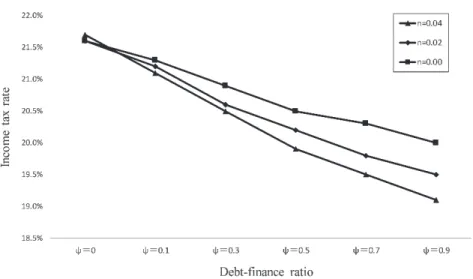
Figure : Growth-maximizing tax rate and debt-finance ratio for n = . , . , .
we consider a situation where the population growth rate slows down from!! . to !! due to a decline in birth rate(!! . " . ). Figure shows the transition of the growth-maximizing tax rate when expanding debt-finance ratioψ for !! . , . , . This figure implies that the lower the population growth rate, the higher the growth-maximizing tax rate. Therefore, governments depending heavily on fiscal deficit has to set a higher tax rate to maximize the economic growth rate in a situation where birth rate declining. The effect of debt-finance ratio on the optimal tax rate mainly depends on the difference between the birth rate and mortality rate.
)As for mortality rate, the implication in this section is not changed even if we set it to the value which is used in section ..
.
CONCLUSION
In this study, we constructed an endogenous growth model with public capital and debt. Some previous studies analyze the effects of the extension of life expectancy under the balanced budget rule against the background of an aging population. Therefore, we account for an aging population in our models to clarify the effects of a fiscal deficit. We also focus on the influence of a declining birth rate given the tendency of population growth to significantly decline in many advanced countries.
Our main findings are as follows. First, under the finite lives assumption, debt-financed public investment can increase or decrease the ratio of public to private capital, implying that economic growth rises if it increases the ratio of public to private capital. However, debt-financed public investment disturbs public capital accumulation by reduced tax revenue if life expectancy is sufficiently high as in the case of advanced countries. Second, as for the growth-maximizing tax rate, we numerically show that an expanding fiscal deficit reduces the tax rate, which is in contrast to the effects of life expectancy. Although this result renders policymaking a more complex process, it implies that the government must further raise the tax rate when implementing fiscal consolidation to reduce excess public debt accumulation. Third, we clarify the effects of birth rate and life expectancy, for which previous studies offer mixed results. An extension of life expectancy reduces the debt-GDP ratio, while a decrease in population growth owing to a declining birth rate raises the debt-GDP ratio. The effects of a declining birth rate can be large when population growth is slow. In addition, when public investment is entirely financed by a fiscal deficit, the effects of the birth rate on the debt-to-GDP ratio disappear ; on the other hand, the effects of life expectancy on the debt-to-GDP ratio persist. As for the growth-maximizing tax rate, a numerical simulation
shows that governments facing the problem of an increase in fiscal deficit has to set a higher it in the case of declining population growth. This suggests the need to address the problem of a declining birth rate and aging population depending on the fiscal situation.
Finally, further study is warranted on the following issues. This study does not consider a welfare analysis on the current and future generations. When a government changes the income tax rate to maximize the economic growth rate, it is important to reveal whether the policy benefits various generations. In addition, an analysis of an aging society is worth considering in the context of unproductive government expenditures, such as social security costs, which tend to be financed by fiscal deficit.
APPENDIX.EXISTENCE AND STABILITY OF THE BGP
Here, we confirm the existence and stability of the BGP using in this model. As in section , we define the left- and right- hand sides of equation( )as Λ%##&
and Ω%##&. Accordingly, these equations can be rewritten as
Λ%##&$%"!%&%"!$&(##$"%"!)&!" (A. )
Ω%##&$%(##$!""%&
##"%"!)&'"%&
"%"!)&%'"&&%&"!&"")#!"%##&#"!
(A. )
As in the case of(A. )and(A. ), we obtain the following properties : Λ
* %##&
Ω * '$#( *$# $!'"!$(%($#$!#!%&$## "'"!)(''"&('&""(**$# "")$ # #'$#( # $#!" (A. ) where Γ * *$# "")$ # #'$#( # $$!'"!)(#'$" #(# '$#(#! Γ'$#($$'"!%('"!$()#($#$!""'"!$(%)"$'"!%('"")(! ")($#$ " #%)'"!$("$'"!%('"!)$(! "($#$!""%'"!$(($#$!#"%& $#"#%&)$# "%&)# Therefore, Ω Λ * '$#( *$# !* '$ #( *$# #!!
Given %$&$#) !Ω'$#($& and %$&$#) &Ω'$#($'"!)('"%&, from(A. ),
we can see that the balanced growth path(BGP) exists. However, in (A. ), Ω'$#(can be a discontinuous function at #'$#($!. To confirm whether $#
satisfies#'$#($!, we describe this equation as follows : #'$#($!*
!'$#(%%($#$!""%&
$#"%&)$#"%&"%&)
!'"!%('"!$()($#$""! "!)")'"!%('"!$(!%! "($#$$!!
(A. )
From(A. ), we obtain the following limit value for !'$#(; %$&
$#) !!'$#($&
and %$&$#) &!'$#($!&. Therefore, there is at least one $# that satisfies
#'$#($!from the intermediate value theorem. Differentiating !'$#(with respect
to$#in order to confirm this uniqueness leads to
##
"%##&$!
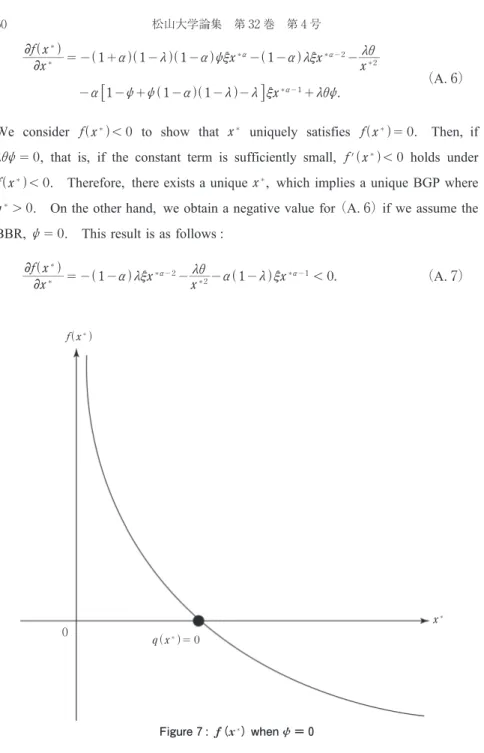
Figure : f(!!)whenψ =
)!%##&
)## $!%""$&%"!%&%"!$&('##$!%"!$&%'##$!#!%&###
!$"!("(%"!$&%"!%&!%! "'##$!""%&(! (A. )
We consider !%##&"! to show that ## uniquely satisfies !%##&$!. Then, if %&($!, that is, if the constant term is sufficiently small, !'%##&"!holds under
!%##&"!. Therefore, there exists a unique ##, which implies a unique BGP where
"##!. On the other hand, we obtain a negative value for(A. )if we assume the
BBR, ($!. This result is as follows : )!%##&
)## $!%"!$&%'##$!#!%&###!$%"!%&'##$!""!! (A. ) !%##&
Figure presents function #&'#'when *$!and demonstrates that a unique '#that
satisfies %&'#'$! exists. As for *%&!""', we obtain the same shape as in Figure if &'*is sufficiently small. Then, we obtain the unique BGP in region %##!.
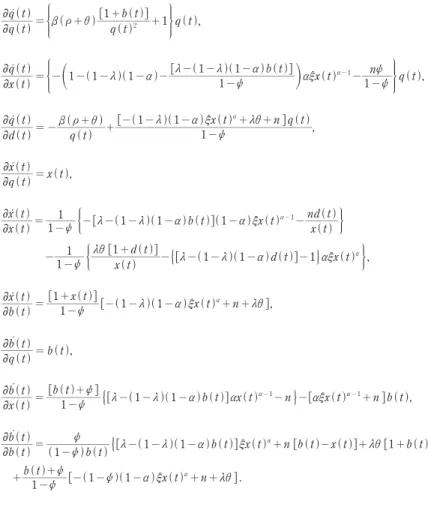
In the following, we consider the unique BGP and confirm its stability. From( )−( ), we partially differentiate these equations with respect to each endogenous variable as follows :
+%$&&'
+%&&'$ %&("''""!&&'' (%&&'#)""(%&&'"
+%$&&'
+'&&'$ ! "!&"!&'&"!$'! &!&"!&'&"!$'!&&''# ( "!* )$$)'&&'$!"! $*"!*(%&&'" +%$&&'
+"&&'$!%&("''%&&' " !&"!&'&"!$')'&&'
$"&'"$ ( )%&&' "!* " +'$&&' +%&&'$'&&'" +'$&&'
+'&&'$ ""!* ! &!&"!&'&"!$'!&&'%( )&"!$')'&&'$!"!$"&&''&&'& ! ""!*%&'"""&&'('&&' )! &!&"!&'&"!$'"&&'!( )!""$)'&&'$&"
+'$&&'
+!&&'$ ""'&&'("!* !&"!&'&"!$')'&&')( $"$"&')" +!$&&'
+%&&'$!&&'" +!$&&'
+'&&'$ !&&'"*("!*)!(&!&"!&'&"!$'!&&')$'&&'$!"!$"! $)'&&'( $!""$)!&&'" +!$&&'
+!&&'$&"!*'!&&'* !(&!&"!&'&"!$'!&&'))'&&'$"$ !&&'!'&&'( )"&'""!&&'( )" "!&&'"*"!* !&"!*'&"!$')'&&'( $"$"&')!
First, we assume ,$!and evaluate the abovementioned results based on the BGP. Then, the above equations can be rewritten as
-$$%%& -$%%& ! ! ! !,$!$ &%*")&" $## ""#$#%$!&" -$$%%& -&%%& ! ! ! ! ,$!$!%"!(&% #+&#%!"$#%#!&" -$$%%& -!%%& ! ! ! !,$!$ &%*")&" $# !%"!(&%"!%&+&#%"()"##$#" -&$%%& -$%%& ! ! ! !,$!$&#%$!&" -&$%%& -&%%& ! ! !
!,$!$! "&#'(%"!%&+&#%"()"%%"!(&+&#%""(%#!&"
-&$%%& -!%%& ! ! ! ! ,$!$%""& #&!%"!(&%"!%&+&' #%"#"()(" -!$%%& -$%%& ! ! ! ! !,$!$!" -!$%%& -&%%& ! ! ! !,$!$!" -!$%%& -!%%& ! ! ! !,$!$!'"#!
!% -%#'&( -%'&( # # # #,%! -'#'&( -%'&( # # # #,%! -##'&( -%'&( # # # # # ,%! -%#'&( -''&( # # # #,%! -'#'&( -''&( # # # #,%! -##'&( -''&( # # # # ,%! -%#'&( -#'&( # # # #,%! -'#'&( -#'&( # # # #,%! -##'&( -#'&( # # # # ,%! ( , , , , , , , , , * ) -+ !
We denote the eigenvalues of this matrix J as X . Given the above results, we obtain the sign of eigenvalues of J :
"!-#-#'&(#'&( # # # # ,%! $ %$ "!-%-%'&(#'&( # # # # ,%! $ %$"!-'-''&(#'&( # # # # ,%! $ %!-%-''&(#'&( # # # # ,%!$-' #'&( -%'&( # # # # ,%! & '%!!
This shows that one of the eigenvalues is negative : ""%!'$##!. Then,
computing a determinant of J , we obtain
! ))%-#-#'&(#'&( # # # #,%!$-%-%'&(#'&( # # # #,%!$-'-''&(#'&( # # # #,%!!-%-''&(#'&( # # # #,%!$-'-%'&(#'&( # # # #,%! $ %" where -%#'&( -%'&( # # # #,%!$-'-''&(#'&( # # # #,%!!-%-''&(#'&( # # # #,%!$-'-%'&(#'&( # # # #,%! %!&'*")('#%# *('"!%(+'#%"'"!((%+'#%"""()+ !%'##!()" "!%'"!((* +%+'#%"""'#!(!
Since )!)$!, it is clear that the product of the three eigenvalues is positive. Therefore, the product of the remaining two eigenvalues is negative since one of the eigenvalues is negative. Thus, the BGP is saddle-path stable for,%!.
When ,&'!""(, it is difficult to analytically prove the stability of BGP. Following previous studies, we numerically compute the eigenvalues. Table
shows that there are two negative eigenvalues and one positive eigenvalue under some plausible parameters. As per the numerical calculation, the BGP can also be saddle-path stable when("#!!"$.
"! . "! . "! . (! . . . . − . − . − . − . − . − . (! . . . . − . − . − . − . − . − . (! . . . . − . − . − . − . − . − . (! . . . . − . − . − . − . − . − . "! . "! . "! . (! . . . . − . − . − . − . − . − . (! . . . . − . − . − . − . − . − . (! . . . . − . − . − . − . − . − . (! . . . . − . − . − . − . − . − . "! . "! . "! . (! . . . . − . − . − . − . − . − . (! . . . . − . − . − . − . − . − . (! . . . . − . − . − . − . − . − . (! . . . . − . − . − . − . − . − .
Table : Sign of eigenvalues For!! (#!%! . ), '! .,
&! . , $! . For!! . (#! . , %! . ),'! . , &! . , $! .
For!! . (#! . , %! . ), '! . , &! . , $! .
References
Barro, R. J.( ). “Government Spending in a Simple Model of Endogenous Growth,” Journal of Political Economy, (S ), S −S .
Baum, A., Checherita-Westphal, C., & Rother P.( ). “Debt and growth : New evidence for the euro area,” ECB working paper series , European Central Bank.
Bokan, N., Hallett, A., & Hougaard Jensen, S.( ). “Growth-Maximizing Public Debt under Changing Demographics,” Macroeconomics Dynamics, ( ), − .
Blanchard, O.( ). “Debt, Deficit, and Finite Horizons,” The Journal of Political Economy,
( ), − .
Buiter, W.( ). “Death, Birth, Productivity Growth and Debt Neutrality.” The Economic Journal , ( ), − . doi : . / .
Checherita-Westphal, C. & Rother, P.( ). “The impact of high and growing debt on economic growth. An empirical investigation for the euro area,” EuropeanEconomic Review,
( ), − .
Futagami, K., Morita, Y., & Shibata, A.( ). “Dynamic Analysis of an Endogenous Growth Model with Public Capital,” The Scandinavian Journal of Economics, ( ), − . Futagami, K., Iwaisako, T., & Ohdoi, R.( ). “Debt Policy Rule, Productive Government
Spending, and Multiple Growth Paths,” Macroeconomics Dynamics, ( ), − .
Futagami, K., T. Hori, & R. Ohdoi.( ). “Debt Policy and Economic Growth in a Small Open Economy Model with Productive Government Spending,” ADBI Working Paper, .
Glomm, G & Ravikumar, B.( ). “Public investment in infrastructure in a simple growth model,” Journal of Economic Dynamics and Control , ( ), − .
Greiner, A.( ). “Debt and Growth : Is There a Non-Monotonic Relation ?,” Economic Bulletin, ( ), − .
Greiner, A. & Semmler, W.( ). “An endogenous growth model with public capital and government borrowing,” Annals of Operations Research, : − .
Minea, A. & Villieu, P.( ). “Borrowing to Finance Public Investment ? The ‘Golden Rule of Public Finance’ Reconsiderd in an Endogenous Growth Setting,” Fiscal Studies, ( ), −
.
Mourmouras, I. & Lee, J.( ). “Government Spending on Infrastructure in an Endogenous Growth Model with Finite Horizons,” Journal of Economics and Business, , − . OECD( ). General government deficit(indicator). doi : . / edb-en(Accessed on
April ).
Pan, H. & Wang, C.( ). “Government debt in the euro area-Evidence from dynamic factor analysis,” Economics Letters, , − .
Saint-Paul, J.( ). “Fiscal Policy in an Endogenous Growth Model,” Quarterly Journal of and aging population in an endogenous growth model
Economics, ( ), − .
Tamai, T.( ). “Public Capital, Taxation and Endogenous Growth in a Finite Horizons Model,” Metroeconomica, ( ), − .
Ueshina, M. & Nakamura, T.( ). “An inverted U-shaped relationship between public debt and economic growth under the golden rule of public finance,” Theoretical Economics Letters,
, − .
Weil, P.( ). “Overlapping Families of Infinitely-lived Agents,” Journal of Public Economics,
, − .
Yaari, M.( ). “Uncertain Lifetime, Life Insurance, and the Theory of the Consumer,” The Review of Economic Studies, ( ), − .
Yakita, A.( a). “Ageing and public capital accumulation,” Int Tax Public Finance, ( ),
− .
Yakita, A.( b). “Sustainability of Public Debt, Public Capital Formation, and Endogenous Growth in an Overlapping Generations Setting,” Journal of Public Economics, , − .