Behavior Induced by Unusual Sensory Precision
Author Hayato Idei, Shingo Murata, Yiwen Chen, Yuichi Yamashita, Jun Tani, Tetsuya Ogata
journal or
publication title
Computational Psychiatry
volume 2
page range 164‑182
year 2018‑12‑27
Publisher Massachusetts Institute of Technology Press Rights (C) 2018 Massachusetts Institute of Technology
Published.
Author's flag publisher
URL http://id.nii.ac.jp/1394/00001081/
doi: info:doi/10.1162/cpsy_a_00019
Creative Commons Attribution 4.0 International (https://creativecommons.org/licenses/by/4.0/)
A Neurorobotics Simulation of Autistic Behavior Induced by Unusual Sensory Precision
Hayato Idei
1, Shingo Murata
2, Yiwen Chen
2, Yuichi Yamashita
3, Jun Tani
4, and Tetsuya Ogata
11Department of Intermedia Art and Science, Waseda University, Tokyo, Japan
2Department of Modern Mechanical Engineering, Waseda University, Tokyo, Japan
3Department of Functional Brain Research, National Center of Neurology and Psychiatry, Tokyo, Japan
4Cognitive Neurorobotics Research Unit, Okinawa Institute of Science and Technology (OIST), Okinawa, Japan
Keywords: autism spectrum disorder, neurorobotics, recurrent neural network, prediction error minimization, sensory uncertainty, online adaptation
ABSTRACT
Recently, applying computational models developed in cognitive science to psychiatric disorders has been recognized as an essential approach for understanding cognitive mechanisms underlying psychiatric symptoms. Autism spectrum disorder is a
neurodevelopmental disorder that is hypothesized to affect information processes in the brain involving the estimation of sensory precision (uncertainty), but the mechanism by which observed symptoms are generated from such abnormalities has not been thoroughly investigated. Using a humanoid robot controlled by a neural network using a
precision-weighted prediction error minimization mechanism, it is suggested that both increased and decreased sensory precision could induce the behavioral rigidity characterized by resistance to change that is characteristic of autistic behavior. Specifically, decreased sensory precision caused any error signals to be disregarded, leading to invariability of the robot’s intention, while increased sensory precision caused an excessive response to error signals, leading to fluctuations and subsequent fixation of intention. The results may provide a system-level explanation of mechanisms underlying different types of behavioral rigidity in autism spectrum and other psychiatric disorders. In addition, our findings suggest that symptoms caused by decreased and increased sensory precision could be distinguishable by examining the internal experience of patients and neural activity coding prediction error signals in the biological brain.
INTRODUCTION
Autism spectrum disorder (ASD) is a neurodevelopmental disorder that affects a broad range of cognitive functions, including perception (Simmons et al., 2009), action (Gowen & Hamilton, 2013), and social cognition (Baron Cohen, 2001). In particular, behavioral rigidity manifested as restricted, repetitive behavior and resistance to change is a core ASD symptom (American Psychiatric Association, 2013; Leekam, Prior, & Uljarevic, 2011; Poljac & Bekkering, 2012;
Poljac, Hoofs, Princen, & Poljac, 2017), albeit such behavioral rigidity can be also observed in other psychiatric disorders (Lewis & Kim, 2009; Zandt, Prior, & Kyrios, 2007). Behavioral rigidity in ASD consists of various behavioral categories, such as stereotyped motor mannerisms
a n o p e n a c c e s s j o u r n a l
Citation: Idei, H., Murata, S., Chen, Y., Yamashita, Y., Tani, J., & Ogata, T.
(2018). A neurorobotics simulation of autistic behavior induced by unusual sensory precision.Computational Psychiatry,2, 164–182. https://doi.org/
10.1162/cpsy_a_00019 DOI:
https://doi.org/10.1162/cpsy
_
a_
00019Received: 27 December 2017 Accepted: 17 July 2018 Competing Interests: The authors declare no conflict of interest.
Corresponding Author:
Tetsuya Ogata [email protected]
Copyright:
©
2018Massachusetts Institute of Technology Published under a Creative Commons Attribution 4.0 International (CC BY 4.0) license
(e.g., hand flapping) and self-injurious or compulsive behavior (Bishop et al., 2013; Lord &
Jones, 2012). Although the reduced behavioral flexibility severely limits the social adaptation of patients, its cause and the underlying cognitive mechanisms remain unclear.
There have been many studies aiming to construct theories that explain the mechanisms underlying autistic symptoms (Baron Cohen, 2001; Happé & Frith, 2006; Hill, 2004), and recently the focus of these attempts has shifted to the idea of describing fundamental brain function as a set of computational processes (Redish & Gordon, 2016). In particular, theoretical explanations based on prediction error minimization frameworks, such as predictive coding (Bar, 2007; Den Ouden, Kok, & de Lange, 2012) and the free energy principle (Friston, Daunizeau, Kilner, & Kiebel, 2010), have been well investigated because they may be able to uniformly explain various ranges of autistic symptoms using a simple and neurologically plausible principle (Friston, Lawson, & Frith, 2013; Lawson, Rees, & Friston, 2014; Pellicano
& Burr, 2012; Van de Cruys et al., 2014; Van de Cruys, Van der Hallen, & Wagemans, 2017;
van Boxtel & Lu, 2013; van Schalkwyk, Volkmar, & Corlett, 2017). The prediction error min- imization mechanism explains how we acquire knowledge and skills (learning) and how we successively infer the causes of sensory inputs and recognize environments as the process of updating a model of the world based on minimizing error between a prediction about incom- ing sensory inputs and actual sensory inputs. Within a scheme in which prediction error causes the brain to update its model of the world, it is crucial to estimate precision (inverse variance) of sensory information: the expected precision of certain sensory information can provide in- formation about the reliability of the generated prediction error, which influences how much weight is given to the error when updating predictions. For example, although prediction errors for certain sensory inputs that contain information refuting the current expectation (e.g., one looks around the seabed in clear water and what seems like sand suddenly moves) should cause the brain to update its expectation (one recognizes it is not sand but flatfish), errors in sensory inputs that are very noisy (one looks around the seabed in foggy water and something moves) should not cause the update (one would think it is only a wave causing the movement). Al- though the estimation of such context-dependent sensory precision (prediction about whether information is informative or just noise) helps us to be flexible and adaptable in an uncertain world, deficits of it are expected to cause perceptual peculiarity and great difficulty in social contexts that are filled with situations of particularly high complexity and uncertainty (Lawson et al., 2014; Palmer, Lawson, & Hohwy, 2017; Van de Cruys et al., 2014, 2017; van Schalkwyk et al., 2017). Van de Cruys et al. ( 2014) suggested that inflexibly overestimated sensory pre- cision causes autistic symptoms and inflexible behavior may be considered as an attempt to minimize prediction errors; otherwise, patients are exposed to huge error signals. Lawson et al.
( 2014) explained autistic behaviors as the consequences of “an imbalance of the precision as- cribed to sensory evidence relative to prior beliefs.” These aberrant precision accounts of ASD in previous studies are normative and testable, but only suggestive. Specifically, there is a gap between the cognitive mechanisms described in the theories and the actual generation of the symptoms.
This kind of problem is broadly described in psychiatry, and there is a need to demonstrate actual generation of symptoms using formal computational models (Adams, Huys, & Roiser, 2015; Friston, Stephan, Montague, & Dolan, 2014; Huys, Maia, & Frank, 2016; Montague, Dolan, Friston, & Dayan, 2012; Teufel & Fletcher, 2016). Indeed, several computational sim- ulations of psychiatric symptoms have been conducted to try to understand the processes underlying these symptoms and clarify the relationships between abnormalities at neurological and behavioral levels (Barakova & Chonnaparamutt, 2009; Brown, Adams, Parees, Edwards, &
Friston, 2013; Diwadkar et al., 2008; Krichmar, 2013; O’Loughlin & Thagard, 2000; Powers,
Mathys, & Corlett, 2017; Rosenberg, Patterson, & Angelaki, 2015; Yamashita & Tani, 2012).
In particular, embodiment (Asada et al., 2009; Smith & Gasser, 2005) in a robot agent acting in physical environments may be useful, or even essential, for understanding the cognitive mechanisms of psychiatric disorders. That is because psychiatric disorders are characterized by behavioral and perceptual conditions observed through interaction with real environments and physical agents. In a related study, Yamashita and Tani ( 2012) performed a neurorobotics experiment to investigate schizophrenic cognition by utilizing a hierarchical neural network model. Their robotic experiment showed that behaviors analogous to psychiatric symptoms, such as fictive sensations and cataleptic, stereotyped behaviors, can be generated in the cou- pled dynamics describing the neural networks, body, and environment due to synaptic discon- nections between different levels of the neural network.
In this study, we investigated the effects of increased and decreased sensory precision on adaptive behaviors by conducting experiments using a humanoid robot implemented with a version of the predictive coding model. In the experiment, a task involving adaptive interaction between the robot and a human experimenter was considered. Initially, the neural network model inside the robot learned to generate a set of sequence patterns representing different behaviors of the robot. After the learning phase, the level of estimated sensory precision was manipulated. Then, the change in the robot’s behavior in response to the alteration of the level of sensory precision was observed through experiments in which the robot was required to appropriately recognize situations determined by the experimenter. The results show that both increased and decreased sensory precision can cause seemingly similar inflexible behavioral patterns, such as inappropriate repetitive behavior and freezing; but these behaviors are the result of different processes at the network level in the two cases. Our findings may provide a system-level account for different types of behavioral rigidity observed in ASD and other psychiatric disorders and extends computational perspectives on the cognitive mechanisms underlying psychiatric symptoms.
METHODS
Computational Framework
We used an artificial recurrent neural network (RNN) model to investigate the effects of in- creased and decreased sensory precision on adaptive behaviors of a robot. An RNN is a con- nectionist model that can process temporal sequences thanks to recurrent connections be- tween neural units (Elman, 1990). Owing to their capacity to learn to reproduce complex dynamic behaviors, RNNs have been used in cognitive neurorobotics studies aiming to un- derstand human cognition (Alnajjar, Yamashita, & Tani, 2013; Marocco, Cangelosi, Fischer,
& Belpaeme, 2010). Murata, Namikawa, Arie, Sugano, and Tani ( 2013), within the cogni-
tive robotics scheme, proposed an RNN model with a mechanism for estimating the time-
varying uncertainty of sensory information in terms of variance (inverse precision) as inspired
by the free energy minimization principle proposed by Friston et al. ( 2010). This RNN, called
a stochastic–continuous time RNN (S-CTRNN), can learn to predict not only sensory inputs
but also their variances based on negative log-likelihood minimization, which is equivalent
to precision-weighted prediction error minimization. Tani, Ito, and Sugita ( 2004) proposed an
RNN with parametric bias (RNNPB) that has an online adaptation mechanism based on pre-
diction error minimization. In this framework, parametric bias (PB) is encoded in a small group
of neural units that works as a higher level neural representation of the network behavior, and
the associations between specific patterns of PB activity and different temporal training pat-
terns are self-organized through a learning process. Owing to this characteristic of PB, a robot
driven by RNNPB can not only generate multiple learned behavioral patterns but also switch
its behavior by adaptively modulating the PB states in response to a discrepancy between a prediction and actual sensory information. PB states thus can be regarded as the higher level
“intention” of a robot Figure 1. Utilizing this model, Ito, Noda, Hoshino, and Tani ( 2006) demonstrated flexible switching of ball-playing behaviors by a humanoid robot in response to changes in the environment.
In the present study, an S-CTRNN with PB was adopted as the computational model for simulating aberrant sensory precision because of its capacity to learn to estimate sensory variance (precision) and adapt to different environments using a prediction error minimization
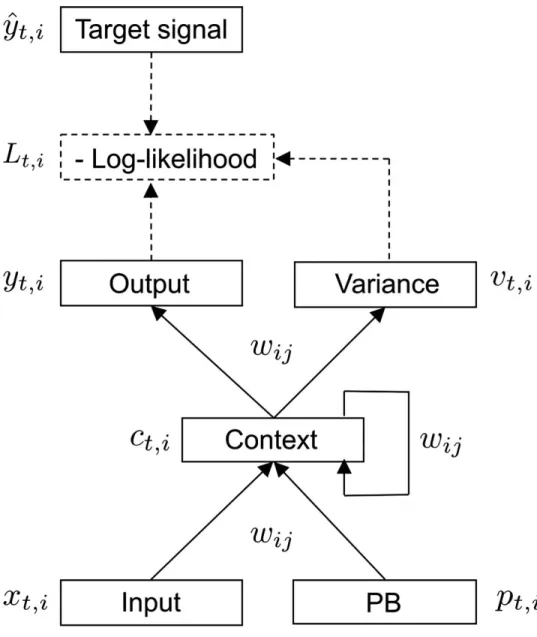
Figure 1. The S-CTRNN utilized in this study. The S-CTRNN has five groups of neural units: input,
context, output, variance, and PB units. Input neural units receive current sensory inputs x
t. Based
on the inputs, PB state p
t, and context state c
t, the S-CTRNN generates predictions about the mean
y
tand variance v
tof future inputs in the output and variance units, respectively. Parameters, such
as synaptic weights w
ijand the internal state of PB units, are optimized by minimizing negative
log-likelihood as calculated using predictions about sensory states, their variance, and actual target
sensory states y ˆ
t.
mechanism. The following subsections describe in detail the mathematical procedures used for the forward dynamics and parameter optimization of the S-CTRNN with PB.
Forward Dynamics The neuronal model is a conventional firing rate model. The internal state of the ith neural unit at time step t, u (
t,is) (t ≥ 1), is described by
u (
t,is) =
⎧ ⎪
⎪ ⎪
⎪ ⎪
⎪ ⎪
⎪ ⎪
⎪ ⎪
⎪ ⎪
⎪ ⎪
⎪ ⎪
⎪ ⎪
⎪ ⎪
⎪ ⎪
⎨
⎪ ⎪
⎪ ⎪
⎪ ⎪
⎪ ⎪
⎪ ⎪
⎪ ⎪
⎪ ⎪
⎪ ⎪
⎪ ⎪
⎪ ⎪
⎪ ⎪
⎪ ⎩
u (
t−
s)
1,i(i ∈ I
P) ,
1 τ
ij
∑ ∈
IIw
ijx (
t,js) + ∑
j
∈
ICw
ijc (
t−
s)
1,j+ ∑
j
∈
IPw
ijp (
t,js) + b
i+
1 −
τ1iu (
t−
s)
1,i(i ∈ I
C) ,
j
∑ ∈
ICw
ijc (
t,js) + b
i(i ∈ I
O, I
V) .
(1)
Here, I
I, I
P, I
C, I
O, and I
Vare index sets of the input, PB, context, output, and variance neural units, respectively; w
ijis the weight of the synaptic connection from the jth neuron to the ith neuron; x (
t,js) is the jth input of the sth sequence at time step t; c (
t,js) is the jth context state; p (
t,js) is the jth PB state, b
iis the bias of the ith neuron; and τ
iis the time constant of the ith neuron.
From this equation, we see that PB units can be considered to be a specific type of context unit whose time constant is infinite. The current study sets all initial values of the internal states of the context units to zero, while those of the PB units are optimized for each target sequence in the learning phase. This indicates that differences between target sequences are represented in the activity of the PB units.
The activation values of each neural unit are calculated as follows:
p (
t,is) = tanh
u (
t,is) (0 ≤ t ∧ i ∈ I
P) , (2) c (
t,is) = tanh
u (
t,is) (0 ≤ t ∧ i ∈ I
C) , (3) y (
t,is) = tanh
u (
t,is) (1 ≤ t ∧ i ∈ I
O) , (4) v (
t,is) = exp
u (
t,is) (1 ≤ t ∧ i ∈ I
V) . (5)
Parameter Optimization The neural network performs parameter optimization based on the gradient decent method aiming to minimize the objective function,
L (
t,is) = ln
2πv (
t,is)
2 +
ˆ
y (
t,is) − y (
t,is)
22v (
t,is)
, (6)
where y ˆ (
t,is) is the ith target value corresponding to the sth sequence. Minimizing this negative
log-likelihood can be regarded as minimizing the precision-weighted (inverse variance–weighted)
prediction error and is formally equivalent to minimizing free energy in the active inference scheme proposed by Friston et al. ( 2010).
In the learning phase, parameters, including synaptic weights w
ij, biases b
i, and the initial internal states of PB units u (
0,is) (i ∈ I
P), are updated in an offline manner. Parameter optimiza- tion is performed by minimizing the sum of the negative log-likelihood over all dimensions, time steps, and sequences as
L = ∑
s
∈
IS T(s) t∑ =
1∑
i
∈
IOL (
t,is) , (7)
where I
Sand T (
s) , respectively, represent the index set and the length of the sth target sequence.
The partial derivative of each parameter, (∂L/∂θ), can be found using the back-propagation- through-time (BPTT) method described in previous studies (Murata et al., 2013; Rumelhart, Hinton, & Williams, 1986).
In the adaptation phase, after learning, only the internal states of the PB units are opti- mized online, and other parameters are fixed. The negative log-likelihood within a short time window W is accumulated as
L =
∑
t t=
t−
W+
1∑
i
∈
IOL (
s)
t,i
. (8)
The time window of length W moves along with the increment of the network time step t.
Using the accumulated negative log-likelihood, the internal states of the PB units at time step t − W are optimized. The partial derivatives of the internal states of PB units are also calculated by the BPTT algorithm.
In both the learning and adaptation phases, parameters that are allowed to be optimized are collected as a vector θ, and θ at the nth epoch is updated using gradient descent on the accumulated negative log-likelihood L:
θ (n) = θ (n − 1) + Δθ (n) (9)
Δθ (n) = −α ∂L
∂θ + η Δθ (n − 1) . (10)
Here, α is the learning rate and η is a coefficient representing the momentum term. In this study, α and η are set at 0.0001 and 0.9, respectively.
Task Setting
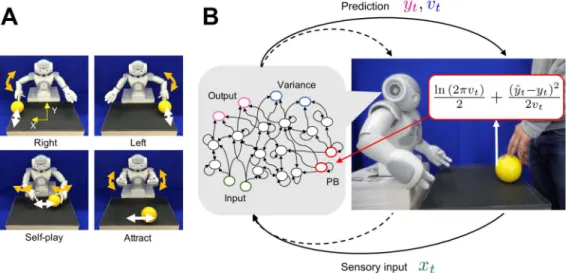
To provide the robot with a task suitable for testing our hypothesis that aberrant sensory preci- sion induces behavioral rigidity, we require a dynamical interaction setup in which the robot needs to perceive sensory information with intrinsic uncertainty and flexibly recognize situa- tions determined by others. We chose a ball-playing scheme involving interaction between a robot and a human experimenter that was used in a previous study by Chen et al. ( 2016). The behavioral patterns of the robot consist of four different ball-playing behaviors (see Figure 2A).
In the “right” and “left" behaviors, the robot is required to wait for the ball coming from the
human subject and then return it. “Self-play” behavior consists of rolling the ball in front of
itself, and the “attract” behavior is an up–down motor action with the arms while the part-
ner engages in the “self-play” behavior of moving the ball left and right. After the S-CTRNN
with PB learned to reproduce these visuo-proprioceptive temporal patterns, the behavioral
Figure 2. Ball interaction tasks in the training and adaptation phases. A) Four interactive behav- ioral patterns learned by a robot controled by an S-CTRNN with PB. The upper left and upper right figures show the right and left behaviors, respectively. The lower left and lower right figures show the self-play and attract behaviors. B) System overview during adaptive interaction between a robot and an experimenter. The solid lines for prediction and sensory input represent visual information about the ball position. The dotted lines represent proprioceptive information about the robot’s joint an- gles. The neural network generates predictions about sensory states y
tand their variances v
tbased on current sensory inputs x
tand also recognizes situations by updating PB activity online in the direction of minimizing the negative log-likelihood calculated using the predictions and the target signal (actual sensory feedback) y ˆ
t.
performance of the robot with the trained neural network model was tested in the task of adaptive ball-playing interaction with a human subject.
Experimental Environment
We employed a small humanoid robot NAO (Aldebaran) that has a body corresponding to only the upper half of the human body. The robot sat in front of a workbench and engaged in a ball- playing interaction with a human experimenter standing on the opposite side of the bench. The robot’s action involved only movements of the arms with 4 degrees of freedom for each arm (two shoulders and two elbows). In addition, a camera located in the robot’s mouth obtained the center of gravity coordinates for the yellow object, which was used as two-dimensional inputs for ball position. Using the minimum and maximum values of each piece of sensory information, the values of joint angles and the ball position were mapped to values ranging from −0.8 to 0.8. The size of the workbench and the diameter of the ball are approximately 45 × 5 × 30 cm and 9 cm, respectively.
Training
Training of the neural network was conducted in an offline manner by supervised learning
using target perceptual sequences recorded in advance. The target perceptual sequences were
recorded while the robot repeatedly performed each ball-playing behavior, where the arm
movement was generated exactly following preprogrammed trajectories instead of the ones
generated by the neural network model. Each of the four behavioral patterns was obtained as
a sequence of 10-dimensional vectors (8 dimensions for joint angles and 2 dimensions for ball
position). For the training, three sequences were prepared for each behavioral pattern. The time
lengths of the sequences were approximately 1,600 time steps for “right,” 1,900 time steps for
“left,” 1,600 time steps for “self-play,” and 1,200 time steps for “attract.”
The neural network learned to reproduce these target visuo-proprioceptive sequences.
The objective of the learning is to find the optimal values of the parameters (synaptic weights, biases, and internal states of PB units) minimizing negative log-likelihood, or precision- weighted prediction error. At first, each parameter was initialized with a random value, and the network produced random sequences. The parameters were updated in the direction of minimizing negative log-likelihood accumulated through the duration of the target sequences.
Repeating the update process many times, the network became able to produce visuo- proprioceptive sequences with the same stochastic properties as the target sequences. In ad- dition, the associations between a particular pattern of target sequence and specific internal states of PB units self-organized.
Online Adaptation
After the learning process, the robot engaged in an adaptive interaction with a human experi- menter by updating PB states (intention) online. In this phase, the robot’s intention was first set to a certain state corresponding to a learned behavior, and situation (ball dynamics pattern) was controlled by the experimenter. The goal of the robot was to flexibly recognize situations using visual cues. Real-time adaptation during task execution by the robot was performed based on an interaction between a top-down prediction generation process and a bottom-up parameter adaptation process. In the top-down prediction generation process, the network generated a temporal sequence corresponding to time steps from t − W + 1 to t, based on the sensory inputs at time step t − W + 1 and the constant PB states (intention). The visuo-proprioceptive sequence was generated by a “closed-loop” procedure, meaning that predictions about mean values of the sensory states at a certain time step were used as inputs at the next step. The initial inputs for proprioceptive states at time step t − W + 1 were taken from the generated mean predictions at t − W, and those for vision states were taken from the vision data caught by the camera at time step t − W + 1. In the bottom-up adaptation process, the negative log-likelihood at each time step within time window W was calculated by using the predictions about vision states, their variance, and the actual visual feedback (see Figure 2B). The PB states (intention) were updated in the direction of minimizing the accumulated negative log-likelihood. Based on the updated PB states, the temporal sequence within the time window was regenerated.
After repeating these top-down and bottom-up processes for a certain number of times, the network generated its predictions for time step t + 1, and the predictions about proprioceptive states were sent to the robot as the target for subsequent joint positions. This procedure, where recognition and prediction in the past are reconstructed based on current sensory informa- tion, is more properly regarded as a “postdiction” process (Eagleman, 2000; Shimojo, 2014), and generated predictions for time steps from t − W + 1 to t are more suitably referred to as postdiction of the past rather than prediction in the literal sense.
Parameter Setting for the Experiment
The number of input, output, and variance neural units were N
I= N
O= N
V= 10, corre- sponding to the dimension of the robot’s sensory states, and the number of PB units was N
P= 2.
The number and time constant of the context units were N
C= 50 and τ
i= 4, respectively. In the learning phase, the weights of synaptic connections w
ij(j ∈ I
I, I
C) and biases b
iwere ini- tialized with random values following uniform distributions on the intervals [ −
N1I,
N1I
] (j ∈ I
I) and [ −
N1C,
N1C
] (j ∈ I
C) for weights and [ − 1, 1] for biases, and the internal states of PB units
were initialized as 0. These parameters are updated offline 300,000 times in the learning phase.
In the adaptation phase, the internal states of PB units were updated online 20 times, and the length of the time window was W = 10.
Simulating Aberrant Sensory Precision
This study simulated increased and decreased sensory precision by altering estimated sensory variance (inverse precision). After the network learned to reproduce the set of behavioral pat- terns, the activation values of the variance units were modified as
v (
t,is) = exp
u (
t,is) + K + (i ∈ I
V) , (11)
where K is a constant determining the level of the estimated variance and is its minimum value, set as 0.00001. K is set as 0 in the normal condition, while K is set to negative values in the decreased sensory variance conditions and to positive values in the increased sensory variance conditions (K ∈ {−8, −4, 0, 4, 8}).
Analysis of Robot’s Behavior
To judge whether the robot’s behavior generated during the test phase is appropriate, the gener- ated time series of joint angles was compared with the target (learned) time series. A simple way to compare two time series is to calculate the distance between the value at each correspond- ing pair of time steps within a certain time window. However, this method is not necessarily appropriate for comparing a general characteristic of time series because a phase shift will increase the distance between the series. Here this would increase the distance even when the robot generates the appropriate action. Thus this study considered histograms of time series values within a specified time window and then compared the histogram of the time series generated through the test experiment with the target time series. Because a histogram of time series values can be considered as a probability distribution, two time series can be compared by calculating the Kullback–Leibler (KL) divergence. Although the probability distribution lacks some information regarding temporal ordering, this comparative approach is suitable for our purpose because a general characteristic of a time series can be extracted. By considering the amount of the state change and calculating the KL divergence from the learned time series, the behaviors observed in the experiments could be classified into one of four types: outwardly normal, freezing (maintaining one posture), unlearned movement (engaging in an unlearned action), and inappropriate learned movement (engaging in a learned action other than the target action). These are explained in more detail in below.
To assess the robot’s behavior in the experiment, an eight-dimensional time series of
joint angles was reduced to a two-dimensional time series by applying principal component
analysis. To extract the probability distribution of the two-dimensional time series, the two-
dimensional space [ −N, N] · [ −N, N] (with N the maximum of the absolute value of time
series S(t) = { z
1(t), z
2(t) } across all data, where z
1and z
2represent the first and second
principal components, respectively) is divided into N
bin2subspaces (here N
bin= 20). Then, the
occurrence frequencies of states within the time series were counted. Based on the acquired
probability distributions of the time series, the KL divergence between the probability distri-
bution of the time series generated in the test experiment and the target (learned) time series
was calculated. The robot’s behavior is judged as “outwardly normal” if the KL divergence is
less than a threshold ξ , set here as half of the minimum of KL divergence between each pair of learned time series:
D
KL(p q) < ξ = 0.5 · min
qi,qj∈
Usˆ∧
qi=
qjD
KL(q
iq
j). (12) Here p is the probability distribution of the generated time series through the test experiment, q is the probability distribution of the target movement, and U
sˆis a set of the probability distributions of each learned movement.
Atypical behaviors can be classified into one of three types of behaviors according to whether the movements were almost stopped and whether they were close to a learned move- ment other than the target. We call these freezing (if d < 0.02 and ∀ q ∈ U
sˆ, D
KL(p q) ξ), unlearned movement (if d 0.02 and ∀q ∈ U
sˆ, D
KL(pq) ξ), and inappropriate learned movement (if d 0.02 and ∃q ∈ U
sˆ, D
KL(pq) < ξ ). In these, d is the amount of the state change, defined as
d = 1 T
∑
Tt
=
0∑
i