Fukushima Medical University
This document is downloaded at: 2021-11-07T23:42:15Z
Title Emergency endotracheal intubation-related adverse events in bronchial asthma exacerbation: can anesthesiologists attenuate the risk?
Author(s) Ono, Yuko; Kikuchi, Hiroaki; Hashimoto, Katsuhiko; Sasaki, Tetsu; Ishii, Jyunya; Tase, Choichiro; Shinohara, Kazuaki
Citation Journal of anesthesia. 29(5): 678-685
Issue Date 2015-10
URL http://ir.fmu.ac.jp/dspace/handle/123456789/527
Rights © Japanese Society of Anesthesiologists 2015. The final publication is available at link.springer.com.
DOI 10.1007/s00540-015-2003-2
Text Version author
Emergency endotracheal intubation-related adverse events in bronchial asthma exacerbation:
Can anesthesiologists attenuate the risk?
Yuko Ono1,2* •Hiroaki Kikuchi1 • Katsuhiko Hashimoto1 • Tetsu Sasaki1 • Jyunya Ishii1 • Choichiro
Tase,2 • Kazuaki Shinohara1
1Department of Anesthesiology, Ohta General Hospital Foundation, Ohta Nishinouchi Hospital,
Koriyama, Japan
2Emergency and Critical Care Medical Center, Fukushima Medical University Hospital, Fukushima,
Japan
*Corresponding Author:
Yuko Ono, MD
Department of Anesthesiology, Ohta General Hospital Foundation, Ohta Nishinouchi Hospital, 2-5-20 Nishinouchi, Koriyama, Fukushima 963-8558, Japan
Tel.: +81-024-925-1188; Fax: +81-024-925-7791; E-mail: [email protected]
Keywords: Airway management • Status asthmaticus • Mechanical ventilation •Fatal asthma Word count: 3,062 words
Number of tables: 6
Abstract
Purpose Airway management in severe bronchial asthma exacerbation (BAE) carries very high risk and should be performed by experienced providers. However, no objective data are available on the association between the laryngoscopist’s specialty and endotracheal intubation (ETI)-related adverse events in patients with severe bronchial asthma. In this paper, we compare emergency ETI-related adverse events in patients with severe BAE between anesthesiologists and other specialists.
Methods This historical cohort study was conducted at a Japanese teaching hospital. We analyzed all BAE patients who underwent ETI in our emergency department from January 2002 to January 2014.
Primary exposure was the specialty of the first laryngoscopist (anesthesiologist vs. other specialist).
The primary outcome measure was the occurrence of an ETI-related adverse event, including severe bronchospasm after laryngoscopy, hypoxemia, regurgitation, unrecognized esophageal intubation, and ventricular tachycardia.
Results Of 39 patients, 21 (53.8%) were intubated by an anesthesiologist and 18 (46.2%) by other specialists. Crude analysis revealed that ETI performed by an anesthesiologist was significantly associated with attenuated risk of ETI-related adverse events (odds ratio [OR], 0.090; 95% confidence interval [CI], 0.020–0.41; p = 0.001). The benefit of attenuated risk remained significant after adjusting for potential confounders, including Glasgow Coma Score, age, and use of a neuromuscular blocking agent (OR, 0.058; 95% CI, 0.010–0.35; p = 0.0020).
Conclusion Anesthesiologist as first exposure was independently associated with attenuated risk of
ETI-related adverse events in patients with severe BAE. The skill and knowledge of anesthesiologists should be applied to high-risk airway management whenever possible.
Introduction
Bronchial asthma is a major healthcare concern worldwide. In the United States, nearly 14 million people have reported having a bronchial asthma exacerbation (BAE) [1], and every year 1.8 million emergency department (ED) visits, 440,000 hospitalizations [1], and more than 3,000 deaths [1] are the result of BAE, with an estimated economic burden of US$56 billion per year [2]. About 10% of individuals admitted to the hospital for BAE are sent to an intensive care unit, and 2% of all admitted patients are intubated [3].Airway management in severe BAE is challenging and carries a very high risk. Patients with BAE requiring emergency endotracheal intubation (ETI) have little respiratory reserve and are at high risk of rapid decline in oxygen saturation during the procedure, and ETI attempts can exacerbate bronchospasm and worsen respiratory status. Many authors [4–7] have recommended that intubation of patients with severe BAE be performed by an experienced provider. However, no objective data are available on the association between the specialty of a laryngoscopist and adverse events during emergency ETI in severe BAE. Detailed clinical information about ETI-related complications in patients with severe BAE is also lacking. Anesthesiologists perform ETI as an everyday task in the operating room, and are specialists in airway management. Is there a difference in the proportion of emergency ETI-associated adverse events in patients with severe BAE between anesthesiologists and other specialists? If so, how much? What situations cause major ETI complications in the ED? We attempt to answer these clinical questions in the present study, which we believe will provide important implications for airway management in high-risk patients.
Methods
Study design and setting
This was a historical cohort study conducted at Ohta Nishinouchi Hospital, which is a teaching hospital in a suburban Japanese city approximately 200 km north of Tokyo. The hospital serves as a tertiary and referral medical center that receives > 5,500 ambulances and > 22,000 ED visitors per year from areas within a 50-km radius. In Japan, the practice of emergency medicine has been historically viewed as an adjunct to other clinical specialties rather than as a unique specialty [8].Most Japanese EDs, including our own, operate according to a multispecialty staffing model [9]; i.e., instead of staffing ED physicians, there are anesthesiologists, general surgeons, internists, and other specialists serving as emergency medicine practitioners in rotation. This unique ED system in Japan [9] allows us to compare the specialty of the first laryngoscopist (anesthesiologist vs. other specialist) with emergency ETI- associated adverse events in severe BAE.
Participants and data sources
After approval by the institutional review board at our institutions, we included all BAE patients who underwent emergency ETI in our ED from January 1, 2002, to January 1, 2014, for analysis. We
excluded pediatric patients (aged < 16 years); patients whose initial ETI attempt was by a junior resident; and patients who underwent nasal intubation, surgical airway management, or an alternative technique such as video laryngoscopy or supraglottic airway. Data were collected from ED records, inpatient medical records, and nursing records. At our hospital, we use a structured ED record that includes a patient’s age, sex, vital signs on arrival, time course, medical history, detailed history of the present condition, physical examination, laboratory data, radiological findings, final diagnosis, primary indication for ETI, and any adverse events in the ED. All doctors who participate in the management of ED patients are required to complete the form immediately, and an ED director at our hospital (author
KS, a board-certificated anesthesiologist) checks all medical records to verify the completeness and
reliability of data without delay.
Nursing records included information about the specialty of the laryngoscopist, the number of ETI attempts, medication used to facilitate ETI, and vital signs after ETI attempts. Inpatient records included patient disposition and the sequence of emergency ETI-associated adverse events.
Outcome measures
The primary outcome measure was the occurrence of an ETI-associated adverse event in BAE patients.
Adverse events were categorized into major and minor adverse events. Major adverse events included severe bronchospasm after laryngoscopy, hypoxemia, regurgitation, esophageal intubation with delayed
recognition [10, 11], and ventricular tachycardia. Severe bronchospasm after laryngoscopy was defined as severe bronchial obstruction, after an ETI attempt, that is refractory to more than three of the following bronchodilator therapies: intramuscular [IM] or intravenous [IV] epinephrine, inhaled salbutamol, IV methylprednisolone, IV theophylline, and IV magnesium sulfate. Hypoxemia was defined as a decline in pulse oximetry saturation of > 10% from baseline during ETI attempts, not as a result of esophageal intubation. Regurgitation was defined as gastric contents that required removal by suction during laryngoscopy in a previously clear airway [10–12]. Esophageal intubation with delayed recognition was defined as misplacement of the endotracheal tube in the upper esophagus or hypopharynx with time elapsed and desaturation (>10% decline in saturation on pulse oximetry) [10, 11]. Minor adverse events included upper airway trauma, hypertension, hypotension, mainstem bronchus intubation, and cuff leak. Hypotension was defined as systolic blood pressure < 90 mmHg if this represents a >20% decrease from baseline [12]. Hypertension was defined as systolic blood pressure
>160 mmHg if this represents a >20% increase from baseline [12]. The primary analysis pooled all major and minor adverse events.
The primary exposure was the specialty of the first laryngoscopist (anesthesiologist vs. other specialist). Because of the unique ED system in Japan [9], other specialists did not include ED physicians. Anesthesiologists included both senior residents (postgraduate year >4) and consultants.
Similarly, other specialties also included both consultants and senior residents. We presented the clinical details, including salvage treatment and outcome of each patient who experienced a major ETI-
associated adverse event.
Statistical analysis
We first evaluated differences in baseline clinical characteristics of BAE patients treated by anesthesiologists and other specialists. We compared differences in continuous variables such as age, vital signs, and blood gas data between the two groups using Student’s t-test if normal distribution of data was verified by the Shapiro-Wilk test; otherwise, the Mann–Whitney U-test was used. Differences in Glasgow Coma Scale (GCS) score, and number of ETI attempts between two groups were compared using the Mann–Whitney U-test. Differences in categorical variables such as sex, smoking status, cause of BAE, mortality, disposition, indication for ETI, and ETI method between two groups were compared by the Fisher’s exact test.
We then calculated a crude odds ratio (OR) to estimate the relative risks of ETI-related adverse
events (all, major, and minor) in BAE patients by specialty of the first laryngoscopist using a 2 x 2
contingency table. Fisher’s exact test was used to produce p values.
Next, we adjusted for potential confounders including age, GCS score, and use of a neuromuscular blocking agent (NMBA) [13–18] using multivariate logistic regression analysis and produced an adjusted OR for ETI-related adverse events for anesthesiologist as first exposure. A set of potential confounders was chosen based on previous knowledge (age [13, 14] and use of an NMBA
[15–18]) and difference between baseline GCS scores. We used a variance-inflation factor to detect multicollinearity and used the Hosmer–Lemeshow test to verify model fit. All statistical analysis was performed using SPSS Statistics for Windows, Version 21.0 (IBM Corp., Armonk, NY, USA). A p value
< 0.05 was considered statistically significant.
Sample size
Assuming that 50% of BAE patients who underwent emergency ETI experienced adverse events [7], a sample size of 20 patients per group provides 80% statistical power to detect a relative risk ≥ 2.5 and
≤ 0.4 for a two-sided significance level of p < 0.05.
Results
During the 144-month period, of the 631 patients with BAE brought to our ED, 40 required ETI in the ED. One patient was a child and was therefore excluded. There were no patients whose initial airway management was performed by a junior resident or who underwent nasal intubation, video laryngoscopy, or emergency surgical airway. There were no missing data. Thirty-nine patients were thus included in this analysis. Of these, 21 patients (53.8%) were intubated by an anesthesiologist and 18 (46.2%) by other specialists. Anesthesiologists included four postgraduate-year (PGY) 5, two PGY 6, three PGY 7,
three PGY 8, two PGY 9, and seven PGY > 10 doctors. The other specialists included eight pulmonary internists, four general surgeons, three general internists, two thoracic surgeons, and one cardiologist.
Table 1 shows the characteristics of BAE patients undergoing emergency ETI by the specialty of the first laryngoscopist. Most BAEs were caused by poor medication compliance and pneumonia.
Anesthesiologists were more likely than other specialists to intubate patients with severe BAE and a significantly lower GCS score (p = 0.020) or heart rate (p = 0.028). No differences were detected in other clinical characteristics, including cause of BAE, mortality, and disposition between anesthesiologists and other specialists. Table 2 shows the characteristics of emergency airway management in BAE patients. The most frequent indications for ETI in BAE patients were respiratory arrest (38.5%) and altered mental status (30.8%). More than half of BAE patients received ETI without any medication. A sedative without an NMBA was initially used in about one-third of BAE patients.
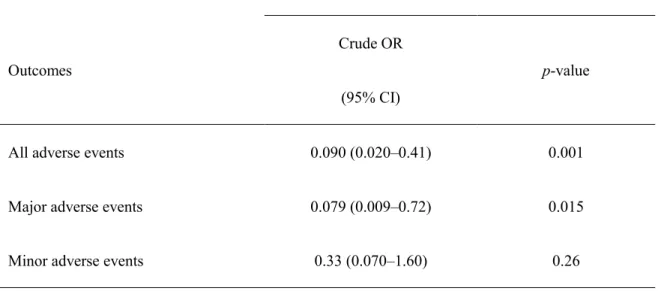
Rapid-sequence intubation technique (sedative + NMBA) was used in only 5% of BAE patients. The preferred sedative was benzodiazepine, and the preferred NMBA was vecuronium. Other specialists were more likely than anesthesiologists to perform ETI using a sedative only (p = 0.0024). Table 3 shows the detailed distribution of ETI-associated adverse events. Overall, 43.6% of BAE patients experienced ETI-associated adverse events, and 20.5% experienced major adverse events. Severe bronchospasm after laryngoscopy, hypoxemia, and regurgitation were the most common major adverse events. Table 4 shows the results of crude analysis comparing ETI-related adverse events between anesthesiologists and other specialists. BAE patients who received emergency ETI by an anesthesiologist
had attenuated risks for all adverse events (crude OR, 0.090; 95% confidence interval [CI], 0.020–0.41;
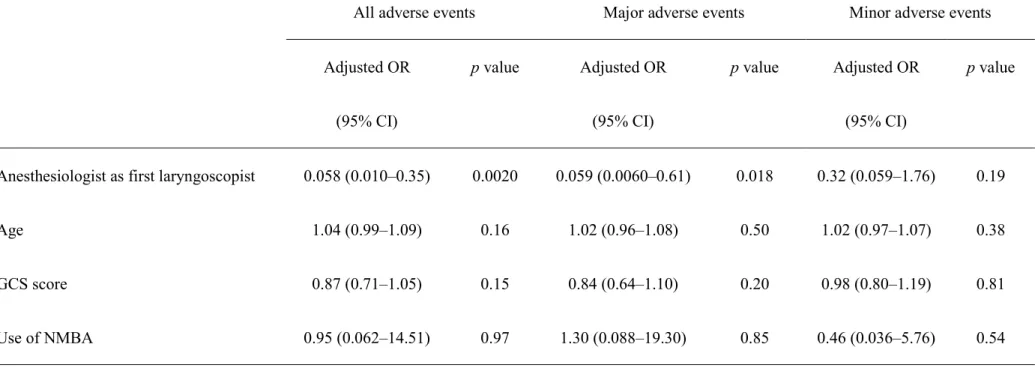
p = 0.001) and major adverse events (crude OR, 0.079; 95% CI, 0.009–0.72; p = 0.015). Table 5 shows the results of multivariate logistic regression analysis for ETI-related adverse events. The attenuated-risk benefit associated with anesthesiologists remained statistically significant after adjusting for potential confounding factors of age, GCS score, and NMBA use (all adverse events: adjusted OR, 0.058; 95%
CI, 0.010–0.35; p = 0.0020; major adverse events: adjusted OR, 0.059; 95% CI, 0.0060–0.61;
p = 0.018). We did not detect multicollinearity (variance-inflation factor < 1.5 in each explanatory variable), and the Hosmer–Lemeshow test verified good fit (p > 0.05 in each model). Absolute risk reduction (ARR) associated with anesthesiologists for all adverse events was 53.0% (95% CI, 22.7–
73.9%), and for major adverse events the ARR was 34.1% (95% CI, 8.9–42.6%). Table 6 presents the clinical situations of seven BAE patients and eight ETI-associated major adverse events. Five (62.5%) of the eight major adverse events occurred in patients with BAE-induced coma who received emergency ETI without medication or with NMBA only. Two patients (patients #2 and #3) developed severe hypoxemia after failed ETI attempt(s) (three attempts in patient #2 and one attempt in patient #3). Both of these patients progressed to cannot-oxygenate/cannot-intubate situations after failed attempts. The devastating status of these patients was salvaged by anesthesiologists who were called urgently. In both patients, ETI was successful at the first salvage attempt, and alternative techniques, including supraglottic airway and emergency surgical procedures, were not used. Of these, one patient (patient
#2) recovered without any sequelae, and the other patient (patient #3) died of pneumonia on hospital
day 8. Severe bronchospasm occurred after ETI attempt(s) in two patients (one attempt in patient #1 and three attempts in patient #2). Conventional bronchodilator therapies, including IM epinephrine, inhaled salbutamol, IV methylprednisolone, IV theophylline, and IV magnesium sulfate, were not successful. Persistent bronchospasm resolved in both patients after sevoflurane inhalation via an anesthesia machine.
Discussion
Attenuation of the risks of ETI-related adverse events in BAE patients by anesthesiologists
This study presents objective evidence for an association between laryngoscopist specialty and ETI- related adverse events in BAE patients. Multivariate logistic regression analysis revealed that anesthesiologist as first laryngoscopist was significantly associated with attenuated risk of ETI-related adverse events, independent of age, GCS score, and NMBA use [13–18]. This outcome difference is likely attributable to the fact that ETI is an everyday task for anesthesiologists in the operating room, so they have keen insight into airway management. In our facility, anesthesiologists perform approximately 300 ETIs per year, while other specialists perform them only occasionally. Our anesthesiologists also have the opportunity to manage the full spectrum of difficult airway situations, including trauma, head and neck surgery, pediatric anesthesia, differential lung ventilation, and ED and
ward emergencies. We believe this experience played an important role in high-risk airway management.
Breckwoldt et al. [19] investigated the incidence, in the prehospital setting, of difficult ETI (number of ETI attempts > 3) between ED physicians with a clinical background in anesthesiology (expert status) and those with a background in internal medicine, and found expert status to be associated with a significantly lower incidence of difficult ETI. They proposed that the value of day-to-day tracheal intubation experience be considered when treating a difficult airway.
In the present study, 43.6% of BAE patients experienced ETI-related adverse events and 20.5% experienced major adverse events. This high rate of adverse events is consistent with a report by Zimmerman et al. [7], who found that 52.8% of BAE patients experienced one or more ETI-associated adverse events and 19.5% experienced post-intubation complications that included dysrhythmias and hypotension. The risk of emergency ETI-associated complications in severe BAE was three times that of past mixed case studies that included both medical and trauma patients [8, 11]. In this study, we also confirmed that the consequences of ETI-associated adverse events in BAE patients could be catastrophic. Therefore, this challenging procedure should be performed by a clinician proficient in airway management whenever possible, and responsibility for this and other high-risk airway management, such as in patients with severe face and neck trauma, airway burn, and epiglottitis, should be delegated to anesthesiologists. It is particularly important in institutions such as ours, in which multispecialty staffing is practiced in the ED.
The role of anesthesiologists in emergency airway management in multispecialty-staffed EDs
Walls et al. [10] reported that in single-specialty-staffed EDs, 87% of ETIs were performed by ED physicians, 3% by anesthesiologists, and 10% by physicians in the remaining specialties. In a setting such as this in the United States and Canada, emergency airway management is considered to be an essential skill for ED physicians [10, 16], who are trained in well-organized residency programs and achieve acceptable skill at performing ETI [10, 16]. In contrast, many Japanese EDs, including our own, operate according to a multispecialty staffing model [9], in which physicians from multiple specialties, including anesthesiology, general surgery, and internal medicine, rather than physicians specifically trained in emergency medicine, serve as emergency medicine practitioners in rotation [8]. We found that other specialists who perform ETI occasionally took part in 46.2% of cases of high-risk airway
management in this representative multispecialty-staffed ED. Most community hospitals in Japan,
especially in suburban or rural areas, share a similar situation. Hasegawa et al. [8] also addressed this problem and suggested the need for an organized national effort to improve ED airway management. In such multispecialty-staffed EDs, the role of anesthesiologists in emergency airway management is more important than in single-specialty-staffed EDs. The skill and knowledge of anesthesiologists should be fully employed, by extending their responsibility—especially for high-risk ETI—into the ED and other
areas of the hospital, rather than limited to the operating room.
BAE patients who receive emergency ETI need appropriate anesthesia
We also found that nearly two-thirds of major adverse events, including all severe bronchospasm, occurred in comatose BAE patients who received emergency ETI without any medication or with NMBA only. Appropriate anesthesia is therefore critical when performing ETI in a BAE patient, regardless of the level of consciousness. In this study, the preferred inducting agent was a benzodiazepine; however, ketamine [20–23] and propofol [24–26] may be better choices because of their bronchodilating properties. Patients with severe BAE can have increased intracranial pressure due to hypercapnia, and unconscious patients with increased intracranial pressure can have worse outcomes if ETI is performed without appropriate premedication [27]. Propofol is an attractive choice for premedication in this scenario because it can decrease intracranial pressure [28–30].
Limitations
We are aware of several limitations of this study. First, the retrospective nature of this study can increase the risk of bias, including self-reporting bias. Although we used a structured ED record that included adverse events and rigorous peer review of the director of our ED, it is possible that there were missed
(especially in the case of minor complications), underestimated, or misclassified ETI complications.
Second, as with any observational study, an association between the first intubator’s specialty and ETI complications may be confounded. Despite adjustment for previously known confounding factors with logistic regression analysis, there may be other, unmeasured confounders. Third, our ED is typical of a Japanese ED but, as with any single-center study, our findings may not apply to other institutions, especially those abroad. Despite these limitations, this study provides detailed clinical information on ETI-associated adverse events in patients with severe BAE and presents objective evidence for an association between the medical specialty of a laryngoscopist and ETI complications. We believe this study provides useful information to medical providers who manage BAE or take part in airway management.
Conclusion
In the present study, anesthesiologists were independently associated with attenuated risks of ETI- related adverse events in severe BAE patients (ARR for all adverse events, 53.0%; ARR for a major adverse event, 34.1%). ETI of BAE patients is a challenging procedure and should be performed by a medical provider proficient in airway management. The skill and knowledge of anesthesiologists should
be applied to high-risk airway management.
Acknowledgments
The authors wish to thank their colleagues at Ohta Nishinouchi Hospital (Koriyama, Japan) for data acquisition and for their contribution to this study. The authors wish to thank Nozomi Ono, MD (Department of Psychiatry, Hoshigaoka Hospital, Koriyama, Japan), Ryota Inokuchi, MD (Department of Emergency and Critical Care Medicine, The University of Tokyo Hospital, Tokyo, Japan), Tetuhiro Yano, MD (Emergency and Critical Care Medical Center, Fukushima Medical University Hospital, Fukushima, Japan), and Makiko Ono, MD (Department of Anesthesiology, Fukushima Medical University Hospital, Fukushima, Japan) for their assistance and helpful advice.
Competing interests
The authors have no competing interests to declare.
References
1. Moorman JE, Akinbami LJ, Bailey CM, Zahran HS, King ME, Johnson CA, Liu X. National surveillance of asthma: United States, 2001–2010.Vital Health Stat 3. 2012;35:1–67.
2. Barnett SB, Nurmagambetov TA. Costs of asthma in the United States: 2002–2007. J Allergy Clin Immunol. 2011;127:145–52.
3. Pendergraft TB, Stanford RH, Beasley R, Stempel DA, Roberts C, McLaughlin T. Rates and characteristics of intensive care unit admissions and intubations among asthma-related hospitalizations. Ann Allergy Asthma Immunol. 2004;93:29–35.
4. Werner HA. Status asthmaticus in children: a review. Chest. 2001;119:1913–29.
5. Phipps P, Garrard CS. The pulmonary physician in critical care. 12: Acute severe asthma in the intensive care unit. Thorax. 2003;58:81–8.
6. Papiris S, Kotanidou A, Malagari K, Roussos C. Clinical review: severe asthma. Crit Care.
2002;6:30–44.
7. Zimmerman JL, Dellinger RP, Shah AN, Taylor RW. Endotracheal intubation and mechanical ventilation in severe asthma. Crit Care Med. 1993;21:1727–30.
8. Hasegawa K, Hagiwara Y, Chiba T, Watase H, Walls RM, Brown DF, Brown CA 3rd; Japanese Emergency Medicine Research Alliance. Emergency airway management in Japan: interim analysis of a multi-center prospective observational study. Resuscitation. 2012;83:428–33.
9. O'Malley RN, O'Malley GF, Ochi G. Emergency medicine in Japan. Ann Emerg Med.
2001;38:441–6.
10. Walls RM, Brown CA 3rd, Bair AE, Pallin DJ; NEAR II Investigators. Emergency airway management: a multi-center report of 8937 emergency department intubations. J Emerg Med.
2011;41:347–54.
11. Hasegawa K, Shigemitsu K, Hagiwara Y, Chiba T, Watase H, Brown CA 3rd, Brown DF; Japanese Emergency Medicine Research Alliance Investigators. Association between repeated intubation attempts and adverse events in emergency departments: an analysis of a multicenter prospective observational study. Ann Emerg Med. 2012;60:749–54.
12. Mort TC. Emergency tracheal intubation: complications associated with repeated laryngoscopic attempts. Anesth Analg. 2004;99:607–13.
13. Hasegawa K, Hagiwara Y, Imamura T, Chiba T, Watase H, Brown CA 3rd, Brown DF. Increased incidence of hypotension in elderly patients who underwent emergency airway management: an analysis of a multi-centre prospective observational study. Int J Emerg Med. 2013;6:12.
14. Langeron O, Masso E, Huraux C, Guggiari M, Bianchi A, Coriat P, Riou B. Prediction of difficult mask ventilation. Anesthesiology. 2000;92:1229–36.
15. Tayal VS, Riggs RW, Marx JA, Tomaszewski CA, Schneider RE. Rapid-sequence intubation at an emergency medicine residency: success rate and adverse events during a two-year period. Acad Emerg Med. 1999;6:31–7.
16. Sagarin MJ, Barton ED, Chng YM, Walls RM; National Emergency Airway Registry Investigators.
Airway management by US and Canadian emergency medicine residents: a multicenter analysis of
more than 6,000 endotracheal intubation attempts. Ann Emerg Med. 2005;46:328–36.
17. Li J, Murphy-Lavoie H, Bugas C, Martinez J, Preston C. Complications of emergency intubation with and without paralysis. Am J Emerg Med. 1999;17:141–3.
18. Combes X, Andriamifidy L, Dufresne E, Suen P, Sauvat S, Scherrer E, Feiss P, Marty J, Duvaldestin P. Comparison of two induction regimens using or not using muscle relaxant: impact on postoperative upper airway discomfort. Br J Anaesth. 2007;99:276–81.
19. Breckwoldt J, Klemstein S, Brunne B, Schnitzer L, Arntz HR, Mochmann HC. Expertise in prehospital endotracheal intubation by emergency medicine physicians–Comparing ‘proficient performers’ and ‘experts.’ Resuscitation. 2012;83:434–9.
20. Hemmingsen C, Nielsen PK, Odorico J. Ketamine in the treatment of bronchospasm during mechanical ventilation. Am J Emerg Med. 1994;12:417–20.
21. Petrillo TM, Fortenberry JD, Linzer JF, Simon HK. Emergency department use of ketamine in pediatric status asthmaticus. J Asthma. 2001;38:657–64.
22. Brown RH, Wagner EM. Mechanisms of bronchoprotection by anesthetic induction agents:
propofol versus ketamine. Anesthesiology. 1999;90:822–8.
23. L’Hommedieu CS, Arens JJ. The use of ketamine for the emergency intubation of patients with status asthmaticus. Ann Emerg Med. 1987;16:568–71.
24. Eames WO, Rooke GA, Wu RS, Bishop MJ. Comparison of the effects of etomidate, propofol, and thiopental on respiratory resistance after tracheal intubation. Anesthesiology. 1996;84:1307–11.
25. Wu RS, Wu KC, Sum DC, Bishop MJ. Comparative effects of thiopentone and propofol on respiratory resistance after tracheal intubation. Br J Anaesth. 1996;77:735–8.
26. Conti G, Ferretti A, Tellan G, Rocco M, Lappa A. Propofol induces bronchodilation in a patient mechanically ventilated for status asthmaticus. Intensive Care Med. 1993;19:305.
27. Yanagawa Y, Sakamoto T, Okada Y, Tuzuki N, Katoh H, Hiroshi N, Shima K. Intubation without premedication may worsen outcome for unconsciousness patients with intracranial hemorrhage.
Am J Emerg Med. 2005;23:182–5.
28. Oshima T, Karasawa F, Satoh T. Effects of propofol on cerebral blood flow and the metabolic rate of oxygen in humans. Acta Anaesth Scand. 2002;46:831–5.
29. Vandesteene A, Trempont V, Engelman E, Deloof T, Focroul M, Schoutens A, de Rood M. Effect of propofol on cerebral blood flow and metabolism in man. Anaesthesia. 1988;43:42–3.
30. Kaisti KK, Långsjö JW, Aalto S, Oikonen V, Sipilä H, Teräs M, Hinkka S, Metsähonkala L, Scheinin H. Effects of sevoflurane, propofol, and adjunct nitrous oxide on regional cerebral blood flow, oxygen consumption, and blood volume in humans. Anesthesiology. 2003;99:603–13.
Tables
Table 1 Demographic characteristics of patients by specialty of first laryngoscopist (anesthesiologist vs.
other specialist)
Variable
All (n = 39)
Anesthesiologist (n = 21)
Other specialist (n = 18)
p value
Age (years) 60.5 (46.5–71.0) 65.0 (55.0–71.0) 57.0 (43.0–71.0) 0.12
Male, n (%) 25 (64.1) 13 (61.9) 12 (66.7) 1.00
GCS score 3 (3–9) 3 (3–3) 4 (3–12) 0.020
Vital signs
SBP (mmHg) 145.0
(77.0–174.8)
131.0 (58.0–155.0)
148.0 (137.0–206.0)
0.234
HR (beats/min) 100.0
(73.5–122.0)
82.0 (45.0–116.0)
111.0 (100.0–133.0)
0.028
RR (breaths/min) 19.0 (0–28.0) 12.0 (0–24.0) 20.0 (18.0–30.0) 0.11
Smoker, n (%) 27 (69.2) 13 (62.0) 14 (77.8) 0.32
Blood gas analysis
pH 7.03 (6.87–7.20) 7.03 (6.99–7.07) 7.03 (6.87–7.24) 0.49
PO2 (mmHg) 86.6 86.6 89.0 0.62
(54.5–223.6) (31.2–234.0) (64.3–175.9)
PCO2 (mmHg) 92.5
(63.1–120.0)
92.0 (72.4–103.1)
95.1 (59.6–125.9)
0.60
Base excess (mEq/L) –5.8
(–12.6–2.8)
–7.7 (–12.6–2.2)
–5.4 (–12.5–3.4)
0.89
Cause of BAE, n (%)
Poor medication compliance 10 (25.6) 6 (28.6) 4 (22.2) 0.73
BA refractory to treatment 4 (10.3) 3 (14.3) 1 (5.6) 0.61
Upper respiratory tract infection
3 (7.7) 0 (0.0) 3 (16.7) 0.090
Pneumonia 11 (28.2) 4 (19.0) 7 (38.9) 0.29
Allergen related 1 (2.6) 1 (4.8) 0 (0.0) 1.00
Trauma 1 (2.6) 1 (4.8) 0 (0.0) 1.00
Unknown 9 (23.1) 6 (28.6) 3 (16.7) 0.46
Mortality, n (%) 16 (41.0) 11 (52.4) 5 (27.8) 0.19
Disposition, n (%) Home without nursing
service
19 (48.7) 7 (33.3) 12 (66.7) 0.060
Secondary hospital 1 (2.6) 1 (4.8) 0 (0) 1.00
Rehabilitation hospital 3 (7.7) 2 (9.5) 1 (5.6) 1.00 Data expressed as median (interquartile range) unless otherwise indicated. BA, bronchial asthma; BAE, bronchial asthma exacerbation; GCS, Glasgow Coma Scale; HR, heart rate; RR, respiratory rate; SBP, systolic blood pressure.
Table 2 Characteristics of emergency airway management in BAE patients by specialty of first laryngoscopist
(anesthesiologist vs. other specialist)
All
(n = 39)
Anesthesiologist
(n = 21)
Other specialist
(n = 18)
p value
Indication for ETI, n (%)
Dyspnea 8 (20.5) 2 (9.5) 6 (33.3) 0.11
Hypoxemia 4 (10.3) 1 (4.8) 3 (16.7) 0.32
Respiratory arrest 15 (38.5) 10 (47.6) 5 (27.8) 0.32
Altered mental status 12 (30.8) 8 (38.1) 4 (22.2) 0.32
Number of ETI attempts,
median (IQR)
1.0 (1.0–1.0) 1.0 (1.0–1.0) 1.0 (1.0–2.0) 0.53
ETI method, n (%)
Without medication 21 (53.8) 14 (66.7) 7 (38.9) 0.11
Sedative only 14 (35.9) 4 (19.0) 10 (55.6) 0.024
NMBA only 2 (5.1) 1 (4.8) 1 (5.6) 1.00
Sedative + NMBA 2 (5.1) 2 (9.5) 0 (0.0) 0.49
Sedative, n (%)
No sedative 23 (59.0) 15 (71.4) 8 (44.4) 0.11
Benzodiazepine 15 (38.5) 6 (28.6) 9 (50.0) 0.20
Propofol 1 (2.6) 0 (0) 1 (5.6) 0.46
Ketamine 0 (0) 0 (0) 0 (0) N/A
NMBA, n (%)
No NMBA 35 (89.7) 18 (85.7) 17 (94.4) 0.61
Vecuronium 3 (7.7) 3 (14.3) 0 (0) 0.24
Rocuronium 1 (2.6) 0 (0.) 1 (5.6) 0.46
Succinylcholine 0 (0) 0 (0) 0 (0) N/A
BAE, bronchial asthma exacerbation; ETI, endotracheal intubation; IQR, interquartile range; N/A, not available;
NMBA, neuromuscular blocking agent.
Table 3 Detailed distribution of emergency ETI-related adverse events in BAE patients by specialty of first laryngoscopist (anesthesiologist vs. other specialist)
Variable
All
(n = 39)
Anesthesiologist
(n = 21)
Other specialist
(n = 18)
All adverse events, n (%)* 17 (43.6) 4 (19.0) 13 (72.2)
Major adverse events, n (%)* 8 (20.5) 1 (4.8) 7 (38.9)
Severe bronchospasm after laryngoscopy 2 (5.1) 1 (4.8) 1 (5.6)
Hypoxemia 2 (5.1) 0 (0) 2 (11.1)
Regurgitation 2 (5.1) 0 (0) 2 (11.1)
Esophageal intubation with delayed recognition 1 (2.6) 0 (0) 1 (5.6)
Ventricular tachycardia 1 (2.6) 0 (0) 1 (5.6)
Minor adverse events, n (%)* 9 (23.1) 3 (14.3) 6 (33.3)
Upper airway trauma 3 (7.7) 1 (4.8) 2 (11.1)
Hypertension 2 (5.1) 1 (4.8) 1 (5.6)
Hypotension 1 (2.6) 1 (4.8) 0 (0)
Mainstem bronchus intubation 1 (2.6) 0 (0) 1 (5.6)
Cuff leak 2 (5.1) 0 (0) 2 (11.1)
*In one case there were three complications (two major and one minor); in another case, two complications (one major and one minor). BAE, bronchial asthma exacerbation,
ETI, endotracheal intubation.
Table 4 Crude analysis of emergency ETI-related adverse events for anesthesiologist vs. other specialist as first laryngoscopist Anesthesiologist vs. other specialist (Reference)
Outcomes
Crude OR (95% CI)
p-value
All adverse events 0.090 (0.020–0.41) 0.001
Major adverse events 0.079 (0.009–0.72) 0.015
Minor adverse events 0.33 (0.070–1.60) 0.26
CI, confidence interval; ETI, endotracheal intubation; OR, odds ratio.
Table 5 Multivariate logistic regression analysis for emergency ETI-related adverse events.
All adverse events Major adverse events Minor adverse events
Adjusted OR
(95% CI)
p value Adjusted OR
(95% CI)
p value Adjusted OR
(95% CI)
p value
Anesthesiologist as first laryngoscopist 0.058 (0.010–0.35) 0.0020 0.059 (0.0060–0.61) 0.018 0.32 (0.059–1.76) 0.19
Age 1.04 (0.99–1.09) 0.16 1.02 (0.96–1.08) 0.50 1.02 (0.97–1.07) 0.38
GCS score 0.87 (0.71–1.05) 0.15 0.84 (0.64–1.10) 0.20 0.98 (0.80–1.19) 0.81
Use of NMBA 0.95 (0.062–14.51) 0.97 1.30 (0.088–19.30) 0.85 0.46 (0.036–5.76) 0.54
CI, confidence interval; ETI, endotracheal intubation; GCS, Glasgow Coma Scale; NMBA, neuromuscular blocking agent; OR, odds ratio.
Table 6 Clinical situations of BAE patients who experienced major emergency ETI-related adverse events
Patient
No.
Age Sex
Specialty of first
laryngoscopist
GCS ETI method
ETI
attempts
Major adverse events Salvage treatment Outcome
1 31 Male Anesthesiology 3 No medication 1 Severe bronchospasm after
laryngoscopy
Sevoflurane inhalation Rehabilitation
hospital
2 79 Male General surgery 3 NMBA only 4 • Hypoxemia
• Severe bronchospasm
after laryngoscopy
Called anesthesiologist;
ETI successful
Sevoflurane inhalation
Home without
nursing service
3 73 Male Thoracic surgery 12 Sedative only 2 Hypoxemia Called anesthesiologist;
ETI successful
Death
4 70 Male General surgery 4 No medication 1 Ventricular tachycardia Observation Home without
nursing service
5 34 Female General surgery 3 No medication 1 Regurgitation Steroid, antibiotics Death
6 88 Female Pulmonology 3 No medication 1 Regurgitation Steroid, antibiotics Rehabilitation
hospital
7 58 Male Pulmonology 4 Sedative only 2 Esophageal intubation with
delayed recognition
Reintubation by the same
laryngoscopist
Death
BAE, bronchial asthma exacerbation; ETI, endotracheal intubation; GCS, Glasgow Coma Scale; NMBA, neuromuscular blocking agent.