熊本大学学術リポジトリ
High pressure effects on high field magnetophotoluminescence in Cd1‑xMxSe (M=Mn,Co)
journal or
publication title
Physical Review B
volume 53
number 8
page range 4471‑4478
year 1996‑02‑15
その他の言語のタイ トル
Cd1‑xMxSe (M=Mn,Co) における強磁場磁気フォトル ミネッセンスに対する高圧効果
URL http://hdl.handle.net/2298/9627
doi: 10.1103/PhysRevB.53.4471
Reprintedfrom
Physical Review
B
CONDENSED MATTER
15 FEBRUARY 1996 II
High-pressure effects on high-field magnetophotoluminescence in Cdj.^M^Se (M=Mn,Co)
Y. Matsuda and N. Kuroda
Institute for Materials Research, Tohoku University, Katahira 2-1-1, Sendai 980-77, Japan pp. 4471-4478
Published by
THE AMERICAN PHYSICAL SOQIETY through the
American Institute of Physics
Volume 53 Third Series Number 8
PHYSICAL REVIEW B VOLUME 53, NUMBER 8 15 FEBRUARY 1996-11
(M=Mn,Co) High-pressure effects on high-field magnetophotoluminescence in
Y. Matsuda and N. Kuroda
Institute for Materials Research Tohoku University, Katahira 2-1-1, Sendai 980-77, Japan (Received 12 June 1995; revised manuscript received 30 October 1995)
Photoluminescence measurements have been performed in the diluted magnetic semiconductors Cdx _xMxSe(M =Mn,Co) at 4.2 K under combined extreme conditions of high hydrostatic pressure up to 2 GPa and high magnetic field up to 27 T. The field-induced shift of the energy of the A exciton is enhanced significantly by pressure in Cdo.988Co0.oi2Se and Cdo.95Mno.05Se, while it is rather reduced in Cdo.75Mno.25Se.
The former effect arises from strengthening of the p-d exchange interaction by pressure, and the latter effect shows that pressure strengthens not only the p-d exchange interaction but also the antiferromagnetic coupling among magnetic ions. The anisotropy energy of the trigonal crystal field is sensitive to pressure, as well. When magnetic field is applied perpendicular to the c axis of the wurtzite structure, the pressure effect on the exciton energy depends strongly on the external magnetic field, demonstrating that the transverse exchange field critically competes with the trigonal crystal field and the spin-orbit coupling.
L INTRODUCTION
Pressure exerts an influence on the chemical bonds of a substance directly to modify the electronic structure as well as the crystal structure, while magnetic field quantizes the electronic states to cause various quantum effects, especially at high fields and low temperatures. Consequently, one may envisage that combination of high pressure, high magnetic field, and low temperature would induce a variety of novel properties of solids. To perform such experiments, however, one has to overcome the difficulty that the bore space of a magnet is usually too tight to set a high-pressure apparatus.
In this respect optical experiment has an advantage because nowadays miniature diamond anvil cell (DAC), which is as small as 30 mm in diameter, is available. In fact the combi nation of a miniature DAC and fiber optic technique has enabled us to make optical measurements of various solids under pressures higher than 10 GPa at liquid-He tempera
tures in the presence of magnetic field up to 23 T.1"9
Photoluminescence in Cd^^Mn^Se and Cd^^Co^Se, which are typical substances of diluted magnetic semicon ductors (DMS), has been a subject for studies under com
bined extreme conditions.5"8 In these compounds spins of
electrons and holes of the host substance strongly couple with spins of magnetic ions through the exchange interac tion. To date a number of experimental studies have been reported on the optical properties related to this exchange interaction.10'11 According to the recent theoretical studies the exchange constant of a hole is much greater than that of an electron and it is dominated by the hybridization between the /?-like valence band and the 3d states of the transition-
metal ions.12"16 This kinetic-exchange scheme claims that
the strength of the hybridization is directly related to the electron-electron correlation of transition-metal ions as well as the transfer integral between the anion p and transition- metal d orbitals. Hence the exchange constants obtained from magneto-optical measurements in various DMS have been interpreted in connection with the on-site Coulomb re
pulsion energies.17 However, as pointed out by Hamdani etal.,11 the interpretation has not been well established yet
because there remain considerable uncertainties in the esti mated values of the on-site Coulomb repulsion energies and the p-d transfer integrals.
In this context optical properties of DMS under combined extreme conditions are of particular interest Within the framework of the kinetic-exchange theory the magnitude of the exchange interaction should be in proportion to the
squared p-d transfer integral Vpd. According to Harrison,18 V2pd scales with the bond length / between a magnetic ion and an adjacent anion of the host substance as / . Namely, the pressure coefficient of the exchange constant should be an order of magnitude greater than the linear compressibility of the lattice. Nevertheless our experiment on the magneto photoluminescence has proved that in Cdo.9oMno.1oSe the
p-d exchange constant is rather insensitive to pressure.6 Ex
perimentally, however, it is uncertain if the pressure depen dence of the exchange constant is generally so small. Our preliminary experiments for the substances other than Cdo 9OMno 10Se have suggested that the exchange constant is indeed sensitive to pressure, but its pressure coefficient var
ies with the content x of transition-metal ions.7'8 To examine
the validity of the kinetic-exchange theory, therefore, it is required to systematically examine the pressure dependence in Cdj _xMn^Se and Cd2 ^Co^Se of various values of x. The study will also allow us to search for new electronic proper ties induced by the combined extreme conditions.
In this paper we present a systematic study on the prop erties of the magnetophotoluminescence due to the A exciton in Cdo.95Mrio.o5Se, Cdo.75Mno.25Se, and Cdo.98sCoo.oi2Se un der the combination of high magnetic field up to 27 T and high pressure up to 2 GPa at 4.2 K. [Hereafter the substances are referred to as Cdj^Mn^Se or Cd1_xCoJCSe with the con tent x of metal ions specified in parentheses in such a way as Cd^^Mn^Se (jc=0.05).] The results are analyzed with weight given to evaluating the pressure dependence of the p-d exchange constant and its dependence on jc. The experi mental details are described in Sec. H The results are pre sented in Sec. IE and discussed in Sec. IV with the previous results on Cdj-^Mn^Se (;c=0.10) taken additionally into ac count. Sectidh V summarizes the results of this study.
0163-1829/96/53(8)/4471(8)/$06.00 53 4471 © 1996 The American Physical Society
4472 Y. MATSUDA AND N. KURODA 53
Windows of acrylic resin
Ar GAS
Stainless-steel metal Dewar
TABLE I. The values of the pressure coefficients b and c of the energy gap in CdO-95Mno 05Se, Cdo^Mno^Se, and
Cdo.988Co0.012Se-
Windows of acrylic resin
7
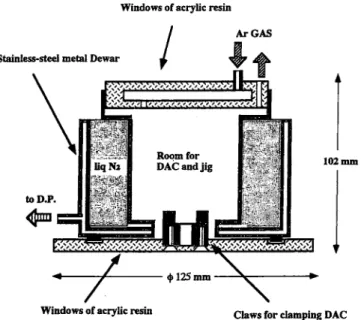
FIG. 1. Schematic diagram of an apparatus to liquefy argon in a clamp-type diamond anvil cell.
H. EXPERIMENT
A miniature DAC that has an outer diameter of 30 mm is used for generating hydrostatic pressure. This DAC is a modification of the Merrill-Bassett cell, which is of clamp- type, and can generate pressure up to about 10 GPa rather easily. Single crystals of Cd^Mn^Se (x=0.05, 0.25) and Cd1_JCCoJCSe (jc=0.012) are cut into platelets with the typical area of 200 /uumXlOO jum and thickness of 30-100 juan such that the platelet surfaces are parallel or perpendicular to the c axis of the wurtzite structure. Condensed argon is used as the pressure-transmitting medium/To load the DAC with liquid argon we have constructed an apparatus with reference to the method developed by Grimsditch, Loubeyre, and Polian for the lever-type DAC.19 Figure 1 shows the outline of the ap paratus. The apparatus consists of a jig of a DAC and a stainless-steel metal Dewar. In operation, we cool the DAC down to about 77 K by using liquid N2. Ar gas flows through the space between the upper diamond anvil and the gasket of the DAC. The dewar has a window of acrylic resin, which enables us to watch liquefied Ar by using an optical micro scope. When the sample cell is filled with liquid Ar, the cell is closed by clamping the diamond anvils. The DAC is taken out of the jig after the whole system is warmed up to room temperature, and then pressure is raised to an appropriate value. Since the substances studied here undergo the struc
tural phase transition to a rock-salt phase at 2-3 GPa,20 the
pressure range is limited to 0-2 GPa in the present work.
The value of pressure at 4.2 K is deduced from the pressure-induced energy shift of the exciton luminescence band itself at zero magnetic field on the basis of the pressure versus energy gap relationship that was obtained from the absorption measurement at room temperature. In the absorp tion measurement the value of pressure was obtained by the ruby fluorescence method. The pressure dependence of the fundamental absorption spectrum at room temperature shows that the shift of the energy gap below 2 GPa can be ex pressed well with a quadratic function of pressure P as
&Eg=bP + cP2 in all the three materials examined. The val-
Material b (10~2 eV GPa"1) c (10~3 eV GPa"2)
(x=0.05) dj-jMn^Se
(jc=0.25) d^Co^Se
(x=0.012)
5.5±0.16
4.4±0.14
5.7±0.13
-2.1 ±0.63
-1.1 ±0.64
-3.1±0.60
ues of the coefficients b and c are listed in Table I.
Magnetic field is generated with a hybrid magnet or
Bitter-type electromagnet.21 The former can generate static
magnetic fields up to 28 T in a bore of 52 mm, and the latter can generate static magnetic fields up to 15 T in a bore of 82 mm. We employ a homemade cryogenic optical fiber
system.5 The system is directly immersed in liquid He at 4.2
K in a metal Dewar. The 514.5-nm radiation of an Ar-ion laser is used as the excitation light source. The sample sur face irradiated by the laser beam is mounted perpendicular to the external magnetic field and the photoluminescent light is detected in the reflection geometry.
m. RESULTS AND DATA ANALYSIS
Hydrostatic pressure widens the energy gap and thus causes a blueshift to thephotoluminesceiice spectrum due to the A exciton. As the external magnetic field H increases, on the other hand, the spectrum shifts rapidly toward lower en ergies under any pressure. Figure 2 shows the field depen dence of the photoluminescence spectrum in Cd^^Mn^Se (*=0.05) for HWc at 1 atm and 1.2 GPa. The observed lumi nescence spectrum is comprised of two bands; with increas ing field the intensity of the lower-energy band is reduced significantly compared to the higher-energy band. The higher-energy band is attributable to the luminescence due to free excitons, while the lower-energy band to the lumines
cence due to bound excitons.22
Figures 3 and 4 show the plot of the energy shift of the free exciton luminescence band in Cd1_JCMnxSe (jc=0.05) and Cdi-^COjSe (*=0.012), respectively, at several pres sures as a function of magnetic field. The exciton energy shift depends strongly on the field orientation, reflecting a strong magnetic anisotropy of the A valence band in II-VI wurtzite-type semiconductors. We see that in contrast to the case of Cd^jMn^Se (jc=0.10) (Ref. 6) pressure enhances the shift not only for Hlc but also for HWc in both Cd^Mn^Se (*=0.05) and Cd^Co^Se (jc=0.012). In ad dition the shift is saturated almost completely above 15 T in Cdi-jCo^Se (x=0.012) and thus the diamagnetic effect that
leads to a blueshift proportional to H2 can be clearly seen
above 15 T. In Fig. 5 is shown the result of Cdj-jMn^Se (x=0.25) for HWc. Interestingly in this substance the field- induced shift is rather suppressed by pressure.
The influence of the exchange interaction on the energies of the valence bands near the zone center of wurtzite-type
DMS has been treated by Komarov et al.23 Gubarev,24 and Aggarwal et al25 The dominant part of the Hamiltonian is
53 HIGH-PRESSURE EFFECTS ON HIGH-FIELD ... 4473
■S
i i i •
Cdi.xMrixSe 1 atm 1.2
-Ju J
E
1.8 Photon
x=0.05 GPa
i
(IA
1_
1.9 Energy
Hllc 4.2 K
27T
10T
5T
2T
L 1T
\ 0.5T
A OT
A(eV)
FIG. 2. Photoluminescence spectra due to the A exciton in Cdo^MnoosSe under various magnetic fields at 1 atm and 1.2 GPa.
The features due to free and bound excitons are denoted as F and 5, respectively.
given by the crystal field, spin-orbit interaction, and p-d ex change interaction:
One may espouse Hopfield's quasicubic model for
^C+J^so. The p-d exchange interactions of the spin s of a hole with spins S of magnetic ions are nearly isotropic and thus ^ex can be written as
Cdi.xCoxSe x=0.012 Free Exciton 4.2 K
HXc 1 atm
1.1 GPa 1.7 GPa
1 atm 0.7 GPa 0.8 GPa 1.7 GPa
0 10 20 30
Magnetic Field (T)
FIG. 4. Field-induced energy shift of the A exciton photolumi nescence line in Cdo 988Co0.oi2Se under several pressures. Experi mental and theoretical values are shown by markers and solid tines, respectively.
(2)
where NQ is the density of cations, /? is the exchange con stant, x is the mole fraction of magnetic ions, and (S) is the thermal average of the spins of magnetic ions. Let the crystal c axis be the z axis and the angle between the c axis and (S) be ft Then putting iNof3x(S) = Si the Hamiltonian ^0 can be written in a matrix form as
-20 -
111
-40
If Free
MnxSe x=0.05 Exciton 4.2K
- V HI
1 i i i i 1
Ic
i
• 1 atm t 0.6 GPa "
■ 1.8 GPa
!■■■■■■■■ ■
o 1 atm "
v 1.2 GPa fcOOOrw-v
^ i 1 i i i i
0 10 20 30
Magnetic Field fT)
FIG. 3. Field-induced energy shift of the A exciton photolumi nescence tine in Cdo^MnoosSe under several pressures. Experi mental and theoretical values are shown by markers and solid tines, respectively.
I
HI 0
-20
-40
-0
0
-
■
g
xSe x=0.25 4.2 K
H II c -
^ 1 atm
° 0.3 GPa . o 0.4 GPa v 1.4 GPa "
^ A P V v •
A
0 5 10 15
Magnetic Field (T)
FIG. 5. Field-induced energy shift of the A exciton photolumi nescence tine in Cdo.75M110 ^Se under several pressures.
4474 Y. MATSUDA AND N. KURODA 53
1 8 cos 8 sin 0 0 0
l 0
e e
8 sin 6 -2A2-£cos 0
V2A3 0 0 0
0 V2A3 -A1-A2+£cos 6
0 0 8 sin 6
0 0 0 - 8 cos 6
8 sin 6 0
0 0 0 8 sin 6 -2A2+£cos 6
V2A3
0 0
<5 sin 6 0 V2A3
— Ax — A2— 5 cos
(ZT)
(3)
where Ax is the crystal-field anisotropy energy and A2 and A3 are constants of the spin-orbit interaction. In addition, the linear Zeeman energy is important at high fields not only for iflie but also for H± c because for H± c the strong transverse exchange field due to a large value of (5) induces a trans verse component of hole spin; besides, the large Zeeman energy causes mixing of spin states of low-lying B and C valence bands with the A valence band. To treat these effects in the present study we incorporate the Zeeman term
(4) in the total Hamiltonian, where [iB is the Bohr magneton, L is the orbital angular momentum, and gh is the effective g parameter of a hole for HWc.
The A exciton consists of the electron of the conduction band and the hole of the A valence hand. Since for H>5 T the exchange field due to magnetic ions reaches the order of 100 T at 4.2 K, the effects of the electron-hole exchange interaction are negligible regardless of the direction of the external field. The photoluminescence observed is due to the Is exciton consisting of the electron of the lower magnetic sublevel of the conduction band and the hole of the upper magnetic sublevel of the A valence band. Under high mag netic fields the exciton executes a significant diamagnetic shift, as it is clearly seen above 15 T in Cd^^Co^Se (x
=0.012). Writing this shift as aH2, the field-induced energy
shift AEA of the observed exciton is given by
AEA= - $ (5)
where a and ge are the s-d exchange constant and the g parameter of the electron, respectively; the energy Ev is the highest eigenvalue of the sum of the Hamiltonians 3%% and The value of (S) is controlled by the external magnetic field. If the content of magnetic ions is sufficiently low, (S) comes mainly from isolated ions and the nearest-neighbor pairs of ions. The isolated ions are paramagnetic, while a pair of the nearest-neighbor ions couple antiferromagnetically to one another. Then if the magnetic ion occupies a cation site in isolation at a probability Px and if two magnetic ions form
the nearest-neighbor pair at a probability P2, we have26
kB(T+TQ)
. (6)
The function JPt of the first term on the right-hand side of Eq. (6) is the Brillouin function of index i, which equals to 5, i.e., the Brillouin function relevant to Cdi_^Mn^Se and Cdj -jCo^Se is ^5/2 and w^3/2, respectively; gM is the g pa rameter of a magnetic ion, kB is the Boltzmann constant, T is the temperature of the sample, and To is an effective tem perature representing the exchange mean field due to mag netic ions except for the pairs. The second term on the right- hand side of Eq. (6), which represents the contribution from the nearest-neighbor pairs, is important if the content of magnetic ions is significantly larger than 1% in such a case as Cdj.^Mn^Se (;t=0.05). The energy of the pair is quan tized into states with the total spin of 5p=0,l,2,.,., 25. At zero field these states are energetically unequally separated depending on the exchange constant Jm. Consequently the ground state, which at zero external field is the state 5P=0, is replaced successively by the lowest Zeeman sublevel of the state 5/>=l,2,..., and IS as the external magnetic field in creases: At the field
(7) the lowest Zeeman sublevel of the state of SP=n crosses downward over that of the state of SP=n-1 to become the ground state of a pair of magnetic ions.
As evident from Eqs. (3) and (4), the magnitude of the spin splitting of the A valence band in the configuration iflie is simply given by 28+ghjmBH. Thus the field-induced en ergy shift AEA|| in this configuration is expressed as
AEM=-\N0{a-p)x{S)-\\ge-gh\iJ,BH+^H2. (8) Since pressure dependencies of \ge—gh\ and cry are expected to be very weak, the effect of pressure on AEA)( would be dominated by the exchange interactions. We see from Figs. 3 and 4 that the exchange constant a—ft is enhanced signifi cantly by pressure in both Cdj.^Mn^Se (x=0.05) and Cd^Co^Se (x=0.012). In the case of the configuration HLc, on the other hand, the theoretical value of the field- induced shift Ais^ of the exciton is obtained by numerically diagonalizing the sum of the Hamiltonians ^0 and $£z given by Eqs. (3) and (4), respectively.
To analyze the experimental results we take the exchange constant N0f3 and the crystal field anisotropy energy Aj as the adjustable parameters dependent on pressure, whereas the quantity To is treated as a parameter being adjustable but independent of pressure; besides, the electron g parameter, ge, is assumed to be equal to 2 independent of pressure. Of course, from definition the effective temperature Tq should
53 HIGH-PRESSURE EFFECTS ON HIGH-FIELD ... 4475
H
6
8
en
en
^ cmo d
© ©
S 8
^h d
I
<n 06*h d
60
I
60 vo
•s a
i
1—1
1
d
d 1
2d d
o o
JS >n o i
0.5 1 1.5 2
Pressure (GPa)
FIG. 6. Pressure dependence of the crystal field anisotropy en ergy Ai in (•) Cdo.95Mno.o5Se and (□) Cdo.pggCoo.onSe. The dotted line shows the linear least-squares fit to the experimental data.
depend on pressure. However, our main concern is the high- field regime satisfying gM/uLBH2?:2kB(T+T0). Since (5) is almost saturated in this regime, the influence of the pressure dependence of To on the exciton energy can be neglected.
For A2, A3,-a, gM, and 01., as well as \ge-gh\ and oj, we employ the experimental values at 1 atm and assume them independent of pressure because they are essentially insensi tive to pressure. The values of the parameters used for cal culating AEM and A£A1 are listed in Table II. They are all
consistent with previous studies at 1 atm.25*27"30 The contri bution from magnetic ion pairs to (S) is significant in Cdj-jMn^Se (jc=0.05). In principle, the parameter Jm, as well as /3, must be sensitive to pressure. An increase of /nn functions to reduce A£A through a change in the field Hn given by Eq. (7). However, if Jm is enhanced by 10%, the amount of the reduction estimated from Eq. (8) is merely 1 meV at 20 T. Therefore Jm is also assumed to be constant, as shown in Table n, in the present analysis. The validity of this assumption is discussed later.
1.2
H lie
0 12
Pressure (GPa)
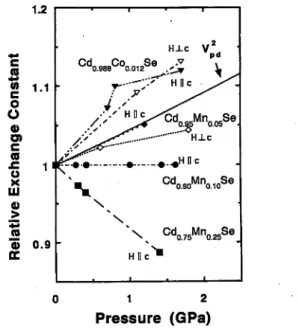
FIG. 7. Pressure-induced change of the exchange constant KAiybl in Cdo.95Mno.o5Se, Cdo.75Mno.25Se, and Cdo.988Co0.oi2Se.
Previous experimental results for Cdo.9oMno.1oSe (Ref. 6) are also shown for comparison. The continuous line shows the pressure de pendence of the squared p-d transfer integral V2pd.
4476 Y. MATSUDA AND N. KURODA 53
Figures 3 and 4 show the theoretical curves of A£A in Cd^Mn^Se (x=0.05) and Cd^Co^Se (x=0.012), respec tively, along with the experimental data. We see that in both substances the calculated curves reproduce the experimental data very well at all pressures examined. In Fig. 6 is shown the pressure dependence of the crystal-field anisotropy en ergy Aj deduced from this analysis. It is found that At de creases at a rate of din A1/di)=-(ll±l)X10"2 GPa"1 in Cd^Mn^Se (jc=0.05) and Cd^Co^Se (x=0.012), in good
accord with the case of Cd! ^Mn^Se (x=0.10).6
IV. DISCUSSION A. Exchange constant
Figure 7 shows the pressure dependence of \N0(/3-a)\ in Cd^Mn^Se (x=0.05) and Cd^Co^Se (x=0.012); the data in Cdj-jMn^Se (x=0.10) obtained by our previous study are also shown for comparison. We have seen in Fig. 5 that in Cdi-jMn^Se (x=0.25) pressure suppresses the field-induced energy shift significantly. In the case of Cd^^Mn^Se (x
=0.25), however, the probabilities Px and P2 should be lower than 0.03 and 0.02, respectively. This fact means that most Mn2+ ions form clusters rather than pairs. Therefore in this case Eq. (6) is not appropriate for describing the mag netization of magnetic ions. Hence for Cd^^Mn^Se (x
=0.25) the mean value of the relative exciton energy shift is taken as a measure of the relative exchange constant
\N0(/3-a)\. The result is also plotted in Fig. 7. It appears from this plot that the pressure coefficient of the exchange
constant d]n\N0(/3-a)\/dP is as large as about 8X10"2 and 4X10"4 GPa"1 in Cd^Co^Se (x=0.012) and
Cd^Mn^Se (*=0.05), respectively. Moreover, one may note that the quantity (5), i.e., the magnetization of transition-metal ions, is largely suppressed by pressure in the substances Cd^Mn^Se (jc=0.10) and Cd^Mn^Se (x
=0.25).
The exchange constant /3 may be written in terms of two
parts as ^jSpot+Ayb.11 where Pp* and Aiyb *» the contri
butions from the potential (ferromagnetic) and p-d hybrid ization, respectively. Since the value of /3pot is approximately equal to a, we have
(9) is given by the gen-
In the kinetic-exchange theory13
eralized Schrieffer-Wolff formula
(10) where sd and C/eff are the mean energy and the effective on-site Coulomb energy, respectively, of the d state. As men
tioned in Sec. I, the squared transfer integral V 2d scales with the Mn(Co)-Se bond length / as Z"7. The compressibility of
the lattice constant in CdSe can be evaluated to be
0.62X 10"2 GPa"1 from the data of elastic constants,32 which yields d In y2rf/dP«4.3X10~2 GPa"1 as shown by the solid
line in Fig. 7. Consequently, from the above-mentioned ex
perimental result d lnpVo/^yJ/dP^SX 10~2 GPa"1, the value of dln[(Ev— Gd)~l+(sd+Ue&—Ej'^/dP is estimated to be -3.7X10"2 GPa-1 in Cd^Co^Se (jc=0.012), the most
diluted entity of the substances studied here. It is conceived that C/eff«5.9 eV and Ev-sd=3.5 eV at 1 atm in Cdi-jCo^Se (*=0.012).13'33 The present result suggests that the quantities I7eff and/or Ev - ed depend significantly on hy drostatic pressure.
A good agreement between the values y
and d In V2pd/dP in the case of Cd^Mn^Se (jc=0.05) could be rather accidental. In the present analysis Jm is assumed independent of pressure. However, our experimental results suggest that this assumption is not necessarily valid. Since the spins of the nearest-neighbor ions are coupled to one another by a superexchange interaction, within the frame work of the kinetic-exchange theory the coefficient Jm is proportional to Vpd and thus scales with the bond length as
/ . Hence, even if the energy denominator terms,12'34
which are also given by C/eff and Ev — sd, are assumed un
affected by pressure, one may expect d ]n Jm/dP*°*9XlO~2 GPa-1. As mentioned in Sec. m, in Cdj.^Mn^Se (jc=0.05) the increase in 7nn by 10% leads to a reduction of the exci ton energy shift by about 1 meV at 20 T for #11 c. Since this effect is neglected in the present analysis, the value of d)n\N0(l3-a)\/dP should be significantly underestimated in Cd^jMn^Se (x=0.05). Similarly, in the case of sub stances with comparatively large values of x the magnetiza tion of clusters is expected to decrease rapidly with pressure.
The effect of the decrease of magnetization of clusters on the exciton energy might almost cancel or even predominate over the effect of enhancement of the p-d exchange interac tion. It may be for this reason that the apparent pressure coefficient of \N0(f3-a)\ is almost null in Cd^MaJSe (x
=0.10) and is negative in Cd! _^MnxSe (jc=0.25).
B. Spin state under transverse magnetic fields Here we look at the properties of spins under transverse magnetic fields. The spin and orbital angular momentum of a hole of the A valence band are forced to align parallel to the c axis by the spin-orbit interaction and the trigonal crystal field. As a consequence the spin of the hole in II-VI com pounds with wurtzite structure has an almost ideal Ising character. In fact the A exciton exhibits no intrinsic Zeeman
splitting in CdSe in the configuration Hlc up to 12 T.27
A distinctive feature of DMS is that the exchange interac tion between an electron and magnetic ions is strong enough to break down the electron-hole exchange coupling, which rules the spin state of the exciton if magnetic ions are absent, even if the external magnetic field is very low. Therefore the exciton undergoes a large paramagnetic splitting in both of the configurations H\\c and HLc. Moreover the p-d ex change energy IS of a hole reaches 0.14 eV, which corre sponds to an exchange field of 1200 T, under the external magnetic field of 20 T in Cd^Mn^Se (jc=0.05), for ex ample.
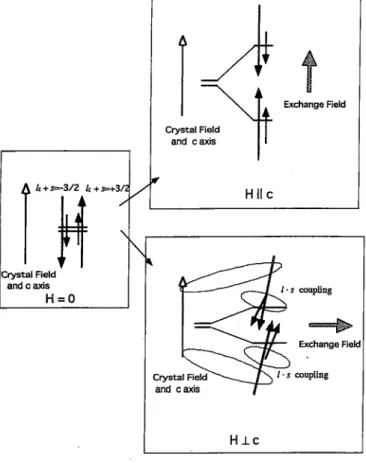
In the Hlc configuration the exchange energy critically competes with the anisotropy energy of the crystal field and the spin-orbit coupling to induce a large transverse compo nent of the hole spin. Figure 8 shows this situation schemati cally. The effect of pressure on the exciton spectrum in this situation cannot be a simple sum of the changes in the ex change energy and the crystal-field anisotropy energy. The relative exciton energy shift obtained by calculation shown in Fig. 3 is plotted as a function of magnetic field in Fig. 9,
53 HIGH-PRESSURE EFFECTS ON HIGH-FIELD ... 4477
Crystal Field and caxis
Exchange Field
Hllc
Crystal RelcT^
and caxis --1
H
_——
?
±c
rr
•5 coupling
\
• Exchange Reid
5 coupling
FIG. 8. A schematic representation of> the orientation of spin (solid arrows) and angular (shaded arrows) momentum of the A valence band under magnetic field relative to the rotation axis (open arrows) of the trigonal crystal field.
where the linear Zeeman and diamagnetic energy terms are omitted for simplicity. Evidently the pressure-induced en hancement of the exciton energy shift depends strongly on the external field if H±c, although it does not if HWc. This phenomenon may be regarded as a kind of combined effect of high pressure and high magnetic field.
V. CONCLUSIONS
Magnetophotoluminescence due to the A exciton in Cdi-xMxSe (M=Mn, Co) has been measured under mag netic fields up to 27 T at 4.2 K in the presence of high hydrostatic pressure up to 2 GPa. It is found from the magnetic-field-induced giant shift of the luminescence en ergy that pressure enhances the strength of the p-d exchange interaction between holes and magnetic ions at a rate of
about 8% GPa"1 and 4% GPa"1 in CdogggCooo^Se and
Cdo.95Mnao5Se, respectively. These experimental results have been interpreted consistently in terms of the kinetic- exchange theory. It has turned out that a major part of those pressure coefficients comes from an increase in the p- d hy bridization due to the compression of the bond length.
Within the framework of the kinetic-exchange theory, the exchange constant Nofi depends on the electronic correlation, particularly the effective on-site energy C/eff of the Coulomb repulsion. The results of the present study suggest that £/eff is also affected by pressure. This is reasonable because C/eff
iyShift
Enerc
:iton
RelativeExc
1.15
1.1
1.05
1
■ Cd, JIM.
!
0 10
Magnetic
x=0.05 HJLc"
—hiic:
1.8
0.6
———«.—~-«,
1.2
1
20 Field
GPa ;
GPa
GPa .
atm -
30
(T)
FIG. 9. Theoretical field-induced shift of the energy of the A exciton at several pressures relative to the shift at 1 atm in Cdo.95MnOO5Se for #11 c (solid lines) and H±c (dashed lines).
may depend on the p- d hybridization through the screening by the p electrons. As argued in Refs. 12 and 34, the metal- metal exchange constant Jm should be very sensitive to C/eff. Therefore if we can measure the pressure dependence of the magnetization steps at a lower temperature, it will enable us to study the pressure dependence of £/eff and thus to experimentally explore the mechanism of the correlation effects in DMS. The study is now in progress.
In CdojsMiiq 25Se, on the other hand, the giant shift of the luminescence energy is suppressed by application of pres sure, suggesting that if the content of magnetic ions is large the effect of suppression of magnetization due to the en hancement of antiferromagnetic coupling among magnetic ions predominates over the effect of enhancement of the ex change interaction between holes and magnetic ions.
When magnetic field is applied perpendicular to the c axis of the wurtzite structure, the p-d interaction competes with the anisotropy of the trigonal crystal field, which also de pends on pressure, and the spin-orbit interaction. As a result, the pressure effect on the energy of the A exciton depends strongly on the external field.
ACKNOWLEDGMENTS
The authors are grateful to J. R. Anderson and W. Giriat for providing single crystals of Cdo.95Mno.o5Se and Cdo 75Mno 25Se and to I. Mogi for providing a single crystal of Cdo.988Co0 onSe. The authors acknowledge J. R. Anderson also for the critical reading of the manuscript The experi ments were performed at the High Field Laboratory for Su perconducting Materials, Tohoku University, with technical assistance by M. Kamiko. This work was supported in part by a Grant-in-Aid for Scientific Research from the Japanese Ministry of Education, Science and Culture. One of the au thors (Y.M.) was supported by the Fellowships for Junior Scientists of the Japan Society for Promotion of Science.
4478 Y. MATSUDA AND N. KURODA 53
lD. Heiman, X. L. Zheng, S. Spnint, B. B. Goldberg, and E. D.
Isaacs, Proc. SPEE-Int. Soc. Opt. Eng. 1055, 96 (1989).
2Y. Oeda, M. Takeda, N. Kuroda, G. Kido, Y. Nishina, and Y.
Nakagawa, in Advances in Mageto-Optics, Proceedings of the International Symposium on Magneto-Optics, edited by K.
Tsushima and Shinagawa [J. Magn. Soc. Jpn. 11, Suppl. SI 157 (1987)].
3N. Kuroda, Y. Oeda, G. Kido, M. Takeda, Y. Nishina, and Y.
Nakagawa, High Press. Res. 2, 65 (1989).
4N. Kuroda, H. Kanda, G. Kido, M. Takeda, Y. Nishina, and Y.
Nakagawa, Jpn. J. Appl. Phys. 31, L700 (1992).
5Y. Matsuda, N. Kuroda, and Y. Nishina, Rev. Sci. Instrum. 63,
5764(1992).
6Y. Matsuda, N. Kuroda, I. Mogi, G. Kido, Y. Nishina, Y. Naka
gawa, J. R. Anderson, and W. Giriat, Jpn. J. Appl. Phys. Suppl.
32-1,270(1993).
7 Y. Matsuda, N. Kuroda, I. Mogi, G. Kido, and Y. Nishina, Physica
B 201, 411 (1994).
8Y. Matsuda, N. Kuroda, and I. Mogi, in Proceedings of the 22nd
International Conference on the Physics of Semiconductors, Vancouver, 1994, edited by D. J. Lockwood (World Scientific, Singapore, 1995), Vol. 3, p. 2513.
9W. Zhou, C. H. Perry, and J. M. Worlock, Phys. Rev. B 42, 9657
(1990).
10See Diluted Magnetic Semiconductors, Semiconductors and
Semimetals, edited by J. K. Furdyna and J. Kossut (Academic, Boston, 1988), Vol. 25.
11 J. K. Furdyna, J. Appl. Phys. 64, R29 (1988).
12B. E. Larson, K. C. Hass, H. Ehrenreich, and A. E. Carlsson,
Phys. Rev. B 37, 4137 (1988).
13 A. K. Bhattacharjee, Phys. Rev. B 46, 5266 (1992).
14J. Blinouski and P. Kacman, Phys. Rev. B 46, 12 298 (1992).
15Su-Huai Wei and Alex Zunger, Phys. Rev. B 35, 2340 (1987).
16J. Masek, Solid State Commun. 78, 351 (1991).
17 F. Hamdani, J. P. Lascaray, D. Coquillat, A. K. Bhattacharjee, M.
Nawrocki, and Z. Golacki, Phys. Rev. B 45, 13 298 (1992).
18W. A. Harrison, Electronic Structure and the Properties of Solids
(Freeman, San Francisco, 1980), p. 451.
19M. Grimsditch, P. Loubeyre, and A. Polian, Phys. Rev. B 33, 7192 (1986).
20S. Jiang, S. C. Shen, Q. G. Li, H. R. Zhu, and G. L. Ju, Phys. Rev.
B 40, 8017 (1989).
21Y. Nakagawa, K. Noto, A. Hoshi, K. Watanabe, S. Miura, G.
Kido, and Y. Muto, Physica 155B, 69 (1989).
22D. Heiman, P. Becla, R. Kershaw, D. Ridgley, K. Dwight, A.
Wold, and R. R. Galazka, Phys. Rev. B 34, 3961 (1986).
23 A. V. Komarov, S. M. Ryabchenko, Yu. G. Semenov, B. D.
Shanina, and N. I. Vitrikhovskii, Zh. Eksp. Teor. Fiz. 79, 1554 (1980) [Sov. Phys. JETP 52, 783 (1980)].
^S. I. Gubarev, Zh. Eksp. Teor. Fiz. 80, 1174 (1981) [Sov. Phys.
JETP 53, 601 (1981)].
25 R. L. Aggarwal, S. N. Jasperson, J. Stankiewicz, Y. Shapira, S.
Foner, B. Khazai, and A. Wold, Phys. Rev. B 28, 6907 (1983).
26R. L. Aggarwal, S. N. Jasperson, P. Becla, and R. R. Galazka,
Phys. Rev. B 32, 5132 (1985).
27 H. Venghause, S. Suga, and K. Cho, Phys. Rev. B 16, 4419
(1977).
28 M. Inoue, N. Adachi, I. Mogi, G. Kido, Y. Nakagawa, and Y. Oka,
Physica B 184, 441 (1993).
29N. Adachi, G. Kido, Y. Nakagawa, T. Onishi, Y. Oka, J. R. Ander
son, M. Gorska, and W. Giriat, Physica B 177, 453 (1992).
30E. D. Isaacs, D. Heiman, P. Becla, Y. Shapira, R. Kershaw, K.
Dwight, and A. Wold, Phys. Rev. B 38, 8412 (1988).
31 A. K. Bhattacharjee, G. Fishman, and B. Coqblin, Physica B+C
117&118, 449 (1983).
^Elastic, Piezoelectric, Pyroelectric, Electrooptic Constants and
Nonlinear Dielectric Susceptibilities of Crystals, edited by K. H.
Hellwege and A. M. Hellwege, Landolt-Borstein, New Series, Group m, Vol. II (Springer, Berlin, 1979), p. 40.
33 K. Kopalko, B. J. Kowalski, B. A. Orlowski, A. Mycielski, and V.
Chab, Acta Phys. Pol. A 77, 403 (1990).
34M. Gorska and J. R. Anderson, Phys. Rev. B 38, 9120 (1988).