Original
*Author: Division of Obstetric Anesthesia, Department of Anesthesiology, Saitama Medical Center, Saitama Medical University 1981 Kamoda, Kawagoe, Saitama 350-8550, Japan
Tel: + 81 49 228 3654, Fax: + 81 49 226 2237, E-mail: [email protected]
◯The authors declare that there are no conflicts of interest associated with the present study.
Does maternal mean arterial pressure predict fetal acidemia better than systolic blood
pressure during spinal anesthesia for cesarean delivery?
Yusuke Mazda
1)*, Katsuo Terui
1), Motoshi Tanaka
2), Kazumi Tamura
1)1) Division of Obstetric Anesthesia, Department of Anesthesiology, Saitama Medical Center, Saitama Medical University, Saitama, Japan
2) Department of Anesthesiology, National Defense Medical College, Saitama, Japan
【Purpose】Spinal anesthesia-induced hypotension has been shown to cause fetal bradycardia and fetal acidemia. Although anesthesiologists attempt to prevent or treat hypotension by controlling systolic blood pressure (SBP), organ perfusion, including the uterus, is most affected by mean arterial pressure (MAP). Thus, we investigated whether maternal MAP predicts fetal acidemia better than SBP during spinal anesthesia for cesarean delivery.
【Methods】All medical and anesthesia records of patients, who received spinal anesthesia for elective cesarean delivery at term with a healthy singleton fetus at our hospital in 2009, were retrospectively reviewed. Anesthetic management was standardized. Blood pressure was measured non-invasively every minute from induction of anesthesia to delivery of the infant. The lowest SBP and MAP during this interval were retrieved from electronic anesthesia records and neonatal conditions were also evaluated.
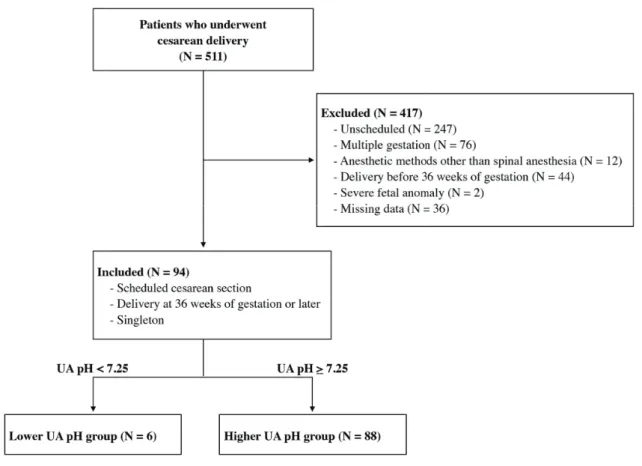
【Results】A total of 94 of 511 cesarean patients met the inclusion criteria. Among these patients, six had an umbilical arterial pH < 7.25 (lower UA pH group). Compared with the remaining 88 cases with UA pH ≥ 7.25, minimum MAP was significantly lower in the lower UA pH group, though the minimum SBP was not different. Additionally, all patients in the lower UA pH group had a minimum MAP of < 70 mmHg. No differences between the two groups in the dose of vasopressors administered or uterine incision to delivery interval were found.
【Conclusions】Our results suggest that maternal MAP is associated with lower UA pH better than SBP. Maintaining MAP above 70 mmHg may be an important target in managing spinal anesthesia-induced hypotension.
J Saitama Medical University 2016; 42(2): 131-137 (Received January 15, 2015 / Accepted July 29, 2015)
Key words: Cesarean delivery, Spinal anesthesia, Hypotension, Mean arterial pressure, Fetal acidemia
Introduction
The number of cesarean deliveries is increasing worldwide1). Most cesarean deliveries are provided under
regional anesthesia; specifically, spinal anesthesia, epidural anesthesia, and combined spinal and epidural anesthesia. Many anesthesiologists consider that spinal anesthesia is the best method for cesarean delivery because of its rapid onset, lack of depressant effect on the neonate, retained maternal memory of childbirth and relative safety compared
with general anesthesia2). However, hypotension after spinal
anesthesia for cesarean delivery is frequently observed, and it has been shown to cause fetal bradycardia and acidemia3, 4).
Anesthesiologists attempt to maintain uterine blood flow by maintaining maternal blood pressure during cesarean delivery, especially from the induction of anesthesia to delivery of the neonate5-7).
be affected mostly by mean arterial pressure (MAP), not by systolic blood pressure (SBP)9). Yet many published
studies define spinal anesthesia-induced hypotension variously, SBP being most frequently used, rather than MAP 6). In addition to the physiological rationale behind
controlling MAP during anesthesia, commercially available blood pressure measurement technology, using automated non-invasive blood pressure measurement devices, is based on the oscillometric method, where pressure at maximum oscillation is equal to MAP. In addition, SBP and diastolic blood pressure (DBP) are calculated using formulas based on specific algorithms10). However, these algorithms are not
open to users, and it is unlikely that pregnant women are included in the process of developing the algorithms. Thus, we hypothesized that MAP may be a better predictor of uterine blood flow than SBP.
In this study, we attempted to determine whether maternal MAP predicts fetal acidemia better than SBP during spinal anesthesia for cesarean delivery. Additionally, we aimed to specify the threshold of MAP required to maintain fetal well-being after spinal anesthesia.
Patients and Methods
Medical and anesthetic records were reviewed retrospectively after obtaining Institutional Review Board approval (#856).
Participants
Participants in this study were all patients who underwent cesarean delivery at the Saitama Medical Center in 2009. Patients with unscheduled cesarean delivery, multiple gestation, anesthetic methods other than spinal anesthesia, delivery before 36 weeks of gestation, and fetal life-threatening anomaly were excluded from this study. Thus, only patients with scheduled cesarean delivery, delivery at 36 weeks of gestation or later, and singleton birth were included.
Anesthetic management
We used anesthetic techniques based on our institutional protocol as follows: after the patient’s arrival to the operating room, pre-hydration with 1,000 mL of 6% hydroxyethyl starch 70/0.5 in isotonic saline (Salinhes, Fresenius Kabi Japan, Tokyo, Japan) was administered through an 18G intravenous line at the upper extremity5). Spinal anesthesia
was performed at the right lateral decubitus position at the L2/3 or L3/4 interspace via a Whitacre spinal needle 25G or 27G with an introducer (Unisys Corporation, Tokyo, Japan). Hyperbaric bupivacaine 12 mg, fentanyl 10 µg and morphine 150 µg were injected intrathecally in all patients. Left uterine
displacement and supplemental oxygen via mask at a flow rate of 6 L/min were continued from induction of anesthesia to delivery of the neonate.
Blood pressure was measured every minute using the oscillometric method (PB4000, NEC Medical Systems, Tokyo, Japan) until delivery and recorded automatically. Vasopressor was administered when SBP fell below 100 mmHg, or < 80% of baseline SBP when the patient’s SBP on arrival to the operating room (baseline SBP) was < 100 mmHg. Phenylephrine 100 µg was immediately administered as an intravenous bolus when maternal heart rate was ≥ 60 bpm. Ephedrine 5–10 mg was administered if maternal heart rate was < 60 bpm. Vasopressors were repeated as needed to restore SBP as above.
Data assessment
The information retrieved from medical and anesthetic records included the following: patients’ obstetric characteristics including gestational age and indications for cesarean delivery, baseline blood pressure defined as the first measurement after the patient’s arrival to the operating room, minimum SBP and MAP defined as the lowest value from induction of spinal anesthesia to delivery of the neonate, dose of vasopressor, uterine incision to delivery interval (UI-D interval), umbilical artery (UA) blood analysis and neonatal outcomes. Duration of hypotension was defined as the period in minutes below predefined criteria. When the patient repeatedly became hypotensive below the criteria, the longest period was adopted as the duration of hypotension.
Statistical analysis
Patients were divided into two groups according to UA pH value (UA pH < 7.25 or ≥ 7.25), because UA pH less than 7.20 is virtually absent in scheduled cesarean delivery under spinal anesthesia. Data are expressed as mean ± standard deviation. In addition, the average UA pH was compared with several hypotension criteria: SBP < 100 mmHg, SBP < 80% of baseline SBP and MAP < 70 mmHg. Welch’s t-tests and Fisher’s exact tests were used to compare numerical and nominal variables, respectively. Stata/MP for Mac version 13.0 was used for statistical analyses (Stata Corporation, College Station, TX, USA).
Results
Minimum MAP of the lower UA pH group was significantly lower compared with the higher UA pH group, but the minimum SBP was not. There were no significant differences in the frequency of vasopressor use, dose of vasopressors, or the UI-D interval (Table 2).
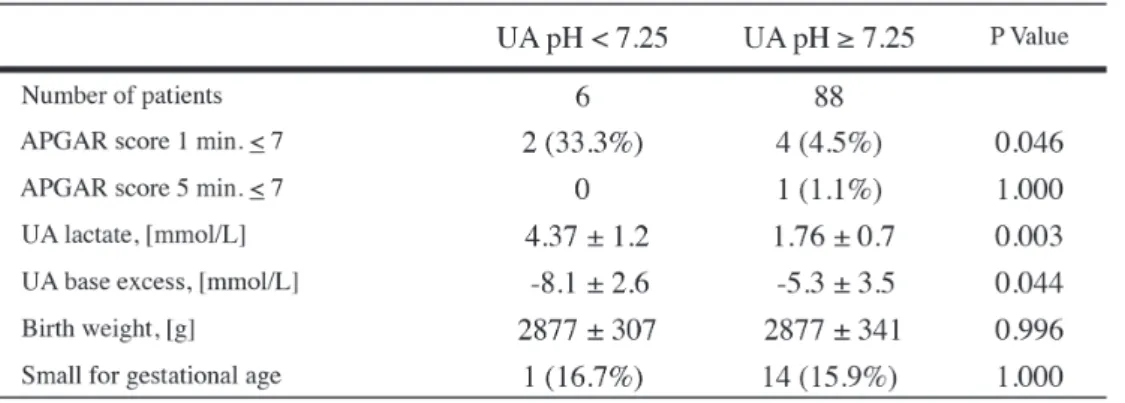
For neonatal outcomes, while the results of 5-minute Apgar were equivalent, the incidence of 1-minute Apgar ≤ 7 was significantly higher in the lower UA pH group. Furthermore, the lower UA pH group showed remarkably higher UA
lactate and lower UA base excess (Table 3).
Three different criteria for hypotension, i.e., SBP < 100 mmHg, SBP < 80% of baseline SBP and MAP < 70 mmHg, were compared to see if there was any correlation with lower UA pH. Although the incidence of hypotension associated with the above two SBP criteria was not different between the lower and higher UA pH groups, the incidence of hypotension defined by MAP was significantly greater in the lower
UA pH group compared with the higher UA pH group (Table 4).
Comparing UA pH with hypotension under the different
criteria for hypotension revealed that the group with MAP < 70 mmHg had a significantly lower UA pH, while groups with hypotension defined by SBP did not (Table 5).
Table 2. Hemodynamics, anesthesia information and vasopressor
Discussion
In obstetric anesthesia practice, maintaining maternal SBP has been the surrogate target used to maintain uterine blood flow, as the latter is not easily monitored. However, as organ blood flow is determined by the perfusion pressure of each organ, mean uterine arterial pressure is the major determinant of uterine blood flow, and mean uterine arterial pressure is similar to maternal MAP8). In addition, most automated
non-invasive blood pressure monitoring devices are based on the oscillometric method, in which variations in cuff pressure resulting from arterial pulsations during cuff deflation are measured10). The peak amplitude of arterial pulsation
corresponds closely with true MAP. Values of systolic and diastolic pressure are derived using proprietary formulas that examine the rate of change of pressure pulsations. SBP is generally chosen as the pressure at which pulsations are increasing, and are at 25–50% of maximum, but algorithms are unique to each manufacturer11). Thus, only MAP is
measured directly by automated non-invasive blood pressure
monitoring devices; SBP and DBP are not.
In our study, minimum MAP was significantly lower in the lower UA pH group, but minimum SBP was not different between the two groups. The definition of hypotension varies in previous studies5 -7). We investigated what criterion of
hypotension was most related to lower UA pH. We found that the incidence of SBP < 100 mmHg, commonly used as a hemodynamic marker, and SBP < 80% of baseline were not increased in the lower UA pH group. However, the incidence of MAP < 70 mmHg was solely related to lower UA pH. Our unpublished preliminary study suggested that MAP < 70 mmHg is an appropriate cut-off point for maternal hypotension after spinal anesthesia; therefore, we used this criterion in the current study. From a physiological and measurement perspective, our results suggest that MAP is a better indicator for prediction of uterine hypoperfusion. Blood pressure and duration of hypotension are also important factors for maintaining uterine blood flow. According to Corke et al., a short period, lasting < 2 min, of hypotension was not harmful to the neonate4). In our study,
Table 4. Incidence and duration of hypotension between the lower UA pH vs.
higher UA pH group by various criteria of hypotension
the duration of SBP < 100 mmHg was significantly longer in the lower UA pH group, and all patients in this group had hypotension that lasted longer than three minutes. The average duration of MAP < 70 mmHg in the lower UA pH group was longer compared with the higher UA pH group, 4.3 ± 3.9 min vs. 1.2 ± 1.7 min. Although this difference was not statistically significant, this result suggests that in addition to longer duration of low SBP, longer duration of low MAP is also relevant to lower UA pH. The occurrence of hypotension, regardless of its criteria, should be treated promptly and aggressively to correct uterine hypoperfusion. The group with MAP < 70 mmHg had a significantly lower UA pH compared with the group with MAP ≥ 70 mmHg, 7.306 ± 0.051 vs. 7.323 ± 0.027. The comparison based on SBP did not reveal any significant differences in UA pH. Although the UA pH data remained within the clinically normal range, this result suggests that MAP < 70 mmHg may be related to lower UA pH, and hypotension with SBP below 100 mmHg or 80% of baseline may not induce lower UA pH. The cause of lower UA pH is multifactorial, involving more than just hemodynamic changes after induction of anesthesia. In the lower UA pH group, the level of sensory block by spinal anesthesia was significantly higher than in the higher UA pH group. Although refractory bradycardia was not recorded at all in both groups, ephedrine was used more in the lower UA pH group compared with the higher UA pH group (50% vs. 31.8%). The incidence of fetal acidemia is significantly higher with the use of ephedrine compared with phenylephrine12), and frequent use of ephedrine may affect
fetal acidemia and hypotension.
Our results showed that baseline MAP was slightly lower in the lower UA pH group, but pre-existence of chronic uteroplacental hypoperfusion could not be definitively ruled out. However, this preliminary observation may not be significant because the obstetricians in our institute routinely examine fetal cardiotocograms before cesarean delivery, and no observation of non-reassuring fetal status was recorded. Several limitations of the current study must be noted. First, this study was a retrospective electronic anesthesia record review study, and therefore, selection bias could not be completely excluded. Second, there were only six patients in the lower UA pH group. In our institute, left uterine displacement from induction of anesthesia to delivery of neonates and colloid co-loading are routinely performed to prevent maternal hypotension. After adoption of this policy, the incidence of fetal acidemia defined by UA pH < 7.2 was dramatically reduced from 20.4% to 1.7% (unpublished data). Consequently, we assumed that fetal acidemia would be rarely seen in this study. Third, we defined UA pH < 7.25 as lower UA pH. Fetal acidemia is usually defined by UA
pH < 7.2. Because UA pH < 7.2 is very rare in scheduled cesarean delivery, we set a higher cutoff point in this study. Correspondingly, no fetus had a UA pH < 7.2 in the study. There is the possibility that a type I error could occur due to the unsubtle cutoff value. Last, SBP and MAP are related to each other. This also suggests our study may contain type I statistical errors. Thus, additional prospective studies are needed to confirm the results of the current study.
In conclusion, the results of our study suggest that minimum MAP during spinal anesthesia for cesarean delivery predicts lower UA pH better than minimum SBP. We suggest that maintaining MAP above 70 mmHg should be the target used to maintain uterine perfusion for healthy singleton fetuses in women undergoing elective cesarean delivery.
References
1) World Health Organization. Facts and Figures from the World Health Report. 2005. http://www.who.int/ whr/2005/media_centre/facts_en.pdf.
2) Hawkins JL, Chang J, Palmer SK, Gibbs CP, Callaghan WM. Anesthesia-related maternal mortality in the United States: 1979-2002. Obstet Gynecol 2011; 117: 69-74.
3) Ebner H, Barcohana J, Bartoshuk AK. Influence of postspinal hypotension on the fetal electrocardiogram. Am J Obstet Gynecol 1960; 80: 569-72.
4) Corke BC, Datta S, Ostheimer GW, Weiss JB, Alper MH. Spinal anaesthesia for caesarean section. The influence of hypotension on neonatal outcome. Anaesthesia 1982; 37: 658-62.
5) Ueyama H, He YL, Tanigami H, Mashimo T, Yoshiya I. Effects of crystalloid and colloid preload on blood volume in the parturient undergoing spinal anesthesia for elective Cesarean section. Anesthesiology 1999; 91: 1571-6. 6) Cyna AM, Anrew M, Emmett RS, Middleton P,
Simmons SW. Techniques for preventing hypotension during spinal anaesthesia for caesarean section. Cochrane Database Syst Rev 2006; 4: CD002251.
7) Teoh WH, Sia AT. Colloid preload versus coload for spinal anesthesia for cesarean delivery: The effects on maternal cardiac output. Anesth Analg 2009; 108: 1592-8.
8) Ngan Kee WD. Uteroplacental blood flow. In: Chestnut DH, Polleu LS, Tsen LC, Wong CA. Chestnut’s Obstetric Anesthesia: Principles and Practice. 5th ed. Philadelphia (PA): Mosby Elsevier; 2014. p. 39-54. 9) McGhee BH, Bridges EJ. Monitoring arterial blood
pressure: what you may not know. Crit Care Nurse 2002; 22: 60-79.
Cardiovascular monitoring. In: Miller RD, Eriksson LI, Fleisher LA, Wiener-Kronish JP, Young WL. Miller’s Anesthesia. 7th ed. Philadelphia (PA): Mosby Elsevier; 2009. p. 1267-328.
11) Newmark JL, Sandberg WS. Noninvasive physiological monitors. In: Sandberg WS, Urman R, Ehrenfeld J.
The MGH Textbook of Anesthetic Equipment. 1st ed. Philadelphia (PA): Mosby Elsevier; 2010. p. 127-47. 12) Ngan Kee WD, Khaw KS, Tan PE, Nq FF, Kamakar MK.
Placental transfer and fetal metabolic effects of phenylephrine and ephedrine during spinal anesthesia for cesarean delivery. Anesthesiology 2009; 111: 506-12.
帝王切開術の脊髄くも膜下麻酔における胎児アシデミアの関連因子 -収縮期血圧か平均動脈圧か?- 松田 祐典1),照井 克生1),田中 基2),田村 和美1) 【目的】帝王切開術における脊髄くも膜下麻酔後の低血圧は,胎児徐脈や胎児アシデミアの原因となる.脊髄くも膜下麻酔 後低血圧予防策に関する多くの研究では低血圧を「収縮期血圧(SBP)100 mmHg未満,あるいは基準値の80%未満」と 定義している.一方,子宮胎盤血流は,平均子宮動脈圧,子宮静脈圧,子宮血管抵抗によって規定され,平均子宮動脈圧は, 母体のSBPではなく平均動脈圧(MAP)と関連している.従って脊髄くも膜下麻酔後低血圧の予防や治療においても,SBP ではなくMAPに基づいて管理する方が,生理学的に理にかなっていると考えられる.そこで我々は,脊髄くも膜下麻酔下 帝王切開術においてSBPとMAPのどちらが胎児アシデミアの関連因子として適切かを後方視的に検討した. 【対象と方法】埼玉医科大学総合医療センターにおいて脊髄くも膜下麻酔下に施行された妊娠36週以降の単胎予定帝王 切開症例を対象とした.入室時の血圧を基準血圧とし,血圧は麻酔後から児娩出まで自動血圧計にて1分間隔で測定した. 児娩出後,臍帯動脈血液ガス分析を行い,新生児科医によりAPGARスコアを評価した.UA pH 7.25未満群とUA pH 7.25 以上群の二群を統計学的に比較検討した. 【結果】該当した94症例のうち,UA pHが7.25未満であった症例は6例だった.UA pH 7.25未満群は,UA pH 7.25以上 群と比較して,最低SBPは同等であったが(89.7 ± 7.3 mmHg vs. 93.4 ± 11.4 mmHg, p=0.289),最低MAPが有意に低かった (64.7 ± 3.8 mmHg vs. 70.5 ± 10.8 mmHg, p=0.012).また,UA pH 7.25未満群では全例最低MAPが70 mmHgを下回って いた(100% vs. 47.7%, p=0.027).昇圧薬の種類と使用量,子宮切開から娩出までの時間,生後5分後APGARスコアには 二群間に有意な差はなかった. 【結論】脊髄くも膜下麻酔による妊娠36週以降の単胎予定帝王切開術において,最低平均動脈圧は,最低収縮期血圧よりも 臍帯動脈血pH低下と関連があった. 1) 埼玉医科大学総合医療センター 産科麻酔科 〒 350-8550 埼玉県川越市鴨田 1981 2) 防衛医科大学校 麻酔科学講座 〔平成27 年 1 月 15 日受付 / 平成 27 年 7 月 29 日受理〕