• 検索結果がありません。

Agreement between long-term care users’ quality of experience in daycare and providers’ perceptions: a cross-sectional study based on the flow model

N/A
N/A
Protected

Academic year: 2021

シェア "Agreement between long-term care users’ quality of experience in daycare and providers’ perceptions: a cross-sectional study based on the flow model "

Copied!
25
0
0

読み込み中.... (全文を見る)

全文

(1)

1

学位論文

Agreement between long-term care users’ quality of experience in daycare and providers’ perceptions: a cross-sectional study based on the flow model

Masami Yasunaga

1)

, Yoshikazu Ishii

2)

& Norikazu Kobayashi

2)

1) Department of occupational Therapy, Faculty of Health Science Technology, Bunkyo Gakuin University, Saitama, Japan.

2) Department of occupational Therapy, Graduate School of human Health Science, Tokyo Metropolitan University, Tokyo, Japan.

KEYWORDS: Activity; long-term care users; providers; challenge; skill;

flow

World Federation of Occupational Therapists Bulletin vol.74

https://doi.org/10.1080/14473828.2018.1533692

(2)

2

Abstract

Occupational therapists assist individuals by providing suitable activities and skills,

making it important to understand the user’s experiences. We explored discrepancies

between daycare facility users’ quality of experience (based on the channels of the

flow model) and providers’ perceptions of that quality. We obtained the cooperation of

48 daycare facility users and five providers. The results showed that the experience

channels differed according to the user for the same activities. Furthermore, providers

found it difficult to perceive users’ channels during daycare facility activities; overall,

they accurately perceived only 24.5% of users’ channels, even for the easiest for the

providers to perceive, agreement occurred in approximately half of the cases. Since it

is difficult for health care providers to fully perceive what users are experiencing while

participating in activities in their daycare facility, we recommend that providers put

further effort into attending to users’ situations and emotions to provide suitable

activities.

(3)

3

Introduction

Occupational therapists help support individuals in pursuing various desired activities, such as work, hobbies, housework, or studies. Yerxa et al. (1990) described the role of occupational science in occupational therapy practice as follows, ‘this science could help us understand how to better create the “just right” challenge from the environment which could elicit the drive for competence and result in greater independence and satisfaction in daily living’ (p12). In order to support an individual in pursuing an occupation, therapists must understand what challenges are ‘just right’ for each individual to identify a suitable occupation.

Csikszentmihalyi (1975) advocated the Flow Model as one approach in determining an appropriate occupation. Flow is defined as the ‘optimal experience’, a state in which an individual experiences high enjoyment and absorption in an activity when they feel that the activity has a good balance of challenge and skill. Flow can aid in skill

development. When the challenge of a task exceeds an individual’s skill, people often attempt to hone their skills to help face that challenge and experience growth

(Csikszentmihalyi, 2003). Many researchers have reported that flow is conducive to happiness. Flow has been associated with higher quality of life (QOL; Csikszentmihalyi, 1997), and learning and work efficiency (Csikszentmihalyi, 2003). Asakawa (2010) also reported that flow is related to QOL in college students, and Kobayashi et al. (2007) suggested that flow promotes stress relief. Collins, Sarkinsian, and Winner (2009)

reported that flow is related to positive emotion in elderly adults, while Hirao, Kobayasi,

and Okishima, and Tomokuni(2012) reported that flow and relaxation, as two channels

of experience quality, were related to QOL enhancement. Delle, Fave, and Massimini

(1992) reported that experiencing flow for a given activity promoted engagement and

improved reflection on the daily experiences of anxiety patients. Over time, anxiety

(4)

4

patients’ apathy decreased and flow increased in patients’ daily lives, and most stopped medication treatment after 10 months (Delle, Fave & Massimini, 1992).

Based on the concept of flow, Massimini and Carli (1988) classified the quality of individuals’ experience into eight channels, based on the variations in the level of

‘challenge’ and ‘skill’: flow, arousal, control, worry, anxiety, relaxation, boredom, and apathy (Figure 1). Flow is characterized by concentration and happiness, and tends to occur when ‘challenge’ and ‘skill’ are both high (Csikszentmihalyi, 2003). Jonsson and Persson (2006) described these eight channels as capturing the various dimensions of people's lived experiences.

Researchers have classified the experiences of different populations using these channels. For instance, Massimini and Carli (1998) classified the experiences of adolescents, while Voelkl (1990) classified those of elderly nursing home residents.

Accordingly, it might be useful to apply this model to investigate the quality of activities. Yasunaga, Kobayashi, and Yamada (2012) investigated the levels of

challenge and skill among long-term care users attending daycare facilities for elderly adults (daycare users) and used these levels to classify daycare users’ activities into the various experience channels.

Daycare is a service offered by the long-term care insurance system of Japan (Ministry of Health, Labour and Welfare, n.d.). In most facilities, about 40 elderly people who require assistance go to the facility two or three times a week for approximately six hours, and receive care from approximately 10 service providers.

Daycare users are transported from their homes to the facility, where they are given

vital checks, meals, rehabilitation, and bathing, and have the opportunity to select and

engage in various activities, all in a familiar area. Through these activities, daycare

users are able to maintain and improve their mental and physical functioning and health.

(5)

5

Care providers provide activities according to the service plan created for each user, and monitor users’ safety and provide assistance as necessary. Yasunaga et al. (2012) found that experience channels for given activities differed markedly by daycare user, even when the activity, time, and place were the same. Furthermore, the QOL of daycare users was negatively correlated with anxiety and worry channels.

We believe that these eight channels offer a useful method for capturing the experiences of daycare facility users, and that facility services can be improved by offering activities that enable users to reach more desirable channels. Thus, it is

necessary for providers to accurately perceive the level of challenge and skill that users themselves perceive for various activities, and provide activities with an optimal balance for these dimensions. However, it remains unclear whether providers can accurately perceive users’ experiences. Sneeuw, Sprangers, and Aaronson (2002) examined the agreement between patient self-report and provider-reported QOL and found moderate to high agreement. Conversely, Okamoto and Okada (2002)

investigated the agreement between elderly facility users’ reported needs and providers’

perceptions of those needs and found low agreement. Thus, it may be difficult for providers to ascertain the psychological experiences of others.

We believe that the channels of the Flow Model provide a useful method for

identifying the experiences of daycare facility users and that offering activities with

challenges and skills that are ‘just right’ may improve facility services as enabling users

to reach more desirable channels. Therefore, in the present study, we identified the

experience channels of a sample of daycare users and investigated whether they agreed

with those channels that were perceived by service providers.

(6)

6

Methods

Selection of participants

Managers of three daycare facilities in the Kanto region of Japan advertised the study to daycare users. Participants were users without aphasia who could engage in daily conversation. Users who responded to the advertisement were told the study purpose;

after agreeing to participate, they completed a questionnaire. We also asked a service provider who knew each user well to complete a questionnaire from users’ perspectives.

Data collection

Daycare users answered questions on: (1) the activities usually performed at the daycare facilities or home; and (2) the level of challenge, rated on a 5-point scale from low/easy to high/difficult, and skill perceived for those activities, rated on a 5-point scale from low to high (based on Ishimura, 2008; Kobayashi et al., 2005). Daycare service providers rated their estimates of the challenge and skill levels of users for the user- reported activities on their questionnaires. Data were collected from September 2013 to December 2015.

Analysis

First, we classified the activities into eight channels according to the balance of challenge and skills (based on Massimini, Csikszentmihalyi, & Carli,1987; Figure 1).

Both the challenge and skill levels for each participant were normed and standardized so that the mean was assigned a 0, with a standard deviation of 1. Thus, values that

exceeded 0 indicated that the skills or challenges were higher than the average for the

participant. Once these values were determined, by graphing the challenge on the

vertical axis and skill on the horizontal axis, the position of both challenge and skill

(7)

7

determined eight different channels for each participant. We repeated this process for both the users’ and providers’ data. In order to help identify more suitable activities for facilities to provide, I thought it important to know what are the activities for each of the desired and undesired channels. Arousal, flow, and control channels have been

associated with positive emotions (Csikszentmihalyi, 2003), and were grouped into

‘positive channels’. Anxiety is the channel that people try the most to avoid

(Csikszentmihalyi, 2003). Worry is an area of stress, as well as anxiety, so anxiety and worry were grouped into ‘demanding channels’. Thus, ultimately five channels (i.e., positive, relaxation, boredom, apathy, and demanding) were used in the analysis.

Second, we counted the total number of activities and their channels and calculated the percentages for each channel out of the total channels reported. The extracted activities for each channel were categorized according to the basic survey on social life by the Statistics Bureau of the Ministry of Internal Affairs and Communications

(Statistics Japan, 2011), which is widely used in lifestyle surveys in Japan.

Third, we counted the number of activities for which the channel reported by users agreed with that perceived by the service providers and calculated the agreement percentage for each channel.

Fourth, the agreement frequencies and percentages for each channel were calculated for the most popular activities.

Fifth, to determine how daycare users’ personal characteristics (e.g., gender, duration

of facility usage, age, level of long-term care needs) were related to the odds of their

reported channels agreeing with perceived by providers, we conducted a binary logistic

regression analysis (agreement = 1, disagreement = 0). We conducted a binary logistic

regression for the two activities that were reported by all users: eating and physical

activity using training machines. We used the backward elimination (likelihood ratio)

(8)

8

method, to avoid removing independent variables that had a meaningful influence on dependent variables using an exclusion criterion of p > .10.

Finally, Spearman’s correlations were conducted between the challenge level reported by users and that perceived challenge by providers for the activities and skill levels, with the alpha levels set at p < .05. IBM SPSS Statistics version 21 was used for the statistical analyses.

Ethical considerations

This study was conducted with the approval of the Tokyo Metropolitan University Research and Safety Ethics Committee (acceptance number 12032). All subjects received an explanation of the study purpose and procedure and gave written informed consent.

Results

Description of participants

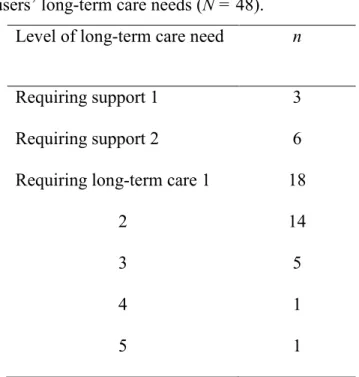
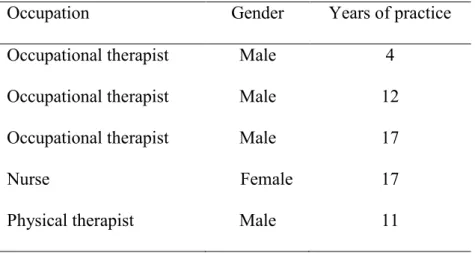
Ultimately, 48 daycare users (24 male, 24 female, mean age = 75.7 ± 10.0 years), and five providers participated. Users’ average period of using the facilities was 39.6 ± 28.0 months. Users’ long-term care needs levels are shown in Table 1, and the providers' occupation, gender, and years of experience are shown in Table 2.

Activities at the three daycare facilities and their channels

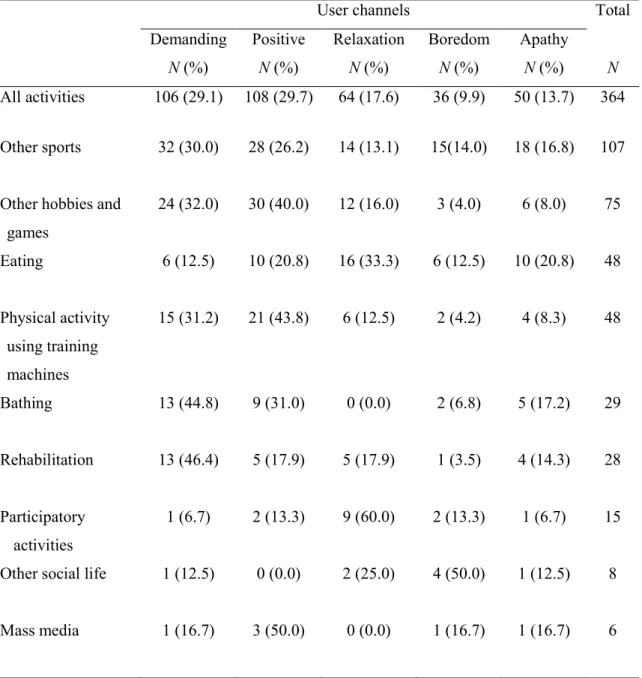
Each user reported 5 to 10 activities, totaling 364 individual activities. Table 3 shows

the frequency and proportion of each channel for all activities. According to user reports,

29.1%, 29.7%, 17.6%, 9.9%, and 13.7% of all listed channels were in the demanding,

positive, relaxation, boredom, and apathy channels, respectively.

(9)

9

Table 3 shows know the channel frequency and percentage distribution for the

reported activities; note that activities are listed in descending order of frequency. Other sports and other hobbies and games were activities performed during free time. There were multiple reports of this category by many users. Other sports included voluntary physical exercise, such as group gymnastics and walking, while other hobbies and games included puzzles, games, and handicrafts. A characteristic channel distribution was seen for each activity. Demanding and positive channels accounted for 25–40% of other sports, other hobbies and games, physical activity using training machines, and bathing. Relaxation reached 33.3% for eating, while demanding channels occupied a large proportion (46.4%) of rehabilitation.

Agreement in channels between users and provider perceptions

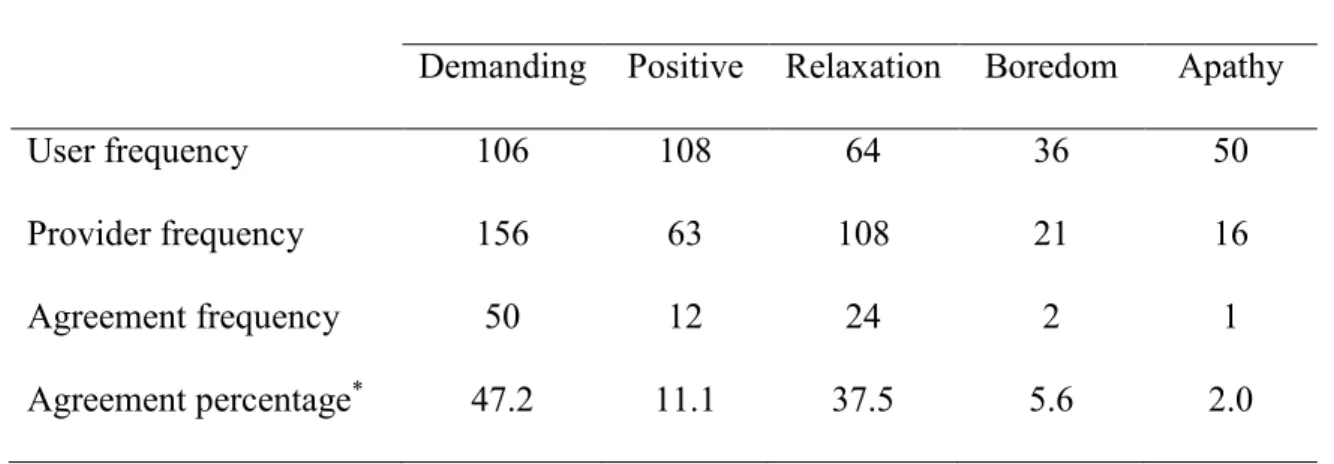
Among the 364 activities, only 89 showed agreement between users and providers (24.5%). Table 4 shows the user and provider frequencies, as well as the agreement frequency and percentages, for the individual channels. Notably, the frequency of demanding channels was higher based on providers’ perception than based on users’

reports, and the agreement percentage was only 47.2%. Providers’ perception was also higher than was users’ for the relaxation channel, with an agreement percentage of only 37.5%. The agreement percentages for the positive, boredom, and apathy channels were 11.1%, 5.6%, and 2.0%, respectively.

Agreement in channels between users and provider perceptions according to activity

For each activity, we examined the frequencies of channels based on user reports and provider perceptions and calculated the agreement frequency and percentages (Table 5).

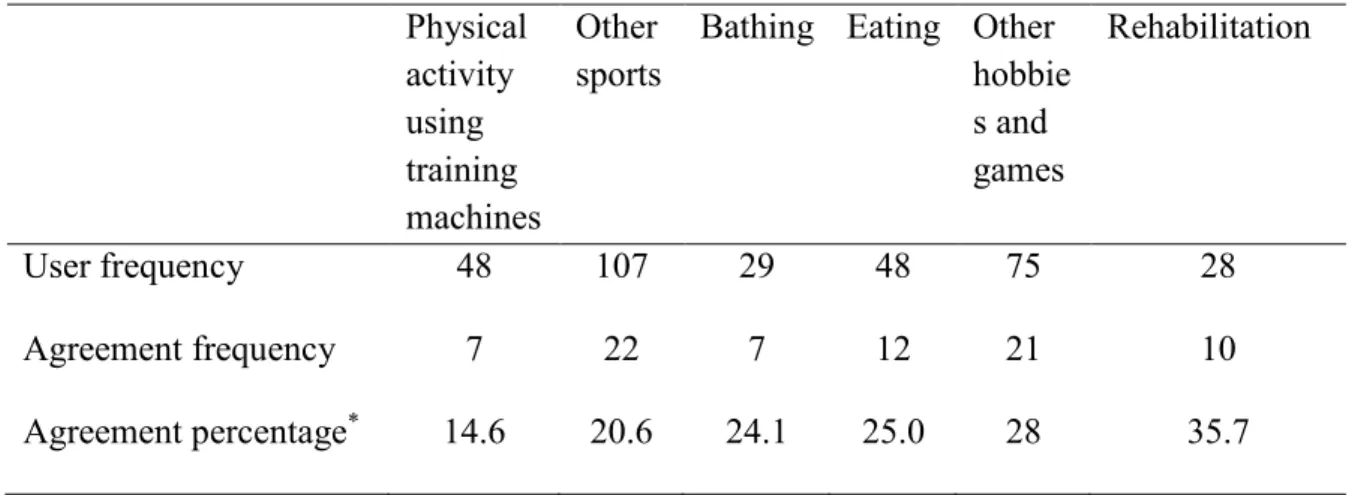
Physical activity using training machines showed the lowest agreement percentage

(10)

10

between users and providers (14.6%), while rehabilitation showed the highest agreement percentage between users and providers (35.7%; Table 5).

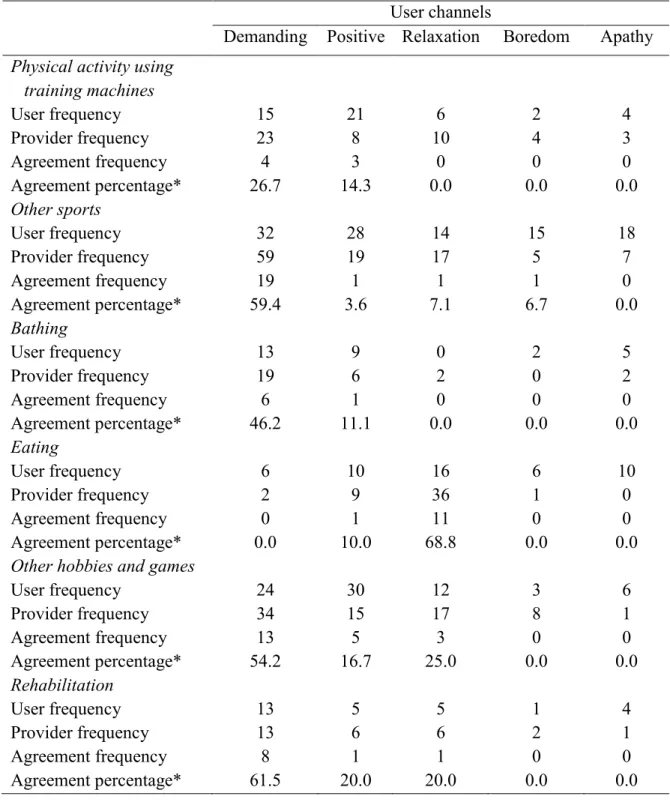
The frequencies of agreement results for each channel and activity are shown in Table 6. Low agreement was found in physical activity using training machines and other sports, although the channel distributions differed for these activities. Providers tended to perceive the demanding channels more often than the positive or other channels, particularly for physical activity using training machines, where providers perceived the demanding channel about twice as often as users, and the agreement percentage was low (at 26.7%). On the other hand, rehabilitation showed higher agreement, particularly for the demanding channel (agreement percentage = 61.5%), with a similar frequency distribution between users and providers. Note that the demanding channels showed high agreement for most activities, except for eating, (agreement percentage = 0.0%). The demanding channel was reported only six times for this activity by users and, therefore, the perception of providers was in disagreement.

Users reported positive, boredom, and apathy, in relation to eating, but it was difficult for the provider to perceive it. Providers’ perception of the relaxation channel for eating was higher than for the other channels (agreement percentage = 68.8%).

Influencing factors for channel agreement

Binary logistic regression analysis examined the influencing factors of channel agreement (as the dependent variable); gender, duration of facility use (months), age, and long-term care needs level served as independent variables. Based on the variable selection criteria, only duration of facility use was deemed an independent factor associated with channel agreement of eating (adjusted odds ratio 0.098, 95% CI [0.95–

1.004], p = .098; Hosmer–Lemeshow test, p = .045). However, given that the p-value of

the Hosmer–Lemshow test (which tests the goodness-of-fit of the logistic regression

(11)

11

model) was below .05, the model could be considered not a good fit to the data.

Binary logistic regression analysis was also performed with channel agreement on the physical activity using training machines with the same procedure. As a result, age (adjusted odds ratio 1.127, 95% CI [0.988–1.286]; p = .074) and gender (adjusted odds ratio 0.13; 95% CI [0.016–1.085], p = .060) were regarded as independent contributors (Hosmer–Lemshow test, p = .204). However, for both independent variables the p-value was above .05. This model was statistically significant.

Correlations for challenge and skill levels

We observed no significant correlations between the challenge levels of users and providers (rho = 0.106). The same was true for skill (rho = 0.130).

Discussion

Difficulty for providers in estimating the experiences of daycare users

Providers largely found it difficult to perceive users’ experience channels during facility activities. Among the 364 activities reported by users, the number of channels that the providers could perceive correctly was only 89 (24.5% of the total). Notably, we found no significant correlations between the challenge and skill ratings (which enable our classification of channels) between users and providers, and none of the user

characteristics that we assessed appeared to predict channel agreement. In the following sections, we propose several potential explanations for these findings.

Daycare activities of note

We suggest two possible reasons why providers found it difficult to recognize particular

experience channels. The first concerns the ratio of providers to users during activities,

(12)

12

while the second refers to the general image associated with each activity.

For the better perception of experience, Siösteen, Kreuter, Lampic, and Persson (2005) stated that ‘small units with high staff density and a long stay and/or prolonged contact with the patients probably facilitate communication with and knowledge about the patients’. In the present study, numerous types of activities were offered at the daycare facilities, some involving one-to-one interaction between providers and users, and others involving one provider for multiple users. When activities, such as physical activity using training machines, are performed by many users under the care of a small number of providers, providers might have more difficulty in estimating all of the users’

channels due to their dispersed attention. In contrast, rehabilitation is also based on physical exercise but principally offered on a one-on-one basis, which may enable providers to be more aware of users’ states. Therefore, the ratio of providers to users may affect the level of agreement for the channel of rehabilitation.

The second potential explanation considers the effect of the general image of an

activity. Here, the results for eating offer some support. Generally, relaxation is

considered the main channel of eating (Csikszentmihalyi, 2003). Here, providers

perceived relaxation twice as often as users regarding the activity of eating. However,

users also reported other channels such as demanding, positive, and apathy, which

providers often did not select. In students, demanding and positive channels have been

rarely reported for eating (Massimini & Carli, 1987), while in nursing home residents,

apathy and positive channels were the most often reported (Voelkl, 1990). Potentially,

the channel distribution for eating differs according to the age of the person performing

the activity and their mental and physical functioning. Providers at daycare facilities

should, therefore, avoid being influenced by the general image of an activity, and

(13)

13

instead pay attention to the individual feelings of the users, who are elderly people with declining physical and mental functioning due to aging and/or illness.

Offering ‘the just right challenges’

To provide the ‘just right challenges’, providers must devise activities while keeping in mind that estimating others’ experiences is difficult. Demanding channels, which were often reported by users in this study, are believed to be associated with emotions such as stress, vigilance, and sorrow. If a user experiences a demanding channel (i.e., ‘high challenge, low skill’), his or her motivation can be diminished. Yasunaga et al. (2012) reported a relationship between the frequency of anxiety and worry (demanding)

channels in facility activities and low QOL, so care must be taken to avoid inadvertently accumulating demanding channels.

In rehabilitation, the frequency of demanding channels was high for users, which providers tended to correctly perceive. Therefore, in order to improve the physical and psychological functioning of users, therapists and users should collaborate to produce activities with higher challenge than skill levels, as engagement in such activities can help improve users’ skills over time.

In order to promote elderly adults’ health, reducing experience of demanding channels, and promoting experience of more desirable channels (Collins et al., 2009;

Hirao et al., 2012; Kobayashi et al., 2007), such as flow and relaxation (in other words,

to ensure that the challenge is ‘just right’), it is necessary to capture the feelings of users

during their activities, verify the reasons for those feelings, and adjust the activity and

environment. We discuss now several ways of reducing demanding channels and

promoting flow and relaxation for eating, which users reported as demanding and

providers found difficult to perceive.

(14)

14

Eating is a daily activity with which occupational therapy is often involved. When evaluating a client, it is important for therapists to know not only their physical risks during eating but also what they are feeling and why. Here, users made comments such as ‘I am eating food I do not like with effort’, ‘I am not good at eating hard food’, ‘I cannot eat well with chopsticks’, and ‘It takes time to eat, and I am worried that I am causing trouble to the staff’. In such cases, we propose improving users’ skill in using chopsticks, or adjusting the level of ‘challenge’ by using spoons and forks that fit their level of physical function, or arranging meals to ensure sufficient time for users who require longer periods for eating. It is important that providers spend time with users, pay attention to their situations, frequently ask for users’ viewpoints, and make sure that users do not fall into a demanding state during activity. We believe that supporting users in a way that allows for the ‘just right challenges’ will lead to better quality service.

Limitations and future prospects

This study was conducted at only three facilities in the Kanto region of Japan, making it is difficult to generalize the results. Nevertheless, the results suggest that it is difficult for providers to perceive the quality of users’ experiences, at least for some channels.

We believe that the results will become more generalizable as the number of target facilities and different areas increase in the future.

Conclusion

In summary, our findings indicate a difficulty for providers in perceiving users’ quality of experiences. As it is difficult to imagine the experience of the user, it is necessary to provide activities while paying attention to how the user feels. We believe that

supporting users in a way that allows for ‘just right challenges’ will lead to better

quality service. It is important that care be taken to avoid accumulating the impact on

(15)

15

the negative channel inadvertently, due to the relationship between high anxiety and worry channels and low QOL. It is also important to pay attention to the user's feelings to help provide the ‘just right challenge’ and to assist a transition from the undesirable experience channel to the desired channel.

Acknowledgements

We thank Mr. Goto, Mr. Takimura, and Ms Kawabata for clinical assistance. We are grateful to the daycare users and providers. The authors declare no conflicts of interest.

We would like to thank Editage (www.editage.jp) for English language editing.

Funding

This research did not receive any specific grant from funding agencies in the public,

commercial, or not-for-profit sectors.

(16)

16

References

Asakawa, K. (2010). Flow experience, culture, and well-being: How do autotelic Japanese college students feel, behave, and think in their daily lives? Journal of Happiness Studies, 11, 205–223. doi:10.1007/s10902-008-9132-3.

Collins, A. L., Sarkisian, N., & Winner, E. (2009). Flow and happiness in later life: an investigation into the role of daily and weekly flow experiences. Journal of Happiness Studies, 10, 703–719.

Csikszentmihalyi, M. (1975). Beyond boredom and anxiety: Experiencing flow in work and play. San Francisco: Jossey-Bass Publishers.

Csikszentmihalyi, M. (1997). Finding flow: The psychology of engagement with everyday life. New York NY: Basic Books.

Csikszentmihalyi, M. (2003). Good business: leadership, flow, and the making of meaning. New York NY: Penguin Books.

Delle Fave, A., & Massimini, F. (1992). The ESM and the measurement of clinical change: a case of anxiety disorder. In M. W. deVries (ed.), The experience of psychopathology: Investigating mental disorders in their natural settings. (pp.

280–289). New York, NY: Cambridge University Press.

Hirao, K., Kobayashi, R., & Okishima, K. (2012). Flow experience and health-related quality of life in community dwelling elderly Japanese. Nursing and Health Sciences, 14, 52–57.

Ishimura, I. (2008). Psychological study on enhancing factors and positive functions of

flow experiences (Unpublished doctoral dissertation). University of Tsukuba,

Ibaraki, Japan.

(17)

17

Jonsson, D., & Persson, H. (2006). Towards an experiential model occupational balance: an alternative perspective flow theory analysis. Journal of Occupational Science, 13, 62–73.

Kobayashi, R., Shirahama, K., Takahashi, K., Nagatani, R., Nagao, S., Azuma, T., &

Satoh, D. (2005). A study on the validity of flow questionnaire using EEG. The Japanese Journal of Occupational Therapy for Mental and Cognitive Disorder, 2, 70–75.

Kobayashi, R., Shiraishi, H., Satoh, D., Tomori, K., Matsuda, I., Hirotsu, K., &

Takahashi, A. (2007). Effect of flow condition through occupation on

biochemical markers of stress. Journal of Kibi International University School of Health Science, 12, 91–95.

Massimini, F., & Carli, M. (1988). The systematic assessment of flow in daily experience. In M. Csikszentmihalyi & I. S. Csikszentmihalyi (Eds.). Optimal experience: Psychological studies of flow in consciousness. (pp. 266–287).

Cambridge, MA: Cambridge University Press.

Massimini, F., Csikszentmihalyi, M., & Carli, M. (1987). The monitoring of optimal experience: a tool for psychiatric rehabilitation. Journal of Nervous and Mental Disease, 175, 545–549.

Ministry of Health, Labour and Welfare (n.d.). Health and welfare services for the elderly. Retrieved from http://www.mhlw.go.jp/english/wp/wp-hw9/dl/10e.pdf.

Okamoto, H., & Okada, S. (2002). Differences in subject needs between nursing home

residents’ and residential care professional’s perspectives. Japanese Journal of

Public Health, 49, 911–921.

(18)

18

Siösteen, A., Kreuter, M., Lampic, C., & Persson, L. (2005). Patient–staff agreement in the perception of spinal cord lesioned patients’ problems, emotional well-being, and coping pattern. Spinal Cord, 43, 179–186. doi:10.1038/sj.sc.3101693 Sneeuw, K. C. A., Sprangers, M. A. G., & Aaronson, N. K. (2002). The role of health

care providers and significant others in evaluating the quality of life of patients with chronic disease. Journal of Clinical Epidemiology, 55, 1130–1143.

Statistics Japan. (2016). Survey on Time Use and Leisure Activities. Retrieved from:

http://www.stat.go.jp/english/data/shakai/2016/pdf/qua.pdf

Voelkl, J. E. (1990). The challenge skill ratio of daily experiences among older adults residing in nursing homes. Therapeutic Recreation Journal, 24, 7–17.

Yasunaga, M., Kobayashi, N., & Yamada, T. (2012). The challenge skill ratio of users’

experiences at an adult daycare center: Emotional states based on the flow model. Japanese Occupational Therapy Research, 31, 83-93 (In Japanese with English abstract)

Yerxa, E. J., Clark, F., Jackson, J., Parham, D., Pierce, D., & Zemke, R. (1990). An

introduction to occupational science, a foundation for occupational therapy in

the 21st century. Occupational Therapy in Health Care, 6, 1–17.

(19)

19

Figure 1. The eight channels of quality of experience according to Massimini and Carli

(1988), and Csikszentmihalyi (2003).

(20)

20

Table 1. Daycare users’ long-term care needs (N = 48).

Level of long-term care need n

Requiring support 1 3

Requiring support 2 6

Requiring long-term care 1 18

2 14

3 5

4 1

5 1

Note: Long-term care needs level, defined by the Ministry of Health, Labour and

Welfare, depends on users’ mental and physical conditions. Requiring support 1 is the

mildest, where users can complete basic activities of daily living independently but

require minor support for instrumental activities of daily living. Requiring long-term

care 5 is the most severe condition, where users require assistance for all activities of

daily living.

(21)

21

Table 2. Provider characteristics (N = 5).

Occupation Gender Years of practice

Occupational therapist Male 4

Occupational therapist Male 12

Occupational therapist Male 17

Nurse Female 17

Physical therapist Male 11

(22)

22

Table 3. Channels of users’ activities.

User channels Total

Demanding N (%)

Positive N (%)

Relaxation N (%)

Boredom N (%)

Apathy N (%) N All activities 106 (29.1) 108 (29.7) 64 (17.6) 36 (9.9) 50 (13.7) 364 Other sports 32 (30.0) 28 (26.2) 14 (13.1) 15(14.0) 18 (16.8) 107

Other hobbies and games

24 (32.0) 30 (40.0) 12 (16.0) 3 (4.0) 6 (8.0) 75 Eating 6 (12.5) 10 (20.8) 16 (33.3) 6 (12.5) 10 (20.8) 48

Physical activity using training machines

15 (31.2) 21 (43.8) 6 (12.5) 2 (4.2) 4 (8.3) 48

Bathing 13 (44.8) 9 (31.0) 0 (0.0) 2 (6.8) 5 (17.2) 29

Rehabilitation 13 (46.4) 5 (17.9) 5 (17.9) 1 (3.5) 4 (14.3) 28

Participatory activities

1 (6.7) 2 (13.3) 9 (60.0) 2 (13.3) 1 (6.7) 15 Other social life 1 (12.5) 0 (0.0) 2 (25.0) 4 (50.0) 1 (12.5) 8

Mass media 1 (16.7) 3 (50.0) 0 (0.0) 1 (16.7) 1 (16.7) 6

(23)

23

Table 4. Agreement in channels between user reports and provider perceptions according to channel.

User channels

Demanding Positive Relaxation Boredom Apathy User frequency

Provider frequency Agreement frequency Agreement percentage

*

106 156 50 47.2

108 63 12 11.1

64 108

24 37.5

36 21 2 5.6

50 16 1 2.0

Notes: *Agreement percentage is the proportion of channels reported by users that agree with channels perceived by providers out of the total frequency of user-reported

channels (Agreement frequency/user frequency × 100).

(24)

24

Table 5. Agreement in channels between user reports and provider perceptions according to activity.

Physical activity using training machines

Other

sports Bathing Eating Other hobbie s and games

Rehabilitation

User frequency Agreement frequency Agreement percentage

*

48 7 14.6

107 22 20.6

29 7 24.1

48 12 25.0

75 21 28

28 10 35.7 Note: *Agreement percentage is the proportion of channels reported by users that agree with channels perceived by providers out of the total frequency of user-reported

channels (Agreement frequency/user frequency × 100).

(25)

25

Table 6. Agreement in channels between user reports and provider perceptions for each channel and activity.

User channels

Demanding Positive Relaxation Boredom Apathy Physical activity using

training machines User frequency Provider frequency Agreement frequency Agreement percentage*

15 23 4 26.7

21 8 3 14.3

10 6 0 0.0

2 4 0 0.0

4 3 0 0.0 Other sports

User frequency Provider frequency Agreement frequency Agreement percentage*

32 59 19 59.4

28 19 1 3.6

14 17 1 7.1

15 5 1 6.7

18 7 0 0.0 Bathing

User frequency Provider frequency Agreement frequency Agreement percentage*

13 19 6 46.2

9 6 1 11.1

0 2 0 0.0

2 0 0 0.0

5 2 0 0.0 Eating

User frequency Provider frequency Agreement frequency Agreement percentage*

6 2 0 0.0

10 9 1 10.0

16 36 11 68.8

6 1 0 0.0

10 0 0 0.0 Other hobbies and games

User frequency Provider frequency Agreement frequency Agreement percentage*

24 34 13 54.2

30 15 5 16.7

12 17 3 25.0

3 8 0 0.0

6 1 0 0.0 Rehabilitation

User frequency Provider frequency Agreement frequency Agreement percentage*

13 13 8 61.5

5 6 1 20.0

5 6 1 20.0

1 2 0 0.0

4 1 0 0.0 Notes: *Agreement percentage is the proportion of channels reported by users that agree with channels perceived by providers out of the total frequency of user-reported

channels (Agreement frequency/user frequency × 100).

Figure 1. The eight channels of quality of experience according to Massimini and Carli  (1988), and Csikszentmihalyi (2003)
Table 1. Daycare users’ long-term care needs (N = 48).
Table 2. Provider characteristics (N = 5).
Table 3. Channels of users’ activities.
+4

参照

関連したドキュメント

Assessment subcategories were: skills to predict life risk in older adults (seven skill items); skills to predict life risk in older adults based on the action of nursing care

In 1997, TAAE using ethanol was performed for right unilateral PA, rather than adrenalectomy and medical treatment, in order to reduce the aldosterone level as well as the BP..

Whereas tube voltages and HVLs for these four X-ray units did not significantly change over the 103-week course, the outputs of these four X-ray units increased gradually as

This study was performed to examine attitudes toward evacuation(wish to stay at home, access evacuation sites)among elderly community residents that were able to choose

The excess travel cost dynamics serves as a more general framework than the rational behavior adjustment process for modeling the travelers’ dynamic route choice behavior in

[Mag3] , Painlev´ e-type differential equations for the recurrence coefficients of semi- classical orthogonal polynomials, J. Zaslavsky , Asymptotic expansions of ratios of

Wro ´nski’s construction replaced by phase semantic completion. ASubL3, Crakow 06/11/06

For the assessment of the care burden we used the Japanese Version of the Zarit Caregiver Burden Interview (J- ZBI) and compared it with the caregiver’s age, relationship, care term