Teaching English phonology
in linguistically diverse classrooms in Nepal
Astha TULADHAR
1and Mari AKATSUKA
2Abstract
Teaching English phonology may require special strategies when sounds cannot be expressed in written form in a student’s native language. In Nepal, though Nepali is the common offi cial language, one can expect to meet students whose mother tongues may differ. In this study, a private high school was chosen to test students’ Eng- lish pronunciation. Two types of tests were conducted: listening and pronunciation tests. In the listening test, three types of sounds were selected: 1) sounds existing in both English phonetic chart and Nepali Devanagari script, 2) sounds existing in English but not in Nepali and 3) sounds existing in Nepali but not in English. The listening test, involved matching recorded words on printed paper. The pronunciation test involved recording students’ pronunciation to detect mistaken vowels and consonants (segmental sounds) and stress, rhythm and intonation (prosody). Acquiring native-level pronunciation is emphasized in Nepali classrooms. However, it is common that learners of English as a second language often mispronounce sounds non-existent in their native script. Although acquiring native-level pronunciation and adopting an accent has been debated, incorrect pronun- ciation hampers intelligibility in oral communication. Teaching phonemes that are non-existent in students’ na- tive language can be a challenging task. In this study, English pronunciation of Nepali high school seniors was compared to that of native level. We found that Nepali students faced some diffi culty pronouncing phonemes that were very similar to their native script, so it may be effective to target similar-yet-different phonemes and help students differentiate those sounds by pair drill method.
I. Introduction:
Nepal is a multi-lingual country with more than 36 indigenous languages and the offi cial common language is Nepali. In Nepal, the daily radio news is broadcasted in fi ve major ethnic languages. The use of English was fi rst recorded in the seventeenth century but, it wasn’t until the fi rst half of the twentieth century that it was adopted as an offi cial foreign language. At present, English is commonly used in the educational and economic domains (Giri, 2014).
In most government-aided schools of Nepal, Nepali is the medium of instruction for all other subjects except English, but the opposite is true in most privately owned schools where students are encouraged to use English even outside their classrooms to communicate with teachers and among themselves (Sharma, 2006). English is taught as a subject and as a medium in Nepal. When it is taught as a subject, the medium of instruction is also
1
College of Liberal Arts and Sciences, Mie University
2
Nagoya University of Foreign Studies and Meijo University
English. In such a scenario, the fact that English is taught in schools from early years shows that it is valued as a language of communication internationally and among different ethnic groups as well. It is being taught as a compulsory subject starting from primary level in most private schools, so an average Nepali high school gradu- ate completes 13 years of English education. During this long period of English education, is perfecting pronun- ciation emphasized? In this study, we focused on the importance of pronunciation since it is the foundation of intelligibility in oral communication. Locally, English pronunciation may be easily understood among Nepali people, but less so internationally if pronunciation differs substantially. One particular aspect of teaching English phonology in a Nepali classroom is that the students’ mother tongues may differ, and this could be challenging when compared to classrooms where the majority of students speak a uniform language as their fi rst language, like in Japan. A teacher’s pre-knowledge about student’s native language is important for lesson planning and delivery, like when teaching students of different nationalities. According to Avery and Ehrlich (1992), biologi- cal, socio-cultural, personality and linguistic factors are known to affect the acquisition of the sound system of a second language.
In our previous study (Tuladhar and Akatsuka, 2017), we concluded that being able to express a sound in writ- ten form in one’s native language greatly infl uences pronunciation, for example glottal reinforcement or retrofl ex fricative sounds and diphthongs are absent in Japanese so Japanese students tend to insert vowels to pronounce
Fig. 1. Nepali Devanagari script with alphabet reading, phonetic symbol and approxi- mate pronunciation in English word. The circled phonemes are related to this study.
13 vowels in Nepali Devanagari script
[aݜ]
fun father fill machine pull rude fade site bone now uncle all umbrella
kin blockhead go log hut sing chin pitch hook job hedgehog
lip uphill baby abhor maim yard rare lily we pot anthill did adhere own little boat house then and he no
ޝ
34 consonants in Nepali Devanagari script
palatalized retroflexed
shy shy sand hat action trust guess
the word “taxi” as “ta-ku-shi.” Nepali is a language belonging to the family of Indo-Aryan languages. It is also known as Gorkhali or Parbatiya and uses the Devanagari script written from left to right with alpha syllabaries or abugidas (Matthew, 2013). It is written with each consonant-vowel sequence as a unit, called “aksara” in which the vowel symbol functions as an obligatory diacritic to the consonant (Bright, 1996) (Fig.1.1). Devana- gari script is shared by many other languages like Sanskrit, Marathi, Konkani and Hindi. It has 13 vowels and 34 consonants (Fig.1.) and more than 442 vowel diacritics. In the world, there are many languages that share the same script for example, Roman alphabet in English, French and German. Similarly, Kanji is used in Chinese and is the origin of Japanese and Korean. In the Devanagari script there are more than double the number of vowel sounds than the fi ve in English or Japanese. In their book, Avery and Ehrlich (1992) point out that the characteristic accent of Hindi speakers, is partly a result of the use of retrofl ex because the tongue is curled back slightly like when /r/ is produced but nothing was mentioned about Nepali. In Hindi, there are many more retrof- lexed consonants than in English and the same may be true for Nepali, therefore, there may be some similarities in the pronunciation styles of Nepali and Hindi speakers. In his study, Rai (2006) highlighted that Nepali speak- ers of English have their own pronunciation which is different not only from British and American English but also from Hindi. Some examples highlighted are 1) Nepali speakers can hardly make any difference between the sound /s/, /ʃ/, /z/, /ʤ/, and /f/, [ph] 2) they pronounce the sound /ɔ/ as /o/ and fi nd no difference between /ə/ and / ʌ/ and 3) their pronunciation of consonant clusters is different from English. For example, they pronounce
“school” as “iskul”, “student” as “istudent” and “spray” as “ispray.”
In the world today, non-native speakers of English outnumber native speakers and so do non-native English teachers. In this regard, it is important to perfect pronunciation to enhance smooth oral communication. Devel- oping strategies to teach English phonemes non-existent in students’ native language is necessary. In this study, we chose phonemes that, according to previous studies, are diffi cult for Nepali speakers of English. We chose /s/
and /ʃ/ because both these sounds exist in Devanagari (Fig.1) yet; Nepali students have diffi culty differentiating it with a third similar sound /ʂʌ/. Secondly, we chose the phonemes /z/ and /ʤ / because these sounds do not ex- ist in Devanagari so students tend to replace it with a similar sound /ʤʌ/. Then we chose phonemes /ɔ/ and /oʊ/
because in Devanagari, /aʊ/ is a vowel and not a diphthong (Fig.1) but in English both /aʊ/ and /oʊ/ are diph- thongs and /ɔ/ is easily confused with /ʌ/. Next we chose the phonemes /ə/ and /ʌ/ because the phoneme /ə/ does not exist in Devanagari but /ʌ/ does. Lastly, we checked the phoneme /f/ because it does not exist in Devanagari.
Fig.1.1. Vowel diacritic markings for each vowel of the Devanagari script except. Note
that “a” is the default vowel and thus need not be marked. The second row shows how
the consonant /p/ is represented after it adopts the representative markings. All 34 con-
sonants can adopt the 13 vowels resulting in 442 compound characters with different
sounds. Conjunct consonants that form by compound form of two consonants and/or
vowels not related to this study are not expressed here.
Instead of /f/ the aspirated sound /p
h/ exists in Devanagari (Fig.1). When we look at English words that have this phoneme, the spelling is sometimes “f” as in “fl ower” or “ph” as in “telephone.” Nepali students tend to replace the /f/ sound with this aspirated /p
h/ in speech so we tested whether they would correctly identify the spelling of selected English words. Secondly, we also tested their ability to correctly incorporate stress, rhythm and intona- tion by their fi nal years of high school, regardless of their ethnic background. In this study, we checked the level of English pronunciation of Nepali high school students by detecting English phonemes that are especially diffi - cult for Nepali students and suggested useful strategies to target English phonemes unavailable in students’ na- tive script.
II. Method:
This study was conducted in a privately owned high school situated in Kathmandu, Nepal. The participants were 31 Nepali high school seniors who undertook two types of tests; the listening test followed by the pronun- ciation test. The listening test had four parts. In part 1, students were asked to listen to eight recorded words as shown in Table 1, part 1 and circle the same word on printed paper provided to them. They were tested to distin- guish sound pairs /s/, /ʃ/ and /z/, /dʒ/ when these sounds came at the beginning and end of the word. In part 2, phonetic sounds /ɔ/ and /oʊ/ were tested and in part 3, phonetic sounds /ə/ and /ʌ/ were tested. For these tests, students were asked to circle the phonemes on printed paper. In part 4, the phonetic sound/f/ was tested when spelled with “f” or “ph.” All tested phonemes were specifically selected because it was thought that Nepali speakers of English have diffi culty differentiating them. The words selected for each test are as shown in Table 1, parts 1-4.
The pronunciation test had 4 parts. In part 1, students were asked to pronounce 20 words with phonetic sounds diffi cult for Nepali students given in Table 2, part 1. The purpose of this test was to check the students’
ability to pronounce the underlined phonemes. In part 2, their ability to identify the stressed syllable was tested by asking students to pronounce 4 independent words given in Table 2, part 2. In part 3, students were tested for their ability to incorporate stress related rhythm by pronouncing 4 sentences shown in Table 2, part 3. Finally, to test whether students could distinguish the rising and falling intonation, they were asked to pronounce words, phrases or questions in a given situation, as shown in Table 2, part 3. The recordings of students’ pronunciation were collected using software called “Wave surfer” downloaded from (www.speech.kth.se/wavesurfer/) and evaluated using software called “Praat” downloaded from (www.fon.hum.uva.nl/praat/download_win.html).
III. Results and Discussion:
Listening Test Part 1: In this test, students were asked to listen and match eight words provided in print as shown in Table 1, part 1. They were tested for the sounds /s/, /ʃ/, /z/ and /ʤ/ when these sounds came at the be- ginning and end of the word. The fi rst 4 word pairs tested the sounds /s/ and /ʃ/. The other 4 pairs tested the pho- nemes /z/ and /ʤ/. In Nepali Devanagari script /s/, /ʃ/, z/ and /ʤ/ do not exist but similar sounds /ʂʌ/, /ʃʌ/, /sʌ/
and /ʣʌ/ exist (Fig.1). From the results shown in Fig. 2, more than 75% of the students had no problem with
these phonemes. Yet, the most mistaken word pairs were “sort/short” in the fi rst category and “zest/jest” in the
second category. When compared, it is interesting to note that 94% of the students were correct when the sounds
/z/ and /ʤ/ came at the end of words like in “rays/ rage.” On the other hand, most students correctly pronounced
/s/ and /ʃ/. The reason why “sort/short” was mistaken may be because of the unfamiliarity with the word “sort”
Table 1. Listening test word list:
Part 1. Students were asked to circle the recorded word.
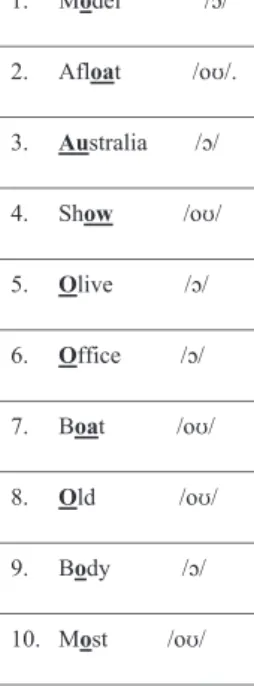
Part 2. Students were asked to listen to the recorded words given below and circle the phonemes /ɔ/ and /oʊ/.
Part 3. Students were asked to listen to the recorded words given below and circle the phonemes /ə/ and /ʌ/.
Part 4. Students were asked to listen to the recorded words
with /f/ phoneme and circle the correct spelling f or ph.
Table 2. Pronunciation tests word list:
Part 1. Students had to pronounce 20 words chosen to test different phonemes.
Part 3. Students had to read the following sentences determining.
Part 2. Students had to pronounce 4 words determin- ing the stress.
Fig. 2. Result of word pairs that tested students’ ability to distinguish /s/, /ʃ/, /ʒ/ and /ʤ/. More than 75% of the
students could clear this test. “Sort/short” and “zest/jest” were the most mistaken word pairs.
or because they were accustomed to pronouncing “short” as “sort.”
Listening Test Part 2: In this test, students listened to recorded words with phonemes /ɔ/ and /oʊ/ as shown in Table 1, part 2 and circled the matching sound on paper. The results are shown in Fig. 3. Out of /ɔ/ and /oʊ/, 70% correctly pronounced /oʊ/ in “show”, “boat”, “old” and “most.” Only 49% correctly pronounced “afl oat”
Part 4. Students had to read the following words, phrases or questions determining the rising and falling intonation.
Fig. 3. Result of words with the phonemes /ɔ/ and /oʊ/. Students had less diffi culty with /oʊ/ than /ɔ/ sound.
“Australia” was the most mistaken word in /ɔ/ category and “boat” and “most” were the most mistaken in the /
oʊ/ category.
perhaps because they evaluated the /ə/ sound in the fi rst syllable as /ɔ/ instead of /oʊ/ sound in the second sylla- ble. In Devanagari, /aʊ/ and /oʊ/ exist as a vowel instead of diphthong and /o/ and /u/ also exist as separate vow- els. The most mistaken word with /ɔ/ sound was “Australia” perhaps because students were exposed to /ɒstreɪliə/
in British English than /ɔstrelyə/ in American English. In English phonetic chart there are phonemes /ʌ/ and /ɔː/
but in Nepali only /ʌ/ exists. “Australia” is not pronounced /aʊ/ though its spelling has “a” followed by “u” and students may have mistaken it as either /aʊ/ or /ʌ/.
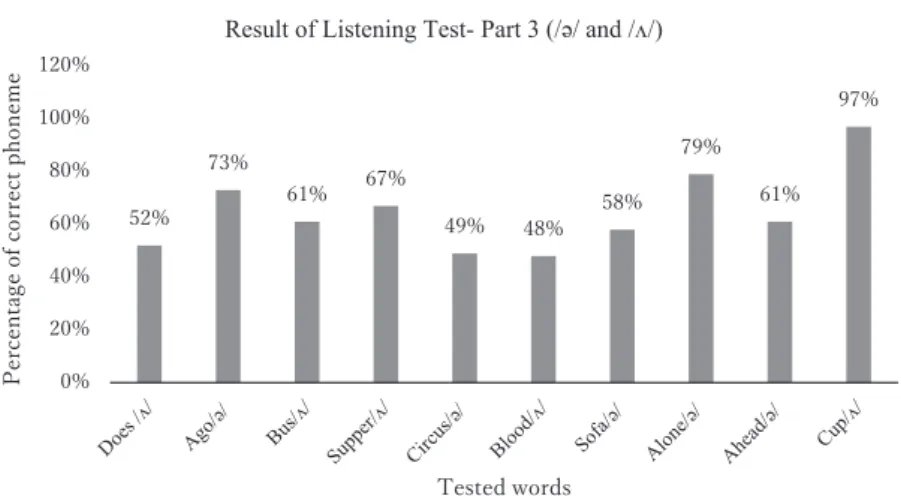
Listening Test Part 3: In this test, students listened to recorded words with phonemes /ə/ and /ʌ/ as shown in Table 1, part 3 and circled the matching sound on paper. The results are shown in Fig. 4. “Blood” was the most mistaken word in /ʌ/ category and “circus” was the most mistaken in /ə/ category. Instead of /blʌd/, they may have heard /bləd/ or /blɔːd/. The confusion may have risen because there is only one phoneme /ʌ/ in Devanagari that does not differentiate /ɔ/, /ɔː/, /ʌ/ and /ə/. The word “circus” has two syllables and the target /ə/ sound is on the second syllable. Students may have mistaken it for the fi rst syllable.
Fig. 4. Result of words with the phonemes /ə/ and /ʌ/. Students had diffi culty with both sounds /ə/ and /ʌ/. “Circus”
was the most mistaken word in /ə/ category and “boat” and “most” were the most mistaken in the /oʊ/ category.
Fig. 5. Result showing the correct spelling of words spelled with “f” or “ph.” More than 80% of the students could clear
this test. All students correctly spelled “pharmacy” but they had problems with “elephant”, “infant” and “physical.”
Listening Test Part 4: In this test, students listened to recorded words with phonemes /f/ as shown in Table 1, part 4 and circled the matching spelling on paper. The results are shown in Fig.5. The phoneme /f/ is sometimes spelt “ph” in English. In Devanagari, the /f/ sound is usually pronounced as an aspirated sound /p
h/ (Fig.1). In this category, students’ ability to distinguish “f” and “ph” in spelling was tested. Results show that almost all students could distinguish the spelling. Perhaps they had memorized the spelling of these words and did not rely on the sound. Some words mistaken in this category were “elephant”, “infant” and “physical.” Words with the same sound but different spelling are commonly mistaken, yet 80% of the students had no problem differentiat- ing the spellings in this test.
Pronunciation Test Part 1: In this test, students’ pronunciation of 20 words was recorded as shown in Table 2, part 1. The results shown in Fig. 6 indicate that the word “shy” was the most mistaken word followed by “Eng- lish”, “desk”, “zero”, “cut” and “June.” The phoneme /ʃ/ was mistaken for /s/. In the Devanagari script there are 3 similar sounds /ʃʌ/, /sʌ/ and /ʂʌ/ that are written differently and hence the confusion (Fig.1). The word “desk”
was mispronounced as /deks/ by many, though that word can be written in Devanagari. Similarly, the word “cut”
was mispronounced /kɔːt/ instead of /kʌt/. The longer sound /ɔː/ does not exist in Devanagari. Yet the longer sounds /iː/ and /uː/ do (Fig.1). The confusion between /ʌ/ and /ɔː/ may be due to the absence of longer sound /ɔː/
as in “caught.” The next mispronounced word was “June.” Instead of /ʤuːn/, it was pronounced /zuːn/. “Zero”
was mispronounced /ʤero / instead of /zIroʊ/. Students tend to replace the unavailable sound with /ʣʌ/ in the Devanagari script.
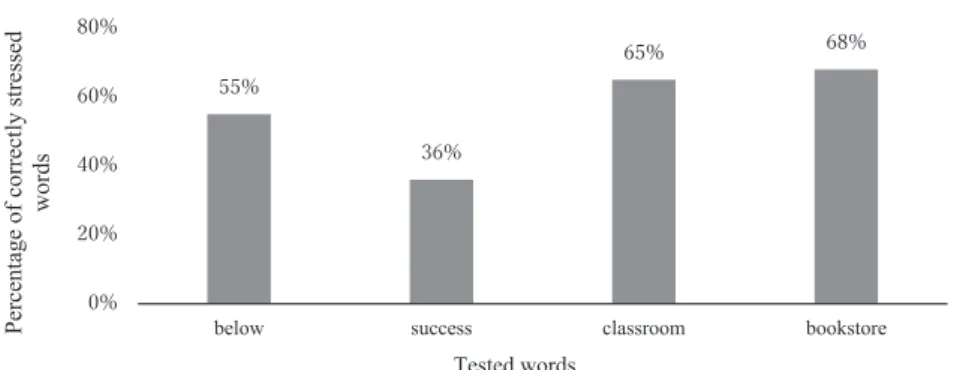
Pronunciation Test Part 2: In this test, students’ pronunciation of four words with two syllables was recorded
to see whether they stressed the correct syllable (Table 2, part 2). The results are shown in Fig. 7. Out of the four
words, most students mispronounced “success” and “below”, which are words with stress on the second sylla-
ble. Just two words are not enough to determine that Nepali learners are weak at pronouncing words with stress
Fig. 6. Results showing the pronunciation of 20 different words tested for different phonemes thought diffi cult
for Nepali speakers of English.
on the second syllable. However, the result shows that only 36% correctly stressed the second syllable in “suc- cess” and 55% in “below.” More than 60% made no mistakes pronouncing “classroom” and “bookstore.” Bear- ing in mind that only two syllable words were used for this test, we may conclude that Nepali learners made comparatively less mistakes pronouncing words with stress on the fi rst syllable.
Pronunciation Test Part 3: In this test, students read four selected sentences taken from the book by Avery and Ehrlich (1992). They were tested for correct sentence rhythm as shown in Table 2, part 3. The results are shown in Fig. 8. It was considered a mistake when a single word in the sentence was mispronounced. Results were evaluated based on soundwaves shown by software and perception impression rather than by direct comparison to recordings of a native speaker. 68% of the students’ sentence rhythm was correct for sentence 2, “Ravi bought a new sweater at the store” but only 29% correctly read sentence 4, “Search the word on Google,” perhaps be- Fig. 7. Results showing the words stressed on the correct syllable. Most students mistakenly stressed the fi rst sylla- ble in the word “success” and “below.” Words with stress on the fi rst syllable were correctly pronounced compared to other words.
Fig. 8. Results showing correct rhythm in four sentences. Sentence 2, “Ravi bought a new sweater at the store” was
correctly pronounced by most students whereas sentence 4, “Search the word on Google” was mostly incorrect perhaps
because it is a command.
cause it was the only sentence starting with a verb instead of the subject and may have been perceived as a com- mand.
Pronunciation Test Part 4: In this test, students were provided a list of eight words, phrases or questions with a given situation, selected from Wells (2006). Then their pronunciation was recorded to test rising or falling into- nation as shown in Table 2, part 4. According to the results shown in Fig. 9, none of the students correctly pro- nounced the phrase “Excuse me.” The correct intonation was fall-rise but most used rise. In Nepal, the word
“Hello” is usually used to stop someone and “Excuse me” is mostly used to apologize so the students may not have used it to stop someone. Only 7% correctly pronounced the intonation for “Are you sure? I think so” with the given situation (incomplete). Perhaps it should have been typed as “Are you sure? I think so (but)...” The students may not have understood that it was an incomplete situation. However, 73% correctly pronounced
“How about you?”, 67% correctly pronounced “Sorry?” as in pardon, 64% correctly pronounced “Lovely day, isn’t it?”, 61% correctly pronounced “Thank you” and “Does he really want to go home” and 55% correctly pro- nounced “I really don’t care!” More than 50% could correctly pronounce the intonation of words, phrases and questions printed on paper except “Excuse me” as when stopping someone, and “Are you sure? I think so” when it is incomplete. Evaluation was done using the same method as part 3.
IV. Conclusion:
In this study, a private high school in Nepal was chosen to test students’ ability to distinguish English pho- nemes by conducting listening and pronunciation tests. In listening test part 1, English phonemes /s/, /ʃ/, /z/, /ʤ/
were tested and more than 75% of the students could clear this test. In listening test part 2, phonemes /ɔ/ and /
oʊ/ were tested and more than 70% could differentiate these sounds, except “afl oat” and “Australia.” In listening
test part 3, phonemes /ə/ and /ʌ/ were tested and almost 50% correctly differentiated these sounds. In listening
test part 4, words pronounced with /f/ sound but spelt with “f” or “ph” were tested and 80% cleared this test. In
Fig. 9. Results showing the rising and falling intonation in words, phrases or questions in a given situation. “Ex-
cuse me” as for stopping someone has fall-rise intonation but all students pronounced it as rise intonation. “Are
you sure? I think so” when the sentence is incomplete was correctly pronounced by only 7% of the students. For
others, more than 50 % of the students cleared this test.
pronunciation test part 1, 60% could correctly pronounce the 20 words except “shy”. In pronunciation test part 2, more than 50% correctly stressed all 4 words except “success.” In pronunciation test part 3, almost 50% got the sentence rhythm correct except sentence 4. In pronunciation test part 4, almost 60% got the intonation cor- rect except for “Excuse me” and “Are you sure? I think so.”
From the above results, we conclude that, in case of Nepali students in private high school, their English pro- nunciation of tested phonemes was close to native level. We did not test students of government-aided high schools in this study. It is known that there is a gap in the level of English education between government-aided and privately owned schools in Nepal which needs to be standardized in future.
Next, Nepali students tend to replace sounds non-existent in Devanagari script with similar sounds available.
In this study, we compared their English pronunciation to only Devanagari script used in Nepali. However, each students’ mother tongue was not considered in this study and hence the variation in their pronunciation abilities in spite of the possibility to express the word in Devanagari script. Concerning the stress, rhythm and intonation, there is a need to teach stressed syllable in words and practice rhythm and intonation that’s natural in oral com- munication. According to Avery and Ehrlich (1992), in the past there has been much research on whether stu- dents must be given the choice of accents from “World Englishes” such as American English, British English, Canadian English and Australian English. It has been questioned whether the purpose of teaching pronunciation is to eradicate all traces of a ‘foreign’ accent through pronunciation drills. In light of internalization of English, the goal of global intelligibility has been emphasized over the mastery of a particular native accent but in terms of pronunciation teaching, an international version of English, called the “lingua franca core,” has been suggest- ed as a more realistic model (Crystal, 2003; Jenkins, 2006). In this study we did not test students for all the sounds in English phonetic chart. We selected only those phonemes thought to be diffi cult for Nepali students so we can identify teaching strategies. We also did not study whether learning an accent was given much priority in Nepal. Jenkins (2000, 2002) has argued that learners of English as an international language should not adapt to native speaker norms but should adjust their speech to suit an audience of primarily nonnative speakers. She has also mentioned that if it is important for the learners to preserve their own cultural identity, they may hold on to their foreign accent as a marker of this identity and it is viewed positively by members of that culture. Students may wish to improve their pronunciation in order to make themselves more comprehensible but, they may not be interested in sounding like native-speakers of English. Such considerations become important in setting realistic goals in pronunciation class.
This study focused on teaching English phonology in Nepal where the offi cial common language is Nepali.
Many comparisons are available about Hindi and English but rarely Nepali. Again, though Devanagari script is shared by Nepali and Hindi, in Nepal, students’ native languages and scripts could differ due to ethnic diversity.
English has the potential to be another common language to communicate with people of other ethnic groups
within Nepal. As House (2003) has mentioned, accepting English as a lingua franca is not a threat to multilin-
gualism so accepting its hybridity and using English creatively for one’s own communicative purpose is a way of
interaction. According to Jenkins (2006), every language has a different inventory of sounds, different rules for
combining these sounds into words, different stress and intonation patterns so pronunciation errors that learners
of English as a second language (L2) make, refl ect the rules of their native language. Also, it not only affects the
ability to produce English sounds but also the ability to hear English sounds. Therefore, in case of teaching Ne-
pali students, it is true that teachers may not decide, without fi rst listening to their students, which learners need
more practice with pronunciation.
In this study, we tested phonemes in isolation however, the mere ability to produce a sound or hear a diffi cult distinction in isolation does not guarantee that the problem will be overcome in speech. Further, as a strategy of teaching English phonemes unavailable in Devanagari, teachers could try creating minimal pairs consisting Ne- pali and English words so that it becomes easy to recognize similar-but-different sounds. Finding teaching strat- egies for such phonemes and checking their effectiveness is a topic of further research. Teaching pronunciation to L2 deserves more attention since chances of word recognition in speech is marred to confusion. According to Kang (2010), researchers in applied linguistics have paid little attention to learners’ perceptions of pronunciation instruction in L2 contexts and if teachers target only native-like accents they may even set their students up for failure. Also, it is known that L2 are more comfortable with written communication than with oral communica- tion because of the diffi culty they face with English phonetics and so this kind of study is important to tailor better teaching strategies to boost their listening and speaking confi dence.
Acknowledgement:
We express our deep gratitude to Dr. Shiba Thapa for helping us conduct this survey at the high school and to all the students for participating in the tests.
References:
Avery, P. and Ehrlich, S. (1992). Teaching American English pronunciation. (pp 128-138.) Oxford University Press.
Bright, W. (1996). The Devanagari script. The world’s writing systems. (pp.384-390). Oxford University Press.
Crystal, D. (2003). English as a global language (2nd ed.). Cambridge, Englandː Cambridge University Press.
Giri, R. A. (2014). Changing faces of Englishː Why English is not a foreign language in Nepal. Journal of World Languages, 1 (3), 192-209.
House, J. (2003). English as a lingua francaː A threat to multilingualism? Journal of Sociolinguistics, 7(4), 556-578.
Jenkins, J. (2000). The phonology of English as an international language. Oxford: Oxford University Press.
Jenkins, J. (2002). A socio-linguistically based, empirically researched pronunciation syllabus for English as an interna- tional language. Applied Linguistics, 23(1), 83-103.
Jenkins, J. (2006). Current perspectives on teaching world Englishes and English as a lingua franca. Tesol Quarterly, 40(1), 157-181.
Kang, O. (2010). ESL learners’ attitudes toward pronunciation instruction and varieties of English. In Proceedings of the First Pronunciation in Second Language Learning and Teaching Conference. (pp. 105-118). Ames, IAː Iowa State Uni- versity
Matthews, D. (2013). Course in Nepali. (pp. 1-15). Routledge.
Rai, V. S. (2006). English, Hinglish and Nenglish. Journal of NELTA, 11, 34-39.
Sharma, B.K. (2006). Mother Tongue Use in English Classroom. Journal of NELTA Vol. 11 No. 1-2
Tuladhar, A. and Akatsuka, M. (2017). Infl uence of accurate pronunciation on the correctness of spelling in written Eng- lish: Does accurate pronunciation lead to correct spelling? Journal of the School of Contemporary International Studies, Nagoya University of Foreign Studies.13, 97-112.
Wells, J.C. (2006). English intonation: An introduction. (pp. 15-92). Cambridge: Cambridge University Press.
異なる母語のネパール人学習者を対象とした 英語音韻指導に向けて
トゥラダール アスタ・赤塚 麻里
要 旨
本稿は、ネパール人英語学習者における英語の発音と聞き取りの特徴を検証したものである。ネ パールでは、民族の多様性から異なる母語を持つ学習者が同じ教室で英語を学習している。ネパール の第二言語学習では、英語母語話者の発音に到達することが強調されており、英語による授業を受け ている。世界中で英語を第二言語として学ぶ際、母語に存在しない音を誤って聞き取り、発音するこ とがしばしばある。本調査では、このような背景で、ネパールの私立高校(最終学年)の生徒を対象 にリスニングテストと発音テストとを実施した。リスニングテストでは、英語とネパールの書き言葉、
Devanagari(デーバナガリ)の両者に存在する音、と存在しないけどよく似た音を提示し、学習者に
配布用紙に書かれた音と一致するように回答させた。一方、発音テストでは、学習者の英単語、文ス トレス、リズム、イントネーションを録音し、音響分析と聴覚印象から、誤答分析を行った。その結 果、ネパール人学習者にとって、聞き取りと発音の弁別に困難な音や特徴が示された。調査結果から、母語に存在しない音、存在していても似ていることから識別が困難な音があることが分かった。以上 から、ネパール語に存在しない音はネパール語と英語の単語をペアして発音練習するなどの教授法の 工夫が課題であると考えらえる。