All
Global Bifurcation Curves
for
a
Cell Polarization
Model
龍谷大学大学院 理工学碩究科 数理情報学専攻 森 竜樹 本研究は久藤衡介氏 (電通大・情報理工), 辻川 亨氏 (宮崎大・工), および,四$\backslash$ ノ$\grave{}$ 谷 贔二氏 (龍谷大・理工) との共同概究である.
S.lshihara, et al. $|1$], M.otsuji, et al. [7] に由来を持った,Y.Mori, A.Jilkine and
LEdelstein-Keshet [6] による細胞極性モデル
(TP) $\{\begin{array}{l}\hat{\epsilon}f\prime V_{t}=\mathcal{E}^{2} 監.\iota +W(W-IXV+I-W) , \alpha’:\in(0,1) , t\in(0, \infty) ,\epsilon V_{t}=DV_{xx}-W(W-1)(V+1-W) , X 欧 (0,1) , t\in(0, \infty) ,t/t_{x}’\prime-(0, t) =\iota 覧 (1, t)=f/_{\chi}’(0, t)=V_{x^{\fbox{Error::0x0000}}}(1, t)=0,\mathfrak{l}/t^{7}\prime(\fbox{Error::0x0000}x:, 0)=\dagger T_{ \zeta)}^{7}/(x:), V(x, 0)=V_{0}( \lambda)\end{array}$
を数学的に調べる.ここで,$W(J:_{\backslash }t\dot{j}$ は活牲タンパク質の濃度 $V(x_{\backslash }t)$ は不活性タンパク質
の濃度,$\epsilon>0,$ $D>0$ は拡散係数である.方程式より,タンパク質の総量は初期の総量
に一致し,保存される.実際の現象では $D$ は$\check{}\tau$ に比べて十分大きいと考えられている.
(TP) の定常問題において $Darrow\infty$ とすると,$V(x)$ は定数となる.この未知定数を Vと
かく.単調増加な解に着目すると,定常極限方程式
(SLP) $\{\begin{array}{l}\epsilon^{2}V7_{xx}^{\gamma}\prime+W(W-1)(\overline{V}+\}-tV)=0, x\in(0,1) ,{[}鷲 (0)=1 鵜 (1) =0,t\prime\{\prime\gamma(x)>0, \mathfrak{s}\eta/^{r_{L}}.(x)>0, x\in(0,1) , \tilde{V}>0_{7}/n^{1_{Wdx+\tilde{V}=m}}\end{array}$
を得る.K.Kuto $(3J1$ T.Tsujikawa [3] により、この問題の数学的解析がはじめられた.
(SLP) の解析を行うにあたり,次の補助問題
$(AP_{1}\tilde{V})\{\begin{array}{l}\vee-\prime^{\sim}\dagger,\uparrow\nearrow_{X\tau}\gamma.\cdot+W(W-1)(\tilde{V}+1-W\rangle=0, x\in(0,1) . 稀\acute{}\check {}x (O )=W_{x}(1)=0,f,l^{j_{X}}(J:)>0 ill (0,1)\end{array}$
を導入する.$(AP_{\backslash }\cdot\tilde{V})$) が解を持つための必要十分条件は,$(V, \epsilon^{2})\in \mathcal{G}$, ただし,
$\mathcal{G}:=\{(V, c\prime 2):0<\overline{c}^{2}<\frac{\tilde{V}}{\pi^{2}}\rangle$
である.このとき,解は一意である.
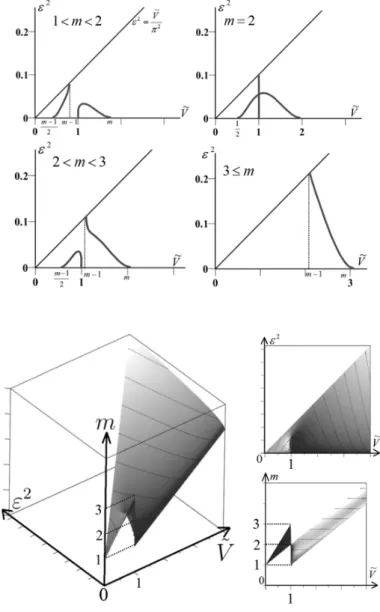
数値計算結果を紹介する.(SLP) の解が存在する点を図示すると図 1 のようになる.分岐
曲線の各点ごとに一つの解が対応している.すべての正数$m$ に対して,(SLP) に対する分
岐曲線の存在・非存在および分岐の様子を数学的に証明することが研究欝的である. まず,
$m( \tilde{V}, r^{2}\vee) :=\int_{0}^{1}W(x;\tilde{V}, \epsilon^{2})dx+\tilde{V}.$
と定義する.$\mathcal{G}$上の$m(\tilde{V},$ $\epsilon$ のグラフを大域的分岐シートとよぶ.図1に大域的分岐シー
ベることはシートの形状と等高線を詳細に調べることに帰着される.しかし従来,大域的分 岐シートを考えることはできても,表示式を求めることは不可能と考えられてきた.
図1: $m$ ごとの分岐曲線と大域的分岐シート.
本研究ではSKosugi, Y.Morita and S.Yotsutani [2] の結果を応用して,大域的分岐シー
トの完全楕円積分を用いた表示式を得ることに成功した ([4]). これに基づき [5] を得た.本 講演では,さらに詳しい解析を行うことにより,数学的証明が極めて困難と思われてきた, (SLP) の分岐曲線の様子に関する次の問題 $\bullet$ すべて $m$ について分岐曲線の存在非存在を決定できるか? $\bullet$ 分岐の方向,接続の様子はわかるか? $\bullet$ 非自明定常解からの分岐点が一意に存在することは証明できるか? $\bullet$ 非自明定常解から分岐した分岐曲線の大域的存在とその行き先はどうなっているか? を解決したことを報告する.具体的に述べると,次の定理を得た.
Theorem 0.2 Let
$1<m<2$
be given. Thefollowing holds:(i) There exists no solution
of
$(SLP)$for
$\tilde{V}\in(0, (m-I)/2$] $\cup[m-1_{i}1]\cup[m, \infty$).$(xi)$ There exists the unique$\epsilon(\tilde{V})\in(o, \sqrt{\tilde{V}}/\prime t()$
such that$W(x\grave{\cdot}\tilde{V}, \epsilon^{2}(\tilde{V}))$ is a solution
of
$(SLP)$
for
$\tilde{V}\in((m-1)/2, m-1)$.
Moreover. $\epsilon(\tilde{V})$is continuous on $[(m-1)/2,$
$?n-1]$ bydefining $\epsilon((m.$$-1)/2)=0,$ $e(m-1)=\sqrt{m-1}/\pi.$
(iii) There exists the unique$e(1^{\sim}j^{\gamma})\in(0, \sqrt{\tilde{V}}/\pi)$ such that $W(x;^{\tilde{y}\sim^{2}}-\vee(\tilde{V}))$ is a solution
of
$(SLP)$for
$\tilde{V}\in(1, m)$. Moreover, $\vee\tau(\tilde{V})$is continuous on $[$1, $m$]. by defining
$\epsilon(1)=0$ $\epsilon(m)=0.$
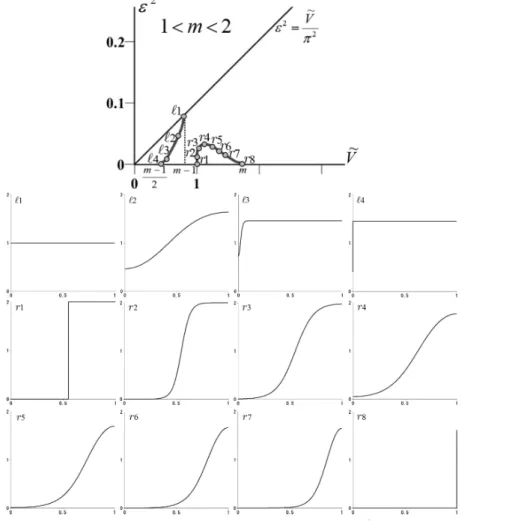
図2に
$1<m<2$
のときのそれぞれの $(\tilde{V}, \epsilon^{2}(V))$ に対応する解$\ddagger\prime V(x;\tilde{V}_{\xi i^{2}}(V))$ の形状を示す.
Theorem 0.3 Let $m=9\sim be$ yiven. The
followinJ
holds:(i) There exists no solution
of
$(SLP)$for
$\tilde{V}\in(0,1/2] U[2, oo)$.(ii) There exists the unique $\epsilon(\overline{V})\in(o, \sqrt{V-}/\pi)$ such that $W(x;\tilde{V}, \epsilon^{2}(\tilde{V}))$
is a solution
of
$(SLP)$for
$\overline{V}\in(1/2_{\backslash ,\prime} 1)$. Moreover, there ex\’ists the unique $\epsilon_{*}=0.23529\cdots$ such
that$\epsilon(\tilde{V})$
is continuous on [1/2, 1] by defining$\hat{c}(1/2)=0,$ $\epsilon(1)=\epsilon_{*}.$
(iii) For $\tilde{V}=1_{\dot{J}}$
there e$\alpha\cdot$\’ists??$,o$ solution
of
$(SLP)$for
$\hat{c}\in[1/\pi, \infty$), and there exists theunique solution $W(x;1, \epsilon^{2})$
of
$(SLP)$for
$\epsilon\in(0,1/\pi)$.(iv) There exists the unique $\epsilon(\tilde{V})\in(o, \sqrt{\tilde{V}}/\pi)$
such that $W(x;\tilde{V}, \epsilon^{2}(\tilde{V}))$
is a solution
of
$(SLP)$for
$\tilde{V}\in(1,2)$. Moreover. $\epsilon(\tilde{V})$is continuous $or\prime_{J}[1$, 2$]$ by defining $\xi j(1)=\vee*\tau,$
$\epsilon(2)=0.$
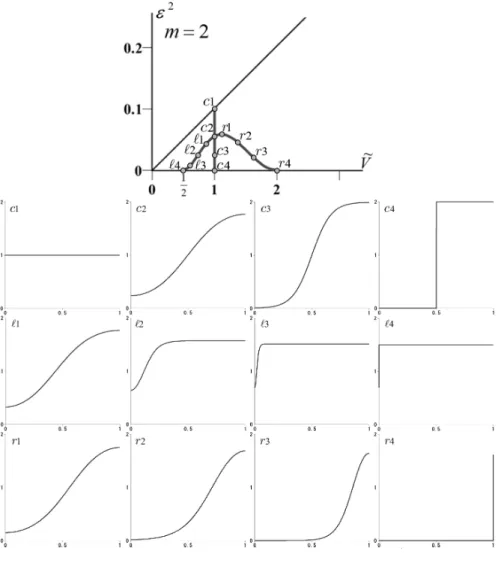
図3に $m=2$ のときのそれぞれの$(V, \hat{\overline{c}}(V))$ に対応する解$W(x;\tilde{V}, \epsilon^{2}(V))$ の形状を示す.
Theorem 0.4 Let
$2<m<3$
be given. The following holds:(i) There exists
no
solutionof
$(6^{Y}LP)$for
$\tilde{V}\in(0_{:}(m-1)/2$]$U[1, m-1]\cup[\prime r\iota$,oo).(ii) There exists the unique$\hat{c}(\tilde{V})\in(o, \sqrt{\tilde{V}}/\tau\})$
such that $W(x;\tilde{V}, e^{2}(\tilde{\mathcal{V}}))$ is a solution
of
$(SLP)$
for
$\tilde{V}\in((m-1)/2_{:} 1)$.
Moreover, $\vee\epsilon(\overline{V})$ is continuous on $[(m-1)/\sim 9, 1]$ bydefining$\hat{c}((m-\lambda)/2)=0_{\tau}\hat{c}(1)=0.$
(iii) There ex.ists the unique$\epsilon(\tilde{V}\rangle\in(O, \backslash \Gamma_{\tilde{V}/}\prime rr)$ such that $W(x;\tilde{V}, \epsilon^{2}(\tilde{V}))$ is a solution
of
$(SLP)$
for
$\tilde{V}\in(m-1, m)$. Moreover, $e(\tilde{V})$ is continuous on$[7?\lambda-\lambda, 7?t]$ by defining$\circ\sigma(m-1)=\sqrt{m-1}/\pi,$ $(m)=0.$
Theorem 0.5 Let $Tt\iota\geq 3$ be $give\gamma\iota$. The following holds:
(i) There exists no solution
of
$(SLP)$$for\tilde{\backslash \gamma}\in(O, 77?-1$]$\cup[7,X\dot{\fbox{Error::0x0000}}$(ii) There exists the unique$\xi j(\tilde{V})\in(0, \sqrt{\tilde{V}}/\pi)$ such that $W(x,\cdot;\tilde{V}, \vee^{\vee}\prime(\hat{V}))\prime$ )
is a solution
of
$(SLP)$for
$\tilde{V}\in(m-1, ;n)$.
Moreover, $\epsilon(\tilde{V})i6^{\backslash }\zeta,\cdot or\iota ti\prime nuous$ on.$[m\cdot-1_{2}m]$ bydefining$\vee\tau(n\dot{\iota}-1)=\sqrt{\gamma/t-1}/\pi,$ $\epsilon(7?|,)=0.$
参考文献
[1] S.Ishihara, M.Otsuji axld A.Mochizuki, Transient and steady state
of
mass-conservedreaction-diffusion
systems, Phys. Rev. E75015203(R) (2007).[2] S. Kosugi. Y. Morita andS. Yotsutani, Stationary solutions to the one-dirn ensional $Cah$ -Hilliard equation:
Proof
by the complete elliptic integrals, Discrete andContin-uous Dynamical Systems 19(2007), 609-629.
[3] K. Kuto$\not\subset\prime\iota nd$T. Ts jikawa,
Bifurcation
$str\tau$xctureof
steady statesfor
bistableequations$with_{\mathfrak{b}}7I$
.
onlocag constraint, Discrete and Continuous Dynaanical Systells Supplement(2013), 467-476.
[4] T. Mori, K. $Kuto_{\backslash }$ T. Tsujikawa, M. Na,gayaz)$a$ and S. Yotsutani, Gtobal
bifurcation
sheet and diagrams
of
wave-pinning in areaction-diffusion
modelfor
cell polarization,Proceedingsof the leth AIMS $conf_{(^{3}}.$
rence
2$014$, toappear.[5] T. Mori, K. Ixuto, T. Tsujikawa, and S. Yotsutani, Exact multiplicity
of
stationarylimitingproblem
of
a cell$polari_{\vee}^{\sim}ation$ model. preprint.[6] Y. Mori, A. Jilkine and L. EdelsteinKeshet, Asymptoticand
bifurcataon
analysisof
wave-pinning ina
reaction-diffusion
modetfor
celt$potari_{\sim}7(x$tion, SIAM $ii$.
Appl. Math$71(2011)$, 1401-1427.
[7] M.$Otsuji_{\backslash }$ S.lshihara. C.Co,et al., A Mass Conserved