NOTE ON STABILITY OF AN SIRS EPIDEMIC MODEL
YUKIHIKO NAKATA
ABSTRACT. Inthis paperwederive ascalardelaydifferentialequationfrom.an
epidemic model with waning immunity. The model is formulated asa system
of delay differential equations. The characteristic equation is computed. We
visualizethestabilitycondition foranendemic equilibrium inatwo-parametcr
plane.
1. INTRODUCTION
In [9] we consider periodicoutbreak ofmycoplasma pneumoniacin Japan. Minor
variation of the immunity period is shown to be essential in order to explain the infectious disease dynamics. Ouragendaincludes mathematical studie$s^{}$ $\{\dot{o}r$periodic
solutions of the mathematical model employed in [9]. This note is
a
prcliminary study for the project. The modelin $|9$] takes theform ofSEIRStype epidemic model with a gamma distribution which thc immunity period follows. In this papcr for mathematical analysis we consider SIRS type epidemic model with fixed immunityperiod (such that the variance of thc immunc period is zero). Let us consider thc following SIRS epidcmic model
(l.la) $\frac{d}{dt}S(t)=-\beta S(t)I(t)+\gamma I(t-\tau)$,
(l.lb) $\frac{d}{dt}I(t)=\beta S(t)I(t)-\gamma I(t)$,
(l.lc) $\frac{d}{dt}R(t)=\gamma I(t)-\gamma I(t-\tau)$,
where the total population is fixed as
(1.2) $S(t)+I(t)+R(t)=1, t\geq-\tau$
and recovered population satisfies
(1.3) $R(t)= \gamma\int_{0}^{ア}I(t-s)ds, t\geq 0.$
Here $S(t)$, $I(t)$ and $R(t)$ respectively denote the fraction of susceptible, infectivc
and recoveredpopulations at time$t$
.
The model has threeparameters: transmissioncoefficient $\beta>0$, the recovery rate $\gamma>0$ and the imrnunc period $\tau>0$. We also
refer the papers [6, 10, 4] for analyses of similar SIRS epidemic znodels. See also
{5]
for detail of compartmental modcl inepidemiology. The model (1.1) appears in the paper $|5$] and we here $revie\backslash v$ thc stability analysis.From (1.2) and (1.3)
we
get$S(t)=1-I(t)- \gamma\int_{0}^{ア}I(t-s)d_{\mathcal{S}}$
then we obtain a scalar delay differential equation:
(1.4) $\frac{d}{dt}I(t)=I(t)\{\beta(1-I(t)-\gamma\prime_{0^{\gamma}}J(t-s)ds)-\gamma\}.$
The basic reproduction number is given as $R_{4}:= \frac{\beta}{\gamma}.$
It is assumed that $R_{0}>1$ holds
so
that (1.4) hasa
positive equilibrium:$I_{e}:= \frac{1-\frac{1}{R_{0}}}{1+\gamma\tau}.$
Remark 1. $\gamma\tau=-\frac{\tau r}{\gamma}$ denotes the fraction of the immunity period
over
the expectedinfectious period, which may be
a
large parameter. Note that$\gamma_{\mathcal{T}>}1rightarrow\tau>\frac{1}{\gamma}$
implies that the immunity period is longer than thc expected infectious period.
We normalize the equation (1.4) defining
$x(t):= \frac{I(t\rangle}{I_{e}}-1$
and $su\})$scqucntly consider the $nondimcnsiol\backslash al$ tinxe $u= \frac{t}{\tau}$. Abusing notation we
finally obtain
$(1.5\rangle$ $\frac{d}{dt}x(t)=-p(x(t)+1)(x(\ell_{j})+\eta\int_{()}^{1}x(t-s)ds)$ ,
where
(1.6a) $p:= \frac{\gamma\tau}{1+\gamma\tau}(R_{\zeta)}-1)\}$
(1.6b) $\eta:=\gamma\tau.$
Initial condition for (1.5) is
$x(\theta)=\psi(\theta)\geq-1, \theta\in[-1, 0],$
excluding $tl\backslash c$ constant function $\psi(\theta)\equiv-1,$ $\theta\in[-1, 0].$
Remark 2. To apply the time transformation
wc
introduce a nondimensional timc $u= \frac{t}{r}$ and define$\tilde{x}(u):=\tilde{x}(\frac{t}{\tau})=x(t)$.
Tlzen olae can
see
$\frac{d}{du}\tilde{x}(u)=\tau\frac{d}{dt}x(t)$ andNOTE ON STABILITY OF AN SIRS EPIDEMIC MODEL
2. STABILITY ANALYSIS
Applying the fluctuation lemma we can obtain a global stability result. There
seems
to beno
other results for global stability. See also the global stabilitycondi-tion by the fluctuacondi-tion lemma in $|7$].
Theorem 3. Let
us assume
that $\eta<1$ holds. Then the trivial equilibriumof
(1.5)is globally attractive.
Proof
Lct us writc$\overline{x}=\lim\sup x(t) , \underline{x}=\lim_{tarrow}\inf_{\infty}x(t)$.
$tarrow\infty$
Consider a sequence such that $x(t_{n})arrow\overline{x}$
as
$narrow\infty$ with $x’(t_{n})\geq 0$.
Thenwe
get $0 \geq x(t_{n})+\eta\int_{0}^{1}x(t_{n}-s)ds.$Taking the limit and estimating the second term ofthe right hand side from below
by $\underline{x}$, we get
$0\geq\overline{x}+\eta\underline{x}.$
Similarly, considering a sequence which tends to $\underline{x}$, we get
$0 \leq x(u_{71})+\eta\int_{0}^{1}x(u_{n}-s)ds.$ Thus $0\leq\underline{x}+\eta\overline{x}.$ Therefore it holds $\overline{x}+\eta\underline{x}\leq 0\leq\underline{x}+\eta\overline{x},$ thus $(\overline{x}-\underline{x})\leq\eta(\overline{x}-\underline{x})$ .
Since $\eta<1$ is assumed, we obtain $\underline{x}=\overline{x}$. It is easy to
see
that $\underline{x}=\overline{x}=0$follows. $\square$
If $\eta<1$ then $t$he trivial equilibrium is shown to be asymptoticaJly stable in thc
following section.
2.1. Linearized stability analysis. To analyze asymptotic stability of thc
triv-ial equilibrium of (1.5) we derive the characteristic equation. The characteristic
equation is computed as
(2.1) $\lambda=-p(1+\eta\int_{0}^{1}e^{-\lambda s}ds) , \lambda\in \mathbb{C}.$
We $al)$alyzc the characteristic equation (2.1) following Chapter XI of $|2$]. See aJso
[3, 1, 8] for analysis of characteristic equationsof dclay equations. One
can
$\sec$ that$\lambda=0$ is a root of (2.1) if$p=0$ holds, where the transcritical bifurcation
occurs
(as$p$ increases). Substituting $\lambda=i\omega,$ $\omega\in \mathbb{R}$ we gct
(2.2) $0=1+ \eta\int_{0}^{1}\cos(\omega s)ds,$
$R\sim om(2.2)$
one
has$\eta=\frac{-1}{\int_{0}^{1}\cos(\omega s)ds}=-\frac{\omega}{\sin\omega}.$
Thcn$p$ is determined from (2.3) as
$p= \frac{\omega}{\eta\int_{0}^{1}\sin(\omega s)ds}=-\frac{\omega\sin\omega}{1-\cos\omega}.$
For $n\in N_{+}$ let
$I_{n} :=((2n+1)\pi, 2(n+1)\pi)$.
Thc parametric curve
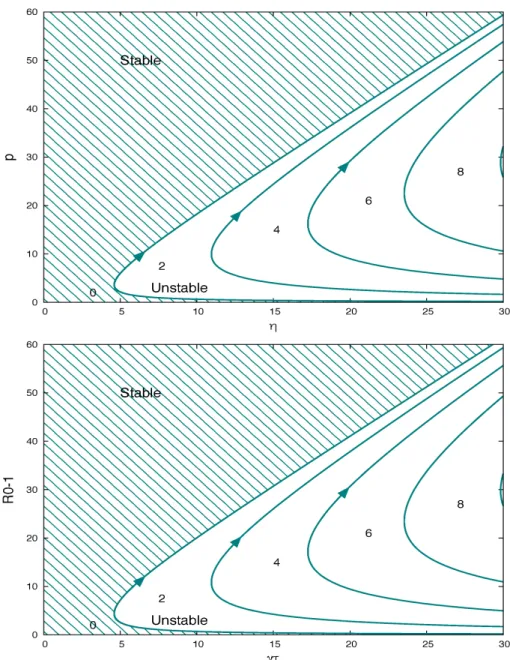
(2.4) $( \eta(\omega), p(\omega))=(-\frac{\omega}{si_{11}\omega}\prime-\frac{\omega si_{12}\omega}{1-\mathfrak{c}\cdot.os\omega}) \omega\epsilon I_{n}.$
depicts the condition whcre the characteristic equation (2.1) has
a
conjugated pairof pul’cly imaginary roots $\lambda=\pm i\omega,$ $\omega\in I_{n}$
.
Onecan
easilysee
that $(\eta(\omega)_{:}p(\omega)\rangle\in \mathbb{R}_{+}^{2}, \omega\in I_{7?}.$The parametric
curve
(2.4) can be trarslated in terms of $R_{0}$ and $\gamma\tau$ using therelation (1.6). Wc get tluc following condition
$R_{0}-1=- \frac{\omega\sin\omega}{1-\cos\omega}(1-\frac{\sin\omega}{\zeta_{4}\}})$ ,
$\gamma\tau=-\frac{\omega}{si_{11}\omega},$
$\backslash \backslash$here the charactcristic equation (2.1) has purely
$i_{1}$naginary roots.
3. $DlSC($jSSION
We here sketch the stability allal$\backslash$/sis ノ for the SIRS epidemic model with delay.
Although the $modc!1$ equation has a simple looking, it exhibits destabilization of
the cndemic equilibrium and has a periodic solutions via Hopf bifurcation. In the paper $|9$] wc discuss a role of the minor variation of thc $i\iota$nxnunity period in thc
periodic cpidclnic cycle sccll in a childhood disease, in particular, for small $R_{0}$. Sce
also $\zeta 8$]. The author study periodicity and uniqucllcss of a periodic solution $oi$
.
thcequation (1.5) in the collaboration with G. Kiss, G. Vas and R. Omori.
Acknowledgment. Thc author $\iota vas$ supported $b$ JSPS Fellows, No.268448 of
Japan Society for the Promotion of Science. A part of $t1_{1}is$ paper is written during
thc stay at thc Bolyai Institute of thc Univcrsity ofSzeged in February 2016. The research visiting was supported by JSPS Bilatcral Joint Rcscarch Project (Open Partnership).
REFERENCES
$|$1} T. Alarc\’o11, Ph. Getto,y. Nakata, Stability analysis of a rcncwalequationfor cell population
dynamics With quicsccnce. SIAM J. Appl. Math. $\sim(4$ (4$\rangle$ pp. 1266-1297 (2014)
[2] $\circ$. Dickmann, S.A. van Gils, S.M.y. Lunel. H.-O. Walthcr, Delay Equations FUnctiona],
Complex and Nonlinear Analysis, Springcr Vcrlag (1991)
$|$3$|$ O. Dickmann, Ph. Getto, y. Nakata, On thc characteristic equation$\lambda=\alpha 1+(\alpha_{2}+\alpha 3\lambda)e^{-\lambda}$
and its use in the context ofa cell population model. J. Math. Bio. 72 (4) pp 877-908 (2016$\rangle$
[4] S. Gongalves, A. Guillermo, M.F.C. Gomcs Oscillations in SIRS model with distributed
dc-lays. TheEuropean Physical Journal $B$-Condensed Mattcr and Complex Systems, 81(3) pp.
NOTE ON STABILITY OF AN SIRS EPIDEMIC MODEL
$\eta$
FIGURE 2.1. Stability boundary of the endemic equilibrium in
$(\eta,$p) planc (above) and in $(\gamma\tau, R_{0}-1)$ plane (below). The number
depicts the number of roots of the characteristic equation in the
right half complex plane. Thc arrows in the curves indicate the
direction ofincreasing $\omega.$
[5] H.W. Hethcotc, H.W. Stech, P. van dcnDriesschc, Nonlinear oscillationsin cpidcmicmodels.
SIAM J. Appl. Math., 40 pp. 1-9 (1981)
[6] Y.N. Kyrychko, K.B. Blyuss, Global properties of a delayed SIR model with temporary
immunity and nonlincar incidence rate. Nonlinear Anal. RWA. 6 pp. 187-204 (2005)
[7]y. Nakata, Y. Enatsu, H. Inaba, ’r. Kuniya, Y. Muroya, Y. Takcuchi, Stability ofepidemic
models with waning immunity. SUT J. Math. 50 (2) 205-245 (2014)
[8] Y. Nakata, R. Omori, Delay equationformulation foran epidemic model with waning
immu-nity: an application to mycoplasma pneumoniae. IFAC-PapersOnLine 48 (1S) pp. 132-135
[9] R. Omori,Y. Nakata, H.L.Tcssmer, S. Suzuki, K. Shibayama,The determinant ofpcriodicity
in Mycoplasma pneumoniae incidence: an insight from mathematical modelling. Scientific
Reports 5: 14473 (2015)
[10] M.L. Taylor, T.W. Carr, An SIR epidemic modc}with partial temporary immunity modeled with delay. J. Math. Bio. 59 (6) pp. S41-S80 (2009)
GRADUATE SCHOOL 0F $MATH\otimes$MATlCAL SCIENCgS, TME $UNlVBRS\ddagger TY$ 0F $ToKYO_{{\}}$ 3-8-1,