Title:
Estimation
for
the prevalence ofsyphilis in
Japan
Yuichiro
Miyamatsul
and HiroshiNishiura1
$|$
Graduate School ofMedicine,The University ofTokyo,[email protected]
Keywords:syphilis, MSM, natural history
Introduction:
Overthe pastdecades. thenotified number ofsyphilis patients iniapan had steadily
decreased,perhapsowingto $pro\searrow\fbox{Error::0x0000}$ision ofantibiotics and improvementin the
manner
ofsexualintercourse
among
prostiUttes. Nevertheless. there has beena
recent increase in syphilisnolificationsespecial
among
MSM $\{mcn$havingsex
with men) in $()rl\backslash a\iota\tau$areas.
$Col\cdot\iota$sideringthat the natural history of syphilis involves long incubatioR period and asymptomatic
infection,all infected int$i$\vee$iduals
are
notcounted bymedical attendance.$3^{{\}}Ise\iota$)$\iota\cdot e\dot{s}et\backslash tec4$ studyaimed to statisticallyestimatetheincidcnce and prevalence ofsyphilis
over
timcand age inJapan.
Methods:
Amathematical model that describes the natural history ofTreponema pallidum
was
devisedto fit the observablevariables toempiricaldata andestimate undiagnosed fractions ofcases.
Estimatingthetime dependentgrowth of infected individuals ineach disease-stageand jointly quantifyingthe time-dependent rateof diagnosis, the incidenceas well
as
$P^{levalence}$of syphilis
are
estimated.Amaximum likelihood methodwas
applied. ushgthe datasets ofnotified $sy$})hilis
cases
from the National Surxei lance Report.Results:
InFigure
1.
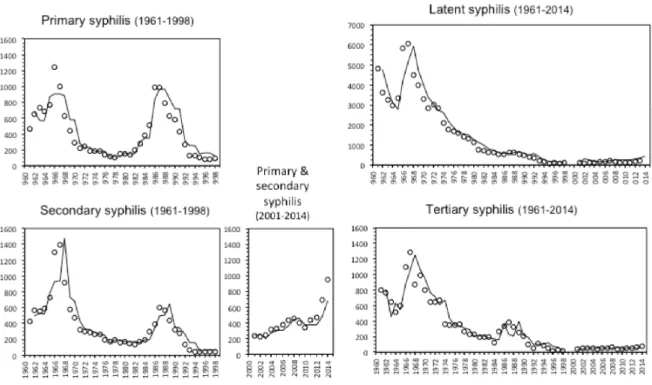
which isthe comparison between observed and expecteddata,we were
abletoobtain the goodness of fit in all stages, despite ofthe factthat primaryand secondarysyphilis
were
combined in the sulveillance data inthe recent $yea\iota\cdot s$after200]. Figure2 shows theyearly incidence
as
newlyinfectedincidences.
lambda. Inthe recentyears,we were
able toestimatethe increase inmale’s incidence.which
can
explainthe recentresurgence. Inaddition.
atthattime,the incidence in female started to $inc\iota\cdot$ease.
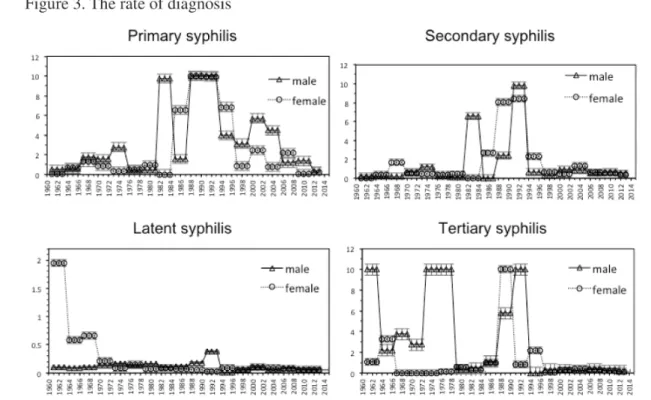
Figure 3 illustratesthe ratesofdiagnosisina114stages.These diagnosticrates increased in $199(\rangle_{3}$
.
mostlikely duetotheAIDS panic, contribntingpeople to testtheirSTIs
more
frequently in clinics. Inthe recent5数理解析研究所講究録
years,
diagnosticratesare
quite low in all stages.Conclusion:
Wehave identified thatdramatic decline in incidence
over
50 years fromover
5000individualsper yearto below
1000
individuals in recentdecades. There has been therecentresurgence.
Themost recent incidencewas
about4000 persons per year.
compal.ableto late$i960s$. Resur
ence
was
notcaused by increasedascertainment in recentyearsFigure 1. Comparison between observed and expecteddata
Figure2. Yearly incidence (lambda)
$\simarrow\prime\overline{s}^{n\emptyset\phi a\prime r\wedge\infty\wedge\sim}\aleph^{\omega’\grave{w}\overline{\infty}\alpha\infty}\underline{\Phi}_{\wedgearrow\simarrow\sim\cdot\sim}Q{\}^{m\wedge\approx_{\underline{\tilde{o}}\underline{\alpha}\alpha}}\underline{{\}}$${\}\overline{\S}$
\S
$\not\in\triangleright$\S $\S_{\overline{\tilde{S}}\tilde{8}}^{\kappa}$
Figure3.?herate ofdiagnosis
Primary syphilis Seoondarysyphilis
Latent syphilis Tert$ary syphilis
Contact:Yuichiro Miyamatsu
Graduate School ofMedicine. $/I^{\neg}he$University $ofTok\rangle$
$7arrow 3arrow t$ Hongo, Bunkyo-ku. Tokyo, 1$13-\zeta t03$
.
JapanTel:$+813$ 58413688Fax:$+813$ 58413637
email:$yy.\cdot C^{2}$