I.はじめに
冠血行再建療法は現代における虚血性心疾患治療の主軸 をなしており,カテーテル治療(PCI)と外科的バイパス術
(CABG)がある.この 2 通りの治療方法については,これ まで複数の無作為比較試験が試行され,その結果いずれの 治療を用いても遠隔期生存率に大きな差はみられないが,
CABG の方が再血行再建や狭心症回避率の点で優れている ことが明らかとなった.しかしながら,個々の患者でいず れの治療を選択するかについては,いまだ議論の絶えない ところである.とりわけ,PCI ではステントの導入から薬 剤溶出性ステント(DES)の出現,CABG では off-pump 手 術の導入と積極的動脈グラフトの使用といずれの治療もそ の発展はまさに日進月歩であり,現況での両治療方法の特 性を正しく把握することは非常に困難でもある.また,糖 尿病患者では,インスリン抵抗性,高血糖,脂質代謝障害 に,血管内皮障害や血小板および凝固異常が加わる糖尿病 患者特有の病態が関与し,治療方針決定のうえでも非糖尿 病患者とは分けて考えるべきとされてきた.ここではこれ まで発表された報告から,糖尿病患者の特異性,PCI と CABG の比較,DES の影響,CABG の現況について検討 を加え,当院での糖尿病患者に対する CABG の治療成績 を総括したい.
II.糖尿病患者にみられる冠動脈疾患の特異性
糖尿病患者の虚血性心疾患罹患率は非糖尿病患者に比べ て 2〜4 倍高いとされており,死亡原因の約半数を占めて いる1).特に心筋梗塞発症や心血管死亡といったハードエ ンドポイントにいたるケースが多いことが特徴的である.
Haffner らの 7 年の自然経過を追った報告2)では,1 年あた りの心筋梗塞発症率は非糖尿病患者が 0.5%/ 年であるのに 比べ糖尿病患者では 3.2%/年であり,心血管死亡率でも非 糖尿病が 0.3%/年であるのに対し糖尿病患者は 2.5%/年と いずれも高率である.冠動脈形態においても糖尿病患者は
特 異 的 で あ り,こ れ ま で に 病 理 解 剖3)な ら び に 血 管 造 影4)を用いた冠動脈形態の検討では,より末梢におよぶ びまん性の動脈硬化病変が指摘されている.Nicholls らに よる IVUS を用いた 2237 例の解析5)でも,糖尿病患者は 非糖尿病患者に比べ,アテローマ容積や血管内腔に閉める アテローマ比率が有意に高く,血管内径が有意に小さいこ とが示されている.これらの検討により糖尿病患者の冠動 脈形態の特徴は,狭小化した血管径,びまん性病変,末梢 病変の 3 点に要約される.つまり,PCI,CABG のいずれ を行うにせよ,これらの特性は,糖尿病患者が非常に治療 の難しい患者群に属していることが示されているに他なら ない.
III.糖尿病患者に対する冠血行再建
(PCIとCABGの比較)
1.PCI vs CABGの現況
糖尿病患者のみを対象にした PCI と CABG を比較した 無作為比較試験は現在進行中であり,いまだ報告はなされ ていない.非糖尿病患者も含んだ虚血性心疾患患者全体の 無作為比較試験のメタ解析の結果6)をみると,一般に遠 隔期生存率(5 年生存率 PCI:90.7%,CABG:89.7%)に差 はなく,狭心症回避率(5 年,PCI:79%,CABG:84%)と 再血行再建施行率(5 年,POBA:46.1%,stent:40.1%,
CABG:9.8%)の点では CABG が有利である.対象をステ ント導入以降の 4 つの無作為比較試験(AWESOME, ERACI II, MASS II, ARTS, SoS)に限定してメタ解析7)を行って も,結果はほぼ同様である.
2.糖尿病患者に対する冠血行再建療法
このような冠血行再建療法における非糖尿病患者も含め た虚血性心疾患症例全般でみられた結果が,糖尿病患者に 対してどの程度当てはまるかについては議論のあるところ である.上記無作為比較試験の多くは対象に糖尿病患者を 含んでいるため,糖尿病患者のみを抽出したサブグループ 解析がいくつかの研究で行われており,その結果を表 1 に 列挙する.多くの試験では遠隔期死亡率は CABG 群の方 が低い傾向にあるが,有意差がみられたのは BARI 試験の みである.また RITA 試験では PCI 治療群の遠隔期死亡率
榊原記念病院心臓血管外科(〒 183-0003 東京都府中市朝日町 3-
16-1)
糖尿病に対する冠血行再建療法
真鍋 晋,高梨秀一郎
Manabe S, Takanashi S: Coronary revascularization in patients with diabetes. J Jpn Coron Assoc 2008; 14: 266-272
が極端に低い結果となったが,これには本試験が対象患者 に 1 枝病変を多く含んでいることが関与していると考えら れる.またこうした糖尿病患者のサブグループ解析のメタ 解析も行われている.ただそれぞれの無作為比較試験の結 果にばらつきが多いため,どの試験を対象にしたかでメタ 解析の結果は大きく異なっている.ステント導入以前に行 われた 3 つの試験(EAST, CABRI, BARI)を統合したメタ 解析では,4 年後のリスク差(2 つの治療方法の間で患者 100 人あたりに生じうるイベント数の差)は 8.6 であり,有 意に CABG が良好であった17).また最新の SOS 試験の遠 隔期成績も含めた 8 つの試験(AWESOME, BARI, EAST, ERACI II, MASS II, RITA, SoS, ARTS)を統合したメタ解 析では遠隔期死亡率は CABG 12.6%,PCI 16.2%で,リス ク差 0.049 とその差は僅差であった7).
3.BARI試験
BARI 試験は,こうした試験の中でも最大規模であり,
糖尿病患者における治療効果の特異性が様々な角度から検 証されている.まず遠隔期成績において,糖尿病患者では CABG 群の生存率が明らかに良好であった(5 年:CABG 80.6% vs PCI 65.5%,p=0.003;7 年:CABG 76.4% vs PCI 55.7%,p=0.0011;10 年:CABG 57.8% vs PCI 45.5%,
p=0.025)11,18,19).また,ここでみられた生存率の差は,ま さに心臓死の発症率の差(CABG 5.8% vs PCI 20.6%)から 生じており,非心臓死の発症率は両群間で全く差がなかっ た(CABG 13.3% vs PCI 14.1%)20).さらに興味深いことに 糖尿病患者における CABG 群の心臓死の軽減は,その多 くが心筋梗塞(MI)発症後の死亡率の軽減効果の結果であ ることも示されている.MI の発症率自体は CABG 群と PCI 群では同等である(8〜9%)が,CABG を一度でも受け たことのある糖尿病患者の MI 発症後死亡率が 17%である のに比べ,CABG を受けていない糖尿病患者では 80%と 高率であった21).また別の報告では,突然死の発症率も CABG を受けたことがある患者では低率であったと報告さ
れている(CABG 2.4%,PCI 3.9%)22).また糖尿病患者の 中でも経口血糖降下薬で治療を受けている群では CABG の優位性が 7 年後になって初めて明らかになるのに比べ て,インスリン治療を受けていた群ではより早期から CABG の生存率の優位性がみられている23).
ではなぜ CABG 群の遠隔期生存率が良好であったの か.その原因について検証を行うと,PCI の再狭窄率は糖 尿病患者では非糖尿病患者に比べて明らかに高いのに対し て,CABG のグラフト開存率は両群で差がみられない(内 胸動脈開存率:糖尿病 89% vs 非糖尿病 85%;大伏在静 脈:糖 尿 病 71% vs 非 糖 尿 病 75%)こ と が 示 さ れ て い る24).その結果,糖尿病患者においては,血行再建した箇 所自体が同等(CABG 3.5 vs PCI 3.4)であっても,遠隔期に 有効に機能している治療箇所は CABG の方が有意に多い
(CABG 87% vs PCI 76%)ことも示されている23).さらに こうした標的病変の再狭窄だけでなく,新規病変の出現も 考慮にいれ,50%以上の狭窄病変にさらされている領域
(jeopardized myocardium)を両群で検討すると,糖尿病 患者では PCI 群の方が CABG 群よりも虚血領域が多かっ たことも報告されている25).また BARI 試験とほぼ同時期 に行われた EAST 試験では遠隔期の血管造影所見から,
有効な血行再建が CABG においてより広い領域で行われ ている(1 年後:CABG 群 88% vs PCI 59%;3 年後:CABG 87% vs PCI 70%)ことが示されている26).つまりこれら の検証から遠隔期死亡率の差は血行再建の成功率の差にほ かならず,糖尿病患者では血行再建の成功の是非が生命予 後に大きく影響しうることが示唆されている.
IV.糖尿病患者への薬剤溶出ステント(DES)の影響
1.DES vs BMS
非糖尿病患者も含めた虚血性心疾患患者全体の結果をみ ると,再狭窄率(BMS 29.3% vs DES 8.9%),標的病変に 対する再血行再建率(BMS 13.2% vs DES 4.2%)について
表1 PCI と CABG を比較した無作為比較試験における糖尿病患者のサブグループ解析の結果
文献 p 値 死亡率
追跡期間 症例数
試験名
CABG PCI
CABG PCI
ステント導入以前
8)
0.09 24.2 6.9 6.5 年
33 29
1993 RITA
9)
0.23 24.5 39.9
8 年 30
29 1994 EAST
10)
NA 12.5
22.6 4 年
60 64
1995 CABRI
11)
0.025 42.2
54.5 10 年
180 173
1996 BARI
ステント導入以降
12)
0.39 8.3 13.4
5 年 96
112 2001 ARTS
13)
0.27 34
26 5 年 79
65 2001 AWESOME
14)
NA 10.2
10.0 5 年
39 39
2001 ERACI II
15)
NA 5.4 17.6
6 年 74
68 2002 SoS
16)
NA 15.3
16.1 5 年
59 56
2004 MASS II
は 大 幅 な 減 少 が み ら れ る も の の,死 亡 率(BMS 0.9%,
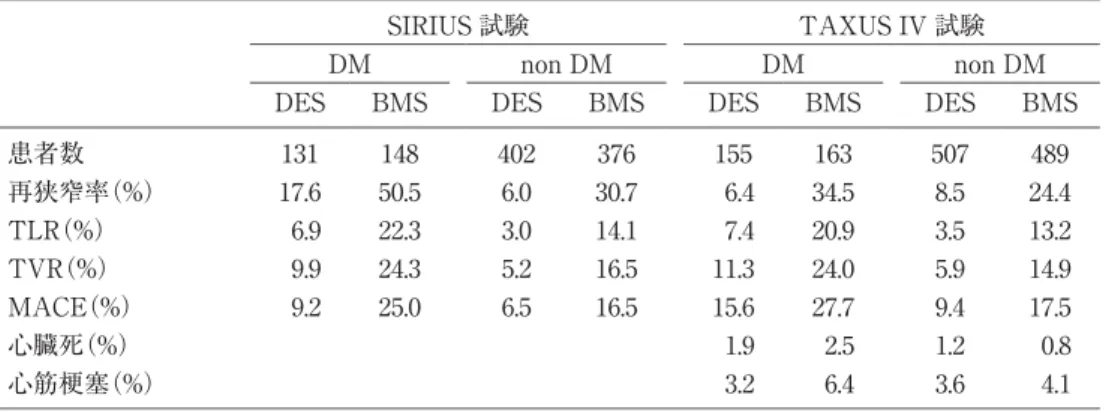
DES 0.9%),心筋梗塞発症率(BMS 2.9%,DES 2.7%)と いったいわゆるハードエンドポイントでは全く差がみられ ないことが無作為比較試験のメタ解析27)の結果から明ら かとなっている.ただ現況ではこうした DES の治療効果 が糖尿病患者においてどの程度再現できるのかは,これま でに糖尿病患者のみを対象にした無作為比較試験の結果が いまだ報告されていないため十分に明らかにされていると はいえない.これまで報告された 2 つの無作為比較試験
(SIRIUS,TAXUS IV)における糖尿病患者のサブグルー プ解析の結果を表 2 に列記する.SIRIUS 試験では BMS に 比 べ DES は 再 狭 窄 率 を 65%,主 要 心 血 管 イ ベ ン ト
(MACE)を 63%軽減しており28),TAXUS IV 試験では再 狭窄率を 81%,MACE を 44%軽減し29),DES は糖尿病患 者においても非糖尿病患者と同等のステント再狭窄予防効 果が得られていることが示されている.さらに TAXUS IV 試験の結果は,糖尿病患者でも心臓死,心筋梗塞発症 といったハードエンドポイントの発症率は DES と BMS の 間で差はみられていないことも示されている.また一方で は,糖尿病患者と非糖尿病患者の間で比較を行うと,再狭 窄,TLR,TVR,MACE といったすべての指標で,DES を用いても糖尿病群の方が依然として高い値であることも 示されている.
2.DES vs CABG
糖尿病患者に対する DES と CABG の比較はこれまで比 較的小規模な retrospective study でしか報告はなされてい ない.Ben-Gal らの報告(n=523)30)では,遠隔期(2 年)狭 心症回避率(DES 47.8% vs CABG 88%,p=0.001),再血行 再建回避率(BMS 83.6% vs CABG 95%,p=0.01)のいずれ においても CABG 群で良好であった.また Briguori らの 報 告(n=218)31)で は,遠 隔 期(1 年)MACE 発 症 率(DES 29% vs CABG 20.5%,p=0.17)で CABG 群が良好であっ た.Ohno らは網膜症を合併した糖尿病症例で検討を行っ た結果,MACE 回避率は CABG 群の方が良好であったと 報告している32).
V.CABGの現況
1.手術リスク(表 3)
最近報告された CABG における糖尿病患者と非糖尿病 患者の手術死亡率ならびに遠隔期生存率の比較を表 3 にま とめる.従来より糖尿病は CABG の手術リスクを増加さ せると報告されてきた.2002 年に報告された STS データ ベースに基づいた大規模(n=146,786)な糖尿病患者と非糖 尿病患者の比較試験34)では,粗死亡率は有意に糖尿病患 者で高く(DM 3.7% vs non DM 2.7%),多変量解析でも オッズ比は 1.23 で有意な危険因子であった.ところが最近
表2 DES と BMS の無作為比較試験(SIRIUS 試験,TAXUS IV 試験)の糖尿病患者のサブグルー
プ解析の結果
TAXUS IV 試験 SIRIUS 試験
non DM DM
non DM DM
BMS DES
BMS DES BMS
DES BMS
DES
489 507 163
155 376
402 148
131 患者数
24.4 8.5
34.5 6.4 30.7
6.0 50.5
17.6
再狭窄率(%)
13.2 3.5
20.9 7.4 14.1
3.0 22.3
6.9 TLR(%)
14.9 5.9
24.0 11.3 16.5
5.2 24.3
9.9 TVR(%)
17.5 9.4
27.7 15.6 16.5
6.5 25.0
9.2 MACE(%)
0.8 1.2
2.5 1.9
心臓死(%)
4.1 3.6
6.4 3.2
心筋梗塞(%)
表3 CABG の糖尿病患者と非糖尿病症例の比較
文献 5 年生存率(%)
多変量解析
入院死亡率(%)
症例数
p value nonDM
DM p value オッズ比
p value nonDM
DM nonDM DM
33)
88 78 0.0001 1.768
<0.0001 1.6
3.9 9920 2278
1999 Thourani
<0.05 34)
1.23 NA
2.7 3.7 105123 41663
2002 Carson
<0.001 35)
91.3 84.4 0.15
1.6 2.6 2239 540
2002 Szabo
36)
0.03 93.9
92.5 0.18
1.4 0.0023
1.9 3.3 2593 767
2003 Calafiore
37)
0.119 94.2
87.7 0.456
1.3 1.4 303 214
2005 Jae-Son
38)
0.57 1.14
0.003 2.0
3.7 5219 814
2005 Kubal
<0.001 39)
91.1 84.4 0.089
1.63 NA
1.0 2.2 4382 877
2006 Rajakaruna
40)
0.19 0.61
0.74 0.9
1.0 3537 1030
2008 Antunes
報告された同様の比較試験の結果では,両群の死亡率の差 は縮まる傾向にあり,特に多変量解析ではほとんどの報告 において,もはや糖尿病は CABG の手術死亡のリスク ファクターではないと報告している.
2.グラフト選択
糖尿病患者の CABG 遠隔期成績の改善にはグラフト選 択が特に重要と思われる.前述の BARI 試験においては,
CABG 群の中で生存率が優れていたのは ITA グラフトを 使用した CABG 群に限られていた(7 年の生存率:ITA 使 用 CABG 群 83.2%,SV 使 用 CABG 群 54.5%,PCI 群 55.5%)19).また Szabo らの単施設の retrospective study 35)
では入院死亡率においても,ITA 使用群の入院死亡率 が良好な傾向がみられた(ITA 2.3% vs no ITA 8.0%,
p=0.13)と 報 告 し て い る.さ ら に は,近 年 で は 片 側 ITA
(SITA)よりも両側内胸動脈(BITA)を使用することでさ らなる遠隔期臨床成績の向上が得られるとも報告されてい る.Calafiore ら は 術 後 8 年 の 生 存 率(BITA 86.2% vs SITA 79.5%,p=0.03),心 臓 死 回 避 率(BITA 96.3% vs SITA 88.4%,p=0.04),心筋梗塞回避率(BITA 99.5% vs SITA 92.0%,p=0.01)いずれも BITA 群が良好であったと 報告している41).Endo らは左室駆出率が 40%以上の比較 的心機能の保持された糖尿病患者に限ると,10 年の生存 率(BITA 87.4% vs SITA 75.2%,p=0.04),再 CABG また は 心 筋 梗 塞 回 避 生 存 率(BITA 86.6% vs SITA 69.0%,
p=0.001)において BITA 群が良好であったと報告してい る42).Lev-Ran ら は 7 年 の 生 存 率(BITA 75% vs SITA 59%,p=0.006)が明らかに BITA 群が良好であったと報
告している43).ただ上記 3 つの報告のうちインスリン治 療を行っている糖尿病患者を一定程度含んでいるのは Calafiore の報告のみであり,残る 2 つの報告は主に内服治 療のみを行っている糖尿病患者が主な対象となっている.
特にインスリン治療を行っている糖尿病患者においては,
BITA の使用は縦隔炎のリスクを増大させるとの懸念から 必ずしも現在でも普及していない.しかしながら,最近で は糖尿病患者に対する BITA の使用は SITA に比べ必ずし も縦隔炎のリスクを増大させないとの報告44-46)が相次い でおり,特に 2 つの報告44,45)ではインスリン使用糖尿病 患者を対象としているが,それでも縦隔炎発症リスクは増 大していない.
3.Off-pump CABG
糖尿病患者における off-pump CABG の有用性について はいまだ十分に解明されていない.Magee らの報告では リスク調整死亡率は差がみられないが(on-pump 2.98% vs off-pump 2.19%,p=0.42),輸血,長期人工呼吸の使用,
透析を要する腎不全を有意に回避できたと報告してい る47).
VI.当院(榊原記念病院)での治療経験
1.基本方針
当院では単独 CABG 症例はすべて off-pump CABG を第 一選択としており,糖尿病患者であっても基本的に方針は 同じである.グラフト選択については,左前下行枝は必ず ITA(通常は LITA)を用い,残る左冠動脈領域(対角枝,
回旋枝領域)で最も重要と思われる枝にもう片方の ITA
表4 患者背景,術式
インスリン治療 内服治療 n=51
n=165 糖尿病全体
n=216 非糖尿病n=319
患者背景
67.1±8.2 67.9±9.0
67.7±8.8 69.5±8.8
平均年齢
64.7%
82.4%
78.2%
82.7%
男性 冠危険因子
80.4%
77.0%
77.8%
71.8%
高血圧
49.0%
66.7%
62.5%
57.1%
高脂血症
39.2%
63.0%
57.4%
54.5%
喫煙歴 術式
15.7%
10.9%
12.0%
13.5%
緊急手術
11.8%
4.8%
6.5%
3.1%
IABP 補助
4.2±1.1 4.2±1.3
4.2±1.2 4.0±1.3
バイパス枝数
51.0%
45.5%
46.8%
34.5%
On-lay patch 使用グラフト
0 0
0 0
内胸動脈不使用
7.8%
10.3%
9.7%
14.7%
片側内胸
92.2%
89.7%
90.3%
85.3%
両側内胸
54.9%
53.9%
54.2%
52.4%
橈骨動脈
15.7%
9.1%
10.6%
14.7%
胃大網動脈
66.7%
60.6%
62.0%
56.7%
大伏在静脈
(通常は RITA)を用いている.左冠動脈領域枝で 2 つの ITA でカバーされない部分には橈骨動脈を用いることを 原則としている.右冠動脈領域は大伏在静脈,または胃大 網動脈(通常は大伏在静脈)を用いている.特に糖尿病患者 で多くみられる LAD 末梢の狭窄性病変があれば,on-lay patch grafting を積極的に行うことでより完全な血行再建 を行っている.こうしたグラフト選択においても,糖尿病 患者であっても基本方針は同じである.
2.治療成績
2004 年 9 月から 2007 年 5 月の間に当院で単独 off-pump CABG を施行した 535 例について検討を行う.なお糖尿病 は食事療法のみ受けている症例を除外し,内服治療または インスリン治療を受けているもののみを対象とした.糖尿 病患者は 216 例で全体の 40.4%を占めていた.患者背景,
術式を表 4 に示す.特に術式では LAD に on-lay patch grafting を要する症例が糖尿病群に多いことが特徴的であ る.また使用グラフトは糖尿病の有無にかかわらず,85〜
90%の症例で両側内胸動脈を使用した.治療成績を表 5 に 示す.死亡率,脳梗塞発症率,縦隔炎のいずれも低率であ り,各群に差はみられなかった.グラフト開存率を表 6 に 示す.いずれのグラフト開存率も各群で差はみられなかっ た.特に LITA-LAD グラフトは 98.8%(167/169)と良好 で,on-lay patch grafting を行った ITA の開存率も 98.8%
(82/83)と良好であった.
VII.結 語
血行再建が比較的難しいとされる糖尿病患者に対して も,PCI,CABG いずれもその治療成績は近年確実に向上 しつつある.PCI における DES の導入は糖尿病患者にお いても再狭窄を飛躍的に軽減しており,CABG においても 糖尿病患者の手術リスクは以前より低下してきている.特 に外科医の立場からは,内胸動脈の開存率が糖尿病患者に おいても非常に良好であり,内胸動脈をいかに有効に活用 するかが治療戦略上特に重要と思われる.当院では両側内 胸動脈の使用に加え,糖尿病患者に多くみられる左前下行 枝のびまん性や末梢性の狭窄病変に対して,積極的に ITA を用いた on-lay patch grafting を行い,これまでのと ころ開存率を含めた術後成績は良好である.現在のところ PCI,CABG のいずれもこうした new modalities の遠隔 期成績は未知であり,今後さらなる治療経過の観察が必要 と思われる.
文 献
1) Flaherty JD, Davidson CJ: Diabetes and coronary revascu- larization. JAMA 2005; 293: 1501-1508
2) Haffner Sm, Lehto S, Ronnemaa T, Pyorala K, Laasko M:
Mortality for coronary heart disease in subjects with type 2 diabetes and non-daibetic subjects with and without prior myocardial infarction. N Engl J Med 1998; 339: 229-
表5 治療成績
インスリン治療 内服治療 n=51
n=165 糖尿病全体
n=216 非糖尿病n=319
2.0%(1)
0%
0.4%(1)
1.9%(6)
入院死亡
2.0%(1)
1.2%(2)
1.4%(3)
0.6%(2)
周術期脳梗塞
2.0%(1)
2.4%(4)
2.3%(5)
1.2%(4)
縦隔炎
表6 グラフト開存率
インスリン治療 n=51 内服治療
n=165 糖尿病全体
n=216 非糖尿病
n=319 直後
35/36 97.2%
132/133 99.2%
167/169 98.8%
250/256 97.7%
左内胸動脈
28/28 100%
118/119 99.2%
146/147 99.3%
215/216 99.5%
右内胸動脈
19/20 95.0%
69/71 97.2%
88/91 96.7%
141/135 95.7%
橈骨動脈
4/4 100%
12/12 100%
16/16 100%
46/46 100%
胃大網動脈
24/24 100%
77/84 91.7%
101/108 93.5%
138/133 96.4%
大伏在静脈 1 年後
23/24 95.8%
87/88 98.9%
110/112 98.2%
154/158 97.5%
左内胸動脈
21/21 100%
73/77 94.8%
94/98 95.9%
117/129 90.7%
右内胸動脈
10/13 76.9%
43/52 82.7%
53/65 81.5%
63/88 71.6%
橈骨動脈
1/2 50.0%
8/9 88.9%
9/11 81.8%
16/19 84.2%
胃大網動脈
11/14 78.6%
42/53 79.2%
53/67 79.1%
78/88 88.6%
大伏在静脈
234
3) Goraya TY, Leibson CL, Palumbo PJ, Weston SA, Killian JM, Pfeifer EA, Jacobsen SJ, Frye RL, Roger VL: coronary atherosclerosis in diabetes mellitus: a population-based autopsy study. J Am Coll Cardiol 2002; 40: 946-953 4) Ledru F, Ducimetière P, Battaglia S, Courbon D, Beverelli
F, Guize L, Guermonprez JL, Diébold B: New diagnostic criteria for diabetes and coronary artery disease: insights from an angiographic study. J Am Coll Cardiol 2001; 37:
1543-1550
5) Nicholls SJ, Tuzcu EM, Kalidindi S, Wolski K, Moon KW, Sipahi I, Schoenhagen P, Nissen SE: Effect of diabetes on progression of coronary atherosclerosis and arterial remodeling. J Am Coll Cardiol 2008; 52: 255-262
6) Bravata DM, Gienger AL, Mcdonald KM, Sundaram V, Perez MV, Varghese R, Kapoor JR, Ardehali R, Owens DK, Hlatky MA: Systematic review: the comparative effec- tiveness of percutaneous coronary interventions and coro- nary artery bypass graft surgery. Ann Intern Med 2007;
147: 703-716
7) Hlatky MA, Bravata DM: Stents or surgery? New data on the comparative outcomes of percutaneous coronary inter- vention and coronary artery bypass graft surgery. Circula- tion 2008; 118: 325-327
8) Henderson RA, Pocock SJ, Sharp SJ, Nanchahal K, Scul- pher MJ, Buxton MJ, Hampton JR: Long-term results of RITA-1 trial: clinical and cost comparisons of coronary angioplasty and coronary-artery bypass grafting. Random- ized Intervention Treatment of Angina. Lancet 1998; 352:
1419-1425
9) King SB III, Kosinski AS, Guyton RA, Lembo NJ, Wein- traub WS: Eight-year mortality in the Emory Angioplasty versus Surgery Trial (EAST). J Am Coll Cardiol 2000; 35:
1116-1121
10) Kurbaan AS, Bowker TJ, Ilsley CD, Sigwart U, Rickards AF: on behlf of the CABRI Investigators (Coro- nary Angioplasty versus Bypass Revascularization Investigation): Difference in the mortality of the CABRI diabetic and nondiabetic populations and its relation to coronary artery disease and the revascularization mode.
Am J Cardiol 2001; 87: 947-950
11) The BARI Investigators: The final 10-year follow-up results from the BARI randomized trial. J Am Coll Cardiol 2007; 49: 1600-1606
12) Serruys PW, Ong AT, van Herwerden LA, Sousa JE, Jatene A, Bonnier JJ, Schönberger JP, Buller N, Bonser R, Disco C, Backx B, Hugenholtz PG, Firth BG, Unger F: Five- year outcomes after coronary stenting versus bypass sur- gery for the treatment of multivessel disease: the final analysis of the Arterial Revascularization Therapies Study (ARTS) randomized trial. J Am Coll Cardiol 2005;
46: 575-581
13) Sedils SP, Morrison DA, Lorin JD, Esposito R, Sethi G, Sacks J, Henderson W, Grover F, Ramanathan KB, Wei- man D, Saucedo J, Antakli T, Paramesh V, Pett S, Vernon S, Birjiniuk V, Welt F, Krucoff M, Wolfe W, Lucke JC, Mediratta S, Booth D, Murphy E, Ward H, Miller L, Kiesz S, Barbiere C, Lewis D; Investigators of the Dept. of Veter- ans Affairs Cooperative Study #385, the Angina With Extremely Serious Operative Mortality Evaluation
(AWESOME): Percutaneous coronary intervention ver-
sus coronary bypass graft surgery for diabetic patients with unstable angina and risk factors for adverse out- comes with bypass: outcome of diabetic patients in the AWESOME randomized trial and registry. J Am Coll Car- diol 2002; 40: 1555-1566
14) Rodriguez AE, Baldi J, Fernández Pereira C, Navia J, Rodriguez Alemparte M, Delacasa A, Vigo F, Vogel D, O’Neill W, Palacios IF; ERACI II Investigators: Five-year follow-up of the Argentine randomized trial of coronary angioplasty with stenting versus coronary bypass sur- gery in patients with multiple vessel disease (ERACI II). J Am Coll Cardiol 2005; 46: 582-588
15) Booth J, Clayton T, Pepper J, Nugara F, Flather M, Sig- wart U, Stables RH; SoS Investigators: Randomized, con- trolled trial of coronary artery bypass surgery versus per- cutaneous coronary intervention in patients with multives- sel coronary artery disease: six-year follow-up from the Stent or Surgery trial (SOS). Circulation 2008; 118: 381- 388
16) Soares PR, Hueb WA, Lemos PA, Lopes N, Martinez EE, Cesar LA, Oliveira SA, Ramires JA: Coronary revasculari- zation (surgical or percutaneous) decreases mortality after the frist year in diabetic subjects but not in nondia- betic subjects with multivessel disease: an analysis from the Medicine, Angioplasty, or Surgery Study (MASS II). Circulation 2006; 114: I420-I424
17) Hoffman SN, TenBrook JA, Wolf MP, Pauker SG, Salem DN, Wong JB: A meta-analysis of randomized controlled trials comparing coronary artery bypass graft with percu- taneous transluminal coronary angioplasty: one-to eight- year outcomes. J Am Coll Cardiol 2003; 41: 1293-1304 18) The Bypass Angioplasty Revascularization Investigation
(BARI)Investigators: Comparison of coronary bypass sur- gery with angioplasty in patients with multivessel disease. N Engl J Med 1996; 335: 217-225
19) The BARI Investigators: Seven year outcome in the Bypass Angioplasty Revascularization Investigation
(BARI) by treatment and diabetic status. J Am Coll Car- diol 2000; 35: 1122-1129
20) The BARI Investigators: Influence of diabetes on 5-year mortality and morbidity in a randomized trial comparing CABG and PCI in patients with multivessel disease: the Bypass Angioplasty Revascularization Investigation
(BARI). Circulation 1997; 96: 1761-1769
21) Detre KM, Lombardero MS, Brooks MM, Hardison RM, Holubkov R, Sopko G, Frye RL, Chaitman BR: The effect of previous coronary-artery bypass surgery on the prog- nosis of patients with diabetes who have acute myocardial infarction Bypass Angioplasty Revascularization Investi- gation Investigators. N Engl J Med 2000; 342: 989-997 22) Holmes DR Jr., Kim LJ, Brooks MM, Kip KE, Schaff HV,
Detre KM, Frye RL; Bypass Angioplasty Revasculariza- tion Investigation (BARI) Investigators: The effect of coronary artery bypass grafting on specific causes of long- term mortality in the Bypass Angioplasty Revasculariza- tion Investigation. J Thorac Cardiovasc Surg 2007; 134:
38-46
23) Detre KM, Guo P, Holubkov R, Califf RM, Sopko G, Bach R, Brooks MM, Bourassa MG, Shemin RJ, Rosen AD, Krone RJ, Frye RL, Feit F: Coronary revascularization in dia- betic patients: a comparison of the randomized and obser-
vational components of the Bypass Angioplasty Revascu- larization Investigation (BARI). Circulation 1999; 99: 633- 640
24) Sckwartz L, Kip KE, Frye RL, Alderman EL, Schaff HV, Detre KM; Bypass Angioplasty Revascularization Investigation: Coronary bypass graft patency in patients with diabetes in the Bypass Angioplasty Revasculariza- tion Investigation (BARI). Circulation 2002; 106: 2652- 2658
25) Kip KE, Alderman EL, Bourassa MG, Brooks MM, Schwartz L, Holmes DR Jr, Califf RM, Whitlow PL, Chait- man BR, Detre KM: Differential influence of diabetes melli- tus on increased jeopardized myocardium after initial angioplasty or bypass surgery: bypass angioplasty revas- cularization investigation. Circulation 2002; 105: 1914-1920 26) Zhao XQ, Brown BG, Stewart DK, Hillger LA, Barnhart
HX, Kosinski AS, Weintraub WS, King SB 3rd: Effective- ness of revascularization in the Emory angioplasty versus surgery trial: A randomized comparison of coronary angio- plasty with bypass surgery. Circulation 1996; 93: 1954- 1962
27) Babapulle MN, Joseph L, Bélisle P, Brophy JM, Eisenberg MJ: A hierarchical Bayesian meta-analysis of randomized clinical trials of drug-eluting stents. Lancet 2004; 364: 583- 591
28) Moussa I, Leon MB, Baim DS, O’Neill WW, Popma JJ, Buchbinder M, Midwall J, Simonton CA, Keim E, Wang P, Kuntz RE, Moses JW: Impact of sirolimus-eluting stents on outcome in diabetic patients: a SIRIUS (SIRolimus- coated BX Velocity balloon-expandable stent in the treat- ment of patients with de novo coronary artery lesions)
substudy. Circulation 2004; 109: 2273-2278
29) Hermiller JB, Raizner A, Cannon L, Gurbel PA, Kutcher MA, Wong SC, Russell ME, Ellis SG, Mehran R, Stone GW;
TAXUS-IV Investigators: Outcomes with the polymer- based paclitaxel-eluting TAXUS stent in patients with dia- betes mellitus. The TAXUS-IV trial. J Am Coll Cardiol 2005; 45: 1172-1179
30) Ben-Gal Y, Mohr R, Uretzky G, Medalion B, Hendler A, Hansson N, Herz I, Moshkovitz Y: Drug-eluting stents ver- sus arterial myocardial revascularization in patients with diabetes mellitus. J Thorac Cardiovasc Surg 2006; 132:
861-866
31) Briguori C, Condorelli G, Airoldi F, Focaccio A, D’Andrea D, Cannavale M, Abarghouei AA, Giordano S, De Vivo F, Ricciardelli B, Colombo A: Comparison of coronary drug- eluting stents versus coronary artery bypass grafting in patients with diabetes mellitus. Am J Cardiol 2007; 99:
779-784
32) Ohno T, Takamoto S, Motomura N, Ono M, Ando J, Morita T, Fujita H, Hirata Y, Nagai R, Shigeeda T, Hirose A: Coronary artery bypass grafting versus coronary implantation of sirolimus-eluting stents in patients with diabetic retinopathy. Ann Thorac Surg 2007; 84: 1474- 1478
33) Thourani VH, Weintraub WS, Stein B, Gebhart SS, Craver JM, Jones EL, Guyton RA: Influence of diabetes mellitus on early and late outcome after coronary artery bypass grafting. Ann Thorac Surg 1999; 67: 1045-1052
34) Carson JL, Scholz PM, Chen AY, Peterson ED, Gold J, Schneider SH: Diabetes mellitus increases short-term mor-
tality and morbidity in patients undergoing coronary artery bypass graft surgery. J Am Coll Cardiol 2002; 40:
418-423
35) Szabo Z, Hakanson E, Svedjeholm R: Early postoperative outcome and medium-term survival in 540 diabetic and 2239 nondiabetic patients undergoing coronary artery bypass grafting. Ann Thorac Surg 2002; 74: 712-719 36) Calafiore AM, Di Mauro M, Di Giammarco G, Contini M,
Vitolla G, Iacò AL, Canosa C, D’Alessandro S: Effect of dia- betes on early and late survival after isolated first coro- nary bypass surgery in multivessel disease. J Thorac Car- diovasc Surg 2003; 125: 144-154
37) Choi JS, Cho KR, Kim KB: Does diabetes affect the postop- erative outcomes after total arterial off-pump coronary bypass surgery in multivessel disease? Ann Thorac Surg 2005; 80: 1353-1361
38) Kubal C, Srinivasan AK, Grayson AD, Fabri BM, Chalmers JA: Effect of risk-adusted diabetes on mortality and morbidity after coronary artery bypass surgery. Ann Thorac Surg 2005; 79: 1570-1576
39) Rajakaruna C, Rogers CA, Suranimala C, Angelini GD, Ascione R: The effect of diabetes mellitus on patients undergoing coronary surgery: a risk adjusted analysis. J Thorac Cardiovasc Surg 2006; 132: 802-810
40) Antunes PE, Oliveria JF, Antunes MJ: Coronary surgery in patients with diabetes mellitus: a risk-adjusted study on early outcome. Eur J Cardiothorac Surg 2008; 34: 370-375 41) Calafiore AM, Di Mauro M, Di Giammarco G, Teodori G,
Iacò AL, Mazzei V, Vitolla G, Contini M: Single versus bilateral internal mammary artery for isolated first myo- cardial revascularization in multivessel disease: long-term clinical results in medically treated diabetic patients. Ann Thorac Surg 2005; 80: 888-895
42) Endo M, Tomizawa Y, Nishida H: Bilateral versus unilat- eral internal mammary revascularization in patients with diabetes. Circulation 2003; 108: 1343-1349
43) Lev-Ran O, Braunstein R, Nehser N, Ben-Gal Y, Bolotin G, Uretzky G: Bilateral versus single internal thoracic artery grafting in oral-treated diabetic subsets: comparative seven-year outcome analysis. Ann Thorac Surg 2004; 77:
2039-2045
44) Kai M, Hanyu M, Soga Y, Nomoto T, Nakano J, Matsuo T, Umehara E, Kawato M, Okabayashi H: Off-pump coronary artery bypass grafting with skeletonized bilateral internal thoracic arteries in insulin-dependent diabetics. Ann Tho- rac Surg 2007; 84: 32-36
45) Momin AU, Deshpande R, Potts J, El-Gamel A, Marrinan MT, Omigie J, Desai JB: Incidence of sternal infection in diabetic patients undergoing bilateral internal thoracic artery grafting. Ann Thorac Surg 2005; 80: 1765-1772 46) Peterson MD, Borger MA, Rao V, Peniston CM, Feindel
CM: Skeletonization of bilateral internal thoracic artery grafts lowers the risk of sternal infection in patients with diabetes. J Thorac Cardiovasc Surg 2003; 126: 1314-1319 47) Magee MJ, Dewey TM, Acuff T, Edgerton JR, Hebeler JF,
Prince SL, Mack MJ: Influence of diabetes on mortality and morbidity: off-pump coronary artery bypass grafting versus coronary artery bypass grafting with cardiopul- monary bypass. Ann Thorac Surg 2001; 72: 776-780; dis- cussion 780-781