Japanese ODA to Asian Countries
“An Empirical Study of Myanmar Compared with Cambodia, Laos, and Vietnam”
Nam Pan Visiting Scholar Policy Research Institute Ministry of Finance, Japan
TABLE OF CONTENTS
Abstract………..i
List of Figures………..iii
List of Tables………iv
1. Introduction………1
2. General Overview of Japanese ODA 2.1 Historical Overview………..4
2.2 The Japanese ODA Charter………..5
2.3 Recent Trends of Japanese ODA………..7
3. Japanese ODA to Asian Countries 3.1 Asia as a priority region ……….12
3.2 Japan’s Interest to ASEAN ……….14
3.3 Contribution to East Asian Dynamism………15
4. Japanese Bilateral ODA to Cambodia, Laos, Myanmar and Vietnam (CLMV Countries) 4.1 Cambodia 4.1.1 Initial Conditions and Framework of Reforms ………17
4.1.2 Japan’s Country Assistance Strategy for Cambodia ………...17
4.2 Lao PDR 4.2.1 Initial Conditions ……….………19
4.2.2 Japan’s Country Assistance Strategy for Lao PDR .………....19
4.3 Myanmar 4.3.1 Initial Conditions ……….20
4.3.2 Japan’s Country Assistance Strategy for Myanmar………21
4.4 Vietnam 4.4.1 Initial Conditions and Framework of Reforms………..22
4.4.2 Japan’s Country Assistance Strategy for Vietnam ………22
4.5 Macro-economy in CLMV …………..………..24
4.5.1 Real GDP Growth………...24
4.5.2 Current Account Balance ………..24
4.5.3 FDI ………25
5. A Pivotal Moment of Myanmar 5.1 Recent Reforms ………..27
5.2 Japan’s New Commitment Aid ………..28
5.3 Tangible Support of International Communities………29
5.4 Recent Challenges ………..31
6. Findings ……….35
6.1 Earnest Efforts of Recipient ..………37
6.2 Coordination among Donors and Recipient ..………...38
6.3 Successful Strategies of Donors .………..38
6.4 Discussion ………….……….39
7. Recommendation and Conclusion ..………42 References
Abstract
A major part of Japanese ODA has been extended to Asian countries as mentioned in the ODA Charter. Japanese ODA focus on East Asia is a natural outcome of its geographical, social and economic interest. For the developing countries, with low level of domestic saving, ODA represent the main source of finance.
This paper attempts to an empirical study on Japanese bilateral ODA to Myanmar comparing with Cambodia, Laos and Vietnam.
The CLMV countries, members of ASEAN and which located in Mekong region, are more low income countries than that of other ASEAN member states, however, have high potential to achieve their sustainable development. Japan adopts it assistance policy for those countries (except for Myanmar at present) and ranks the top donor in those countries.
Among CLMV countries, Myanmar has long been the region’s lowest recipient of Japanese bilateral ODA as well as overseas aid since 1988, after military regime sized power in Myanmar. Since then, donors and international organizations cut off ODA to Myanmar. In line with other donors Japan also cut off its ODA Loan aid though it has continued to funds for humanitarian purposes by grant aid and technical cooperation. This paper also stresses imposing sanction and cutting aid on Myanmar’s military rule systematically further worsened to Myanmar’s economy and the livelihoods of its citizens as well.
After 20 years of economic isolation and consequent economic stagnation, Myanmar government has formulated an ambitious economic, political, and governance reform program.
The transition from authoritarian to a democratic regime had led to the relaxation of sanctions.
Most of the international communities and foreign nations have lifted sanction against Myanmar to support its reforms. In 2012, Myanmar became the top recipient of Japanese bilateral ODA among ASEAN at the first time since 1988.
Here, Japan’s assistance by reviewing its assistance policy for Myanmar is the most significant effort among all DAC countries. Japan is Myanmar’s largest creditor as accounted for about ¾ of Myanmar external arrears. Japan had provided a bridge loan to resolve its arrears, and also helped a bridge financing operation by borrowing about US$900 million that enable Myanmar government to pay off the past loan from the World Bank and the ADB.
This paper also discusses the need of strategies to be effective and efficient use of aid for Myanmar which has been now re-engaging of international organizations and aid agencies.
Because of all donors, especially Japanese government make earnest effort and dedication on Myanmar’s reforms and development, some strategies for receiving foreign aid will be needed on Myanmar side.
Aid will not be worked alone and needs to interact with good policy and good institutions, this paper also recommend Myanmar for building a knowledge age for human resource development, to design attractive incentive system for well-trained technicians (human resource management), and strongly convinced in the necessity of receiving of grant and aid.
As we understood that foreign aid should be seen only as a supplement to the recipient’s owned effort, we should not take loans and even grants while we can do through our owned resources and only take assistance for big infrastructure projects. As Japanese ODA always based on the recipient government’s request, the government needs to consider about which the
most priority area is, what the advantages and disadvantages are, and how much the cost will be, etc. Otherwise, money borrowed today by the government will become tomorrow financial burden for the government as well as debt for its people.
In order to avoid highly dependent on aid, it is important to give priority attention to the matter of strengthening owned capacities under strong economic policies with effective implementation and monitoring activities in the country. With its highly potential of resources and ambitious reforms, Myanmar is likely to achieve MDGs and graduate from the LDCs index in near future.
List of Figures
Page
Figure 1 Japan’s ODA Disbursement (1993-2012) 7
Figure 2 The ratio of Japan’s ODA disbursement by sector (2011) 7 Figure 3 Sector Distribution of Bilateral ODA by Major DAC Countries (2011) 8 Figure 4 Japanese Bilateral ODA by Region in 2012 ( Share % ) 12 Figure 5 Share Percentage of Japanese Bilateral ODA by Region 13
Figure 6 Japan’s ODA Disbursements to CMLV 26
Figure 7 Myanmar’s External Arrears by Creditors (2012) 30
Figure 8 Ease of Doing Business (Myanmar) 33
Figure 9 Myanmar’s Expenditure in Health and Education (as % of GDP) 33 Figure 10 Myanmar’s Expenditure in Health, Education and Defense (as % of total
expenditure)
33
Figure 11 Net ODA Received of CLMV Countries (1980-2012) 34 Figure 12 Good Governance Process for Myanmar (to attract more aid by using aid
effectively and efficiently)
41
Figure 13 Mutual relationship between Aid, Good Governance and Human Resources
41
List of Tables
Page
Table 1 Sector Distribution of Bilateral ODA by Major DAC Countries (2011) 8 Table 2 Japan's Contributions to Multilateral Institutions by Major Donor
Countries 9
Table 3 Japanese ODA disbursement to ASEAN by fiscal year 15 Table 4 Amount of DAC Countries ODA Disbursement to Cambodia 18
Table 5 Japan’s ODA Disbursements to Cambodia 19
Table 6 Amount of DAC Countries ODA Disbursement to Laos 20
Table 7 Japan’s ODA Disbursements to Laos 20
Figure 8 Amount of DAC Countries ODA Disbursement to Myanmar 21
Table 9 Japan’s ODA Disbursements to Myanmar 22
Table 10 Amount of DAC Countries ODA Disbursement to Vietnam 23
Table 11 Japan’s ODA Disbursements to Vietnam 23
Table 12 Japan’s ODA Disbursements to CMLV 26
Table 13 Key Indicators for CLMV 26
Table 14 Myanmar’s External Arrears by Creditors (2012) 29
Table 15 Myanmar’s External Sector Indicators 31
Table 16 ASEAN Members by Human Development Index (2011 and 2013) 32 Table 17 Ease of Doing Business Rankings 2014 (out of 189 countries) 32
1. Introduction
This paper comprises the Japanese Official Development Assistance (ODA) to Asian countries and an empirical study on Japanese bilateral ODA to Myanmar comparing with Cambodia, Laos and Vietnam. Japanese ODA has several noticeable features that differ from that of other countries. Japan began allocating aid to Southeast Asian nations in 1954. When the Japanese government joined the club of foreign aid donors by participating in the Colombo Plan in 1954 Japan was recovering from the destruction of World War II and was itself borrowing from the World Bank. In 1958, Japan disbursed the first Yen loan to India and began its standard ODA.
In 1989, Japan became the world’s largest aid donor and held that position until 2001. It has been now one of the world’s top ten donors. The ODA Charter adopted by the government of Japan declares historically, geographically, politically, and economically, Asia is a region close to Japan. As mentioned in the Charter, most of Japanese aid has gone to Asia.
Throughout its formative stages, Japan was facing with arguments and criticisms. On the other hand, Japan has been involving experiences that transformed Japanese perspectives towards ODA. The Japanese government began to implement foreign aid policy that would establish Japan as a major “soft power”, initiating to accumulate and consolidate development experiences of East Asian countries and to create a basis for trade and investment promotion.
Besides focusing on soft power, Japan has shown maturation as an aid donor through its strengthening relationship with Asian countries, its major aid recipients. Then, in 2000, many Asian countries have been graduating from Japanese foreign aid, particularly its yen loans. Thus, the effectiveness of its contribution depends on its ability to articulate foreign aid policy seem in the right direction.
In particular, the East Asian region which includes Association of Southeast Asian Nations (ASEAN) has been making efforts to enhance its regional competitiveness by maintaining economic growth and strengthening integration. Since 1970s, Japan has a range of interest in ASEAN and its member countries. In the first place, it has become deeply involved in ASEAN in both trade and investment.
Today, the ASEAN region has a population of approximately 600 million people and has grown to become a massive market with a GDP totaling over US$2 billion. Japanese ODA has functioned effectively as “investment in the future” for both ASEAN member states and Japan, and supported the development and prosperity of Japan and ASEAN member states.
In 2012, East Asian region, which includes ASEAN, as a region received more aid than did South Asia. One Southeast Asian country, Vietnam, was listed as the top Japanese aid recipient from 2009 to 2011. In 2012, as the first time when refraining from providing large- scale official development assistance in the form of yen-denominated loan since 1988, Myanmar became the top Japanese aid recipient country among ASEAN, followed by Vietnam. For the same year, other Southeast Asian countries, Philippines ranked third after Vietnam and Indonesia, Thailand and Cambodia were the 4th, 5th and 6th largest recipients respectively.
Moreover, Japan offers its full support for ASEAN’s efforts for strengthening ASEAN connectivity assisting such projects which comprises the Southern Economic Corridor and East-
West Economic Corridor and connects the major economic centers of Mekong region. It is one of the Japan’s support and Priority Projects in the Master Plan on ASEAN Connectivity.
For the developing countries, with low level of domestic saving, ODA represent the main source of finance. Japan’s support for the Mekong countries, such as Cambodia, Laos, Myanmar, Thailand and Vietnam, which include more low income countries than the other areas of ASEAN, is important for reducing intraregional disparities as well.
The CLMV countries, member of ASEAN and which located in Mekong region, are more low income countries than that of other ASEAN member states, however, have high potential to achieve their sustainable development. Japan adopts it assistance policy for those countries (except for Myanmar at present) and ranks the top donor.
Among CLMV countries, Myanmar has long been the region’s lowest recipient of Japanese bilateral ODA as well as overseas aid since 1988, after military regime sized power in Myanmar. Since then, donors and international organizations cut off ODA to Myanmar. In line with other donors Japan also cut off its ODA Loan aid though it has continued to funds for humanitarian purposes by grant aid and technical cooperation. Moreover, in 1989, remained under house arrest of Daw Aung Sun Suu Kyi1, the West imposed sanction to Myanmar.
Imposing sanction and cutting aid on Myanmar’s military rule further worsened to Myanmar’s economy and its citizens.
Actually, among CLMV countries, Myanmar and Vietnam started the reform at nearly the same time in 1988 and 1986, and were economically similar in many ways. However, two decades from then, Myanmar is still in the status of lowest recipient of aid and poorest in the region with low social and economic indicators. Vietnam with sound management and continuous reforms get more aid and achieve more growth potential than the other countries in the region. Thus, it can also be said that, aid and growth need good policies, which lead country’s rapid development.
After 20 years of economic isolation and consequent economic stagnation, Myanmar government has formulated an ambitious economic, political, and governance reform program.
The transition from authoritarian to a democratic regime had led to the relaxation of sanctions.
Most of the international communities and foreign nations have lifted sanctions against Myanmar to support its reforms.
Here, Japan’s assistance is the most significant among that of the other donors. Myanmar has debt arrears with Japan and other donors and cannot make repayment on its loan around 1987. In April 2012, Myanmar agreed with Japan, its largest creditor, on a debt restructuring plan to resolve its arrears through a bridge loan. Under the context of the Paris Club framework, Japan cancelled arrears due after 2003 and principal and interest arrears on pre-2003 payments due were reschedule on very concessional terms. In January 2013, Japan has also provided Myanmar with a bridge loan operation that enables the government to pay off the past loans from the World Bank and the ADB. These bridge loans intend to promote medium and long- term to development of Myanmar through supporting its return to international financial markets.
1 General Secretary of the National League for Democracy, which is a strong opposition political party in Myanmar
Research Objective: This paper investigates the flow of Japanese ODA and the economic growth of selected countries, such as Cambodia, Laos, Myanmar and Vietnam (CLMV countries) and focuses on Myanmar’s recent economic environment. With the reengagement of Japanese Loan aid and international financial markets, Myanmar has more potential achievements for its sustainable and long-term development. Thus, this paper discusses the two main prior actions to be taken by Myanmar to use aid effectively and efficiently. It also discusses the relationship between development aid, good governance and human resources development, and recommended that the measures for enhancing and promoting human capital, the country’s greatest resources.
To achieve the objective, data are collected and compiled from secondary sources, including books, catalog of World Development Indicators (WDI), websites of the International Monetary Fund, the Asian Development Bank, Ministry of Foreign Affairs of Japan, Organization for Economic Cooperation and Development(OECD), some other reading materials and information sources provided by JICA Headquarters.
Following this introduction, the paper is organized as follows; chapter 2 describes general overview of Japanese ODA; Chapter 3 addresses the Japanese ODA to Asian countries;
Chapter 4 comprises an empirical study on Japanese bilateral ODA to Myanmar comparing to Cambodia, Laos and Vietnam; Chapter 5 discusses the pivotal moment of Myanmar; Chapter 6 is the core part of this paper which focuses situational analysis for Myanmar’s reengaging of development aid and the rest Chapter discusses about recommendation for Myanmar.
2. General Overview of Japanese ODA
Economic cooperation measures of the developed countries have their own features.
Japan Official Development Assistance has several noticeable features that differ from that of other countries. ODA has been the keystone of Japanese foreign policy since Japan began allocating aid to Southeast Asian nations in 1954.
2.1 Historical Overview
When the Japanese government joined the club of foreign aid donors by participating in the Colombo Plan in 1954 Japan was recovering from the destruction of World War II and was itself borrowing from the World Bank. In the same year, Japan concluded the Japan-Burma Peace Treaty and Agreement on Reparation of Economic Cooperation with Burma (Myanmar) and it was the first case of reparations payments to Asian countries. In 1958, Japan disbursed the first Yen loan to India and began its standard ODA.
In 1950s and 1960s, Japanese economy expanded rapidly to become a great economic power in the world. Along with this dramatic economic growth, Japan expanded its ODA amount. In 1970s and 1980s, Japan expanded its ODA activities to other developing countries.
Japanese ODA was disbursed for the Middle-East, Africa, Latin-America and selected Pacific countries. In 1976, Japan finished reparations payments and in 1978 the government of Japan issued its Medium-Term Goal of ODA. The content of ODA were also expanded, e.g. Japanese ODA was not disburse only for improving infrastructures but also for basic human needs (BHN) and human resources development. In 1989, Japan surpassed the United States in the disbursement of the ODA and became the largest ODA donor in the world.
The Government of Japan started the Grassroots Grant Program in 1989 to assist NGOs, local government authorities and other grassroots organizations in developing countries to implement small-scale projects that directly affect basic needs of target communities in health, education and other non-profit associations. This program has gained an excellent reputation because of providing timely and flexible support to development project at the grassroots level though its per-project value is small up to 10 Million Yen.
In 2001, after 10 years of economic recession or stagnation is running with a huge deficit, a general ODA were cut for year by year apart from 2005. This is an attempt to improve the situation of the Japanese state budget.
Throughout its formative stages, Japan was facing with arguments and criticisms. Here, some development specialists tend to criticize that “a large part of the money provided is in the form of loans rather than grants; Japan tends to pour money into large infrastructure projects rather than providing technology transfer; Japanese money is often tied to Japanese suppliers; Japanese ODA does not reflect the interest of the donors (i.e. the Japanese voters) nor the recipients ( the people in developing countries ) ”. Besides, the public, which had approved foreign aid as a means to contribute to the international community, also began to criticize it as wasteful and ineffective.
On the other hand, Japan has been involving experiences that transformed Japanese perspectives towards ODA. First, Japan began to focus on “soft power”. The Japanese government began to implement foreign aid policy that would establish Japan as a major “soft
power”, initiating to accumulate and consolidate development experiences of East Asian countries and to create a basis for trade and investment promotion followed by Africa.
Besides focusing on soft power, Japan has shown maturation as an aid donor through its strengthening relationship with Asian countries, its major aid recipients. Japanese government stepped up efforts to support its Asian neighbours by initiating the $ 30 billion New Miyazawa Initiative in the wake of the Asian financial crisis in 1997-1998. Then, in 2000, many Asian countries have been graduating from Japanese foreign aid, particularly its yen loans. Thus, the effectiveness of its contribution depends on its ability to articulate foreign aid policy seem in the right direction.
2.2 The Japanese ODA Charter
The first Japan’s ODA Charter was adopted by the government of Japan as a Cabinet decision on June 30, 1992. The Charter consists of basic philosophy, principles, priority, measures of the effective implementation of ODA and to promote understanding and support at home and abroad. It was stating that Japan’s ODA will be provide in accordance with the principle of the United Nations(UN) Charter, especially those of sovereign equality and no- intervention in domestic matters. It was called for the consideration of the following principles in aid implementation;-
- Environmental conservation and development should be pursued in tandem.
- Any use of ODA for military purposes or for aggravation of international conflicts should be avoided.
- Full attention should be given to trends in recipient countries’ military expenditure, their development and production of weapons of mass destruction and missiles, their export and import of arms.
- Full attention should be given to efforts for promoting democratization and the introduction of a market oriented economy, and the situation regarding the securing of basic human rights and freedom in the recipient country.
Based on the ODA Charter, in 1999, the Medium-Term Policy was set down by the Government of Japan with a five-year time frame. It sets poverty reduction is the main objective of development assistance by promoting economic growth. Under the Charter and Medium- Term policy, Japan sets out assistance plans for specific countries and initiative for priority sectors.
The Government of Japan has revised the Charter in August 2003 to address new development challenges such as peace-building. It has been aiming enhancing the strategic value, flexibility, transparency, and efficiency of ODA, encouraging wide public participation, deep understanding of its ODA policies both within Japan and abroad.
According to the revised Charter, the philosophy of Japan’s ODA consists of objectives, policies and priorities.
The objectives stress first, to contribute to the peace and development of the international community to ensure its own security and prosperity. Second, taking advantage of her experiences, Japan significantly and actively contributed to economic and social development of developing countries, especially in East Asia, a region close to her. Third,
stresses humanitarian viewpoint, i.e international community need to be addressed that the fact of extreme poverty, famine, natural disasters and important issues are still exist in some developing countries and that present a grave threat to each and every human being. Finally, as conflicts and terrorisms are becoming more serious issues, preventing conflicts and terrorisms, efforts to build peace, as well as efforts to foster democratization, and to protect human rights, Japan is determined to make best use of ODA to take the initiative in addressing the issues.
To achieve the objectives, Japan has been carrying out of the basic policies as follow;- Supporting self-help efforts of developing countries
- Japan attaches key importance to support for the self-help efforts of developing countries based on good governance through extremely cooperating for their human resource development and socioeconomic infrastructure.
Perspective of “Human Security”
- Japan implement ODA to strengthen the capacity of local communities through human resource development and external assistance for protection and empowerment of individuals considering not only for global, regional and national perspectives, but also for human security with focus on individual.
Assurance of fairness
- Taking step to assure fairness for the gap between the rich and the poor as well as the gap between various regions in developing countries.
Utilization of Japan’s experience and expertise
- Utilizing its own experiences of advanced technologies, expertise, human resource, and institutions in economic and social development as well as in economic cooperation when assisting the development of developing countries.
Partnership and collaboration with the international community
- Enhancing collaboration with international organizations that possess expertise and endeavouring to ensure that Japan’s policies are reflected appropriately in the management of those organizations.
In accordance with the basic policies and objectives to set out above, the priority issues deal with first, poverty reduction should be a key development goal; second, sustainable growth should be substantial influence on the development of recipient countries; third, full attention should be paid to address global issues such as global warming, and other environmental problems, finally, full attention should be paid to prevent conflicts from arising developing regions as well as to expedite and assist for the consolidation in post-conflict situations.
In light of the objectives and priority issues, at first, historically, geographically, politically, and economically, Asia is a priority region for Japan. In particular, the East Asian Region which includes ASEAN has been making efforts to enhance its regional competitiveness by maintaining economic growth and strengthening integration. Apart from Asian countries, Japan will give due consideration to prioritize its assistance for other regions on the basis of the objectives, basic policies and priority issues set out in the Charter.
2.3 Recent Trends of Japanese ODA
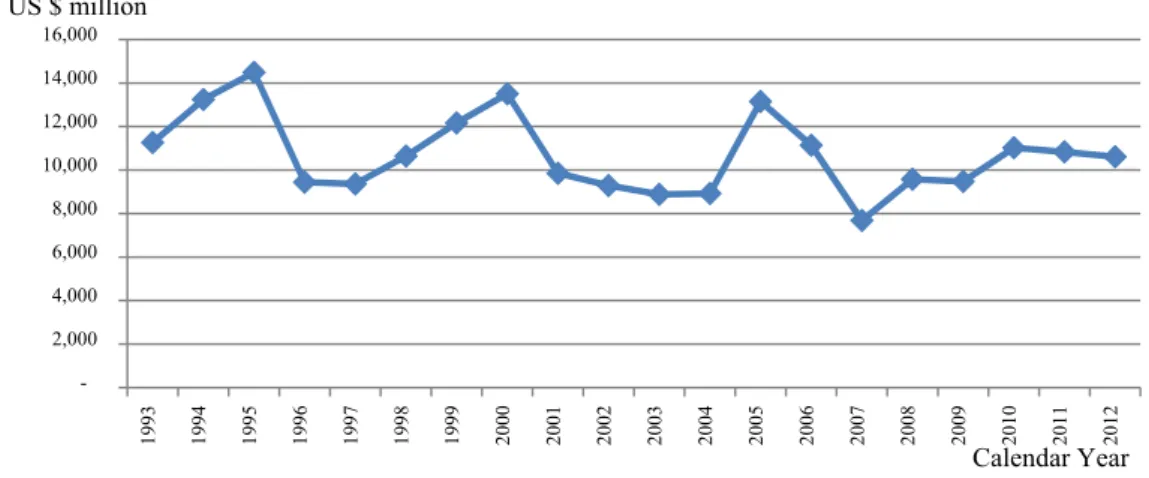
The value of ODA extended by Japan to developing countries and multilateral organizations for 20 years from 1993 to 2012 is shown in Figure 1. As demonstrated in the Figure, apart from 2005, the aid budget is clearly on the decline since 2001. Recent years, in 2010, the volume increased 16 percent over the year before to US$ 11,021 million and it declined again 1.7 percent in 2011 to US$ 10,831 million and 2.1 percent in 2012 to US$ 10,606 million respectively.
Figure 1. Japanese ODA Disbursement (1993-2012)
Source: Japan’s Official Development Assistance White Paper
In comparison with other countries Japanese ODA gives a special emphasis on economic infrastructure development. Within the category of economic infrastructure, building roads and railways and other transportation facilities receives the large part of ODA.
By sector, in 2011, the ratio of Japan’s ODA disbursement is high for economic infrastructure while the other major DAC countries’ share is high in social infrastructure. The economic infrastructure includes transport, communications, electricity, etc. It is followed by social infrastructure including education, health, water and sewerage, etc., industry and other production sectors consist of mining, environmental, etc. The ratio for agricultural infrastructure is low in that year. The ratio of Japan’s ODA disbursement by sector is demonstrated in the Figure 2.
Figure 2. The ratio of Japanese ODA disbursement by sector (2011)
Source: Japan’s Official Development Assistance White Paper
- 2,000 4,000 6,000 8,000 10,000 12,000 14,000 16,000
1993 1994 1995 1996 1997 1998 1999 2000 2001 2002 2003 2004 2005 2006 2007 2008 2009 2010 2011 2012
US $ million
Calendar Year
Social infrastructure
24%
Economic infrastructure Agricultural 41%
infrastructure 4%
Industry and other production sectors
17%
Emergency aid 5%
Program assistance
9%
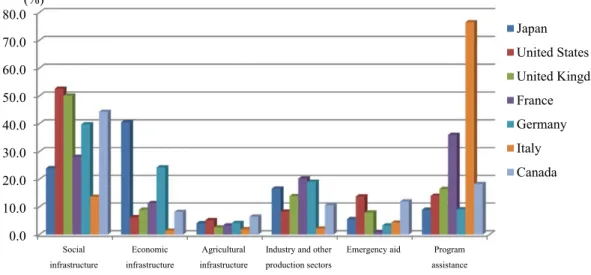
Table 1 reports sector distribution of bilateral ODA by major DAC countries in 2011. It is also shown in Figure 3.
Table 1. Sector Distribution of Bilateral ODA by Major DAC Countries (2011)
(Commitment basis, Units: % ) Country Japan United
States
United Kingdom
France Germany Italy Canada DAC
Average
Sector
Social infrastructure (education, health, water and sewerage, etc.)
24.0 52.6 50.1 28.1 39.8 13.7 44.3 40.3
Economic infrastructure (transport, communications, electricity, etc.)
40.6 6.3 9.0 11.4 24.3 1.4 8.2 15.0
Agricultural infrastructure (agriculture, forestry, fishery, etc.)
4.1 5.2 2.6 3.3 4.2 1.9 6.5 4.9
Industry and other production sectors (mining, environmental, etc.)
16.6 8.3 13.9 20.3 19.1 2.2 10.7 13.2
Emergency aid (humanitarian aid, etc.), food aid
5.6 13.8 8.0 0.9 3.3 4.3 12.0 8.4
Program assistance, etc. (debt relief, administrative expenses, etc.)
9.0 14.0 16.5 36.0 9.2 76.5 18.3 18.2
Total 100.0 100.0 100.0 100.0 100.0 100.0 100.0 100.0
Source: Japan’s Official Development Assistance White Paper
Figure 3. Sector Distribution of Bilateral ODA by Major DAC Countries (2011)
Source: Japan’s Official Development Assistance White Paper
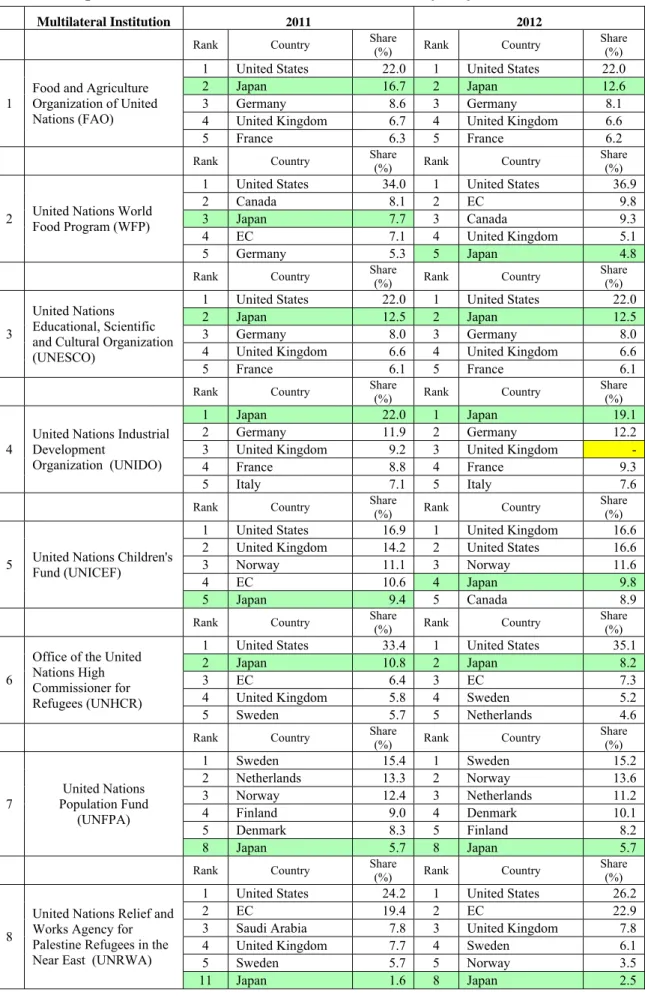
Japan's share percentage contributions to multilateral institutions of 2011 and 2012 by major donor countries are shown in Table 2. As shown in the table, there are 19 multilateral institutions which Japan contributes its aid and Japan ranked mostly fifth among the member countries of the Development Assistance Committee (DAC) of the Organization for Economic Co-operation and Development (OECD).
0.0 10.0 20.0 30.0 40.0 50.0 60.0 70.0 80.0
Social infrastructure
Economic infrastructure
Agricultural infrastructure
Industry and other production sectors
Emergency aid Program assistance
Japan United States United Kingdom France
Germany Italy Canada (%)
Table 2 : Japan's Contributions to Multilateral Institutions by Major Donor Countries
Multilateral Institution 2011 2012
Rank Country Share
(%) Rank Country Share
(%)
1
Food and Agriculture Organization of United Nations (FAO)
1 United States 22.0 1 United States 22.0
2 Japan 16.7 2 Japan 12.6
3 Germany 8.6 3 Germany 8.1
4 United Kingdom 6.7 4 United Kingdom 6.6
5 France 6.3 5 France 6.2
Rank Country Share
(%) Rank Country Share
(%)
2 United Nations World Food Program (WFP)
1 United States 34.0 1 United States 36.9
2 Canada 8.1 2 EC 9.8
3 Japan 7.7 3 Canada 9.3
4 EC 7.1 4 United Kingdom 5.1
5 Germany 5.3 5 Japan 4.8
Rank Country Share
(%) Rank Country Share
(%)
3
United Nations Educational, Scientific and Cultural Organization (UNESCO)
1 United States 22.0 1 United States 22.0
2 Japan 12.5 2 Japan 12.5
3 Germany 8.0 3 Germany 8.0
4 United Kingdom 6.6 4 United Kingdom 6.6
5 France 6.1 5 France 6.1
Rank Country Share
(%) Rank Country Share
(%)
4
United Nations Industrial Development
Organization (UNIDO)
1 Japan 22.0 1 Japan 19.1
2 Germany 11.9 2 Germany 12.2
3 United Kingdom 9.2 3 United Kingdom -
4 France 8.8 4 France 9.3
5 Italy 7.1 5 Italy 7.6
Rank Country Share
(%) Rank Country Share
(%)
5 United Nations Children's Fund (UNICEF)
1 United States 16.9 1 United Kingdom 16.6 2 United Kingdom 14.2 2 United States 16.6
3 Norway 11.1 3 Norway 11.6
4 EC 10.6 4 Japan 9.8
5 Japan 9.4 5 Canada 8.9
Rank Country Share
(%) Rank Country Share
(%)
6
Office of the United Nations High Commissioner for Refugees (UNHCR)
1 United States 33.4 1 United States 35.1
2 Japan 10.8 2 Japan 8.2
3 EC 6.4 3 EC 7.3
4 United Kingdom 5.8 4 Sweden 5.2
5 Sweden 5.7 5 Netherlands 4.6
Rank Country Share
(%) Rank Country Share
(%)
7 United Nations Population Fund
(UNFPA)
1 Sweden 15.4 1 Sweden 15.2
2 Netherlands 13.3 2 Norway 13.6
3 Norway 12.4 3 Netherlands 11.2
4 Finland 9.0 4 Denmark 10.1
5 Denmark 8.3 5 Finland 8.2
8 Japan 5.7 8 Japan 5.7
Rank Country Share
(%) Rank Country Share
(%)
8
United Nations Relief and Works Agency for Palestine Refugees in the Near East (UNRWA)
1 United States 24.2 1 United States 26.2
2 EC 19.4 2 EC 22.9
3 Saudi Arabia 7.8 3 United Kingdom 7.8
4 United Kingdom 7.7 4 Sweden 6.1
5 Sweden 5.7 5 Norway 3.5
11 Japan 1.6 8 Japan 2.5
Multilateral Institution 2011 2012
Rank Country Share
(%) Rank Country Share
(%)
9
United Nations Development Program (UNDP)
1 Norway 13.6 1 Norway 16.3
2 Sweden 10.7 2 Sweden 12.2
3 Netherlands 9.7 3 United Kingdom 10.3
4 United Kingdom 9.0 4 Japan 9.5
5 United States 8.6 5 United States 9.3
6 Japan 8.4 6 Netherlands 8.4
Rank Country Share
(%) Rank Country Share
(%)
10 World Health Organization (WHO)
1 United States 22.0 1 United States 22.0
2 Japan 12.5 2 Japan 12.5
3 Germany 8.0 3 Germany 8.0
4 United Kingdom 6.6 4 United Kingdom 6.6
5 France 6.1 5 France 6.1
Rank Country Share
(%) Rank Country Share
(%)
11
International Bank for Reconstruction and Development (IBRD)
1 United States 16.7 1 United States 16.7
2 Japan 7.2 2 Japan 7.2
3 Germany 4.2 3 Germany 4.2
4 France 3.9 4 France 3.9
4 United Kingdom 3.9 4 United Kingdom 3.9
Rank Country Share
(%) Rank Country Share
(%)
12
International
Development Association (IDA)
1 United States 12.1 1 United States 12.1 2 United Kingdom 12.0 2 United Kingdom 12.0
3 Japan 10.9 3 Japan 10.9
4 Germany 6.5 4 Germany 6.5
5 France 5.0 5 France 5.0
Rank Country Share
(%) Rank Country Share
(%)
13 International Monetary Fund (IMF)
1 United States 17.7 1 United States 17.7
2 Japan 6.6 2 Japan 6.6
3 Germany 6.1 3 Germany 6.1
4 France 4.5 4 France 4.5
4 United Kingdom 4.5 4 United Kingdom 4.5
Rank Country Share
(%) Rank Country Share
(%)
14 Asian Development Bank (ADB)
1 Japan 15.7 1 Japan 15.7
1 United States 15.7 1 United States 15.7
3 China 6.5 3 China 6.5
4 India 6.4 4 India 6.4
5 Australia 5.8 5 Austria 5.8
Rank Country Share
(%) Rank Country Share
(%)
15 Asian Development Fund (ADF)
1 Japan 35.0 1 Japan 35.0
2 United States 10.0 2 United States 10.0
3 Australia 6.5 3 Australia 6.5
4 United Kingdom 5.1 4 United Kingdom 5.1
5 Germany 4.8 5 Germany 4.8
Rank Country Share
(%) Rank Country Share
(%)
16 African Development Bank (AfDB)
1 Nigeria 9.3 1 Nigeria 9.3
2 United States 6.6 2 United States 6.6
3 Japan 5.6 3 Japan 5.6
4 Egypt 5.4 4 Egypt 5.4
5 South Africa 4.8 5 South Africa 4.8
Rank Country Share
(%) Rank Country Share
(%)
17 African Development Fund (AfDF)
1 United Kingdom 14.0 1 United Kingdom 14.0
2 Germany 9.5 2 Germany 9.5
3 United States 9.3 3 United States 9.3
4 France 8.7 4 France 8.7
5 Japan 6.7 5 Japan 6.7
Rank Country Share
(%) Rank Country Share
(%)
18 Inter-American
Development Bank (IDB)
1 United States 30.0 1 United States 30.0
2 Argentina 10.8 2 Argentina 10.8
2 Brazil 10.8 2 Brazil 10.8
4 Mexica 6.9 4 Mexica 6.9
5 Venezuela 5.8 5 Venezuela 5.8
6 Japan 5.0 6 Japan 5.0
Rank Country Share
(%) Rank Country Share
(%)
19 European Bank for Reconstruction and Development (EBRD)
1 United States 10.1 1 United States 10.1
2 Japan 8.6 2 Japan 8.6
2 United Kingdom 8.6 2 United Kingdom 8.6
2 France 8.6 2 France 8.6
2 Germany 8.6 2 Germany 8.6
2 Italy 8.6 2 Italy 8.6
Source: Japan’s Official Development Assistance White Paper
3. Japanese ODA to Asian Countries
The Ministry of Foreign Affairs of Japan published in 1978 “The Current State of Economic Cooperation, and Its Outlook: The North-South Problem and Development Assistance”. In that book, the Ministry pointed out the following two points as significance of Japan’s economic cooperation.
1. “Japan can insure its security and prosperity only in a peaceful and stable world.
One of the most appropriate means for Japan to contribute to the peace and stability of the world is assistance to developing countries.
2. Japan is closely independent with the developing countries since it is able to secure natural resources only through trade with those countries. Therefore it is essential to maintain friendly relationship with developing countries for Japan’s economic growth.
3.1 Asia as a priority region
Japan’s ODA was the first driven by political motivation to rebuild disrupted political and economic relations with Asian countries. It was started in the early 1950s. The Japan-Burma Peace treaty and Agreement was concluded in 1954 and then followed by similar agreement with other Asian countries. Thus, Japan’s ODA has been used as an important diplomatic tool since its war reparation period.
For this, because of its close historical, geographical, political and economic links, a large share of Japan’s ODA have been directed toward Asian countries allocating in the field of economic infrastructure to improve the environment for investment by foreign capitals and promoting their export industries. On the other hand, by concentrating physical infrastructure, Japan’s foreign aid has managed to provide a solid economic base for Asian countries, particularly in Southeast Asia.
A major part of Japanese ODA has been extended to Asian countries, as mentioned in the ODA Charter. In 2012, UD$ 8157 million, 56.2 percent of Japanese bilateral ODA, were extended to Asia. On the other hand, UD$ 4084 million, 28.1 percent went to Africa and the rest went to Latin America and the Caribbean, Oceania and Europe. Share percentage of Japanese bilateral ODA by region in 2012 is shown in Figure 4.
Figure 4. Japanese Bilateral ODA by Region in 2012 (Share %)
Source: Japan’s Official Development Assistance White Paper
Asia Middle East and North 56%
Africa 15%
Sub-Saharan Africa 13%
Latin America and the Caribbean
3%
Oceania 1%
Europe
1% Assiatance encompassing multiple regions
11% Asia
Middle East and North Africa Sub-Saharan Africa
Latin America and the Caribbean Oceania
Europe
Assiatance encompassing multiple regions
Apart from Asian countries, Japan will give due consideration to prioritize its assistance for other regions on the basis of the objectives, basic policies and priority issues set out in the Charter. Figure 5 demonstrates the share percentage of Japanese bilateral ODA by region. As demonstration in the Figure 5, since its early stages, Japanese bilateral ODA is significantly extended to Asia.
Figure 5. Share Percentage of Japanese Bilateral ODA by Region
Source: Japan’s Official Development Assistance White Paper
Asia comprises of three regions: East Asia, South Asia and Central Asia and the Caucasus. It also consists of a verity of nations. For example in South Asian region India has an enormous economic potential, and has been increasing its presence in the international community. Besides this, politically and geographically, Central Asia and the Caucasus regions are also important areas for Japan since they are surrounded by Russia, China, South Asia, the Middle East and the Europe.
Moreover, in East Asia, such as Republic of Korea and Singapore, which have attained high economic growth and have already shifted from aid recipients to donors; least developed countries (LDCs) such as Laos, Cambodia and Myanmar; countries such as Vietnam, which is the process of transitioning from a centrally planned economy to market economy; and countries such as China, which still has internal disparities despite its dramatic economic growth.
Among those countries, China received the mass amount of Japanese aid. Since 1979, Japanese ODA to China has contributed to maintaining and promoting Opening Up Policy of China, and at the same time it has formed a strong foundation to support Japan-China relations.
The Chinese economy has seen stable development through assistance of the economic infrastructure. This has contributed to the stabilization of the Asia-Pacific region, as well as the improvement of China’s investment environment for the Japanese companies and the development of economic relations between Japanese and Chinese private sectors. On the other hand, China had developed economically, and has seen an increase in its technological level.
Thus, Japanese ODA to China has already fulfilled its role at a certain degree.
0 10 20 30 40 50 60 70 80 90 100
1970 1980 1990 2000 2010 2011 2012
Asia Middle East and North Africa
Sub-Saharan Africa Latin America and the Caribbean
Oceania Europe
Assiatance encompassing multiple regions
3.2 Japanese Interest to ASEAN
In particular, the East Asian region which includes Association of Southeast Asian Nations (ASEAN) has been making efforts to enhance its regional competitiveness by maintaining economic growth and strengthening integration.
According to Kinju Atarashi(1985): “It can be said that the visit of the Japanese Prime Minister, Takeo Fukuda, to the member countries of the Association South East Asian Nations (ASEAN) in August 1977 marked a new era in bilateral relations between Japan and those countries, then the visit of his successor, Yasuhiro Nakasone, in April-May 1983 added something new to the relationship”.
Since then, Japan has a range of interest in ASEAN and its member countries. In the first place, it has become deeply involved in ASEAN in both trade and investment.
According to OHNO Kenichi (2002): “Japan is an industrial country whose forte is in monozukuri –‘making things’, or in other words, skilled manufacturing—and that it is a chief architect of the Asian production network. The first of our ODA principles should thus be that ODA is to be used as a tool for sustaining and developing Asian dynamism”. He maintained that: “Drives to promote regional integration have recently been gaining momentum in a number of places around the world. But in Asia, strong linkages have already been formed among the industries of countries at different stages of development. These linkages, mediated by trade and investment, have provided the motive power of the “East Asian miracle” over the past few decades”.
In 2012, East Asian region, which includes ASEAN, as a region received more aid than did South Asia. In 2012, the total Japanese aid for the region was US$ 4,856.71 million (ASEAN for US$ 4169.98 million) higher by about 2 billion dollars than the aid flow to South Asia during the same year.
One Southeast Asian country, Vietnam was listed as the top Japanese aid recipient from 2009 to 2011 by OECD sources. The totals were about ¥ 1579 billion in 2009, ¥ 1014 billion in 2010 and ¥ 2865 billion in 2011 respectively. In 2012, as the first time when refraining from providing large-scale official development assistance in the form of yen-denominated loan since 1988, Myanmar became the top Japanese aid recipient country among ASEAN. The total was about ¥ 2307 billion followed by Vietnam with a received aid flow of ¥ 2132 billion in 2012.
For the same year, other Southeast Asian country, Philippines ranked third after Vietnam with a received aid flow of about ¥ 700 billion and Indonesia, Thailand and Cambodia were the 4th, 5th and 6th largest recipients respectively.
Japanese ODA disbursement by fiscal year is stated in Table 3. According to the Table, except from 2012, among the developing countries in the region only Myanmar received very small amount of aid and technical assistance relative to its needs.
Table 3. Japanese ODA disbursement to ASEAN by fiscal year
(¥ 100 million) Fiscal Year 2008 2009 2010 2011 2012
Country Cambodia 134.34 225.79 151.2 223.73 103.64
Indonesia 1323.16 1271.13 588.47 847.52 277.55 Lao PDR 64.33 88.37 65.8 119.72 79.62
Malaysia 34.44 24.81 30.61 82.71 8.7 Myanmar 47.43 46.34 38.79 63.16 2306.7
Philippines 422.24 804.48 594.52 802.33 699.72 Thailand 685.58 93.05 311.63 41.61 124.65
Vietnam 946.19 1579.45 1013.7 2865.17 2131.51
Source:www.mofa.go.jp
3.3 Contribution to East Asian Dynamism
Japanese foreign aid in East Asia has a history of over 60 years. It has become an important feature of economic development in the region since 1970s when countries in Southeast Asia began to set up their development efforts. Likewise Japan has close relationship with the countries included in the region in all aspects of politics, economy and culture, she also has in the process of development and stability of the region. It significantly impacts the security and prosperity of Japan as well. Japan has contributed to the significant economic growth in East Asia by implementing development cooperation that combines ODA with trade and investment, including the improvement of infrastructure, development of human resources, promotion of trade, and revitalization of private investment.
By 2015, ASEAN aims to establish the “ASEAN Community,” which is comprised three pillars, namely the “Political-Security Community,” “Economic Community,” and “Socio- Cultural Community.” To achieve this, “strengthening connectivity” is deemed to be at the top of their agenda. During the 17th ASEAN Summit in October 2010, the master plan for strengthening connectivity was adopted, which has three components, namely: “physical connectivity” including transport, information communications, and energy network;
“institutional connectivity” including the liberalization and facilitation of trade, investment and services; and “people-to-people connectivity” in tourism, education, and culture.
Japan offers its full support for ASEAN’s efforts for strengthening ASEAN connectivity, such as the “National Road No. 5 Rehabilitation Project”, “National Road No. 6 and 7”, National Road No. 1”, and the “Project for Construction of Neak Loeung Bridge” in Cambodia, which comprises the Southern Economic Corridor connecting the major economic centers of Mekong region, i.e., Ho Chi Minh (Vietnam), Phnom Penh (Cambodia), Bangkok (Thailand), Dawei (Myanmar), and the “ASEAN Ro-Ro Shipping Network Development Project”, one of the Japan’s support and Priority Projects in the Master Plan on ASEAN Connectivity. Japan’s support is also extended to East-West Economic Corridor, starting at Da Nang, Vietnam, goes
through Laos, Thailand, and reaches to Mawlamyaing, Myanmar, conducting such vital infrastructure as: Da Nang Port, the eastern gateway of the Corridor; Hai Van Tunnel, Lao National Road No. 9, and 2nd Mekong International Bridge.
In particular, support for the Mekong countries, such as Cambodia, Laos, Myanmar, Thailand and Vietnam, which include more low income countries than the other areas of ASEAN, is important for reducing intraregional disparities as well. In April 2012 at the Meeting of Fourth Mekong-Japan Summit, the leaders adopted the new Tokyo Strategy 2012 for Mekong-Japan Cooperation based on three pillars: (i) enhancing Mekong connectivity; (ii) developing together; and (iii) ensuring human security and sustainability. Japan announced that it would provide ¥ 600 billion of ODA over the three years starting in 2013 to steadily implement the Tokyo Strategy. Japan also adopted the Mekong-Japan Action Plan that describes specific actions and measures to realize the Tokyo Strategy 2012 at the Fifth Mekong-Japan Foreign Ministers’ Meeting in July 2012 in Phnom Penh, Cambodia.
Among the Mekong region countries, in Myanmar, democratization is rapidly progress in recent years. In April 2012, Japan announced that it would review its economic cooperation policy and provide a wide of assistance to Myanmar to Back up the rapid progress of its reform efforts. Since then, Japan has been actively providing various kinds of assistance to Myanmar including its arrears clearance operation of Myanmar’s debt of ¥ 500 billion, the resumption of the provision of ODA loans, and the provision of a total of ¥ 91 billion assistance such as new ODA loans that Japan committed itself to implement by the end of 2013.
In 2013, on the 40th Year of ASEAN-Japan Friendship and Cooperation, Japan and the ten ASEAN member states held an array of exchange programs and conferences throughout the year covering a wide range of areas, including politics, economy, culture, youth exchange, and tourism. In December, the ASEAN-Japan Commemorative Summit was held in Tokyo. Prime Minister Shinzo Abe pledged that Japan would continue its infrastructure assistance and assistance to narrow the development gap in the region in order to continue to strengthen ASEAN connectivity, and announced Japan’s ODA commitment on the scale of ¥ 2 trillion over the next 5 years.
4. Japanese Bilateral ODA to Cambodia, Laos, Myanmar and Vietnam
In this part of paper investigates the flow of ODA and the economic growth of the selected countries, such as Cambodia, Lao PDR, Myanmar and the Vietnam. In particular, these 4 countries, which situated in Mekong region, are more low income countries than that of other ASEAN member states.
In the late 1980s, these countries started to open up their economies to the world economies by transforming centrally-planned to market-oriented economies. The fundamental are substantially the same – promoting foreign direct investment; deregulation of domestic and foreign trade; price and enterprise reforms; and structural adjustment in the financial sectors.
Among them, Vietnam alone is a development success story. Political and economic reform (Doi Moi) launched in 1986 have transformed Vietnam from one of the poorest countries in the world, with per capita income below US$100, to a lower middle income country with per capita income over US$1700 in 30 years.
4.1 Cambodia
4.1.1 Initial Conditions and Framework of Reforms
Cambodia, officially known as Kingdom of Cambodia is a country located in the southern portion of the Indochina Peninsula in Southeast Asia. Its total land area is 181,035 square kilometers, bordered by Thailand to the northwest, Laos to the northeast, Vietnam to the east, and the Gulf of Thailand to the southwest. With a population of over 15 million, Cambodia is the 69th most populous country in the world. Cambodia has experienced over twenty years of civil war and political unrest since 1970s. After recovering from decades of war and international isolation, in 1993, Cambodia became a multi-party democracy country. It is now struggling to rebuild itself and has become one of the emerging economies in the region due to its high growth rate coupled with new market opportunities and high potential for local economic development and attracting investment. Due to its promoting reforms and assistance need for postwar development, Cambodia is one of the favour recipients of ODA, which is in addition to the increase in trade volume and inflow of FDI.
The Cambodian economy remain robust amidst a challenging global economic environment and in 2013, Cambodia reached its GDP to US$15.25 billion with the growth of 7.5 percent. Garment industry, agriculture sector, and a diversification in sources of tourism have helped Cambodia’s three key engines of GDP growth. It also has oil and gas, timber, gemstones, iron ore, and hydropower potential.
4.1.2 Japan’s Country Assistance Strategy for Cambodia
Japan’s assistance to Cambodia is an instrument to prevent from the nation’s political instability. It is greatly contributes to peace and stability in Asia, a region of vital importance for Japan’s diplomacy.
Since the first yen loan was extended in 1968, Japanese ODA, notwithstanding the interruption during 1970s and 1980s, has consistently supported Cambodia to enhance the welfare of Cambodian people.
In 1992, Japan dispatched Peace Keeping Operation corps (PKO) to Cambodia not to extend its diplomatic efforts for the political restoration of peace and stability, but to make sustainable a significant portion of its ODA resources in support of the physical and social rehabilitation of the war-torn Cambodia.
Japanese ODA to Cambodia, which is mainly grant aid and technical cooperation, has focused on: (i) development of social and economic infrastructure; (ii) improvement of basic social services like health and medical care; (iii) promotion of agriculture and rural development; and (iv) human resources development. Because of its political instability, Japan had not extended any yen loans to Cambodia since 1968.
Cambodia became a multi-party democracy in 1993. After the 1998 elections, the international community concluded that, for the most part of the elections was free and fair, and the government’s current policies pay serious attention to democratization. In accordance with the principles of the Japan’s ODA Charter, it can be said that Cambodian government is heading a desirable direction and thus, in 1999, after about a thirty years interval from 1968, Japan decided to extend to Cambodia a loan of up to 4 billion yen for the rehabilitation and renovation of the Cambodia’s only one deep sea-port.
Japan has also been making positive conditions in the areas of administrative and fiscal reforms by participating Consultative Group (CG) meeting since 1999. Besides, Japan has been contributing in the areas of forest preservation, demobilization of armed forces and also assisting Cambodia with social services improvement and good governance.
Japan is the biggest ODA provider to Cambodia. Every year it contributes about US$100 million to help the country in such concerns as infrastructure, health, education and human resources development. In recent years, from 2007 to 2011 Japanese aid to Cambodia was over US$1.1 billion every year. The share percentage was 25 and it was ranked the top position among DAC countries followed by United States and then Australia. (See Table 4)
Table 4. Amount of DAC Countries ODA Disbursement to Cambodia
( US$ million )
Year 1 2 3 4 5 Total
2007 Japan 113.56 U.S.A 87.22 Germany 37.62 Korea 35.28 France 35.00 452.73 2008 Japan 114.77 U.S.A 69.78 Australia 39.03 France 35.16 Korea 34.66 459.90 2009 Japan 127.49 U.S.A 68.56 Australia 48.50 Germany 37.90 U.K 32.31 476.53 2010 Japan 147.46 U.S.A 84.70 Australia 53.91 Germany 41.26 Korea 37.33 517.72 2011 Japan 130.93 U.S.A 73.78 Australia 71.55 Korea 62.23 Sweden 28.53 491.88 Source: www.mofa.go.jp/policy/oda/data/pdfs/Cambodia.pdf
In recent years, Japanese aid to Cambodia grew gradually. As shown in the Table 5, in contrast with Japanese aid to Vietnam, most of the Japanese aid to Cambodia has been grant aid and technical cooperation. From 2008 to 2012, Japan provided grants amounting to US$355.7 million, technical cooperation of US$247.17 million and loans of US$100.22 million respectively.