Curriculum Design for the Tourism and Hospitality Japanese Course at the University of Guam
IWATA Yuka
*Key words:Curriculum design, Tourism-oriented Japanese, Japanese for specific purposes
Summary:
The Japanese Language Program at the University of Guam developed and launched a new course JA 215 Japanese for Tourism, offered in the Spring semester of 2005 and 2006. This paper illus- trates how JA 215 was developed and implemented using Turner s curriculum development model with particular emphasis on curriculum design and the development of syllabus. A needs analysis was conducted through multiple methods which made it possible to establish goals of instruction and to identify the areas to be focused on and covered in this course. This process assisted in outlining and developing the JA 215 course curriculum, units, and lesson format. A barrage of student evaluation assessments led to many discussion forums, highlighting the strengths and weaknesses of the program.
Evaluations were carried out for the purpose of modification to increase the efficiency of the program for future students.
1.The Current Situation in Guam
The island of Guam is a hub for Japanese tourism. Therefore, developing a high level of proficiency in the Japanese language is a worthwhile skill for Guam residents to possess. There are potential career enhancement benefits and opportunities for those who have acquired Japanese language ability. The lat- ter is important, due to the increased number of Japanese tourists who visit Guam each year. For exam- ple, in 2004, 1,206,676 people visited Guam, and some 81%(906,106)of these visitors were from Ja- pan. Clearly, Guam is one of the most popular destinations for Japanese travelers. Due to its close prox- imity to Japan and warm weather, Guam also represents a resort of sorts for many Japanese who plan to marry or take short vacations. In addition, according to the 2004 Guam Statistical Yearbook, 14,560 in- dividuals were employed in the service industry on Guam. As seen in job advertisements, employers in-
*岩田 V佳:Associate Professor, University of Guam
[125]
volved in tourism and hospitality normally seek to hire individuals who have some Japanese proficiency.
Not surprisingly, due to the growing popularity surrounding the Japanese language, all five public high schools on Guam now offer Japanese language courses. Two of Guam s accredited institutions of higher learning offer Japanese language courses as well. The University of Guam, a four-year university, offers Japanese courses that are designed to develop all four linguistic skills: listening, speaking, reading, and writing, as well as cultural knowledge. There are approximately 150 students who typically enroll in Japanese language classes, ranging from the first to the fourth year. Japanese is the most popular lan- guage that students choose to study(among Chamorro, Tagalog, Spanish, Chinese, and French)to ful- fill their two-semester language requirement for general education. In addition, students can earn a mi- nor in the Japanese Language by completing of three advanced Japanese courses. Offering Japanese for Tourism(JA215)adds variety to the selections of courses within the Japanese Program. It also builds strength in academics, and is greatly beneficial for the students who wish to gain advanced occupational training. Because of the nature of the course, the class emphasizes speaking and listening, and also cul- tural knowledge.
2.JA215 Japanese for Tourism
JA215 is a four-credit course. Each class is 100 minutes in length and is held twice per week. This is a one semester, 16-week course. As the title of this course suggests, the main objective of JA215 is to develop Japanese language proficiency for the tourism and hospitality sectors. The course focuses on improving occupational language skills in an academic classroom environment. Since JA215 falls into the category of Japanese for Specific Purposes(JSP), the focus of JSP is placed on specific skills as opposed to Japanese for Academic Purposes(JAP), which is based on general language development.
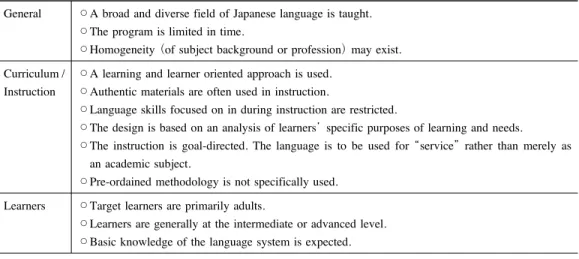
In this regard, learners understand that the course was established to improve practical language skills, rather than to serve as a simple subject of study. At the same time, JAP was designed to be more process-oriented, under the assumption that communication involves language progression, instead of fo- cusing on a specific area of the language. The JAP curriculum emphasizes communicative competence, which is developed through a set of learning activities and tasks. There is extensive research on English for Specific Purposes(ESP)(Johns & Dudley-Evans, 1991; Mackay & Palmer, 1981)around the world however few have studied the area of JSP(Mulvihill, 1992). The structure of curriculum devel- opment for JSP shown in Table 1 was designed based on the English for Specific Purposes(ESP)
model. This model was brought to the academic forefront by Robinson. It highlights general views on JSP, curriculum/instruction, and the profiles of target learners. As JSP represents a version of ESP, the
Table 1 Characteristics of JSP(modified from resources for ESP)
General =A broad and diverse field of Japanese language is taught.
=The program is limited in time.
=Homogeneity(of subject background or profession)may exist.
Curriculum / Instruction
=A learning and learner oriented approach is used.
=Authentic materials are often used in instruction.
=Language skills focused on in during instruction are restricted.
=The design is based on an analysis of learners specific purposes of learning and needs.
=The instruction is goal-directed. The language is to be used for service rather than merely as an academic subject.
=Pre-ordained methodology is not specifically used.
Learners =Target learners are primarily adults.
=Learners are generally at the intermediate or advanced level.
=Basic knowledge of the language system is expected.
pedagogical characteristics of both models are similar. In the end, the main difference separating ESP from JSP is the target language.
3.Planning and Designing JA215
Turner s model of curriculum development was used to construct the steps in building the entire cur- riculum of JA215 in the following order: Needs Analysis→Curriculum Development→Unit and Les- son Development→Program Evaluation. Appendix 1 shows the entire process of building JA215 and how each phase relates to the others.
4.Needs Analysis
Needs analysis sets the stage for the design of the entire JA215 program. This stage gives light to the identification of language needs of the learner(Johnson & Johnson, 105-106). It encompasses three types of analytical methods:(1)learner analysis,(2)task analysis, and(3)register analysis. These methods were not only used to identify learner language needs and objectives, but they also highlighted language function, explained content and established the objectives of the program. In the end, learner needs were assessed through interviews with qualified officials, from travel agents to individuals in- volved in the hotel industry. Existing textbooks for hospitality and tourism language instruction and books related to hospitality and service industries were also examined.
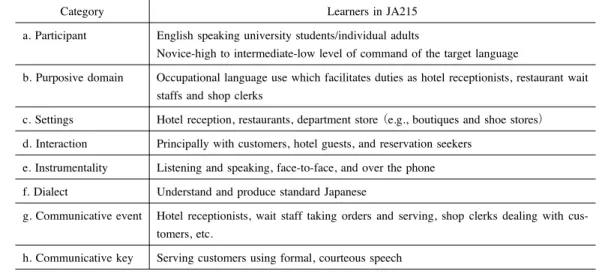
Table 2 Learner Analysis for JA215
Category Learners in JA215
a. Participant English speaking university students/individual adults
Novice-high to intermediate-low level of command of the target language
b. Purposive domain Occupational language use which facilitates duties as hotel receptionists, restaurant wait staffs and shop clerks
c. Settings Hotel reception, restaurants, department store(e.g., boutiques and shoe stores)
d. Interaction Principally with customers, hotel guests, and reservation seekers e. Instrumentality Listening and speaking, face-to-face, and over the phone f. Dialect Understand and produce standard Japanese
g. Communicative event Hotel receptionists, wait staff taking orders and serving, shop clerks dealing with cus- tomers, etc.
h. Communicative key Serving customers using formal, courteous speech 4-1.Learner analysis
For learner analysis, student profiles and needs were defined by Munby s framework(1978: 34-0), as illustrated in Table 2. As mentioned in the target learner profile(Table 1), learners were expected to have reached a novice-high to intermediate-low level before taking JA215. In the Japanese language, the relationship between interactants appears in the level of politeness of the speech, manifested through honorific forms. Understanding the honorific forms and customary expressions used extensively in the hospitality industry requires a prior basic knowledge of the structure of the Japanese language. Accord- ing to the American Council on the Teaching of Foreign Languages(ACTFL)Proficiency Guidelines- Speaking(1999), learners at a novice-high level are able to perform basic communicative exchanges, and ask and answer simple questions. As for reading skills, learners at this level are able to read hira- gana and katakana(the syllable based-sound systems of the Japanese language)and understand the main contents in simple material, such as menus(ACTFL, 1987).
4-2.Task analysis
The intention of task analysis was to define the specific language skills reguired in communicative situations and to measure learner language function in JA215 through interviews and an examination of existing instructional materials. Discussion and interviews with qualified officials, such as hotel service managers and travel agents, suggested that communication to assist Japanese tourists, standard practice in dealing with customers in Japan, consumer expectations, and sociolinguistic and sociocultural proto-
cols in promoting communicative competence should be included in instruction. Examining the types of activities and drills and pedagogical approaches adopted in the existing instructional materials, and scru- tinizing their effectiveness helped to coordinate learner activities in upcoming instruction.
Concerning instructional materials for tourism-oriented Japanese in general, there are a few available for English-speaking learners in Hawaii and Japan, where tourism is a major industry. Many of these references adopt a register-based approach, focusing on grammar and lexis; however, they lack cultural information. In addition, the information provided is often substantially outdated. There are two text- books(Hotel Japanese: Practical Japanese for the Hotel Industry and Japanese for Hotel Staff) mainly targeting to hotel workers. One displays Roman characters, translates them and gives some ex- planations in English. However, it lacks grammar explanations and expressions, which makes learning more complicated. Insufficient cultural information linked to hospitality in many existing references is a significant weakness as well.
4-3.Register analysis
Register analysis, conducted primarily through textbook analyses, revealed the topics, language situ- ations, terminology and expressions, and pedagogical approaches that had been emphasized in tourism- oriented language instructions written for both ESP and JSP learners. The examination of numerous text forms(sentence patterns and lexis)and the gathering of linguistic information(vocabulary, phrases, and expressions)relevant to the topic assisted in the organization of lesson plans, especially in develop- ing the course manuscript.
5.Curriculum Development
Curriculum goals, instructional level and language content were determined by developing the course outline. Some decisions in selecting content, expressions and vocabulary taught in the course were made at the discretion of the creator(Nunan, 1994). JA215 is taught in an academic environment, and institu- tional constraints(e.g., instructional time and number of students)needed to be taken into considera- tion. The JA215 course design was developed based on a series of analyses and professional decisions based on experience and research(see Appendix 2 for the official course outline).
A. Objectives
Students will demonstrate the following three communicative components in order to serve Japanese tourists and customers at tourist sites such as hotels, restaurants, and boutiques professional manner.
Linguistic Component:
Develop communicative skills; internalize and produce vocabulary, phrases and expressions at the appropriate level of politeness; be fluent in the customary and routine expressions used in service;
comprehend and respond to the basic needs of customer or guest involving more complex tasks such as lodging, transportation, and shopping; and perform spontaneous face-to-face interaction(ACTFL Proficiency Guidelines-Listening, 1985).
Sociocultural Component
Be familiar with Japanese social norms and cultural values; and learn verbal and nonverbal commu- nicative behaviors appropriate to Japanese culture
Hospitality and Tourism Component
Understand protocols in hospitality and tourism; and be aware of the importance of using polite ex- pressions
B. Target Learners
>English speakers who have received basic Japanese language instruction(approximately 120 hours)and have knowledge of the basic grammar of the Japanese language
>Learners who seek to advance their career opportunities by mastering tourism and hospitality Japa- nese
C. Level: Novice-high to intermediate-low
The Japanese employed in hospitality and tourism contains honorific expressions that encompass po- liteness, formality, and courtesy. A fundamental grasp of grammatical, lexical, and sociocultural knowl- edge of the target language facilitates a better understanding of the latter.
D. Language Functions
Students should be able to respond to inquiries and requests; recommend products; make suggestions;
request, acknowledge, inform, apologize, and confirm E. Length of instruction
60-64 hours(4 hours/week, 15-16 weeks)
F. Content
Hospitality-related jobs, specifically hotel services, food and beverage services, and stores G. Method
Communicative language teaching encompasses situational and contextualized language used in the tourism and hospitality industry. Class activities such as role-play and simulation practices provide meaningful and personal language practice. They also aid students in making a smooth transition from what they have learned and practiced in the classroom to dealing with Japanese tourists in the real
world. Also, the use of realia(fast food restaurant menus, pictures of item of clothing from fashion magazines and catalogs, pamphlets for optional tours, etc.)helps create an authentic language learning environment. Feedback given by the instructor raises communicative effectiveness in interactions(i.e., whether the message is successfully delivered), rather than emphasizing on grammatical corrections alone.
H. Instructional Materials
An original course packet was developed for this course.
6.Unit and Lesson Development
This section provides detailed illustrations of the content adopted and implemented in the semester- long JA215 course, followed by an example of the lesson format for one class. First of all, the units, separated by the content of instruction, were created based on the curriculum, which had been developed through multiple methods of needs analysis, and in consideration of institutional constraints and other related matters. Appendix 1 shows all of the stages in developing JA215 and how each stage corre- sponds to the others(See Appendix 1). The following five units, Review(of the Japanese Language), Sociolinguistic Knowledge for Hospitality, Hotel Service, Food and Beverage Services, and General Customer Service at the Stores, were built into the JA215 syllabus. The first two units were intended as a means for learners to review basic grammar and vocabulary and build sociolinguistic knowledge re- garding tourism and hospitality. This preparatory stage enabled learners to make a smooth transition to actual language learning experiences from Unit 3.
Unit 1: Review of the Japanese Language
Writing Positional Words
Pronunciation Names of Places and Buildings
Numbers Adjectives
Time Expressions Adverbs
Counters Verbs
Greetings Particles
Interrogatives
Unit 2: Sociolinguistic Knowledge for Hospitality
Tips to Advance Your Knowledge of Hospitality Japanese Variations between Japanese and English
Phrases that Need Special Attention
Making Your Conversation Natural The Do s and Don ts of hospitality Japanese Unit 3: Hotel Services
Taking Reservations over the Phone Check-in
At the Door Money Exchange
Talking about Optional Tours
Room Service(Taking orders and delivering room service)
Taxi Service
Ground Transportation Check-out
Holding Luggage for Customers Unit 4: Food and Beverage Services
Restaurant(Taking reservations over the phone; seating; informing customers that seating is unavailabile; at the table; at the cash register)
Fast food Restaurant Self-service Coffee Shop Unit 5: At Stores
Boutique Jewelry Shop Shoe Store Cosmetic Store
The class activities designed for individual lessons of main language instruction for covering Units 3 to 5 reflected the three underlying principles(linguistic, sociocultual, and hospitality components)pro- posed in the learning objectives.(See Appendix 1.)Each 100-minute class was divided into two phases: language instruction and instruction on sociocultural knowledge and manners relating to Japa- nese hospitality. Lessons were structured in the traditional presentation → practice→ production se- quence. The presentation aspect of each lesson regarding the sociolinguistic factors that affect Japanese communication and service in hospitality was modeled from Welcoming the Japanese Visitors(Nishi- yama, 1996). Table 3 shows an example of one 100-minute class session.
7.Program Evaluation and Assessment
Students were graded based on class attendance and participation, which represented 10% of their overall grade. This was followed up by two oral exams(20%), a final exam(20%), two quizzes
(10%), interview projects(15%), reflection essays(10%)and presentations(15%). The two oral ex- ams were performance tests that demonstrated the students comprehension and production in contextu- alized situations, such as role-play in the target language(Bailey, 208-209). These were diagnostic tests that measured whether the students could demonstrate the skills they had learned in the curriculum.
Role-play represented an invaluable opportunity for the students to demonstrate what they had acquired academically. Students, for instance, role-played working as front desk receptionists or shop clerks or Japanese tourist assistants. Meanwhile, the instructor played the role of a hotel guest or customer. First, the student-instructor interactions were video-taped, and then student performances, comprehension skill, accuracy, fluency, structure, and pronunciation, as well as their sociocultural knowledge applicable to the situation, were evaluated. The final exam, however, was designed differently. Students took the exam individually at separate times. On a sheet of paper, situational cues were given in English in dif- ferent linguistic segments(words, phrases, and sentence-level)containing various linguistic functions, and the students speech was audio taped. This was an achievement test that was comprehensive in na- ture, examining whether students had reached their learning objectives in this course. Students were evaluated on how well they could respond to certain situations, whether their utterances were embedded in sociocultural contexts, and on their speech delivery. Student understanding of grammar and vocabu- lary introduced in later units was also assessed, mainly through quizzes. Other class assignments, discus- sions, essays and interview projects raised student awareness of and sensitivity to better communication
Table 3 Structure of the 100-Minute Lesson Weekly quiz for new vocabulary
Review previous content
Presentation(Schemata-building and presentation of new dialogues: Explanation of the dialogues and grammar explanation)
Practice(with authentic materials)
Production(Activities, simulation practice, role-play, etc.)
Introduction to useful expressions and vocabulary
(Introduction of new vocabulary for the following section/unit)
Activities that raise cultural awareness(Presentation/discussion of book chapters and lectures by guest speakers, etc.)
Sociocultural/
Hospitality/
Services
with Japanese tourists. In class discussion, for instance, students selected one chapter from Welcoming the Japanese Visitor:Insights, Tips, Tactics presented and then led a class discussion on the topic cho- sen. For the reflection essays, a senior Japanese guest manager from one of the upscale hotels on Guam was invited to speak about hotel services and management issues. Students were asked to write what they learned from the lecture in English. For the interview project, each student was instructed to survey five employees working in the tourism industry. Then they interviewed at least three survey respon- dents, answering questions concerning their jobs, for example, challenges, advantages, and benefits. Fi- nally, students analyzed the results of both the surveys and the interviews and summarized their findings in a report which was later presented to the class.
By and large, students who completed JA215 demonstrated improved skills relevant to the sociocul- tural and hospitality-tourism areas. Their achievement was acknowledged based on the reflection essay, the interview project report, the class discussion session and the oral exams.
For instance, the students reported the types of complaints that the interviewees had frequently re- ceived and discussed their possible strategies for the handling of those complaints in class. In essays, they elaborated the views that trying one s best to satisfy customers and providing the best service could be accomplished by providing customer service with a sincere attitude(seii), which includes never saying no to the customers, apologizing even though problems were not their fault, and being respectful by using polite language. One student mentioned that providing service with seii could be productive in increasing repeat customers, a point made by a guest speaker. Student realization of so- ciocultural knowledge in hospitality also emerged into the use of bowing,aizuchi(back-channels), ex- pressions that acknowledge customer requests(Hai kashikomarimashita.)and apology at the appropri- ate level of politeness during the oral examinations.
However, in terms of linguistic skills, some students did not reach the level of expected fluency.
Since the prerequisite of JA215 is a novice-high to intermediate-low level of Japanese proficiency(See Table 2), one could reasonably expect students to reach a higher level of proficiency, say intermediate- low to intermediate-mid level. ACTFL Japanese Proficiency Guidelines define Intermediate-mid level as follows:
Speakers at the Intermediate-Mid level are able to handle successfully a variety of uncomplicated communicative tasks in straightforward social situations. Conversation is generally limited to those predictable and concrete exchanges necessary for survival in the target culture; these include personal information concerning self, family, home, daily activities, interests and personal preferences, as well as physical and social needs, such as food, shopping, travel and lodging.
However individual students possessed different levels of Japanese proficiency and had different
amounts of exposure to the Japanese language and culture before taking JA215. Some students were su- perior in speaking; others had some experience working in the tourism industry. I observed, however, that some students struggled to demonstrate routine activities/tasks done throughout the day. This might translate into students not speaking effectively, and a disruption of a smooth verbal production.
Student feedback(course evaluation)on JA215 obtained at the end of each semester was largely positive. One student wrote in a 2005 evaluation that she applied the learned class skills to her work- place, and as a result, enhanced her job performance. Another referred to the strength of the content ar- eas covered in the class as reasons for his success. More favorable comments given in 2006 included:
JA215 provided useful material; contents covered in JA215 were applicable to real-life working situ- ations in tourism; class discussions were quite helpful; and the class was well-organized and made learn- ing easy. At the same time, constructive criticism was also taken into account in the aftermath of the course. Two students stated, for instance, that if a CD or recorded tape accompanied the course materi- als, it would have enhanced their learning even more.
8. Conclusion
This paper addressed how the JA215 course curriculum was developed, and highlighted needs analy- sis, organization of the course content, lesson development and the assessment and evaluation procedure.
JA215 was offered in two semesters, with 8 students enrolling in 2005 and 9 students enrolling in 2006.
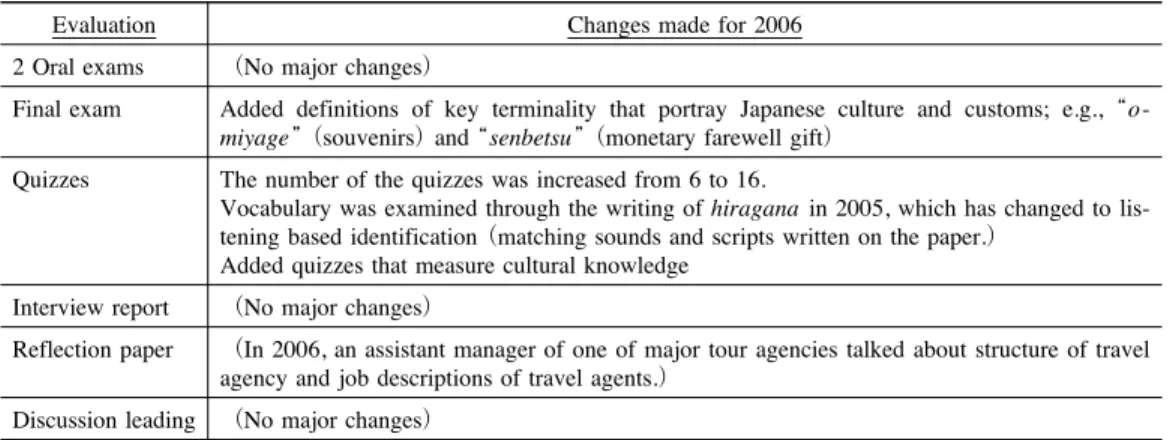
Although course organization remained nearly the same, necessary modifications and adjustments were made in some areas of instruction in 2006. For instance, more quizzes were given, and more definitions regarding cultural terminology were added to both the quizzes and to the final exam. More diverse, task- based activities were also added. Table 4 illustrates details of the modifications made in 2006.
Table 4 Major Modification made for 2006
Evaluation Changes made for 2006
2 Oral exams (No major changes)
Final exam Added definitions of key terminality that portray Japanese culture and customs; e.g., o- miyage(souvenirs)and senbetsu(monetary farewell gift)
Quizzes The number of the quizzes was increased from 6 to 16.
Vocabulary was examined through the writing ofhiraganain 2005, which has changed to lis- tening based identification(matching sounds and scripts written on the paper.)
Added quizzes that measure cultural knowledge Interview report (No major changes)
Reflection paper (In 2006, an assistant manager of one of major tour agencies talked about structure of travel agency and job descriptions of travel agents.)
Discussion leading (No major changes)
For both years, the course was designed to be learner-centered with students engaging in interactive simulation practice(role-play)using authentic materials and practice sheets during class. The course was designed for students to promote the delivery of effective, meaningful, and contextualized oral pro- duction. However, it should be noted that some students did not excel in the development of linguistic skills. There are several possible factors that may have contributed to low performance in this area. A low level of confidence in speaking Japanese, an inadequate amount of practice and individual differ- ences, such as nervousness and test anxiety, seemed to have greatly affected to student performance.
Nonetheless, over time(with an adequate amount of practice), learners were able to overcome confi- dence issues and improve fluency in an effective and efficient learning environment.
In JA215, students relied on written materials. The course packet and theWelcoming the Japanese Visitor:Insights, Tips, Tactics acted as the main set of resources for the students. Many foreign lan- guage institutions support the adoption of technology as a means of delivering authentic material, which contributes to active learning and the development of maximum proficiency. The Internet, audio-visual aids, CDs and DVDs that supplement the course packet, allow students to experience a greater degree of authenticity in the classroom. For instance, the use of computers for simulated language practice maxi- mizes the use of the target language in meaningful ways. This resource may even be used outside of the classroom, and it brings fluency to a student s speech production. Audio-visual aids allow students to better learn physical movements, gestures and manners for communication with Japanese tourists that are usually difficult to acquire from text-based learning materials. In their evaluations, students also mentioned authentic material and technology as ways of building their confidence and improving their weakness in performance.
Finally, students learned not only about serving customers, but also that professionalism and under- standing customer expectations both play a major role in hospitality. Students who completed JA215 successfully demonstrated the emerging ability to distinguish between politeness and formality in most uncomplicated communicative tasks and social situations described as Intermediate-high level speaking skills(ACTFL Japanese Proficiency Guidelines). As for future classes following the same curriculum, students may be more motivated and excited about learning if they are given the opportunity to apply skills they learned in JA215 to real-life situations, such as through internship programs and at places where students experience hands-on professional training. Of course, there are always challenges in learning in a classroom environment, even with contextualized settings to practice the language through activities with authentic materials. However, two semesters of JA215 show that any challenge can be met when the curriculum includes an effective/learner-centered environment and provides first-hand so- ciocultural knowledge about Japan. In the end, this is what made improving Japanese fluency realistic
and achievable for the students of JA215.
Work Cited
ACTFL(1985). ACTFL Proficiency Guidelines. Retrieved on December 11, 2008, from〈http://www.lifeprint.com/
asl101/topics/actfl.htm〉.
ACTFL.(1987).ACTFL Japanese proficiency guidelines. Foreign Language Annals, 20, 589-603.
――(1999).ACTFL proficiency guidelines speaking. Retrieved on November 22, 2008, from〈http://www.actfl.
org/files/public/FLAManuscriptGuidelines.pdf〉.
Bailey, M.K. 1998.Learning about language assessment:Dilemmas, decisions, and directions. Cincinnati: Heinle &
Heinle Publishers.
Bureau of Statistics & Plans. 2005. 2004 Guam Statistical Yearbook. Hagatna, Guam: Office of the Governor of Guam.
Johns, A.M. & Dudley-Evans, T. 1991. English for specific purposes: International in scope, specific in purpose.
TESOL Quarterly, 25, 297-314.
Johnson, K. & Johnson, H. 1999.Encyclopedic dictionary of applied linguistics:A handbook for language teaching.
Oxford: Blackwell Publishers.
Mackay, R. & Palmer, J. 1981.Languages for specific purposes:Program design and evaluation. London: Newbury House.
Mulvihill, E. 1992. Designing a Japanese-for-specific course: Putting theory into practice.Japanese-Language Educa- tion around the Globe 2, 171-183.
Munby, J. 1978.Communicative syllabus design. Cambridge: Cambridge University Press.
Nishiyama, K. 1996.Welcoming the Japanese visitors:Insights, tips & tactics.
Honolulu: University of Hawaii Press.
Nunan, D. 1994.Syllabus design. Oxford: Oxford University Press.
Robinson, P. 1991.ESP Today:A practitioner s guide. New York: Prentice Hall.
Turner, L.J. 1995.Testing preparation. Presentation at the TESOL convention, Long Beach, CA.
Appendix 1.Overview of Entire JA215 Course Design
Appendix 2.The course outline formatted by the university
1. CATALOG DESCRIPTION: This course is designed to develop Japanese language skills and cultural knowledge for use in the tourism industry on Guam. Prerequisite: JA 102 with a grade of C or better or equivalent.
2. COURSE CONTENT: This course focuses on the development of vocabulary and expressions, in- creased knowledge of grammatical structures, and cultural knowledge to facilitate a better understand- ing of Japanese tourists, which allows students to expand competence in spoken Japanese for use in Japanese tourism.
3. RATIONALE FOR THE COURSE:
=All Japanese courses currently offered are academic-oriented.
=Guam is a hub for Japanese tourism.
4. SKILLS AND BACKGROUND REQUIRED OR EXPECTED: Elementary Japanese II(JA 102)
with a grade of C or better or equivalent
5. TEACHING METHODOLOGIES AND ANTICIPATED CLASS SIZE: Audio-visual materials, in- tensive situational/functional oral practice, and field trips that allow students to gain practical skills in
dealing with Japanese tourists will be used. Anticipated class size is 20 students.
6. ADDITIONAL COURSE DESCRIPTION: None
7. LEARNING OBJECTIVES FOR STUDENTS: Upon completion of the course, students will be able to communicate appropriately with Japanese tourists and customers at tourist sites, such as hotels, res- taurants, and boutiques.
8. METHODS OF EVALUATION: Class participation, projects, journals, activities, and examinations.
9. REQUIRED AND RECOMMENDED TEXTS AND/OR STUDY GUIDES
=Course packet
=Nishiyama, K.(1996). Welcoming the Japanese visitors: Insights, tips & tactics. Honolulu: Uni- versity of Hawaii Press.
10. SUBSEQUENT COURSES: Higher level(JA 201 or above)Japanese courses