17 Abstract: The purpose of this study is to investigate causal relationships
between components of self-regulated language learning and learners’
proficiency using a structural equation modeling framework to extend a previous study by the author (2016). The present study specifically focused on the role of motivational aspects in self-regulated learning (SRL), which has remained a controversial subject. Participants were 97 Japanese EFL university students who completed a questionnaire measuring the degree of self-regulated learning. The most recent TOEIC score for each participant was obtained prior to completing the measure.
Path analysis was used to analyze the three hypothesized models. The final structural model demonstrated the following causal relationships:
motivation in SRL had no direct but rather an indirect effect on learners’
L2 proficiency; learning strategies in SRL were significantly influenced by motivation, and directly predicted L2 proficiency. These results suggest that the use of metacognitive strategies, cognitive strategies, and effort regulation promoted by learners’ self-efficacy and intrinsic goal orientation may lead to increased academic proficiency.
Examining the Relationship Between Self-Regulated Learning and EFL Learners Proficiency
日本人EFL学習者の熟達度と自己調整学習の関係性の検討
Akiko FUKUDA
Key words
self-regulated learning, L2 proficiency, structural equation modeling
1. Introduction
The concept of self-regulated learning (SRL) emerged in educational psychology during the mid-1980s to explore the process by which students become masters of their own learning (Zimmerman, 2001). In recent years, it has come to the forefront in the field of
18
second language acquisition (SLA), as it assists comprehensive language learners (Dӧrnyei, 2005). Research has revealed that learners’ proficiency is correlated with SRL (e.g., Pintrich
& DeGroot, 1990), and higher learner proficiency is evidence of having acquired more self- regulation. Learners’ motivation, self-efficacy, and the use of learning strategies have all been associated with SRL (e.g. Zimmerman & Martinez-Pons, 1990; Zimmerman & Schunk, 2011). The concept of SRL has several motivational and strategic components; each of them plays an important role in learning languages. Fukuda (2016) ascertained that certain factors of SRL predicted learners’ English proficiency. Although the motivational factors were not significant, learning strategies significantly predicted proficiency. Therefore, it is important not only to investigate the influence of SRL on proficiency, but also to examine the influence of the relationships between factors of SRL. Accordingly, the purpose of this study was to expand upon the work of Fukuda (2016) to address the causal relationships between SRL and proficiency and the role of motivational elements with regard to SRL.
2. Background
2.1. Self-regulated learning
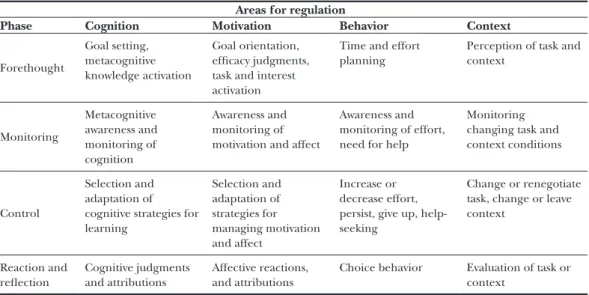
SRL is generally defined as “self-generated thoughts, feelings, and actions that are planned and cyclically adapted to the attainment of personal goals” (Zimmerman, 2000, p. 14). Further, SRL can be ambiguous and defined in various ways depending upon what is emphasized. In fact, the definition of SRL can be highlighted depending on the specific skills in language learning that are to be the focus, such as which constructs or cyclical processes in SRL are described. For example, in order to develop a questionnaire measuring self-regulatory capacity in vocabulary learning, Tseng, Dӧrnyei, and Schmitt (2006) defined it by including every specific aspect in SRL such as strategic planning, volitional control, effective time management, or self-reflection. Lam (2015), who investigated instruction of SRL strategies in a process-oriented writing course, emphasized goal setting and metacognitive knowledge in his definition. Pintrich (2000a) converged similarities of several definitions, and summarized it as “an active, constructive process whereby learners set goals for their learning and then attempt to monitor, regulate, and control their cognition, motivation, and behavior, guided and constrained by their goals and the contextual features in the environment” (p. 453). He assumed that there were four phases and areas in SRL, shown in Table 1. The forethought, monitoring, control, and reaction and reflection phases represent a general time-ordered sequence, although they are not expected to work linearly or hierarchically, but rather simultaneously and dynamically (Pintrich, 2000a). In addition, the four areas of regulation, cognition, motivation, behavior, and context, are divided to enable understanding the role of these areas and their synchronous occurrence. He claims that the model of SRL should contain both cognitive and motivational aspects, including cycles that integrate both processes.
The present study used this definition because the items in the questionnaire were closely linked with four phases and areas for regulation; indeed, Pintrich (2000a) was one of the
19
developers who established the Motivated Strategies for Learning Questionnaire (Pintrich et al., 1991).
Table 1. Chart of self-regulated learning based on the framework devised by Pintrich (2000a) Areas for regulation
Phase Cognition Motivation Behavior Context
Forethought
Goal setting, metacognitive knowledge activation
Goal orientation, efficacy judgments, task and interest activation
Time and effort
planning Perception of task and context
Monitoring
Metacognitive awareness and monitoring of cognition
Awareness and monitoring of motivation and affect
Awareness and monitoring of effort, need for help
Monitoring changing task and context conditions
Control
Selection and adaptation of cognitive strategies for learning
Selection and adaptation of strategies for managing motivation and affect
Increase or decrease effort, persist, give up, help- seeking
Change or renegotiate task, change or leave context
Reaction and reflection
Cognitive judgments and attributions
Affective reactions, and attributions
Choice behavior Evaluation of task or context
2.2. The relationship between self-regulated learning and learners proficiency
It is generally known that SRL is related to learners’ proficiency, and is interpreted as an indispensable ability when learning any subject (Zimmerman & Schunk, 2011). Pintrich and DeGroot (1990) determined the relationship between SRL and academic achievement, illuminating that SRL correlated with learners’ academic grades in English and Science classes during junior high school. They used the Motivational Strategies for Learning Questionnaire (MSLQ; Pintrich, Smith, Garcia, & McKeachie, 1991) to measure motivation, cognitive strategy use, metacognitive strategy use, and management of effort. The MSLQ includes sections on both motivation and learning strategies, in addition to a resource management section, corresponding to “behavior” in Pintrich’s (2000a) definition. The items in this questionnaire can measure learners’ SRL features from multiple perspectives.
Pintrich and DeGroot (1990) assessed 173 seventh grade students with the 81-item questionnaire that measured their academic performance on a 100-point scale. They performed an exploratory factor analysis that revealed the following factors: intrinsic value, self-efficacy, test anxiety, strategy use, and self-regulation. As a result of the zero-order correlations between motivation, SRL, and academic performance variables, every factor except for test anxiety was positively correlated with student academic performance; test anxiety had a negative correlation with students’ grades and exams/quizzes.
With respect to SRL in the second language (L2) learning setting, Vandergrift (2005) focused on the specific SRL skill—metacognitive awareness—and investigated relationships among L2 listening proficiency, motivation, and metacognitive awareness in Canadian
20
French learners. He discovered that both intrinsic and extrinsic motivation had non- significant correlations with proficiency (intrinsic motivation: r = .12, extrinsic motivation:
r = .16), while amotivation was significantly negatively correlated with it (r = -.34, p <
.05). Further, greater use of metacognitive strategies led to higher motivation. Thus, it was concluded that higher motivation is positively correlated, while lower motivation is negatively related to language proficiency.
2.3. The effect of components in self-regulated learning on proficiency
The more self-regulatory learners acquire target languages, the increased likelihood they have for academic success regardless of subjects; however, there is conflicting evidence regarding which factors of SRL are directly linked to learners’ proficiency. Furthermore, discussions concerning the role of motivation in SRL have occurred. As Pintrich (2000a) described in his definition and taxonomy of SRL (in Table 1), motivation is placed as one of the regulated areas; in particular, goal orientation and efficacy are the key concepts for activating SRL due to placement in the forethought phase. In fact, self-efficacy is regarded as a central element to academic success in terms of it affecting lower levels of anxiety, higher levels of persistence and greater effort, more flexible learning strategy use, and higher levels of intrinsic interest in tasks (Pajares & Schunk, 2001). That is, self-efficacy is considered a trigger for inducing learning activity.
Zimmerman, Bandura, and Martinez-Pons (1992) focused on the causal impact of learners’ self-efficacy, personal goal setting, and academic grades. They used students’ prior and final grades at the end of the semester in a social studies course, and administered a questionnaire to measure their self-efficacy. Using path analysis, they found that self-efficacy for academic achievement significantly predicted both personal goal setting and final grades. In other words, self-efficacy, which is one of the cardinally motivational components in SRL, directly influenced academic grades. This result was supported by Kim and Kim (2014) in an investigation on the impact of motivation and the use of self-regulated learning skills on the learners’ English test scores using a concept of the L2 Motivational Self System (Dӧrnyei, 2009).
They insisted that motivation is a prerequisite of SRL, and used the concept of the L2 Motivational Self System to serve as the same meaning to motivational aspects in SRL; that is, both the Ideal L2 Self and the Ought-to L2 Self play a crucial role to set goals, make effort for learning materials, and draw attention to the source of motivation (Kim et al., 2014). They perceived motivation in SRL and learning strategies in SRL as divided between the L2 Motivational Self System and SRL strategies. In their study, the L2 Motivational Self System explained learners’ English proficiency more than SRL skills; learners’ Ideal L2 self (the intent to succeed in language learning) significantly predicted their English proficiency, whereas the predictive capacity of SRL skills for proficiency was much weaker than that for motivation. These studies showed that motivation to learn L2 had a crucial role in academic learning success, and directly influenced learners’ proficiency.
However, Kormos and Csizer (2014) found a different result for a role of motivation.
21
They also defined the L2 Motivational Self System as motivation in SRL, and explored how it affects other SRL strategies and autonomy-related variables, elucidating the interaction between the Ideal L2 self, self-regulatory strategies, and autonomous learning among different age groups. Results showed a significant path between the Ideal L2 self to intended learning effort (for secondary school learners, university students, and young adult language learners: .59, .74, and .54, respectively), which affected other self-regulated strategies, and subsequently autonomy-related variables. They concluded that the Ideal L2 self might serve as a mediator to the use of self-regulatory strategies and autonomous learning. In other words, it was suggested that the L2 Motivational Self System might be relevant to motivated behavior, and motivated behavior then elicits use of self-regulatory strategies, which influences learners’ proficiency; motivational factors seem to be indirectly linked to learners’ proficiency.
There are several views on the relationship between components of SRL and learners’
proficiency, especially as it is understood that while cognitive or metacognitive skills have a direct benefit to proficiency, motivational factors are interpreted from different stances.
It is possible that the current study clarifies the role of motivational components in the L2 learning from the SRL perspective.
Fukuda (2016) investigated the influence of SRL on English as a foreign language (EFL) learners’ proficiency, with particular emphasis on examining SRL characteristics of less proficient learners compared to that of more proficient learners. The survey was administered to 97 university students; their TOEIC scores were reported and they responded to the 81 items in the MSLQ (Pintrich et al., 1991), one of the authorized questionnaires in the study of SRL. In the process of its development, reliability and validity for each motivation and learning strategy sections were examined. According to the procedure of developing the MSLQ, an exploratory factor analysis was performed for each of the two motivational and learning strategies sections separately. Five motivational factors—intrinsic goal orientation, extrinsic goal orientation, self-efficacy, test anxiety, and control learning beliefs—and six learning strategies factors—metacognitive strategies, cognitive strategies, effort regulation, task approach, peer learning in classroom, and coping problem—were found. T-tests were done to compare the characteristics of SRL between high and low proficient learners. Further, Fukuda (2016) verified that SRL influenced proficiency before examining the characteristics of SRL between different proficient groups; multiple regressions were separately conducted to explore the effect of motivation and learning strategies in SRL on learners’ proficiency. Despite the significant correlations among proficiency and self-efficacy and intrinsic goal orientation, the multiple regression analysis for motivational factors did not show any significant prediction of learners’ proficiency, and accounted for little variance. However, the six learning strategies accounted for 23.2 % of the variance in proficiency, and three significant predictors for proficiency were found: metacognitive strategies, effort regulation, and coping problems.
This showed the direct influence of learning strategies on proficiency, but went no further than suggesting the possibility of an indirect influence from motivation to proficiency
22
(Fukuda, 2016). Because this work was not enough to conclude motivation had indirect effects due to dealing with motivational and learning strategies factors separately, correlations between motivation and learning strategies were not examined. The current study further examined these prior results; that is, the data were reanalyzed using a structural equation modeling (SEM) framework in order to explore the role of motivation and the causal relationships between three variables: motivation, learning strategies, and proficiency in the view of SRL. Unlike Fukuda (2016), the present study handled motivation and learning strategies factors collectively in the hypothesized structures; therefore, three models were hypothesized defining motivation and learning strategy factors as predictor variables, and proficiency as a criterion variable.
3. Hypotheses
As reviewed above, it is well-established that SRL itself has an important connection with proficiency, however, with respect to relationships between motivational and learning strategies components within SRL, there have been some mixed perspectives. One view suggested motivational perspectives are influential factors to learners’ proficiency, and this directly affects high academic achievement (i.e., Kim et al., 2014; Zimmerman et al. 1992).
In the other approach, motivational factors were considered mediators to improve learners’
proficiency, which means these factors were directly linked to learning strategies and they eventually influenced academic achievement (i.e., Kormos et al., 2014; Pintrich & DeGroot, 1990). To shed light on the role of motivational aspects in SRL, the current study aimed to examine the causal relationships among these factors and test these two standpoints within a SEM framework.
Three models were hypothesized based upon the combination of earlier results by Fukuda (2016) and prior research on motivation and SRL. All were tested using SEM. The three paths are shown in Figure 1.
Model 1: Direct motivational influence model
This model expected that motivational factors directly affect learners’ proficiency as well as learning strategies; therefore, all 11 factors were treated as exogenous variables and proficiency was set as an endogenous variable. Every motivational and learning strategy factor was correlated with each other, and hypothesized to impact learners’ proficiency.
Model 2: Indirect motivational influence model
For this model, motivational factors were set to have an indirect influence on proficiency. As some previous research has shown, if motivational factors play covert roles, it is hypothesized that they are predictive of learning strategy factors, which directly affect learners’ proficiency.
23 Model 3: Direct and indirect motivational influence model
Learners’ motivation can influence learning strategies as well as their proficiency.
This model was based on prior research (Fukuda, 2016) that found correlations between motivation and proficiency. Model 3 hypothesized that motivational factors were dependent variables for proficiency and learning strategies, while learning strategy factors were predictors of proficiency.
Motivational
foactors Learning
strategic factors
Proficiency
Motivational foactors
Learning strategic factors
Proficiency
Motivational
foactors Learning
strategic factors
Proficiency
Model 3: Direct and indirect motivational influence model
Model 2: Indirect motivational influence model Model 1: Direct motivational influence model
Figure 1. Schematic views of the three hypothesized models
4. Method 4.1. Participants
Data for this study consisted of the same data from Fukuda (2016). Ninety-seven university students, 29 males and 68 females, participated. All were freshmen majoring in law, intercultural communication, sociology, science, or literature.
4.2. Materials
TOEIC scores were used as a proxy for students’ proficiency. It should be noted that some do not consider the TOEIC sufficient to measure learners’ proficiency in English because it only assesses listening and reading. However, this was the only measure that all participants had to provide an estimate of proficiency. Mean TOEIC scores was 471.8 (SD = 125.00; Range = 545).
Learners’ SRL was measured using the MSLQ (Pintrich et al., 1991), with motivation and learning strategies representing the two sections. Self-efficacy, intrinsic or extrinsic goal orientation, learning beliefs, task value, and test anxiety comprise the motivation section, whereas resource management strategies such as effort regulation and help-seeking, as well as metacognitive and cognitive strategies define the learning strategies section. All 81 items were included because every component was judged plausible to understand learners’ SRL. The participants answered all items on a response scale of 1 (not at all true for me) to 7 (very true for me). They completed the questionnaire online, which took approximately 30 minutes.
24
4.3. Procedures and analysis
Fukuda (2016) showed that five motivational and six learning strategies factors were extracted through the exploratory factor analyses, as shown in Table 2. Most factors obtained a reliability value (Cronbach’s alpha) above .60 except for Coping problems (CP); its reliability seemed inadequate, however, given the situation where it contained only two items and both of them obviously appeared important in Pintrich et al. (1991)’s original factor Help Seeking, CP was retained in the current study. Based on these variables, confirmatory factor analyses were conducted for the three hypothesized models using SEM after analyzing bivariate correlations between 11 factors, which were used to determine covariations or paths.
Table 2. Means, standard deviations, and inter reliabilities after the EFA for 11 factors
SE IGO EGO TANX CLB MCS CS ER TAP PLIC CP
Mean 31.15 43.64 16.20 15.18 13.72 34.93 29.77 21.78 14.65 8.82 7.89
SD 10.35 9.43 4.84 4.85 3.34 9.15 9.94 5.14 4.40 2.94 2.56
Cronbach .90 .87 .67 .72 .62 .82 .85 .65 .71 .75 .36 N=97
SE = self-efficacy, IGO = intrinsic goal orientation, EGO = extrinsic goal orientation, TANX = test anxiety, CLB = control learning beliefs, MCS = metacognitive strategies, CS = cognitive strategies, ER = effort regulation, TAP = task approach, PLIC = peer learning in classroom, CP = coping problem
5. Results
Correlations between motivational and learning strategy factors are provided in Table 3. All but Peer Learning in Classroom (PLIC) had some significant correlations with other factors. Confirmatory factor analyses showed a possibility that 11 factors would be implicated in the second-order constructs1, in which every factor can be treated as first- order factors, and explained with a few second-order factors. However, each second-order factor included each first-order factor in a way that varied from the definition by Pintrich (2000a) in that motivation, learning strategies, and resource management were divided.
They have been conceived as totally separate constructs by many previous researchers;
therefore, the original 11 factors were simply used instead of adopting the higher order structural model.
The comparison of the three hypothesized models was tested using AMOS 24. All path analyses were repeatedly operated to establish the final structural models.
First, Model 1 was configured so that each motivational and learning strategy factor was an exogenous variable. The TOEIC score was set as an endogenous variable. In the final structural model, the results showed that no motivational factors had significant paths to proficiency, whereas five significant paths from learning strategies to English proficiency appeared: Metacognitive Strategies (MCS;β= .292, p < .01), Cognitive Strategies (CS;β=
25
-.206, p < .05), Effort Regulation (ER;β= .231, p < .05), Coping Problems (CP;β= -.238, p
< .05), and Task Approach (TAP;β= -.203, p < .05). They predicted 28.4 % of the variance in the learners’ English proficiency (β= .284). With respect to motivational variables, Self- efficacy (SE) and Test Anxiety (TANX) had paths to proficiency but they did not appear significant. Significant covariance was as follows: SE and Intrinsic Goal Orientation (IGO; r
= .500, p < .001), SE and Extrinsic Goal Orientation (EGO; r = .244, p < .01), SE and TANX (r = -.165, p < .05), SE and MCS (r = .434, p < .001), SE and CS (r = .260, p < .01), SE and ER (r = .304, p < .001), SE and TAP (r = .290, p < .01), IGO and EGO (r = .234, p < .001), IGO and CLB (r = .227, p < .01), IGO and MCS (r = .644, p < .001), IGO and TAP (r = .428, p <
.001), EGO and TANX (r = .275, p < .01), EGO and CLB (r = .215, p < .01), EGO and ER (r = .262, p < .01), TANX and Control Learning Beliefs (CLB; r = .278, p < .01) TANX and Coping Problems (CP; r = .210, p < .05), MCS and CS (r = .247, p < .01) MCS and TAP (r = .354, p < .001), CS and TAP (r = .225, p < .05), and CS and CP (r = -.290, p < .01).
With respect to Model 2, motivational factors were established as predictor variables to learning strategy variables, which served as criterion variables and predictor variables to English proficiency. TOEIC was treated as a criterion variable. Path analysis yielded eight significant predictions from the motivational variables to learning strategy variables: SE to CS (β= .369, p < .001), SE to ER (β= .336, p < .001), IGO to MCS (β= .624, p < .001), IGO to CP (β= -.242, p < .05), IGO to TAP (β= .494, p < .001), EGO to ER (β= .233, p
< .05), TANX to CS (β= .210, p < .05), and CLB to MCS (β= -.180, p < .05). In addition, five learning strategy factors had significant pathways to proficiency: MCS (β= .373, p <
.001), CS (β= -.205, p < .05), ER (β= .269, p < 01), TAP (β= -.186, p < .05), and CP (β= -.246, p < .01). These factors predicted 28.9% of the variance in TOEIC (β= .289).
Significant covariances were found between SE and IGO (r = .611, p < .001), SE and EGO (r
= .362, p < .001), IGO and EGO (r = .373, p < .001), IGO and CLB (r = .209, p < .01), EGO and TANX (r = .297, p < .01), CLB and TANX (r = .349, p < .001), CLB and EGO (r = .270, p < .01), MCS and CS (r = .301, p < .01), and CS and CP (r = -.276, p < .01).
Model 3 tested the hypothesis that motivation directly affects proficiency, and indirectly Table 3. Correlation matrix of observed variables
TOEIC SE IGO EGO TANX CLB MCS CS ER TAP PLIC CP
TOEIC — .304** .263** .037 -.193 -.040 .307** .035 .332** -.018 .101 -.270**
SE — .610** .372** -.070 .027 .542** .430** .423** .390** .071 -.106
IGO — .388** .054 .235* .685** .398** .295** .540** .035 -.242*
EGO — .315** .283** .163 .327** .347** .322** .178 -.095
TANX — .357** .010 .242* .068 .136 .086 .162
CLB — -.020 .265** .170 .106 .128 .008
MCS — .451** .259** .398** .015 -.116
CS — .250* .387** .143 -.237*
ER — .159 .036 -.168
TAP — .178 -.140
PLIC — -.065
CP —
Note: * p < .05, ** p < .01
26
affects it via learning strategies; thus, the five factors of motivation were set as exogenous variables, and the six factors of learning strategies were set as endogenous variables for motivational factors and exogenous variables to proficiency. English proficiency was treated as an exogenous variable for both motivational and learning strategy variables. As a result of path analyses, ten paths were judged significant from motivation to learning strategies:
SE to MCS (β= .185, p < .05), SE to CS (β= .379, p < .001), SE to ER (β= .341, p <
.001), IGO to MCS (β= .596, p < .001), IGO to CP (β= -.232, p < .05), IGO to TAP (β
= .529, p < .001), EGO to ER (β= .219, p < .05), CLB to MCS (β= -.165, p < .05), CLB to CS (β= .218, p < .05), and TANX to CP (β= .211, p < .05). Additionally, four paths from learning strategies to learners’ proficiency were significant: MCS (β= .254, p < .05), CS (β= -.231, p < .05), CP (β= -.216, p < .05), and ER (β= .239, p < .05). These factors predicted 27.7% of the variance in TOEIC (β= .277). In fact, two motivational predictors to proficiency were observed, but both were not significant, thus no motivational factors directly affected English proficiency. Covariance was significant between SE and IGO (r = .603, p < .001), SE and EGO (r = .387, p < .001), IGO and EGO (r = .364, p < .001), IGO and CLB (r = .191, p < .05), EGO and TANX (r = .323, p < .01), EGO and CLB (r = .259, p <
.01), TANX and CLB (r = .331, p < .01), MCS and CS (r = .331, p < .01), and CS and CP (r = -.261, p < .01).
Table 4 shows the model fit summaries for the three models. They were scrutinized in order to determine the final structural model; Model 2 provided the best fit for the data by examining fit indices. The Goodness of Fit Index (GFI) and Adjusted Goodness of Fit Index (AGFI), whose indices show to what extent the estimated models predict the data, was the highest among the three models for Model 2 (GFI = .954, AGFI = .901). The Incremental Fit Index (IFI) and Comparative Fit Index (CFI) of Model 2 appeared to be the highest and closest to 1.000 (IFI = 1.023, CFI = 1.000), which suggested that the discrepancy between the model and the data was appropriately improved. Considering the complexity of each model, Root Mean Square Error of Approximation (RMSEA) of Model 2 was .000. Every Model revealed a somewhat higher Akaike Information Criterion (AIC), though Model 2 produced the lowest (AIC = 112.668). In fact, Model 3 provided the lowest RMSEA (.000) and acceptable values for IFI (1.016) and CFI (1.000), but it also showed an AGFI than .90 (.890), which should be nearly 1.000 to be appropriate. The AIC which is considered to be the information criterion used to evaluate the degree of discrepancy between the model and data which was higher in Model 2 (113.055); this was the information criteria used to determine the best fit model, as it is only available if comparing several models (Toyoda, 2003). Thus, Model 2 best explained the causal relationships among motivation, learning strategies, and learners’ English proficiency in this study. The final structural model is displayed in Figure 2, in which the significant paths of correlations and regressions are presented.
The final structural model (Model 2) represents some obvious findings. The noteworthy finding is that no motivational variables had any direct pathway to learners’
English proficiency; however, all variables had significant direct predictions to learning
27
strategies. On the other hand, TOEIC, regarded as learners’ English proficiency, was significantly predicted by five learning strategy factors, with the exception of peer learning in the classroom. Also, self-efficacy significantly influenced cognitive strategies, and effort regulation, but not metacognitive strategies, while intrinsic goal orientation was a strong predictor of metacognitive strategies and task approach. In addition, coping problems showed a negative effect on proficiency.
Table 4. Summary of the goodness of fit indices among the three models
Model CMIN (df, p) GFI AGFI IFI CFI RMSEA AIC
1 57.059
(36, p < .014) .908 .801 .933 .926 .078 141.059
2 28.668
(36, p < .803) .954 .901 1.023 1.000 .000 112.668
3 33.055
(38, p < .697) .946 .890 1.016 1.000 .000 113.055
Note: CMIN = Minimum Discrepancy (Chi-Squared), GFI = Goodness of Fid Index, AGEI = Adjusted Goodness of Fit Index, IFI
= Incremental Fit Index (DELTA2), CFI = Comparative Fit Index, RMSEA = Root Mean Square Error of Approximation, AIC = Akaike Information Criterion
SE IGO EGO TANX CLB
MCS CS TAP PLIC
Proficiency
ER CP
.39***
.35***
-.18*
-.21*
-.27**
-.28**
-.19* -.25**
.22 .31 .00 .06
.23* .21*
.53***-.24*
.61***
.37***
.37***
.21** .27**
30**
-.24*
.50***
.53
.30**
.30
.29 .37**
.62***
.34***
.34***
Note: * p < .05, ** p < .01, *** p < .001
SE = self-efficacy, IGO = intrinsic goal orientation, EGO = extrinsic goal orientation, TANX = test anxiety, CLB = control learning beliefs, MCS = metacognitive strategies, CS = cognitive strategies, ER = effort regulation, TAP = task approach, PLIC = peer learning in classroom, CP = coping problem
Figure 2. Final structural model (Model 2).
Note: Only squared multiple correlations and significant paths are shown.
28
6. Discussion
The present study found that motivation in SRL was not directly predictive of proficiency; rather, it had significant indirect effects on proficiency as evidenced by the mediating function of learning strategies. With respect to the relationship between motivation and learning strategies, self-efficacy appeared to be strongly related to cognitive strategies and effort regulation, while there was no significant association with metacognitive strategies. Self-efficacy is deemed most essential to activate language learning, and it influences the use of self-regulatory metacognitive strategies such as planning and monitoring (Anam & Stracke, 2016; Milles et al., 2007). Although the hypothesis was that self-efficacy had a direct effect on metacognitive strategies, it did have a non-significant path ( β = .16, p < .07), and only had a significant correlation with intrinsic goal orientation, which significantly predicted metacognitive strategies and task approach. Namely, self- efficacy might influence metacognitive strategies through closely interacting with intrinsic goal orientation, as Schunk (2001) described. In other words, learners who have high self- efficacy can choose appropriate ways to learn English, score high on exams, and regulate their own emotions. In the current study, this resulted in the high achievement in L2 learning.
With regard to the correlations between motivational factors, the results of this study were consistent with prior research. Pintrich (2000b) concluded that when both mastery goals (= intrinsic goal orientation) and approach performance goals (= extrinsic goal orientation) were combined together, this enhanced prediction of academic outcomes.
In regards to the connection between the two types of goal orientations, the present study showed that both intrinsic and extrinsic goal orientations were correlated with each other.
Intrinsic goal orientation indicates a desire to learn or a willingness to master L2; it did not always affect effort regulation that represents overcoming difficulties. On the contrary, extrinsic goal orientation suggests that learners try to attain their goals, but are motivated from rewards or compliments by others; thus, it demonstrated a profound path to effort regulation.
Peer learning in the classroom was the only learning strategy factor that did not predict English proficiency, however, proficiency measured by TOEIC does not require learners to learn languages with others and does not capture the extent to which learners do well in their classrooms. Thus, it seems plausible that learning English well with classmates has no relation to proficiency. Instead, the other five learning strategies were significant direct predictors of proficiency, which means selecting appropriate strategies results in higher scores on English exams.
Coping problems is defined as how learners solve a problem when they encounter one while learning. This was the only negative effect on English proficiency. Considering some of the example items for coping problems, it contains behaviors of asking friends or instructors for help to cope with troubles learning English. That is to say, even if learners successfully learn languages with help from someone, it is not related to their proficiency
29
indicated by TOEIC; rather, the more learners commit to their own English learning by themselves, the higher score they might attain. This negative effect was likely due to dissonance between the measurement of proficiency and the items included in coping problems.
7. Conclusion
It should be noted that the present study revealed the causal-effect relationship among motivation, learning strategies, and L2 proficiency. Fukuda (2016) did not explore how motivational factors played their roles in the framework of SRL; thus, the current study provided the evidence that motivational factors definitely affected learners’ English proficiency throughout the mediation of learning strategies. However, there are some basic limitations. First, TOEIC was treated as a learners’ English proficiency due to the research procedure, but it might be inadequate as a proficiency measure because it only assesses two language skills, listening and reading. Learners’ proficiency should be defined using several measurements to reflect the concept of English proficiency. It might cause the divergence between what the TOEIC evaluates and what the MSLQ measures; the MSLQ measured general SRL skills in language learning, but not those specialized in listening and reading. Second, even though the path analysis in the framework of SEM was conducted, the number of participants was small. When a factor analysis is performed, at least 100 participants are required (e.g., Fraenkel & Wallen, 2003).
Nevertheless, the current findings reconfirmed the importance of the motivational role in language learning. Further, it highlighted that the use of metacognitive or cognitive strategies and regulation of efforts were directly linked to English proficiency and resulted from high motivational attitudes. Motivational aspects, such as intrinsic motivation, strongly influenced the use of learning strategies in SRL. Thus, it seems important that learners are motivated by themselves, not solely from motivation provided by their teachers (Ushioda, 2003). As Nakata (2010) also noted, intrinsic motivation has a great influence when learning languages, but it is difficult for learners to experience intrinsic motivation through simple enjoyment. In other words, a willingness or desire to succeed in L2 learning is required to sustain intrinsic motivation. In educational settings, teachers’ help might be needed for learners to connect their intrinsic motivation and metacognitive strategies, but cannot be the exclusive way to generate learners’ self-efficacy, intrinsic motivation, or goals.
Based on the present study, future research should investigate the use of other proficiency measures, focus on specific English skills, and compare paths between different SRL skill groups.
30
Acknowledgments
This work was supported by Rikkyo University Special Fund for Research. The author also would like to thank the anonymous referees for their constructive and valuable feedback on this study.
Note
1. There were five motivational and six learning strategies factors; although the higher-order factor analysis model allows correlations between higher-order factors, correlations between subordinate (=first-order) factors in different higher-order factors are not assumed (Ozaki & Shojima, 2014). According to the correlations between motivational and learning strategies factors (Table 3), all but PLIC were correlated each other, thus this model was not used in the present study.
References
Anam, S., & Stracke, E. (2016). Language learning strategies of Indonesian primary school students: In relation to self-efficacy beliefs. System, 60, 1-10.
Dӧrnyei, Z. (2005). The Psychology of the language learner: Individual differences in second language acquisition. New York, NY: Routledge.
Dӧrnyei, Z. (2009). The L2 motivational self system. In Z. Dörnyei & E. Ushioda (Eds.), Motivation, language ldentity and the L2 self (pp. 9-42). Clevedon: Multilingual Matters.
Fraenkel, J., & Wallen, N. (2007). How to design and evaluate research in education (7th ed.). New York, NY:
McGraw-Hill.
Fukuda, A. (2016). Exploring the relationship between self-regulated language learning and proficiency: A focus on less proficient Japanese EFL learners (Unpublished master’s thesis). Rikkyo University, Tokyo.
Kim, T., & Kim Y. (2014). EFL students’ L2 motivational self system and self-regulation: Focusing on elementary and junior high school students in Korea. In K. Csizer & M. Magid (Eds.) The impact of self-concept on language learning. (pp. 87-107). Bristol: Multilingual Matters.
Kormos, J., & Csizer, K. (2014). The interaction of motivation, self-regulatory strategies, and autonomous learning behavior in different learner groups. TESOL Quarterly, 48(2), 275-299.
Lam, R. (2015). Understanding EFL students’ development of self-regulated learning in a process-oriented writing course. TESOL Journal, 6(3), 527-553.
Milles, N. A., Pajares, F., & Herron, C. (2007). Self-efficacy of college intermediate French students: Relation to achievement and motivation. Language Learning, 57(3), 417-442.
Nakata, Y. (2010). Toward a framework for self-regulated language-learning. TESL Canada Journal, 27(2), 1-10.
尾崎幸謙・荘島宏二郎(2014)パーソナリティ心理学のための統計学―構造式モデリング.誠信書房.
東京
Pajares, F. & Schink, D. H. (2001). Self-beliefs and school success: Self-efficacy, self-concept, and school achievement. In R. Riding and S. Rayner (Eds.) International perspectives on individual differences, Volume 2 self perception (pp.239-266). London: Ablex Publishing.
Pintrich, P. R. (2000a). The role of goal orientation in self-regulated learning. In M. Boekaerts, P. R. Pintrich,
& M. Zeidner (Eds.) Handbook of self-regulation (pp. 451-502). San Diego: Academic Press.
Pintrich, P. R. (2000b). Multiple goals, multiple pathways: The role of goal orientation in learning and achievement. Journal of Educational Psychology, 92(3), 544-555.
Pintrich, P. R., & De Groot, E. V. (1990). Motivational and self-regulated learning components of classroom academic performance. Journal Educational Psychology, 82(1), 33-40.
Pintrich, P. R., Smith, D., Garcia, T., & MacKeachie, W. J. (1991). A manual for the use of the Motivated Strategies for Learning Questionnaire (MSLQ). The Education Resources Information Center (ERIC).
31 Schunk, D. H. (2001). Social cognitive theory and self-regulated learning. In D. H. Schunk & B. J.
Zimmerman (Eds.), Self-regulated learning and academic achievement: Theoretical perspectives (2nd ed.) (pp. 125-151). New York, NY: Lawrence Erlbaum.
豊田秀樹(2003)共分散構造分析[疑問編]―構造方程式モデリング―.朝倉書店.東京.
Tseng, W., Dӧrnyei, Z., & Schmitt, N. (2006). A new approach to assessing strategic learning: the case of self- regulation in vocabulary acquisition. Applied Linguistics, 27(1), 78-102.
Ushioda, E. (2003). Motivation as a socially mediated process. In D. Little, J. Ridly, & E. Ushioda (Eds.), Learner autonomy in the foreign language classroom: Teacher, learner, curriculum, and assessment (pp. 90-102). Dublin: Authentic Language Learning Resources.
Vandergrift, L. (2005). Relationships among motivation orientations, metacognitive awareness and proficiency in L2 listening. Applied Linguistics, 26(1), 70-89.
Zimmerman, B.J. (2000). Attaining self-regulation: A social cognitive perspective. In M. Boekaerts, P. R.
Pintrich, & M. Zeidner (Eds.) Handbook of self-regulation (pp. 13-39). San Diego: Academic Press.
Zimmerman, B. J., Bandura, A., & Martinez-Pons, M. (1992). Self-motivation for academic attainment: The role of self-efficacy beliefs and personal goal setting. American Educational Research Journal, 29(3), 663-676.
Zimmerman, B. J., & Martinez-Pons, M. (1990). Student differences in self-regulated learning: Relating grade, sex, and giftedness to self-efficacy and strategy use. Journal of Educational Psychology, 82(1), 51-59.
Zimmerman, B. J., & Schunk, D. H. (Eds.). (2011). Handbook of self-regulation of learning and performance.
New York, NY: Routledge.
Appendix
Eleven factors and their item examples extracted in Fukuda (2016)
Sections Factors Item examples
Motivation
Self-efficacy “I’m confident I can understand the most complex material presented by the instructor in the English class”
Intrinsic goal orientation “Understanding the subject matter of the English class is very important to me”
Extrinsic goal orientation “Getting a good grade in the English class is the most satisfying thin for me right now”
Test anxiety “When I take tests, I think of the consequences of failing”
Control learning beliefs “If I don’t understand the course material, it is because I didn’t try hard enough”
Learning strategies
Metacognitive strategies “I try to play around with ideas of my own related to what I am learning in the English class”
Cognitive strategies “When I study for the English class, I go over my class notes and make an outline of important concepts”
Effort regulation “I make sure that I keep up with the weekly readings and assignments for the English class”
Task approach “When studying for the English class, I read my class notes and the course readings over and over again”
Peer learning in classroom “When I can’t understand the material in the English class, I ask another student in the class for help”
Coping problems “I ask the instructor to clarify concepts I don’t understand well”