氏 名 山田怜央 学位の種類 博士(学術)
学位記番号 博甲第288号 学位授与の日付 2020年3月12日 学位授与大学 東京外国語大学
博士学位論文題目 アイルランド語‘be done’構文について
Name YAMADA Leo
Name of Degree Doctor of Philosophy (Humanities) Degree Number Ko-no. 288
Date March 12, 2020
Grantor Tokyo University of Foreign Studies, JAPAN Title of Doctoral Thesis On the ‘be done’ Construction in Irish
On the ‘be done’ Construction in Irish
アイルランド語 ‘be done’ 構文について
Leo YAMADA
i
Table of Contents
List of Table and Figures ... viii
Abbreviations and Symbols ... x
Acknowledgement ... xi
0. Introduction ... 1
1. On the Irish Language ... 3
1.1. Classification ... 3
1.2. Dialects ... 3
1.3. Phonology ... 5
1.3.1. Stress ... 5
1.3.2. Consonants ... 5
1.3.3. Vowels ... 6
1.3.4. Initial Mutations ... 7
1.3.4.1. Lenition ... 7
1.3.4.2. Eclipsis ... 8
1.3.4.3. Insertion ... 9
1.3.5. Palatalisation and Velarisation ... 10
1.4. Grammar ... 10
1.4.1. Syntax ... 10
1.4.2. Nouns and Adjectives ... 11
1.4.2.1. Gender and Number ... 12
1.4.2.2. Cases ... 13
1.4.2.3. Remnant of the Dual Number ... 15
1.4.3. Articles ... 15
1.4.4. Pronouns ... 16
1.4.4.1. Conjunctive and Disjunctive Form ... 16
1.4.4.2. Prepositional Pronouns ... 17
1.4.4.3. Contrastive Forms ... 18
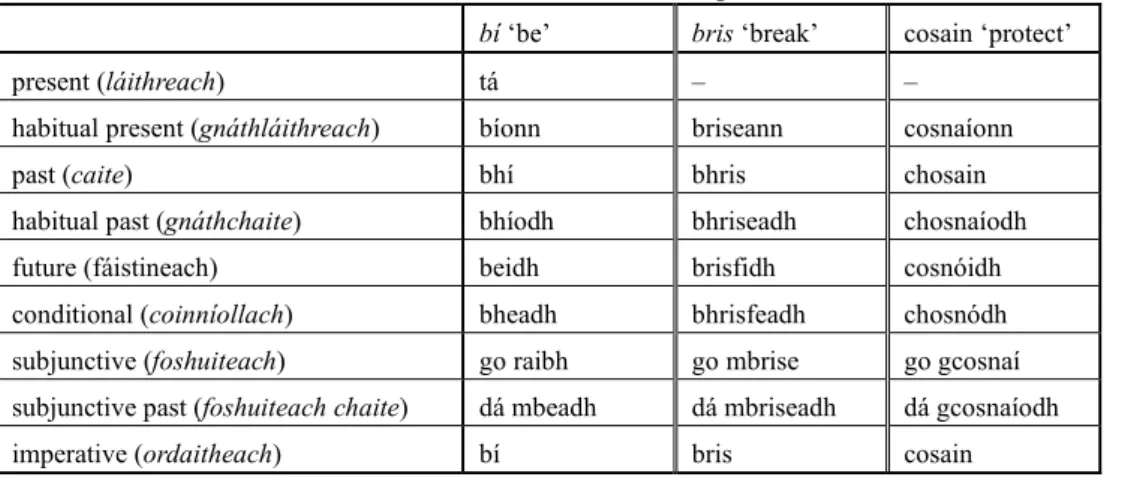
1.4.5. Verbs ... 19
1.4.5.1. Synthetic and Analytic Forms ... 20
1.4.5.2. Impersonal Form ... 21
1.4.5.3. Dependent Forms ... 21
1.4.5.4. Verbal Noun and Verbal Adjective ... 22
1.4.5.5. Defective Verbs ... 22
1.4.5.6. Substantial Verb and Copula ... 22
1.4.6. Relative Clauses ... 23
ii
1.5. Aspect and Voice System ... 24
1.5.1. Active Voice ... 25
1.5.1.1. Active Progressive ... 25
1.5.1.2. Active Perfective ... 26
1.5.1.3. Active Prospective ... 27
1.5.2. Passive Voice... 27
1.5.2.1. Passive Progressive ... 27
1.5.2.2. Passive Perfective ... 27
1.5.2.3. Passive Prospective ... 28
1.5.3. Impersonal Passive... 28
2. Previous Research ... 32
2.1. Typological Studies ... 32
2.1.1. Passive: Givón (1994) ... 32
2.1.2. Ergativity: Dixon (1994) ... 35
2.2. ‘be done’ Construction in Irish... 37
2.2.1. Na Bráithre Críostaí (1999)... 38
2.2.1.1. Syntax of Verbs ... 38
2.2.1.2. Morphology of Verbs ... 38
2.2.1.3. Verbal Adjective and Participles ... 39
2.2.2. Keenan and Dryer (2007) ... 43
2.2.3. Ó Siadhail (1989) ... 44
2.2.4. Nolan (2001) ... 46
2.2.5. Ó Sé (1992) ... 46
2.2.5.1. Historical and Typological Viewpoint ... 47
2.2.5.2. Semantic Viewpoint ... 48
2.2.5.3. Structural Viewpoint ... 50
2.2.6. Orr (1989) ... 52
2.2.7. Noonan (1994) ... 55
2.3. Summary ... 60
2.4. Questions and Problems ... 62
3. Corpora ... 65
3.1. Corpus for Contrastive Studies ... 65
3.1.1. Texts ... 65
3.1.2. Correspondence of Examples Between English and Irish ... 65
3.2. Corpus with 100 Verbs ... 67
3.2.1. Detail of Electronic Corpus... 67
3.2.2. List of 100 Verbs ... 67
3.2.3. Methodology ... 71
iii
4. Research Α: A Contrastive Study with English ... 80
4.1. Corpus and Methodology ... 80
4.1.1. Corpus ... 80
4.1.2. Methodology ... 80
4.2. Results ... 80
4.3. Consideration ... 82
4.3.1. Irish ‘be done’ Construction Correspondence ... 82
4.3.1.1. English Passive Construction... 82
4.3.1.1.1. Agent Phrases ... 84
4.3.1.1.2. Transitivity ... 88
4.3.1.1.3. Lexical Aspect ... 91
4.3.1.1.3.1. Non-Resultative ... 91
4.3.1.1.3.2. Resultative ... 94
4.3.1.2. English Perfect Construction ... 105
4.3.1.2.1. Agent Phrases ... 106
4.3.1.2.2. Transitivity ... 109
4.3.1.2.3. Lexical Aspect ... 110
4.3.1.2.3.1. Non-Resultative ... 110
4.3.1.2.3.2. Resultative ... 113
4.3.1.3. English Progressive Construction ... 114
4.3.1.4. English Simple Tense Construction ... 115
4.3.2. English Passive Construction Correspondence ... 117
4.3.2.1. Irish ‘be done’ Construction ... 117
4.3.2.2. Irish Impersonal Construction ... 118
4.3.2.2.1. Agent Phrases ... 119
4.3.2.2.2. Transitivity ... 121
4.3.2.2.3. Lexical Aspect ... 121
4.3.2.2.3.1. Non-Resultative ... 121
4.3.2.2.3.2. Resultative ... 124
4.3.2.3. Irish Simple Tense Construction ... 129
4.3.3. English Perfect Construction Correspondence ... 131
4.3.3.1. Irish ‘be done’ Construction ... 131
4.3.3.2. Irish Impersonal Construction ... 132
4.3.3.3. Irish After-Perfect Construction ... 133
4.3.3.4. Irish Simple Tense Construction ... 135
4.3.4. Misceallaneous Cases ... 136
4.3.4.1. Irish Constructions ... 136
4.3.4.1.1. Independent Use of Verbal Adjectives ... 136
4.3.4.1.2. Progressive Passive Construction ... 137
iv
4.3.4.1.3. Prospective Passive Construction ... 138
4.3.4.1.4. Light Verb Constructions ... 140
4.3.4.1.5. Idiomatic Use of the Impersonal Form ... 142
4.3.4.1.6. Constructions with the Substantive Verb bí ‘be’ ... 142
4.3.4.1.7. Combination ... 144
4.3.4.2. English Constructions ... 145
4.3.4.2.1. Independent Use of Past Participles ... 145
4.3.4.2.2. Constructions with the Copula Verb be ... 146
4.3.4.2.3. ‘have got’ in English ... 147
4.3.4.2.4. Ambiguous Auxiliary Verbs ... 147
4.4. Summary ... 148
5. Research Β: A Study with 100 Verbs ... 152
5.1. Corpus and Methodology ... 152
5.2. Results ... 152
5.2.1. How to Read ... 152
5.2.2. Transitivity Types ... 154
5.2.3. Data ... 156
5.2.3.1. Verbs with an ‘Inappropriately’ High Score (over 70%) ... 156
5.2.3.1.1. Overview ... 156
5.2.3.1.2. Syntactic Features ... 157
5.2.3.1.3. Consideration ... 157
5.2.3.2. Verbs with an Excessively High Score (40% to 70%) ... 159
5.2.3.2.1. Overview ... 160
5.2.3.2.2. Syntactic Features ... 160
5.2.3.2.3. Consideration ... 161
5.2.3.3. Verbs with a High Score (20% to 40%) ... 164
5.2.3.3.1. Overview ... 164
5.2.3.3.2. Syntactic Features ... 165
5.2.3.3.3. Consideration ... 167
5.2.3.4. Verbs with a Relatively High Score (10% to 20%) ... 172
5.2.3.4.1. Overview ... 173
5.2.3.4.2. Syntactic Features ... 173
5.2.3.4.3. Consideration ... 175
5.2.3.5. Verbs with a Moderate Score (5% to 10%) ... 182
5.2.3.5.1. Overview ... 183
5.2.3.5.2. Syntactic Features ... 184
5.2.3.5.3. Consideration ... 185
5.2.3.6. Verbs with a Relatively Low Score (3% to 5%)... 194
v
5.2.3.6.1. Overview ... 194
5.2.3.6.2. Syntactic Features ... 195
5.2.3.6.3. Consideration ... 196
5.2.3.7. Verbs with a Low Score (1% to 3%) ... 199
5.2.3.7.1. Overview ... 200
5.2.3.7.2. Syntactic Features ... 200
5.2.3.7.3. Consideration ... 202
5.2.3.8. Verbs with an Excessively Low Score (0.01% to 1%) ... 206
5.2.3.8.1. Overview ... 206
5.2.3.8.2. Syntactic Features ... 207
5.2.3.8.3. Consideration ... 209
5.2.3.9. Verbs with a Score of Zero (0%) ... 211
5.2.3.9.1. Overview ... 211
5.2.3.9.2. Syntactic Features ... 211
5.2.3.9.3. Consideration ... 212
5.2.4. Summary of Results ... 214
5.3. Analysis of Some Groups... 215
5.3.1. Consumption Verbs ... 215
5.3.1.1. Overview ... 215
5.3.1.2. Syntactic Features ... 216
5.3.1.3. Consideration ... 217
5.3.2. Perception Verbs ... 219
5.2.2.1. Overview ... 219
5.3.2.2. Syntactic Features ... 220
5.3.2.3. Consideration ... 222
5.3.2.2.1. clois ‘hear’ and feic ‘see’ ... 222
5.3.2.2.2. breathnaigh ‘observe’, éist ‘listen’ and féach ‘look’ ... 222
5.3.3. Aspectual Verbs ... 224
5.3.3.1. Overview ... 224
5.3.3.2. Syntactic Features ... 225
5.3.3.3. Consideration ... 226
5.3.3.3.1. tosaigh ‘begin’ and tosnaigh ‘begin’ ... 226
5.3.3.3.2. stad ‘halt’ and stop ‘stop’ ... 228
5.3.4. Motion Verbs ... 228
5.3.4.1. Overview ... 228
5.3.4.2. Syntactic Features ... 229
5.3.4.3. Consideration ... 230
5.3.4.3.1. imigh ‘go out’ ... 230
vi
5.3.4.3.2. rith ‘run’ ... 231
5.3.4.3.2. téigh ‘go’ ... 234
5.3.4.3.4. Others ... 235
5.3.5. Utterance Verbs ... 238
5.3.5.1. Overview ... 238
5.3.5.2. Syntactic Features ... 238
5.3.5.3. Consideration ... 238
5.3.5.3.1. luaigh ‘mention’ and léirigh ‘explain’ ... 239
5.3.5.3.2. abair ‘say’... 240
5.3.5.3.3. inis ‘tell’ ... 241
5.3.5.3.4. labhair ‘speak’ ... 242
5.3.5.3.5. freagair ‘answer’ and fiafraigh ‘inquire’ ... 243
5.3.6. Mental Verbs ... 244
5.3.6.1. Overview ... 244
5.3.6.2. Syntactic Features ... 245
5.3.6.3. Consideration ... 247
5.3.6.3.1. ceap ‘invent’ ... 247
5.3.6.3.2. Others ... 249
5.4. Syntactic Features and the ‘be done’ Construction ... 251
5.4.1. Syntactic Features and Scores ... 251
5.4.1.1. Ambitransitive Verbs and the ‘be done’ Construction ... 252
5.4.1.2. Indirect Transitive Verbs and the ‘be done’ Construction ... 254
5.4.2. Syntactic Features and Grammatical Subjects ... 256
5.4.2.1. Two Possibilities of the ‘be done’ Construction of Intransitive Verbs ... 256
5.4.2.2. The ‘be done’ Construction and Zero Subject ... 259
5.4.2.2.1. Impersonal ‘be done’ Construction ... 259
5.4.2.2.2. Apersonal ‘be done’ Construction ... 260
5.4.2.2.3. Consideration ... 261
5.5. Analysis of Person of Agents ... 262
5.5.1. Voice and Topicality ... 263
5.5.2. Simple Tense Construction versus ‘be done’ Construction in Irish ... 263
5.5.2.1. Simple Tense Construction ... 263
5.5.2.1.1. Results ... 264
5.5.2.1.2. Consideration ... 266
5.5.2.2. ‘be done’ Construction ... 267
5.5.2.2.1. Results ... 267
5.5.2.2.2. Consideration ... 269
5.5.3. Passive Construction in French ... 271
vii
5.5.3.1. Brief Summary of the Passive Construction in French ... 271
5.5.3.2. Corpus ... 271
5.5.3.3. Results ... 272
5.5.3.4. Consideration ... 273
5.5.4. Comparison ... 275
5.6. Summary ... 276
6. Conclusion ... 277
References ... 279
Appendix ... 281
viii
List of Table and Figures
Table 1: Underlying Consonantal System ... 5
Table 2: Underlying Vocalic System ... 6
Table 3: Lenition ... 7
Table 4: the Eclipsis ... 8
Table 5: Definite Article... 15
Table 6: Personal Pronouns ... 16
Table 7: Prepositional Pronouns of ag ‘at’ and ar ‘on’ ... 18
Table 8: Contrastive Clitics ... 18
Table 9: Verb Forms of bí ‘be’, bris ‘break’ and cosain ‘protect’ ... 19
Table 10: Relative Particle ... 23
Table 11: Aspect and Voice System ... 25
Table 12: Relative topicality of the agent and patient in the four main voices ... 35
Table 13: Verbal Adjectives Used in Munster Irish (at least 5 times) ... 51
Table 14: Verbal Adjectives Used in Donegal Irish ... 51
Table 15: Topicality of Agents and Patients in Verbal Clauses ... 57
Table 16: Topicality of Agents and Patients in Nominal Clauses ... 57
Table 17: Topicality of Agents and Patients in Participial Clauses ... 59
Table 18: Summary of Previous Research ... 61
Table 19: Corpus for Contrastive Studies (See Appendix 1 and Appendix 2) ... 65
Table 20: Corpus used for Research Β (see Appendix 3) ... 67
Table 21: List of 100 verbs ... 69
Table 22: Correspondences between the two languages ... 81
Table 23: Contents in this section ... 82
Table 24: Irish ‘be done’ / English Passive ... 83
Table 25: Irish ‘be done’ / English Perfect... 106
Table 26: Irish ‘be done’ / English Progressive ... 115
Table 27: Irish ‘be done’ / English Simple Tense ... 116
Table 28: English Passive / Irish ‘be done’ ... 117
Table 29: English Passive / Irish Impersonal ... 119
Table 30: English Passive / Irish Simple Tense ... 130
Table 31: English Perfect / Irish ‘be done’ ... 131
Table 32: English Perfect / Irish Impersonal ... 132
Table 33: English Perfect / Irish After-Perfect ... 134
Table 34: English Perfect / Irish Simple Tense ... 135
Table 35: Correspondence of the Irish ‘be done’ construction and English constructions... 150
Table 36: Data of Verbs ... 153
ix
Table 37: Data of Verbs (example) ... 154
Table 38: Verbs with an Inappropriately High Score (over 70%) ... 157
Table 39: Verbs with an Excessively High Score (40% to 70%) ... 160
Table 40: Verbs with a High Score (20% to 40%) ... 165
Table 41: Verbs with a Relatively High Score (10% to 20%) ... 173
Table 42: Verbs with a Moderate Score (5% to 10%) ... 183
Table 43: Verbs with a Relatively Low Score (3% – 5%) ... 194
Table 44: Verbs with a Low Score (1% to 3%) ... 200
Table 45: Verbs with an Excessively Low Score (0.01% to 1%) ... 207
Table 46: Verbs with a Score of Zero (0%) ... 211
Table 47: Consumption Verbs ... 215
Table 48: Perception Verbs ... 220
Table 49: Aspectual Verbs ... 225
Table 50: Motion Verbs ... 229
Table 51: Perception Verbs ... 238
Table 52: Mental Verbs ... 245
Table 53: Grammatical Subjects of Each Clause ... 256
Table 54: Relative topicality of the agent and patient in the four main voices ... 263
Table 55: Person of agents in the Irish simple tense construction ... 264
Table 56: Person of agent in the Irish ‘be done’ construction ... 268
Table 57: Person of agent in the French passive construction ... 273
Table 58: Summary of the Person of the Agent ... 275
Table 59: Split Ergative System in Irish ... 278
Figure 1: The Celtic Languages ... 3
Figure 2: The Language Map of Ireland [based on Údarás na Gaeltachta] ... 4
Figure 3: Score and Syntactic Features ... 252
x
Abbreviations and Symbols
Phonological Terms
L lenition e.g. bean /bʲan/ ‘woman’ > an bhean /ə vʲan/ ‘the woman’
E eclipsis e.g. Tóiceo /toːkʲoː/ ‘Tokyo’ > i dTóiceo /ə doːkʲoː‘in Tokyo’
h h-insertion e.g. éan ‘bird’ > na héin ‘the birds’
n n-insertion e.g. éan ‘bird’ > na n-éan ‘of the birds’
t t-insertion e.g. éan ‘bird’ > an t-éan ‘the bird’
i slendarisation (palatalisation) of a stem e.g. cat /kat/ ‘cat’ > cait /katʲ/ ‘of cat’
u broadening (velarisation) of a stem e.g. athair /ahəɾʲ/ ‘father’ > athar /ahəɾ/ ‘of father’
Grammatical Terms (Used for Irish)
- inflection DEF definite NOM nominative
= morpheme boundary DFCTV defective NP numeral particle
+ fusion DIM diminutive PL plural
() approximate meaning DIR direct PM past marker
1 first person DSJTV disjunctive POSS possessive
2 second person DU dual PRS present
3 third person F feminine PST past
ACC accusative FS future stem Q question marker
ADV adverb FUT future REFL reflexive
ATR attributive GEN genitive REL relative
C composing HPRS habitual present S substantive
CMPL complementiser HPST habitual past SG singular
CNJTV conjunctive IMP imperative SUBJ subjunctive
CNTR contrastive IMPERS impersonal VA verbal adjective
COMP comperative INDIR indirect VN verbal noun
COND conditional M masculine VOC vocative
COP copula NEG negative VP vocative particle
DAT dative
Grammatical Terms (Used Only for Other Languages)
<> internal inflection INF infinitive PFS perfect stem
AOR aorist INST instrumental PFV perfective
CONV converb IO indirect object PLPF pluperfect
E epethesis IPFV imperfective PREP prepositional
EMP emphatic N neuter PRN pronoun
ERG ergative OBL oblique PRV preverb
IMPF imperfect past PASS passive PTCP participle
INDEF indefinite PFM perfect marker
xi
Acknowledgement
I would like to express my sincere gratitude to my advisor Prof. Shinjiro Kazama for his continuous support to my dissertation and related research and for his patience, motivation, and immense knowledge. Being an undergraduate student, I was grateful that his guidance helped me during the entire course of my research. I could not have imagined having a better advisor and mentor for my dissertation.
I would also like to thank the rest of my committee, specifically Prof. Kazuyuki Urata and Associate Prof. Nobukatsu Minoura, for their insightful comments and encouragement and for the hard questions that intended me to widen my research from various perspectives.
Ordinary linguistic discussions with my friends in the seminar also immensely helped me to improve and organize my idea of the study. Talking to people with different fields of expertise always gives me new ideas.
The author would like to thank Enago (www.enago.jp) for the English language review.
Finally, I would also like to express my greatest gratitude to my family for their moral support and warm encouragements. If it were not for their help, I would be unable to finish this dissertation. Go raibh maith agaibh!
1 0. Introduction
Modern Irish has a VSO word order, exemplified in (1). There, léigh ‘read’ is the main verb, mé ‘I’ is the subject and an leabhar ‘the book’ is the direct object. Clauses with this basic word order will be called the ‘simple tense’ construction throughout the dissertation.
1) Léigh mé an leabhar.
lé-igh mé an leabhar-Ø read-PST 1SG.CNJTV DEF.M.NOM book.M-SG.NOM
‘I read the book.’
When the ‘be done’ construction is applied to it, it is rendered as (2). This construction is composed of the substantive verb bí ‘be’ (tá in the present tense) as an auxiliary verb and a verbal adjective1 (e.g.
léite ‘read (PP)’ < léigh ‘read’). In this case, the agent in the simple tense construction is demoted to a prepositional phrase with ag ‘at’, and the patient is promoted to the grammatical subject. In addition, an agent phrase can be omitted.
2) Tá an leabhar léite (agam).
tá-Ø an leabhar-Ø lé-ite ag-am be-PRS DEF.M.NOM book.M-SG.NOM read.VA at-1SG
‘The book is read (by me).’2
[example from Ó Siadhail (1989: 299)]
The ‘be done’ construction is sometimes called the perfective passive, but as Ó Siadhail (1989) points out, it can also be applied to intransitive clauses, as seen in (3). In this case, no syntactic operation can be observed, and the subject in the simple tense construction retains its grammatical status.
3) Tá sé imithe.
tá-Ø sé im-ithe be-PRS he.SG.CNJTV go.out.VA
‘He is gone off.’
[example from Ó Siadhail (1989: 300)]
The terminology for this construction varies among scholars, but in this study the author calls it the
‘be done’ construction based on its literal translation. However, in some studies this construction is
1 Traditionally called a verbal adjective (gl. aidiacht bhriathartha). It is often called a past participle and the terms verbal adjective and past participle are distinguished in some studies, but the former is adopted throughout the dissertation.
2 Ó Siadhail (1989) gives the translation ‘I have the book read’ for the agentful version. For the English translation, see
§2.2.
2 analysed as a split ergative system in the perfect aspect.
In this dissertation the author will carry out some research based on the text: Α) contrastive studies between Irish and English using a novel originally written in English Harry Potter and the Philosopher’s Stone and its Irish translation as well as a novel originally written in Irish Cré na Cille and its English translation and Β) corpus studies using 100 Irish verbs retrieved from the electronic modern Irish corpus Nua-Chorpas na hÉireann. Finally, the author will support the ergative analysis and clarify that the ‘be done’ construction is characterised in terms of the resultativity.
Unless there are special indications, in my survey, translations, glosses and text effects are mine.
Please note that translations of Irish examples are written word-by-word when possible. Consequently, even though the ‘be done’ construction is sometimes translated into English as passive in this dissertation, it does not necessarily mean that it is functionally a passive clause. In addition, second person pronouns are distinguished in number: thou / thy / thee for singular and you / your / you for plural. The terms typical of the Irish, Goidelic or Celtic languages, follow Ó Siadhail (1989).
In addition, please note that the morpheme analyses of the languages provided in the studies are based on their orthographies, so they do not necessarily reflect their exact structures.
3 1. On the Irish Language
In this chapter, an overview of the Irish language will be presented: classification of the language in
§1.1.; the three major dialects in §1.2.; phonology in §1.3.; grammar in §1.4; and the aspect and voice system in §1.5.
1.1. Classification
The Irish language (or the Irish Gaelic language) belongs to the Celtic branch of the Indo-European family. As shown in Figure, it belongs to the Goidelic (or Gaelic) languages of the Insular Celtic, along with Scottish Gaelic (Gàidhlig) and Manx (Gaelg). On the other branch of the Insular Celtic, the Brittonic languages of Welsh (Cymraeg), Cornish (Kernewek) and Breton (Brezhoneg) are found.
Indo-European Common Celtic
Insular Celtic Continental Celtic
Goidelic Brittonic
Irish (Gaeilge)
S. Gaelic (Gàidhlig)
Manx (Gaelge)
Welsh (Cymraeg)
Cornish (Kernewek)
Breton (Brezhoneg) Figure 1: The Celtic Languages
[based on Ó Siadhail (1989: 2)]
It is known that the Goidelic languages belong to Q-Celtic while the Brittonic languages belong to P-Celtic. In the former, a labialised velar plosive *kw reconstructed in the Proto-Indo-European corresponds to the Q sound while in the latter it corresponds to the P sound. For example:
4) Irish Welsh cf. Latin
cé pwy quis ‘who’
ceathair pedwar quattuor ‘four’
1.2. Dialects
Irish is spoken in Ireland, and UNESCO estimates the number of speakers to be about 44,000 people (2007; labelled as definitely endangered). Ethnologue estimates that about 138,000 are L1 speakers and 1,000,000 are L2 speakers (2012). Note that the total population in Ireland is approximately 6.60 million (4.80 million in the Republic of Ireland and 1.80 million in Northern Ireland).
4
Figure 2: The Language Map of Ireland [based on Údarás na Gaeltachta]
The Irish language is the first official language of the Republic of Ireland (the second is English) and is taught in schools and encouraged by the government. However, the majority of residents speak English, not Irish.
Areas in grey represent Irish-speaking areas, called Gaeltacht, where the residents speak Irish and signs such as traffic signs are written only in Irish.
Ireland is divided into four regions: Ulaidh (Ulster) in the north, Laighin (Lenster) in the east, Mumhain (Munster) in the south and Connachta (Connacht) in the west.
The standard language (called an Caighdeán Oifigiúil (en. ‘the Official Standard’)) has been artificially created for the grammar and the spelling, but there is no standard pronunciation. As for the dialects, the following three major dialects are known: Ulster, Munster and Connacht. In Leinster there remains no dialect and, according to Údarás na Gaeltachta (en. ‘the Gaeltacht Authority’), the Gaeltacht areas there are resettled communities from other areas.
Baile Átha Cliath (Dublin) Béal Feirste
(Belfast)
Gaillimh (Galway) Dún na nGall
(Donegal)
Port Láirge (Waterford)
Corcaigh (Cork)
Luimneach (Limerick)
ULAIDH (ULSTER)
LAIGHIN (LEINSTER)
MUMHAIN (MUNSTER) CONNACHTA (CONNACHT)
Poblacht na hÉireann (Republic of Ireland)
national border
provincial (dialectal) border Gaeltacht
(Irish-speaking area)
Tuaisceart Éireann – an Ríocht Aontaithe (Northern Ireland – the United Kingdom)
5
Dialect forms are often used even in the written language. The Irish language in this dissertation contains not only the standard language but also all the dialects.
1.3. Phonology
In this section, the descriptions are based on Ó Siadhail (1989) and present the topic of Irish phonology with some additional remarks. Discussed below are stress (§1.3.1.), the consonantal system (§1.3.2.), the vocalic system (§1.3.3.), the initial mutations (§1.3.4.) and the palatalisation and velarisation of a stem (§1.3.5.).
1.3.1. Stress
In Irish, stress is normally placed on the first syllable. However, there are some exceptions. For example:
5) Albain /ˈaləbən′/ ‘Scotland’ anocht /əˈnoxt/ ‘tonight’
dearmad /ˈd′arəməd/ ‘oblivion’ turnapa /tərˈnaːp/ ‘turnip’ (borrowings)
In addition, in some dialects—especially in Munster (southern Ireland)— the stress may be attracted to a long vowel.
1.3.2. Consonants
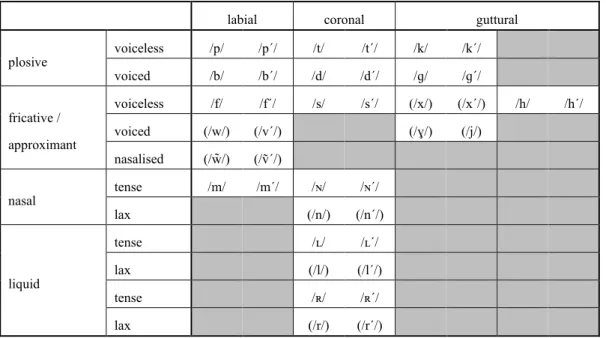
The underlying consonantal system, which includes all the dialects, can be shown as follows:
Table 1: Underlying Consonantal System
labial coronal guttural
plosive voiceless /p/ /p´/ /t/ /t´/ /k/ /k´/
voiced /b/ /b´/ /d/ /d´/ /ɡ/ /ɡ´/
fricative / approximant
voiceless /f/ /f´/ /s/ /s´/ (/x/) (/x´/) /h/ /h´/
voiced (/w/) (/v´/) (/ɣ/) (/j/)
nasalised (/w̃/) (/ṽ´/)
nasal tense /m/ /m´/ /ɴ/ /ɴ´/
lax (/n/) (/n´/)
liquid
tense /ʟ/ /ʟ´/
lax (/l/) (/l´/)
tense /ʀ/ /ʀ´/
lax (/r/) (/r´/)
[based on Ó Siadhail (1989: 82)]
There are some points to be noted:
6
i) The consonants are presented in pairs where the left one represents a broad consonant (a non-palatalised consonant, as a more general term) and the right one a slender consonant (a palatalised consonant). Traditionally, slender consonants are indicated with the symbol /´/ after corresponding broad consonants (except that here, in Ó Siadhail (1989), the slender /j/ corresponds to its broad counterpart /ɣ/, and the broad labial approximants /w/ and /w̃/ correspond to their slender counterparts /v´/ and /ṽ´/).
ii) Consonants in brackets initially occur only as a result of lenition (see §1.3.4.1.).
iii) Coronal nasals and liquids distinguish a tense consonant /ɴ/ /ʟ/ /ʀ/ and a lax consonant /n/ /l/ /r/, the symbols of which are typical in the Irish language and do not correspond to those of IPA.
iv) The slender fricative /h´/ is usually realised as its broad counterpart /h/.
1.3.3. Vowels
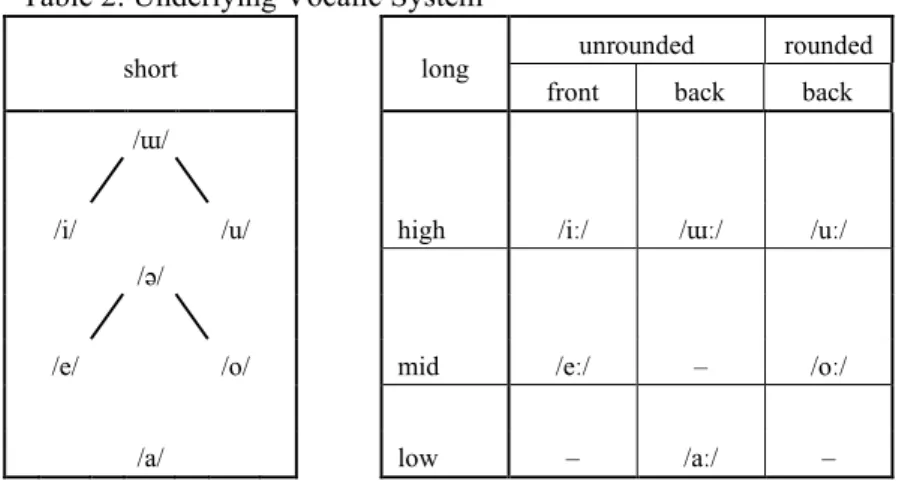
The underlying vocalic system, which includes all of the dialects, can be shown as follows:
Table 2: Underlying Vocalic System
short long unrounded rounded
front back back
/ɯ/
/i/ /u/ high /iː/ /ɯː/ /uː/
/ə/
/e/ /o/ mid /eː/ – /oː/
/a/ low – /aː/ –
[based on Ó Siadhail (1989: 35)]
There are some points to be noted here as well:
i) Short vowels are neutralised as /ə/ when they are not stressed, while long vowels retain their quality, even in the unstressed syllable.
ii) At a more abstract level, the high vowels /i/ and /u/ and the mid-vowels /e/ and /o/ can be neutralised as /ɯ/ and /ɵ/, respectively. Their appearance can be predicted from phonological environments: the back vowels will appear before a broad consonant and the front vowels before a slender consonant as
7 exemplified in (6).
6) liom /l´ɯm/ > /l´um/ ‘with me’ sop /sɵp/ > /sop/ ‘wisp’
linn /l´ɯɴ´/ > /l´iɴ´/ ‘with us’ soip /sɵp´/ > /sep´/ ‘wisp (GEN)’3
[examples from Ó Siadhail (1989: 36)]
iii) The long high vowel /ɯː/ normally becomes /iː/, /eː/ etc. according to the phonological environment.
As for diphthongs, the falling diphthongs /iːə/ and /uːə/ are counted as primary ones. In addition to these, some diphthongs which arise from the combination of a vowel and a semi-vowel, like /aj/, /aw/, etc., can be seen.
1.3.4. Initial Mutations
In Irish, the initial sound of a word may change according to its morpho-syntactic condition, which can be considered one of the most characteristic features of the Celtic languages.
As for such initial mutations, Irish has the following two types:
a) Lenition (Séimhiú, ‘attenuation’) b) Eclipsis (Urú, ‘eclipse’)
1.3.4.1. Lenition
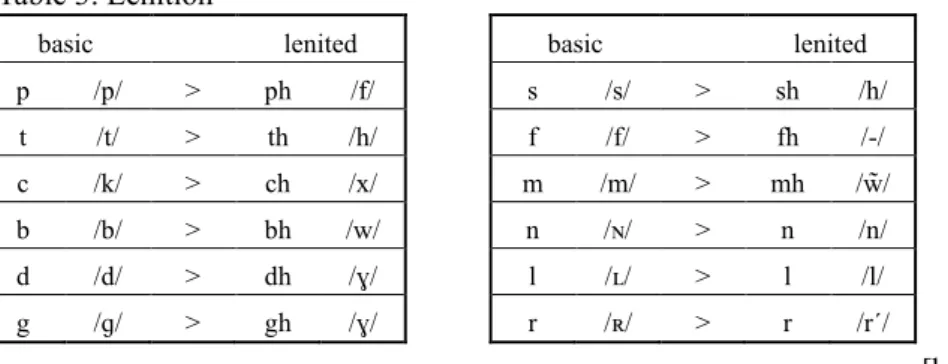
When a consonant is lenited, its spelling and sound will change as follows (here, broad variations of each consonant are given as representatives):
Table 3: Lenition
basic lenited basic lenited
p /p/ > ph /f/ s /s/ > sh /h/
t /t/ > th /h/ f /f/ > fh /-/
c /k/ > ch /x/ m /m/ > mh /w̃/
b /b/ > bh /w/ n /ɴ/ > n /n/
d /d/ > dh /ɣ/ l /ʟ/ > l /l/
g /ɡ/ > gh /ɣ/ r /ʀ/ > r /r´/
[based on Ó Siadhail (1989: 112)]
In summary, plosives become fricatives (in some cases they are not phonetically corresponding), /s/
3 I take responsibility for the correction. In the original text on pp. 36, he gives an example of this process as /sɵ´p/ >
/sep/ with a broad consonant at the end of its surface realisation. It may be a mistake, and on pp. 45 he gives a pronunciation as /sep´/ for the very same word.
8
becomes /h/, /f/ disappears, /m/ becomes /w̃/, and tense sounds /ɴ/ /ʟ/ /ʀ/ become lax ones /n/ /l/ /r´/ (the last one is also palatalised at the same time). Orthographically, this process is indicated with the letter h after a consonant (though in the old orthography with Gaelic type, it is indicated with a dot over a consonant, e.g. ċ for ch). As for the three tense sounds, basic forms and lenited forms are not distinguished, at least in orthography.
It occurs, for example, when the definite article appears before a feminine noun in the nominative singular (here, I was unable to find an appropriate example to explain it from Ó Siadhail (1989), so I have cited one from na Bráithre Críostaí (1999)4).
7) an bhean
anL bean-Ø
DEF.F.NOM woman.F-SG.NOM
‘the woman’ (cf. bean ‘woman’)
[na Bráithre Críostaí (1999: 27)]
In this dissertation, this morpho-phonological process will be indicated with the superscript of the capital letter L, as seen in (7), where the underlying anL bean is realised as an bhean in the surface structure.
1.3.4.2. Eclipsis
When a consonant is eclipsed, its spelling and sound change as follows (here, broad variations of each consonant are given as representatives):
Table 4: the Eclipsis
basic eclipsed basic eclipsed
p /p/ > bp /b/ b /b/ > mb /m/
t /t/ > dt /d/ d /d/ > nd /n/
c /k/ > gc /ɡ/ g /ɡ/ > ng /ŋ/
f /f/ > bhf /w/
[based on Ó Siadhail (1989: 112)]
In summary, voiceless plosives become voiced counterparts, voiced plosives become corresponding nasal consonants, and /f/ becomes /w/. Orthographically, this process is indicated with letter(s) representing a changed sound before a consonant concerned.
It occurs, for example, when the present positive question particle an appears before a verb, as observed in (8).
4 En. ‘the Christian Brothers’.
9 8) An mbriseann sé... ?
anE bris-eann sé
Q break-HPRS 3SG.M.CNJTV
‘Does he break... ?’
[example from Ó Siadhail (1989: 125)]
In this dissertation, this morpho-phonological process will be indicated with the superscript of the capital letter E, as in (8), where the underlying anE briseann is realised as an mbriseann in the surface structure.
1.3.4.3. Insertion
Apart from the two initial mutations, some consonants are placed before a word according to the morpho-syntactic environment. There are three types of inserted consonants:
a) h insertion – this occurs, for example, when the negative imperative particle appears before a verb beginning with a vowel:
9) Ná hól náh ól-Ø
NEG drink-IMP.2SG
‘Don’t drink’ (cf. ól ‘drink’)
[example from Ó Siadhail (1989: 122)]
b) t insertion – this occurs, for example, when the combination of a certain preposition and the definite article appears before a noun beginning with s:
10) faoin tsúil
faoi+ant súil-Ø under+DEF.F.NOM eye.F-SG.NOM
‘under the eye’ (cf. súil ‘eye’)
[an example from Ó Siadhail (1989: 127) with a translation]
c) n insertion – this occurs, for example, when the conjunction dá ‘if (hypothetical)’ appears before a verb beginning with a vowel (this kind of insertion is normally separated by a hyphen):
11) Dá n-íosfaidh sé é...
dán íos-f-aidh sé é
if eat-FS-FUT 3SG.M.CNJTV 3SG.M.DSJTV
‘If he were to eat...’ (cf. íosfaidh ‘eat (FUT)’)
[an example from Ó Siadhail (1989: 125) with a translation]
In this dissertation, this morpho-phonological process will be indicated with the superscripts of the
10
small letters h t n as in (9) – (11), where the underlying náh ól, faoint súil and dán íosfaidh are realised as ná hól, faoin tsúil and dá n-íosfaidh in the surface structure.
1.3.5. Palatalisation and Velarisation
In Irish orthography, the rule called Caol le Caol agus Leathan le Leathan (‘Slender with Slender and Broad with Broad’) is applied. In other words, slender (= palatalised) consonants must be surrounded by slender vowels (the letters e, i) and broad (= velarised or depalatalised) consonants by broad vowels (the letters a, o, u).
Then, when a word ends in a palatalised consonant, it ends with the combination -iC (e.g. clois
‘hear’)5. The palatalisation and velarisation can occur at the morphological level, such as in the formation of the genitive case: (12) is an example of palatalisation (/ɡasuːr/ > /ɡasuːr´/) and (13) of velarisation (/ahər´/ > /ahər/).
12) gasúr gasúir 13) athair athar
gasúr-Ø gasúr-i athair-Ø athair-u child.M-SG.NOM child.M-SG.GEN father.M-SG.NOM father.M-SG.GEN
‘a child’ ‘of a child’ ‘a father’ ‘of a father’
[based on Ó Siadhail (1989: 135-136)]
While it could seem to be an infix (*gasúr > gasú<i>r or *atha<i>r > athar), it, in fact, simply indicates the palatalisation of consonants. Therefore, if they were written in the Cyrillic alphabet, they would be гасу́р > гасу́рь (gasúr > gasúir) and атхарь > атхар (athair > athar).
In this dissertation, this morpho-phonological process will be indicated with the superscripts of the small letters i u, as in (12) and (13) where the underlying gasúr-i and athair-u are realised as gasúir and athar in the surface structure.
1.4. Grammar
In this section, a brief summary of Irish grammar will be explained. The description in this section is based on na Bráithre Críostaí (1999) (‘the Christian Brothers’), and all the examples are cited from this reference (note that not all the examples are from the section concerned).
1.4.1. Syntax
Irish has a VS / VSO constituent order, which is exemplified by an intransitive clause in (14) and a transitive clause in (15).
5 This i functions like мягкий знак (en. ‘soft sign’: palatalization sign) in Russian (e.g. угол ‘corner’ vs. уголь ‘coal’).
However, it is not placed in the end but inserted in the word.
11 14) Tháinig[V] sé[S].
L táinig-Ø sé
PM come-PST 3SG.M.CNJTV
‘He[S] came[V].’
[example from na Bráithre Críostaí (1999: 153)]
15) Bhris[V] an naíonán[A] an buidéal[P].
L bris-Ø an naíonán-Ø an buidéal-Ø
PM break-PST DEF.M.NOM infant.M-SG.NOM DEF.M.NOM bottle.M-SG.NOM
‘The infant[A] broke[V] the bottle[P].’
[example from na Bráithre Críostaí (1999: 294)]
More precisely, Irish syntax can be formularised as follows (N.B.: verbal particle includes ní [NEGATIVE], an [QUESTION], a [RELATIVE] etc.):
[mír bhriathartha] + briathar + ainmní [lena cháilitheoir] + focail eile ([verbal particle] + verb + subject [with its qualifier] + other words)
[based on na Bráithre Críostaí (1999: 294)]
In this study, I will refer to clauses like those in (14) and (15) as the simple tense construction, contrasting them with composed tenses, especially with the ‘be done’ construction presented in (2). In the simple tense construction, the S-argument of an intransitive clause and the A-argument of a transitive clause are regarded as a grammatical subject. When I use the term subject (position), it means the element just after the verb.
Here, their syntactic functions V, S, A and P are indicated after each element. However, in the following section they will be omitted, except in cases of special need.
1.4.2. Nouns and Adjectives
Irish nouns and adjectives have the following grammatical categories:
a) two genders (inscne):
• masculine (firinscneach)
• feminine (baininscneach)
b) two numbers (uimhir):
• singular (uatha)
• plural (iolra)
(in addition, a remnant of the dual (déach) can be seen)
12 c) four cases (tuiseal):
• nominative (ainmneach)
• genitive (ginideach)
• dative (tabharthach)
• vocative (gairmeach)
In addition, Irish adjectives have another category:
d) two degrees (céim)
• positive (cothrom)
• comparative (comparáide)
Irish nouns can be devided into five classes according to the formation of their genitive singular form (I: bád > báid ‘boat’; II: cos > coise ‘foot’; III: am > ama ‘time’; IV: rí > rí ‘king’ (unchanged); V: bráid >
brád ‘neck’).
1.4.2.1. Gender and Number
In Irish, two genders, masculine and feminine, are distinguished only in the singular, and their distinction is neutralised in the plural. In the gloss, as for nouns, a gender is indicated by its inherent properties, and I will gloss adjectives and articles with an M for masculine singular, F for feminine singular and PL for masculine / feminine plural.
For example, in (16) and (17) a gender is given for the nouns as their inherent properties (indicated by a dot) but for adjectives as inflectional properties (indicated by a hyphen). Then, a number is given only for nouns because if a gender is given for adjectives, the number is necessarily decided (there is no need to say M.SG or F.SG).
16) fear beag 17) bean bheag
fear-Ø beag-Ø bean-Ø L-beag-Ø man.M-SG.NOM little-M.NOM woman.F-SG.NOM ATR-little-F.NOM
‘a little man’ ‘a little woman’
[based on na Bráithre Críostaí (1999: 106, 107)]
Similarly, there is no need to say M.PL or F.PL because, as explaiend above, a gender is neutralised in the plural form, so it is good enough to use the simplified gloss PL, as in (18) and (19).
18) fir bheaga 19) mná beaga
fear-i L-beag-a mná beag-a man.M-PL.NOM ATR-little-PL.NOM woman.F.PL.NOM little-PL.NOM
‘little men’ ‘little women’
[based on na Bráithre Críostaí (1999: 106, 107)]
13
Incidentally, the gloss ATR (attributive) in the form of the lenition (see §1.3.4.1.), as used in (17) and (18), may seem to indicate a nominal category such as a feminine gender or a plural number, but it simply denotes an attributional relationship between a noun and an adjective in some mopho-syntactic cases. This occurs in various situations: in (17) a feminine singular nominative noun is modified by an adjective, and in (18) a masculine plural nominative noun is modified by an adjective. It is, however, inappropriate to gloss it as F.SG or M.PL. The most crucial reason for this is that the element ATR (attributive) is not limited to adjectives. For example, this lenition appears even when a feminine singular nominative noun is modified by a genitive singular noun, which does not have an inflexion for gender accordance, as seen in (20).
20) maidin gheimhridh
maidin-Ø L-geimhreadh-i morning.F-SG.NOM ATR-winter.M-SG.GEN
‘a winter morning’
[example from na Bráithre Críostaí (1999: 79)]
1.4.2.2. Cases
As shown above, Irish has four cases: nominative, genitive, dative and vocative. I will gloss them with the symbols NOM, GEN, DAT and VOC, respectively. However, these terms seem to need some explanation.
i) Nominative case (NOM):
21) Tháinig Seán.
L táinig-Ø Seán-Ø
PM come.PST Seán.M-SG.NOM
‘Seán came.’
[example from na Bráithre Críostaí (1999: 77)]
22) Bhris an naíonán an buidéal.
L bris-Ø an naíonán-Ø an buidéal-Ø
PM break-PST DEF.M.NOM infant.M-SG.NOM DEF.M.NOM bottle.M-SG.NOM
‘The infant broke the bottle.’
[example from na Bráithre Críostaí (1999: 294), identical to (15)]
As you can see in (21) and (22), nouns in the nominative case can serve as a subject or an object (a direct object).
14 ii) Genitive case (GEN):
23) mac Sheáin 24) trasna na tíre
mac-Ø L-Seán-i trasna na tír-e son.M-SG.NOM ATR-Seán.M-SG.GEN across DEF.F.GEN land.F-SG.GEN
‘Seán’s son’ ‘across the land’
[example from na Bráithre Críostaí (1999: 79)]
25) a mharú an éin
aL mar-ú an éan-i
to kill-VN DEF.M.GEN bird.M-SG.GEN
‘to kill the bird’ (lit. ‘to killing of the bird’)
[example from na Bráithre Críostaí (1999: 79)]
The genitive case has, of course, an attributive usage, as seen in (23). In addition to this, it is governed by some prepositions, as in (24), and is used as an object of a verbal noun, as in (25).
iii) Dative case (DAT):
26) ag mo chois 27) ar do láimh
ag moL cos-i ar do lámh-i at 1SG.POSS foot.F-SG.DAT on 2SG.POSS hand.F-SG.DAT
‘at my foot’ ‘on thy hand’
[example from na Bráithre Críostaí (1999: 80)]
Normally, the nominative case and the dative case have the same form. However, there are generally few words where the nominative and dative are morphologically distinguished. These words are the following (given as NOM / DAT): bos / bois ‘palm (of hand)’, bróg / bróig ‘shoe’, cluas / cluais ‘ear’, cos / cois ‘foot’, lámh / láimh ‘hand’ and Éire / Éireann ‘Ireland’6. Words other than these six, except for some idiomatic phrases, normally do not show a morphological distinction between the two cases, and there the dative case merges into the nominative case.
The dative case is not used independently but usually with prepositions like ag ‘at’ in (26), ar ‘on’ in (27), etc., which require the dative case for the noun. In other words, the term ‘dative’ is simply a traditional one, and its usage is similar to the prepositional case in Russian (e.g. в Москве ‘in Moscow’).
In this study, I will use the term dative and the gloss DAT in my analyses only when the noun concerned is explicitly marked as the dative case. When the noun does not have a (morphological) dative form, I will gloss it with NOM, even if it is governed by a preposition.
6 This word is not given in na Bráithre Críostaí (1999), but here it is worth mentioning.
15 iv) Vocative case
28) a Sheáin 29) a mharcacha
aL Seán-i aL marcach-a
VP Seán.M-SG.VOC VP rider.M-PL.VOC
‘Seán!’ ‘riders!’
[examples from na Bráithre Críostaí (1999: 55; 57)]
In the vocative case, the vocative particle a is needed, which requires the lenition of the following word. As for the form of nouns, in (28) it is identical to the genitive singular, but in (29) it has a special form with the ending -a.
In this study, I will use the gloss VP for the vocative particle and VOC for the noun in the vocative case.
1.4.2.3. Remnant of the Dual Number
The form identical to the dative case is also used after the numeral dhá ‘two’ in all cases except the genitive. This use can be considered a remnant of the former dual number, as shown in (30).
30) dhá bhróig déag
LdáL bróg-i déag two shoe.F-DU.NOM teen
‘twelve shoes’
[examples from na Bráithre Críostaí (1999: 36)]
In this study, I will gloss it as DU only when, again, the noun concerned is explicitly marked as the dual number. When the noun does not have a (morphological) dual form, I will gloss it with SG, even if it is placed just after the numeral dhá ‘two’.
1.4.3. Articles
Irish has only got a definite article, and does not have an indefinite article. The definite article is inflected according to the gender, the number and the case as follows:
Table 5: Definite Article
masculine feminine plural (M / F)
NOM an anL na
GEN anL na naE
DAT an an na
VOC – – –
a) Nominative and genitive
The definite article itself distinguishes only between the two forms an and na, but according to the initial mutations (L: lenition or E: eclipsis), it can be divided into the four forms an, anL, na and naE with six
16
functions (glossed as M.NOM, M.GEN, F.NOM, F.GEN, PL.NOM and PL.GEN, respectively).
b) Dative
The dative form of the definite article is identical to that of the nominative, but the process of the initial mutations will be different according to the preposition or dialect. In addition, it is amalgamated with some prepositions or the interrogative pronoun cé ‘what’ (the latter combination means ‘which’). The combinations are presented in (31).
31) de ‘of’ + an > den ‘of the’
i ‘in’ + na > sna ‘in the’
cé ‘what’ + an > cén ‘which’
[based on na Bráithre Críostaí (1999: 45)]
In this paper, regarding the gloss, such combinations will be indicated by the symbol ‘+’, as in the following examples: ‘of+DEF.M.NOM’ or ‘of+DEF.M.DAT’ (when an explicit dative case is used).
c) Vocative
The definite article does not have the vocative form.
1.4.4. Pronouns
Here, some characteristics of Irish pronouns are explained.
1.4.4.1. Conjunctive and Disjunctive Form The Irish personal pronouns are the following:
Table 6: Personal Pronouns
singular plural
conjunctive disjunctive conjunctive disjunctive
1st mé mé sinn, muid sinn, muid
2nd tú thú sibh sibh
3rd m sé é
siad iad
f sí í
[based on na Bráithre Críostaí (1999: 126)]
As you can see, there are two different forms of the second person singular (tú / thú ‘thou’) and third person singular / plural (sé / é ‘he’, sí / í ‘she’ and siad / iad ‘they’). They are morphologically distinguished according to their grammatical functions.
In (32) and (33), the forms in the left column are used as a subject just after the verb, while in (34) and (35) the forms in the right column are used as an object (i.e. not as a subject).
17
32) Ar chuala tú? 33) Chuaigh sé amach.
arL cuala-Ø tú L cua-igh sé amach
Q.PM hear-PST 2SG.CNJTV PM go-PST 3SG.M.CNJTV out
‘didst thou hear?’ ‘he went out.’
[examples from na Bráithre Críostaí(1999:126)]
34) Feicfidh sé thú. 35) Cheannaigh mé é.
feic-f-idh sé thú L ceann-aigh mé é
see-FS-FUT 3SG.M.CNJTV 2SG.DJSTV PM buy.PST 1SG.CNJTV 3SG.M.DSJTV
‘He will see thee.’ ‘I bought it.’ (lit. ‘I bought him’)
[examples from na Bráithre Críostaí (1999: 80; 141), partly omitted]
In examples (32) to (35), the difference between the two series of personal pronouns corresponds to their syntactic function—the subject in (32) and (33) and the object in (34) and (35)—so they are sometimes glossed as SUBJECTIVE / OBJECTIVE or as he / him, she / her and they / them using English personal pronouns.
However, such a glossing rule does not make sense, for example, in the case of a coordinated subject with the conjunction agus ‘and’ as in (36).
36) Rachaidh Seán agus í go Sasana.
rach-aidh Seán-Ø agus í go Sasana-Ø go.FS-FUT Seán.M-SG.NOM and 3SG.F.DSJTV to England.M-SG.NOM
‘Seán and she will go to England.’
[example from na Bráithre Críostaí (1999: 126)]
In (36) the grammatical subject is Seán agus í ‘Seán and she’, the second element of which belongs to that in the right column, while its syntactic function is apparently a subject. In other words, rigidly speaking, the distinction between a subject and object is not essential for Irish personal pronouns.
The most important thing used to distinguish them is whether or not the personal pronoun is placed just after the verb. In (32) and (33), it is placed just after the verb, but in (34), (35) and (36) they are not.
Because of this, Ó Siadhail (1989) calls them the conjunctive form and disjunctive form, which are indicated with CNJTV and DSJTV in this study.
The other personal pronouns mé ‘I’, sinn or muid ‘we’, and sibh ‘you’ do not show a morphological distinction between the two forms. However, I will gloss them with CNJTV and DSJTV according to their syntactic function (similar to the case of tú / thú ‘thou/you’, sé / é ‘he’, sí / í ‘she’ and siad / iad ‘they’).
1.4.4.2. Prepositional Pronouns
In Irish, some prepositions can be ‘conjugated’, i.e. they are combined with personal pronouns and become one single word. For example, the preposition ag ‘at’ and ar ‘on’ are inflected as follows:
![Figure 2: The Language Map of Ireland [based on Údarás na Gaeltachta]](https://thumb-ap.123doks.com/thumbv2/123deta/9806270.1884317/17.892.114.723.111.742/figure-language-map-ireland-based-údarás-na-gaeltachta.webp)