Effectiveness of the Environmental Soft Loan Program for Industrial Pollution Prevention:
A Case Study of JBIC’s Program in Indonesia and Thailand*
By
Akihisa MORI**
**Associate Professor, Graduate School of Global Environmental Studies, Kyoto University
Yoshida-Honmachi, Kyoto, 606-8501, Japan Fax +81-75-753-9203
Email:[email protected]
_________________
We are thankful to Ms. Emma Rachmawaty, Mr. Iman Wisnuadi, Mr. Anat Prapasawad, Mr. Hikaru Machita, Mr. Yasuaki Okita and Mr. Yasuo Fujita for giving us a chance to conduct interviews. All the possible errors are attributed to us. This article is partly supported by the Research Fund from the Faculty of Economic, Shiga University for Year
ABSTACT
The Japan Bank for International Cooperation (JBIC) has provided the financial assistance to establish an environmental soft loan program with several Asian countries. This article evaluates the effectiveness and impact of the program in Indonesia and Thailand, in view of the conditions and context in which it has brought effective industrial pollution control in Japan. It shows that the program proved to be ineffective for Japan, but that it definitely has developed the management capacity of Indonesia and the JBIC to implement the program in future.
Key words: Southeast Asia, Indonesia, Thailand, Japan, environmental soft loan, and industrial pollution
1. Introduction
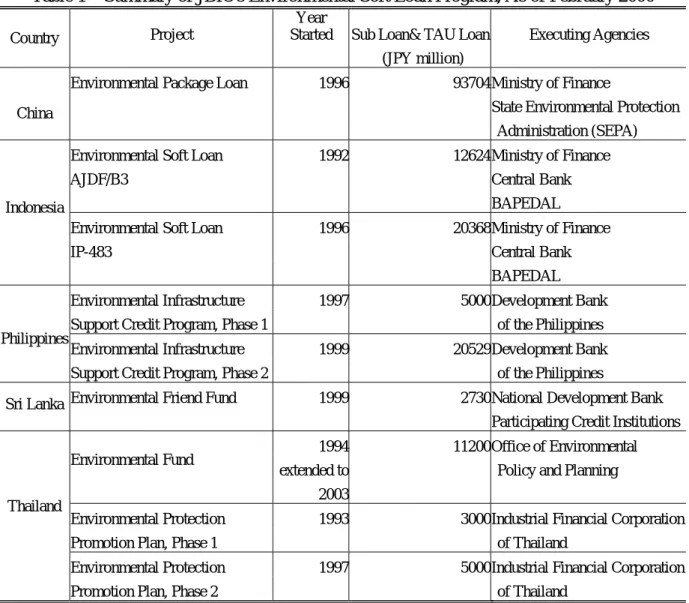
The Japan Bank for International Cooperation (JBIC, former Overseas Economic Cooperation Fund) has provided the financial assistance to establish environmental soft loan programs with several developing countries (Table 1). The program aimed for promoting pollution abatement investment in the industrial sector by providing financial resource at a subsidized interest rate. It also intended to enhance handling banks' capacity for loan in the environmental sector, because loans were to be provided to factories (end-users) through handling banks.
This environmental soft loan program is designed with due reference to the Japan’s pollution control experience (Konishi, 1996). It was one of the key policy instruments when the government tackled serious industrial pollution during the 1960s and 1970s. The central government embarked on the program to enforce stringent environmental regulation without
Table 1 Summary of JBIC's Environmental Soft Loan Program, As of February 2000 Project
Year
Started Sub Loan& TAU Loan Executing Agencies Country
(JPY million)
Environmental Package Loan 1996 93704 Ministry of Finance
State Environmental Protection
China
Administration (SEPA)
Environmental Soft Loan 1992 12624 Ministry of Finance
AJDF/B3 Central Bank
BAPEDAL
Environmental Soft Loan 1996 20368 Ministry of Finance
IP-483 Central Bank
Indonesia
BAPEDAL
Environmental Infrastructure 1997 5000 Development Bank Support Credit Program, Phase 1 of the Philippines Environmental Infrastructure 1999 20529 Development Bank Philippines
Support Credit Program, Phase 2 of the Philippines
Environmental Friend Fund 1999 2730 National Development Bank Sri Lanka
Participating Credit Institutions
1994 11200 Office of Environmental extended to Policy and Planning Environmental Fund
2003
Environmental Protection 1993 3000 Industrial Financial Corporation
Promotion Plan, Phase 1 of Thailand
Environmental Protection 1997 5000 Industrial Financial Corporation Thailand
Promotion Plan, Phase 2 of Thailand
hampering economic growth. Factories recognized investment on pollution abatement technology did not make any profit, but soft loans could reduce pollution abatement cost. The program was said to be effective in pollution reduction, especially in the sulfur dioxide emission reduction at that time in Japan (Lee, 1999; Mori, Lee and Ueta, 2003).
However, the environmental soft loan program may not have the same impact in developing countries as in Japan: social context as well as economic and financial institutional arrangements are different; the fund is financed by JBIC in most of the developing countries while by domestic source in Japan. In addition, JBIC program may not properly refer to the Japan’s experience in the 1980s when the limitation of the effectiveness became clear. In fact, several JBIC’s environmental soft loan programs are suspended or cancelled, while the water pollution has not been improved in rivers, and people have still been suffering from polluted tap water in several cities1.
Post-project evaluation reports have already been published with regard to the environmental soft loan program in Indonesia (TAU of OECF-PAE, 1997; JBIC, 2001) and Thailand, (Sasaki, Hayashi and Takagi, 2001). However, they could not evaluate the impact and the sustainability of the program in detail, for they did not focus the incentive and capacity building of the handling banks and appraisal institution.
In this article we elucidate the conditions and context where environmental soft loan program work effectively in pollution reduction, with special focus on the experience after the 1980s in Japan. Then we examine the sustainability of the program and impact of the JBIC program in Indonesia and Thailand and compare the conditions and context. Finally some implications are indicated to enhance the impact and its sustainability.
2. Conditions that Support the “Success" in the 1970s in Japan
At least four factors can be found behind the effective use of environmental soft loan program in Japan. First of all, it was implemented as a part of integrated pollution control measures. Policy integration was strongly required from firms, for compliance cost would become huge as the government tightened environmental regulations. Pushed by the wins of victims in the several pollution cases and those of the opposition party in local elections, local as well as the central government had to accept their requests. On the other hand, they wanted to soften the impact on the economic growth. As the regulation was tightened and extended to wider variety of pollutants, the environmental soft loan program was established and expanded to cover wider type of pollution abatement technologies (Table 2).
Local and prefectural governments played a vital role in implementing the program and in packaging it in the policy. They are delegated some administrative authority and have some latitude for innovation and experimentation in introducing environmental regulations and in raising revenue, though subject to strict control by the central government. The governors and mayors, along with members of council, are elected directly by residents.
Residents paid more attention to evaluating local and prefectural governments’ management performance in the late 1960s and 1970s when they inaugurated anti-pollution movements. Pushed by the election results, several local governments started to enhance regulation enforcement and/or create new regulation in order to reflect the intention of the residents. Some local governments also distributed the information and the availability of the environmental soft loan program when they visited factories and found incompliance with the standards. Prefectural governments supported the implementation of the program by conducting de facto technical appraisal2.
Table 2 Environmental Regulations and Environmental Soft Loan Program in Japan Environmental Regulations Development Bank of Japan JFCSB Japan Environmental Corporation 1958
Enactment of "Water Quality Preservation Law" and "Industrial Wastewater Control Law"
1960 started "Wastewater treatment
facilities loans"
1962
Enactment of "Smoke Exhaust Control Law" Revision of Industrial Water Supply Law
1963 started "Smoke prevention facilities loan"
1964
First pollution control agreement concluded Cancellation of the
investment on petrochemical complex in Mishima-Numazu
started "Industrial water
conversion project loan"
1965 Extend the lending target to nationwide
started "Industrial pollution control facilities loan" with limit to industries specified in the law
Establishment of the Environmental Corporation Started "loan for existing plants' soot and smoke prevention and wastewater treatment facilities in designated area"
1967 started "Industrial water
conversion project loan"
1968 Enactment of "Air Pollution Control Law"
started loans for big plants' sewage and soot and smoke treatment plants as part of factory expansion
started "low sulphurization of petroleum and heavy oil desulfurization loans"
Extend the lending target to
nationwide
1969
Establishment of the low sulphurization
target by the Advisory Committee for Energy 1970 Establishment of the Automobile Pollution Measures Enactment of "Waste Management Law"
started "loan for fuel-gas desulphurization plant"
started "Loans for facilities acquisition necessary for plant relocation"
1971
started "Pollution prevention loans"
started "Lead-free gasoline loans"
started "Waste disposal and discarded car disposal loans"
started existing plants' "noise prevention
facilities loans"
1972
Enactment of "Industrial Relocation Promotion Law" Victims' Win in Yokkaichi Air Pollution Case
started "LNG thermal power generation loans"
started "Pollution-free process conversion loans" started "Low sulphurization of oil loans"
started "Business change-over loans"
started existing plants' "odor prevention facilities loans" started industrial waste in-house disposal facilities loans
1973
Victims' Win in MInamata Case
Establishment of Conference for Promoting Measures against Mercury
started "Congestion and pollution relocation loans"
started loans for industrial waste disposal business
1974
started "Emergency measures for caustic soda production process change loans"
1978 started "Energy
conservation loans" 1979 Enactment of "Energy
Conservation Law"
introduced special lending rate for
"energy conservation loan" 1980 Enactment of "Alternative
Energy Law"
1981 started "alternative energy
loans"
1982 started "LPG loan"
Source: Konishi (1996)
The second factor is that loans were provided only for the facilities and technologies that had been established as a technical standard. The technical standard was established so that firms could ensure compliance with the environmental standard by investing them. It was established soon after the environmental soft loan program was embarked on, but it covered a limited pollutants and industries at the outset (Japan Environmental Corporation, 1976). The Ministry of Economic, Trade and Industry (METI, former Ministry of International Trade and Industry) was responsible for the review of the effectiveness of the technology. The METI was also active in expanding the target to cover wider pollutants and type of industries, and dispersing the information on a technical standard. To do this job effectively, METI held consultations and had cooperation with the handling banks and the Ministry of Health and Welfare, who was in charge of environmental health damage by the establishment of the Environmental Agency.
The technical standard approach had an advantage in lowering firms’ cost of compliance with the regulatory standards. Firms could choose proper abatement technology without hiring consultant services. They could also avoid duplication of the investment, for investment and proper operation of the standard technology would automatically ensure compliance. This helped handling banks reduce default risk, even without hiring in-house experts for technical appraisal3. Local governments could also ensure firms' compliance easily,
for they could give guidance to them in accordance with the technical standard. Finally, the technical standard approach encouraged the mass production of the specific types of pollution abatement technology, which might reduce the production cost.
The third factor is that the program was designed to enhance the access to small and medium size enterprises (SMEs) at the outset. SMEs can give rise to serious pollution problems because of huge number, even though individually each firm discharges only small amount of emission. On the other hand, most of them operate in a highly competitive market, and environmental regulation may threaten their viability if it requires too much additional cost. In addition, most of them face severe constraints in obtaining financial resources from big commercial banks with which the government can initiate a dialogue.
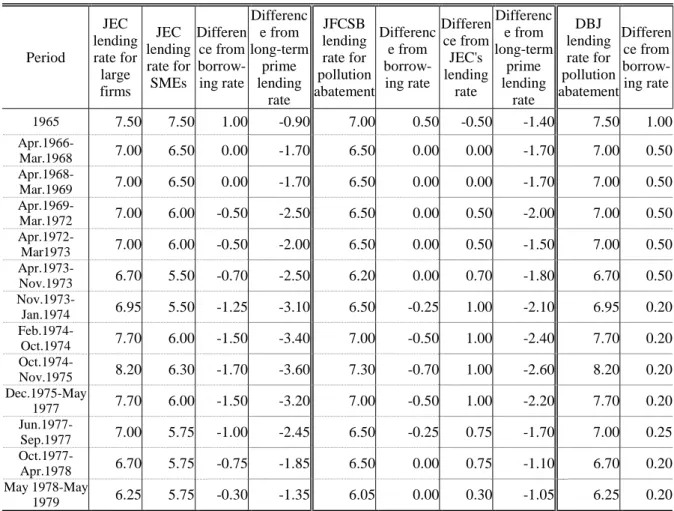
To tackle this issue and to avoid duplication of the function among handling banks, METI made a demarcation among them4, especially among Japan Environmental Corporation (JEC), Development Bank of Japan (DBJ) and Japan Financial Corporation for Small Business (JFCSB)5. First, target firms were demarcated. DBJ has provided most of the loan with big firms in a specific type of industry such as energy and steel, to offer financial support for Japan’s economic reconstruction. Thus it took the role of environmental soft loan program for such industries. JEC and JFCSB, by contrast, focused more on SMEs, especially those specified by the pollution control laws. Considering that most of their customers were SMEs, they provided the loan at more concessional conditions than DBJ6 (Table 3 and 4). In addition, to enhance SME's access they made as many local commercial banks and mutual trust funds to be their agents, because they did not have any local branch and these institutions had a clear advantage in providing loans with SMEs. This approach was also beneficial to JEC and JFCSB, for they could reduce cost of having local branches and enhancing financial appraisal capacity at each branch.
The target was also expanded in response to investment demand. METI had tried to obtain information on the investment needs in advance when it designed the environmental soft loan program in DBJ and JFCSB7. In JEC, on the other hand, the program was expanded in accordance with the strengthening local government's enforcement8.
The range of financing activities was also demarcated. JEC provided loan exclusively for investment on specific environmental technologies, factory relocation and industrial park with joint treatment plant. On the other hand, DBJ and JFSCB made environmental soft loans as a part of corporate finance, thus made them for installment and expansion of production technology9. Thus, institutionally, environmental soft loan program could flexibly adjust to firms' investment needs, might the invested technology be end-of-pipe or cleaner production.
Table 3 Lending Rate for Pollution Abatement Investment in JEC, JFCSB and DBJ, 1965-1979 (%)
Period JEC lending rate for large firms JEC lending rate for SMEs Differen ce from borrow-ing rate Differenc e from long-term prime lending rate JFCSB lending rate for pollution abatement Differenc e from borrow-ing rate Differen ce from JEC's lending rate Differenc e from long-term prime lending rate DBJ lending rate for pollution abatement Differen ce from borrow-ing rate 1965 7.50 7.50 1.00 -0.90 7.00 0.50 -0.50 -1.40 7.50 1.00 Apr.1966-Mar.1968 7.00 6.50 0.00 -1.70 6.50 0.00 0.00 -1.70 7.00 0.50 Apr.1968-Mar.1969 7.00 6.50 0.00 -1.70 6.50 0.00 0.00 -1.70 7.00 0.50 Apr.1969-Mar.1972 7.00 6.00 -0.50 -2.50 6.50 0.00 0.50 -2.00 7.00 0.50 Apr.1972-Mar1973 7.00 6.00 -0.50 -2.00 6.50 0.00 0.50 -1.50 7.00 0.50 Apr.1973-Nov.1973 6.70 5.50 -0.70 -2.50 6.20 0.00 0.70 -1.80 6.70 0.50 Nov.1973-Jan.1974 6.95 5.50 -1.25 -3.10 6.50 -0.25 1.00 -2.10 6.95 0.20 Feb.1974-Oct.1974 7.70 6.00 -1.50 -3.40 7.00 -0.50 1.00 -2.40 7.70 0.20 Oct.1974-Nov.1975 8.20 6.30 -1.70 -3.60 7.30 -0.70 1.00 -2.60 8.20 0.20 Dec.1975-May 1977 7.70 6.00 -1.50 -3.20 7.00 -0.50 1.00 -2.20 7.70 0.20 Jun.1977-Sep.1977 7.00 5.75 -1.00 -2.45 6.50 -0.25 0.75 -1.70 7.00 0.25 Oct.1977-Apr.1978 6.70 5.75 -0.75 -1.85 6.50 0.00 0.75 -1.10 6.70 0.20 May 1978-May 1979 6.25 5.75 -0.30 -1.35 6.05 0.00 0.30 -1.05 6.25 0.20
Note: JEC set 0.5% higher lending rate to the above one for loans beyond four years until March 1968. JFCSB and DBJ did the same until January 1974 and the period between June 1977 and April 1980. They set 0.3% higher rate in the period between February 1974 and June 1977 to mitigate the impact of oil crisis.
Source: the author made with reference to Japan Environmental Corporation (1991) and Bank of Japan, various years.
The last factor of the effectiveness of the environmental soft loan program in Japan is that the Fiscal Investment and Loan Program provided enough financial resources to the handling banks every year. The Program obtained financial resources from the public pension fund and postal savings programs at a repressed interest rate10. They are free from risk in fund-raising, so handling banks can adjust the amount of borrowing flexibly. This enabled them to widen the target to satisfy the increasing demand and to promote the firms’ pollution abatement investments.
It should be noted, however, that soft loans could not be provided without expenditure from the central government budget. As shown in Table 3, DBJ obtained a slice of margin to cover financial cost, while the lending rate was determined lower than the borrowing rate in JEC and JFCSB. To make the both ends meet, the central government provided subsidies with them from the general budget. The amount of subsidy was 9.5% of the annual lending, or 2.2% of annual revenue on average during 1966-80, though it varied according to loan demand.
Handling banks End-user (borrower)
Main target technology
Maximum loan
coverage ratio Lending rate a)
Repayment period b) Maximum amount of loan big business: 70% big business: 8.2% machinery: 15 years big business joint pollution
control plants
others: 80% others: 5.0% others: 20 years big business:
50%
big business: 8.2% small business individual pollution
control plants others: 80% others: 6.3% within 15 years Japan Environmental Corporation local governments industrial waste
disposal facility same as above 4.5-8.7% within 15 years none
pollution abatement
technology 50% 8.70% about 10 years waste recycling
technology 50% 9.90% about 10 years relocation of
polluting plants 50% 9.00% within 15 years Development
Bank of Japan big business
industrialization of
new technology c) 50% 8.00% 10-15 years none
pollution abatement
technology none 7.50%
relocation of
polluting plants none 8.4-9.4% Japan Finance
Corporation for Small Business
small business
industrialization of
new technology c) none 8.50%
within 15 years 150 million
yen
Note: a) as of end of March 1997. Lending rate during 1960-70s are shown in Table 3. b) Including 1-3 years of grace period.
c) Loan for environmental technological progress for Japanese companies. Source: Mori, Lee and Ueta (2003).
To summarize the discussion, (a) regulation-soft loan package with ex-post monitoring by local governments (b) establishment of technical standard at the early stage (c) design to ensure access from SMEs (d) easy access to low-cost fund raising source, were the key factors and conditions behind the successful experience of the environmental soft loan program in the 1960s and 1970s in Japan.
3. Factors that Hinders the Effectiveness
The demand for an environmental soft loan program has decreased since 1980s: the amount of loans for pollution abatement technology decreased after 1975 and the one for energy saving technology after 1981-82. Major factors can be depicted as (a) firms’ preference to cleaner production technology, (b) financial deregulation and liberalization, (c) setback in environmental policy and regulation in 1980s.
After the 1980s, more and more firms tended to invest on cleaner production technologies that are out of target of the environmental soft loan program. To comply with the regulation, many firms had little choice but to hurriedly invest on the end-of-pipe technologies in the 1970s. They found, however, that these technologies required them huge amount of investment and operational and maintenance (O&M) cost11. To reduce the O&M cost and/or to enhance the efficiency of the production process, firms tried to find cheaper and more productive alternative methods and technologies to invest on (Mori, 2002).
On the other hand, few cleaner production technologies has been established as a technical standard and has been added to the target of the soft loan program since 1980s. It is difficult to establish a technical standard for cleaner production technologies, for it takes longer time to develop them. Also, the government does not always have an advantage in developing them because they are firm/industry-specific in nature12. In addition, it was thought firms could and ought to invest on these technologies by themselves for several reasons: firms could finance investment on a commercial basis, for the investment would make profit to them.
In addition, as the deregulation and liberalization went on in the financial market, the lending rate in the market has been declining and sometimes got lower than the one offered by the handling banks. The handling banks usually borrow from the Fiscal Investment and Loan Program at a fixed interest rate with 1year repayment period, while provided loan with 5-20-year repayment period. This mechanism enables them to use repaid loan as a revolving fund and to lend several times. It does not work any more when the lending rate in the market gets lower, for end-users prefer to obtain loan from the market to make early redemption of the loans from the handling banks, while the handling banks was forbidden in principle. As a result, handling banks lost prominent customers and the financial position was getting worse.
To find new customers, the handling banks expanded the target. First, they embarked on the soft loan to the waste disposal and recycling industry when the several laws on waste management and recycling were enacted. Faced with the small collateral and high business risk in the industry, commercial banks are reluctant to provide loans with them. In addition, they expand the target end-users to cover the technology for business and domestic use and to loosen the loan condition13 (Japan Environmental Corporation, 1991; Development Bank of Japan, 2002). However, most of the end-users were new to the handling banks, which has not enhanced either technical nor financial appraisal capacity to ensure repayment and proper waste management and/or recycling14. As a result, they have gone through many default cases, which charged them higher reserve fund.
Furthermore, the handling banks, especially JEC, did not reduce the amount of disbursement even after the demand for environmental soft loan decreased. By the 1980s environmental quality had improved to some extent. But further improvement required total load control for many pollutants, which aroused strong opposition from the business. The government gave up tightening environmental regulation and making strict enforcement to
firms, and the demand for environmental soft loan decreased. Here relocation became one of the effective methods to settle conflicts on noise pollution, and to reduce hazardous wastewater discharge from SMEs. Then JEC increased the amount of investment on the industrial park equipped with joint treatment plants in outlying areas.
As time passed on, investment on industrial park was also employed as a tool to fulfill non-environmental policy goals such as attraction of factories in inner area. In addition, some firms could not relocate there due to lack of financial resources and others went bankrupt in the long depression in the 1990s. As a result, the cost-effectiveness of the environmental industrial park has declined and the financial position of JEC has worsened.
To summarize, the demand for environmental soft loans has necessarily declined when (a) cleaner production technology became the driving force for a firm's environmental management, or (b) market lending rate became low for the soft loan program to attract potential end-users. Cost-effectiveness of the program will be lost unless the government adjusts the amount of loan to the decreasing demand. It can be defined as the intrinsic limitation of the effectiveness of the environmental soft loan program.
In the next section, the article employs the above conditions and limitations as evaluation points and examines the design and operation of the JBIC's environmental soft loan program in Indonesia and Thailand.
4. Environmental Soft Loan Programs in Indonesia and Thailand
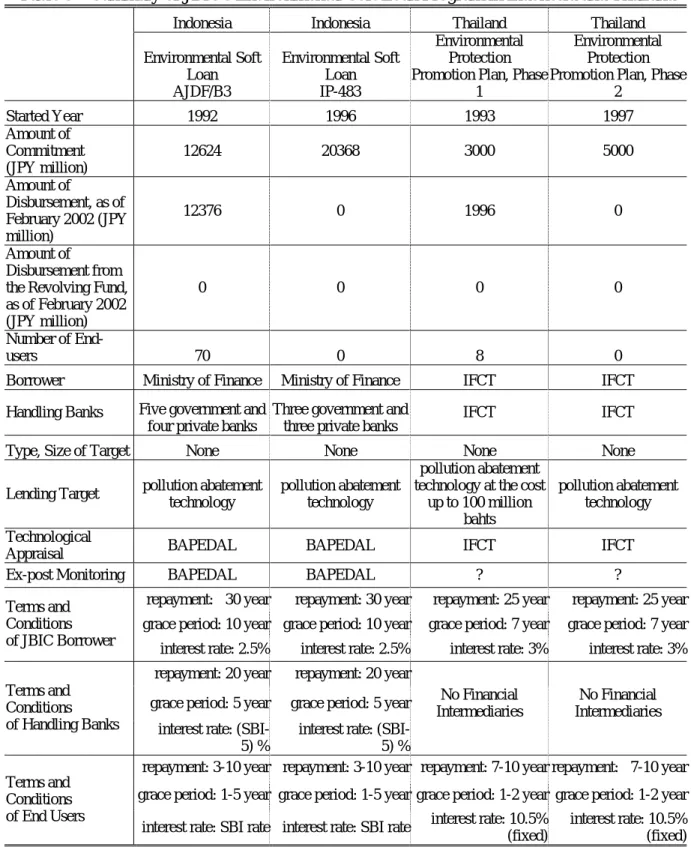
The scheme and performance of the JBIC's environmental soft loan program in Indonesia and in Thailand are summarized in Table 5. In Indonesia, a pilot phase of the environmental loan program, AJDF/B3, was launched in 1992, followed by a full-scale program, IP-483 in 1996. The loan was provided to end-users through three stages: first from JBIC to Ministry of Finance (then to the central bank: Bank Indonesia), second from Bank Indonesia to handling banks, and to third to end-users. Terms of conditions were less concessional in the latter stage, but the scheme was designed so that potential end-users could obtain soft loans promptly without harming handling banks' incentives to charge their functions. The handling banks were responsible for financial appraisal while the Environmental Impact Management Agency (Bapedal) took responsibility for technological one.
In Thailand, the pilot program (EPPP-1) as well as the full scale one (EPPP-2) were implemented at the same time as in Indonesia. However, the design was slightly different. The loan was provided only through two stages: from JBIC to Industrial Financial Corporation of Thailand (IFCT), and then to end-users. IFCT was appointed as the only handing bank, for it had long been the counterpart of the foreign financial assistance program and had mobilized financial resources in accordance with the government industrial policies. It employed a fixed
lending rate rather than a floating one. The maximum amount was prepared so that the loan would not concentrate on few end-users.
Table 5 Summary of JBIC's Environmental Soft Loan Program in Indonesia and Thailand
Indonesia Indonesia Thailand Thailand
Environmental Soft Loan AJDF/B3 Environmental Soft Loan IP-483 Environmental Protection Promotion Plan, Phase
1
Environmental Protection Promotion Plan, Phase
2 Started Year 1992 1996 1993 1997 Amount of Commitment (JPY million) 12624 20368 3000 5000 Amount of Disbursement, as of February 2002 (JPY million) 12376 0 1996 0 Amount of Disbursement from the Revolving Fund, as of February 2002 (JPY million)
0 0 0 0
Number of
End-users 70 0 8 0
Borrower Ministry of Finance Ministry of Finance IFCT IFCT Handling Banks Five government and
four private banks
Three government and three private banks
IFCT IFCT
Type, Size of Target None None None None
Lending Target pollution abatement technology
pollution abatement technology
pollution abatement technology at the cost
up to 100 million bahts
pollution abatement technology Technological
Appraisal BAPEDAL BAPEDAL IFCT IFCT
Ex-post Monitoring BAPEDAL BAPEDAL ? ?
repayment: 30 year repayment: 30 year repayment: 25 year repayment: 25 year grace period: 10 year grace period: 10 year grace period: 7 year grace period: 7 year Terms and
Conditions of JBIC Borrower
interest rate: 2.5% interest rate: 2.5% interest rate: 3% interest rate: 3% repayment: 20 year repayment: 20 year
grace period: 5 year grace period: 5 year No Financial Intermediaries
No Financial Intermediaries Terms and
Conditions
of Handling Banks interest rate: (SBI-5) %
interest rate: (SBI-5) %
repayment: 3-10 year repayment: 3-10 year repayment: 7-10 year repayment: 7-10 year grace period: 1-5 year grace period: 1-5 year grace period: 1-2 year grace period: 1-2 year Terms and
Conditions of End Users
interest rate: SBI rate interest rate: SBI rate interest rate: 10.5% (fixed)
interest rate: 10.5% (fixed) Note: Number of handling banks are reduced to six in IP-483, for several government banks were merged and one private bank was bankrupted after the economic crisis.
To compare the performance, almost all the fund was disbursed and seventy firms obtained loan in AJDF/B3 in Indonesia while one-third of the fund remained to be spent and only eight firms obtained loan in the EPPP-1 in Thailand. No loan has been provided so far from the revolving fund in both countries. In addition, no loan has been provided from IP-483 and EPPP-2, which are twice as large in the amount of commitment as in the pilot programs.
In the following subsections, we will clarify the differences in the performance in view of the factors depicted in the above sessions.
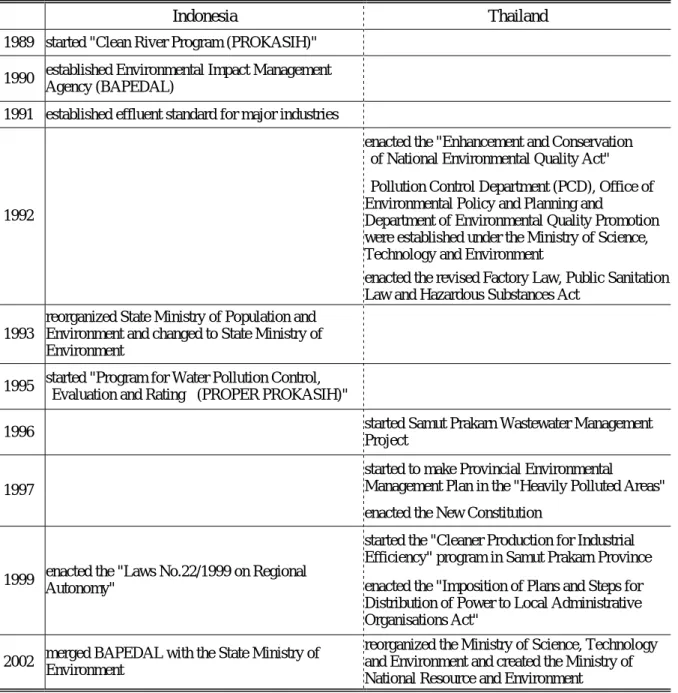
Table 6 Development of Environmental Administration in Indonesia and Thailand
Indonesia Thailand
1989 started "Clean River Program (PROKASIH)" 1990 established Environmental Impact Management
Agency (BAPEDAL)
1991 established effluent standard for major industries
enacted the "Enhancement and Conservation of National Environmental Quality Act"
Pollution Control Department (PCD), Office of Environmental Policy and Planning and
Department of Environmental Quality Promotion were established under the Ministry of Science, Technology and Environment
1992
enacted the revised Factory Law, Public Sanitation Law and Hazardous Substances Act
1993
reorganized State Ministry of Population and Environment and changed to State Ministry of Environment
1995 started "Program for Water Pollution Control, Evaluation and Rating (PROPER PROKASIH)"
1996 started Samut Prakarn Wastewater Management Project
started to make Provincial Environmental
Management Plan in the "Heavily Polluted Areas" 1997
enacted the New Constitution
started the "Cleaner Production for Industrial Efficiency" program in Samut Prakarn Province 1999 enacted the "Laws No.22/1999 on Regional
Autonomy" enacted the "Imposition of Plans and Steps for Distribution of Power to Local Administrative Organisations Act"
2002 merged BAPEDAL with the State Ministry of Environment
reorganized the Ministry of Science, Technology and Environment and created the Ministry of National Resource and Environment Source: the author.
In Indonesia and Thailand the environmental soft loan program was established when the central government embarked on tightening environmental regulations and enhancing its environmental management capacity to tackle increasing disputes between factories and residents (Table 6). Both recipient countries and JBIC expected an increasing demand for environmental soft loans, because tightening regulations would push firms to invest on pollution abatement technologies (JBIC, 2001).
In reality, however, demand did not increase as was expected. This resulted mainly from lax enforcement. The ministry which had regulatory authority did not have either a strong will or an enough capacity to conduct stringent enforcement. In addition, unlike in Japan, local governments, which could have conduct enforcement at their responsible areas, did not have either enough capacity or any authority to do so, even though they were urged to solve pollution problems by residents and NGOs15.
4.1.1 Integration with the Factory Act and the Pollution Control Area in Thailand
In Thailand, the Ministry of Industry and the Industrial Estate Authority of Thailand have an authority to enforce laws and regulations under the Factory Control Act. At the local level, provincial industrial offices, under the supervision of the governor in each province, oversee necessary legal matters including environmental regulations. However, there have been several cases where they failed to reduce pollution from factories. Such unsatisfactory outcomes derived partly from the inefficient administration by the provincial offices (Wongsekiarttirat, 1999), and partly from the passive attitude toward stringent enforcement on the part of the Ministry of Industry16.
In addition, provincial governors are not responsible for its council and residents. Governor and high-level administrators were appointed and sent among officials of the Ministry of Interior, and were subject to periodic transfer. Even if provincial governors want to respond to local opposition, they couldn't prepare enough resources. Officials are subject to the personnel management policy of the central ministries, and provincial governors cannot manage transfer and promotion of functional officials within their provinces. Provincial governments have few own revenue sources and most of the expenditures are financed by central subsidies that are come down directly to each branch. Local governments have not played any role in the industrial sector, because they had no authority under the Factory Act.
The National Environmental Bureau (NEB) designated several areas as pollution control areas and expected environmental soft loans to allocate firms located there. However, enforcement was not always conducted stringently in pollution control areas. Firms had stringer incentive to invest on pollution abatement technology in the areas where they faced fierce local opposition.
Furthermore, IFCT, the handling bank, had no formal relations with relevant ministries and provincial government. It did not obtain any information on the potential end-users, including type of industry and areas. Except the environmental agencies, either the ministries
or provincial government did not know the loan availability and did not distribute that information to the firms.
To summarize, the environmental soft loan program failed to be integrated into environmental policy either at the central or the local level. No agency conducted post monitoring and ensured firms’ compliance with regulations, thus several firms who obtained soft loan do not always operate the wastewater treatment plants. Also the demand for the soft loan was not increased, and IFCT disbursed the loan to any area, just in accordance with the "first come, first served" principle.
4.1.2 Integration with PROKASIH in Indonesia
In Indonesia, Bapedal is responsible for enforcing the Clean Water Program (PROKASIH) and PROPER PROKASIH, which evaluated firms' efforts toward BOD reduction and rated and disclosed to the public17. But its administrative capacity was quite limited. To conduct an effective enforcement, it invited provinces to participate in PROKASIH and each participating province was asked to assemble a local PROKASIH team, which would be responsible for identification of pollution source. Once identified, vice governors invited major polluters to sign a voluntary, legally non-binding pollution reduction agreement with the vice governor and the State Ministry of Environment (Rock, 2002).
In response, the environmental departments (Bapedalda) were established to enforce it in several provincial and local governments that had suffered from severe pollution problems from factories. They had incentives to implement PROKASIH stringently.
However, most of the regional/local governments had little incentive and capacity for stringent enforcement. Central dominance of the policy process reduced the responsiveness of regional/local governments and administrations to regional/local political and policy demands (Gerritsen and Situmorang, 1999). Either regional/local governors or mayors were not responsible for the residents. Minister of Home Affairs appointed half of the councilors in the local councils. The government controlled media and independent organizations in the civil society and sometimes intervened to environmental movements in the name of national security. In addition, higher levels of government were usually involved to some degree even in cases where particular services were the statutory responsibility of local governments. The system of fiscal transfers featured by the tight specification attending grants further inhibited provincial and local governments’ initiatives and autonomy. Most of the regional/local governments did not have strong will and enough capacity to implement PROKASIH.
In addition, local governments had no formal relations and cooperation with the handling banks and the Bapedal office in charge of environmental soft loans. They did not obtain information on the loan availability and could not distribute to the firms under the PROKASIH.
Handling banks, on the other hand, had no formal relations and cooperation with either regional/local governments or the Bapedal office in charge of PROKASIH. Then they made
loans just in accordance with the "first come, first served" principle, and without considering whether end-users were the firms under the PROKASIH.
Furthermore, there were little program coordination and budget allocation within the Bapedal. The office in charge of PROKASIH did not know well about the soft loan program and did not provide budget for post monitoring of the end-users.
To summarize, the environmental soft loan program was not effectively integrated into the PROKASIH and PROPER PROKASIH at any level. As a result, no agency could ensure either proper operation of the invested technology or compliance with the environmental regulations.
4.1.3 Compliance with EIA requirements
On the contrary, he environmental soft loan program happened to help firms to comply with the environmental impact assessment (EIA) requirements. Both Indonesian and Thai governments have enacted EIA laws and regulations, which require firms to submit EIA reports for government permission before they install new plants or expand existing ones. Firms and industrial estates have strong incentives to comply with EIA requirements, because it would minimize preparation and construction period by prompting bureaucratic procedures for permission, providing firms with tools for convincing local residents, even though EIA in both countries are evaluated as ineffective in ensuring due consideration to the environment18. For this reason, all the end-users who obtained environmental soft loans to invest new plants invested on the pollution abatement technologies and properly operated, managed and even upgrade them.
4.2 Design of the environmental soft loan program and the technological standard
JBIC and Indonesian and Thai government agreed that loans were allocated exclusively for investing on pollution abatement technologies, especially for wastewater treatment ones. In other words, the environmental soft loan program was employed as a measure to ensure firms' compliance to regulations. As shown in Japan’s experience, it is indispensable that the technical standard has been established in advance if the investment on that technology would bring the compliance with the regulations.
However, it was several years after the implementation of the program that the technical guideline was established for appraisal in both countries. Before the establishment, consultants were the only information source for both firms and appraisal body. In Thailand, end-users could comply with the standard even if IFCT did not have appraisal capacity, because most of them were large and could hire internationally qualified consultants. On the other hand, several end-users could not comply with the regulations and had to make further investments to replace the technology in Indonesia, because the consultant could not show an appropriate technology and the Bapedal could not make accurate appraisal.
Even though end-users selected appropriate technologies, most of them were end-of-pipe ones, which made little profit to them. As a result, six out of eight end-users has suffered from default after the economic crisis in Thailand19. The problem is more serious in Indonesia, for not only several of them have suffered from default, but also BAPEDAL suffered from firms’ loan diversion into production purpose20 (Bank Indonesia, 1999).
To cope with these problems, the program was adjusted to expand to include cleaner production technologies in EPPP-2 in Thailand. In Indonesia, Bapedal allowed firms to choose it as long as they invested on the end-of-pipe technology at the same time during the implementation of the pilot stage (AJDF/B3). Nonetheless, demand for environmental soft loans has no longer increased in both countries after the economic crisis. In Thailand demand was so small that it took long time to lend out all the amount of the fund in the EPPP-1 even before economic crisis. No loan has been made from the EPPP-2. In Indonesia, a few firms obtained loans to invest on the cleaner production technology. But most of them are facing default due to either the inappropriate specification of the technology or skyrocketing of the investment cost after the economic crisis.
To summarize the above findings, lack of technical guidelines and standards made end-users and appraisal body relied on consultant services, which caused investment on improper or ineffective technology in several cases. However, establishment of technical standards for end-of-pipe technology, as had conducted in Japan, might not be a solution any more, for firms prefer cleaner production technology. Unlike the situation in the 1970s in Japan, there are plenty of cleaner production technologies in developed countries. Export-oriented large firms in developing countries can obtain information on the latest environmental technologies. But end-users, especially SMEs might suffer heavily from the lack of the technical standard unless technical guidelines on cleaner production technology are established and distributed to them.
4.3 SME's access
Besides the access to technological information, the design and operation of the program itself put disadvantage to SMEs, while they'd been regarded as the main target under the agreement between JBIC and the governments in both countries. The disadvantage is quite obvious in Thailand, where no measure has been prepared to ensure easy access to the handling bank. Either the government or JBIC did not require IFCT to set up a special section to implement the program within the bank, as like DBJ and JFCSB in Japan21. IFCT had little incentive to adjust existing financial agreements and activities to ensure SME’s easy access. What IFCT did was just to distribute leaflets to the existing customers and waited them to come. Most of the SMEs, however, did not know how to access to IFCT loans, because they'd conducted no financial transactions before. In addition, they had to pay for travel cost to visit IFCT's Bangkok office when submitting application and be reviewed for appraisal. As a result,
no application came from SMEs and most of the end-users turned out to be the existing big customers.
In Indonesia, the program ensured easy access to many big firms. This is partly because the central bank (Bank Indonesia) and JBIC appointed five government and four private banks as handling banks, considering the predominance in the government commercial bank’s share in the total lending, and their reluctance to lend to the private sector22. However, SMEs did not ensure easy access, for few of them had experienced any financial transaction with these handling banks. Several SMEs could not obtain soft loans because handling banks had difficulty in finding collateral and refused to provide loans to them.
These SMEs might have obtained loans at least later on, had the revolving fund worked effectively. But it did not work at all, because there created no central mechanism that got all the repayments together to monitor the management. Then each handling bank had its own revolving fund and did not transfer the repayment to other banks. It did not provide loans for firms that were affiliated with other handling banks. As a result, mismatch of the fund allocation occurred. On the one hand, potential end-users could not obtain soft loan if their affiliated handling banks did not have enough revolving fund. On the other hand, other handling banks had enough revolving fund but did not find end-users among their affiliated firms23. This mismatch became serious after the economic crisis, for several handling banks went bankrupt and were restructured under the Indonesian Bank for Restructure Agency on the one hand, and demand for pollution abatement investment had shrunk on the other hand. Then several handling banks are suspected to provide environmental soft loans for non-environmental purpose.
4.4 Financial sources
The environmental soft loans in both countries were financed by JBIC's loan in terms of Japanese yen. Unlike Japan where most of the fund was financed by the domestic public sources, this posed both countries a burden of foreign exchange risk.
In Thailand, the government did not provide any financial assistance or guarantee for foreign exchange risk, while it had done in the past foreign assistance programs. IFCT has prime responsibility for the risk. To keep the financial soundness, it shifted all the burdens onto the end-users. In other words, it fixed the lending rate at 10.75% in EPPP-1, reflecting swap cost, spread, fees and reserves for default risk of end-users. As a result, firms did not regard the terms of condition as subsidized and few of them were attracted for them. The program completely lost the advantage after the economic crisis, when the commercial lending rate got lower than the one of the environmental soft loan program24. The lending rate was set lower in EPPP-2, but demand did not increase any more, partly because end-users had to burden the foreign exchange risk without any guarantee from the government and IFCT.
Table 7 The Financial Burden of Environmental Soft Loan Program to Ministry of Finance in Indonesia(% of JBIC loan)
Average 1992-96 Average 1992-97
Lending rate for end-users (year average) 11.73 11.74 Rate of currency depreciation to Japanese yen 6.52 7.31
Spread to handling banks 5.00 5.00
Borrowing rate from JBIC 2.50 2.50
Spread to Ministry of Finance -2.29 -3.07
Note: Economic crisis was started in 1997.
Source: The author calculated based on JBIC (2001) and Bank Indonesia (2001).
On the contrary, the Ministry of Finance took the foreign exchange risk burden in Indonesia. Then handling banks could provide the loans at the same rate as the central bank bond (SBI) interest rate even after they secured a 5% interest spread for each loan. As the currency was declining continually, the burden amounted to 2.3-3.1% of total amount of the fund (Table 7). This burden will reveal explicitly when the government repays the loan to JBIC.
To summarize the discussion, the program may easily lose the advantage in the terms of conditions as long as it relies on foreign financial source. This is true especially when the government precedes liberalization in the financial and capital market, as shown in the section 3. Financial support from the government general budget may help it, but it may increase the government foreign debt implicitly.
5. Impact of the Program and Its Sustainability
The experience of the environmental soft loan program, nonetheless, has made positive impacts upon the environmental capacity development in Indonesia and Thailand later on. Environmental departments started to integrate the financial instruments with regulation enforcement, and have created technical standards, including cleaner production technologies. In Thailand, PCD started the "Cleaner Production for Industrial Efficiency Program," in which regulation enforcement, user charge and IFCT's financial support were integrated25. PCD held an international seminar on pollution abatement technology and financial instruments, and embarked on establishing technical standard for process as well as end-of-pipe technology jointly with the Ministry of Industry. In Indonesia, the Bapedal tries to make regulation enforcement, financial support and environmental capacity development into a package in the Kreditanstalt fur Wiederaufbau’s (KfW) environmental soft loan program26. As a result, now handling banks regards loans to the environmental sector as prospective and they try to find new customers among SMEs. The technical guideline that was completed in the last process of JBIC's soft loan program, has been expanded to include process technology, and has done much for the effective operation of the KfW program.
Later on, it also made an impact on the design of the JBIC's environmental soft loan program in other developing countries. When it provided the environmental soft loan program in the Philippines, it adjusted the program design in order to:
(a) enhance regulation-soft loan package with stringent post monitoring. To ensure the enhancement, it selected the Development Bank of the Philippines as a sole handling bank in view of competence and willingness for the technical and financial appraisal and for the close collaboration with regulatory bodies. It also keeps aside the budget for post evaluation of the environmental performance in the loan program
(b) establish a technical standard that include cleaner production technology, and give training to the staff of the local as well as head office of the handling bank by keeping aside the budget for it
(c) ensure SME’s access by focusing on the specific area and on the specific pollution problem, i.e., water pollution in Metro Manila and Lake Laguna (Laguna de Bai)
The sustainability of the impact of the program and of the environmental performance, however, remains to be examined. Also it might be considered as exception that the Development Bank of the Philippines accepted the finance to technical assistance by loan, not by grant. In anyway, it seems this adjustment implies the future direction for developing environmental soft loan program.
6. Conclusion and Future Challenges
This article elucidates that the environmental soft loan program was implemented in Indonesia and Thailand without due consideration to the differences of the conditions and contexts that brought off a success in Japan -- regulation-soft loan package, establishment of technical standard at the early stage, ensuring SME’s access and domestic public financial source. It finds out the causes rested on both donor and recipients: recipient countries lacked administrative authority and financial source to satisfy the conditions, while JBIC has not designed the program to complement the deficiency and made little adjustment to solve the inconsistency. This resulted in the end-users' diversion of the environmental soft loans to the productive purpose, investment on inappropriate technology and improper operation and management of the technology. Economic crisis has further damaged the effectiveness and sustainability of the program because the terms of conditions of the environmental soft loans became less favorable to the one of the market loans.
Despite the poor performance, it seems potential demand for environmental soft loan will not vanish as long as the government takes stringent measures for swift pollution reduction. In addition, adjustment in the design and the change in the regulatory circumstances can enhance the effectiveness of the program, as examined in section 5. In
view of the Japan’s experience, additional measures are required to enhance the impact and its sustainability of the environmental soft loan program. The one is the expansion of the loan target to include investment on production purpose, as DBJ and JFCSB did in Japan. This measure has an advantage in both attracting firms and promoting investment on the latest, less pollution discharge technology, though it requires adequate appraisal capacity to assess technical and cost appropriateness in the government or in the handling banks. The government may adjust the scheme to allow loans only for those who invested on end-of-pipe technology if it wants firms’ compliance with the regulations.
The other measure is the provision of the technical assistance within the regulation-soft loan package. In Japan, several big municipalities took the lead in pollution control, but they could not clarify scientific relations between cause and damage unless the central government gave technical assistances (Mori, 1999a). In developing countries, it may not be expected that all the municipalities that are suffering from pollution can obtain technical assistance. Some of them might already obtain it as a grant, but it has little, if any, relations with the environmental soft loan program. It would be critical to create the institutional arrangement that can conduct regulation enforcement, technical assistance and the soft loan program within a package.
Finally, to keep the advantage of the program and to reduce the government burden, it becomes necessary to find out proper domestic financial sources, such as public pension fund or environmental tax. Until now, however, collection has not enforced effectively. This issue remains to be examined in the future.
References
Bank Indonesia, 2001. Indonesian Financial Statistics, May 2001.
Bank Indonesia, 1999. Project Completion Report in Respect of Loan No. IP-AJDF/B3. Unpublished internal material.
Bank of Japan, Economic Statistics Annual. various years.
Development Bank of Japan, 1976. A Twenty-five Years’ History of JDB. (in Japanese) Development Bank of Japan, 2002. The History of JDB. (in Japanese)
Gerritsen, Rolf and Saut Situmorang, 1999. “Beyond Integration? The Need to Decentralize Central-Regional/Local Relations in Indonesia,” in Mark Turner (ed.), Central-Local
Relations in Asia-Pacific: Convergence or Divergence? Hampshire: MacMillan Press Ltd.
International Monetary Fund, 2001. International Financial Statistical Yearbook 2001. Washington D.C: IMF.
Japan Bank for International Cooperation (JBIC), 2001. "Indonesia AJDF category B/ Small Scale Industry and Pollution Abatement," Japan Bank for International Cooperation (ed.),
Post Evaluation Report 2001, pp.364-375.
Japan Bank for International Cooperation (JBIC), Annual Report of the JBIC. Various years. Japan Environmental Corporation, 1976. A Ten Years’ History of JEC. Tokyo: Gyosei. (in
Japanese)
Japan Environmental Corporation, 1991. A Twenty-five Years’ History of JEC. Tokyo: Gyosei. (in Japanese)
The Japan Soda Industry Association, 1982. A Hundred Year’s History of Japanese Soda
Industry. (in Japanese)
Konishi, Aya, 1996. "Public Lending Scheme for Pollution Control in Japan," OECF Journal
of Development Assistance, Vol.2, No.1, pp.137-161.
Lee, Soo Cheol, 1999. Environmental Subsidies by Fiscal Investment and Loan in Japan, The
Research and Studies (Kyoto University Economic Society), Vol. 18, pp.30-48. (in
Japanese)
Mori, Akihisa, 2002. "Industry and Water Management in Shiga Prefecture." The Asian
Journal of Biology Education, Vol.1, No.1. pp.59-71.
Mori, Akihisa, 2000. "Features and Challenges of Japanese Environmental ODA: With Special Focus on the Environmental Assistance Projects in Thailand," Journal of
International Development Studies, Vol. 9, No.1, pp.21-39. (in Japanese)
Mori, Akihisa, 1999a. "Local Environmental Capacity Building amid Rapid Industrialization: A Review of the Experience in Osaka Prefecture Government," Working Paper No.57. Faculty of Economics, Shiga University.
Mori, Akihisa, 1999b. "Local Environmental Capacity Building in Thailand: A Japanese View," Setsutaro Kobayashi Memorial Fund: Kobayashi Fellowship Program A Research
Mori, Akihisa, Soo Choel Lee and Kazuhiro Ueta, 2003. "Some Economic Aspects of Environmental Soft Loan Program in Japan," World Bank Institute (eds.), Promoting
Practical Environmental Compliance and Enforcement Approaches in East Asia,
forthcoming.
O'Conner, David, 1994, Managing the Environment with Rapid Industrialization: Lessons
from the East Asian Experience. Paris: Organisation for Economic Cooperation and
Development.
Pargal, Sheoli and David Wheller, 1996. "Informal Regulation of Industrial Pollution in Developing Countries: Evidence from Indonesia," Journal of Political Economy, Vol.104, No. 6. pp.1314-1327.
Rock, Michael T., 2002. Pollution Control in East Asia: Lessons from Newly Industrializing
Economies. Washington DC: The Resource for the Future Press.
Smoke, Paul and Blane D. Lewis, 1996. "Fiscal Decentralization in Indonesia: A New Approach to an Old Idea," World Development, Vol.24, No.8, pp.1281-1299.
Sasaki Toshiharu, Kingo Hayashi and Ken Takagi, 2001."Environmental Protection Promotion Program in Thailand," Japan Bank for International Cooperation (ed.), Post
Evaluation Report 2001. pp.36-39.
Technical Assistance Unit (TAU) of OECF-PAE, 1997. BAPEDAL-OECF Pollution
Abatement Equipment (PAE) Environmental Soft Loan Program: TAU Final Report.
Wongsekiarttirat, Wathana, 1999. “Central-Local Relations in Thailand: Bereaucratic Centralism and Democratization,” in Mark Turner (ed.), Central-Local Relations in
Asia-Pacific: Convergence or Divergence? Hampshire: MacMillan Press Ltd.
World Bank, 1994. Indonesia: Environment and Development. Washington D.C.: The World Bank.
Yap, Norita T., 1994. "Environmental Assessment: The Process in Thailand and Canada," in Goodland, Robert and Valerie Edmundson (eds.), Environmental Assessment and
Note
1
See the details in the Jakarta Post, November 20, 2000; September 14, 2001; November 24,
2001; December 6, 2001; and September 5, 2002.
2
De facto monitoring by prefecture governments helps handling banks to ensure firms’ compliance with environmental regulations. Handling banks also conduct appraisal and ex-post monitoring on the compliance with the loan agreement. They prepare penalty to the non-compliance, and there are only few cases that end-users changed the disbursement from the original purpose.
3
The METI is said to have made de facto technological appraisal for loans by the Development Bank of Japan, because firms were required to obtain recommendation letter from the Ministry (Konishi, 1996). Japan Environmental Corporation hired environmental experts to make it by itself, but technical standard made a lot in the appraisal process.
4
In Japan, all the handling banks were designated among public financial institutions or newly established by the government.
5
These three handling banks have provided largest during 1965-1990 and it amounts to 80% of the total environmental soft loan (Lee, 1999). But it should be noted that several local governments as well as public financial institutions established their own environmental soft loan program.
6
When compared with the condition among three handling banks, repayment period was 5 years longer in JEC and JFSCB, and maximum coverage ratio in JEC was 30% higher than DBJ, and lending rate in JEC was 1.7% lower than in DBJ at the maximum. However, it should be noticed that loan conditions in DBJ was more concessional than commercial loan. 7
Concretely, the METI had obtained information the investment demand from several ministries and firms through public financial institutions before the regulation got tightened, and reflected it to adjust the detailed loan conditions.
8
To ensure the compliance of SMEs, the government has established networks of counselors who offer advice on technical, legal and financial matters (O'Conner, 1994).
9
For example, DBJ could provide loan to cover up to 70% of the replacement cost of existing plant and up to 35% of the expansion and installation cost of the new plant (Development Bank of Japan, 1976).
10
The government could obtain fund at a repressed interest rate because the government guaranteed the repayment and economic growth rate was higher than deposit rate.
11
According to Konishi (1996), O&M cost was three times as expensive as investment cost. 12
A typical example was the process change in caustic soda industry. To prevent reoccurrence of the Minamata disease, the METI initiated to develop alternative technology to mercury cell. When diaphragm cell was invented, the METI established it as a technical standard to dissimulate it nationwide. However, few firms changed the technology, for the
operational as well as investment cost of the diaphragm cell was more expensive, even if firms obtained soft loan. It was until the membrane cell, whose operational cost is less expensive than one of mercury cell, had been sold on a commercial basis that most of the firms changed production process in the caustic soda industry. Firms who invested on diaphragm cell also had to invest to change the process again (The Japan Soda Industry Association, 1982).
13
Concretely, requirement on collateral and debt guarantee was loosened, on the one hand, and the maximum ratio of the loan to investment cost was raised on the other hand.
14
In principle, the difficulty in appraisal does not change between agent and head office when they appraise the application form from new customers. They say, however, that an agent has less incentive to make strict appraisal for JEC loan, because it burdens only 20% of default risk.
15
This article focuses on the government environmental capacity and inter-governmental relations before the decentralization. On the process of local environmental capacity building in Thailand before decentralization, see Mori (1999b). See also Smoke and Lewis (1996) on the decentralization process in Indonesia.
16
The Pollution Control Department (PCD) in the central government has administrative authority for monitoring and inspection, but the range is limited to business sector excluding factories.
17
See Pargal and Wheeler (1996) on the detail of the program and factors that ensured the effectiveness.
18
This is because EIA requirements provide insufficient procedure to ensure informed public participation and it is sometimes conducted after the major decision has been made. For more discussion, see World Bank (1994), Yap (1994) and Rock (2002).
19
According to the interview to the responsible person at IFCT in February 2002. 20
Up to 1999, the Bapedal found seven cases of diversion out of seventy end-users (Bank Indonesia, 1999). This happened partly due to the lack of post monitoring capacity and partly due to the lack of penalty.
21
When providing the ozone depletion fund, by contrast, the World Bank required her to set up special section and appoint an environmental manager to implement the program.
22
Most of the private banks and their affiliated firms are set up by Indonesian Chinese, which occupies large share in the economic activities. The government banks prefer lending to local Indonesian firms so that they could be competitive to Chinese firms.
23
In the sub-loan agreement, the government puts 2% charges for revolving fund when it finds the fund is not used for proper purpose. According to the interview to the officials at Bank Lippo and Bank Mandiri in January 2002, it is indicated as improper that a handling bank keeps revolving fund over one year.
24
According to an IFCT officer, minimum commercial lending rate was 6.5-7% during 2001 in average.
25
This program was started in connection with the Sumut Prakarn Wastewater Management Project. See Mori (2000) for the background and detail of the program.
26
Now government officials advise firms to apply to the environmental soft loan program when they conduct site visit to find violation, as local officials did in Japan during the 1960-1970s. Also they give technical assistance and training opportunities to handling banks.