D04
Numerical Simulation On The Stability Of Armor Units
〇Jiabo LI, Tetsuya HIRAISHI
Back Ground
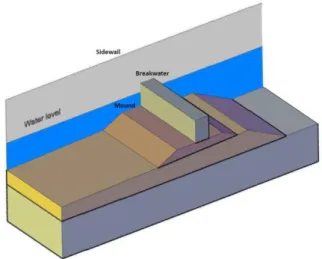
the model experiment is designed to simulate the situation that Powerful Unit is utilized as all parts of the armor blocks forming the revetment of normal breakwater to protect the rubble mound from continuous coastal waves for an adequately long time (Fig 1).
Under a proportion of 1/50, the experiment is operated in a two-dimensional wave generation channel. After simulated waves are generated by electronic motor power generator, they move along the channel around 10 meters and get stronger by sidewall halfway. Then they will attack the model of breakwater system (Fig 2). In the breakwater system, the model breakwater is made of concrete and it is heavy and strong enough to be influenced little by waves and keep almost no displacement. The rubble mound is piled up with small gravels. On the wave-attacked side of mound the models of Powerful Unit are set to protect it from waves. After the breakwater system the generated waves will still go forward for a long distance and meet with wave-dissipating works made of chemical sponge sheet (Fig 3.3) so that the former waves will impact almost nothing on the latter ones.
Damage rate is applied as the criterion for judging whether the model revetment is destroyed. It means the ratio of the damaged part to the total revetment. It is usually applied when researching the revetment made of armor blocks. Therefore, in this experiment it means the ratio of the number of model units removed by attacking waves to the total number:
Fig 1 3D perspective of model experiment
Fig 2 The model of breakwater system
()
Once damage rate exceeds the limitation value, the situation will be considered as revetment failure. According to the Technical Standards and Commentaries for Port and Harbour Facilities in Japan (2009), the recommended value is usually 1%.
In this experiment the critical value of damage rate is added to 2%, because this study is not used for design standard and the previous experiment of Powerful Unit also applies 2% (Kuroda et al. 2014).
Calculation of stability number
the stability number of Powerful Unit cannot be obtained directly by the experimental conditions, it can be calculated through the result of this model experiment. The calculation formula in this study is transformed from the Hudson’s formula:
: estimated value of stability number under the certain simulated condition
: critical significant wave height when damage rate is 2% (unit: m)
: mass of Powerful Unit (8t)
: density of Powerful Unit (2.6t/m3)
: density of water (1t/m3)