Students
著者
小川 エリナ
著者別名
OGAWA Erina
journal or
publication title
東洋大学人間科学総合研究所紀要
number
17
page range
59-73
year
2015-03
URL
http://id.nii.ac.jp/1060/00007165/
Creative Commons : 表示 - 非営利 - 改変禁止 http://creativecommons.org/licenses/by-nc-nd/3.0/deed.ja1 . Introduction
1 . 1 Cultural Identities of Japanese Youth
With the aging of Japanese society, it seems only natural to focus on the values of the older generation. However, it is the younger generation who may hold the key to Japan's future and it is their values that are likely to determine many aspects of life once their influence takes a stronghold in society. As Goodman (2012) writes:
Japan is a country with very few natural resources other than its young people, and as the population gets older and smaller the importance that is placed on the well-being of these young people becomes greater. How young people are socialized and enter the labor market is of crucial importance to the whole society (p. 164).
Therefore, it is important that attention be paid to the cultural identities of Japan's youth, especially since those identities may be undertaking accelerated changes due to the effects of the Great East Japan Earthquake of March 11, 2011.
The triple disasters of the earthquakes, tsunamis, and nuclear meltdowns of the officially-named Great East Japan Earthquake (Ministry of Foreign Affairs of Japan, 2011) which suddenly ravaged much of eastern Japan on that cataclysmic day, as well as the continuing effects of these disasters, are both undeniably and understandably highly traumatic events affecting not only the lives and lifestyles of everyone involved, but also perhaps their cultural identities - the very sense of who they are. This paper aims to highlight this issue and to provide insights into how the cultural identities of the Japanese people may have been affected in the aftermath of these calamities, with a particular focus on Japanese university students.
The authori believes that an examination of the cultural identities (even of a convenience sample from mainly
one institution) of Japanese university students may provide some insight into possible changes, as this segment
The Great East Japan Earthquake and Cultural Identity Shifts
of Japanese University Students
OGAWA Erina
of the Japanese population will likely influence the future direction of Japan. This paper has been written to contribute (however minutely) to the limited information available for the forthcoming debate (Reid, 2011) about what kind of a nation Japan will become in this new era of her history.
1 . 2 Aftermath of the Great East Japan Earthquake
Many Japanese youth of today have the experience of a recent major disaster – a combination of natural and man-made causes that was the Great East Japan Earthquake- in their collective memories. A disaster such as this can cause permanent changes in the physical landscape. Likewise, it can cause lasting changes in the cultural identities of those affected by it.
The earthquake was sudden - and of an almost unprecedented magnitude. It was the strongest recorded in Japanese history , it shifted the earth's axis by 25 centimeters, shortening the length of a day by 1.8 microseconds , and had a magnitude which measured a whopping 9.0 (The Japan Times, 2011, p. 6). Then came the tsunami. According to tsunami expert Shigeo Takahashi,ii devastation from the tsunami alone was a
once-in-a-century event (The Japan Times, 2011). The nuclear meltdowns at reactors 1, 2, and 3 of the Fukushima Daiichi Nuclear Power Plant followed. There is still no consensus as to the scale of the environmental damage caused by these meltdowns, but it was deemed serious enough to be rated a level 7 on the International Nuclear Event Scale, the only nuclear crisis since the 1986 Chernobyl disaster that has been assessed so severely (The Japan Times, 2011, p. 8).
Just as the earthquakeiii has shaken the physical foundations of much of Japan, the tsunami has permanently
changed the landscape of a large part of the country's coastline, and the nuclear disaster has contaminated the soil, water, and air around us, so has the stability of the nation and its individuals been altered in ways that Japan and the people of Japan may never be the same again.
1 . 3 Societal Changes
According to Goodman (2012, p. 171), Japanese society has been displaying a greater focus on personal and social development since the 1990s and this may lead to a better-balanced, more caring society and population compared to the period of fixation on money and material goods in the 1970s and 1980s. Likewise, Yamanaka (2002) found indications that Japan is at a crossroads of becoming a multicultural society (cited in Burgess, 2008). As explained in Ogawa (2013a), such change in society can be accelerated by catalysts (Burgess, 2008), such as the Great East Japan Earthquake, which mark a turning point in Japanese history (Stockwin, 2012, p. xvii). As Shikata (2012) aptly puts it, the memory of March 11, 2011, is now a part of Japan's collective consciousness and critical in understanding the country as we look to the future. The landscape of Japan – literally and metaphorically – has been irrevocably changed (p. 60).
in Japanese society. In fact, Funabashi (2011) has illuminated an historical pattern of connections between major earthquakes (namely, the 1854 and 1855 Ansei Great Earthquakes, the 1923 Great Kanto Earthquake, and the 1995 Great Hanshin Earthquake), which appeared to correlate with major social changes such as the opening of Japan in 1854, the loss of the Anglo-Japanese Alliance in 1922, and the advent of Japan's lost era (p. 8) in the 1990s. Likewise, Takezawa (2008) describes the Great Hanshin-Awaji (or Kobe) Earthquake as a turning point in relationships between Japanese nationals and other Japanese residents. Changes in society like those witnessed in Kobe are desirable for Japanese society; even though their causes are not. In fact, Shikata (2012) claims that not only is it likely that the Great East Japan Earthquake created a turning point in Japanese society, but that there is a moral responsibility to make sure that it did. This determination has been repeatedly expressed in the media in the form of gambareiv and one Japan - so that it has come to gain a ring of nationalism to it (Johnston, 2011).
Comments like this would suggest a subsequent strengthening of identification with being Japanese by many people throughout Japan.
However, it appears the effects of the disaster have been quite different from one region of Japan to another, as Nagata and Nakata (2012) discuss in their article on the impact of power saving measures and the imbalance in energy availability between different regions of Japan. The fact that the Kanto region was affected is significant. The Great East Japan Earthquake was truly unprecedented. It affected not only millions in the Tohoku region directly but tens of millions in the Tokyo region indirectly (Johnston, 2011, p. 76). Perhaps because Tokyo was affected, many people suddenly challenged the government's long-standing proclamation that nuclear power is safe and energy-awareness increased dramatically (Nagata, 2012), as illustrated in the example provided by Aoki (2012) of how the lives of a group of Tokyo mothers were changed in their efforts to protect their children from the potential health risks from exposure to radiation.
In addition to the eroding stress of ongoing radiation concerns, there have also been emotional effects following the vast physical damage and changes resulting from these events. An example of emotional effects of living through such trauma are evident in this quote in Daimon (2012) from a high school student, who survived only by deserting her own mother: The following months were so difficult that she even felt like killing herself, she said. But she now says that after experiencing such great hardships she has learned many things (p. 35). Such experiences may influence not only those who were directly affected but also those who were indirectly exposed to them via the media or through social contacts. Further, they are likely to influence the way that young people view themselves and the world, since crises and transformation enable identity development (Ferguson, 2000). In any generation, a number of youth experience bullying, abuse, a family member dying, or some other crisis in their lives while growing up. However, the large numbers of youth (particularly in the devastated Tohoku area and the influential Kanto area) who were influenced by this particular event mean that the Great East Japan Earthquake should not be ignored as a possible factor influencing the future society of Japan as these young people become more and more active in it. Funabashi (2011) points out that just as many elderly Japanese people remember what
they were doing when the surrender of World War II was declared, so will this generation remember where they were and what they were doing at zero hour – 2: 46 p.m. on March 11, 2011 (p. 14).
1 . 4 Cultural Identity Research
While Japan is likely to have entered a new phase in its history, what type of society will develop is as yet unclear. Reid (2011) claims this to be a matter of intense debate and this research project was conducted to assist with providing information on possible ways the cultural identities of Japanese university students may have been affected. On the surface, this area of research may not appear as valuable to society as, say, engineering or economics. However, as Economics Nobel Prize winner Amartya Sen (2006) writes in his highly-acclaimed book
Identity and Violence, identity can also kill – and kill with abandon. A strong – and exclusive - sense of belonging
to one group can in many cases carry with it the perception of distance and divergence from other groups (pp. 1-2). Throughout his book Sen urges all people, for the sake of world peace and prosperity, to see themselves and others as being multicultural, as we all are. Similar views are expressed by other scholars, such as Omoniyi (2006) and Valentine (2009). It is now apparent that to succeed in today's global environment, an understanding of cultural identities is essential and therefore cultural intelligence needs to be highly developed. Livermore (2011) defines cultural intelligence as the ability to function in a variety of contexts.
Given the importance of the development of cultural intelligence for young people of all nations, but especially in this case, young people in Japan, the author holds that the March 2011 triple disaster provides us with a timely opportunity to examine the cultural identities of Japanese young people. As one young Japanese babysitter changed her mindset from wanting to sleep alone to wanting to sleep with her employer's family (Sherriff, 2011), suggesting that her cultural identifications with the family had adjusted after the earthquake, likewise, it is predictable that many other people who experienced the effects of 3/11 have similarly made shifts in their cultural bearings.
It is these predicted, invisible yet very real, shifts of the cultural identities of Japanese people following the Great East Japan Earthquake that have prompted this research. The author believes that university students, who are more open to change than the more mature population and yet more aware of those changes than the very young, are an ideal target segment of the Japanese population to examine. Further, since university students represent the next generation of this nation's leaders (Stewart, 2011), the author sincerely hopes that this paper may provide some tentative insights into the future direction of the cultural affiliations of Japanese young people, and therefore perhaps of Japan. The author holds that it is important for attention to be paid to the cultural identities of Japan's youth, especially since those identities may be undertaking accelerated changes due to the Great East Japan Earthquake of 2011.
This paper is related to a series of papers published in the Journal of Business Administration (see References) which report on various aspects of this three year longitudinal study, the aim of which is to provide early insight
into possible changes in the cultural identities of Japanese university students following the devastating events in Japan beginning March 11, 2011. These papers: introduced the topic and provided a comparison of students from two different universities (Ogawa, 2011), illuminated differences between students of different faculties at one of the universities (Ogawa, 2013a), compared responses of male and female respondents (Ogawa, 2013b), and analyzed regional differences (Ogawa, 2014). For more background information on the connections between the Great East Japan Earthquake, cultural identities, and university students, please refer to the Introduction of Ogawa (2011). Some questions raised regarding research of this nature are answered in Ogawa (2013a). Background information on the cultural identities surveyed in this project is provided in Ogawa (2013b). Finally, specific examples of regional effects of the Great East Japan Earthquake are available in the Introduction of Ogawa (2014). Please note that due to the nature of this type of analysis, differing sizes of the total datasets used in each analysis, different p values, and other factors have resulted in figures reported here not always being identical to corresponding results previously published.
2 . Research Method 2 . 1 Respondents
The analysis in this report uses the data from 935 questionnaires from the first administration in July 2011, along with 1,002 from the second time in July 2012, and 1,067 questionnaires completed in July 2013. These questionnaires have been analyzed for trends over this three-year period and the relevant results are reported in the year analysis section of this report. Most of the respondents were students from several faculties at one university in central Tokyo. In 2011, 75 students from a second university (in Saitama, Kanto) completed questionnaires through the cooperation of a lecturer there. In 2012, questionnaires were distributed at another university in Tokyo but only two students participated. The data from these respondents is included in this analysis. Of these 3,004 questionnaires, 1,259 were completed by females and 1,627 by males. The remaining 118 questionnaires of unspecified gender were removed from the sample in order to complete a gender analysis of the data.
2 . 2 Instrument
This study was conducted by means of a Cultural Identification Questionnaire (see Appendix) administered to Japanese university students over the course of three years. This questionnaire was created by the author and distributed in Japanese. It was on a single A4 sheet of paper with a demographic section at the top, followed by two columns of lists of 10 possible cultural identifications thought to be most applicable to the respondents and useful for analysis in this research project. This rank-item survey consisted of the following ten cultural identifications: Faculty, Academic Year, University, High School of Graduation, Region of Japan, Gender, Japanese, Global, Japanese Speaker, and English Speaker.
analyzed. In other words, the cultural identity of Japanese was thought to be the easiest to endorse and thus would define one end of the continuum; whereas, on the other end of the continuum, English Speaker was thought to be the most difficult cultural identity to endorse for Japanese university students. The survey task was to rank these ten possible cultural identifications before (in retrospect) and after the Great East Japan Earthquake. The column on the left was designated as being for cultural identification rankings before the Great East Japan Earthquake of March 11, 2011, and the column on the right was designated for ranking the same cultural identities after.
2 . 3 Procedures
Nearly all of the completed questionnaires used for this study were collected with the cooperation of university lecturers from different faculties of a university in central Tokyo. These lecturers administered the questionnaires to willing respondents in their classes. The respondents were informed about the general purpose of the study. In the latter two years of the project, this was enabled by the provision of a bilingual information sheet to lecturers in Japanese and English (so that lecturers could read it in their native language) describing the reasons for the survey and how to distribute the questionnaires. Then, respondents followed the instructions written in Japanese on the questionnaire form itself to complete the questionnaire (in Japanese), which took approximately ten minutes to complete.
2 . 4 Analysis
The design of the questionnaire was such that it provided rank-order data. Rank-order data, however, cannot be used to specify the true differences between students (Hays, 1988) because the distances between students on a continuum of cultural identification cannot be assumed to be interval. In order to achieve an interval level of measurement, rank-order data must be first transformed into interval data using a statistical procedure such as a Rasch analysis (Wright & Stone, 1979).
The students responses to the Cultural Identification Questionnaire were analyzed using the Rasch partial credit model (Andrich, 1978) implemented by Winsteps (Linacre, 2004). The Rasch partial credit model estimates each cultural identity separately and thus creates individual ranking scales for each cultural identity. The students'responses to this questionnaire are reported in logits, which in the context of this study measures the degree of difficulty students experienced in identifying with each of the cultural identities pre- and post-March 11, 2011, according to how they ranked them in each column of the questionnaire. The norm referenced choice of 0 logits represents the average level of difficulty that the students experienced ranking the different cultural identities. In other words, a logit score below 0 logits for a particular cultural identity means that students experienced little difficulty identifying themselves with that cultural identity. Conversely, for a cultural identity to have a logit score above 0 logits, it means that students experienced more difficulty identifying themselves with that particular cultural identity.
3 . Results
3 . 1 Yearly Analysis
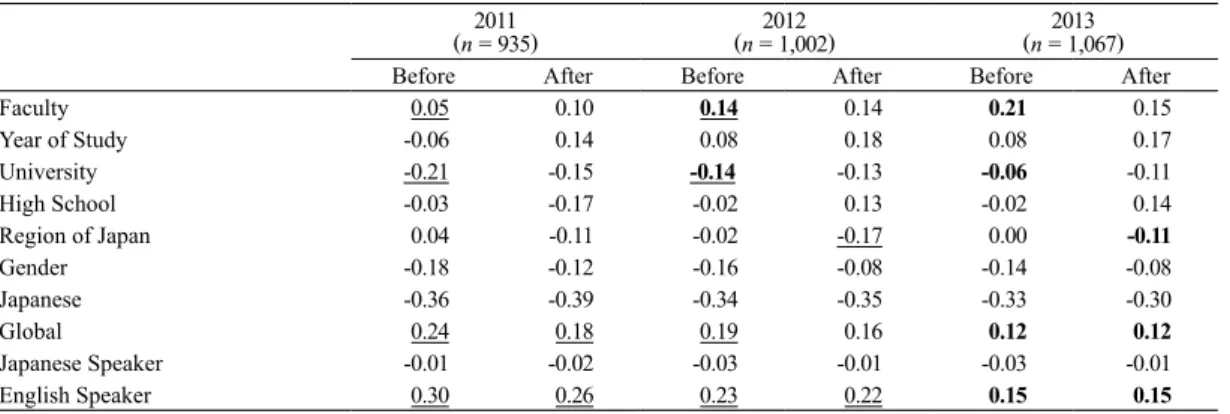
First, the data was analyzed by year of administration in order to discover the overall trends over the three years. Table 1 shows the cultural identification rankings of each of the ten identities, both before and after the Great East Japan Earthquake, for each yearv. Please note that the numbers in bold represent significant differences
from the corresponding figures of previous years, which are underlined. It is also necessary to note that, perhaps deceivingly, negative figures depict positive identification, whilst positive figures represent negative identification (eg. English Speaker is an identity that respondents tended NOT to relate strongly to).
Most notable in Table 1, the final year of the survey (2013) produced figures representing significantly stronger identification with both global and English speaker identifications than the previous two years. Significant differences are evident between years 2011 and 2013, as well as between years 2012 and 2013. In addition, in the case of the English speaker identity factor, the figures are statistically significant in all instances. These results suggest that the group of students surveyed in 2013 are more likely to identify with being both English speakers and having a global identity than those surveyed in the two previous years. Specifically, English speaker identification figures have increased steadily from extremely low logits of 0.30 (Before) and 0.26 (After) in 2011, to 0.23 (Before) and 0.22 (After) in 2012, and then again to 0.15 (Before) and 0.15 (After) in 2013. This is a marked change from an extremely low position to a mildly low one. Likewise, but not as dramatically, global identification figures have risen from 0.24 (Before) and 0.18 (After) in 2011 to 0.19 (Before) and 0.16 (After) in 2012, and further to 0.12 (Before) and 0.12 (After) in 2013. Therefore, similar to the trend evident with English speaker identification, identification with having a global identity has also displayed an overall strengthening of a weak identification. In other words, identifying with having a global identity was also less unlikely in 2013 than in 2012 or 2011.
Table 1. Yearly Differences Before and After March 11, 2011
2011
(n = 935) (n = 1,002)2012 (n = 1,067)2013 Before After Before After Before After Faculty 0.05 0.10 0.14 0.14 0.21 0.15 Year of Study -0.06 0.14 0.08 0.18 0.08 0.17 University -0.21 -0.15 -0.14 -0.13 -0.06 -0.11 High School -0.03 -0.17 -0.02 0.13 -0.02 0.14 Region of Japan 0.04 -0.11 -0.02 -0.17 0.00 -0.11 Gender -0.18 -0.12 -0.16 -0.08 -0.14 -0.08 Japanese -0.36 -0.39 -0.34 -0.35 -0.33 -0.30 Global 0.24 0.18 0.19 0.16 0.12 0.12 Japanese Speaker -0.01 -0.02 -0.03 -0.01 -0.03 -0.01 English Speaker 0.30 0.26 0.23 0.22 0.15 0.15
Further statistically significant differences were found for faculty as well as university identifications before the disaster, and regional identifications after. Significant differences in faculty identifications before the disaster are between: 0.05 in 2011 and 0.14 in 2012; 0.14 in 2012 and 0.21 in 2013; and 0.05 in 2011 and 0.21 in 2013. This represents a gradual lessening of faculty ties from a relatively (compared to the ten other cultural identification factors surveyed) neutral position in 2011 to a much weaker position in 2013. Statistically significant differences were not found in the related post-disaster figures. However, it is interesting to note that, although not necessarily statistically so, students tended to rank their faculty ties higher before the earthquake than after in 2011, about the same in 2012 (or at least the numbers have averaged out the same), and lower before the earthquake than after in 2013. University identification figures also show a gradual weakening of pre-disaster identifications, although the identification figures themselves are much stronger than those of faculty ties. Significant differences were found between each of the three years with regard to pre-disaster affiliations: -0.21 in 2011 and- 0.14 in 2012; -0.14 in 2012 and -0.06 in 2013; and -0.21 in 2011 and -0.06 in 2013.
The only statistically significant difference regarding regional identifications is between the post-disaster average of -0.17 in 2012 and -0.11 for the corresponding data in 2013. The lack of a statistically significant difference between post-disaster regional identifications in the data of 2011 and 2012 despite 2011 and 2013 having the same numerical values appears inconsistent. However, this is likely to be due to the difference in sample sizes. While analyses for 2012 and 2013 were both conducted with data from over one thousand questionnaires, analysis of 2011 data was from the lower number of 935 questionnaires. This, in tandem with the high benchmark of p > 0.0005, may have resulted in statistical difference not showing up for these particular figuresvi.
3 . 2 Gender Analysis
Next, the data was analyzed according to gender groups. Table 2 shows the cultural identification rankings for females and males of each of the ten identities, both before and after the Great East Japan Earthquake. Please note that the numbers in bold represent significant differences between the genders and that, again, negative figures depict positive identification, while positive figures represent negative identification.
In general, females are more likely to identify with being English speakers and having global identities than males. On the other hand, males are more likely to identify with their gender, as well as both their high school and region of origin. Although females tend to have relatively (to other factors) low identifications with having a global identity (0.14 Before and 0.12 After), males are statistically even less likely to relate to having a global identity (0.21 Before and 0.19 After). The same could be said about identifying with being an English speaker, with scores of 0.18 (Before) and 0.17 (After) for females compared to 0.27 (Before) and 0.26 (After) for males.
Table 2. Gender Differences Before and After March 11, 2011
Female (n = 1,259)
Male (n = 1,627) Before After Before After Faculty 0.13 0.13 0.14 0.13 Year of Study 0.10 0.18 0.06 0.15 University -0.13 -0.11 -0.13 -0.14 High School 0.03 0.17 -0.04 0.12 Region of Japan 0.02 -0.11 -0.02 -0.16 Gender -0.12 -0.07 -0.18 -0.12 Japanese -0.34 -0.33 -0.35 -0.37 Global 0.14 0.12 0.21 0.19 Japanese Speaker -0.03 -0.04 -0.03 0.01 English Speaker 0.18 0.17 0.27 0.26
N.B. Bold font indicates a significant difference (p < 0.0005) between genders.
In contrast, results revealed males to have stronger gender identifications on average (-0.18 Before and -0.12 After) than females (-0.12 Before and -0.07 After). Also, in contrast to the results for the global and English speaker factors discussed above, both males and females were shown to be likely to relate more strongly to their gender comparative to most other factors. Additional significant differences were found between the average post-disaster regional identifications of males at -0.16 and females at -0.11. Finally, the average pre-post-disaster high school of graduation identifications of females at 0.03 and males at -0.04 were also significantly different.
4 . Discussion and Conclusions
The results presented in the yearly analysis section suggest that these Japanese university student respondents are more likely to identify with both being English speakers and having a global identity in 2013 than in the previous two years. This suggests the possibility of increased internationalization of these students for whatever reason. An investigation into the existence and essence of such a trend is a related, yet separate research topic that the author intends to pursue in future research endeavors.
Yearly-contrasted figures relating to faculty and university identifications before the disaster were found to be significantly different in 2011, 2012, and 2013. While one may expect similar figures relating to self-identifications pre-disaster for all years, it must be remembered that students have merely been asked to rank their identifications before and after the Great East Japan Earthquake, thus comparing their identifications before and after the disaster, not from year to year. However, the significant changes over the three years of the reported pre-disaster faculty and university identifications, combined with the more stable corresponding post-disaster figures, results in a contrast between the relativity of pre-disaster and post-disaster figures between the years. What is of interest here is that there appears to be a difference in students perceptions of their university and faculty ties before the Great East
Japan Earthquake as time has passed. Examination of changes over time in self-perceptions of cultural identity before and after a particular event is an area of possible further research.
Gender analysis revealed that, in general, the females in this study have more internationally-focused identities (namely, global and English speaker ones) than the males. In contrast, males tended to identify more strongly with factors closer to home, such as their high school of graduation, region of origin, and gender. In other words, these results suggest that males have stronger ties to their cultural roots than females, who have stronger cultural identifications with the wider world. This is an interesting finding of which the author wishes to pursue further research. Also, since the majority of the respondents are from a single university, this finding would be more meaningful if it could be linked to similar results revealed in other studies.
Consideration of the various limitations to this research is essential. Since cultural identities of any individual are numerous and fluid (Greer, 2005) and change both over time and according to the cultural situation people are acting in at that particular point in time, those examined in this report must be considered a mere representation of numerous possibilities. This complexity of the nature of cultural identities also means that they are difficult to accurately rank in order of importance. Further, this research project was not initiated until after the Great East Japan Earthquake, so rankings of identities before 11 March 2011 have been made in retrospect. Time constraints also limited the questionnaire to the basic response format employed and did not allow for triangulation with interviews or other types of data elicitation procedures. In addition, the respondents in this research project are not demographically representative of the Japanese population in general. Being students in the Kanto region, they are young peoplevii and are mainly from the Kanto areaviii. However, as explained in the Introduction, university
students should be considered an appropriate target group for research investigating future trends in society. In addition, at the time of sampling, nearly all of the respondents were studying in Tokyo, which many people consider to be the cultural, as well as political and economical, center of Japan. Consequently, the choice can be regarded as being not inappropriate.
These and other limitations (see Ogawa, 2011, for more details) may cast doubt on the validity of the results presented in this paper. However, there is no doubt regarding the necessity for timely research of this nature at this juncture in Japan's history as Japan once again overcomes severe hardship after a devastating historic eventix.
Therefore, despite the difficulty in determining a causal link with the Great East Japan Earthquake to the findings reported here (due to being unable to exclude other possible factors), the author considers this research to be worthwhile if this paper contributes however insignificantly to the awareness of the cultural identities of Japanese young people.
Over time, changes in society become clear. However, awareness or hints of such changes as they happen could be useful to policy makers and business strategists, as well as to the public in general since what kind of a nation will emerge from this transformative event remains a matter of intense debate (Reid, 2011, p. 28). It is hoped that this research project will assist in this task by indicating possible changes in the cultural identities of Japanese
university students in order to provide hints as to the direction these young people may lead Japanese society in the future. The author hopes that this direction will entail Japan evolving into a respected nation of individuals with a strong sense of their multiple and varied cultural identifications.
Notes
ⅰ Erina Ogawa writes this article as a long-term foreign resident of Japan.
ⅱ Shigeo Takahashi is a senior researcher and tsunami expert at the Port and Airport Research Institute, which is a Japanese
government-affiliated organization.
ⅲ In fact, there were multiple - many of them major - earthquakes on March 11, 2011 and the following days and weeks.
Likewise, there was more than one tsunami. For example, the author listened to a friend from Iwate Prefecture relate about the four tsunami which devastated approximately 60% of the land area (and the vast majority of the houses and other buildings as only the sparsely inhabited hilly area was spared) of her hometown, Yamadamachi. This included her family home in the center of town, which was in a part of town thought to be unreachable by a tsunami. Her mother only survived by climbing on top of debris and clinging for her life as the tsunami waters rushed in up to her neck while her head was pressed against the ceiling. Similarly, media reported that three of the six nuclear reactors at Fukushima Daiichi Nuclear Power Plants were damaged beyond control by the tsunami.
ⅳ Gambare could be roughly translated as We can do it! although the appropriate pronoun is only apparent through
context.
ⅴ Please note that some of the figures presented in Table 1 have previously been published in the related series of papers by this
author. However, they have not previously been compared from year to year.
ⅵ Results from this project have produced confusing results regarding regional identifications. While Ogawa (2014) revealed
significant differences in regional identifications before and after the earthquake in the 2011 dataset, this extreme result was not apparent in the datasets of 2012 and 2013. Please also note that figures reported in Ogawa (2014) and this paper are not always identical, since p < 0.01 in the analysis reported in Ogawa (2014), while p < 0.0005 was used for calculations in this paper.
ⅶ There was not a single mature student amongst the thousands of respondents, which is not unusual for the university student
population in Japan.
ⅷ It should be noted that while the Kanto area was the most often indicated as region of origin in the demographic section of
the questionnaire, a significant number of respondents indicated that they were from the various other regions of Japan.
ⅸ Other devastating events in recent Japanese history include the Great Kanto Earthquake and World War II.
Acknowledgements
This research project would not have been possible without the co-operation of Professor Christopher Weaver for statistical analysis. Nor would the collection of the large numbers of questionnaires have been possible without the assistance of several lecturers in the Business Administration and other faculties of Toyo University and one lecturer from Surugadai University. Finally, the author wishes to express her gratitude to the thousands of students who participated in this research project by examining their cultural identities and sharing their findings.
References
Andrich, D. (1978). A rating formulation for ordered response categories. Psychometrika, 43(4) 561-573. doi: 10.1007/ BF02293814
Aoki, M. (2012). Mothers first to shed food-safety complacency. In T. Kitazume (Ed.), 3.11 one year on: A chronicle of Japan's
road to recovery (pp. 54-55). Tokyo: The Japan Times.
Burgess, C. (2008). (Re)constructing boundaries: International marriage migrants in Yamagata as agents of multiculiuturalism. In N. Graburn, J. Ertl, & R. Tierney (Eds.), Multiculturalism in the New Japan: Crossing boundaries within (pp. 63-81). New York: Berghahn Books.
Daimon, S. (2012). Tohoku students share tales of disaster on global stage. In T. Kitazume (Ed.), 3.11 one year on: A chronicle of
Japan's road to recovery (pp. 34-35). Tokyo: The Japan Times.
Ferguson, H. (2000). Deception and despair: Ironic self-identity in modern society. In J. Davies (Ed.), Identity and Social Change (pp. 179-208). New Brunswick: Transaction Publishers.
Funabashi, Y. (2011). March 11–Japan's Zero Hour. In C. Chandler, H. Chhor, & B. Salsberg (Eds.), Reimagining Japan: The
quest for a future that works (pp. 8-14). San Francisco: VIZ Media.
Goodman, R. (2012). Shifting landscapes: The social context of youth problems in an ageing nation. In R. Goodman, Y. Imoto, & T. Toivonen (Eds.), A sociology of Japanese youth: From returnees to NEETs (pp. 159-173). New York: Routledge.
Greer, T. (2005). The multi-ethnic identity paradox: Towards a fluid notion of being Haafu . Japan Journal of Multilingualism
and Multiculturalism, 11(1), 1-18.
Hays, W. (1988). Statistics (4th ed.). Fort Worth, TX: Holt Rinehart and Winston.
Johnston, E. (2011). The Tohoku earthquake and tsunami, the Fukushima nuclear reactor, and how the world's media reported
them. Tokyo: The Japan Times.
Linacre, J. (2004). WINSTEPS Rasch measurement computer program (Version 3.51). Chicago: Winsteps.com. Livermore, D. (2011). The cultural intelligence difference. New York: Amacom.
Ministry of Foreign Affairs of Japan. (2011). Great East Japan Earthquake. Retrieved from http://www.mofa.go.jp/j_info/visit/ incidents/index.html
Nagata, K. (2012). The nuclear debacle: What it means. In T. Kitazume (Ed.), 3.11 one year on: A chronicle of Japan's road to
recovery (pp. 50-51). Tokyo: The Japan Times.
Nagata, K. & Nakata, H. (2012). Summer power crunch looms large. In T. Kitazume (Ed.), 3.11 one year on: A chronicle of
Japan's road to recovery (pp. 21-23). Tokyo: The Japan Times.
Ogawa, E. (2011). Changes to Toyo University students perceptions of their cultural identities after the Great East Japan Earthquake. Journal of Business Administration, 78, 69-80.
Ogawa, E. (2013a). Faculty differences in Toyo University students cultural Identifications. Journal of Business Administration, 81, 15-27.
Ogawa, E. (2013b). Gender differences in Toyo University students cultural Identifications. Journal of Business Administration, 82, 29-38.
Ogawa, E. (2014). Regional differences in Toyo University students cultural Identifications. Journal of Business Administration, 84, 1-11.
Continuum.
Reid, T. (2011). The power of gaman. In C. Chandler, H. Chhor, & B. Salsberg (Eds.), Reimagining Japan: The quest for a future
that works (pp. 28-32). San Francisco: VIZ Media.
Sen, A. (2006). Identity and violence. New York: Norton.
Sherriff, P. (2011). 2:46 Aftershocks: Stories from the Japan earthquake. London: Enhanced Editions.
Shikata, N. (2012). The new determination of post-March 11 Japan. In T. Kitazume (Ed.), 3.11 one year on: A chronicle of Japan's
road to recovery (p. 60). Tokyo: The Japan Times.
Stewart, D. (2011). Is Japan a vampire finch? In C. Chandler, H. Chhor, & B. Salsberg (Eds.), Reimagining Japan: The quest for a
future that works (pp. 181-184). San Francisco: VIZ Media.
Stockwin, J. (2012). Preface. In R. Goodman, Y. Imoto, & T. Toivonen (Eds.), A sociology of Japanese youth: From returnees to
NEETs (pp. xvi-xvii). New York: Routledge.
Takezawa, Y. (2008). The Great Hanshin-Awaji Earthquake and town-making towards multiculturalism. In N. Graburn, J. Ertl, & R. Tierney (Eds.), Multiculturalism in the New Japan: Crossing boundaries within (pp. 32-42). New York: Berghahn Books. The Japan Times. (2011). 3.11: A chronicle of events following the Great East Japan Earthquake. Tokyo: The Japan Times. Valentine, T. (2009). World Englishes and gender identities. In B. Kachru, Y. Kachru, & C. Nelson (Eds.), The handbook of World
Englishes (pp. 567-580). West Sussex: Blackwell.
Appendix: Cultural Identification Questionnaire (English Translation)
Please note that this is an English translation of the Japanese questionnaire used in July 2011. The questionnaires used in July 2012 and July 2013 were slightly altered to use the officially declared name of the earthquake and appropriate wording, such as before and after March 11th last year for the 2012 version.
University Students Cultural Identification Rankings and the Tohoku Kanto Earthquake Faculty of Study: Year of Study: 1st / 2nd / 3rd / 4th Gender: Male /Female
What region of Japan are you from? Hokkaido / Tohoku / Kanto / Chubu / Kinki / Chugoku / Shikoku / Kyushu and Okinawa / Not from Japan
This survey is designed to observe the effect that the Tohoku-Kanto Earthquake has had on university students cultural identities. Please rank the importance to you of the following cultural identities - both now and before March's disasters in the Tohoku and Kanto areas of Japan. Please write ALL numbers from 1 to 10 in both columns.
BEFORE March 11, 2011 AFTER March 11, 2011
a student from XX Faculty a student from XX Faculty
a XX year student a XX year student
a XX University Student a XX University Student
a graduate of XX High School a graduate of XX High School a person from XX region of Japan a person from XX region of Japan
a male/female a male/female
a Japanese person a Japanese person
a Global citizen a Global citizen
a Japanese speaker a Japanese speaker
an English speaker an English speaker
I agree for this data to be used for research purposes.
Signature: Date: 2011 Thank you very much for taking part in this research project. Erina Ogawa, Business Administration Faculty, Toyo University Contact email: [email protected]
【Abstract】
東日本大震災と文化的アイデンティティの変化
小川 エリナ* 高齢化社会のピークに入り、その対応に迫られている日本の社会で、若い世代の日本人は将来へ向けて自らが国の 道筋を切り開いていかなければならない状況にある。どのような道筋になるかは、将来の社会と彼ら自身の生活をど のように形成したいかという彼ら自身の考えによって変化する。こうしたことから、国家の政策的な判断は、若い世 代の文化的アイデンティティを参考にして下す必要がある。本論文は、2011 年から 2013 年の毎年7月に質問紙調査 を実施し、東日本大震災後、日本人大学生の自文化に対するアイデンティティが年度また性別ごとにどのような変化 をたどってきたかを調査した。調査の結果、2011 年と 2012 年よりも、2013 年は英語を話すことが出来る人、ならび に国際人としてのアイデンティティを持つ傾向が強まったことが判明した。また、男子大学生は自文化に対するアイ デンティティを強く持つのに対して、女子大学生は自文化以外の広い世界に対するアイデンティティを持つ傾向があ ると考えられる。 キーワード:文化的アイデンティティ、日本の社会、東日本大震災、社会の変化、男女の比較With the ageing of society, Japan is experiencing increasingly stifling pressures, which today's young people must inherit and attempt to alleviate. What path this will lead Japan down depends on these youths perceptions of society and themselves. Therefore, strategic decisions concerning the future should take into consideration the cultural identities of today's youth. This paper examines changes in the cultural identities of Japanese university students following the Great East Japan Earthquake through questionnaire surveys conducted in July of 2011, 2012, and 2013 - comparing the results from these three years and those between the genders. Results indicate that these respondents are more likely to identify both with being English speakers and having a global identity in 2013 than in the previous two years. They also suggest that males have stronger ties to their cultural roots than females, who have comparatively stronger cultural identifications with the wider world.
Keyword: Cultural identities, Japanese society, Great East Japan Earthquake, societal changes, gender comparisons