Religious prints as expressions of the sacred : the Tsuruya Kokei collection
著者(英) Hillary Pedersen
journal or
publication title
Doshisha University Jinbungaku (Studies in Humanities)
number 204
page range 160‑121
year 2019‑11‑15
権利(英) The Literary Association, Doshisha University
URL http://doi.org/10.14988/pa.2020.0000000072
Religious Prints as Expressions of the Sacred:
The Tsuruya Kōkei Collection
Hillary Pedersen
Since the late nineteenth century, Japanese religious prints such as ofuda and miei have been examined by both Western and Japanese collectors and scholars alike. However, despite their status as indispensable documents of Japanese re
ligious and cultural history that demonstrate religious beliefs and practices com
mon across many social strata, they have not garnered the sustained academic attention of Buddhist or Shinto paintings or sculptures, or of other prints such as ukiyoe. This brief article will first examine the significant features of relig
ious prints in general, including ways in which the print production process re
lates to religious ideals. I will then introduce a selection of works in the collec
tion of the print artist Tsuruya Kōkei (弦屋光渓b. 1946), which are published for the first time here.1)Referencing extant prints in other collections, I will dis
cuss the subject matter and the physical aspects of the prints, in order under
stand ways in which these prints fit into certain lineages of belief and image production.
Religious Prints: an Overview
The prints introduced in this article are those that were distributed by religious
(160) 1
institutions and were believed to be manifestations (kesshin 変身) of a deity.
They can be broadly categorized into two types: miei 御影 and ofuda 御札.
Miei are used as objects of worship in home altars, either in Buddhistbutsudan 仏壇or in Shintokamidana 神棚, as affordable alternatives to more expensive paintings or sculptures. This trend began in the Kamakura period.2) They are often mounted, although the quality of the mounting can vary widely.
Ofuda, also known as gofu 護符, can be loosely defined as either talismans that bring good fortune, or as amulets that can protect from disasters or mala
dies.3) Both types can be site and/or functionspecific. They are often hung in particular places within a home or workplace (for example in a kitchen, entry
way, or near a well or rice field), folded and worn in a pouch hung on the body (in which case they are also known as omamori お守り), or even ingested to ward off evils. There are cases where the uses of miei and ofuda overlap;for example, anofudamay be put in a home altar. Regardless of their placement or categorization, bothmiei and ofuda are meant to bring their owners some kind of worldly benefit (genze riyaku 現是利益) such as safe childbirth, wealth, or protection from illness.
Religious prints boast a vast array of visual designs, textual information, and functions, thus are not easily categorized because of their rich variety. They can range in scale from postcardsize to meterlong vertical hanging scrolls. They can feature visual imagery, text, or a combination of the two. Imagery can in
clude deities such as Buddhas, bodhisattvas, myōō, tenbu, gongen, eminent priests, itinerant monks, Shinto deities, etc., which can be depicted alone or in groups, in landscapes, or in altar settings. These deities are often illustrations of honzon (本尊, in the case of Buddhism) orkami (神, in the case of Shinto);es
sentially, the deities worshipped in a temple or shrine. Text, either printed or 2 (159) Religious Prints as Expressions of the Sacred
handwritten, can appear as Chinese or Sanskrit characters, and can consist of a temple or shrine name, location, deity name, legends of sacred sites or sculp
tures (engi 縁起), sacred phrases (kyōku 経句), efficacy (kōgen 効験), the names of the designer or creator of the print, production date, etc. Text can also be stamped with a red seal onto the surface after printing, and can convey infor
mation such as the name of the temple or shrine, or symbols associated with a deity. The text offers a framework in which to understand the religious and his
torical significance of the print, while the image serves as a tangible focal point for veneration.
The History and Production of Religious Prints
While documentary evidence that printed images existed in Japan dates from the eighth century onwards, the earliest extant religious prints date from the twelfth century, and are primarily Buddhist. Most of these were created through stamping a carved piece of wood called akatagi 形木upon paper;the resulting imprint is known as aninbutsu 印仏, in the case of Buddhist deities. Buddhist sculptors, skilled at carving wood, typically made these stamps, although the imprinting was left to a printing specialist.4)The prints were often used as port
able talismans during the Kamakura period (11851333).5) Since comprehensive scholarship on the early history of prints depictingkami is still developing, it is unclear if such portable talismans existed for such deities;however, early exam
ples of prints depicting such subjects date from the late Muromachi period (13331573).6)
The process of printing with larger woodblocks emerged in the thirteenth century. The first step of this process is to create an original preparatory design Religious Prints as Expressions of the Sacred (158) 3
(gakō 画稿7)orgenga 原画) that takes as its subject a deity, which could be a sculpted or painted image housed in a specific temple or shrine (a honzon or kami). The genga can be an observational drawing (rinsha 臨写) of ahonzon, or a traced copy (tōsha 謄写 or shiki utsushi 敷き写し) of an older print. A master drawing, orhanshita e 版下絵is then created from thegakō. Thehan
shita e is placed atop a blank woodblock and used as a guideline for carving the surface of the block;in the carving process, however, thehanshita e is de
stroyed. Once the remains of this drawing are removed and the block is cleaned, ink is applied to the surface. A sheet of paper is then placed upon the inked block, rubbed with a baren, and the finished print is peeled carefully from the block and left to dry.8)
Copious amounts of woodblock printedofudaandmiei were produced during the Edo period when travel, primarily in the form of governmentsanctioned Buddhist pilgrimage, became popular among people of all social classes.9) Popular routes that became firmly established during this time included the Shikoku 88 temple pilgrimage (associated with the priest Kūkai (774835)), and the Saikoku Kannon pilgrimage. Protective talismans were sold at temples along the pilgrimage routes; the practice ofshuin 朱印also likely developed during this time, as pilgrims needed official temple stamps in order to prove the relig
ious motivations behind their journeys. These were the beginnings ofnōkyōchō 納経帳, or booklets that held temple and shrine stamps.10) Independent prints sold at temples also had the same function, as well as specific protective func
tions for ones’ home or family.11)The popularity of obtaining ofuda from pil
grimage routes continued into the Meiji period, especially on the Saikoku, Shik
oku, Bando板東and Seven Lucky Gods pilgrimages七福神巡り.12) 4 (157) Religious Prints as Expressions of the Sacred
Religious Prints as Generators of Merit and Sacrality
One of the main tenants in Buddhist practice is the accumulation of merit (ku
doku o tsumu 功徳をつむ), which can be done in various ways: image venera
tion, sutra copying, patronage of a temple or Buddhist image, essentially, any activity that helps propagate the Buddhist faith, through creation or replication of a site, word, or image. This accrued merit can be used to ensure one’s entry into paradise upon death, to receive earthly benefits, or to help someone (either one’s self or another person) achieve Buddahood. Prints provided a fast and economical way to replicate Buddhist images, and thus accumulate merit in a short amount of time. For example, Heian period aristocrats created “daily de
votional” prints by repeatedly stamping inbutsu as a means to gain merit.13) Sheets of paper with multiple imprints of the same stamp were often found in
side Buddhist sculptures (a concept known aszōnai nyūhin 像内入品) as a way to generate further merit, or to create and solidify tangible bonds between the creator or patrons of a sculpture in a process known askechien結縁.14)
When the woodblock printing process developed in the thirteenth century, it lent itself to replication, necessary for merit accumulation. It also provided op
portunities for the transfer of sacrality, with the gakō, or preparatory drawing, playing a key role, especially if it depicted an eminent priest’s visual interpreta
tion of a sculpture or painting used in veneration, or even a vision of a deity seen by priest. To understand this, it is important to explain further how wood
block reprints are produced.
Most woodblocks made from hard wood such as cherry and zelkova can withstand about 200 prints, known as the first printing (shozuri初摺り), before Religious Prints as Expressions of the Sacred (156) 5
the sharp ridges wear dawn and the line quality degrades. Subsequent prints from the same block, known as atozuri 後摺り, are of inferior quality. Once the lines of a woodblock had degraded to a certain point, a new woodblock would be carved by one of two methods;an old print would be used as a han
shita e, from which a new woodblock would be carved. This produces a print almost identical to the old print, and is known as a fukkokubon 復刻本(con
temporary edition, a reprint or reproduction) or asaihanbon再版本(print made from recut blocks).15) This technique is known as kabuse bori 被彫り, or fac
simile printing.16)The other method is to attempt to create as faithful a repro
duction as possible by hand copying an older print or woodblock and carving a new block, a technique which produces a derivation of the original (dōitsu so
hon 同一祖本).
As I will demonstrate below with examples from the Tsuruya collection, many religious prints feature the names of eminent personages who were asso
ciated with the imagery on the print (in carving or painting thehonzon depicted on a print, designing the genga, or carving a woodblock, for example17)). This aspect added an element of sacrality and authority to the print, providing evi
dence of physical or visual contact between said person and the print. Consider
ing that the number of printings that one woodblock can sustain is limited, the kabuse bori method of reproduction discussed above held more religious sig
nificance, as it involved physical contact with a sacred object, or at least a re
production of an object that had contact with a sacred object.
There are different types of relics that aid in understanding how physical con
tact increases the sacrality of religious prints. The first type is an actual body part of a Buddha or holy person (Skt. sarīracetiyam, J.shari 舎利), for exam
ple a bone, tooth, or fingernail. The next type is known as a contact relic (Skt.
6 (155) Religious Prints as Expressions of the Sacred
pāribhogikacetiyam, J.seiibutsu聖遺仏), which is an object that belonged to a Buddha or holy person. Examples include a robe or a begging bowl, and it is believed that traces of the person’s holiness remains on the object eternally. The third type (Skt. uddesikacetiyam, J.zō 像) is anything that represents a Buddha or holy person, such as an icon.18) Woodblock prints of deities, and especially the woodblocks themselves, that a priest designed with their own hands, can be considered sacred in the same way as a contact relic. If a holy person carved a woodblock, it would retain some of that person holiness. If such a person saw a vision, or even an actual icon, and then designed a print based on what they saw, that print, having come from the imagination of the person, would be be
lieved to retain some of their holiness. If a new block was carved from a print designed by such a person, the resulting print would still be believed to be sa
cred. In addition to having characteristics of a contact relic, many prints also depict icons, which, as noted above, is another form of relic. From the point of view of a collector, these religious objects are especially valued not only be
cause of their aesthetic qualities but also because of their connection to the sa
cred.19)Because of the ease with which prints can be reproduced, as well as the possible sanctification of the original woodblock via association to its creator or designer, the print production process lends itself to a distinctive type of sacral
ity in the Buddhist sense. Since the same ideas of relics are not necessarily ap
plicable tokamibased belief, prints depicting kami rarely name their creators, and thus are valued for their depiction of a deity, its location, and its efficacy, rather than for contact with a holy person.
Religious Prints as Expressions of the Sacred (154) 7
Disposal and Scarcity
Another important feature ofofuda is that they are typically discarded after one year of use, ideally at the shrine or temple where they were procured, where they are ritually burned.20)A new print is then purchased for a new cycle of ef
ficacy. This custom of disposal (known as takiage 焚き上げ21)) may have two reasons. The first is economic;worshippers must return to the temple or shrine to purchase a new print, thus providing financial support to the institution. The other is religious;regular renewal of theofuda ensures that the image stays in
tact. If a sacred image is allowed to fall into disrepair, become discolored or ripped, it is disrespectful to the deity and is akin to iconoclasm. This makes the existence of older ofuda somewhat rare, as most are theoretically destroyed af
ter one year of use. This rarity adds to their allure as collector’s items.22)
The Collection of Tsuruya Kōkei
Tsuruya Kōkei (b. 1946) is asōsaku hanga artist from the Kanto region. Al
though his father and grandfather were bothyōga painters, he dedicated his tal
ents to designing and carving woodblock prints. He is known both domestically and abroad for his colorful prints of kabuki actors with exaggerated features and contorted poses. He most recently exhibited his work at the USC Pacific Asia Museum and the Asia Society, Texas in the fall and summer of 2019.
His interest in woodblock printing extends to his collection of premodern and early modern prints. My survey of 100 of his prints reveals that they vary in di
mensions from modest, almost postcardsize slips of paper (19×16 cm) to 8 (153) Religious Prints as Expressions of the Sacred
large, complex prints mounted as hanging scrolls (127×56 cm). Ninetysix of the prints are monochrome prints, but three are handcolored. They depict a wide variety of religious subject matter that shows the multivalent nature of Japanese belief. Approximately onefourth can be categorized as depicting Shinto deities such as Ebisu (5), Inari (2) and Shichimen daimyōjin (2), while approximately onehalf depict Buddhist content such as Buddhas (7), bodhi
sattvas (8),ten (6), eminent priests (6), and Buddhist pilgrimage sites (8). The remaining onefourth depict subject matter that fits into many categories, such asgyūō(5), Kishibojin (5), and Chintafuku reijin (3).
While there are many different ways to categorize such a collections of relig
ious prints (for example, by sect, deity, distribution location, production date, function, technique, etc.), this paper will introduce a selection of representative prints by focusing on the deities and text featured in the prints. I will also make references to prints with similar iconography which are held in other collections in Japan and around the world, in order to sketch out the networks of practice and lineage in which these prints functioned.
Sanja Takusen
The first print, a mounted handscroll depicting the Sanja takusen 三社託宣 (Oracles of the Three Shrines), is one of only three handcolored prints in the collection, and is also one of the largest (fig. 1). It depicts the three Shinto dei
ties Amaterasu sume ookami 天照皇大神 (center), Hachiman daijin 八幡大神 (bottom right) and Kasuga daijin春日大神(bottom left). The names of the dei
ties are written in vertical script above the figures. Over the “皇” character in Amaterasu’s name is a square seal, which could possibly read “替臍館”, the meaning of which is unclear at this stage in my research.
Religious Prints as Expressions of the Sacred (152) 9
Amaterasu dominates the composition as a youthful, round-faced beauty, standing upon a cloud base with a prominent vermillion sun behind her head.
She wears a white robe and holds a red ribboned mirror in her right hand, and the hilt of a sword in her left. A multicolored beaded necklace and a thin golden crown show her exalted status. Hachiman, at the lower right, is depicted as a middle-aged man in a black damask red-lined robe over white trousers, armed with a sword, bow and arrows. Kasuga, on the lower left, is depicted as an aged man with white hair, and wears a white robe over blue trousers, a
Fig. 1 detail
Fig. 1 Mieiof Sanja Takusen.
Monochrome woodblock print with hand coloring.
Meiji period.
98.4×31.8 cm.
10 (151) Religious Prints as Expressions of the Sacred
sword at his side and a plain wood shaku held in both hands at chest height.
Both the male deities are decidedly more earth-bound, as they stand as colossal entities atop landmasses painted with miniature trees and mountains, rather than on a cloud as Amaterasu does.
These deities represent sites associated with ancient Shinto oracles: Ise jingū, Iwashimizu hachimangū, and Kasuga taisha, respectively. Emerging in the four- teenth century,Sanja takusen took many forms: text-based, which included only the written names of the deities but also sometimes included excerpts from clas- sical texts like Kojiki『古事記』that extolled the virtues of each deity;textual and figural, which developed during the later Muromachi period; and figural only, which emerged in the Edo period. The Edo period also saw the spread of these types of prints and paintings into the homes of all levels of society.23)In- fluential from the medieval and into the early modern period, they became the basis for moral teachings based upon Buddhist and Confucian ideals of purity of mind, honesty, and benevolence.24)From the Meiji period and beyond,Sanja takusen were “icons of the imperial institution,” which functioned “as an ad- junct to the imperial portraits or the ubiquitous Ise taima 大麻 talisman, em- ployed until 1945 as a signifier of the imperial Ise shrine in every home.”25)
The iconography of the Tsuruya collection print is consistent with what Brian Bocking has identified as a typical early Meiji period depiction. Up until the Edo period, Amaterasu’s attributes consisted of a hōju (宝珠 sacred jewel) in- stead of a mirror and ahōbō(宝棒jeweled staff) instead of a sword. Pre-Meiji period depictions also show a gorintō (五輪塔 five-storied pagoda) atop her head, while Meiji period ones do not.26) Her visage also becomes more female in appearance in the Meiji period.27)This change in iconography was due to the official division of Buddhism and Shinto that occurred in 1868, which separated Religious Prints as Expressions of the Sacred (150) 11
what was until then a complex and rich religious tradition that considered Bud- dhist and Shinto deities as different manifestations of corresponding concepts.
The Zenkōji Amida Triad
The second print, likely made in the late Edo period, is an ofuda depicting the Amida Triad from the Tendai/Pure Land sect temple of Zenkōji in Nagano pre- fecture (fig. 2). The print features a large Amida Nyorai, flanked by smaller fig- ures of Kannon Bosatsu and Seishi Bosatsu to the right and left, all standing on an elaborate altar. A single, large mandorla embellished with the seven Buddhas of the past and swirling cloud forms backs the three figures; this type of all- encompassing mandorla is relatively rare in Japanese Buddhist imagery.
At the foot of the altar are two figures, kneeling and gazing reverently up at the icon. On the right is a male figure identified as the wealthy Indian Gakkai 月蓋長者(Skt. Somachattra), and on the left is his daughter, Princess Nyoze如 是姫. According to Zenkōji engi (The Origin of the Zenkōji Amida Triad), Shaka Nyorai advised Gakkai to venerate Amida Nyorai in the west when his daughter fell ill. Gakkai followed suit, Amida, Kannon and Seishi appeared in the sky in response to Gakkai’s prayers, and Nyoze was healed. In gratitude for saving his daughter’s life, Gakkai commissioned a golden Amida Triad; it is this triad that became the basis for the icon of Zenkōji, although the relation- ship between the Indian icon and that at Zenkōji is admittedly ambiguous.28) Nevertheless, with this legend the popularity of the Zenkōji icon spread, and multiple copies were created throughout Japan especially during the Kamakura period, when prints of the triad are first seen.29)
The icon of Zenkōji is ahibutsu 秘仏, or secret image, displayed to the pub- lic only on certain days. The restricted access to the image heightened the per- 12 (149) Religious Prints as Expressions of the Sacred
ceived efficacy of this triad and contributed to its popularity;it was displayed at kaichō 開帳 (public openings), as well as degaichō 出開帳 (travelling public openings) held at other temples. These events became large public gatherings with a festival atmosphere, and continued into the Meiji and Taisho periods, into the present day.30)Many ofuda would be sold at such events, necessitating a large-scale supply operation to meet demands.
Such large-scale production could account for the ubiquity of such prints in many collections;in the Tsuruya collection alone, there are a total of five with
Fig. 2
Mieiof Amida Triad at Zenkōji, Nagano Prefecture.
Monochrome woodblock print.
Late Edo period.
39.5×29.5 cm.
Religious Prints as Expressions of the Sacred (148) 13
this design. There are four prints mounted together on a hanging scroll in the collection of Manly P. Hall (1901-1990), located in the Sam Fogg Gallery in London. Hall was a Canadian-born American spiritual philosopher who trav- elled through Asia from the 1920’s collecting objects that were representative of different mystic practices around the world;in Japan alone he amassed over 800 religious prints.31)The Zenkōji Amida scroll in the Hall collection dates to the Edo period, and each of the four measure 26.3×12.7 cm, which is smaller than the Tsuruya print.32)In addition, while the iconography is similar to that of the Tsuruya collection print, it does not have the same carefully carved details.
Yet another print survives in the collection of Basil Hall Chamberlain (1850- 1935), an English Japanologist who resided in Japan periodically between 1873 and 1911 and taught at various institutions including Tokyo Imperial University (later Tokyo University). His collection, currently housed at the Pitt Rivers Mu- seum in Oxford, comprises over 600 printed objects, the majority of which are text-based ofuda, omamori and envelopes. The Zenkōji print in his collection measures 145×96 cm, much larger than the Tsuruya version, and is printed in red ink. While the name of the temple does not appear on the print, nor does the style of the figures resemble the Tsuruya print, the composition of the Amida Triad on the altar with Gakai and Princess Nyoze gazing adoringly up at the images (Chamberlain describes their actions as “playing on the floor”), places it in the same iconographic lineage.33)
A set is also found in the collection of Mitsui Atsuo三井淳生(1929-2000), the whereabouts of which are unfortunately unknown. Mitsui was a Nihonga painter and like Tsuruya, sōsaku hanga artist, and had academic interests in Japanese traditional prints, including those of a religious nature. In 1976, he es- tablished the Museum of Japanese Buddhist Prints in Reihōji (Tokyo), but after 14 (147) Religious Prints as Expressions of the Sacred
the museum closed, the location of the prints has remained unclear. Mitsui iden- tified ten different variations of the Zenkōji triad print, some of which include the name of the temple on the altar.34)The Tsuruya print has no such text, but the dimensions do correspond to a surviving woodblock that Mitsui has identi- fied. It is useful to note that many of the Zenkōji Amida Triad prints, including the one under discussion here, have crease marks, indicating it was folded into a neat square. After folding, such amulets could be tucked away in a pocket or pouch to protect the wearer from various calamities.
Daihiganji Thousand-Armed Kannon
The next print is amiei that features a central image of Thousand-armed Kan- non with two smaller figures placed at the bottom of the composition (fig. 3). A large cartouche at the bottom reads Daihiganji 大悲願寺, a Shingon temple lo- cated in present-day Akiruno-shi, Tokyo Prefecture.
Its worship-like setting is similar to that of the Zenkōji ofuda. A large figure of Thousand-armed Kannon stands upon a lotus base, which is then placed upon another base comprising a two-tiered blocky form, while two figures sit at the foot. At the top of the composition a roundel-and-arabesque patterned cur- tain is pulled to either side, as if to reveal the icon. The figure at the bottom right, clad in a secular noble’s robe with an overlyingkesa 袈裟(priest’s man- tle) stands upon an small landscape with a priest’s staff (shakujō 錫杖) in one hand. His distinctive hairstyle, tied in knots on either side of the head (a style known as mizurai) closely resembles depictions of Shōtoku Taishi 聖徳太子 (574-622), but in a rare form known as “Shōtoku Taishi as a Pilgrim聖徳太子 行脚像.” A similar depiction of the prince is seen in a late fourteenth century painting housed at the Freer Sackler Gallery in Washington, D.C. Entitled Por
Religious Prints as Expressions of the Sacred (146) 15
trait of Prince Shotoku (Aged 14) as a Pilgrim, this color-on-silk hanging scroll depicts Shōtoku seated on a rocky outcropping, holding ashakujō and wearing akesa over his robe. This form of the prince pictorializes a legendary episode of Shōtoku Taishi as a teenager walking on foot as a pilgrim to the burial of Emperor Yōmei in Kawachi (modern-day Osaka).35) The figure on the left, a man wearing a medieval nobleman’s costume and sitting on a dais, is more dif- ficult to identify. Considering that after the temple’s establishment in the Ka- makura period, Minamoto Yoritomo源頼朝(1147-1199) became a major donor
Fig. 3
Mieiof Thousand-armed Kannon at Daihiganji, Tokyo Prefecture.
Monochrome woodblock print.
51.5×20.7 cm.
16 (145) Religious Prints as Expressions of the Sacred
of the temple,36)this attribution seems the most likely.
However, comparison with two similar prints in other collections complicates the identification of both Shōtoku Taishi and Yoritomo in this print. The first, in the Chamberlain collection, has a similar tripartite configuration with Thousand-armed Kannon in the center, a kesa-clad person on a rocky platform to the right, and a nobleman seated on a dias to the left.37) Museum records identify the figure on the left as Kyoo Bosatsu, while the figure on the right is not identified.38)In addition, the name “Kowakadera”粉河寺appears below the figures. This is a temple in Wakayama prefecture and a popular stop on the Saikoku Kannon pilgrimage. The temple’s founding legend is illustrated in Kowakadera engi emaki 粉河寺縁起絵巻(twelfth century, Kyoto National Mu- seum), but further research is needed to discern any connections.
A print in the Bernard Frank collection has similar iconography. Bernard Frank (1927-1996) amassed almost 800 prints during several trips to Japan from the 1950’s onward. Currently housed in the College de France, Institute des Hautes Etudes Japonaises in Paris,39) his collection includes objects newly printed as well as older works. The print in question has a similar composition to that of the Tsuruya collection print, and like the Chamberlain print, also car- ries the name of Kowakadera at the bottom.40)Why the Tsuruya print, which is clearly labeled “Daihiganji”, a temple not even included in the Saikoku pilgrim- age route, has iconography associated with Kowakadera remains unclear.
To the right of Thousand-armed Kannon is the deity’s name 千手観世音菩 薩, and to the left, the phrase “The true brush of Shōtoku Taishi聖徳太子御真 筆”. This would suggest that the Kannon depicted here is based on a painting of the deity by Shōtoku, or that he designed the print. It is this type of naming that gives the print an additional layer of sacredness since it in some way came Religious Prints as Expressions of the Sacred (144) 17
in contact with a historically and religiously revered personage. This inscription also strengthens the identification of the right figure as Shōtoku.
However, there are no records of Shōtoku having created such an image. Fur- thermore, since the temple’s inception, its main icon has been a late Heian-early Kamakura period sculptural triad of Amida Nyorai, Seishi Bosatsu and Thousand-armed Kannon (all seated).41) Both the pose and iconography of the two Kannons differ, so clearly the print does not depict the main icon of Daihi- ganji. With some iconographical discrepancies, the deity on the print does re- semble the colossal Standing Thousand-armed Kannon sculpture housed at Hasedera長谷寺in Sakurai City, Nara prefecture, which is the head temple to which Daihiganji belongs. Although the date of the print is unclear, its iconog- raphy, worship-like setting, and the mounting remnants still attached suggest that this printed icon was used for worship in a Buddhist home altar. It visually connects the temple, the Thousand-armed Kannon sculpture, and the figures at the bottom (whom I provisionally identify as Shotoku Taishi and Minamoto Yoritomo). Creating associations between icons, temples, and historical figures helps to establish a legitimizing narrative, around which believers can orient their beliefs and practices.
Akiha jinha Kagudo
The next print (fig. 4) is an ofuda from Akiha jinja 秋葉神社 in Hamamatsu City, Shizuoka Prefecture. At the top of the print, “Akiha jinja 秋葉神社”42)is printed in large characters;over the “葉” character in the inscription is a ver- million seal reading “Akiha jinja Hamamatsu 秋葉神社 浜松” enclosed within a double-layered octagonal frame. The phrases “safety of the family家内安全”
and “protection from calamities 火災防護” are printed on either side. In the 18 (143) Religious Prints as Expressions of the Sacred
center of the print, a male figure stands upon a small rocky island, his loose robe and long beard billowing in a violent gust of wind. It is unclear whether the undulating forms at the base of island are clouds or waves. He holds a sword and a wish-fulfilling jewel, and a large, flaming nimbus rises behind him.
The sense of motion in the composition is striking, speaking to the inherent power of the deity, and by extension, the efficacy of theofuda itself in protect- ing the family from especially fire-related calamities.
The name of the deity is not indicated on the print;however, many subsidi- Fig. 4 detail
Fig. 4 Ofudaof Kagudo
at Akiha jinja, Hamamatsu.
Monochrome woodblock print.
55×17.9 cm.
Religious Prints as Expressions of the Sacred (142) 19
ary Akiha jinja found nationwide enshrine the deity Hi no kagudo daijin 火之 迦具土大神 (known as Kagudo), a deity related to fire, and from the flaming nimbus rising behind the figure, it can be surmised that this is indeed the deity depicted.43)The website of the Akiha jinjahongūlocated in Hamamatsu City at Mt. Akiha states that the temple enshrines this deity.44)
Shōtokuji Shoki
The Nichiren sect, to which the following two prints belong, spread widely dur- ing the Edo period, which could explain why there are many extantofudaasso- ciated with this sect. The first is a print (fig. 5) from Shōtokuji 正徳寺, a Nichiren sect temple founded in 1493 in the mountains of Yamanashi prefec- ture.45)It exemplifies the very specific types of information thatofuda can pro- vide. The print can be divided into a central, upper and lower portion. The eye is first drawn to the ferocious demon-queller Shōki鍾馗in the center, standing in a battle-ready position upon a six-sided lobed platform topped with a rocky formation. To his right is the inscription “Made by the Sixth Disciple Nisshō Jōnin Himself 六老第一日昭大上人自行自作,” likely referring to the produc- tion of the Shōki figure that is depicted in the print. To the left of the figure is the location of the sculpture (Shōtokuji in Amahata-mura, present-day Hayakawa-cho). While the current honzon of the temple seems to be a Jikkai kanjō十界勧請,46)a nearby shrine in Amahata-mura called Shōki jinja鍾馗神 社47)may have loaned or given its Shōki image to Shōtokuji at some point.
In the upper center, written in the characteristic elongated, flourishing script of the priest Nichiren (1222-1282) is a phrase that reads “Namu myōhōrenge kyō南無妙法蓮華経” (Praise be the Lotus Sutra). This is the daimoku, or the phrase that Nichiren believed would aid a believer toward enlightenment when 20 (141) Religious Prints as Expressions of the Sacred
chanted. These types of script-based objects of worship (honzon)48) are often used by the Nichiren sect. To the right of the daimoku is the phrase “Honored deity Shōki, protector from smallpox疱瘡守護鍾馗太神,” and to the left is “如 世尊勅當具奉行”, loosely translated as “One should serve in this world like the World Honored One,” referring to Siddhartha Gautama. This is a phrase found in theZokurui bon nijūni属累品二十二chapter inMyōhōrenge kyō 妙 法蓮華経, one of the primary texts used by the Nichiren school.
The lower portion of the composition is dominated by the rounded, looped Fig. 5
Ofudaof Shōki at Shōtokuji, Yamanashi Prefecture.
Monochrome woodblock print.
58×20.7 cm.
Religious Prints as Expressions of the Sacred (140) 21
signature, or kao, used by Nichiren school priests. This one reads, “Nitten日 宣,” with “Jun’uzan潤雨山” to the right and “twenty-eighth generation,” to the left. Putting these pieces of information together, what emerges is the following possible scenario: Nichren’s sixth disciple Nisshō(1221-1323)49)made a sculp- ture of Shōki, and in later years, the twenty-eighth head priest of Shōtokuji, Nitten (act. possibly late Edo period), printed the image of the sculpture on this ofuda and distributed it for the benefit of the masses. Like the Zenkōji icon print discussed above, this print also has crease marks, indicating that it could have been folded and worn to protect its owner from illness. In short, this print not only shows a very specific function (showing the efficacy of a specific Shōki sculpture in preventing smallpox), but also shows the complex relation- ship between an icon, an eminent priest affiliated with said icon (Nisshō), and a contemporary priest active at the temple many years later at the time the print was produced (Nitten), showing how lineage was important to establish the le- gitimacy, and the by extension the perceived efficacy, of anofuda.
Hokkekyōji Kishibojin
Another Nichiren school print in the collection (fig. 6) features the daimoku, this time as part of a complex textual arrangement, as well as an image of Kishibojin 鬼子母神, also known as Kariteimo. The distinctive daimoku ap- pears at the top center surrounded by the names of other deities, forming a tex- tual mandala. To the left of the daimoku is “Namu Tahō Nyorai 南無多寶如 来,” to the right is “Namu Shakamuni Butsu南無釈迦牟尼佛,” and surround- ing these names are the names of other deities present when the core of the ori- gin teaching of the Lotus Sutra was expounded.50)To the bottom left is thekao of another Nichiren priest, but is difficult to distinguish. A Kōan era (1278- 22 (139) Religious Prints as Expressions of the Sacred
1287) date is written at the top left, but beyond “third month, sixteenth day,”
the specific year is not legible. The year Kōan 5 (1282) is important in the Nichiren school, for not only is it the year that Nichiren died, but is also the year that his disciple Nichijō日常(1216-1299) turned his residence into a tem- ple named Hokkeji 法華時, which later became Nakayama Hokkekyōji in present-day Ichikawa city, Chiba prefecture,51) the very temple that generated this print.
The bottom half features an image of Kishibojin, a deity of birth, protection Fig. 6
Miei of Kishibojin at Hokkekyōji, Ichikawa City,
Chiba Prefecture.
Monochrome woodblock print.
81×34 cm.
Religious Prints as Expressions of the Sacred (138) 23
of children, and theft prevention. She has both a benevolent (see fig. 7 of Myō- seiji Kishibojin) and a demon form (kigyō鬼形);52)the print under discussion is the latter. The two forms show her in different phases of her existence. Known in India as the god Hariti, she was a wrathful deity who consumed other peo- ple’s children to feed her own 500 offspring. After losing one of her own chil- dren and feeling great loss, she converted to Buddhism and became a benevo- lent protector of children. She appears in the Lotus Sutra,53)which explains the Nichiren connection, but in addition, she is said to have appeared to Nichiren in
Fig. 7
Ofudaof Kishibojin at Myōseiji, Yamanashi Prefecture.
Monochrome woodblock print.
59×22.5 cm.
24 (137) Religious Prints as Expressions of the Sacred
a vision, and he subsequently carved a sculpture of the deity based on this ex- perience.54)She stands frontally atop an inverted lotus leaf with her hands held together ingasshō in front of her chest. Below her is “Nakayama中山” another name for Hokkekyōji, and next to her is the phrase “御祈祷本尊宗祖大士御 作”, “this honored prayer image was made by the sect founder,” likely a refer- ence to Nichiren. Today, similarly designedmiei of varying sizes are sold at the temple. One can also attend a special sutra reading in front of a secret Kishibo- jin sculpture, said to be modelled upon the one that Nichiren saw in his vision.
A simplified print of Kishibojin that does not include thedaimoku and other inscriptions is found in the Wilfried Spinner collection.55)Measuring 105×32.2 cm, it is dated to the nineteenth century. A line of text written vertically along the right side explains that this is the image that Nichiren made of Kishibojin.
Wilfried Spinner (1854-1918) was a Swiss missionary who resided in Japan from 1885-1891, and in his effort to understand Japanese religion, collected ap- proximately eighty religious prints during his tenure. His collection is currently held in the Ethnographic Museum in the University of Zurich.
Another similar print measuring 38.5×13.5 cm and thought to be from the first half of the later Edo period is in a private collection in Tokyo.56) Its in- scription reads “Kōan 5,” again referring to the establishment of the precursor to Hokkekyōji. The depictions of Kishibojin on these three prints are almost identical, including the placement of the pomegranate motifs on the deity’s robe (a testament to her ability to bestow fecundity), but because of the differing sizes, it is clear that they are not printed from the same block;it does suggest that the same design was used over and over in fidelity to an original image, as in adōitsu sōhon.This is an example of the importance that clerics placed upon an original image made by a famous priest, and that that no matter the temporal Religious Prints as Expressions of the Sacred (136) 25
distance, that the scacrality of the original image is preserved. This print is mounted on a handscroll and was likely installed in a home altar, as a sacred trace of Nichiren himself.
Sensōji Kannon
The Tsuruya collection also holds a print depicting a standing, three-quarter view image of Shō Kannon holding a lotus flower (fig. 8). Sensoji 浅草寺in Asakusa, Tokyo, houses a well-known secret image of the deity that was pur- portedly pulled from the sea by fishermen in the seventh century and installed in the temple.57) Centuries later, the eminent Tendai priest Enchin (814-891) visited the temple; however, being dismayed at not being able to view the se- cret icon, he made his own and set it in front of the temple to venerate. His ex- perience of not being able to view the actual icon is expressed in the print’s
Fig. 8 detail Fig. 8
Miei of ShōKannon at Sensōji, Tokyo.
Monochrome woodblock print.
80×33 cm.
26 (135) Religious Prints as Expressions of the Sacred
blurry depiction, as if seen through willow branches.58)These types of images are thus known asyanagi miei (“sacred image seen through willow branches”).
At first glance, the print appears to only depict a solitary image of the deity.
However, when held up to the light a watermark appears that reads “Kinryūzan Sensōji yanagi miei 金龍山浅草寺柳御影,” written in seal script. Kinryūzan Sensōji is the official name of the temple, while “yanagi miei” refers to the leg- end involving the secrethonzon and Enchin.
In addition to referencing the view of the sculpture through willow branches, the image man have been intentionally blurred to evoke the sense of having been created from an old highly treasured woodblock.. The print could have been produced from such a woodblock, or from a newer woodblock intention- ally made to look like an old, highly treasured woodblock. As noted above, af- ter the first 200 prints are made from a particular woodblock, the line sharpness begins to degrade. Subsequent prints, have less distinct lines, such as this one.
Despite this decrease in quality, old woodblocks are highly prized because they are chronologically closer the saintly origins of ahonzon or print creator. In ad- dition, the sculpture on which this print is based is a hibutsu, meaning that some distance or barrier should be maintained between the viewer and the icon.
The image of the deity may have been intentionally blurred so that at least the illusion of indirect contact can be maintained. Similarly, the woodblock may have been intentionally distressed to depict how Enchin’s view of the Sho Kan- non sculpture was obscured by the willow branches. A similar print is in the Spinner collection.59)Mounted in elaborate fabric as a hanging scroll, it depicts the same general design as the Tsuruya print, but the lines are clearer, indicat- ing that the two may be in the same print lineage, but not made from the same block.
Religious Prints as Expressions of the Sacred (134) 27
The Sensōji Kannonofuda are also mentioned in the Meiji and Taisho period writings of Yamanaka Kyōko山中共古 (1850-1928), a Methodist priest, eth- nologist and collector of the Meiji and Taisho periods.60) Yamanaka amassed a large amount of religious prints, and while the whereabouts of these objects is unknown, descriptions of them are found in his three-volumeEishu zakki『影守 雑記』.61)Included in this somewhat random compilation of anecdotes is an en- try related to the Sensōji Kannon prints distributed by the temple. In the entry entitled “Sensōji Kannon chokuei to iu mono 浅草寺観音直影といふもの”, Yamanaka lists three vendors of Kannon prints within the temple precincts, each one descended from one of the three fishermen that are said to have pulled from the ocean the very Kannon sculpture that is thehonzon of Sensōji.62) Al- though other versions of the story only mention two fishermen, such legends surrounding the production and distribution of prints nevertheless adds to their legitimacy and authenticity.
Kannonkyō-ji Niō
The last group of prints in the Tsuruya collection to be discussed depict images of the Niōsculptures housed at Kannonkyōji, a Tendai temple located in Shi- bayama, Chiba prefecture. The official name of the temple is Kazusa Shi- bayama Tennō Kanonkyōji 上総芝山天応山観音教寺; Kazusa is the premod- ern name for present-day Chiba prefecture, Shibayama is the area within Kazusa where the temple is located, and Tennōrefers to the regnal era during which the temple was established (Tennō1, or 781).63)
Although the principle image of worship at the temple is an Eleven-Headed Kannon sculpture, the temple is perhaps more famous for the Niō(as they are known as a pair) sculptures housed in the Niōmon (Niōgate). Both made from 28 (133) Religious Prints as Expressions of the Sacred
Japanese cypress using the joined-woodblock technique, Agyō 阿形stands on the right at 177 cm tall, and Ungyōon the left at 183 cm tall. When restorations of the sculptures were carried out in 2007-08, they were dated to 1388 (Kaikei 2) by an inscription found inside the sculptures.64)
Fig. 9 a Odōshiki
Niōmon.
1869 (Meiji 2).
Kannonkyōji, Chiba Prefecture.
Photo by author.
Fig. 9 b Odōshiki Niōmon.
1869 (Meiji 2).
Kannonkyōji, Chiba Prefecture.
Photo by author.
Religious Prints as Expressions of the Sacred (132) 29
Unlike other Niō sculptures housed in temple gates, these sculptures are not only smaller in size (compare, for example, the colossal 8.3 meter Niō sculp- tures in the Great South Gate of Tōdaiji in Nara), but are objects of worship within small ritual spaces that have been created inside the base of each side of the gate (figs. 9 a, 9 b). This style of gate is known as odō keishiki お堂形式.
Temple tradition states that the two deities, known familiarly as “O Niōsama,”
have the ability to ward off fire and robbers, and that in the Edo period there was not a single shop or fire station in Edo that did not have a “O Niōsama”
ofuda hanging on the wall.65) Similar ofuda are sold at the temple today, al- though they are produced by a printing company on machines, rather than by hand (fig. 10). The sculptures clearly hold a sacred position not only as guardi- ans of the temple grounds, but as focal points of worship known for specific benefits, and for this reason were likely chosen to adorn the temple’s official ofuda.
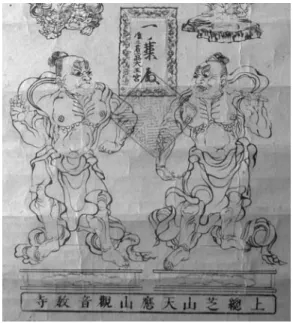
Two prints in the Tsuruya collection appear to depict these Niō sculptures;
one smallofuda, and a larger miei mounted as a hanging scroll. The first, and
Fig. 10 OfudaofNiō at Kannonkyōji, Chiba Prefecture.
2019.
Monochrome woodblock print.
24.5×35.0 cm.
Private Collection.
30 (131) Religious Prints as Expressions of the Sacred
most informal, is printed on a thin sheet of paper and features the Niōstanding on two separate bases (fig. 11);Agyōon the right with a vajra raised in his left hand and the right hand pressing down, and Ungyōon the left with a splayed right hand held at shoulder height and the left fist held at the waist. Both fig- ures are bare-chested and wear amo 裳, or skirt, which swirls around their legs in thick, fluid lines, along with the ends of the trailing tenne 天衣 (garland).
Fig. 11 OfudaofNiō at Kannonkyōji, Chiba Prefecture.
Monochrome woodblock print.
24.5×35.0 cm.
Fig. 12 OfudaofNiō at Kannonkyōji, Chiba Prefecture.
Monochrome woodblock print.
33.5×23.5 cm.
Private Collection.
Religious Prints as Expressions of the Sacred (130) 31
The thinner, yet no less calligraphic lines depicting the exaggerated musculature of the naked torsos make the bodies look at once muscular and skeletal. Agyō’s base reads“Kazusa Shibayama上総芝山”, and Ungyō’s reads “Kannonkyōji観 音教寺”;together they state the official name of the temple. Between the two figures is a red, diamond-shaped temple seal, the content of which is unclear.
An almost identical print is seen in another private collection (fig. 12). How- ever, careful comparative analysis of these two prints (for example, in the ends of the tenne, calligraphy on the bases, or abdominal muscles) and comparison
Fig. 13 Mieiof Thousand-armed
Kannon, FudōMyōō, Taishakuten and Niōat Kannonkyōji, Chiba Prefecture.
Monochrome woodblock print.
62.0×29.0 cm.
32 (129) Religious Prints as Expressions of the Sacred
with woodblocks at Kannonkyōji’s Shibayama Haniwa Museum reveals slight discrepancies between them, indicating that they were not likely printed from the same block, but are dōitsu sohon, or derivations of an original. Because of their stylistic discrepancies, it is also clear that they were not produced by the kabusebori technique described above. Because they are on such thin, rather low quality paper, it is likely that they were meant to be destroyed after use.
The fact that they were not, however, increases their cultural value.
The other print in the Tsuruya collection that features the Niō is visually
Fig. 13 detail Eleven-headed Kannon
Religious Prints as Expressions of the Sacred (128) 33
Fig. 13 detail FudōMyōō
Fig. 13 detail Taishakuten
34 (127) Religious Prints as Expressions of the Sacred
more complex, and is mounted as a hanging scroll (fig. 13). The composition depicts Eleven-headed Kannon, thehonzon of Kannonkyōji, at the top center of the composition, with FudōMyōōto the right, and Taishakuten to the left. The two Niōare at the bottom of the composition, and between them is a framed plaque that relates to the temple’s imperial patronage, reading “一乗殿 准三后 一品大王宮”. The fine, expressive lines of this print, seen particularly in the in- tricate base of the Eleven-headed Kannon, the flaming mandorla of FudōMyōō, and the windswept drapery of Taishakuten, indicate it was produced by a highly -skilled print artist. The Niōstand upon rectangular bases, and below these is a separate cartouche reading “上総芝山天応山観音教寺”. From comparison of this version to the two smaller prints discussed above, particularly in the ex- pressions of the torso musculature and the swirling tenne, it is clear that the two Tsuruya collection prints share a similar design, while the private collection
Fig. 13 detail Niō
Religious Prints as Expressions of the Sacred (126) 35
print is of another design lineage.
Conclusions
Religious prints embody religious values in many ways. First and foremost, they are icons to be venerated, most often for specific benefits. Secondly, in the case of Buddhist prints, their replicability ensures efficient merit accumulation, as each print produced propagates the faith. Thirdly, woodblocks designed or created by holy personages are considered sanctified, a quality that is carried forward with each print or derivation thereof. The issue of physical contact is of utmost importance, as the holiness of an object is believed to transfer to other objects or even people. Finally, proper disposal and regular renewal ofofuda is also integral to their function as icons, as the degradation of an object, no mat- ter how meager or humble, is, in the strict sense, akin to desecration;this aspect makes their existence somewhat rare, and thus prime candidates for collecting.
Using prints in the collection of Tsuruya Kōkei, as well as prints held in other collections, the preliminary research presented in this brief essay has shown concrete examples of the issues mentioned above, shedding light upon the com- plex relationship between common belief and the production of sacred images.
Notes
1)I am grateful to Tsuruya Kōkei for graciously providing me with access to his col- lection of prints. Unless otherwise indicated, all prints are in the collection of Tsu- ruya Kōkei.
2)Mosaku Ishida, trans. Charles S. Terry,Japanese Buddhist Prints(Tokyo: Kodan- sha International, 1964), p.15.
3)Shimzu Norifumi, “Gofu to kamidana,” Chijiwa Minoru, ed.,Nihon no gofu bunka (Tokyo: Kōbundō, 2010), p.37;Ian Reader and George Tanabe,Practically Relig- 36 (125) Religious Prints as Expressions of the Sacred
ious: Worldly Benefits and the Common Religion of Japan (Honolulu: University of Hawai’i Press, 1998), p.67.
4)Uchida Keiichi,Nihon bukkyōhangashi ronkō(Kyoto: Hōzōkan, 2001), p.3.
5)Ishida, p.14.
6)See the print entitledKitano Tenjinin the collection of Hiratsuka Un’ichi, Tokyo, reproduced in Ishida, fig. 133. See also Yabe Senzō,Shinsatsukō (Tokyo: Sojinsha shoya, 1943) for an early study on Shinto prints.
7)For print production processes, see specific entries in Amy Reigle Newland, The Hotei Encyclopedia of Japanese Woodblock Prints, vol.2 (Amsterdam: Hotei Pub- lishing, 2005).
8)Genshoku ukiyo-e daihyakka jiten henshūiinkai ed., Genshoku ukiyo-e daihyakka jiten,vol.3 “Yōshiki, chōzuri, hangen” (Tokyo: Daishūkan shoten, 1982), p.101.
9)Ian Reader, Making Pilgrimages: Meaning and Practice in Shikoku (Honolulu:
University of Hawai’i Press, 2005), pp.20-25.
10)The practice ofnōkyō納経, or having a temple seal stamped in a pilgrim’s book, onto a scroll or an item of clothing is a common practice even today. Gathering many stamps began to be viewed among the populace as the amassing of religious capital, and could ostensibly function as a passport to the Pure Land after death.
Such books, as well as scrolls that carried prints or stamps from each pilgrimage location, could also function as a “memory aid” to help the pilgrim relive the pil- grimage again, thus enabling them to gain additional spiritual merit. Reader,Mak- ing Pilgrimages,pp.20-25.
11)Reader,Making Pilgrimages,pp.20-25.
12)Uchida Keiichi,Utsukushiki Nihon no bukkyōhanga: suriutsushi mairaseru hotoke (Yamato-shi: Yamato puresu, 2018), p.9.
13)Ishida, 30. Morimoto Kyōjun and Kabutogi Shōkō, “Inbutsu, suributsu,” in Ishida Mosaku, ed.,Kodaihanga, vol.1 Nihon hanga bijutsu zenshū (Tokyo: Kodansha, 1961), pp.164-165. In some cases, religious meaning is attached to the production of Buddhist prints. For example, in a process called intsu kuyō印捺供養, a practi- tioner performs the stamping as part of a deceased person’s memorial service.
Uchida, 2018, p.5. In another process called inbutsu sahō印仏作法, a priest im- presses the image of a deity in the air or water, rather than paper, and then visual- izes the deity. Komai Nobukatsu, “‘Sahōshū’ shoshū no inbutsu sahō ni tuite,”
Gendai mikkyō28, 2018, pp.37-56.
14)For examples of early prints used in such a context see Nara kokuritsu hakubutsu- kan, ed,Nihon kohanga shūsei (Tokyo: Chikuma shobō, 1984). For examples of Religious Prints as Expressions of the Sacred (124) 37
zōnai nyūhin see Helmut Brinker, Secrets of the Sacred: Empowering Buddhist Images in Clear, in Code, and in Cache (Lawrence, Seattle: Spencer Museum of Art and University of Washington Press, 2011).
15)Reigle, p.482.
16)Reigle, p.450.
17)Ishida notes that from the Momoyama period onward, division of labor was more common in the printmaking process, meaning that an eminent priest of the early modern period, for example, would likely be involved in only part of the produc- tion process. Ishida, p.15.
18)Brian Ruppert, Jewel in the Ashes: Buddha Relics and Power in Early Medieval Japan (Cambridge, Harvard University Press: 2000), p.5.
19)Krzysztof Pomian, trans. Elizabeth Wiles-Portier,Collectors and Curiosities: Paris and Venice, 1500-1800(Cambridge: Polity Press, 1987), pp.16-17.
20)Reader and Tanabe, p.196-197.
21)Chijiwa Itaru et al, “Gofu, kishōmon no chōsa to kenkyū,” Kokugakuin daigaku 21 seiki COE proguramu, “Shinto to Nihon bunka no kokugakuteki kenkyū hasshin no kyoten keisei,” ed., Kokugakuin daigaku 21 seiki COE proguramu,
“Shinto to Nihon bunka no kokugakuteki kenkyūhasshin no kyoten keisei,” (To- kyo: Monbukagakushō 21 seiki COE puroguramu Kokugakuin Daigaku, 2007), p.82.
22)Pomian, p.89 23)Flitsch, ed., p.174.
24)Brian Bocking, A Popular Dictionary of Shinto (Richmond, Surrey: Curzon Books, 1995), 151-152;The Oracles on the Three Shrines: Windows on Japanese Religion(London and New York: Routledge, 2001).
25)Bocking,The Oracles of the Three Shines,” p.101.
26)BockingThe Oracles of the Three Shines,” p.97.
27)Flitsch, ed., p.174.
28)Donald McCallum, Zenkōji and its Icon (Princeton: Princeton University Press, 1994), p.46-49.
29)Mitsui Atsuo,Nihon no bukkyōhanga: inori to mamori no sekai(Tokyo: Iwahashi bijutsushisha, 1986), p.136.
30)For more on Edo periodkaichō, see Barbara Ambrose, “The Display of Hidden Treasures: Zenkōji’s Kaichō at Ekōin in Edo,” Asian Cultural Studies (vol.30, Spring 2004), pp.1-26.
31)McArthur, p.5.
38 (123) Religious Prints as Expressions of the Sacred
32)McArthur, p.13 and figs. 38-41.
33)Pitt Rivers Museum,Pitt Rivers Museum Catalogue(Oxford: Pitt Rivers Museum, 2019), pp.65-66.
34)Mitsui, pp.136-137.
35)https://www.freersackler.si.edu/object/F1962.13a-f/ accessed September 15, 2019.
Shimada Shūjirō, ed.,Bukkyōhanga yamatoe suibokuga, Zaigai hihō:Ōbei shūzō Nihon kaiga shūsei(Tokyo: Gakushūkenkyūsha, 1969), plate 44 and p.65.
36)Heibonsha, ed.Tokyōto,vol.73 ofNihon rekishi chimei taikei(Tokyo: Heibonsha, 1979), pp.1223-1224.
37)Accession no. 2009. 50. 20 38)Pitt Rivers Museum, pp.1210-1211.
39)See Josef Kyburz, ed.,Ofuda: Images gravées des temples du Japon, la collection Bernard Frank (Paris: Collége de France, Institut des Hautes Études Japonaises, 2011).
40)Kyburz, ed., p.172.
41)Heibonsha, ed.Tokyōto,pp.1223-1224.
42)There are approximately 400 Akiha jinja in Japan.
43)A passage inKojiki explains that this deity is the offspring of Izanami and Izangi.
Heibonsha, ed., Shinto daijiten, vol.1 (Tokyo: Heibonsha, 1941), p.302. Some Akiha jinja also enshrine Akiha gongen, who has wings, a bird’s beak, and rides a fox.
44)http://www.akihasanhongu.jp/history/index.html Accessed June 24, 2019.
45)Heibonsha, ed.Yamanashiken,vol.19 ofNihon rekishi chimei taikei(Tokyo: Hei- bonsha, 1979), p.752.
46)http://www.joryuken.net/2000/kitamura/data/syoutokuji.html accessed September 18, 2019.
47)Heibonsha, ed.Yamanashiken, pp.751-752.
48)Watanabe Yoshikatsu, Moji mandara no sekai (Tokyo: Iwanami shoten, 1999), p.38;Watanabe Hōyō, “Mandara honzon zuken no igi,” Kawazoe Shōji, ed.,Man- dara honzon, vol.1 of Nichiren shōnin to Hokke no shihō (Tokyo: Dōhosha, 2012), pp.14-18. For more on Nichiren’s interpretation of textual honzon see Jaqueline Stone, Original Enlightenment and the Transformation of Medieval Japanese Buddhism(Honolulu: University of Hawai’i Press, 1999), pp.272-274.
49)Nihon bukkyō jinmei jiten henshū iinkai, ed.,Nihon bukkyōjinmei jiten (Kyoto:
Hōzōkan, 1992), p.644.
50)Stone, p.274.
Religious Prints as Expressions of the Sacred (122) 39
51)Nihon bukkyōjinmei jiten,p.625;Mitsui, p.208-209.
52)Nicole Fabricand-Person, “Demonic Female Guardians of the Faith: The Fugen JūrasetsunyoIconography in Japanese Buddhist Art,” Barbara Ruch, ed., Engen- dering Faith: Women and Buddhism in Premodern Japan(Ann Arbor: University of Michigan Press, 2002), p.371-372.
53)Manabe Shunshō,Nihon butsuzōjiten(Tokyo: Yoshikawa kōbunkan, 2004), p.315 -317.
54)Mitsui, p.208-209.
55)Mareile Flitsch, ed.Tokens of the Path: Japanese Devotional and Pilgrimage Im- ages, the Wilfried Spinner Collection (1854-1918),pp.168-9.
56)Mitsui, fig. 134, p.208.
57)Such miraculous “discoveries” or “rescues” of icons are not entirely rare in Japa- nese Buddhism. For example, the main icon of worship at Ichibata Yakushi was found in the ocean. Reader, p.20.
58)Tomoe Irene Maria Steineck, “Japanese Devotional and Pilgrimage Images,”
Flitsch, ed., p.47.
59)Tokens of the Path, p.47, p.122.
60)Yamanaka was an active member of the Shūkokai集古会, an association of col- lectors that operated from 1896-1943. See various entries in Shūkokai, ed.,Shūko- shi(Kyoto: Shibunkaku shuppan, 1980).
61)Iijima Yoshiharu,Kyōkōzuihitsu(Tokyo: Heibonsha, 1995), p.214.
62)Iijima, p.214.
63)Heibonsha, ed.Chibaken, vol.12 ofNihon rekishi chimei taikei(Tokyo: Heibon- sha, 1979), p.701.
64)Meikodō,Shūri hōkokusho: mokuzōNiōzō(Agyō) Kannonkyōji(Tokyo: Meikodō, 2007).
65)http://niouson.or.jp/goriyaku.html accessed March 5, 2019.
40 (121) Religious Prints as Expressions of the Sacred