Universality, Characteristic Kernels and RKHS Embedding of Measures
Bharath K. Sriperumbudur BHARATH@GATSBY.UCL.AC.UK
Gatsby Computational Neuroscience Unit University College London
Alexandra House, 17 Queen Square London WC1N 3AR, UK
Kenji Fukumizu FUKUMIZU@ISM.AC.JP
The Institute of Statistical Mathematics 10-3 Midori-cho, Tachikawa
Tokyo 190-8562, Japan
Gert R. G. Lanckriet GERT@ECE.UCSD.EDU
Department of Electrical and Computer Engineering University of California, San Diego
La Jolla, CA 92093-0407, USA
Editor: John Shawe-Taylor
Abstract
Over the last few years, two different notions of positive definite (pd) kernels—universal and characteristic—have been developing in parallel in machine learning: universal kernels are pro- posed in the context of achieving the Bayes risk by kernel-based classification/regression algo- rithms while characteristic kernels are introduced in the context of distinguishing probability mea- sures by embedding them into a reproducing kernel Hilbert space (RKHS). However, the relation between these two notions is not well understood. The main contribution of this paper is to clarify the relation between universal and characteristic kernels by presenting a unifying study relating them to RKHS embedding of measures, in addition to clarifying their relation to other common notions of strictly pd, conditionally strictly pd and integrally strictly pd kernels. For radial kernels onRd, all these notions are shown to be equivalent.
Keywords: kernel methods, characteristic kernels, Hilbert space embeddings, universal kernels, strictly positive definite kernels, integrally strictly positive definite kernels, conditionally strictly positive definite kernels, translation invariant kernels, radial kernels, binary classification, homo- geneity testing
1. Introduction
Kernel methods have been popular in machine learning and pattern analysis for their superior per- formance on a wide spectrum of learning tasks. They are broadly established as an easy way to construct nonlinear algorithms from linear ones, by embedding data points into higher dimensional reproducing kernel Hilbert spaces (RKHSs) (Sch¨olkopf and Smola, 2002; Shawe-Taylor and Cris- tianini, 2004). In the regularization approach to learning (Evgeniou et al., 2000), it is well known that kernel-based algorithms (for classification/regression) generally invoke the representer theorem (Kimeldorf and Wahba, 1970; Sch¨olkopf et al., 2001) and learn a function in a RKHS that has the
representation,
f :=
∑
j∈Nn
cjk(·,xj), (1)
where Nn :={1,2, . . . ,n}, k : X×X →R is a symmetric positive definite (pd) kernel on some arbitrary space, X and {cj : j ∈Nn} ⊂R are parameters typically obtained from training data, {xj : j∈Nn} ⊂X . As noted in Micchelli et al. (2006), one can ask whether the function, f in (1) approximates any real-valued target function arbitrarily well as the number of summands increases without bound. This is an important question to consider because if the answer is affirmative, then the kernel-based learning algorithm can be consistent in the sense that for any target function, f⋆, the discrepancy between f (which is learned from the training data) and f⋆ goes to zero (in some appropriate sense) as the sample size goes to infinity. Since the linear hull of{k(·,x) : x∈X}is dense in the RKHS,H associated with k (Aronszajn, 1950), and assuming that the kernel-based algorithm makes f “converge to an appropriate function” in H as n→∞, the above question of approximating f⋆ arbitrarily well by f in (1) as n goes to infinity is equivalent to the question of whetherHis rich enough to approximate any f⋆arbitrarily well (such an RKHS is referred to as a universal RKHS and the corresponding kernel as a universal kernel). Depending on the choice of X , the choice of target function space and the type of approximation, various notions of universality—
c-universality (Steinwart, 2001), cc-universality (Micchelli et al., 2006; Caponnetto et al., 2008), c0-universality (Carmeli et al., 2010; Sriperumbudur et al., 2010a) and Lp-universality (Steinwart and Christmann, 2008; Carmeli et al., 2010)—have been proposed and characterized in literature.
Recently, a seemingly related (to universality) notion of characteristic kernel has been proposed and characterized (Fukumizu et al., 2004, 2008, 2009; Gretton et al., 2007; Sriperumbudur et al., 2008, 2009, 2010b), which has found applications in testing for homogeneity (Gretton et al., 2007), independence (Gretton et al., 2008), conditional independence (Fukumizu et al., 2008), to find the most predictive subspace in regression (Fukumizu et al., 2004), etc. Formally, given the set of all Borel probability measures defined on the topological space X , a measurable and bounded kernel, k is said to be characteristic if
P7→
Z
X
k(·,x)dP(x), (2)
is injective, that is, Pis embedded to a unique element, RXk(·,x)dP(x) inH. The motivation to consider such an embedding is that it provides a powerful and straightforward method of dealing with higher-order statistics of random variables, which has been exploited in the above mentioned applications. Gretton et al. (2007) related characteristic and universal kernels by showing that if k is c-universal—see Section 2 for the definition—then it is characteristic. Besides this result, not much is known or understood about the relation between universal and characteristic kernels.
The main contribution of this paper is to clarify the relation between universal and characteris- tic kernels by presenting a unifying study relating them to RKHS embedding of measures (Suquet, 2009), in addition to clarifying their relation to other common notions of strictly pd, conditionally strictly pd and integrally strictly pd kernels, which extends our preliminary study in Sriperumbudur et al. (2010b, Section 3.4). This is done by first reviewing all the existing characterizations for uni- versal and characteristic kernels, which is then used to clarify not only the relation between them but also their relation to other notions of pd kernels (see Section 3). Since the existing characteri- zations do not explain the complete relationship between all these various notions of pd kernels, we raise open questions in Section 3 about the relationships to be clarified, which are then addressed in Section 4 by deriving new results. In particular, in Section 4, we establish the relation between (a)
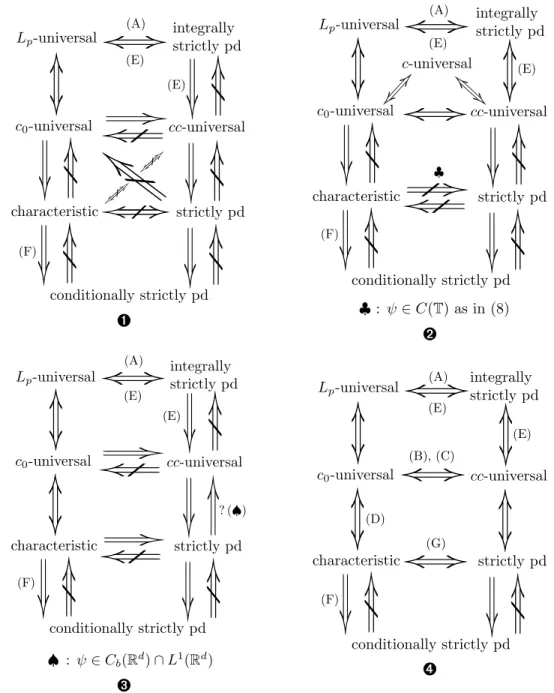
c0-universality and RKHS embedding of finite signed Borel measures, (b) universal and integrally strictly pd kernels, (c) characteristic and conditionally strictly pd kernels and (d) all the above men- tioned notions when the pd kernel is radial onRd. A summary of the relation between all these notions of pd kernels is shown in Figure 1, which shows the equivalence between these notions for radial kernels onRd. Supplementary results are collected in appendices. Throughout the paper, we assume X to be a Polish space,1the reason for which is discussed in the paragraph following (3).
In the following section, we introduce the notation and collect all definitions that are used throughout the paper.
2. Definitions and Notation
Let X be a topological space. C(X)denotes the space of all continuous real-valued functions on X . Cb(X) is the space of all bounded, continuous real-valued functions on X . For a locally compact Hausdorff space (examples include Rd, infinite discrete sets, topological manifolds, etc.), X , f ∈ C(X) is said to vanish at infinity if for everyε>0 the set{x :|f(x)| ≥ε}is compact.2 The class of all continuous f on X which vanish at infinity is denoted as C0(X). The spaces Cb(X)and C0(X) are endowed with the uniform norm,k · kudefined askfku:=supx∈X|f(x)|for f ∈C0(X)⊂Cb(X).
Radon measure: A signed Radon measure µ on a Hausdorff space X is a Borel measure on X satisfying
(i) µ(C)<∞for each compact subset C⊂X ,
(ii) µ(B) =sup{µ(C)|C⊂B,C compact}for each B in the Borelσ-algebra of X .
µ is said to be finite ifkµk:=|µ|(X)<∞, where|µ|is the total-variation of µ. Mb+(X)denotes the space of all finite Radon measures on X while Mb(X)denotes the space of all finite signed Radon measures on X . The space of all Radon probability measures is denoted as M1+(X):={µ∈Mb+(X): µ(X) =1}. For µ∈Mb(X), the support of µ is defined as
supp(µ) ={x∈X|for any open set U such that x∈U,|µ|(U)6=0}. (3) Mbc(X)denotes the space of all compactly supported finite signed Radon measures on X . We refer the reader to Berg et al. (1984, Chapter 2) for a general reference on the theory of Radon measures.
If X is a Polish space, then by Ulam’s theorem, every finite Borel measure is Radon (Dudley, 2002, Theorem 7.1.4). Therefore, for the simplicity of not requiring to distinguish between Borel and Radon measures, throughout the paper, we assume X to be a Polish space.
Positive definite (pd), strictly pd, conditionally strictly pd and integrally strictly pd: A symmet- ric function k : X×X →Ris called positive definite (pd) (resp. conditionally pd) if, for all n∈N (resp. n≥2),α1, . . . ,αn∈R(resp. with∑nj=1αj=0) and all x1, . . . ,xn∈X , we have
∑
n l,j=1αlαjk(xl,xj)≥0. (4)
1. A topological space(X,τ)is called a Polish space if the topologyτhas a countable basis and there exists a complete metric definingτ. An example of a Polish space isRdendowed with its usual topology.
2. LCH spaces have a rich supply of continuous functions that vanish outside compact sets—see Tietze extension theo- rem (Folland, 1999, Theorem 4.34).
Furthermore, k is said to be strictly pd (resp. conditionally strictly pd) if, for mutually distinct x1, . . . ,xn∈X , equality in (4) only holds forα1=···=αn=0.
A measurable, symmetric and bounded kernel, k is said to be integrally strictly pd if Z Z
X
k(x,y)dµ(x)dµ(y)>0,∀µ∈Mb(X)\{0}.
This definition is a generalization of integrally strictly positive definite functions on Rd (Stewart, 1976, Section 6): RRRdk(x,y)f(x)f(y)dx dy>0 for all f ∈L2(Rd), which is the strictly positive definiteness of the integral operator given by the kernel.
c-, cc-, c0- and Lp-universal kernels: A continuous pd kernel k on a compact Hausdorff space X is called c-universal if the RKHS,Hinduced by k is dense in C(X)w.r.t. the uniform norm, that is, for every function g∈C(X)and allε>0, there exists an f ∈Hsuch thatkf−gku≤ε(Steinwart, 2001).
A continuous pd kernel k on a Hausdorff space X is said to be cc-universal if the RKHS, H induced by k is dense in C(X)endowed with the topology of compact convergence, that is, for any compact set Z⊂X , for any g∈C(Z)and allε>0, there exists an f ∈H|Z such thatkf−gku≤ε, whereH|Z:={f|Z : f∈H}is the restriction ofHto Z and f|Zis the restriction of f to Z (Carmeli et al., 2010; Sriperumbudur et al., 2010a).
A pd kernel, k is said to be a c0-kernel if it is bounded with k(·,x)∈C0(X),∀x∈X , where X is a locally compact Hausdorff (LCH) space. A c0-kernel on an LCH space, X is said to be c0- universal if the RKHS,H induced by k is dense in C0(X) w.r.t. the uniform norm (Carmeli et al., 2010; Sriperumbudur et al., 2010a).3
A measurable and bounded kernel, k defined on a Hausdorff space, X is said to be Lp-universal if the RKHS,Hinduced by k is dense in Lp(X,µ)w.r.t. the p-norm, defined as
kfkp:=
Z
X|f(x)|pdµ(x) 1/p
,
for all Borel probability measures, µ, defined on X and some p∈[1,∞). Here Lp(X,µ)is the Banach space of p-integrable µ-measurable functions on X (Steinwart and Christmann, 2008).
We would like to stress that in the above definitions of universality, the assumptions on k ensure that the associated RKHS,His continuously included in the target space. Steinwart and Christmann (2008, Lemma 4.28) showed that k is bounded and k(·,x)is continuous for all x∈X (X being a topological space) if and only if every f ∈His bounded and continuous. In addition, the inclusion id : H→Cb(X)is continuous. Similarly, by modifying the proof of Lemma 4.28 in Steinwart and Christmann (2008), it can be easily shown that k is bounded and k(·,x)∈C0(X),∀x∈X (X being an LCH space) if and only if every f ∈His in C0(X), and the inclusion id : H→C0(X) can be shown to be continuous (also see Carmeli et al., 2010, Proposition 2.2). Steinwart and Christmann (2008, Theorem 4.26) showed that if k is measurable and bounded on a measurable space X , then
3. Note that cc-universality (resp. c-universality) deals with X being a non-compact (resp. compact) Hausdorff space, whereas c0-universality requires X to be an LCH space. While X being Hausdorff ensures that it has an abundance of compact subsets (as required in cc-universality), the stronger condition of X being an LCH space ensures that it has an abundance of continuous functions that vanish outside compact sets (see footnote 2). In addition, this choice of X being an LCH space ensures the existence of topological dual of C0(X)through the Riesz representation theorem, which is required in the characterization of c0-universality. See Proposition 2 in Section 4 for details.
H consists of p-integrable (w.r.t. any Borel probability measure, µ) functions and the inclusion id :H→Lp(X,µ)is continuous for some p∈[1,∞).
Characteristic kernel: A bounded measurable kernel, k is said to be characteristic if µ 7→
R
Xk(·,x)dµ(x)is injective, where µ is a Borel probability measure on X .
Translation invariant and Radial kernels on Rd: A pd kernel, k :Rd×Rd →Ris said to be translation invariant if k(x,y) =ψ(x−y), whereψis a pd function. If k is bounded and continuous, then by Bochner’s theorem (Wendland, 2005, Theorem 6.6),ψ∈Cb(Rd)is the Fourier transform of Λ∈Mb+(Rd), that is,
ψ(x) =Z
Rd
e−√−1xTωdΛ(ω),x∈Rd. (5)
A bounded continuous kernel, k is said to be radial onRd×Rd if there existsν∈M+b([0,∞)) such that
k(x,y) = Z
[0,∞)e−tkx−yk22dν(t),x,y∈Rd. (6) It is easy to see that a radial kernel is also bounded translation invariant on Rd (see Appendix A). Examples of radial kernels include the Gaussian kernel, k(x,y) =e−σkx−yk22,σ>0; inverse multiquadrics, k(x,y) = (c+kx−yk22)−β,β>d/2, etc.
A continuous pd kernel is said to be translation invariant on Td:= [0,2π)d if k(x,y) =ψ((x− y)mod 2π), whereψ∈C(Td)is such that
ψ(x) =
∑
n∈Zd
Aψ(n)e√−1xTn,x∈Td, (7)
with Aψ:Zd→R+, Aψ(−n) =Aψ(n)and∑n∈ZdAψ(n)<∞.
3. Relation Between Various Notions of Positive Definite Kernels Based on Known Characterizations
In this section, we review existing results on the characterization of universal and characteristic kernels, which are then used to clarify not only the relation between them but also their relation to other notions like strictly pd, conditionally strictly pd and integrally strictly pd kernels. In Sec- tion 3.1, we discuss various notions of universality, review all their existing characterizations and then summarize the relation between them. In Section 3.2, we discuss and summarize the relation between characteristic and universal kernels based on their existing characterizations. The relation of universal and characteristic kernels to strictly pd, conditionally strictly pd and integrally strictly pd kernels are summarized in Section 3.3. Since the existing characterizations do not explain the complete relationship between all these various notions of pd kernels, we raise questions at the end of each subsection that need to be addressed to obtain a complete understanding of the relationships between all these notions. A summary of the relationships between various notions of pd kernels based on the existing characterizations is shown in Figure 1.
Before proceeding further, we would like to highlight a possible confusion that can raise while comparing these various notions of pd kernels. Suppose we would like to compare c0-universal vs. characteristic kernels, that is, (a) Is a c0-universal kernel characteristic? (b) Is the converse true?
While (a) is a valid question, answering (b) trivially yields that characteristic kernels are not c0-
➊ ➋
➌ ➍
Figure 1: Summary of the relations between various families of c0-kernels: The implications shown without any reference are based on the review of existing results (see Section 3) while the ones with a reference are based on new results derived in Section 4 that addresses the open questions (A)–(G). The implications which are still open are shown with “?”. ➊ X is an LCH space. ➋The implications shown hold for any compact Hausdorff space, X . When X =T and k is continuous and translation invariant on T—see (7)—then k being characteristic implies it is strictly pd, which is shown as♣. ➌The implications shown hold for bounded continuous translation invariant kernels onRd—see (5). Ifψ∈ Cb(Rd)∩L1(Rd), then the implication shown as (♠) holds, that is, strictly pd kernels are cc-universal. Otherwise, it is not clear whether the implication holds. ➍Radial kernels onRd—see (6).
universal. This is because k need not be a c0-kernel for it to be characteristic.4 Therefore, to make a non-trivial comparison between characteristic and c0-universal kernels, it is important that we assume k to be a c0-kernel before answering the questions in (a) and (b). In extending this reasoning for the non-trivial comparison of any two notions of pd kernels, it is important to assume that k satisfies the strongest possible condition. Therefore, in order to present a concise summary of the relationships between these various notions, in Figure 1, we assume k to be a c0-kernel—this is the strongest condition to be satisfied in order to compare all these notions of pd kernels.
3.1 Relation Between Various Notions of Universality
As mentioned before, a universal kernel is such that its corresponding RKHS, H is rich enough to approximate any target function (belonging to some target space) arbitrarily well. Therefore, depending on the choice of X , the choice of target space and the type of approximation, various notions of universality—c, cc, c0and Lp—have been proposed. In the following, we review the ex- isting characterizations for all these notions of universal kernels and summarize the relation between them.
c-universality: Steinwart (2001) proposed the notion of c-universality, wherein X is a compact metric space with C(X)being the target space andHbeing dense in C(X)w.r.t. the uniform norm.
By applying the Stone-Weierstraß theorem (Folland, 1999, Theorem 4.45), Steinwart (2001, The- orem 9) provided sufficient conditions for a kernel to be c-universal—a continuous kernel, k on a compact metric space, X is c-universal if the following hold: (a) k(x,x)>0,∀x∈X , (b) there exists an injective feature mapΦ: X→ℓ2 of k withΦ(x) ={Φn(x)}n∈Nand (c) span{Φn: n∈N}is an algebra—using which the Gaussian kernel is shown to be c-universal on every compact subset of Rd. Micchelli et al. (2006, Proposition 1) related c-universality to the injective RKHS embedding of finite signed Borel measures by showing that k is c-universal if and only if
µ7→
Z
X
k(·,x)dµ(x),µ∈Mb(X), (8)
is injective.
cc-universality: One limitation in the notion of universality considered by Steinwart (2001) is that X is assumed to be compact, which excludes many interesting spaces, such as Rd and infi- nite discrete sets. To overcome this limitation, Carmeli et al. (2010, Definition 4.1, Theorem 4.3) and Sriperumbudur et al. (2010a) introduced the notion of cc-universality which can handle non- compact Hausdorff spaces, X . Carmeli et al. (2010, Proposition 2.3, Theorems 4.3 and 4.4) showed that a bounded continuous pd kernel, k is cc-universal if and only if the following embedding is injective for all µ∈Mbc(X)and some p∈[1,∞):
f7→
Z
X
k(·,x)f(x)dµ(x),f ∈Lp(X,µ). (9) In addition, Carmeli et al. (2010, Remark 4.1) showed that k being cc-universal is equivalent to it being universal in the sense of Micchelli et al. (2006) and Caponnetto et al. (2008): for any compact Z⊂X , the set K(Z):=span{k(·,y): y∈Z}is dense in C(Z)in the uniform norm, which is shown by
4. Let k1be a characteristic kernel onR. Define k2(x,y) =1 if x=y∈Rand k2(x,y) =0 if x6=y∈R. Clearly k2is not continuous and therefore k1+k2is not a c0-kernel, even if k1is a c0-kernel. However, it is easy to verify that k1+k2
is characteristic.
Micchelli et al. (2006, Proposition 1) to be equivalent to the following embedding being injective:
µ7→
Z
Z
k(·,x)dµ(x),µ∈Mb(Z). (10)
Since (10) holds for any compact Z⊂X , the universality in the sense of Micchelli et al. and Capon- netto et al. is equivalent to the following embedding being injective:
µ7→
Z
X
k(·,x)dµ(x),µ∈Mbc(X). (11)
Therefore, k being cc-universal is equivalent to the injectivity of (11)—in Section 4, we present a more direct proof of this result (see Remark 3). It is clear from the definitions of c- and cc- universality that these notions are equivalent when X is compact, which also follows from their characterizations in (8) and (11).
As special cases, Micchelli et al. (2006, Propositions 14, Theorem 17) showed that a translation invariant kernel onRdis cc-universal if supp(Λ)is a uniqueness subset5ofCd, while a radial kernel onRd is cc-universal if and only if supp(ν)6={0}—see (5) and (6) for the definitions ofΛandν.
Using these characterizations, many popular kernels onRdare shown to be cc-universal (Micchelli et al., 2006, Section 4): Gaussian, Laplacian, B2l+1-spline, sinc kernel, etc.
c0-universality: Although cc-universality solves the limitation of c-universality by handling non-compact X , the topology of compact convergence considered in cc-universality is weaker than the topology of uniform convergence, that is, a sequence of functions,{fn} ⊂C(X)converging to f ∈C(X) in the topology of uniform convergence ensures that they converge in the topology of compact convergence but not vice-versa. So, the natural question to ask is whether we can charac- terizeHthat are rich enough to approximate any f⋆on non-compact X in a stronger sense, that is, uniformly, by some g∈H. Carmeli et al. (2010, Definition 2.2, Theorem 4.1) and Sriperumbudur et al. (2010a) answered this through the notion of c0-universality, wherein X is an LCH space with C0(X)being the target space andHbeing dense in C0(X)w.r.t. the uniform norm (note that a notion of universality that is stronger than c0-universality can be defined by choosing X to be a Hausdorff space, Cb(X)to be the target space andHbeing dense in Cb(X)w.r.t. the uniform norm. However, this notion of universality does not enjoy a nice characterization as c0-universality—see (12) and (13) for the characterization of c0-universality—and therefore, we did not include it in our study of relationships between various notions of pd kernels. See Appendix C for details).
Carmeli et al. (2010, Theorem 4.1) showed that a c0-kernel k is c0-universal if and only if it is Lp-universal, which by Proposition 2.3 and Theorem 4.2 of Carmeli et al. (2010) is equivalent to the injectivity of the following embedding for all µ∈Mb(X)and some p∈[1,∞):
f7→
Z
X
k(·,x)f(x)dµ(x),f ∈Lp(X,µ). (12) We provide an alternate characterization for c0-universality in Section 4 (see Proposition 2) that k is c0-universal if and only if the following embedding is injective:
µ7→
Z
X
k(·,x)dµ(x),µ∈Mb(X). (13)
5. A subset S ofCd is a uniqueness set if an entire function onCd vanishes on S then it is everywhere zero onCd. Non-empty interior is sufficient for a set to be a uniqueness set.
As a special case, Carmeli et al. (2010, Proposition 5.6) showed that a translation invariant k on Rdis c0-universal if and only if supp(Λ) =Rd. Examples of c0-universal kernels onRdinclude the Gaussian, Laplacian, B2l+1-spline, inverse multiquadrics, Mat´ern class, etc.
Summary: The following statements summarize the relation between various notions of univer- sality, which are depicted in Figure 1.
• c- and cc-universality are related to the injective RKHS embedding of finite signed Borel measures, as shown in (8) and (11).
• For c0-kernels defined on an LCH space X , c0-universality implies cc-universality, which fol- lows from (9) and (12). The converse is however not true as a bounded continuous translation invariant c0-kernel onRd is c0-universal if and only if supp(Λ) =Rd while(supp(Λ))◦6= /0 is sufficient for cc-universality, where A◦represents the interior of A.
• When X is compact, then c-, cc- and c0-universality are equivalent.
• For an LCH space X , a c0-kernel is c0-universal if and only if it is Lp-universal.
• If k is a radial kernel onRd, then k is cc-universal if and only if supp(ν)6={0}. Open questions: The following relationships need to be clarified, which we do in Section 4.
(A) As mentioned in the summary, c- and cc-universality are related to the injective RKHS em- bedding of finite signed Borel measures. However, the relation between c0-universality and the injective RKHS embedding of finite signed Borel measures as shown in (13) is not clear, which we clarify in Section 4.1.
(B) For c0-kernels defined on an LCH space X (that is not compact), it is clear from the summary that c0-universality implies cc-universality. Is there a case for which cc-universality implies c0-universality? We address this in Section 4.3.
(C) While cc-universality is characterized for radial kernels on Rd, the characterization of c0- universality for radial kernels is not known. In Section 4.3, we provide a characterization of c0-universality for radial kernels onRdand then establish the relation between c0-universality and cc-universality for such kernels.
3.2 Relation Between Characteristic and Universal Kernels
In this section, we comprehensively clarify the relation between various notions of universality and characteristic kernels, based on already existing characterizations for characteristic kernels and the results summarized in Section 3.1 for universal kernels.
c-universal kernels vs. Characteristic kernels: Gretton et al. (2007) related universal and char- acteristic kernels by showing that if k is c-universal, then it is characteristic. In our preliminary study in Sriperumbudur et al. (2010b, Section 3.4), we showed that the converse is not true: as an example, a translation invariant kernel, k onTd×Td is characteristic if and only if Aψ(0)≥0, Aψ(n)>0,∀n∈Zd+while it is universal if and only if Aψ(n)>0,∀n∈Zd.
cc-universal kernels vs. Characteristic kernels: cc-universal kernels on a non-compact Haus- dorff space need not be characteristic: for example, a bounded continuous translation invariant
kernel onRd is cc-universal if(supp(Λ))◦6= /0(see the summary of Section 3.1) while it is char- acteristic if and only if supp(Λ) =Rd (Sriperumbudur et al., 2008, Theorem 7). Although, this example shows that a bounded continuous translation invariant kernel onRd is cc-universal if it is characteristic, it is not clear whether such a relation holds on a general non-compact Hausdorff space (not necessarilyRd). The following example shows that continuous kernels that are characteristic on non-compact Hausdorff space, X also need not be cc-universal.
Example 1 Let X =N. Define k(x,y) =δxy,x,y∈X\{1}, k(x,1) =0 for any x ∈X , where δ represents the Kronecker delta. Suppose µ=δ1∈Mbc(X)\{0}, where δj represents the Dirac measure at j. ThenkRXk(·,x)dµ(x)k2H=kk(·,1)k2H=k(1,1) =0,which means there exists µ∈ Mbc(X)\{0} such thatRXk(·,x)dµ(x) =0, that is, (11) is not injective and therefore k is not cc- universal. However, k is characteristic as we show below.
LetPandQbe probability measures on X such thatP=∑j∈Npjδj,Q=∑j∈Nqjδj with pj≥ 0,qj≥0 for all j∈Nand∑j∈Npj=∑j∈Nqj=1. Consider
B :=
Z
X
k(·,x)d(P−Q)(x)
2 H=
∑
j∈N
(pj−qj)k(·,j)
2 H=
∑
l,j∈N
(pl−ql)(pj−qj)k(l,j)
= (p1−q1)2k(1,1) +2(p1−q1)
∑
j∈N\{1}
(pj−qj)k(j,1) +
∑
l,j∈N\{1}
(pj−qj)(pl−ql)k(j,l)
=
∑
j∈N\{1}
(pj−qj)2.
Suppose B=0, which means pj=qj,∀j∈N\{1}. Since∑j∈Npj=∑j∈Nqj=1, we have p1=q1 and soP=Q, that is, (2) is injective and therefore k is characteristic.
c0-universal kernels vs. Characteristic kernels: Fukumizu et al. (2008, 2009) have shown that a measurable and bounded kernel, k is characteristic if and only ifH+R(the direct sum ofHand R is defined as H+R:={f+c : f ∈H,c∈R}) is dense in Lp(X,P) for all P∈M+1(X) and for some p∈[1,∞). Using this, it is easy to see that ifH is dense in Lp(X,P)for allP∈M1+(X) and for some p∈[1,∞), then k is characteristic. Based on the results summarized in Section 3.1, it is clear that for an LCH space, X , if k is c0-universal, which means k is Lp-universal, thenH is dense in Lp(X,P)for allP∈M+1(X)and for some p∈[1,∞)and therefore is characteristic. In Section 4, we provide an alternate proof for this relation between c0-universal and characteristic kernels by answering (A). Clearly, the converse is not true, that is, a c0-kernel that is characteristic need not be c0-universal (see Proposition 4 and footnote 8). However, for bounded continuous translation invariant kernels onRd, the converse is true, that is, a translation invariant c0-kernel that is characteristic6is also c0-universal. This is because of the fact that a translation invariant kernel onRdis characteristic if and only if supp(Λ) =Rd(Sriperumbudur et al., 2008, Theorem 7), which is also the same characterization summarized in Section 3.1 for c0-universal kernels.
Summary: The following statements summarize the relation between universal and characteris- tic kernels, which are depicted in Figure 1.
6. Let k(x,y) =ψ(x−y)be a bounded continuous translation invariant kernel onRd, which by Bochner’s theorem is of the form in (5). Supposeψ∈L1(Rd). Then by the Fourier inversion theorem (Dudley, 2002, Theorem 9.5.4),Λ has a density, ˆψw.r.t. the Lebesgue measure such that ˆψ∈L1(Rd). Therefore, sinceψis the Fourier transform of ψˆ, by the Riemann-Lebesgue lemma (Rudin, 1991, Theorem 7.5),ψ∈C0(Rd), that is, k is a c0-kernel. Most of the well-known characteristic kernels satisfy the condition ofψ∈L1(Rd)and therefore are c0-kernels. This means, for all practical purposes, we can assume bounded continuous translation invariant kernels to be c0-kernels.
• For c0-kernels defined on an LCH space, X , Lp-universal⇔ c0-universal⇒ characteristic.
But in general, c0-kernels that are characteristic need not be c0-universal. However, for trans- lation invariant kernels onRd, c0-universal⇔characteristic.
• When X is compact, c-universal⇒characteristic but not vice-versa.
• For translation invariant kernels onRd, characteristic⇒cc-universal but not vice-versa. How- ever, on general non-compact Hausdorff spaces, continuous kernels that are characteristic need not be cc-universal.
Open questions: The following relationship need to be clarified, which we do in Section 4.
(D) While the relation between universal and characteristic kernels that are translation invariant onRdis clear (see the summary above), the characterization of characteristic and c0-universal kernels that are radial onRd is not known and therefore the relation between characteristic and universal kernels that are radial onRdis not clear. We address this in Section 4.3.
3.3 Relation of Universal and Characteristic Kernels to Strictly PD, Integrally Strictly PD and Conditionally Strictly PD Kernels
In this section, we relate characteristic kernels and various notions of universal kernels to strictly pd, integrally strictly pd and conditionally strictly pd kernels. Before that, we summarize the relation between strictly pd, integrally strictly pd and conditionally strictly pd kernels. In Sriperumbudur et al. (2010b, Section 3.4), we showed that integrally strictly pd kernels are strictly pd. The converse is not true, which follows from Steinwart and Christmann (2008, Proposition 4.60, Theorem 4.62).
However, if X is a finite set, then k being strictly pd also implies it is integrally strictly pd. From the definitions of strictly pd and conditionally strictly pd kernels, it is clear that a strictly pd kernel is conditionally strictly pd but not vice-versa.
Universal kernels vs. Strictly pd kernels: Carmeli et al. (2010, Corollary 4.3) showed that cc-universal kernels are strictly pd, which means c0-universal kernels are also strictly pd (as c0- universal⇒cc-universal from Section 3.1). This means, when X is compact Hausdorff, c-universal kernels are strictly pd, which matches with the result in Steinwart and Christmann (2008, Definition 4.53, Proposition 4.54, Example 4.11).
Conversely, a strictly pd c0-kernel on an LCH space need not be c0-universal. This follows from Theorem 4.62 in Steinwart and Christmann (2008) which shows that there exists a bounded strictly pd kernel, k on X :=N∪{0}with k(·,x)∈C0(X),∀x∈X such that k is not Lp-universal (which from the summary of Section 3.1 means k is not c0-universal). Similarly, when X is compact, the converse is not true, that is, continuous strictly pd kernels need not be c-universal which follows from the results due to Dahmen and Micchelli (1987) and Pinkus (2004) for Taylor kernels (Steinwart and Christmann, 2008, Lemma 4.8, Corollary 4.57)—refer to Steinwart and Christmann (2008, Section 4.7, p. 161) for more details.7 Therefore, it is evident that a continuous strictly pd kernel is in general not cc-universal on an Hausdorff space. However, for translation invariant kernels that are continuous, bounded and integrable on Rd, that is, k(x,y) =ψ(x−y),x,y∈Rd, whereψ∈
7. Another example of continuous strictly pd kernels that are not c-universal is as follows. Using the technique in the proof of Theorem 14 of Sriperumbudur et al. (2010b), it can be shown that a continuous translation invariant kernel onT×Tis c-universal if and only if Aψ(n)>0,∀n∈Z. Therefore, by Theorem 8 (see Appendix B), a strictly pd kernel onTneed not be c-universal.
Cb(Rd)∩L1(Rd), strictly pd implies cc-universality. This follows from Theorem 6.11 and Corollary 6.12 of Wendland (2005) that if ψ∈Cb(Rd)∩L1(Rd)is strictly pd, then (supp(Λ))◦6= /0, which from the summary of Section 3.1 means k is cc-universal. Similarly, when the kernel is radial on Rd, then strictly pd kernels are cc-universal. This follows from Theorem 7.14 of Wendland (2005), which shows that a radial kernel onRdis strictly pd if and only if supp(ν)6={0}, and therefore cc- universal (from the summary of Section 3.1). On the other hand, when X is finite, all these notions of universal and strictly pd kernels are equivalent, which follows from the result due to Carmeli et al. (2010, Corollary 4.3) that cc-universal and strictly pd kernels are the same when X is finite.
Characteristic kernels vs. Strictly pd kernels: Since characteristic kernels that are c0- and trans- lation invariant onRd are equivalent to c0-universal kernels (see the summary of Section 3.2), it is clear that they are strictly pd. However, the converse is not true: for example, the sinc-squared kernel, k(x,y) =sin2(x(σ(x−y))
−y)2 onR, which has supp(Λ) = [−σ,σ]( Ris strictly pd (Wendland, 2005, Theorem 6.11), while it is not characteristic. Based on Example 1, it can be shown that in gen- eral, characteristic kernels on a non-compact space (not necessarily Rd) need not be strictly pd:
in Example 1, k is characteristic but is not strictly pd because for(a1, . . . ,an) = (1,0, . . . ,0) and (x1, . . . ,xn) = (1, . . . ,n), we have∑nl,j=1alajk(xl,xj) =a21k(1,1) +2a1∑nj=2ajk(j,1) +∑nj=2a2j =0.
Note that Example 1 holds even if X is a compact subset ofN. Therefore, when X is compact Haus- dorff, a characteristic kernel need not be strictly pd. However, for translation invariant kernels on T, a characteristic kernel is also strictly pd, while the converse is not true: Fukumizu et al. (2009, Theorem 8) and Sriperumbudur et al. (2010b, Theorem 14) have shown that k onT×Tis charac- teristic if and only if Aψ(0)≥0, Aψ(n)>0,∀n∈Z\{0}, which by Theorem 8 (see Appendix B) is strictly pd, while the converse is clearly not true.
Characteristic kernels vs. Integrally strictly pd kernels: In Sriperumbudur et al. (2009, The- orem 4) and Sriperumbudur et al. (2010b, Theorem 7), we have shown that integrally strictly pd kernels are characteristic, while the converse in general is not true.8 When k is bounded continuous and translation invariant on Rd, however the converse holds, which is due to the fact that if k is characteristic, then supp(Λ) =Rd (Sriperumbudur et al., 2008, Theorem 7), which ensures that k is integrally strictly pd.
Summary: The following statements summarize the relation of universal and characteristic ker- nels to strictly pd, integrally strictly pd and conditionally strictly pd kernels, which are depicted in Figure 1.
• c-, cc- and c0-universal kernels are strictly pd and are therefore conditionally strictly pd, while the converse in general is not true. When X is finite, then c-, cc- and c0-universal kernels are equivalent to strictly pd kernels.
• Bounded, continuous, integrable, strictly pd translation invariant kernels onRdare cc-universal.
Radial kernels onRd are strictly pd if and only if they are cc-universal.
• For a general non-compact Hausdorff space, characteristic kernels need not be strictly pd and vice-versa. However, bounded continuous translation invariant kernels onRd orTthat are characteristic are strictly pd but the converse is not true.
8. By Example 1, it is clear that for µ=δ1∈Mb(X)\{0},RRXk(x,y)dµ(x)dµ(y) =k(1,1) =0, whereδ1represents the Dirac measure at 1. Therefore k is not integrally strictly pd but is characteristic.
• Integrally strictly pd kernels are characteristic. Though the converse is not true in general, it holds if the kernel is bounded, continuous and translation invariant onRd.
Open questions: The following questions need to be clarified, which is done in Section 4.
(E) While the relation of universal kernels to strictly pd and conditionally strictly pd kernels is clear from the above summary, the relation between universal and integrally strictly pd kernels is not known, which we establish in Section 4.2.
(F) When X is a finite set, it is easy to see that characteristic and conditionally strictly pd ker- nels are equivalent (see Section 4.4). However, their relationship is not clear for a general measurable space, which we clarify in Section 4.4.
(G) As summarized above, radial kernels onRdare strictly pd if and only if they are cc-universal.
However, the relation between all the other notions of pd kernels—c0-universal, characteris- tic, strictly pd and integrally strictly pd—is not known, which is addressed in Section 4.3.
4. Relation Between Various Notions of Positive Definite Kernels: New Results
In this section, we address the open questions, (A)–(G) mentioned in Section 3 to understand the complete relationship between various notions of positive definite kernels.
4.1 c0-universality and RKHS Embedding of Measures
As mentioned in Section 3.1, Micchelli et al. (2006) have established the relation of c-universality and cc-universality to injective RKHS embedding of finite signed Borel measures—shown in (8) and (11)—through a simple application of the Hahn-Banach theorem (see Theorem 1). The fol- lowing result (also see Suquet, 2009, Remark 1.1) in Proposition 2 provides a measure embedding characterization—shown in (13)—for c0-universality, which is also obtained as a simple applica- tion of the Hahn-Banach theorem, and therefore addresses the open question in (A). Before we state Proposition 2, we present the Hahn-Banach theorem, which we quote from Rudin (1991, Theorem 3.5 and the remark following Theorem 3.5).
Theorem 1 (Hahn-Banach) Suppose A is a subspace of a locally convex topological vector space Y . Then A is dense in Y if and only if A⊥={0}, where
A⊥:={T ∈Y′:∀x∈A,T(x) =0}.
The following result, which presents a necessary and sufficient condition for k to be c0-universal hinges on the above theorem, where we choose A to be the RKHS,Hand Y to be C0(X)for which Y′is known through the Riesz representation theorem (Folland, 1999, Theorem 7.17).
Proposition 2 (c0-universality and RKHS embedding of measures) Suppose X is an LCH space with the kernel, k being bounded and k(·,x)∈C0(X),∀x∈X . Then k is c0-universal if and only if the embedding,
µ7→
Z
X
k(·,x)dµ(x),µ∈Mb(X), (14)
is injective.
Proof By definition, k is c0-universal ifHis dense in C0(X). We now invoke Theorem 1 to charac- terize the denseness ofHin C0(X), which means we need to consider the dual C0′(X):= (C0(X))′of C0(X). By the Riesz representation theorem (Folland, 1999, Theorem 7.17), C′0(X) =Mb(X)in the sense that there is a bijective linear isometry µ7→Tµ from Mb(X)onto C0′(X), given by the natural mapping, Tµ(f) =RX f dµ, f ∈C0(X). Therefore, by Theorem 1,His dense in C0(X)if and only ifH⊥:={µ∈Mb(X):∀f ∈H,RX f dµ=0}={0}. From Lemma 7 (see Appendix B), we have H⊥={µ∈Mb(X):RXk(·,x)dµ(x) =0}and therefore the result follows from Theorem 1.
Remark 3 (a) When X is compact, C0(X) coincides with C(X), and therefore the result in (14) matches with the one in (8), derived by Micchelli et al. (2006).
(b) The characterization of cc-universality, shown in (11) can also be directly obtained as a simple application of Theorem 1, wherein the proof is similar to that of Proposition 2 except that we need to consider the dual of C(X)endowed with the topology of compact convergence (a locally convex topological vector space) to characterize the denseness ofHin C(X). It is known (Hewitt, 1950) that C′(X) =Mbc(X)in the sense that there is a bijective linear isometry µ7→Tµfrom Mbc(X) onto C′(X), given by the natural mapping, Tµ(f) =RX f dµ, f ∈C(X). The rest of the proof is verbatim with Mb(X)replaced by Mbc(X).
(c) Comparing (14) and (2), it is clear that c0-universal kernels are characteristic while the converse is not true, which matches with the result in Section 3.2.
4.2 Relation Between Universal Kernels and Integrally Strictly PD Kernels
In this section, we address the open question (E) through the following result which shows that c0-kernels are integrally strictly pd if and only if they are c0-universal.
Proposition 4 (c0-universal and integrally strictly pd kernels) Suppose the assumptions in Propo- sition 2 hold. Then, a c0-kernel, k is c0-universal if and only if it is integrally strictly pd, that is,
Z Z
X
k(x,y)dµ(x)dµ(y)>0,∀µ∈Mb(X)\{0}. (15) Proof (⇐) Suppose k is not c0-universal. By Proposition 2, there exists µ∈Mb(X)\{0}such that R
Xk(·,x)dµ(x) =0, which implieskRXk(·,x)dµ(x)kH=0. This means 0=DZ
Xk(·,x)dµ(x), Z
Xk(·,x)dµ(x)E
H (e)=
Z Z
Xk(x,y)dµ(x)dµ(y),
that is, k is not integrally strictly pd, where(e)follows from Lemma 7 (see Appendix B). Therefore, if (15) holds, then k is c0-universal.
(⇒) Suppose there exists µ∈Mb(X)\{0}such thatRRXk(x,y)dµ(x)dµ(y) =0, that is,
Z
X
k(·,x)dµ(x) H
=0⇒ Z
X
k(·,x)dµ(x) =0.
Therefore, the embedding in (14) is not injective, which by Proposition 2 implies that k is not c0- universal. Therefore, if k is c0-universal, then k satisfies (15).
4.3 Radial Kernels onRd
In this section, we address the open questions (B), (C), (D) and (G) by showing that all the notions of universality and characteristic kernels are equivalent to strictly pd kernels.
Proposition 5 (All notions are equivalent for radial kernels onRd) Suppose k is radial on Rd. Then the following conditions are equivalent.
(a) supp(ν)6={0}.
(b) k is integrally strictly pd.
(c) k is c0-universal.
(d) k is cc-universal.
(e) k is strictly pd.
(f) k is characteristic.
Proof Note that(b)⇔(c)follows from Proposition 4,(c)⇒(d)from (11) and (13) and(d)⇔(e) from Micchelli et al. (2006, Proposition 14) and Wendland (2005, Theorem 7.14). Theorem 7.14 in Wendland (2005) also ensures that(e)⇒(a). Now, we show(a)⇒(b). To do this, we first derive an intermediate result. Suppose ˆµ is the Fourier transform of µ defined as ˆµ(ω) =RRde√−1ωTxdµ(x), then for anyψdefined as in (5), we have
Z Z
Rdψ(x−y)dµ(x)dµ(y) = Z Z Z
Rde−
√−1(x−y)TωdΛ(ω)dµ(x)dµ(y)
= Z Z
Rde−√−1xTωdµ(x) Z
Rde√−1yTωdµ(y)dΛ(ω)
= Z
Rdˆµ(ω)ˆµ(ω)dΛ(ω)
= Z
Rd|ˆµ(ω)|2dΛ(ω). (16)
ConsiderRRRdk(x,y)dµ(x)dµ(y)with k as in (6), given by B :=
Z Z
Rd
k(x,y)dµ(x)dµ(y) = Z Z
Rd
Z ∞
0
e−tkx−yk22dν(t)dµ(x)dµ(y)
(⋆)= Z ∞
0
Z Z
Rde−tkx−yk22dµ(x)dµ(y)
dν(t)
(♣)
= Z ∞
0
1 (4πt)d/2
Z
Rd|ˆµ(ω)|2e−kωk
2 2
4t dω
dν(t)
(♠)
= Z
Rd|ˆµ(ω)|2 Z ∞
0
1
(4πt)d/2e−kωk
2 2 4t dν(t)
dω, (17)
where Fubini’s theorem is invoked in(⋆)and(♠), while we used (16) in(♣), where we setψ(x) = e−tkxk22 with dΛ(ω) = (4πt)−d/2e−kωk22/4tdω. Since supp(ν)6={0}, the inner integral in (17) is positive for everyω∈Rd and so B>0, which means k is integrally strictly pd.