先端炭素材の調製と応用
1
.バインダー、ニードルコークス2
.Li-ion
電池用負極材3
.ピッチ系炭素繊維4
.活性炭及び活性炭素繊維九州大学先導物質化学研究所、教授
尹 聖昊
2013年9月27日
炭素資源学特論Ⅳ
-
11
世界の一次エネルギー需要見通し(Mtoe)
1980 2000 2006 2015 2030 年平均増加率 2006-30
石炭 1788 2295 3053 4023 4908 2.0%
(米国) 551 580 633 0.6%
(中国) 1214 1898 2441 4.0%
(インド) 223 315 579 6.0%
石油 3107 3649 4029 4525 5109 1.0%
ガス 1235 2088 2407 2903 3670 1.8%
原子力 186 675 728 817 901 0.9%
水力 148 225 261 321 414 1.9%
バイオマス 748 1045 1186 1375 1662 1.4%
他の再生可能エネルギー 12 55 66 158 350 7.2%
合計 7223 10034 11730 14121 17014 1.6%
約45%増加 Outlook of Global Demand for Primary Energy
Annual average increase rate 2006-30
Approx. 45%
increase (US)
(China) (India) Coal
P etroleum Oil Gas Nuclear P ower Hydraulic P ower Biomass Other Renewables Total
Three countries - U.S., China, and India - account for 75% in 2030
Outlook of Total Production of Energy Sources
先端炭素材開発のNeeds
とSeeds
2
2
Energy Demand and Supply in 21 st Century
• Marked Increase of Energy Demand in Asia and Africa in 21 st Century
Population x Demand/Head
Three to Four Times of Current Demands of Fossil Fuels ⇒ Increasing By-products of Fossil Fuels
Issues
◩
Supply
◩
CO 2 Emission Enhances Global Warming
◩ Effective utilization of by-products of fossil fuels
先端炭素材開発の
Needs
とSeeds
Raw materials and precursors for carbons
Coal tar
Polymer: Thermosetting and thermoplastic Heavy oil and residues
Biomass
Raw materials
• Pitches: CF, ACF, MCMB, Ball type AC, Binder pitch, Additives
• Polymer: AC, ACF, Glassy carbon, CF
• Cokes: Electrode, Capacitor, Battery anode, AC, Additives
• Char: AC, Additives, Reducer for Solar cell
Precursor
From fossil fuel to functional carbons 4
Electric and Heat Conductions
Conductor and Semi-conductor
Energy Storage
Battery anode
Super capacitor
Gas storage
Environmental Protection
Activated surface
Mechanical Reinforcement
High Temperature Materials
Allotropes
Fullerene
Bucky Onions Toroidal Structures
Nanotubes Acetylene Blacks
Hexagonal graphite
Poly- crystallin
e Graphite
Carbon Black
Cokes and Activated
Carbons Carbon Fibers Pyrocarbons
Carbyne
SP
1SP
2SP
2+Cubic diamond Diamond-like Carbon
SP
3rehybridization
Bonding
Hybridization Derived and Defective Forms
Ref.) Bourrat, X. Structure in Carbons and Carbon Artifacts. In: Sciences of Carbon Materials. Marsh, H.;
Rodriguez-Reinoso, F., Eds., Universidad de Alicante, 2000. pp1-97.
Carbon Isotopes
6
0.001GP
は10
気圧に相当する炭素の状態図
相 固体
融点
3823 K
(3550 ℃)
沸点
5073 K
(4800 ° C,)
気化熱
355.8 kJ·mol
−1音の伝わる速さ
18350 m·s
−1(293.15 K)
炭素の物理特性
黒鉛の化学反応性
8
各種材料の耐熱性と比重
10
炭 素 化 反 応
炭素の生成反応
炭素の生成(固・液相)
12
プロセス 原 料 炭 素 材 料 特 徴 気相炭化 揮発性有機物 カーボンブラック
熱分解炭素
カーボンホイスカー
超微粒 高配向性
高強度、高電導性、
高弾性 液相炭化 溶融溶解性有機
物、溶融性石炭
コークス 人造黒鉛
高密度等方性黒鉛
高異方牲
高異方牲、高電導性 等方性、高密度
固相炭化 不融性繊維状有 機物
熱硬化性高分子 木材、非溶融性 石炭
炭素繊維
ガラス状炭素 活性炭
モレキュラーシーブ カーボン
高強度、高弾性
高強度、ガス不適過 多孔性、吸着
分子ふるい
炭素化プロセスと特徴
T. Baird
モデル;(a)→(b)→(c)
の順に成長VGCF、CNTの成長モデル
14
低 熱処理温度 高 短 熱処理時間 長
典型的な液相炭化反応の様相
原料ピッチ メソフェーズ 球晶発生
メソフェーズ 球晶成長
球晶成長・合体 バルクメソフェーズ
固相炭化の原料となる高分子
16
炭素の構造
La Lc
a 0
c 0
d 002
炭素の結晶構造パラメータ18
(002)
面とd (002)
結晶面と面間隔の関係
(110)
面とd (110)
(112)
面とd (112)
有機物の加熱による変化
黒鉛化過程 前駆体生成過程 炭素化過程
前期 後期
H
2O, CO
2, CH
4, H
2 低分子生成物
1000 ℃ 1500 ℃ 3000 ℃
500 ℃
炭
素
黒
鉛 前
駆 体 分解
芳香族化 重縮合
構造再編
黒鉛構造発達 共役系
拡大
組織の 緻密化
焼成工程 黒鉛化工程
熱処理温度による結晶構造変化
20
黒鉛
Nanoscopic Structure of PAN Based CF
“Structural comparison of mesophase and PAN based carbon fibers”
S.H. Hong, S. H. Yoon, I. Mochida J. Material Sci., in press (2011)
22
22
STM images of ACFs
OG7A-800H OG20A-800H
In order to remove oxygen containing functional groups for removing the heterogeneous effect of STM, OG7A and OG20A were heat-treated at 800
OC in a hydrogen atmosphere ( H
2/ He =1/4).
Vacant spaces between the two domains of OG20A are larger than that of OG7A.
Domain size of OG20A is a little smaller than that of OG7A.
Slit type pores were observed in domains of OG7A and OG20A.
It can be presumed that almost pores larger than 2nm nucleated by the inter-particle mechanism.
5nm 25nm 5nm 25nm
Slit shaped pore (Intra-particle)
Slit shaped pore (Intra-particle)
Channeling pore
(Inter-particles)
Gas Liquid Solid
Carbon or carbonaceous materials Varieties of structural unit
Heat treatment
What is the synthetic carbon!
Organic materials Carbon
Basic structural units Micro domain
Domain Orientation
Rearrangement
Coagulation
Partial melt fusion
Modified Structures Heat treatment
2 ~ 10 nm
4 ~ 6 nm
Origin of Structural Units And Crystalline Defects
IAMS, Kyushu University
Lc(002) Aromatic planar molecule
Stacking unit of planar molecules (Molecular assemble unit)
Micro-domain
(Quasi-aligned molecular assemble unit)
Domain
Closely packed micro- domains in mesophase
pitch
Heat Treatment
Graphitic unit
Pleat unit Aligned micro-domains in
the mesophase pitch fiber fiber axis
Deformed micro-domain
Pitch fiber Graphitized fiber spinning
“Axial nano-scale microstructure in the graphitized fiber inherited from liquid crystal mesophase pitch”
Carbon, 34, 83-88 (1996) S. H. Yoon, Y. Korai, K.Yokogawa, S. Fukuyama, M. Yoshimura, I. Mochida
Basic structure and structural control of carbon
Understanding carbon structures
:Carbon nano-world
Structures
• Structural units
• Nano-phased units
Spaces
• Pore size
and homogeneity
• Pore amounts
Surfaces
• Edges
(Kinds and amounts)
• Basals
(Perfectness and Orientation)
+
Nano
Syntheses
→
Mass-
production Controls
→
Improving
Performances and
Functions
Hybridization
→
Improving
Performances and
Functions
→
Creating New
Functions
High
performances
High functions
New functions
Applications
Productions
26
Electric and Heat Conductions
Conductor and Semi-conductor
Energy Storage
Battery anode
Super capacitor
Gas storage
Environmental Protection
Activated surface
Mechanical Reinforcement
High Temperature Materials
炭素の応用
Carbon Fiber
Battery, Capacitor, Atomic and Coal Power Plants 28
Graphite Electrode
単結晶シリコン引上げ用CZ炉
30
高温工学試験研究炉(HTTR)
出典:日本原子力研究開発機構 HP
臨界プラズマ(核融合)試験装置
JT-60 32
提供:日本原子力研究開発機構
医療用 X線CTスキャナ
Air Purification Using ACF (Remote Watching System) 34
炭素材の製造
重質油を用いたカーボンサークル
36
重質油又は石炭残渣を用いた炭素材の製造模式図
38
Mixing
Forming
Baking Binder
Pitch
Crushing
Storage bins
Machining Finished product Graphitization
Classified Fractions Screening
Silos
Anthracite Graphite Coke
Weighing
Pitch Impregnation Grinding
黒鉛電極の製造
等方性黒鉛の製造工程(二元系原料)
先端炭素材の製造におけるポイント
40
High performance pitch based carbon fibers: less than 50 ppm
Capacitor : less than 500 ppm
High performance needle coke : 500 ppm Carbon medicines: less than 300 ppm?
Carbon anode for LIB: less than 100 ppm
…
コールタールピッチの
QI
除去Method Principle Advantage Disadvantage
① Filtering (Heat, Solvent)
Decreasing viscosity by heating or solution
Mesh filtering of QI
Only QI Removal
No heavy fraction removal Large equipment X
② Centrifuging (Heat, Solvent)
Decreasing viscosity by heating or solution
Centrifugal condensing of QI
Only QI Removal
No heavy fraction removal Large equipment X
③ Solvent - Precipitation
Mixing of miscible solvents
Precipitation removal of QI Low productivity
④ Non-solvent Precipitation
Mixing of non-miscible solvents
Precipitation removal of QI Large equipment OK Heavy fraction removal
• It is relatively easy to remove QI in lab scale.
• QI removal in the industrial scale
Very difficult to remove finely dispersed QI from large amount of viscous liquid
Only success in Japan
Japan several ten thousands ~ hundreds tons/year scale
ピッチ系炭素繊維
Needs and Seeds of Carbon Fiber
High Performance Carbon Fiber(HPCF) : CF with TS over 3500MPa - CFRP for lightening :
Transportation: Aerospace (B787, A380,…), Military, EV (EV, HEV, FEV: Parts need special properties/performances)
Sports, Robotics, …
Energy Devices: Windmill, …
Construction: CFRC, Supplement
Middle Performance Carbon Fiber(MPCF) : CF with TS of 1500~3500MPa - CFRP Application: CF with TS of 1500~3500MPa, Long Fiber
Transportation: Main Body for EV (EV, HEV, FEV) Construction (Short Fiber CFRC)
Low Performance Carbon Fiber(LPCF) : CF with TS Less Than 1200 MPa - Refractory Materials for High Temperature Devices (Short Fiber)
- ACF for Environmental Protections
Strong demand of MPCF with appropriate mechanical properties and production cost for broadening novel market;
Pitch Based Carbon Fiber Can Meet of the Carbon Fiber.
Production Capacity of PAN CF in the world 44
Company T/Y
Toray 17,600
Toho TENAX 13,900 Mitsubishi Rayon 7,400
etc. 16,400
Total
55,300
* Capacity for less than 24
K, 2010
Current State Production Capacity of Pitch Based CF
Company T/Y Type Precursor Pitch
Kureha 1450 Short Isotropic
Osaka Gas Chemical 600 Short Isotropic Mitsubishi Chemical 1000 Long Mesophase Japan Graphite Fiber 180 Long Mesophase
CYTEC 230 Long Mesophase
Total 3460
* 2010, (From HP Information, China: 200T/Y, Isotropic)
Specific tensile strength and modulus of various reinforcing fibers 46
0 5 10 15 20 25 30
5 10 15 20
Specific str eng th ( 10
6cm )
Specific modulus ( 10
8cm )
PAN CF
MPCF SiC
Steel
Alumina Glass
High modulus CF
High strength CF
Relationship between TS & YM before Improving
Preparation of Mesophase Pitch 48
Raw
Material Before treatment and transferring to mesophase
DO De-ash → Thermal Polycondensation → Thermal Transferring to Mesophase → Mesophase pitch
Coal tar De-ash → Hydrogenation → Thermal Polycondensation (Mesophase) → Mesophase Pitch
Naphthalene Polycondensation (HF/BF
3) → Removal of light Matters → Mesophase Pitch
Isotropic pitch Formation of mesophase
Growth of mesophase
Bulky
mesophase
MPCF Production Processes 49
紡 糸用
ピッチ 溶融紡糸 不 融 化
酸 化 反 応
炭 化
窒 素 下
黒 鉛 化
窒 素 下
O O OH
HO C
C CC
CC CC C
ピッチ
ポンプ
ノズル
M
押出機Smaller Impurities
Pitch with easy orientation property
Increasing Graphitic Units
Higher orientation Higher Strength
&
Modulus
Higher Modulus
Mesophase Pitch
Melt
Spinning Stabilization Carbonization (N2)
Graphitization (N2)
Pitch
Hopper
Extruder
Nozzle
50
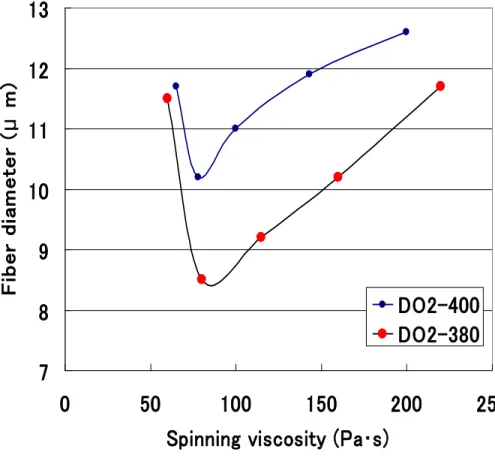
Fig. Correlation between fiber diameter
and spinning viscosity
7 8 9 10 11 12 13
0 50 100 150 200 250
Spinning viscosity (Pa・s)
Fiber diameter (μm)
DO2-400 DO2-380
Fig. Spinning apparatus Pressurized by Nitrogen
M
heater
filter pitch
spinneret
winder
Stabilization of Pitch Fibers
Oxidation
Oxygen
Heat
by-product gas H
2,H
2O,CO
2,etc
Polymerization
Increasing Tensile Strength by Removal of Inorganic Impurities 52
1000 1500 2000 2500 3000 3500 4000
800 1200 1600 2000 2400 2800
Heat treatment temp.,℃
Tensile strength, MPa
30ppm 270ppm
SEM
CF Cross section after Polishing
Fig. Observation of void defect 30ppm 270ppm
SiO
2+ C → SiC + CO
2Over 1250
oC
SiC → Si + C
Nucleation of voids Over 1800
oC
Fig. Relationship between the tensile strength
and heat treatment temperature
Relationship between TS & YM of Recent CFs
Thermal Conductivity of CF 54
1200 1000 800 600 400 200
-1-
T her mal C on du ctivity / W .m .K
10 Al Cu P AN B ased C F Pitc h Based C F Pitc h Based C F Pitc h Based C F
How to Achieve Pitch Based MPCF
Tensile Strength 800~1100 MPa ⇒ 1500~3500 MPa Elongation Property 1.5 % ⇒ 2.0~2.5%
Fiber Shape Diameter: Less than 10 μm, Long Fiber
Required Characteristics
Precursor Low Cost, Linear, high MW highly polymeric molecular compositions
⇒ Introduction of Molecular Orientation, High Purity
Spinning Less than 10 μm and Control of microstructure Stabilization Low Defect (Low Heat Value), Homogeneous
Oxidation
Carbonization High Carbonization Yield, Low Defects
How to Achieve?
Cost : Yields of Pitch and Fiber, High Productivity Fiber
電池材料
Carbon is key element for Batteries !!
リチウムイオン二次電池の動作原理
58
Electrode Materials for Lithium Secondary Battery
A spectacularly reactive cathode Nature Materials 2, 705–706 (2003)
Different materials for different applications
+ Safety
炭素負極材
60
Anodic Electrode to Hold Reduced Li-ion Intercalation → Graphite
Surface Electron Transfer into Sealed Void
→ Hard or Low Temperature Calcined Carbon
Electron Conductive Material
Anodic Carbon and Cathode Material Expansion Moderator
Holding and Release of Ion Is Accompanied with Volumetric Charge
Larger Capacity per Volume → Larger Expansion Moderation and Control of SEI
Irreversible Charge → Surface Coating, Composite
Structure
0.0 0.5 1.0 1.5 2.0 2.5
0 50 100 150 200 250 300 350
Discharge capacity/Ah/kg
Pote nti al /V
A B C D E F
炭素化温度と放電曲線の関係
A:2000C B:2200C C:2400C D:2600C E:2800C F:3000C
黒鉛系材料
62
0.00 0.50 1.00 1.50 2.00 2.50
0 50 100 150 200 250 300
Discharge capacity/Ah/kg
Pot ential/ V
炭素化温度と放電曲線の関係
A:1800C B:1600C C:1400C D:1200C
A B C D
コークス系材料0.0 0.5 1.0 1.5 2.0 2.5
0 200 400 600 800
Discharge capacity/Ah/kg
Pot ential/ V
A B C D
炭素化温度と放電曲線の関係
A:1000C B:900C C:800C D:700C
低温焼成炭素系材料
バイオ由来のハードカーボン
64
IM is heat treated under Ar atmosphere with the heating rate of 10
oC/min 0 100 200 300 400 500 600 700 800
0.0 0.5 1.0 1.5 2.0 0.0 0.5 1.0 1.5 2.0
IM950 IM1000 IM1050 IM700 IM800 IM900
(a)
Po te n ti a l (V, vs. L i/ L i
+)
Capacity (mAh/g)
(b)
65
65
Preparation and Analysis of SiO-CNF Composites
Electrochimica Acta, 55, 5519-5522 (2010)
66
66
Composite (Fe cat.) Mixture (CNF) Mixture (KB) 100
200 300 400
Volume expansion (%)
Electrolyte penetration only (2days) After charging to 0V
301%
248%
153%
124% 126%
112%
Comparison bet. Composite and Mixture
Cycle performances of PCSi-CNF composite
CARBON, 48, 3381-3391, 2009.
68
68
0 5 10 15 20 25 30
0 100 200 300 400 500 600 700 800
Dis c ha ge ca pa c ity (mAh /g)
Cycle
20Si/PyC/CNF-30%
20Si/PyC/CNF-20%
20Si/PyC/CNF-10%
MAG
0 5 10 15 20 25 30
0 100 200 300 400 500 600 700
Disch age ca pac ity (m Ah/g)
Cycle
50Si/PyC/CNF-30%
50Si/PyC/CNF-20%
50Si/PyC/CNF-10%
MAG
Si-CNF composite / Graphite Hybridization
Activated Carbons for Energy and
Environmental Devices
70
C C
C CO
2CO
2CO
2CO
2CO
22CO 2CO 2CO
2CO
(Making small pores in the carbon materials)
C C C
C
Carbon materials
Activation reagents
• Air, CO2, Steam
• KOH (NaOH), ZnCl2
Activation(活性化)
活性炭の構造モデル
71
72
Water Filter Small Water filter
Felt Paper Manufacturing Products
• Thickness 1~8 mm ACF Coat 60~100%
• Mixing organic fibers to improve the strength and dimension stability.
• Needle punched felt (FN type) heat-processed felt (FH type).
• Selection according to the concentration and amount of the contaminant.
10 20 30 40 50
0 1 2 3
Water Amount (ton)
Chlorine Residue (%) Chlorine in Water:
2ppm
Water Flow Rate:
3l/min
Temperature: 20℃
• Thickness 0.2~0.8 mm ACF Coat 60~70%
• Anti-water
• Anti-chemicals
• Easy formation into any shapes
• Columnar
• Low resistivity
• Chlorine removal
ACF Products in Particular Forms
STM images of ACFs
74
VOCs
NVOCs: Dioxin, PCB CO
Sick-house gases
SO 2
CO 2
NO 2 Ox
NO
SPM Benzene Toluene etc.
Typical Hazard Gases in the Atmosphere
SO 2 SO 4 2-
ACF
2001
0 5 10 15 20 25
18:00 12:00 12:00 12:00 12:00 12:00 12:00 12:00 12:00 12:00 12:00 12:00 12:00 12:00 12:00 12:00 12:00 12:00
4/234/23 4/24 4/25 4/26 4/27 4/28 4/29 4/30 5/1 5/2 5/3 5/4 5/5 5/6 5/7 5/8 5/9
OG20A (0.100g)
セットACF
通過後のSO
2濃度 環境SO
2 濃度SO
2濃度(ppb)
2001年 (17日間)
ACF (0.100g)
SO
2(p pb)
SO 2
After ACF Ambient air
Lapse of time (day)
Data from Dr. Shimohara Of Fukuoka H & E Institute
活性炭素繊維を用いた道路辺の
DeSOx
76
ACF surface
SO 2 (ad.) SO 3 (ad.) H 2 SO 4 (ad.)
SO 2 O 2 H 2 O H 2 O
aq. H 2 SO 4 SO 2
SO
2+ad.→SO
2ad.
SO
2ad.+1/2O
2→SO
3ad.
SO
3ad.+H
2O→H
2SO
4ad.
H
2SO
4ad.+H
2O→aq.H
2SO
4×
DeSOx mechanism using ACF
DeSOx by ACF and CNF-ACF Composite
PDU for SOx Removal by ACF DeSOx condition: SO
21000ppm, O
25vol%,
H
2O 10vol%,
N
2balance 、 Total flow rate: 100 ml/min Reaction Temperature: 50 ℃
Time (h)
PO-CNF 1%
cat., 5min growing
PO-CNF 5% cat., 5min growing H11000
DeSOx Properties of ACF and ACF-CNF
NO & NO 2 Oxidation over ACF 78
ACF surface
NO(ad.) O(ad.) NO 2 (ad.) NO 3 (ad.) NO O 2 NO 2 Heating
NO NO 2 NO NO 3
Identified reaction
aq.HNO
3Strong Inhibition of H
2O
The oxidation of NO 2 always produces NO
And NO 3
-through the disproportionation.
The Mechanism of NO Reductive Removal
ACF surface
NO(ad.) O(ad.) NO 2 (ad.) + NH 3 (ad.) NO O 2 NH 3
N 2 +H 2 O
The mechanism of NO removal consists of adsorption and
oxidation of NO into NO 2 which is reduced with NH 3
Characterization of ACF purification 80
Natural ventilation ACF
Room temperature, ozonizer is no need, no light irradiation, compact design
NO 2 NO 2 SPM
SO 2
Hazardous NH 3
Odor NO NO
O 3
Forced ventilation
chemicals H 2 S
HCHO
ACF
Three-dimensional wind vectors
Natural ventilation system (Fixed type) ACF fence
Natural wind
81
Toluene adsorption characteristics of ACFs 82
83
0 1 2 3 4 5 6 7 8 9 10 11 12
0 10 20 30 40 50 60
C / C0 / %
Time / h
HCHO adsorption characteristics of PACNF in humidified atmosphere
Experimental
HCHO : 11 ppm
Sample weight : 0.05g Gas flow rate : 100ml / ml
Humidity of condition : 50%PACNF FE100
FE200 FE300
Under the circumstances of humidity (RH=50%),
PACNF shows specific prominent adsorption characteristics for formaldehyde.
0 1 2 3 4 5 6 7 8 9 10 11 12 0
10 20 30 40 50 60
C / C0 / %
Time / h
PACNF
FE100
Experimental
HCHO : 11 ppm
Sample weight : 0.05g Gas flow rate : 100ml / ml
Humidity of condition : 0%RH BET Elemental analysis (wt%) Microporous
(m2 / g) C H N Odiff ash N / O ratio (%)
90% 375 68.06 1.19 18.02 11.41 1.32 1.80 94.7%
!!!
84 84
Carbons for Super Capacitor
Relationship Between Organic Capacitance And 85
Surface Area
1M Et 4 NBF 4 /PC, 2.7V, Capacitance per Volume
Present
Capacity
86
e- e-
+
+ + + + + + + +
+ +
e-
e- e- e- e-
e- e-
e-
++ + - +
+
+ +
+ + +
- - -
- -
- -
- - -
- - Electrolyte:Et4NBF4
Porous carbon
Cation((C
2H
5)
4N+) Anion(SO
42-)
1.352nm
Ideal Model for capacitor
Stokes’ diameter : 0.676nm Stokes’ diameter : 0.517nm
M. Endo et al. , J. Electrochem.
Soc., 148 (8) A910-914 (2001).
In using Et
4NBF
4as an electrolyte, at least pore size larger than 1.3nm is necessary to have electric double layered capacitance.
Electrolyte:H2SO4
-
1.034nm
Conjecture of pore size using capacitance data
In using H
2SO
4as an electrolyte, pore size of about 1.0nm is enough to have electric double layered capacitance.
EDLC with organic electrolytes EDLC with inorganic electrolytes
Non-aqueous electrode 87
Specific
capacitance Surface property Per
weight
Per surface
area
Surface area
Average pore size
O contents
N contents
F/g mF/m2 m2/g nm % %
OG-5A 0.5 0.6 677 0.65 4.8 1.1
OG-7A 1.6 1.2 988 0.68 5.3 0.7
OG-10A 48.1 32.6 1212 0.77 6.1 0.5 OG-15A 72.5 41.7 1488 0.90 8.3 0.5 OG-20A 81.9 38.7 1817 1.08 6.7 0.3
Specific
capacitance Surface property Per
weight
Per surface
area
Surface area
Average pore size
O contents
N contents
F/g mF/m2 m2/g nm % %
FE-100 0.1 0.2 637 0.67 6.2 10.1
FE-200 0.1 0.2 909 0.72 7.4 6.1
FE-300 24.7 17.3 1131 0.78 7.9 4.1 FE-400 59.3 43.0 1187 0.82 9.3 2.5
0 20 40 60 80 100 120 140 160 180
0 20 40 60 80 100 120 140 160 180
OG-5A OG-7A OG-10A OG-15A OG-20A
Capacitance (F/g) Capacitance (mF/m2 )
0 20 40 60 80 100 120 140 160 180
0 20 40 60 80 100 120 140 160 180
FE-100 FE-200 FE-300 FE-400
Capacitance (F/g) Capacitance (mF/m2 )
Specific Capacitances
in Non-Aqueous Electrolyte (Et 4 NBF 4 /PC)
Non-aqueous electrode
Specific
capacitance Surface property Per
weight
Per surface
area
Surface area
Average pore size
O contents
N contents
F/g mF/m2 m2/g nm % %
OG-5A 0.5 0.6 677 0.65 4.8 1.1
OG-7A 1.6 1.2 988 0.68 5.3 0.7
OG-10A 48.1 32.6 1212 0.77 6.1 0.5 OG-15A 72.5 41.7 1488 0.90 8.3 0.5 OG-20A 81.9 38.7 1817 1.08 6.7 0.3
Specific
capacitance Surface property Per
weight
Per surface
area
Surface area
Average pore size
O contents
N contents
F/g mF/m2 m2/g nm % %
FE-100 0.1 0.2 637 0.67 6.2 10.1
FE-200 0.1 0.2 909 0.72 7.4 6.1
FE-300 24.7 17.3 1131 0.78 7.9 4.1 FE-400 59.3 43.0 1187 0.82 9.3 2.5
0 20 40 60 80 100 120 140 160 180
0 20 40 60 80 100 120 140 160 180
OG-5A OG-7A OG-10A OG-15A OG-20A
Capacitance (F/g) Capacitance (mF/m2 )
0 20 40 60 80 100 120 140 160 180
0 20 40 60 80 100 120 140 160 180
FE-100 FE-200 FE-300 FE-400
Capacitance (F/g) Capacitance (mF/m2 )
Solvated electrolyte ions fail to enter into narrow
micropores.
OG series
FE series
Cap acita nce (mF/ m
2)
in Et4NBF4/PC
Cap acita nce (F/ g) Cap acita nce (mF/ m
2) Cap acita nce (F/ g)
OG 5A & FE 100
OG 15A & FE 300
Collector
+ + + + +
+
+ +
+ + +
+
+ + + +
Adsorbed BF4-ions
Free BF4-ions
OG 5A & FE 100
OG 15A & FE 300 Adsorbed BF4- ions
Free BF4- ions OG-5A -7A -10A -15A -20A
FE-100 -200 -300 -400