Which Factors Created the Impetus for Economic Recovery in Occupied Japan?
―Focusing on the Effects of Economic Distress and American Pressure Groups―
Oktay Kurtulus*
要 旨
戦後のアメリカの対日占領政策の究極目的は,日本を二度と国際の平和と安定を脅かす存在にしない ことであった.この目的を達成するために,日本を再編する懲罰的措置が採用され,対日占領の初期段 階で,実施されていた.だが,1948年初頭になると,懲罰的措置は,日本の経済復興に資するような,
より穏和なものにとって替えられた.多くの歴史学者は,こうした対日占領政策の変化を,米ソ間のイ デオロギー対立と迫り来る冷戦状況の結果だと評価している.すなわち,アメリカの対日占領政策は,
トルーマンドクトリンやマーシャルプランに代表されるような,アメリカのグローバルな対ソ封じ込め 政策の一環と捉えられ,変容されたのだ.
ここで,冷戦の影響のみが,対日占領政策の唯一の要因であるかという疑問が生ずる.本稿では,対 日占領政策の他の要因として,次の二点,つまり,(1)日本の経済窮状,(2)対日占領政策に批判的な アメリカの圧力団体を指摘する.本稿では,この二つの要因が,賠償問題と財閥解体政策に与えた影響 を検証する.本稿は,上記の二つの要因が占領期日本の経済復興政策の推進力となり,そして冷戦状況 の激化により日本の経済復興政策が強化されていく過程を明らかにするものである.
Contents
Ⅰ Introduction
Ⅱ Economic Planning for Occupied Japan, 1943-1947
Ⅲ The Criticism of the SCAP Economic Policies under the Looming Cold War
Ⅳ Entrenchment of Economic Recovery, 1948–1949
Ⅴ Conclusion
* オクタイ クルトゥルシュ 法学研究科政治学専攻博士課程前期課程
2016年10月7日 推薦査読審査終了
第1推薦査読者 滝田 賢治 第2推薦査読者 星野 智
I Introduction
Post-surrender policies for Japan, their establishment, and the reasons behind the policy changes are all well-known subjects that were analyzed by many researchers. Regarding these, much scholarly work was published in the 1980s after many primary sources were made open to the public. During this period, the Revisionist historians left their mark upon the literature. They drew attention to the phenomenon of
“reverse course,” a unilateral and politically reactionary “shift of emphasis” from reform policies to eco- nomic recovery.1)
What Revisionist historians did was link the changes in the occupation policies with the U.S. strategic interest and foreign policy. They explained that policy changes were made under the looming Cold War to protect U.S. national security. According to the revisionists, Washington shifted its emphasis from democ- ratization and demilitarization policies to economic recovery and establishment of limited defense forces in Japan after: (1) the Truman Doctrine and the Marshall Plan deepened the ideological rift between U.S. and the Soviet Union, (2) the consecutive communist gains against Kuomintang (KMT) in the Chinese Civil war pushed the U.S. to reconsider its choices of allies, and (3) the possibility of a spill-over of the commu- nist influence in the South East Asia and the Far East increased concerns in Washington. As a result, the economic democratization policies, such as the deconcentration of excessive economic power and the repa- ration policies that crippled the economic recovery and “self-sufficiency” of Japan, were shelved. Instead, a new set of policies to stabilize the Japanese economy and revitalize the trade relations between Japan and South East Asian countries were put into motion. To achieve the new goals, Washington sent Dodge Mission to implement austerity measures to curb spiraling inflation in Japan and establish a single exchange rate to revitalize its trade. According to revisionist historians, all these steps were taken in order to create a strong ally in the Far East which could prevent the spread of communist influence in the region.
This interpretation which focuses on the macro level explanations of U.S national security is persuasive and plausible. It goes without saying that the Cold War dynamics played the role of a catalyst in the change of occupation policies to protect the core interests of the United States. Having said that, the Cold War dynamics were not the only factor affecting the occupation policies. I claim there are two more factors that explain why the policy reversal occurred: (1) Economic distress in Japan raised concerns over the feasibility of the democratization of Japan, and (2) the American pressure groups and Congress criticized the occupation policies which beaconed an intervention by Washington.
In this paper, I argue that these two factors created the impetus of economic recovery, causing a reversal of occupation policies. As early as 1946, policy-makers in Washington and GHQ started recommending an economic recovery program for Japan to prevent civil unrest and to strengthen democratic tendencies.
They mentioned that radical right or radical left could emerge and destroy all the achievements of the occupation unless the problems underlining the civil unrest were solved. They stressed that the Japanese economy should be brought to the self-sufficiency levels to assure that the democratization program would succeed, and Japan would not become a menace to the world order again. Meanwhile, American business-
men and pressure groups criticized punitive economy program of the Occupation. American businessmen saw Japan as a great market for their businesses. But the Japanese economy was not performing well because of the stern reform policies, such as the purge of the business leaders, and deconcentration of excessive economic power. Uncertainties over reparations and dissolution of Japanese companies in which American businesses had great shares and interests furthered these concerns. Therefore, American pres- sure groups started criticizing the ongoing reform program and recommended changes in the policies to create a suitable environment for conducting business in Japan.
As the result of these factors, the economic recovery program gained utmost importance in late 1947.
William Draper of the Army Department and George Kennan of the State Department went to Japan to stimulate a reversal of occupation policies. They confirmed the need for economic recovery and drew attention to make Japan a strong ally in the Far East under the conditions of looming Cold War. In other words, the intensification of the Cold War did not bring forward the idea of economic recovery, rather it fortified the already existent arguments of the policy-makers and the American businessmen who desired the economic recovery.
However, this doesn’t mean that the Cold War did not play a role in the policy reversal. Moreover, by no means, this paper rejects or criticizes the revisionist interpretation. The main premise here is that revision- ist interpretation could be buttressed by analyzing the economic distress in Japan and the influence of the American pressure groups. We believe that a detailed examination of the developments in 1946 and 1947 would enable us to grasp how the arguments for economic recovery surfaced and then gained utmost importance by late 1947. For these reasons, following questions will be answered as clearly as possible in this paper: How did the punitive measures for occupation occur? To what extent, the economic distress in Japan affected the policy formulation in Washington? Were there any pressures to Washington by American pressure groups/businessmen to revive Japanese economy? If so, did they utilize the threat of communism in Japan to justify their purposes? Did American ex-businessmen/ bureaucrats play a role in reversing the course?
The paper is going to examine the developments and changes in the policies of the Japanese occupation from December 1943 to December 1949. This timeframe will be divided into three parts. In the first part, a historical background of economic policy formulation within the State Department between 1943 and 1945 will be touched upon to enhance our understanding. Next, punitive measures for the zaibatsu and strict reparations policies will be examined. An effort will be made to understand how the directives from Washington were utilized by the GHQ personnel, particularly by “New Dealers,” to draw comprehensive dissolution policies for zaibatsu. In the second part, I will look into the concerns raised by “Japan Lobby”
and American businessmen over the SCAP economy policies under the framework of economic distress, spiraling inflation, and escalating Cold War. The role of the members of “Japan Lobby,” such as James Lee Kauffman and Harry Kern in challenging the Occupation programs will be analyzed. In the third part, I will mainly explore two critical missions –Draper/Johnston and Kennan mission– sent by Washington to Japan in early 1948, and try to explain how they helped the entrenchment of economic recovery. In the last part, I will present the findings of this paper and draw up conclusions.
II Economic Planning for Occupied Japan, 1943-1947
Japan’s perilous walk into a war which started when she closed her eyes and “jumped from the veranda of the Kiyomizu Temple,” came to an end when Emperor Hirohito announced the surrender of Japan on August 15, 1945. Following the Hirohito’s radio broadcast, Instrument of Surrender was signed on U.S.S Missouri on September 2 and the occupation of Japan started. The main objective of the U.S. occupation of Japan was never to let Japan become a menace to the world peace and order ever again. To achieve this security-oriented objective, the U.S. decision makers thought that reforming the political, economic, and social structures of Japan was necessary.
A. The Framework for Policy Formulation
The policy formulation for the post-surrender period started long before the termination of hostilities.
Shortly after the United States became embroiled in Pacific War in December 1945, Roosevelt directed the State Department to carry out the necessary proceedings required for the creation of post-war order. By starting the policy formulation early, Roosevelt administration tried not to repeat the ill-preparedness of the Wilson administration after the WWI.2) Accordingly, a proposal of a work schedule was released on December 1, 1942, by Far East Section of Special Research Division. Thereupon, many reports on a wide range of topics, such as the status of the Japanese Emperor, territorial limitations of the Empire, political structure of the Japan, were prepared by the State Department.3)
The policy formulation process was carried out by a set of labyrinth-like organizations. First, the State Department took the initiative and created Advisory Committee on Post-War Foreign Policy (ACPFP) in the wake of the Pearl Harbor attack. ACPFP had five committees, dealing with economic, territorial, politi- cal, international organization, and security matters. The formulation of postwar policies for Japan started in those committees. In the meantime, George H. Blakeslee, Hugh Borton, Robert A. Fearey, and Joseph W. Ballantine of the State Department played crucial roles in this process. Secondly, in summer 1943, the State Department created Country and Area Committees (CAC) to formulate specific policies for specific countries and regions. In October, Inter-Divisional Area Committee on the Far East (FEAC) headed by George Blakeslee was established under the CAC to coordinate the policies among various committees within the State Department. Thirdly, Committee on Postwar Programs (PWC) was created in January 1944 which replaced the ACPFP and its roles. Recently created Inter-Divisional Area Committee on the Far East (FEAC) then became a subcommittee of the Committee on Postwar Programs (PWC). PWC and the FEAC, therefore, became the central committees that formulated the prototype plans for the occupation policies.
Meanwhile, Department of Navy created Occupied Area Section (OAS) in January 1943. Department of War followed this move by establishing Civil Affairs Division (CAS) in March 1943. Both committees were in charge of making preparations for the postwar policies. However, this situation complicated the policy formulation process. Every major department had their own committees, working on the postwar policies for Japan. A heap of uncoordinated policies by State, War, and Navy Departments ensued as a result. To
overcome this problem, State-War-Navy Coordinating Committee (SWNCC) was created in December 1944 to coordinate the views of three Departments on matters particularly those involving the foreign policy and relations with foreign nations. SWNCC held its first meeting on December 19, 1944, and “the State-War- Navy Coordination Subcommittee for the Far East” (SFE) was established on February 16, 1945.4)
Subcommittee for the Far East (SFE) created the most important documents, namely “Basic Directive”
(SWNCC 52/7), and “Initial Post-Defeat Policy Relating to Japan” (SWNCC 150/4/A) for the occupation of Japan.5)
Going back to 1943, the formulation of the policies for the post-war Japanese economy started around June, under the Advisory Committee on Post-War Foreign Policy (ACPFP). The early discussions under- lined the differences among the three distinct schools of thought which deliberated over to what extent Japanese economy should be reformed. The first group argued that the Japanese foreign policy which leads to aggression is fueled by her industrialization. Therefore, they recommended that all modern indus- tries of Japan should be stripped from her, and U.S. should enforce a reversion of Japanese economy to a dominantly agricultural one. Close to this point of view, the second group proposed the liquidation of all of Japan’s heavy industries, or their transfer to China, followed by the surrender of the Japanese merchant marine. This idea forced Japan to be cut from international trade, and to have an economy based on domestic markets. Disagreeing with those ideas, the third group proposed preserving the essential indus- tries of Japan to give her the opportunity to revive its economy. They argued that the liquidation of ship- building and aircraft manufacturing industries that were used for war-making potential was enough to prevent Japan from becoming a menace to world order.6)
The primary sources do not specifically mention the members of these groups. But, we can argue that first and second schools of thoughts were dominated by “the China Crowd” or their supporters who wished a “weak Japan” to nurture a “strong China” in the Far East. The China Crowd supported the trans- fer of production capabilities from Japan to China to tip the balance of power in favor of China. They rooted for stern occupation policies and reforms for Japan to prevent future aggression. The China Crowd wished for a “hard-peace” and recommended punitive measures to be implemented during the occupation.
Therefore, it is appropriate to say that the China Crowd influenced the first two groups’ way of thinking.
On the other hand, the third group was dominated by “the Japan Crowd,” who recommended moderate policies for the Occupation. They believed that a weak Japan would represent a “malignant cancer in the body of the economic life of the Far East.” Robert A. Fearey7) one of the members of the Japan Crowd, argued that it would not only cause one-quarter of the Japanese population to starve to death but also would cripple the Japanese economy permanently if the plans of the China crowd were to be implemented.
Dismantling all of Japan’s industries meant that Japan would be cut off from foreign trade, depriving Japan the “opportunity to restore her economy and achieve at least a tolerable standard of living.” In the light of these, Fearey favored the moderate plan of the third school. He rejected the plans that would make many Japanese people suffer greatly and underlined that “lasting peace in the Pacific could be achieved only if Japan were economically healthy. Further, Fearey argued that “a healthy Japanese economy would offer important opportunities for American business.”8) (Emphasis added.)
Fearey’s recommendations influenced the discussions. In a report in September 29, 1943, titled “General Principles Applicable to the Postwar Settlement with Japan,” Blakeslee underlined that “economic and financial conditions in the post-war period, so far as they may be controlled by the United Nations, should ultimately permit Japan, within the framework of the restrictions necessary for international security, to share in the development of a world economy on a non-discriminatory basis, looking toward a progressively higher standard of living.”9) (Emphasis added.) In other words, moderate economy policies for Japan found more support within the State Department.
Another focal point for the discussions was the topic of the monopoly control in Japanese industry, com- merce, and finance structure. Curiously, there was a near consensus that reforming the Japanese economy was needed to prevent the future aggression. The near-consensus stemmed from the opinion that zaibatsu (money-clique) and the gunbatsu (military-clique) cooperated and encouraged Japan’s war of aggression.
Both groups gained immense profits by invading Far Eastern and South East Asian countries and exploit- ing their natural resources. Thus, zaibatsu leaders and firms were considered as warmongers which fueled the aggression over neighbors of Japan. On top of that, policymakers in Department of State thought that removal of the zaibatsu from the Japanese industrial scene “would in no way decrease the efficiency of production in Japanese industry,” and more importantly, would pave the way for strengthening the small and medium scale businesses, as well as the labor sector.10) In short, the existence of zaibatsu predomi- nance was perceived as nothing but a danger to U.S. interests in the Far East. Removing them from Japanese economy was considered to be a basis for democratization policies.
Parallel to the monopoly controls, there was a major agreement that substantial reparation should be required of Japan. Reparations were just, because, it was Japan who started the aggression against her neighbors and inflicted great damage to them. Japanese actions justified the reparations which were thought necessary to heal the wounds of ravaged counties. That’s being said, the Japan Crowd considered that reparation policies should not interfere with long-term objectives of U.S. policy.11) It was stressed that Japan does not have the economic capacity to pay the maximum amount of reparation that was demanded by the countries she waged war against. In addition, it is thought that economic burdens of the reparations might cause a failure in Japanese economy which directly influences other reformation plans devised by the U.S. To prevent such failure, the Japan Crowd argued that reparation policies must be given secondary importance and the punitive conceptions should be avoided.12) However, no comprehensive estimates to decide the amount of reparations could be done during the early planning stage. Therefore, the Secretary’
s Staff Committee decided that detailed studies would be done once Japan surrendered.13)
In conclusion, the early reports prepared by the State Department stressed the prerequisite that Japan must be prevented from being a menace to the United States and the other countries of the Pacific area.14)
However, these reports did not envision stern and punitive measures for Japan. Rather, they recommended moderate policies to ensure that Japan could recover and become rehabilitated after democratization and demilitarization reforms achieved success. This situation did not change much up until April 1945 because the Subcommittee for the Far East (SFE), main policy formulation committee, was chaired by Eugene Dooman, and joined by George Blakeslee, Joseph Grew (Under Secretary of State), and Joseph Ballantine
(Director of Far Eastern Affairs). All were the members of “the Japan Crowd” who were sympathetic for a
“soft-peace” for Japan, thus favored moderate occupation policies.
When Roosevelt died and Harry Truman became the president in April 1945, the influence of the Japan Crowd started to fade. The replacement of the Secretary of State Stettinius with James Byrnes heralded the start of stern policies for Japan. Joseph Grew, undersecretary of the State Department resigned on August 15, and replaced by his “arch-adversary” Dean Acheson. Eugene Dooman, chairman of the Subcommittee for the Far East, was replaced by China specialist John Carter Vincent, who also took the Far Eastern Affairs Division of the State Department from the Japan Crowd member Joseph Ballantine.
Another China specialist George Atcheson was dispatched to Tokyo as the Political Advisor (POLAD) for the Gen. MacArthur.15) Meanwhile, individuals such as Owen Lattimore and Andrew Roth who were the supporters of a “hard-peace,” started influencing the top decision-makers after many of the Japan Crowd were replaced by China specialists.16) Hatred towards the Japanese aggression was strong enough to justify punitive measures put forward by the China Crowd. Therefore, the supporters of the punitive measures against Japan started to affect the direction of the occupation policies after August 1945.
B. Post-Surrender Plans for the Occupation
When the occupation started, the Supreme Commander for the Allied Forces (SCAP) Gen. Douglas MacArthur had two guidelines to follow: “Potsdam Declaration” and the summary of “Initial Post-Defeat Policy Relating to Japan” (SWNCC 150/4/A). The former emphasized that militaristic tendencies which deceived and misled the Japanese people into embarking on a world conquest should be eliminated, war criminals should be punished, and all obstacles to the revival and strengthening of democratic tendencies should be removed. In addition, the declaration mentioned “Japan shall be permitted to maintain such industries as will sustain her economy, but not those which would enable her to re-arm for war. To this end, access to raw materials shall be permitted.”17) In other words, Potsdam Declaration of July 26, 1945, gave an opportunity for Japanese people to build its peace-time industry and allowed them to import the necessary raw materials for industrial production. In this sense, the international document emphasized stern justice for militarists and ultra-nationalists but favored a moderate peace and productive lives for the Japanese people.
The latter document, “Initial Policy,” was prepared by the State Department and sent to SCAP on August 29. The document branched out the objectives mentioned in the Potsdam Declaration and laid out the ulti- mate objectives – democratization and demilitarization – of the occupation. Initial Policy, since its inception, had similar objectives as the Potsdam Declaration but it was a more detailed document. It touched upon various matters such as the authority of the SCAP, political demilitarization, war criminals, freedom of speech, freedom of religious worship, and so on. Part IV of Initial Policy banned all factories that were related to war-making power and limited the size and character of Japan’s heavy industries to meet its future peaceful requirements.18) Furthermore, it recommended MacArthur to favor the programs that would ensure the democratic development of organizations in labor, industry, and agriculture. To fulfill this goal, a program for the dissolution of the large industrial and banking combinations which had exercised control
of a great part of Japan’s trade and industry was favored.19) Lastly, a reparation policy, through the transfer of Japanese property located outside of the Japanese mainland, and through the transfer of tools, equip- ment, and facilities that were not necessary for the Japanese economy, was encouraged.20) The Initial Policy was later approved with minor changes by Far Eastern Commission and became the official “Basic Post- Surrender Policy for Japan.”
These two documents shaped two of the three pillars of the occupation policies that were built upon. They both encouraged the democratization and demilitarization of Japan and implicitly suggested a moderate peace. Both documents permitted Japan to keep her peacetime industries and gave Japanese an opportu- nity to recover her economy as Fearey wished for. However, the United States assumed no responsibility for the economic recovery of the Japan. Initial Policy entrusted the responsibility for economic recovery to the Japanese government.
During the first weeks of the occupation, no reform measures were carried out by SCAP. This situation caused some assumptions of the so-called “soft policy” to appear in the press. However, on September 14, 1945, MacArthur rejected the assumption of soft-policy and explained that “the surrender terms are not soft and they will not be applied in kid gloved fashion.”21) SCAP explicitly said that “when the first phase [demobilization] is completed the other phases as provided in the surrender terms will infallibly follow.”22)
Yet, the two documents were very general in nature and did not offer concrete measures on how to prog- ress the reforms. To provide such measures, the last pillar of the occupation policies – “Basic Directive for Post-Surrender Military Government in Japan Proper” known as Joint Chiefs of Staff (JCS) 1380/15 or
“Basic Directive”– was sent to MacArthur on November 3, 1945.23)
JCS 1380/15 had a different tone than the previous two documents. First of all, it contained more severe and punitive provisions. In this sense, it was similar to the famous JCS 1067, the governing statement of policy for the occupation of Germany that reflected the drastic Morgenthau concept of severely limiting the level of the losing country’s industrial production.24) To sum up, it underlined two stern principles related to the operation of Japanese economic system:
(1) SCAP would assume no obligations to maintain, or have maintained, any particular standard of living in Japan.
(2) SCAP will direct the Japanese authorities to make every feasible effort to avoid serious inflation.
However, prevention or restraint of inflation shall not constitute a reason for limiting the removal, destruction, or curtailment of facilities in fulfillment of programs for reparations, restitution, demilitar- ization, or economic disarmament.25) (Emphasis added)
In other words, MacArthur was given the authority by JCS 1380/15 to reform the economic, social, and political structures of Japan without assuming any responsibility for Japanese economic recovery. The demilitarization and democratization programs were favored even in the times of distress with only one exception: If the strikes or other work stoppages interfere with military operations or directly endanger the security of the occupying forces.26)
Secondly, JCS 1380/15 was a more detailed directive, being three times longer than the Initial Policy. It recommended plans for dissolving large Japanese industrial and banking combines or other large concen-
trations of private business control. Moreover, different from the previous documents, JCS 1380/15 pro- vided the details needed for implementing the democratization of Japanese economic institutions. It recom- mended MacArthur to direct the Japanese government to establish a public agency responsible for reorga- nizing Japanese business in accordance with the military and economic objectives of your government.27)
Lastly, JCS 1380/15, contrary to the Potsdam Declaration and Initial Policy, was not made public. It remained undercover until the latter phase of the occupation. This “how-to” guide for translating the prin- ciples into action, was regarded as the “bible of the occupation.”28) The GHQ personnel, especially the “New Dealers29),” treated it as the main framework for the occupation reforms and formulated policies based on this directive. Thus, in time the support for moderate plans for the occupation weakened and punitive mea- sures to reform Japan gained utmost importance in the eyes of the occupiers.
C. The China Crowd and Influence of the New Dealers
Shortly after JCS 1380/15 directive, President Truman appointed Edwin Pauley as his advisor on repara- tions. Pauley, an independent California oil baron, yearned for punitive and retributive policies for Germany and Japan, as well as preventing their hasty revival.30) In November, Pauley went to Japan with his aides, including a longtime member of the China Crowd Owen Lattimore, and recommended removing surplus Japanese plants as war reparations for other Asian nations. They argued that Japan should not be allowed to maintain a higher living standard than her war victims.31) Pauley recommended that Japan will not be left with any plant which represents a key phase in the processing of the raw materials of any of her neigh- bors. The heavy industries, such as steel, should be limited greatly, and the excess production capabilities should be transferred to her neighbors to stimulate economic growth there. To sum up, Pauley underlined that “reparations is a problem of contributing to the economic stabilization and to the political stabilization of East Asia as a whole.” He told, “in a rehabilitated Asia there will be a place for Japan, though no longer a place of leadership or control.”32) Accordingly, the interim Pauley report of December 6, 1945, recom- mended transferal of a huge chunk of Japanese industry machinery to achieve those goals.33)
Around the same time, staff sections34) were created within the GHQ to formulate specific policies that were necessary for the occupation. On September 15, 1945, the Economic and Scientific Section (ESS) was established to control Japan’s economic affairs and formulate policies on zaibatsu dissolution, labor reform, and reparations (until May 1947 when a separate Reparations Section was formed).35) Raymond C. Kramer became the chief of the ESS on October 2. Yet, the policy formulation did not start immediately. The ESS was understaffed and the necessary subsections, such as Antitrust and Cartels Division which handled the zaibatsu dissolution, was not established until January 1946. Even by then, Antitrust and Cartels Division had only 2-3 staff to analyze tremendous amounts of data.36)
Lacking the necessary workforce and specialists, the ESS chief Kramer advised Japanese companies to submit voluntary dissolution plans to get dissolution reform going.37) On November 6, 1945, one of the big four zaibatsu, Yasuda Hozensha, proposed a voluntary reorganization plan after being advised by Watanabe Takeshi, a Finance Ministry officer.38) Yasuda Plan proposed to dissolve the top-holding companies at the apex of the zaibatsu organization. MacArthur, being not sure of the program, telegrammed the Washington
for approval. After Washington’s approval, Yasuda Plan became the first step in the dissolution program39). Thus, on November 6, the ESS sent SCAP Instruction No. 244 (SCAPIN 244) to the Japanese government and called for the creation of a Holding Company Liquidation Commission to dissolve the top holding com- panies and the zaibatsu-controlled firms.40) Washington also proposed to send an expert team to prepare comprehensive guides for the dissolution program.41) With the State Department’s permission and MacArthur’s affirmative response, Assistant Secretary of War John McCloy and Assistant Secretary of State for Economic Affairs Will Clayton sent Corwin Edwards to Japan to further examine the economic democratization program.
The Edwards Mission, officially “The Mission on Japanese Combines,” remained in Japan from January 6 to March 15, 1946. The State-War joint mission perceived zaibatsu as “a type of industrial organization that tends to hold down wages, block the development of labor unions, and destroy the basis for demo- cratic independence in politics.” Thus, the mission argued zaibatsu prevented the rise of interests which could be used as counterweights to the militaristic ambitions of small groups.42)
On March, the mission forwarded a report to Departments of State and War. To eradicate the influence of zaibatsu in Japanese economy, the report interpreted the term zaibatsu as widely as possible: “Any private enterprise conducted for profit, or combination of such enterprises, which … restricts competition or impairs the opportunity for others to engage in business independently, in any important segment of business; and any individual, family, allied group, or juridical person owning or controlling such an enter- prise or combination.”43) In brief terms, Edwards report supported a dissolution program, not necessarily limited to the top-holding companies, but also inclusive of interlocking directorates, contractual and service
Figure 1 Organization of the GHQ
Source: Eleanor M. Hadley, Memoir of a Trustbuster, p. 63.
International Military Tribunal for the Far
East Far Eastern
Commission (Washington)
Supreme Commander Gen. Douglas
MacArthur
Chief of Staff Maj.
Gen. P.J. Mueller
G4: Supply Maj. Gen.
H.E. Eastwood G3: Operations Brig.
Gen. C.A. Russell Deputy Chiefs of Staff
Maj. Gen. P.W.
Clarkson Maj. Gen. L.J.
Whitlock
Civil Information and Education Section Lt.
Col. D.R. Nugent Government Section
Brig. Gen. C.Whitney Economic and
Scientific Section Maj.
Gen. W.F. Marquat Natural Resources
Section Col. H.G.
Schenk Diplomatic Section
George Atcheson
G2: Intelligence Maj.
Gen. C.A.Willoughby G1: Personnel Maj.
Gen. E.M.Almond
Allied Coucil for Japan (Tokyo)
arrangements, procedures for opening up combine patents, oversized operating companies, and removing zaibatsu families and those close to them from business for a 10-year period.44) In this sense, the program for dissolution of the zaibatsu became far more thorough and punitive than the Yasuda Plan.
However, MacArthur did not share the views of the Edwards mission. SCAP’s comments on May 17, 1946, underlined that “the objectives of the report are admirable in purpose, but the practical execution of [it]…
is beyond the size and organization of the Occupation Forces.” It further questioned, “whether the purpose of the occupation is to establish an ideal economy here or whether it is merely to provide the introduction of such democratic methods and the abolition of such menaces as to ensure the disability of Japan to make future war.” Chief of the ESS, William Marquat also stressed that recommendations of the report might penalize the industry.45) Therefore, MacArthur and the ESS favored a plan which introduces democratic methods to Japan, and regarded the report merely as “a guiding study.”46)
Meanwhile, Japanese Imperial Order No. 233 was finally promulgated on April 20, 1946, five months after the SCAPIN 244 instructed the Japanese government to implement the Yasuda Plan. Order No. 233 estab- lished the Holding Company Liquidation Commission (HCLC), a Japanese organization to dissolve the zaibatsu holding companies. The HCLC started the dissolution but limited it to the “top holding compa- nies” and ignored the dissolution of “zaibatsu-controlled enterprises.”47) In other words, the objective of JCS 1380/15, which stressed the need for “striking the head of the ‘octopus’ (top holding companies) and sev- ering its ‘legs’ (zaibatsu-controlled enterprises) to eradicate the influence of the zaibatsu from the Japanese economy, was disregarded by HCLC.48)
As mentioned before, the ESS and MacArthur were content with an introductive plan that was put into motion by the Japanese government. Therefore, they did not order Japanese government to change the direction of the policies implemented by the HCLC. However, the New Dealers within the GHQ, such as Eleanor M. Hadley was against such a plan. Hadley sent a memorandum on June 12, 1946 to the Government Section and criticized the Imperial Order No. 233. She recommended to change the HCLC plan and implement the measures drawn up in the JCS 1380/15 instead.49) Hadley memo convinced the Government Section to implement the punitive measures and forced the Economic and Scientific Section to change its position. On July 23, forty days after the memo, the ESS sent SCAPIN 1079 “Ordinances and Regulations Affecting the Holding Company Liquidation Commission” and ordered the HCLC to dissolve both the top holding companies and their controlled enterprises.50) Even though MacArthur and the Economic and Scientific Section favored a mild-reform program, the New Dealers pushed for comprehen- sive economic reforms and influenced the policy formulation. New Deal thinking was so influential that a famous New Dealer and the Deputy Chief of the Government Section, Charles Kades called SCAPIN 1079 as “Hadley Directive.”51)
Yet, why did MacArthur, who is definitely not a New Dealer, agree to implement these policies in the first place? Was it because he was a military man who was obligated to follow the orders of Joint Chiefs of Staff, or were there any other reasons? The short answer to these questions lies in the decision-making process of the occupation.
During the occupation, MacArthur was the decision-maker which meant every part of the reform plan
had to be approved by him before becoming a SCAPIN to the Japanese government. However, considering the massive amount of reports and time restrictions, it was not possible for MacArthur to digest every piece of information flowing through Special Sections to his office. For this reason, MacArthur chose to delegate freely to his section chiefs. He made decisions after reading a one-page abstract or summary pre- pared by staff officers.52) This meant that not only the Chiefs of the Special Sections but any officer had a chance to influence the reform programs if they can create plausible arguments based on the objectives mentioned in JCS 1380/15 and convince their superiors.53) Therefore, JCS 1380/15 –a product of Franklin Roosevelt’s New Deal era– programmed the operations of GHQ with respect to the Japanese from top to bottom and influenced the policy formulation progress. As Theodore Cohen of the Economic and Scientific Section mentioned, everyone referred to the JCS 1380/15, he recalled: “I cannot remember anyone in GHQ ever referring to the State Department’s policy paper [SWNCC 150/4/A].”54)
New Dealers who rooted for comprehensive reformation of Japanese economic, social, and political struc- tures, could succeed to influence the policy formulation process. After their intervention on July 23, 1946, the Holding Companies Liquidation Commission designated 83 firms as holding companies which were composed of ten zaibatsu head companies (honsha), their related holding companies, and local holding companies. By the end of 1947, forty-two companies were dissolved, and the remaining forty-one were reorganized and their activities were severely restricted.55)
On top of that, New Dealers continued pushing for other reforms. The Capital Levy Law, No. 52 which devised a graduated tax on individuals – especially the wealthy population –, was imposed on November 11, 1946.56) On January 4, 1947, economic purge which purged the officials of the 250 designated compa- nies from any position in public service and from the directorship in any formerly zaibatsu-connected com- panies, was issued. Then, on April 14, 1947, Anti-Monopoly Law was enacted by Japanese Diet to prevent the reappearance of any tendencies toward monopolies.57) On July 3, Edward Welsh, the New Dealer head of the Antitrust and the Cartels Division of the ESS, prepared SCAPIN 1741 which dissolved two giant zaibatsu companies, Mitsui Co. and Mitsubishi Trading by direct action by the Occupation authorities.58)
The last of these measures was the “Elimination of Excessive Concentration of Economic Power Law, also known as “Deconcentration Law.” On December 18, 1947, Deconcentration Law – based on the recommen- dations of the Edwards report of March 1946 – passed the Diet under strong pressure from the Occupation authorities.59) The law ordered a comprehensive “breaking-up” of all big companies in Japan to allow small-medium businesses to compete in the market. With the promulgation of the law, nearly all of the punitive measures were put into motion before the end of 1947. However, around the same time, many American businessmen started showing discontent for the economic policies of the SCAP. The economic distress in Japan and the concerns by American pressure groups over the economic policies sparked dis- cussions for changing occupation policies.
III The Criticism of the SCAP Economic Policies under the Looming Cold War
The social, political, and economic reformation of Japan made a sound start in late 1945. By the end of 1946, the ultra-nationalists and militarists were purged, the new Constitution, the Labor Standards Act, and
the Farm Land Reform Law were promulgated. The vast socio-political reform agenda was devised and implemented within a short time span and achieved remarkable success.
Despite its success in the socio-political reforms, the occupation was not without criticism. During 1947, Japanese economy did not show any promise of economic recovery or self-sufficiency. Industrial produc- tion was low, the raw materials were scarce, and the reparations were still incomplete. Civil unrest, labor strikes, and the unprecedented inflation worsened the situation. Without recovery, Japanese economy became more and more dependent on American Government Aid Relief in Occupied Areas (GARIOA) to survive. The low prospects of the future Japanese economy raised eyebrows in the American business world which eventually beckoned an intervention by Washington.
A. Economic Distress in Japan
In 1947, the Japanese economy was in an abysmal state. GNP in 1947 was only slightly over 50 percent of the 1937 level. The index of real income stood at 54.9 percent (61.1 according to some sources) in 1947, as against 100 in 1934-1936. All raw materials were in extremely short supply, and by October 1947 the total production of coal and electricity fell below the level considered the critical minimum. Japanese people lingered on the line of semi-starvation since the food supplies had fallen very low to support only 1,042 calories per capita per day for the urban consumer.60)
On top of these, the inflation rate, which was uncontrolled during the early years of the occupation, bal- looned and averaged 700 percent through mid-1946.61) The value of yen dropped drastically as a result of unchecked inflation. According to a prominent scholar, 1 dollar was equal to 2 yen before the war.
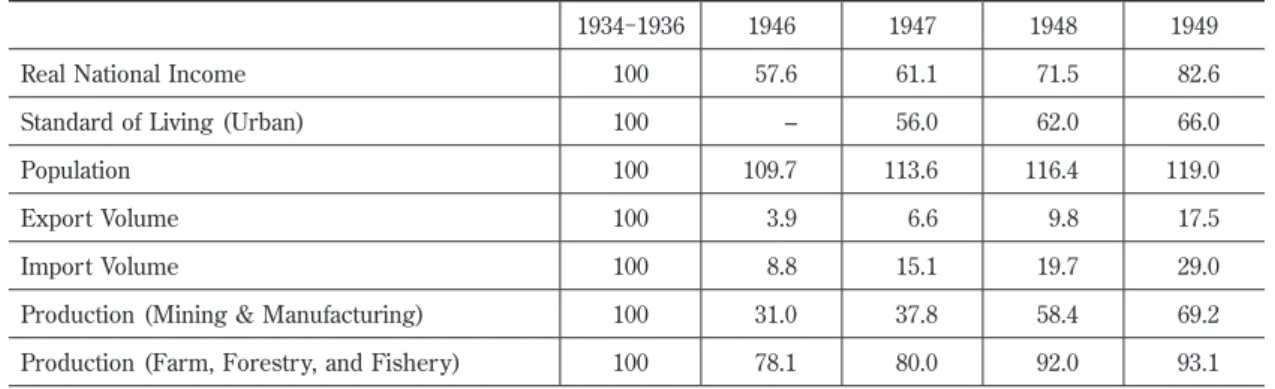
However, by 1947, 1 dollar became equal to almost 270 yen.62) Japan had never before experienced an infla- tion as extreme as that.63) In the meantime, the foreign trade suffered greatly. Japan’s exports crashed to a mere 3.9 percent and its imports 8.8 percent of prewar levels. (Table 1) The production output was nowhere near the prewar levels, yet the population steadily increased after around 6 million repatriates return to Japan.64)
Table 1 Postwar Economic Index (1934-1936 Levels=100 percent)
1934-1936 1946 1947 1948 1949
Real National Income 100 57.6 61.1 71.5 82.6
Standard of Living (Urban) 100 – 56.0 62.0 66.0
Population 100 109.7 113.6 116.4 119.0
Export Volume 100 3.9 6.6 9.8 17.5
Import Volume 100 8.8 15.1 19.7 29.0
Production (Mining & Manufacturing) 100 31.0 37.8 58.4 69.2
Production (Farm, Forestry, and Fishery) 100 78.1 80.0 92.0 93.1
Source: Based on the data provided in Hidezo Inaba, “Problems of Economic Recovery and Self-Support,” Japan Quarterly, vol. 2, no. 2, April-June 1955, pp. 148-158
In light of these, SCAP directed Japanese government to establish the Economic Stabilization Board (ESB) to coordinate the economic planning in May 1946. The newly established board found out that Japan had a massive demand and an insufficient supply. Therefore, Japanese government tried to increase the produc- tion levels to meet the domestic demand. To achieve this, the ESB recommended a “priority production”
(Keishaseisan) strategy and encouraged Japanese companies to produce more. However, Japanese compa- nies did not have any capital to replace the old and broken equipment or buy new machinery that was required to increase their production levels. To overcome this problem, the Japanese government set up the Reconstruction Finance Bank (RFB) in October 1946. The bank issued 44 billion yen in loans through 1947 to these companies. The actions taken by the Japanese government helped increase production but also fueled inflation since Japanese government had to print out and pump more bills into the domestic market.65)
Economic distress in Japan led to the so-called “October offensive.” In October 1946, an extremely left- wing Sanbetsu66) (All-Japan Congress of Industrial Unions, also called as the National Congress of Industrial Unions) started a series of strikes and production control tactics. The union demanded a basic minimum wage plus the abolition of the income tax on labor and stressed that the demonstrations would not stop until their demands were met. Later, Sanbetsu called for a general national strike in February 1947, but it was banned by SCAP’s orders to prevent the crumbling Japanese economy further paralyzing itself.67) Even though the general strike was banned during its inception, its rippling effects were imminent. SCAP real- ized that the civil unrest could cause other occupation reforms to fail. Thus, reconsideration of the liberal/
New Dealer reform programs has started. As early as 1948, some of the rights that were given to unions by reforms, were restricted to contain the civil unrest.
Under these circumstances, the economic recovery and “self-sustainability” plans for Japan surfaced. To begin with, George E. Blakeslee wrote a report after his visit to Japan between December 26, 1945 and February 13, 1946. In his report, Blakeslee underlined that to achieve the democratization of Japan, “it is essential to prevent economic distress for Japanese.” He thought that the immediate problem in Japan was economic and argued “a sane democracy cannot rest on an empty stomach.” Blakeslee recommended that
“to safeguard the American type of democracy in Japan … the United States should prevent acute food shortage and should help the Japanese revive their industries and their export trade.” He further stressed that as pre-requisites, the stabilization of Japanese currency and especially an initial decision on repara- tions will be almost necessary.”68)
In addition, T.A. Bisson of the Government Section (GS) wrote a memo for Courtney Whitney, Chief of the GS on October 23, 1946. In his report, Bisson stressed that the Japanese authorities were intentionally pursuing policies – priority production strategy and Reconstruction Finance Bank loans – that invites infla- tion rather than averting it. Bisson warned that unless the runaway inflation was brought under control, civil unrest would cause the emergence of extremist control which will eventually impede the reform poli- cies. Echoing the recommendations of Blakeslee, Bisson advocated a comprehensive program of price stabilization to solve the inflation problem and get rid of its threat to occupation objectives.69)
Furthermore, Edward M. Martin, Chief of the Division of Japanese and Korean Economic Affairs of the
State Department, wrote a memorandum to General Hilldring on March 12, 1947. Martin considered that economic recovery plans for Japan would create the impetus of nurturing a peaceful and democratic Japan.
Martin argued that if Japan were provided with food and raw materials in 1948 and 1949, Japan could be
“cranked up” to the point where she might be self-supporting in 1950. He pointed out that with enough food and raw materials aid, Japanese industries could produce more and export the excess to other Far Eastern countries.70) By doing so, Martin continued, Japan might break out from the vicious cycle where the food and raw material shortages deteriorate Japanese economy and culminate in a more dependent Japan to the U.S. aid. Research and Statistics Division of the Economic and the Scientific Section prepared a report on August 1, 1947 and echoed the same point of view. The report underlined that Japan would become more dependent on U.S. aid unless Japanese industrial output and foreign trade volume were increased.
Shortly after Edward Martin memo, MacArthur hinted the possibility of an early peace during an interview with press correspondents on March 19, 1947. He divided the occupation into three phases – military, political, and economic – and claimed that the first phase is already completed and the political phase is approaching completion. However, MacArthur continued, the economic recovery of Japan cannot be achieved by the occupation authorities as long as Japan economically blocked by the Allied Powers.71)
Therefore, he recommended to allow Japan to trade with the world, without restrictions applied by the occupation apparatus, and to restore Japan’s production to self-sufficiency levels. In regard to the repara- tions, MacArthur implicitly suggested that reparations burden should be reduced unless the United States was prepared to support Japan economically for many years to come.72)
In the meantime, the U.S. stance against reparations policy started to change. In the spring of 1947, War Department sent the Overseas Consultants Incorporation (OCI), headed by Clifford Strike to Japan. On paper, Strike mission’s objective was to provide technical assistance to SCAP officials on reparation removal levels. However, in reality, Strike was in favor of reducing the reparations while increasing the retention levels of the Japanese industry. During his stay, Strike recommended limiting the reparations to primary war facilities category, while keeping the non-war related industries intact.73) As an expected result, OCI sent a report to MacArthur on February 18, 1947 and recommended higher retention levels for Japanese industries to achieve self-sufficiency levels.74) Only a month and a half later, SWNCC 236/43 established new reparation levels for Japanese industries. The new figures were far more lenient towards Japanese industry than the Pauley recommendations of 1946.75)
Another supporter of the economic recovery was Under Secretary of the State Dean Acheson. On May 8, 1947, Acheson stood before the Delta Council76) in Cleveland and made an epoch-making speech about the “workshops in Europe and Asia.” Acheson pointed out that “until the various countries of the world get on their feet and become self-supporting there can be no political or economic stability in the world and no lasting peace or prosperity for any of us.” He buttressed his point with the argument that the total volume of U.S. exports will not increase until the U.S. accepts increased imports from the world. To achieve eco- nomic recovery around the world, Acheson recommended reconstructing the “two great workshops of Europe and Asia – Germany and Japan – upon which the fate of the two continents largely depends.”77)
Acheson linked the recovery of Japan to the recovery of the international economy and favored changes in occupation policies.
Complementing the Acheson’s point, Political Advisor to Macarthur (POLAD), George Atcheson wrote to Truman on June 19, 1947. Atcheson warned Truman of the situation in Japan: “Japan, whether we like it or not, has become an economic responsibility of the United States …. It is to our interest to assist in the process of getting the country on at least a minimum self-supporting basis.”78)The report also underlined that self-supporting Japanese economy cannot be achieved unless a foreign exchange (U.S. dollar) to finance the essential imports is secured and adequate imports of essential raw materials are obtained.79)
Atcheson’s comment was integral since his opinions were close to the China Crowd’s. However, the wors- ening situation in Japan paved the way for Atcheson to conform, at least, regarding punitive economic measures that were being taken in occupation.
All of these arguments amounted to an action by State and Army Departments to review the occupation policies and change their direction. By October 9, 1947, both State and Army Departments agreed to make Japan self-supporting. Although the implementation of the recovery program remained disputed, State and Army Departments reached an agreement to put more emphasis on the economic recovery.80) On the one hand, the State Department backed SWNCC 381 – prepared by Edward Martin – which favored the revi- talization of Japanese economy based on the Acheson’s speech in May. The State Department rejected unilateral action on the issues of reparations and deconcentration (FEC-230) and rooted for achieving con- sensus on Far Eastern Commission on these issues. The State Department employed this deliberate approach not to irk the Far Eastern Countries which dreaded the resurgence of Japanese aggression.
On the other hand, Under Secretary of the Army, William Draper was considering to bypass the Far Eastern Commission and the involvement of other nations. Draper thought about making further cuts in reparations levels designated in SWNCC 236/43 and revising the FEC-230 policy by sending unilateral directives to MacArthur. After his return from a trip to Japan in September 1947, Draper launched a cam- paign for an overhauling reorientation of American Occupation policy. He directed the Army Department to formulate a new policy which would make “economic recovery the main objective and … give SCAP the authority to interpret other existing directives [FEC-230 and SWNCC 236/43] in light of this primary objective.” On October 3, SWNCC 384 titled “The Economic Recovery of Japan,” was completed and ready for consideration by other Departments.81)
Even though the means for economic recovery remained disputed among the Departments of State and Army, one thing was crystal clear: The economic democratization, including the deconcentration and repa- ration programs, lost its vigor little by little and eventually became bogged down in late 1947 while the economic recovery gained utmost importance. The economic distress in Japan combined with the civil unrest, became the driving force for recovery plans within Washington and GHQ. In addition, the con- cerns over international economy pushed the decision-makers to fortify the Japanese and German econo- mies to overcome the probable future problems.