changes in mothers perception of infant s behavior and perception of breast milk as insufficient from early postpartum to one month postpartum
著者 小西 佳世乃
著者別表示 Konishi Kayono journal or
publication title
博士論文本文Full 学位授与番号 13301甲第4295号
学位名 博士(保健学)
学位授与年月日 2015‑09‑28
URL http://hdl.handle.net/2297/43812
Investigation of the relationship between changes in mothers’ perception of infant’s behavior and perception of breast milk as insufficient from early postpartum to one month postpartum
Kayono Konishi, Keiko Shimada
Doctoral Course, Deviation of Health Science, Kanazawa University Introduction
It has been clarified that breastfeeding offers various health benefits for the mother and child both in the short- term and the long-term
1). The Global Strategy for Infant and Young Child Feeding
2)recommends breastfeeding worldwide, citing targets of exclusive breastfeeding for the first six months and continuing breastfeeding for at least two years.
In Japan, in the “Healthy Parents and Children 21”
initiative theme of “promoting the peaceful mental development of children and reducing childrearing anxiety”, increasing the proportion of mothers breastfeeding at one month after giving birth is cited as an objective. However, although 96.0% of mothers who are pregnant “want to breastfeed”, only 42.4% of mothers are exclusively breastfeeding at one month after birth
3).There have been many studies
4-11)conducted to investigate factors related to breastfeeding continuance, with early contact Abstract
Breastfeeding has been demonstrated to provide various health benefits for the mother and child in both the short-term and long-term. One factor, however, that impedes the continuation of breastfeeding is the perception that breast milk is insufficient. Despite good infant development drinking breast milk alone, the mother may feel anxious regarding the amount of breast milk she is producing and unnecessarily supplement with artificial milk.
Cross-sectional studies have revealed many factors involved in this perception of breast milk insufficiency, such as inadequate knowledge of breastfeeding and maternal stress, especially with regard to infant’s behavior, including crying.
This study was performed to clarify the relationship between mothers’ perception of breast milk insufficiency with their perception of infant’s behavior between the early postpartum period and one month postpartum.
Inclusion criteria for subjects were 1) a full-term birth between 37 weeks and 42 weeks of gestation, 2) singleton birth, 3) normal pregnancy for both mother and child, and 4)
infant birthweight of at least 2500 g. Data were collected from January 2012 to August 2013.
Connectable anonymous self-administered questionnaire surveys were conducted twice—
once during hospitalization and once at the one-month checkup. Of the 78 subjects that consented to participate in the study, 12 subjects that did not meet the requirements were excluded, leaving 66 subjects (84.6%) for the analysis.
The perceptions of breast milk insufficiency in the early postpartum period and at the one-month checkup were 12.4 ± 2.5 points (mean ± SD) and 12.1 ± 3.7 points, respectively.
Thus, a strong positive correlation was observed between a perception of breast milk insufficiency in the early postpartum period and at one month postpartum (r=.74, p<.01).
Mothers’ perception of their infant’s behavior changed from the early postpartum period to one month postpartum.
KEY WORDS
Breastfeeding, Assessment, Tool, Evaluation, Education
between mother and child and prenatal education said to be effective
12). Academic history, income, motivation to breastfeed, and family and community support are said to be influencing factors during the breastfeeding continuance period.
One factor, however, that impedes the continuance of breastfeeding is a perception of breastmilk being insufficient. Despite the infant developing well drinking breastmilk alone, the mother may feel anxious regarding the amount of breastmilk she is producing and unnecessarily supplement artificial milk. A perception of breastmilk being insufficient is thought to lead to early discontinuance of breastfeeding and lower the rate of exclusive breastfeeding
12). It has been shown that 23 to 56% of mothers who discontinue breastfeeding feel a perception of breastmilk insufficiency, with 63% of mothers who discontinue breastfeeding within the first week after birth citing this as the reason
13).A perception of breastmilk being insufficient is most common during the first one to four weeks after birth
14). Thus, reducing this perception of breastmilk insufficiency is an important key to improve breastfeeding rates and has been reported as an problem that is common throughout the world
15-17). In Japan, 20.2% of mothers exclusively breastfeeding, 44.7% of mothers supplementing artificial milk, and 6.9%
of mothers feeding their infants artificial milk are worried about the amount of breastmilk they are producing at one month after birth; indeed, this perception of insufficiency is
the top worry held by mothers regarding breastfeeding. A perception of breastmilk being insufficient is also thought to be a problem impeding breastfeeding in Japan.
Reasons for feeling this perception of breastmilk insufficiency include the infant crying and frequent feeding, infant fussing. Infant crying is said to be a particularly strong influencing factor
15-19), and these results are consistent with those of past studies in Japan.
Therefore, we believe that it is important to clarify mothers’ perceptions regarding their infant’s behavior, the relationship with a perception of breastmilk insufficiency, and subsequent changes in the first four weeks after birth, as this is the time when the exclusive breastfeeding rate drops at the one month checkup and mothers are most susceptible to a perception of breastmilk insufficiency.
Furthermore, based on these findings, we believe that it is necessary to investigate a method of care for effective intervention for a perception of breastmilk insufficiency.
The objective of this study was to clarify the relationship between mothers’ perception of breastmilk insufficient with their perception of infant’s behavior period between the early postpartum and one month postpartum.
Methods
1. Definitions of terms
1 Perception of breastmilk insufficiency
A mother’s feeling that despite producing enough breastmilk to lead to sufficient weight increase of the
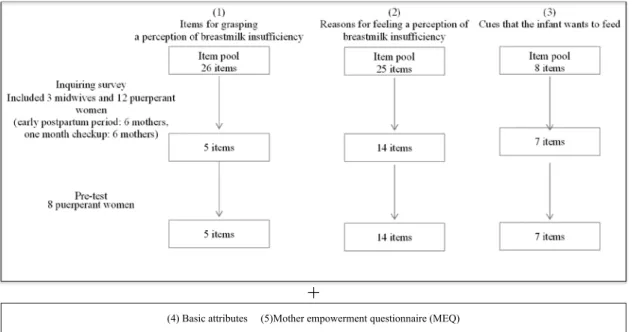
Figure 1. Procedure for survey questionnaire preparation Pre-test
Item pool 25 items
14 items
14 items
Reasons for feeling a perception of (2) breastmilk insufficiency
Inquiring survey
Included 3 midwives and 12 puerperant women
(early postpartum period: 6 mothers, one month checkup: 6 mothers)
8 puerperant women
Item pool 26 items
5 items
5 items Items for grasping (1) a perception of breastmilk insufficiency
Item pool 8 items
7 items
7 items
Cues that the infant wants to feed (3)
(4) Basic attributes (5)Mother empowerment questionnaire (MEQ)
+
Figure1:Procedure for survey questionnaire preparation
infant and the infant ingesting a sufficient amount, her breastmilk is inadequate in amount or nutritional quality to meet her infant’s needs.
2 The early postpartum Within a week after birth.
2. Research participants
Recruiting was conducted at two obstetrics facilities that manage approximately 300 births per year in prefecture A.
Inclusion criteria for research participants were 1 a full- term birth between 37 weeks to 42 weeks gestation, 2 single birth, 3 normal pregnancy for both mother and child and 4 infant birthweight of at least 2,500 g. Data was collected from January 2012 to August 2013.
3. Measurement devices (Figure1)
1 Questionnaire (Table1)
⑴ Perception of breastmilk insufficiency
We extracted five items based on the definition of a perception of breastmilk insufficiency from previous studies
20・21)and interview. The five items were ranked on a six-point scale from “not at all: 5 points” to “yes, very much: 0 points” and total scores ranged from 0 to 25 points. Higher total scores signified a stronger perception of breastmilk insufficiency. The question items were expressed positively and two items was the reverse item.
① Investigation of content validity and face validity
We conducted interview with three midwives, six
mothers in the early postpartum period, and six mothers
Table1. Questionnaire
at the one month checkup. For these surveys, we deleted overlapping items and revised expressions. And furthermore, we also conducted a pre-test on four mothers in the early postpartum period and four mothers at the one month checkup and made some revisions based on their opinions regarding the question methods.
② Investigation of criterion-related validity
To investigate criterion-related validity, the Pearson’
s product-moment correlation coefficient for perception of breastmilk insufficiency questionnaire scores and Mother Empowerment Questionnaire (MEQ) scores were calculated. “Mother empowerment” was defined by Iida
22)as “the mother understanding the infant’s state and cries and being able to predict the infant’s demands, resulting in reduced childrearing anxiety and confidence in childrearing”. Targeted subjects were in postpartum period from directly following birth to three to four months later. The 13 question items were ranked from 1 to 4 points on a four-rank scale, with total scores ranging from 13 to 52 points. Higher scores indicated greater mother empowerment. Cronbach’s alpha coefficient was 0.83, indicating validity. We used this as a scale for measuring mother confidence in order to investigate criterion-related validity.
Results indicated that the correlation coefficient with MEQ at each period was in the early postpartum period (r
=.0.67, p<.01) and at the one month checkup( r =.0.66, p
<.01).
③ To investigation of reliability
To investigate stability in order to examine reliability, as breast and breastfeeding state change daily, we calculated Cronbach’s alpha coefficient rather than using the re-test method. Results of 0.83 in the early postpartum period and 0.89 at the one month checkup confirmed that
internal consistency was maintained.
(2) Reason for a perception of breastmilk sufficiency Reasons for mothers feeling a perception of breastmilk insufficiency were gathered from a past inquiring survey and 25 items were summarized into 14 items.
(3) Cues that the infant wants to feed
To confirm mothers’ knowledge and understanding of signs that the infant wants to feed, eight items for signs that the infant wants to feed were extracted from past studies and summarized into seven items.
(2) and (3) included some overlapping items but we left these unchanged as their meanings were different.
①Investigation of content validity and face validity We also conducted inquiring surveys regarding, (2)
and (3) on three midwives, six mothers in the early postpartum period, and six mothers at
the one month checkup. For these surveys, we deleted overlapping items and revised expressions. We also conducted a pre-test on four mothers in the early postpartum period and four mothers at the one month checkup and made some revisions based on their opinions regarding the question methods.
2) Basic attributes
We gathered information from the questionnaire survey, interview survey and nursing records regarding age, academic history, annual income, reproductive history, employment, income, family structure, gestational weeks, history of breastfeeding and details, infant birthweight, minimum weight and weight at discharge, decreasing ratio in physiological weight, and supplementing with artificial milk.
3) Mother Empowerment Questionnaire (MEQ)
As previously noted the 13 question items were ranked from 1 to 4 points on a four-rank scale.
4. Procedure
1) Survey procedure (Figure 2)
Connectable anonymous self-administered questionnaire surveys were conducted twice . once during hospitalization and once at the one month checkup.
For the survey during hospitalization, mothers were given the questionnaire together with a document requesting cooperation in which an outline of the study and ethical considerations were included. These were distributed to mothers who provided their verbal consent.
The questionnaire survey was then conducted and survey sheets were collected on the spot. Consent to cooperate was once again confirmed at the one month checkup, after which the questionnaire survey was performed.
Consent was considered to have been received when survey sheets were collected on the spot or sent back.
2) Differentiation from actual breastmilk insufficiency Satisfactory standards for breastfeeding have been issued by UNICEF & WHO
23), La Leche League (LLL)
24)and the International Lactation Consultant Association
25・26).
In this study, to determine whether breastmilk production
is sufficient based on the range of daily weight increases
and physiological weight decreases, we used the following
standards by UNICEF & WHO. (1) Minimum weight is decrease of within 10% of the birthweight and (2)
daily weight increases of 18 to 30 g until six months after birth. When mothers fulfilled (1) and (2), had no congenital disease related to breastmilk insufficiency, and had acquired breastfeeding skills including positioning and latching-on, they were diagnosed with breastmilk insufficiency.
3) Determining the acquisition of breastfeeding skills The acquisition of breastfeeding skills including positioning and latching-on was judged by at least two midwives who were involved in the mother’s care until discharge.
4) Determining the need for supplementation with artificial milk
When mothers were supplementing with artificial milk after discharge based on their own judgment, the necessity of artificial milk supplementation was determined by consultation of at least two midwives.
5. Analysis methods
Data collection and analysis was conducted using the SPSS 19.0 for Windows statistical software using the following methods.
Basic statistics for each variable were calculated and mean values were compared using Chi-squared test.
Criterion-related validity was investigated by calculating
Pearson’s correlation coefficient for the relationship between a perception of breastmilk insufficiency and MEQ. Comparison between two groups was conducted using Shapiro-Wilk test, paired t-test and Wilcoxon rank sum test or the Mann-Whitney U test. For all analyses, the level of significance was set at 5%.
6. Ethical considerations
Participants were given written explanations of the research clearly outlining the following matters and also given verbal explanations of the purpose of the study.
・Participation in this study is voluntary and no disadvantages will be caused if you decline participation.
・The survey is anonymous and private information will be protected.
・Research results may be published at academic societies or in specialist journals.
・Data acquired will not be used for any non-research purposes and will be destroyed after a fixed amount of time.
This study was approved by the Kanazawa University Medical Ethical Board. (No346)
Results
1. Basic attributes of participants
Of the 78 subjects who consented to participate in
this study, 11 subjects (14.1%) who did not meet the
Figure2:Survey procedure
requirements and one subject (1.3%) who did not answer the survey at the one month checkup were excluded, leaving us with 66 subjects for analysis (Figure2).
The mean age of participants was 30.1±4.2years (Mean
±SD). Subjects included 48 primipara (72.7%) and 18 multipara (27.3%) (Table2). The mean number of days hospitalized was 6.5±1.1 and mean number of days following birth at the one month checkup was 29.6±2.0 days. With regards to delivery style, 52 subjects had a vaginal delivery
(78.8%) and 14 subjects had a cesarean section (21.2%).
Subjects were excluded if they switched to artificial milk feeding due to infant hospitalization or exacerbation of the
mother’s complications during their postpartum course.
2. Factors related to a perception of breastmilk insufficiency
1) Perception of breastmilk insufficiency
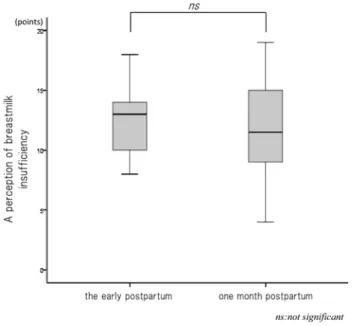
Perception of breastmilk insufficiency in the early postpartum period and at the one month checkup was 12.4
±2.5 points (mean±SD) and 12.1±3.7 points, respectively
(Figure3). Thus, a strong positive correlation was observed between a perception of breastmilk insufficiency in the early postpartum period and at the one month checkup (r=.74, p<.01).
There was a significant correlation between a
Table 2. Basic attributes of particpants
Mean SD Min MAX n=66
Mother age (years) 30.1 4.2 ( 23.0
―42.0 )
Gestational weeks (weeks) 38.7 1.1 ( 37.0
―41.0 )
Birthweight (g) 2922.1 306.0 ( 2500.0
―3910.0 )
Minimum weight (g) 2712.5 273.5 ( 2246.0
―3564.0 )
Physiological weight decreasing ratio (%) 6.6 1.7 ( 2.6
―9.6 )
Weight at discharge (g) 2849 314.8 ( 2405.0
―3846.0 )
Hospitalization days (days) 6.5 1.1 ( 5.0
―10.0 )
One month checkup (days after birth) 29.6 2.0 ( 26.0
―34.0 ) Weight at one month checkup (g) 3911 444.2 ( 3162.0
―4970.0 ) Weight gain per day at one month checkup (g) 39.3 9.7 ( 22.0
―66.0 )
N % ⅹ
2value df p-value
Parity Primipara 48 ( 72.7 )
Multipara 18 ( 27.3 )
Delivery style Vaginal delivery 52 ( 78.8 )
Cesarean section 14 ( 21.2 )
Final education level Postgraduate education 4 ( 6.1 )
University 46 ( 69.7 )
Junior college 9 ( 13.6 )
Vocational school 6 ( 9.1 )
Highschool 1 ( 1.5 )
Marital status Married 65 ( 98.5 )
Single 1 ( 1.5 )
Fertility treatment Yes 17 ( 25.8 )
No 49 ( 74.2 )
Family composition Nuclear family 65 ( 98.5 )
Extended family 1 ( 1.5 )
Yes 52 ( 78.7 )
No 14 ( 21.2 )
Employment Yes 40 ( 60.6 )
No 26 ( 39.4 )
Annual income <4 million yen 23 ( 34.8 )
≥ 4 million yen 43 ( 65.2 )
±
±
±
±
±
±
Returnig to parent's home for birth
±
±
±
±
± Variables
p<.01 2
51.9
21.9 1 p<.01
1
62.1 p<.01
p<.01 4
104.5 Variables
p<.01 1
21.9
p<.05 1
6.1
1
3.0 p=.08
p<.01 1
62.1
p<.01 1
15.5
Table2. Basic attributes of participants
perception of breastmilk insufficiency and amount of supplementation with artificial milk per day at one month postpartum (r=.79, p<.01).
2) Changes of mothers’ perception of infant’s behavior period between the early postpartum and one month postpartum (Table3)
It was compared to the average of a perception of breastmilk insufficiency in the early postpartum and one
month postpartum. Although it significantly increased in one month postpartum from the early postpartum, in the order of item 3, 5, 1, 10, 9, 2, it significantly-decreased in one month postpartum from the early postpartum, in the order of item 6, 12, 13.
3) The correlation between a perception of breastmilk insufficiency and reason for feeling a perception of breastmilk insufficiency (Table 4)
It was classified 2 groups on the basis of the average points, the low-scoring group and the high scoring group.
In low-scoring group, there was a significant correlation between a perception of breastmilk insufficiency and item no.5 (r=-0.26, p<0.05) in early postpartum, item no. 1, 2, 3, 4, 5, 9, 10 at one month postpartum.
In high-scoring group, there was a significant correlation between a perception of breastmilk insufficiency and item no.12, 13 in early postpartum, item no.1, 3, 5, 9, 10, 13 at one month postpartum. It showed that the number of item has increased each scoring group.
4) The correlation between a perception of breastmilk insufficiency and cues that the infants want to feed (Table 5)
In early postpartum, there was a significant correlation between a perception of breastmilk insufficiency and item no.1 in low-scoring group.
And at one month postpartum, there was a significant Figure3: Comparison of a perception of breastmilk
insufficiency
Table3. Comparison of Reasons for feeling a perception of breastmilk Insufficiency
the early postpartum one month postpartum p-value
1 Baby was not appearing satisfied after breastfeeding 4.52 4.09 p<.01
2 There no chancee to chek baby's body weight 4.82 4.70 p<.01
3 Short interval between feedings 4.45 3.89 p<.01
4 No breast milk when express breast milk 3.68 3.68 ns
5 Baby Crying 4.42 3.89 p<.01
6 Breasts engorgement 2.92 3.64 p<.01
7 Baby doesn't breastfeed 3.09 3.17 ns
8 Baby doesn’t pull away from breast 3.91 3.80 ns
9 Drinks formula if given 4.15 3.91 p<.05
10 Goes to sleep if given formula 4.18 3.89 p<.01
11 Count the number of excretion of urine and stool 1.71 1.71 ns
12 Frequency of feeding has changed 2.79 3.20 p<.01
13 No milk ejection 2.94 3.20 p<.01
14 No lactogenic action 3.39 3.48 ns
ns:not significant student's t -test A perception of breastmilk insufficiency
No.
Table 3 : Comparison of Reasons for feeling a perception of breastmilk insufficiency and a perception of breastmilk insufficiency Reasons for feeling a perception of
breastmilk insufficiency
correlation between a perception of breastmilk insufficiency and item no. 1, 2, 3, 5 in low-scoring group, item no.3 and 4 in high-scoring group.
5) A perception of breastmilk insufficiency and care in a hospital
Figure 5 showed we classified 4 groups on the basis of
the average points.
Group A, 26 mothers (89.7%) continue exclusive breastfeeding, otherwise, Group D, 21 mothers (84.0%)
supplied unnecessary artificial milk. And all of the 21 mothers experienced add unnecessary artificial milk to their infants in hospitalization(Table6).
the early
postpartum
postpartumone monththe early
postpartum
postpartumone month1
Baby was not appearing satisfied after breastfeeding .18 .81 ** .14 .69 **
2
There no chancee to chek baby's bode weight .20 .32 * .19 .38 *
3
Short interval between feedings .02 .44 ** .13 .88 **
4
No breast milk when express breast milk .03 .32 * .05 .23
5
Baby Crying .36 * .67 ** .15 .78 **
6
Breasts engorgement -.13 * .14 -.30 .32
7
Baby doesn't breastfeed .06 .22 -.05 .20
8
Baby doesn’t pull away from breast .01 .26 .02 .15
9
Drinks formula if given .22 .59 ** .05 .66 **
10
Goes to sleep if given formula .08 .57 ** .22 .71 **
11
Count the number of excretion of urine and stool .18 .25 .00 -.18
12
Frequency of feeding has changed .19 .21 -.37 * .20
13
No milk ejection .06 -.05 .43 ** .37 *
14
No lactogenic action .09 .18 .11 .29
*p<.05 , **p < .01 Table 4. The correlation between a perception of breastmilk insufficiency and
reasons for feeling a perception of breastmilk insufficiency
Low-scoring High-scoring
No. Reasons for feeling a perception of breastmilk insufficiency
Pecieved Insufficient Breatmilk Supply
Table4:The correlation between a perception of breastmilk insufficiency and reasons for feeling a perception of breastmilk insufficiency
Table5:The correlation between a perception of breastmilk insufficiency and cues that the infant wants to feed
the early
postpartum postpartum one month the early
postpartum postpartum one month
1 Baby Crying .36 * .53 ** .15 .20
2 Fussy baby .14 .52 ** .14 .29
3 Sucking movements .17 .35 * .14 .61 **
4 Hand-to-mouth movements .16 .14 .28 .71 **
5 Baby stay awake .15 .56 ** .19 .11
6 Eye movements .06 -.30 -.07 -.19
7 Make velvety voice sound -.01 -.23 ― .15
*p<.05 , **p < .01 Table 5. The correlation between a perception of breastmilk insufficiency and cues that the infant wants to feed
No. Cues that the infant wants to feed
Pecieved Insufficient Breatmilk Supply
Low-scoring High-scoring
Discussion
1. Change of a perception of breastmilk insufficiency The average of a perception of breastmilk insufficiency, showed no significantly different between in the early postpartum and at the one month postpartum, but a strong positive correlation was observed between them. Thus, we can understand how mothers perceived insufficiency breastmilk supply, and we can know what
their perception is going to be.
2. Change of mother’s perception 1) Perception of infant’s cues
At one month postpartum, we compared low-scoring group and high-scoring group, mothers of low-scoring group understood many cues that infants want to feed more than mothers of high-scoring group. For example, item no.3 of cues that the infant want to feed is related one of neonatal reflex. It is difficult to judge reflex from cues of hunger themselves.
Teaching mothers to interpret her infant's readiness-to- feed behaviors and to judge satiety after feeding will help her feel more competent and satisfied with her experience of breastfeeding
27・28). So health caregivers should support they could judge themselves in hospitalization, it will cause to add artificial milk to their infants. Mothers of low-scoring group in the early postpartum can grow in their own ability of they can understand what infants’ cue means, thus, their scores in one month will not increase.
2) Perception of mother’s physical changes
Although item no.6 and 12 of reasons for feeling a perception of breastmilk insufficiency are sign of mother’s physical changes, these are very close to infants’ behavior.
Following birth, the mother’s body undergoes normal and progressive changes. The breasts increase in size Figure4: Grouped according to Score of a perception of
breastmilk insufficiency
Figure5:Analysis Subject
Table 6. Breastfeeding rate at one month postpartum
n=66
n % n %
A 29 ( 43.9 ) 26 ( 89.7 ) 3 ( 10.3 )
B 2 ( 3.0 ) 1 ( 50.0 ) 1 ( 50.0 )
C 10 ( 15.2 ) 9 ( 90.0 ) 1 ( 10.0 )
D 25 ( 37.9 ) 4 ( 16.0 ) 21 ( 84.0 )
Group n % One month postpartum
Breastfeeding Mixed feeding Table6. Breastfeeding rate at one month postpartum
significantly and the breastfeeding situation changes daily. The breastmilk production mechanism is divided into the endocrine period and autocrine period, with the switchover occurring approximately 10 days after birth
21). Currently, postpartum hospitalization periods in Japan are becoming shorter, with the mean postpartum hospital stay currently five days. Because changes in the breastmilk production mechanism are likely to occur after hospital discharge, mothers may feel that their breastmilk production differs at home compared to when they were hospitalized. In particular, if “breast engorgement” and “Breastmilk ejection” are used as a sign of healthy breastmilk production
12), a decrease breast engorgement and breastmilk ejection will occur after hospital discharge may cause mothers to feel a perception of breastmilk insufficiency. Affirming her body’s ability to produce breastmilk for an infant will support a mother and decreasing her anxiety
13). Therefore, mothers must be given explanations in a hospital that help them to understand such physical changes after hospital discharge.
3) Mother’s experience in hospitalization
Mothers of group D experienced their infants go to sleep after drink artificial milk, on the basis of this experience they feels insufficient breast milk supply strongly.
So we think it has the biggest impact on their breastfeeding after discharge, and they are easy to give their infants artificial milk. Once infants’ behavior is perceived as hunger, formula is often added to the infant’
s diet by the mother’s own judgment. And frequency and completeness of breastmilk removal from the breast decrease, and diminishing milk production ensure with the establishment of insufficient breastmilk
30).
In Japan, 53.4% of hospitals still give artificial milk
infant unnecessary
31). We should understand mothers who perceived insufficient breast milk supply strongly, and if they experience that health caregiver give artificial milk to their infant, it is high risk to wean breastfeeding.
32・33)3. Limitations of this study and future issues
This study was region-specific to Japan and participants were also limited to mothers and infants who could be continuously contacted. Therefore, further study needs to be conducted in the future with an expanded subject region and increased sample size. As our survey was only conducted twice, including once during the early postpartum period and once at the one month checkup, mothers’ perceptions need to be grasped in more detail by means of a continuous survey.
Conclusions
The results of our investigation of the relationship between a perception of breastmilk insufficiency and mothers’ perceptions of their infant’s behavior clarified that mothers were understanding cues that the infants want to feed. As many mothers feel a perception of breastmilk insufficiency, they need to be supported so that they can acquire accurate knowledge about physical changes and infant’s cues to want to feed, and furthermore judge infants’ cues by themselves.
Acknowledgements
We would like to extend our deep gratitude to all of
the participating mothers, facilities and staff members
for cooperating in our research throughout the course
of this study. Upon the conclusion of this report, we
would also like to thank Masayo Awano, certified IBCLC
and Kanazawa University Graduate School research
collaborator.
References
1) American Academy of Pediatrics: Section on breastfeeding, Breastfeeding the use of human milk.
Pediatrics 115: 496-506, 2005
2) WHO/UNICEF: The global strategy for infant and young child feeding: http://www.unicef.org/nutrition/files/
Global_Strategy_Infant_and_Young_Child_Feeding.pdf]:
5.26, 2002
3) Ministry of Health, Labor and Welfare: Outline of 2005 Infant Nutrition Survey Results: 2-7, 2007
4) Coreil J, Murphy JE: Maternal commitment, lactation practices, and breastfeeding duration. J Obstetric, Gynecologic & Neonatal Nursing: 273-278, 1988
5) Quarles A, Brimeyer M: Mothers' intention, age, education and the duration and management of breastfeeding. J Matern Child Nurs 22: 102-108, 1994
6) Janke JR: Development of the breast-feeding attrition prediction tool. J Nurs Res 43: 100-104, 1994
7) Bryant C: The impact of kin, friend and neighbor networks on infant feeding practices. Soc Sci Med 16:
1757-1765, 1982
8) Bryant C, Coriel J, D'Angelo S: A strategy for promoting breastfeeding among economically disadvantaged women and adolescents. J NAACOG's Clin Iss Perinat Women Health Nurs 3: 723-730, 1992
9) O'Campo P, Faden R, Gielen R: Prenatal factors associated with breastfeeding duration: Recommendations for prenatal interventions. J Birth 19: 195-201, 1994
10) Buxton KE, Gielen AC, Faden RR, et al: Women intending to breastfeed: Predictors of early infant feeding experience. J Amer Prev Med 7: 101-106, 1991
11) Rogers CS, Morris S, Taper LJ: Weaning from the breast:
Influences on maternal decisions. J Ped Nurs 13: 341-345, 1987
12) Nichols F, Humenick S: Childbirth education Philadelphia, pp 114-137, 2000
13) Gatti L: Maternal perceptions of insufficient milk supply in breastfeeding. J Nursing scholarship 40: 355-363, 2008 14) Hill P, Aldag J: Potential indicators of insufficient milk
supply syndrome. J Research in Nursing & Health 31: 12- 32, 1991
15) Avery M, Duckett L, Dodgson J, et al: Factors associated with very early weaning among primiparas intending to breastfeed. J Maternal and Child Health 2: 167-179, 1998 16) Segura-Millan S, Dewey KG, Perez-Escamilla R: Factors
associated with perceived insufficient milk in low-income urban population in INfan. J Nutrition 21: 226-230, 1994 17) Sacco ML, Caulfield EL, Gittelsohn J, et al: The
conceptualization of perceived insufficient milk among Mexican mothers. J Human lactation 22: 277-286, 2006
18) Dewey KG: Infant feeding practices among low-income Mexican urban women: a four month follow-up. J Arch Latinoam Nutrition 42: 259-267, 1992
19) Tully J, Cewey KG: Private fears, global loss: a cross- cultural study of the insufficient milk syndrome. J Med Anthropol: 225-243, 1985
20) Hill DP, Humenick SS: Development of the H & H lactation scale. J Nursing Research 45: 136-140, 1996 21) McCarter-Spaulding DE, Kearney MH: Parenting self-
efficacy and perception of insufficient breast milk. J Obstetric, Gynecologic & Neonatal Nursing 30: 515-522, 2001
22) Iida M: Investigation of the reliability and validity of the mother empowerment questionnaire. J the Japan Society of Woman’s Health 3: 19-26, 2004
23) UNICEF/WHO: Baby Friendly Hospital Initiative: http://
www.unicef.org/nutrition/files/BFHI_2009_s3.1and2.pdf
#search='UNICEF+WHO+1993+breastfeeding': 135-144, 2009
24) La Leche League International: Breastfeeding that is Achievable by Everyone. Medicus Shuppan, pp 134-154, 2000
25) Cho Naomi: Continuous breastfeeding support. (Edited by the Japanese Association of Lactation Consultants), Igaku Shoin, pp 253-257, 2007
26) Seo Tomoko: Actual breastmilk insufficiency and a perception of breastmilk insufficiency. (Edited by the Japanese Association of Lactation Consultants), Igaku Shoin, pp 258-264, 2007
27) Nagamori K, Doeda N, Kobayashi N, et al: Breastfeeding mothers identify attitudes and actions of healthcare professionals that resulted in confusion and anxiety about breastfeeding. J Japan Academy midwifery 24, 17-27, 2010 28) Wojnar D: Maternal perceptions of early breastfeeding
experiences and breastfeeding outcomes at 6 weeks. J Clinical Effectiveness in Nursing 8: 93.100, 2004
29) Wakutani K, Tokoro K: Anatomy and Physiology of Breastmilk Production. Breastfeeding Support Standards
(Edited by the Japanese Association of Lactation Consultants), Igaku Shoin, pp 94-105, 2007
30) Neifert MR: Clinical aspect of lactation. Promoting breastfeeding success. J Clin Perinatol 26: 281-306, 1999 31) Taniguchi C: The report of investigation for promoting
breastfeeding. J Waco-planet, pp 6-15, 2007
32) Dennis CL, Faux S: Development and psychometric testing of the breastfeeding self-efficacy scale. J Research in Nursing Health 31: 12-32, 1999
33) Loughlin H, Clapp-Channing NE, Gehlbach SH, et al: Early termination of breastfeeding, Identifying those at risk.
Pediatrics 75: 508-513, 1985
産後 1 カ月までの母親の母乳不足感と新生児のサインに対する認識の変化
小西佳世乃 , 島田 啓子
要 旨