平成25年度
京都大学大学院理学研究科
D3発表会アブストラクト
(平成26年1月21日)
物 理 学 第 二 分 野
D3 発 表 会
日 時 2014年1月21日(火)9時~
場 所 理学研究科5号館 525号室 発表時間 15分 + 5分(質問)
《 目 次 》
1.Modeling the secular evolution of an inspiral orbit around a Kerr black hole
磯山 総一郎(9:00)・・・1
2.π中間子ビームを用いた K 中間子原子核の研究
市川 裕大(9:20)・・・2
3.Formation of supermassive black holes in the high-redshift universe 稲吉 恒平(9:40)・・・3
4. J-PARC での中性子電気双極子能率の検出を目指した 超冷中性子リバンチ装置の改良
今城 想平(10:00)・・・4
5.コンパクト天体現象における QCD 相転移
上田 宏史(10:20)・・・5
6.超新星残骸における過電離プラズマの研究
大西 隆雄(10:40)・・・6
7.Discrete flavor symmetry for lepton mixing and quark mixing
小笠原 敦(11:00)・・・7
8. Integrable deformations of principal chiral models and the AdS/CFT correspondence
川口 維男(11:20)・・・8
9.T2K 実験におけるニュートリノ反応断面積の測定
木河 達也(11:40)・・・9
---午 後 ---
10.F-theory compactified on K3xK3 and its application to landscape 木村 裕介(13:00)・・・10
11.カイラル対称性の部分的回復と核物質中のπ中間子の性質
郷田 創一郎(13:20)・・・11
12. 軽い中性子過剰核におけるダイニュートロン相関の系統的研究
小林 史治(13:40)・・・12
13.低雑音撮像能力をもつ気球搭載型サブ MeV ガンマ線カメラの 天体検出性能の検証
澤野 達哉(14:00)・・・13
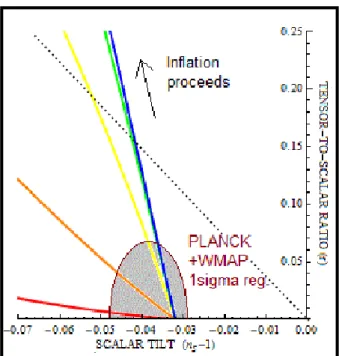
14.Non-minimal coupling in the context of multi-field inflation
Jonathan White(14:20)・・・14
15.Quantum Tunneling During Inflation:
Non-linear Analysis of the Quantum Fluctuations
杉村 和幸(14:40)・・・15
16.Measurement of the energy dependent muon neutrino
charged current inclusive cross section with the T2K INGRID detector 鈴木 研人(15:00)・・・16
17.T2K 前置検出器部分における小型水チェレンコフ検出器
“Mizuche”を使ったニュートリノ反応数測定
髙橋 将太(15:20)・・・17
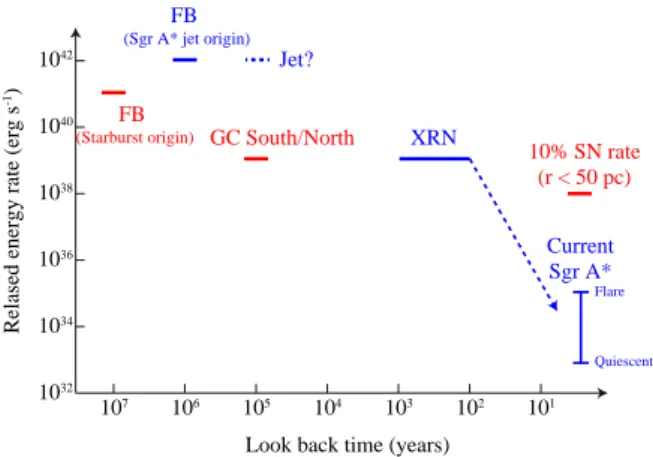
18. X-ray study on plasma outflows from the Galactic center
中島 真也(15:40)・・・18
19.Direction-sensitive dark matter search
with a gaseous micro time projection chamber
中村 輝石 (16:00)・・・19
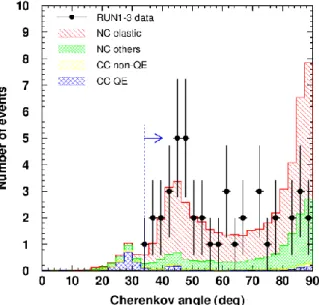
20.SuperKamiokande における T2K ニュートリノビームの NC Gamma 事象探索 黄 坤賢(16:20)・・・20
21.連星中性子星合体からの電磁波の研究
仏坂 健太(16:40)・・・21
22.フェムト秒レーザーと金属表面の相互作用における レーザーナノアブレーションに関する研究
宮坂 泰弘(17:00)・・・22
23.A Self-consistent Model of the Black Hole Evaporation
横倉 祐貴(17:20)・・・23
24.Weyl-Cartan 重力 gauge 理論に基づく inflation 宇宙
渡辺 晶明(17:40)・・・24
Modeling the secular evolution of an inspiral orbit around a Kerr black hole
基礎物理学研究所 磯山 総一郎
Abstract We propose a Hamilton mechanics of the inspiral motion of a particle around a more massive Kerr black hole. With the two-timescale analysis and the action-angle variables, we find that the secular changes of both the action-angle variables are characterized by the long time averaged value of the interaction Hamiltonian.
© 2014 Department of Physics, Kyoto University
Inspirals of compact objects into massive Kerr black holes are important sources for future gravitational wave detectors. The detection of gravitational waves from this system relies on the accurate theoretical models of their inspiral motion. Because of the extreme mass ratio in the binary systems, the motion of inspirals are modeled as the small deviation from the Kerr geodesic subjected to the self-force acting on the small body, which is still very hard to evaluate in practice.
In this talk, we revisit the inspiral motion around a Kerr black hole and describe this system in the language of a Hamilton system. In this framework, instead of directly integrating the equation of the motion with gravitational self-forces, the orbit of the particle can be described by the Hamilton's equations of the geodesic motion on an effective spacetime.
We systematically extract the solution of Hamilton's equations that is relevant to the orbital evolution for a long time period. Relying on the action-angle variables and using the two timescale ansatz, we see that the secular changes of both action and angle variables are characterized by only differentials of a single scalar quantity: the long time averaged value of the interaction Hamiltonian. In addition, at the leading order in the mass ratio of the binary, we show that these secular changes are expressed in the gauge invariant manner.
References
[1] W. Schmidt Class. Quant. Grav. 19, 2743 (2002).
[2] T. Hinderer and E. Flanagan Phys. Rev D78, 064028 (2008).
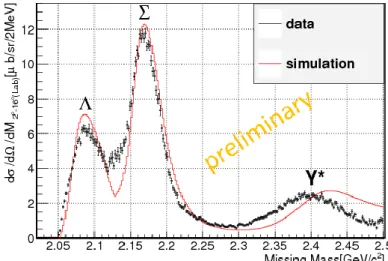
Fig. 1. The experimental data are shown with the black points with error bar. The simulated spectrum is shown with red line.
π中間子ビームを用いた K 中間子原子核の研究
原子核・ハドロン物理学研究室 市川裕大
Abstract We are searching for a K
-pp bound state which is the simplest kaonic nuclei, if existed, via the d(π
+, K
+) reaction at J-PARC K1.8 beam line. A pilot experiment was carried out in June, 2012. An overview of this experiment and current analysis status will be presented.
© 2014 Department of Physics, Kyoto University
K 中間子原子核とは反 K 中間子と原子核が強い相互作用により束縛された系であり、 2002 年に赤石・
山崎による少数系の K 中間子原子核に対する理論予想[1]が発表されて以来、近年活発に研究が行われて いる。 K 中間子原子核の最も単純な系と考えられている K
-中間子と二つの陽子の束縛状態である K
-pp においては、多くの理論予想で存在が示唆されているものの、束縛エネルギーや崩壊幅の予想値は反 K 中間子-核子の相互作用のモデルや計算手法により値が大きく異なる。また、静止 K
-反応を用いた
FINUDA 実験[2]や pp 反応を用いた DISTO 実験[3]で K
-pp 起因と解釈可能な信号が検出されているが、
束縛エネルギーや崩壊幅は必ずしも一致している訳ではなく、K
-pp を仮定しない解釈も提案されてい る。そのため、K
-pp に関しては過去の実験とは異なる反応を用いた系統的な研究が必要である。
我々は J-PARC K1.8 ビームラインにおいて d(π
+, K
+)反応による K
-pp の探索を行っており、2012 年 6 月に約一か月間パイロット実験のデータ収集を行った。 π
+ビームの運動量は 1.7 GeV/c である。本実験 では入射 π
+の運動量をビームラインスペクトロメータで、散乱 K
+の運動量を SKS スペクトロメータで 測定し、質量欠損法を用いて生成粒子の質量を測定する。しかし、 K
+中間子は K
-pp の生成以外の準自
由過程の Λ、Σ、Λ(1405)、Σ(1385)などのハイペロン生成からも放出される。そのため、K
-pp の崩壊か
ら生成されるが、準自由過程のバックグラウンドからは生成され得ない運動学領域の陽子を、標的側方 に設置した飛程検出器で K
+中間子と同時に検出することで準自由過程のバックグラウンドを抑制する。
図 1 に包括的な解析による生成粒子の質量分布の測定データとシミュレーションの比較を示す。この ように、Λ、Σ の領域(< 2.2 GeV/c
2)では測定データとシミュレーションが概ね一致していることがわか る。一方、Λ(1405)、Σ(1385)
+/0の生成領域(2.3~2.5 GeV/c
2)では測定データがシミュレーションに対して 質量が低い側に約 40 MeV/c
2シフトしていることを見出した。また、2.13 GeV/c
2のあたりには ΣN-ΛN 転換反応の閾値における cusp 構造と考えられる過剰事象を検出した。この cusp 構造は過去の実験で測 定されているが、包括的な測定で検出されたのは本データが初めてである。
また、準自由過程のハイペロン生成反応か ら は 生 成 さ れ 得 な い 生 成 角 度 が 大 き い
( θ
Lab>60°)陽子を飛程検出器で同時測定した
排他的な解析では、より顕著に前述の cusp 構 造の信号を確認した。また、包括的な解析の 質量分布と排他的な解析の質量分布の比(陽 子の同時検出確率)をとると、 2.3GeV/c
2付近 に有意な幅の広い構造が検出された。上記の ように準自由過程のバックグラウンドからは この運動学領域には陽子が生成され得ないこ とから、この構造は K
-pp のシグナルである 可能性がある。
本発表では、本実験の概要とパイロット実 験の解析結果を報告する。
References
[1] Y. Akaishi and T. Yamazaki, Phys. Rev. C 65, 044005 (2002).
[2] M. Agnello et al., Phys. Rev. Lett 94, 212303 (2005).
[3] T. Yamazaki et al., Phys. Rev. Lett 104, 132502 (2010).
Formation of supermassive black holes in the high-redshift universe
天体核研究室 稲吉恒平
Abstract As the origin of supermassive black holes observed in the early universe, seed black holes formed by the direct collapse of supermassive stars have been envisaged. We have investigated formation of the supermassive star in first galaxies, using three-dimensional hydrodynamical simulations.
© 2014 Department of Physics, Kyoto University
宇宙初期(z>7)に観測されている超巨大ブラックホール(~10
9Msun)の存在[1]は、ブラックホールの形 成過程に対して強い制限を与えている。特に形成時間を短縮することが不可欠であり、その起源とし て超大質量星 (>10
5Msun) の重力崩壊によりできたブラックホールが考えられている。超大質量星を形 成するためには H2 分子冷却を抑制することが必要である。 H2 分子冷却が抑制された始原ガス雲は、代 わりにH原子冷却により等温に収縮していき、激しい分裂を回避してそのまま超大質量星を形成すると 期待されている [2] 。しかし、これまでの研究 [3] では、主に超大質量ガス雲の形成段階が調べられてお り、重力崩壊し原始星が形成される過程の進化は調べられてこなかった。
本研究では、 3 次元流体シミュレーションを行い、超大質量ガス雲の高密度領域 (>10
10cm
-3) における 重力崩壊、そして最終的に形成される原始星の性質を調べた。重力崩壊していくガスの分裂過程はガ スの熱進化に強く依存するため、 本研究では超大質量ガス雲の進化に重要な影響を与える冷却過程と 化学反応を全て考慮した。また、最近の銀河形成シミュレーションにより、初代銀河形成時には構造 形成に起因するガスの流入により銀河中心部で乱流が発達することが示唆されている。そこで、本研 究では乱流の諸性質が超大質量星形成に与える影響について調べた。結果、初代銀河形成における典 型的な場合には、ガス中心部は高温を保ちながら激しい分裂は起こさずに重力崩壊することが分かっ
た (Fig.1) 。最終的には中心に原始星を形成し (Fig.2) 、その原始星は激しい降着 (>1.0 Msun/yr) により成長
することが分かった。この原始星はこのまま質量を増加させて超大質量星になり、宇宙初期の超巨大 ブラックホールの種を形成すると期待される。
Reference
[1] Mortlock et al., Nature, 474, 616 (2011)
[2] Bromm & Loeb, The Astrophysical Journal, 596, 34 (2003)
[3] Shang et al., Monthly Notices of the Royal Astronomical Society, 402, 1249 (2010)
1
0.5
0
y ( p c)
-1 -0.5 0 0.5 1
x (pc)
10 10 10 10 10 10
-13
-14
-15
-16
-17
-18
Density (g/cm )
-0.5
-1
3
0.1
0.05
0
y ( p c)
-0.1 -0.05 0 0.05 0.1
x (pc)
10 10 10 10 10 10
-11 -12 -13 -14 -15
-16 Density (g/cm ) -0.05
-0.1
10-17
3
100
50
0
-50
-100
y (AU)
-100 -50 0 50 100
x (AU)
10 10 10 10
10
10 -7
-8
-9
-10
-11
-12
Density (g/cm )3 3
10
5
0
-5
-10
y (AU)
-10 -5 0 5 10
x (AU)
10
10
10
10
10 -7
-8
-9
-10
-11
Density (g/cm )
10AU protostar
gas cloud
Temperature (K)
104
103
102
10-20 10-18 10-16 10-14 10-12 10-10 10-8 10-6
CellMass (Msun)
1.0e+4
1.0e+2
1.0e+0
1.0e-2
1.0e-4
1.0e-6
Density (g/cm )3
Fig.1 Density-temperature diagram of a supermassive cloud
Fig.2 Density distribution of a supermassive cloud:
outer region (left) and central region (right)
J-PARC での中性子電気双極子能率の検出を目指した 超冷中性子リバンチ装置の改良
ビーム物理学分科 今城想平
Abstract We have developed an apparatus which can rebunch very low energy neutrons by the technique of AFP-NMR with RF and gradient magnetic fields for neutron EDM experiments in J-PARC. At present we are upgrading this apparatus. The demonstration experiments will be performed at J-PARC MLF.
© 2014 Department of Physics, Kyoto University
スピンと電気双極子能率 (EDM) を同時に持つ粒子の発見は時間反転対称性を直接的に破る事例の発 見となる。また CPT 定理を仮定すれば時間反転対称性の破れの大きさから CP 対称性の破れの大きさ を見積もることができる。これらを背景に中性子や原子、ミュー粒子に対して EDM の探索が行われて おり、我々 NOP (Neutron Optics and Physics) グループも J-PARC での中性子 EDM の検出実験を計 画している[1]。素粒子標準模型の予言する CP 対称性の破れを中性子 EDM の大きさに換算すると 10
-30
~10
-32e・cm 程度となる。現在の中性子 EDM の上限値 2.9×10
-26e・cm では標準模型の予言値にはい まだ程遠いが、超対称性理論等の新しい物理には 10
-27~10
-28e・cm 程度の大きな EDM を予言するもの があり、これらを信じれば上限値をあと 1~2 桁更新することにより有限の EDM を検出できるかもしれ ない。
中性子 EDM の測定は現在では運動エネルギーが 200~300 neV 程度の超冷中性子 (UCN) を一方向 にスピン偏極させたのち十分な外部磁場遮蔽を施した実験容器に貯蔵して行われている。バックグラウ ンド放射線遮蔽材のために実験容器は通常 UCN 源から数メートル以上離れた場所に設置されるが、UCN は約 7 m/s までの様々な速度を持っている。J-PARC のようなパルス駆動の UCN 源は原子炉によるも のと比べて平均強度は劣るものの、瞬間強度は極めて高く従って、瞬間空間密度も極めて高い。現在の EDM の上限値が測定された ILL 原子炉の UCN 源に対して J-PARC では 1 MW 運転下で 30 倍以上の 空間密度を達成できる見込みである。しかしこの利点も、速度拡がりがあるため数 m の輸送中に UCN が拡散し、容器への封入密度が低下し、連続源と比べて統計的に不利である。また 10
-27e・cm の EDM の測定では磁場の不均一性を 10
-12T 以下に抑え込まねばならないため実験容器はあまり大きくできな い。そこで我々は静磁場勾配中で UCN に 1 mT 程度の静磁場と直交した RF 磁場をかけ AFP-NMR 法 [2]によってスピンを反転させることで静磁場の通過前後での UCN の運動エネルギー収支を制御して実 験容器位置に時間的に集束させる装置「UCN リバンチャー」を開発し、原理実証を成功させた[3]。
中性子は 1 T の静磁場中でスピンの向きに応じて ±60 neV のポテンシャルエネルギーを持ち、従 って 1 T の磁場中でスピン反転を行えば運動エネルギーを 120 neV だけ増減させられる。そして我々 の最終目標は 20 neV~124 neV までの 104 neV の幅にわたるエネルギー制御である。しかしこの 1 号機で制御できた運動エネルギー幅は 72 neV ~ 118 neV までの約 46 neV であり、我々の最終目標 の半分以下である。また 1 kW 電源アンプを用いたがインピーダンスの不整合により装置にパワーが十 分入らず RF 磁場出力が 1 mT に達せずスピン反転率も 50 % ほどであった。そこで我々はこれらの問 題点を解決すべく現在 2 号機を開発中である。2 号機は 1 号機の 1.9 倍となる 37 neV ~ 124 neV までの約 87 neV の運動エネルギー幅を制御でき、3 kW 電源アンプを用いた 2 mT 以上の RF 磁場出 力によりスピン反転率は 95 % を達成できる見込みとなっている。
我々は今年 2 月から運転が再開される J-PARC MLF での実験を目指して装置の調整と準備を現在進め ている。
References
[1] Proposal to J-PARC, http://j-parc.jp/jhf-np/pac_1001/pdf/KEK_J-PARC-PAC2009-11.pdf [2] S. V. Grigoriev, et. al., Nucl. Instr. Meth. Phys. Res. A 384, 451-456 (1997).
[3] Y. Arimoto, P. Geltenbort et. al., Phys. Rev. A 86, 023843 (2012).
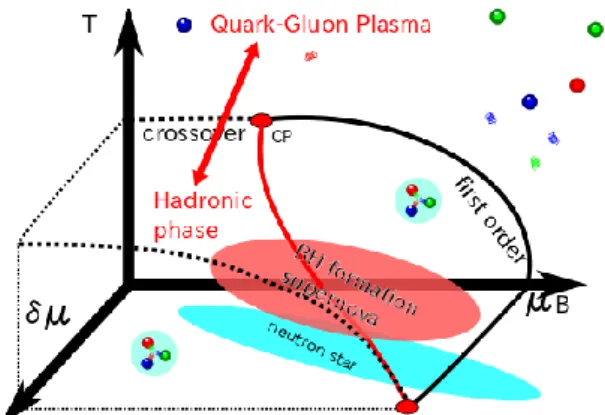
Fig. 1. Phase diagram of asymmetric nuclear matter
コンパクト天体現象における
QCD
相転移原子核理論研究室 上田 宏史
Abstract We discuss the QCD phase diagram of asymmetric nuclear matter by using Polyakov loop extended quark meson model. The critical point temperature is found to decrease in asymmetric nuclear matter. We also discuss the phase structure of matter during the dynamical black hole formation and in the neutron star core.
© 2014 Department of Physics, Kyoto University
量子色力学 (QCD) は強い相互作用の基本理論である。
QCD の熱力学的な性質の知識は非常に広い温度・密度領域 の現象に関わるため、重イオン衝突などの実験のみでなく、
コンパクト天体現象や宇宙初期の状態などを理解するの に必要不可欠である。系の熱力学的な性質の概略は QCD 相 図(Fig.1)によって表現できるため、 QCD 相図を正確に描 くことは非常に重要である。
近年、格子 QCD や有効模型によって QCD 相図の研究がな されている[1]。しかしながら、第一原理計算である格子 QCD のモンテカルロ計算は符号問題のため有限密度の計算 が困難であり、また有効模型では模型やパラメータの依存 性が大きいため、QCD 相図の高密度領域はよくわかっていな
い。実験研究としては、LHC、RHIC 等での重イオン衝突による QCD 相図の探求が行われている。しかし、
重イオン衝突では低温・高密度の平衡状態にある物質を生成するのは容易ではない。
これと相補的な QCD 相図探求の場としてコンパクト天体現象がある。コンパクト天体現象では、非常 に高密度の物質が生成されるため、QCD 相転移の影響が多く議論されている[2]。また、荷電中性などの 条件からクォーク毎の化学ポテンシャルが異なる非対称核物質が生成される。そのためコンパクト天体 現象での QCD 相転移の影響等を議論するためには、Fig.1 に示すように非対称度依存性を含めた相図[3]
を考慮する必要がある。
本研究では、ベクトル結合を取り入れて拡張したカイラル有効模型である Polyakov loop extended quark meson 模型を用い、QCD 相図の非対称度依存性、すなわち 1 次相転移線や臨界点が非対称度によ ってどのように影響を受けるのかを調べる。この相図と、ブラックホール形成過程、中性子星の核に生 成される物質の温度・バリオン化学ポテンシャル(μ
B)・アイソスピン化学ポテンシャル(δμ)を比較す ることで、これらの現象での相転移を議論する[4]。
本研究により、 対称物質からずれると、Fig.1 のように QCD 臨界点(CP)の温度が下がることがわかった。
また、あるδμ以上で QCD 臨界点が消失し、ゼロ温度でもカイラル相転移が連続相転移となりうること を示唆した。さらにコンパクト天体現象との比較により、ブラックホール形成過程において QCD 臨界点 探索の可能性を議論するとともに、中性子星の内部において非対称度依存性のためカイラル相転移が連 続相転移となる可能性を示した。
References
[1] K. Fukushima, Phys. Lett. B 591 (2004) 277; B. J. Schaefer et.al., Phys.Rev. D 76 (2007) 074023;V. Skokov et al., Phys. Rev. D 82 (2010) 034029; S. Ejiri et al., Prog. Theor. Phys. Suppl. 153 (2004)118.
[2] T. Hatsuda, Modern Phys. Lett. A 02 (1987) 805; I. Sagert, et al., Phys. Rev. Lett. 102 (2009) 081101; K.
Nakazato et.al., Phys. Rev. D 78 (2008) 083014.
[3] T. Sasaki et.al, Phys. Rev.D 82, 116004 (2010); K. Kamikado et.al., Phys. Lett. B 718, 1044 (2013).
[4] H.Ueda, T.Z.Nakano, A.Ohnishi, M.Ruggieri and K.Sumiyoshi, Phys. Rev. D 88, (2013) 074006
A.Ohnishi, H.Ueda, T.Z.Nakano, M.Ruggieri and K.Sumiyoshi, Phys. Lett. B 704, (2011) 284
10
-1C o u n ts s
-1k eV
-1χ
4 0 -4 10
-210
-3Energy (keV)
6 10
4 8
10
-1C o u n ts s
-1k eV
-1χ
4 0 -4 10
-210
-3Energy (keV)
6 10
4 8
電離平衡モデル 過電離モデル
Cosmic X-ray Background
Fe RRC
Ca RRC
図左; 電離平衡プラズマモデル (赤) によるフィット結果。緑は Cosmic X-ray Background を示す。
図右; 過電離プラズマモデル (赤) によるフィット結果。
超新星残骸における過電離プラズマの研究
宇宙線研究室 大西隆雄
Abstract We present deep observations of the Galactic supernova remnant IC443 with the Suzaku satellite. We detected the enhanced radiative recombination continua of Fe and Ca ions. We show the results of spectral fitting and discuss the origin of the recombining plasma.
© 2014 Department of Physics, Kyoto University
超新星残骸 (SNR) における高温プラズマは、衝撃波加熱により加速された電子がイオンを電離してい く緩和過程として理解されてきた。電子温度 (kTe) と電離状態を反映する電離温度 (kTz) を用いると、
kTe > kTz である (電離優勢プラズマ)。また、衝撃波加熱後、10
12/n
es のタイムスケールで電離過程 と再結合過程が釣り合った電離平衡状態に達する (電離平衡プラズマ)。ここで、n
eは電子密度 (cm
-3) である。従って、SNR におけるプラズマは電離優勢プラズマ、または電離平衡プラズマとして実現され ることになる。従来の観測結果はこの描像を支持していた。
しかし最近になって、我々はエネルギー分解能に優れた X 線衛星すざくを用いることにより、再結合 過程が優勢なプラズマ (kTe < kTz; 過電離プラズマ) を発見した [1]。このようなプラズマでは、高 階電離したイオンがプラズマ中の自由電子を捕獲した際に放射される放射性再結合連続線 (RRC) の寄 与が大きくなる。RRC を制動放射から切り分けることが、過電離プラズマであることを検証するのに重 要である。これまでに検出されている Mg、Si、S の RRC は~4 keV 以下で見られる。このエネルギー帯 域では、重元素からの輝線が RRC と重なっており、RRC の構造は電離平衡プラズマや電離優勢プラズマ のモデルフィットの残差として現れるだけである。一方、4—10 keV のエネルギー帯域では、Fe や Ca の RRC が輝線と重なり合うことなく分離することが可能であるが、 統計不足のため W49B における Fe の RRC を除いて検出されていなかった。そのため、我々は最も典型的な再結合優勢プラズマである IC443 の 400 ks におよぶ長時間観測を行った。先行研究では Mg、Si、S の RRC を検出したが、統計不足のため Fe か らの RRC が顕著になるエネルギー帯域でのスペクトル構造が明らかになっていなかった。
長時間観測の結果、4 keV 以上における高統計スペクトルを明らかにし、初めて Fe の Kα 輝線、及 び Fe Kβ+Ni Kα輝線を検出した。図左は通常の電離平衡プラズマモデルでフィットした結果である。
Fe Kα輝線の中心値がモデルよりデータで高く、電離平衡よりさらに電離の進んだ状態にある可能性を 示す。8—10 keV では盛り上がった構造が顕著であり、Fe の強い RRC を示唆する。さらに、5—6 keV に波 のような構造が見られる。これは、Ca の RRC と対応する。以上を踏まえて過電離モデルを適用した結果 (図右)、これらの残差
は全て解消し、単一の 過電離モデルでデー タがうまく再現する ことが判明した。結果 として我々はこの天 体から初めて Fe 、Ca の RRC を発見した。
References
[1] Takao Ohnishi, et al., PASJ, 63, 527-533, (2011)
[2] Takao Ohnishi, et
al., submitted to ApJ
Discrete flavor symmetry
for lepton mixing and quark mixing
素粒子論研究室 小笠原敦
Abstract We study non-Abelian discrete flavor symmetries, which could constrain patterns of the lepton mixing and the quark mixing. Through the systematical search for flavor symmetries, we propose a simple model, which generates both the lepton mixing and the Cabbibo angle.
© 2014 Department of Physics, Kyoto University
ニュートリノ質量とそれに伴うレプトンの世代間質量混合の存在は、標準模型を超えた物理を示唆し ているが、その起源は分かっていない。世代間混合の値を説明する候補の一つに non-Abelian な世代間 対称性を導入する方法があり、数多くの模型が提唱されている。
近年の実験により、レプトン世代間質量混合を表す Pontecorvo-Maki-Nakagawa-Sakata 行列(PMNS 行 列)に表れるθ
13角が非零で比較的大きいことが判明した。これまでの多くの世代間対称性模型では、第 一近似として tri-bimaximal 模様の PMNS 行列[1]が与えられてきたが、 実験結果と大きく外れてしまう。
そのため、この差異を説明する新しい機構、または実験値に近い PMNS 行列を導く新しい世代間対称性 が必要になっている。
新しい対称性を用いた模型構築へのアプローチとして Hernandez-Smirnov は、世代間対称性から導き うる PMNS 行列の模様を、模型に依存することなく系統的に調べる方法を提唱した[2]。彼らの手法を用 いれば、PMNS 行列に表れる非零のθ
13角を導く世代間対称性を見つけることが可能であり、現在までに いくつかの候補が提案されている。
一方、クオーク質量やその世代間混合は標準模型の枠組みで予言される現象だが、実験値がどのよう に理論的に定まるかは分かっていない。クオークの世代間質量混合を表す Cabbibo-Kobayashi-Maskawa 行列(CKM 行列)の混合角の大きさは、Cabbibo 角が PMNS 行列のθ
13角程度であり、その他はとても小さ いことが知られている。そのため第一近似で tri-bimaximal 模様の PMNS 行列を導く模型では、CKM 行列 は PMNS 行列のθ
13角と同様に、模型に依存した高次の補正で生まれ得ると考えられてきた。しかし、も し PMNS 行列のθ
13角が世代間対称性の一次の寄与で生成されるなら、Cabbibo 角も同様に一次の寄与で 生成される可能性がある。よって、世代間対称性から導かれる第一近似が、PMNS 行列と CKM 行列をどの 程度再現できるかを調べることは、今後の模型構築において重要である。
そこで本発表では、Hernandez-Smirnov の手法をクオーク部分に拡張することで、クオークの質量混 合を導く世代間対称性を模型に依存しない系統的な方法で調べる[3]。ある範囲の世代間対称性から導 かれ得る CKM 行列の模様を網羅することで、世代間対称性の可能性を探る。その結果を参考に、CKM 行 列の Cabbibo 角と PMNS 行列を同時に出す世代間対称性の模型を提案する。
References
[1] P. F. Harrison, D. H. Perkins and W. G. Scott, Phys. Lett. B 530, 167 (2002).
[2] D. Hernandez and A. Y. Smirnov, Phys. Rev. D 86, 053014 (2012).
[3] T. Araki, H. Ishida, H. Ishimori, T. Kobayashi and A. Ogasahara, Phys. Rev. D 88, 096002 (2013).
Integrable deformations of principal chiral models and the AdS/CFT correspondence
素粒子論研究室 川口維男
Abstract We consider the classical integrable structure of q-deformed SU(2) and SL(2,R) principal chiral models. It is known that the classical dynamics of undeformed principal chiral models can be described in two (left and right) descriptions. The two descriptions degenerate each other and, in fact, equivalent. The deformations which we discussed here resolve their degeneracy. Thus the equivalence becomes obscure.
We show not only how each of the two descriptions is deformed individually but also how the left-right duality is modified.
© 2014 Department of Physics, Kyoto University
We discuss integrable deformations of SU(2) principal chiral models (PCMs)[1,2]. In particular, we concentrate on the deformations preserving SU(2)_L x U(1)_R symmetry. As a result, the deformations can be regarded as a kind of q-deformations of SU(2) PCMs.
In each model, there are two ways to describe the classical dynamics: one of them is called 1) left description and the other is called 2) right description. The former is based on the SU(2)_L symmetry and the later is based on the U(1)_R symmetry. First, we present Lax pairs and monodromy matrices both in left and right descriptions. Then it is shown that a couple of su(2)_L Yangians and the (deformed) quantum affine su(2)_R are realized in the deformed sigma models. The classical r/s-matrices subject to the extended classical Yang-Baxter equation are also obtained. In addition, gauge equivalence between left and right monodromy matrices is shown.
We also discuss a similar integrable deformation of SL(2,R) PCMs[3], which preserves SL(2,R)_L x U(1)_R symmetry. As in case of deformed SU(2) principal chiral models, there are two descriptions for its classical integrable structure and they are gauge equivalent each other. The main distinction is the “direction” of the q-deformation. We consider the non-standard q-deformation (q-deformation to the non-Cartan direction) while the standard q-deformation is considered in case of SU(2) principal chiral models. As a result, the U(1)_R symmetry is no longer enhanced to the quantum affine sl(2,R)_R. It is shown that an infinite-dimensional algebra which has an exotic tower structure is realized in this model. In addition, we construct a homomorphism from the sl(2,R)_R Yangians to the exotic symmetry.
References
[1] I.Kawaguchi and K.Yoshida, ”Hidden Yangian symmetry in sigma model on squashed sphere,” JHEP 1011 (2010) 032, “Hybrid classical integrability in squashed sigma models,” Phys. Lett. B 705 (2011) 251, “Hybrid classical integrable structure of squashed sigma models: A Short summary,” J. Phys. Conf. Ser. 343 (2012) 012055.
I.Kawaguchi, T.Matsumoto and K.Yoshida, “The classical origin of quantum affine algebra in squashed sigma models,” JHEP 1204 (2012) 115, “On the classical equivalence of monodromy matrices in squashed sigma model,” JHEP 1206 (2012) 082.
[2] I.Kawaguchi, D.Orlando and K.Yoshida, “Yangian symmetry in deformed WZNW models on squashed spheres,” Phys. Lett. B 701 (2011) 475. I.Kawaguchi and K.Yoshida, “A deformation of quantum affine algebra in squashed WZNW models,” [arXiv:1311.4696 [hep-th]].
[3] I.Kawaguchi and K.Yoshida, “Classical integrability of Schrodinger sigma models and q-deformed Poincare
symmetry,” JHEP 1111 (2011) 094, “Exotic symmetry and monodromy equivalence in Schrodinger sigma
models,” JHEP 1302 (2013) 024. I.Kawaguchi, T.Matsumoto and K.Yoshida, “Schroedinger sigma models and
Jordanian twists,” JHEP 1308 (2013) 013.
T2K 実験におけるニュートリノ反応断面積の測定
高エネルギー物理学研究室 木河達也
Abstract The neutrino interaction cross sections for inclusive charged current interaction, charged current quasi-elastic scattering and charged current coherent pion production are measured using the T2K
neutrino beam and the fully-active tracking detector “Proton Module”.
© 2014 Department of Physics, Kyoto University
T2K 実験[1]は 2009 年に開始した長基線ニュートリノ振動実験である。J-PARC 加速器により生成され たニュートリノビームを生成点直後にある前置検出器と 295km 離れたスーパーカミオカンデで観測する ことによりニュートリノ振動の精密測定を行う。ニュートリノ振動実験においてはニュートリノ反応に 対する理解が非常に重要になるため、私は T2K 実験のニュートリノビームと自ら開発、製作した Proton Module 検出器を用いて 1GeV 付近のニュートリノ反応断面積の精密測定を行った。Proton Module 検出 器はプラスチックシンチレータのバーを並べた全感知型飛跡検出器であり、この検出器をニュートリノ 標的および反応点付近の飛跡再構成のために用い、すぐ下流に設置されている鉄とシンチレータのサン ドイッチ構造の INGRID 検出器をミューオン識別のために用いる。
ニュートリノ振動はニュートリノ荷電カレント反応を通して測定するため、荷電カレント反応の精密 測定は特に重要である。そのため、まず Proton Module 検出器と INGRID 検出器を用いて鉄と炭素にお ける荷電カレント反応断面積を測定した。それと同時に鉄と炭素における荷電カレント反応断面積の比 を非常に精密に測定した。これらの測定結果はモデルによる予測とよく一致しており、荷電カレント反 応において、標的原子核に依存性したアノーマリーが測定精度の範囲で存在しないことを確認した。こ の結果は前置検出器とスーパーカミオカンデにおいて異なった種類の原子核をニュートリノ標的とし て用いている T2K 実験にとって重要な結果である。
次に Proton Module 検出器を用いて T2K 実験のニュートリノ振動測定で信号モードとしている荷電カ レント準弾性散乱(ν
μ+n→μ
-+p)の断面積を測定した。測定結果はモデルによる予測と無矛盾であったが、
再構成された飛跡が 1 本のサンプルと 2 本のサンプルからそれぞれ求めた断面積にはわずかな違いが見 られた。T2K 実験ではニュートリノ反応における原子核モデルとしてフェルミガスモデルを用いている が、これは近似を用いて単純化されたモデルであり、より複雑な Spectral function と呼ばれるモデル がより現実的であると考えられている。Spectral function を用いた場合の見積もりではこの違いは小 さくなっているため、この違いは Spectral function の正しさを示していると考えられる。
最後に Proton Module 検出器を用いてニュートリノが原子核全体と相互作用する荷電カレントコヒー レントπ生成反応( ν
μ+A→μ
-+π
++A’ : A は原子核)の断面積を測定した。この反応断面積の予測には Rein and Sehgal モデル[2]が広く用いられてきたが、K2K 実験、SciBooNE 実験において 1GeV 付近のエネルギ ー領域で得られた信号は Rein and Sehgal モデルの予測より遥かに小さく、有意な信号が見つかってい ない。Proton Module 検出器による測定結果も Rein and Sehgal モデルによる予測よりずっと小さいも のであったが、荷電カレントコヒーレントπ生成反応が存在しない場合の予測より 1σ以上の超過が見 られた。その信号の終状態の粒子の角度分布を見ると、小角度の領域においては Rein and Sehgal モデ ルとよく一致しており、大角度領域では大きくずれているため、Rein and Sehgal モデルにおける終状 態粒子の運動学の予測に原因がある可能性を示唆した。
いずれの測定結果も T2K 実験において考慮されているニュートリノ反応モデルの不定性の範囲内であ り、T2K 実験においてニュートリノ反応モデルとその不定性が正しく扱われていることを示した。
(ただし荷電カレント準弾性散乱と荷電カレントコヒーレントπ生成反応の断面積の測定結果はまだ T2K 実験の公式の物理結果ではない。)
References
[1] K. Abe et al. (T2K Collaboration), Nucl. Instrum. Meth. A 659 106 (2011)
[2] D. Rein and L. M. Sehgal, Ann. Phys. 133 79 (1981)
F-theory compactified on K3xK3 and its application to landscape
基礎物理学研究所 素粒子論グループ 木村 裕介
Abstract We study flux compactification of F-theory on K3 x K3, and its application to landscape problem. K3 surface admits several distinct elliptic fibrations, and each fibration contains the algebraic information such as gauge group. Using lattice theoretic approach, we investigate distribution of gauge groups over the landscape of vacua.
© 2014 Department of Physics, Kyoto University
ストリング理論をコンパクト化する空間の変形の自由度をモジュライというが、この自由度からスカ ラー粒子が出現してしまう。宇宙論との整合性から、そのような粒子が出現しないようモジュライを安 定させる必要がある。F 理論において4形式フラックスを導入することでモジュライを安定できること が知られている。我々の論文ではコンパクト化する空間が K3xK3 の場合を考える。この時、フラックス の導入は各々の K3 曲面の代数的サイクルの数が増えることに対応する。代数的サイクルの数が可能な 最大に達した K3 曲面を attractive K3 という。コンパクト化する空間である K3xK3 において、両方の K3 曲面とも attractive である場合がモジュライを安定させる観点より理想的である。
ストリング理論では可能な真空の解が一つに定まらず無数に存在するが、これをランドスケープ問題 という。F 理論では、楕円ファイブレーションから非可換ゲージ群などの物理情報を読み取れる。K3 曲 面は複数の楕円ファイブレーションを持ち、それぞれのファイブレーションに応じて対応する物理が変 わってくる。この K3 曲面の特徴を応用することで、非可換ゲージ群に対する条件をつけた従来より精 密なランドスケープ問題の考察が出来る。異なる真空を区別するファイブレーションの分類を便宜上 J
1分類と呼ぶ。同様に、ゲージ群や物質表現が等しくなるかで区別する分類を J
2分類と呼ぶ。一般に J
2分類は J
1分類より粗い。物理的に異なる真空でもゲージ群や物質表現が一致する場合があるのだ。格子 理論を用いて J
2分類を調べる Kneser-Nishiyama 法という数学的手法が存在する[1]が、我々はこの方法 に加え、Piatetski-Shapiro, Shafarevich[2]らの理論に倣い、2 次の整数係数コホモロジー群格子のう ち(-2)-反射群に関する基本領域を調べることで、より細かい J
1分類の意味で楕円ファイブレーション を数える結果を導いた[3]。これにより、K3xK3 のランドスケープにおいて非可換ゲージ群を残すことで どの位真空の数が減るか、またどのゲージ群がより多くの真空を持つかなど、問題の統計的な側面まで 詳細に調べることが出来る。我々は E
n-ゲージ群と E
n-1xU(1)-ゲージ群を持つ真空の数の比率を計算した [4]。これが今発表の主結果である。動機は SU(3)xSU(2)xU(1)をゲージ群として持つ真空より SU(5)を 持つ真空の数の方がランドスケープで多いことを実証することにあるが、類似のケースであり実行可能 な上記の場合を計算対象とした。
Aspinwall、Kallosh は tadpole 相殺条件に更なる制約を加えた条件の下で、どの K3 曲面が許されるか を調べた[5]。我々はこの制約を緩め、全てで 34 個の attractive K3 曲面を今研究のサンプルとして用 いた。一般には上限を見積もったが、うち 10 個については J
1分類と J
2分類が一致することを我々は[3]
で確認している。この事実はランドスケープにおいて真空の数を比べ正確な計算を実行する今発表の主 結果を得るうえで本質的である。
References
[1] K.Nishiyama, Japan. J. Math., 22 (1996).
[2] I.Piatetski-Shapiro and I.R.Shafarevich, Math. USSR Izv. 5 (1971).
[3]A.Braun, Y.Kimura and T.Watari, arXiv: 1312.4421[math.AG]
[4]A.Braun,Y.Kimura and T.Watari, to appear
[5] P. S. Aspinwall and R. Kallosh, JHEP 0510(2005) 001, [arXiv:hep-th/0506014].
カイラル対称性の部分的回復と核物質中のπ中間子の性質
原子核理論研究室 郷田創一郎
Abstract To study partial restoration of chiral symmetry, we evaluate in-medium chiral condensate, pion decay constant and pion mass using in-medium chiral perturbation theory up to the next-to-leading order of nuclear density. We find that NLO corrections are not small and low energy theorems are not satisfied in this order.
© 2014 Department of Physics, Kyoto University
低エネルギーQCD では、カイラル対称性の自発的破れが起きているが、この現象が構成子クォーク質 量を生成し、ハドロン質量のほとんどを与えると考えられている。近年、この対称性の破れを原子核を 舞台として検証する試みが理論・実験ともに盛んである。特にカイラル対称性の自発的破れの秩序変数 である、カイラル凝縮の核媒質中での変化に着目し、質量生成機構を検証するという研究が行われてい る。この変化はカイラル対称性の部分的回復と呼ばれ、この観点から、ゼロ温度・有限密度とみなせる 原子核という有限密度系と中間子との束縛系に特に注目が集まっている。原子核中でのハドロンの性質 の変化を通して、カイラル対称性の部分的回復を理解することが理論・実験ともに重要視されている。
その理解を目指した理論的な研究として、有限密度中でも成り立つ関係式が、密度の一次の範囲内で カレント代数に基づいて系統的に導かれている[1]。またπ中間子原子の深い束縛状態に関する精密分 光実験を通して、対称性の部分的回復が線形密度の範囲内で定量的に見積もられている[2]。
この研究では、まずカイラル対称性の破れの秩序変数であるカイラル凝縮の密度依存性を解析する[3]。
さらにその自発的破れに伴う南部ゴールドストーン粒子であるπ中間子に注目し、核物質中でπ中間子 の性質がどのように変化するかを定量的に議論する。特にπ中間子の崩壊定数、質量の密度依存性を評 価 する [4]。解 析には核物 質中に拡 張したカ イラ ル摂動論 [5,6]を用 い、 線形密度 近似を超えて
Next-to-leading の補正までを議論する。この理論を用いる利点は、カイラル対称性を尊重している点と、
運動量の次数を勘定することで物理量の大きさを系統的に評価することが可能である点である。核物質 中でのπ中間子は波動関数くりこみにより密度効果を受ける。これが核物質中でのπ中間子を特徴付け、
崩壊定数、質量等の物理量に寄与し、本質的に重要であることを示す。またその密度依存性を解析し、
π
0→2γ崩壊から波動関数くりこみの密度依存性を観測できることを示す。核物質中での低エネルギー 定理、特に Gell-Mann-Oakes-Renner 関係式が成り立つかどうかも議論する。
References
[1] D. Jido, T. Hatsuda and T. Kunihiro, Phys. Lett. B 670 ,109 (2008) . [2] K. Suzuki et al., Phys. Rev. Lett. 92, 072302 (2004) .
[3] S. Goda and D.Jido, Phys. Rev. C 88, 065204 (2013) . [4] S. Goda and D.Jido, arXiv:1312.0832 .
[5] J. A. Oller, Phys. Rev. C 65 , 025204 (2002) .
[6] U. G. Meissner, J. A. Oller and A. Wirzba, Annals Phys. 297 ,27 (2002) .
軽い中性子過剰核における
ダイニュートロン相関の系統的研究
原子核理論研究室 小林 史治
Abstract We investigate dineutron correlation in the light neutron-rich nuclei. A dineutron is a compact spin-singlet two-neutron pair regarded as a kind of cluster. We suggest that dineutron correlation can be generally significant in those nuclei. We present contribution of the dineutron correlation in the ground and excited states of
8He.
© 2014 Department of Physics, Kyoto University
近年、科学技術の進歩により自然界には存在しない中性子過剰な不安定核の研究が実験的に可能にな り、長らく研究されてきた安定核における常識を打ち破る新奇な現象がいくつも発見されてきた。その ような多様な様相を見せる原子核の性質を明らかにするために、中性子過剰核は理論・実験両側面から 精力的に研究されている。中性子過剰核特有の物理の一つに“ダイニュートロン相関”がある。ダイニ ュートロンとは空間的にコンパクトなスピン 0 の二中性子対である。自由空間において二中性子は束縛 状態を形成しないにも関わらず、無限核物質の低密度領域や中性子過剰核の核表面付近では、二中性子 間の空間的な相関が強まりコンパクトなダイニュートロンが形成されることが理論的に示唆されてい る[1,2]。特に中性子過剰核中においては、有限効果によってダイニュートロンは全系のサイズに比べ 非常にコンパクトになり一種の擬似的なボソン(クラスター)と見なし得る。しかし二中性子は元々非束 縛なために、ダイニュートロンの形成の度合いやサイズなどの性質は、芯原子核の占有軌道・変形構造・
芯と余剰中性子の束縛の強さなどの状況に応じて多様に変化することが期待される。しかし先行研究で 用いられてきた既存のモデルでは芯の構造を考慮することが難しく、その適用範囲はごく一部の原子核 に限られていた。本研究では芯の構造をあらわに取り入れた上でその周りのダイニュートロンの運動を 詳細に記述する枠組み“ダイニュートロン凝縮波動関数”を一から構築した[3]。この枠組みはダイニ ュートロンの観点からは研究されていない大半の原子核に適用でき、これによりダイニュートロン相関 の普遍的性質を明らかにするための系統的研究が可能になった。
今回の研究では軽い質量数(A≤10)の中性子過剰核に着目し、それらにおけるダイニュートロン相関の 寄与を解析した。その解析からこれら軽い中性子過剰核では一般的にコンパクトなダイニュートロンが 核表面付近で形成され得ることを示した。その中でも今回の発表では
8He の結果に着目する[4]。
8He は
芯+四余剰中性子でよく記述され、四つの余剰中性子が独立に 0p
3/2殻に入って LS 力を稼ぐ殻模型的な 成分と一つもしくは二つのダイニュートロンが形成される成分が競合することが考えられる。今回の解 析により
8He の基底状態においては殻模型的な成分と一つのダイニュートロンが芯から大きく発達する 成分が競合することを示した。芯と余剰中性子が適度に束縛している基底状態においてはダイニュート ロンが LS 力によって崩される効果が重要であり、ダイニュートロンが同時に二つ発達する成分は大き く抑制される。一方で二つのダイニュートロンが発達する成分は励起状態において重要になり、二つの ダイニュートロンが擬似的にボソンとして振る舞い最低軌道を占める “ダイニュートロン凝縮状態”
が励起状態として存在し得る可能性を示唆した。この状態はと 2 ダイニュートロンという三つのクラ スターがガス状に、互いにほぼ相関を持たずに大きく拡がった構造で特徴づけられる。今回の発表では 基底状態における殻模型成分とダイニュートロン成分の競合、および励起状態におけるダイニュートロ ン凝縮という新奇な状態について述べる。
References
[1] M. Matsuo, Phys. Rev. C 73, 0044309 (2006)
[2] K. Hagino, H. Sagawa, J. Carbonell and P. Schuck, Phys. Rev. Lett. 99, 022506 (2007) [3] F. Kobayashi and Y. Kanada-En’yo, Prog. Theor. Phys. 126, 457 (2011)
[4] F. Kobayashi and Y. Kanada-En’yo, Phys. Rev. C 88, 034321 (2013)
低雑音撮像能力をもつ
気球搭載型サブ MeV ガンマ線カメラの 天体検出性能の検証
宇宙線研究室 澤野達哉
Abstract We have been developing an Electron Tracking Compton Camera (ETCC) for the MeV gamma-ray region in the universe by balloon experiments. The simulated detection efficiency of the flight-model-type ETCC is consistent with the simulated one, which enables us to detect Crab nebula with > 5 level.
© 2014 Department of Physics, Kyoto University
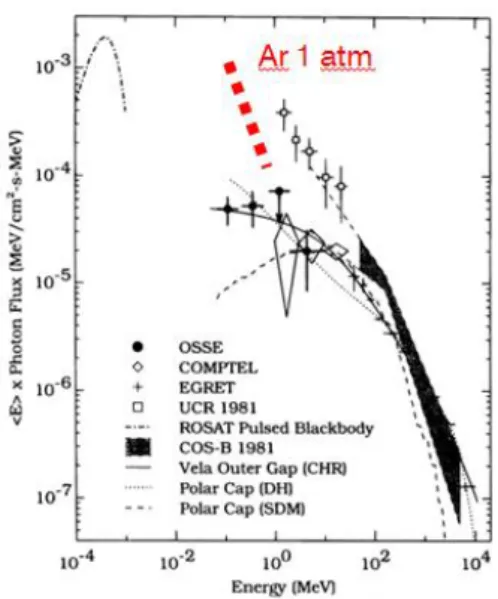
サブ MeV ガンマ線帯域の連続スペクトル観測は、活動銀河核のガンマ線バーストの光度における経験 則を用いた距離梯子への利用[1]など高エネルギー天体現象へのユニークなプローブになる一方で、雑 音事象が非常に多く観測装置の発展が遅れている分野である。観測の困難を克服した観測技術の確立の ため、コンプトン散乱を利用する、ガス検出器とシンチレーションカメラからなる電子飛跡検出型コン プトンカメラ(ETCC)の開発を行い、気球観測による天体撮像能力の実証を目指している。開発した気 球搭載型 ETCC(FM ETCC)の性能を説明すべく、物理過程と検出器のエネルギー分解能のみを考慮したモ ンテカルロシミュレーションにより ETCC の検出効率を評価したところ、FM ETCC と同タイプの試験用小 型 ETCC の実験値と 30%以内で一致しており(Fig. 1)[2]、精度良いシミュレータの構築に成功した。こ のことは、ETCC が雑音事象を含む環境でコンプトン散乱事象を選択的にほぼ 100%捉えられていること を示している。FM ETCC の基本性能を用いて数値計算を行い、高度 40 km の中緯度で数時間の観測によ り、かに星雲を 5以上の有意度で観測可能であることを示した。ガス検出器に用いるガス種の選定によ り 10 倍程度まで有効面積を達成、flux に変動の可能性が指摘される Vela パルサーの観測による検証を 南極周回気球実験によって可能な感度に達成する(Fig. 2)など、気球観測実験によるサブ MeV ガンマ線 天文学の開拓の実現性を検証した。
References
[1] D. Yonetoku et al., ApJ. 609, 935-951 (2004).
[2] T. Sawano et al., JPS Conf. Proc., in press (2013).
[3] M.S.Strickman et al., ApJ. 460, 735 (1996).
Fig. 2. Detection expectation of the circumpolar-flight ETCC (dotted line) for Vela pulsar.
The original figure is from [3].
Fig. 1. Detection efficiency of small ETCC:
simulation (Double-dashed line) and
measured (closed square). See [2] for details.
Non-minimal coupling in the context of multi-field inflation
Yukawa Institute for Theoretical Physics
Jonathan White
Abstract Motivated by their good consistency with recent observational data, we study the class of multi- field inflation models that contain a non-minimal coupling to the gravity sector. In particular, we focus on the formulation dependence of this class of models and the potentially important role of the Higgs.
© 2014 Department of Physics, Kyoto University
Recent observations of the Cosmic Microwave Background (CMB) show very good consistency with inflationary models whose actions can be written in a form that contain non-minimal coupling between the field driving inflation and the Ricci Scalar. Such non-minimal coupling is also theoretically well motivated, for example in the context of unifying particle physics theories. The same theories also predict the existence of many light degrees of freedom in addition to the inflaton. Motivated by these facts, in this work we study multi-field inflationary models with non-minimal coupling.
It is well known that models with non-minimal coupling can be re-cast in the form of Einstein gravity via a conformal transformation of the metric. The original “frame” and that after the rescaling of the metric are referred to as the Jordan and Einstein frames, respectively, and there is a long-standing debate as to the level of equivalence between results obtained in the two frames. We focus on comparing the curvature perturbations associated with the two frames, as these quantities are very closely linked to the temperature fluctuations of the CMB. At linear order we find that, as a result of the isocurvature modes inherent to multi-field models of inflation, the two quantities and their evolutions do not necessarily coincide. In particular, the conservation of one does not necessarily imply the conservation of the other. Using the δN formalism to go beyond linear order, we find that the statistical properties of the two curvature perturbations may also be very different, including the non- gaussianity. Given that non-gaussianity is a powerful tool for distinguishing between different models of inflation, this highlights the importance of determining how each of the curvature perturbations is related to observations.
In the second part of our work we consider the reheating process in the same class of inflation models. Taking a bottom-up approach we assume that there are no direct interaction terms between the inflaton sector and the Standard Model. As such, reheating takes place via gravitationally suppressed dimension-5 interaction terms, with the decay rates of the inflaton sector depending on the masses of the decay products. Since all masses of the standard model particles are acquired from the Higgs field expectation value, we argue that the rate of gravitational particle production can be spatially modulated by the stochastic value of the Higgs condensate generated during inflation. We show that observational constraints on the curvature perturbation generated from this Higgs isocurvature mode can be used to set a lower bound on the inflaton mass during the reheating phase.
Given that gravitational interactions are universal, and that we know the Higgs field to exist, this work is important in constraining the possible role that the Higgs field might play in the dynamics of the early Universe.
References:
[1] J. White, M. Minamitsuji, and M. Sasaki, Curvature perturbation in multi-field inflation with non-minimal coupling, JCAP 07(2012)039.
[2] J. White, M. Minamitsuji, and M. Sasaki, Non-linear curvature perturbation in multi-field inflation models with non-minimal coupling, JCAP 09(2013)015.
[3] J. White and Y. Watanabe, in preparation.
Quantum Tunneling During Inflation:
Non-linear Analysis of the Quantum Fluctuations
Yukawa Institute for Theoretical Physics Kazuyuki Sugimura
Abstract We perform a non-linear analysis of the primordial fluctuations generated from quantum tunneling during inflation, which can become a key to observationally test the string theory landscape in future. We develop formulation and then apply it to a couple of inflation models with quantum tunneling.
© 2014 Department of Physics, Kyoto University
While inflation is now part of the standard cosmology, our knowledge of the physics behind inflation is very limited. The energy scale of inflation is far beyond that of the standard model of particle physics and there is no hope to realize accelerator experiments at such high energy. However, string theory, the most studied candidate of the ultimate theory, recently offered a new framework on inflation: the string theory landscape.
The motivation of this work is to test this theory-motivated framework by observation, which possibly has an extremely large impact on both cosmology and string theory. The string theory landscape is a huge landscape of potential for scalar fields, which are originated from the degrees of freedom of the extra dimension geometry in string theory. Although details of the landscape are not clear yet, string theory generally suggests the existence of local potential minima, where scalar fields jump around by quantum tunneling. Evidences of the string theory landscape can be found by searching for distinctive observational signatures generated by such quantum tunneling.
In this work, we focus on the non-Gaussianity of the primordial fluctuations generated from quantum tunneling during inflation, which can become a key to observationally test the string theory landscape in future. The non-Gaussianity of the primordial fluctuations, an observable related to the higher order correlations of them, is going to be a powerful tool to probe inflation in the coming era of high precision cosmology.
Since there was no previous work on the non-Gaussianity from quantum tunneling, we start with developing formulation to calculate it. The commonly used formulation to calculate the non-Gaussianity, the so-called in-in formalism, is not directly applicable to systems with quantum tunneling because the evolution of the quantum fluctuations during quantum tunneling cannot be described as real (Lorentzian) time evolution. We derive the extended in-in formalism on quantum tunneling background in a system of multi-dimensional quantum mechanics based on the WKB analysis of tunneling wave functions [1], and then further extend this to cosmological systems with quantum tunneling.
We apply this newly developed formulation to a couple of models motivated by the string theory landscape, namely, models where slow-roll inflation is triggered by quantum tunneling [2] and ones where bubbles are nucleated via quantum tunneling during slow- roll inflation [3], to predict the non-Gaussianity of the primordial fluctuations from these models for the first time. As a result of calculation, we find that the bispectrum can be generated in the long-wavelength modes due to quantum tunneling during slow-roll inflation in the former models and that large skewness regions with azimuthal symmetric spatial dependence can be generated due to nucleated bubbles in the latter.
References
[1] K. Sugimura, Phys.Rev. D88 (2013) 025037.
[2] K. Sugimura and E. Komatsu, JCAP 1311 (2013) 065.
[3] K. Sugimura, D. Yamauchi, and M. Sasaki, Europhys.Lett. 100 (2012) 29004.
Measurement of the energy dependent muon neutrino charged current inclusive cross section
with the T2K INGRID detector
高エネルギー物理学研究室 鈴木研人
Abstract The energy dependent muon neutrino charged-current (CC) inclusive cross section from 1 to 3 GeV is being measured at the T2K INGRID detector. The current analysis status and the prospect will be presented.
© 2014 Department of Physics, Kyoto University
The T2K experiment [1] is a long baseline neutrino oscillation experiment. The purpose of this experiment is to measure the neutrino oscillation parameters and the CP violating phase (δ
cp).
In 2013, the non-zero neutrino mixing parameter (θ
13) was observed with a significance of 7.3 σ by measuring the electron neutrino appearance [2]. The combined measurement with other reactor experiments showed thatδ
cppreferred –π/2. On the other hand, the property of the neutrino interaction itself is not fully understood in the neutrino physics. T2K experiment also aims to make the mechanism clear by measuring the neutrino cross section at T2K near detector. The purpose of this analysis is to measure the energy dependent muon neutrino charged-current (CC) inclusive cross section from 1 to 3 GeV with the T2K INGRID detector. Since there is little data measured by the other experiments in this energy region, the result of this analysis will be useful for some neutrino interaction models.
The INGRID (Fig.1) is an on-axis neutrino near detector which is composed of identical 14 modules and designed to measure the neutrino beam direction with the 10 m×10 m coverage. Each module is arranged in horizontal and vertical direction. Each module has iron target plates and plastic scintillator planes. A neutrino interacts with one of the iron plates and generates charged particles. Then, these particles are tracked by the scintillator planes. By counting the number of the interactions, we measure the neutrino CC interaction rates with the high detection efficiency (>70%).
INGRID cannot measure the neutrino energy. But the expected energy spectrum of the neutrino beam is different for each module position. With this feature and categorizing the neutrino events according to some topologies, the energy dependence of the CC inclusive cross section from 1 to 3 GeV can be measured. The principle of this measurement, the systematic errors, the result with Toy MC data, and the prospect of this analysis will be presented.
References
[1] K.Abe et al.[T2K collaboration], Nucl,Instrum.Meth.A 659 (2011) 106.
[2] K.Abe et al.[T2K collaboration], arXiv:1311.4750 [hep-ex]
レータに挿入された波長変換ファイバーによって波長を変換し、MPPCと呼ばれる光センサーによって読み 出しを行っている。
図4.1: on-axis検出器INGRID。 計14 台のモジュール が縦· 横方向に 7 台ずつ並べられている。 両脇にある 2 台のモジュールは今年インスト ールされた INGRID shoulder module(後述)。
図4.2: INGRID を構成し ている 1 モジュール。 鉄 (青 く 塗装さ れている) と シンチレータ のサンド イッ チ構 造となっている(左)。 さらに左右側面と上下に VETO プレーンが設置される(右)。
MPPC
MPPCはMulti-Pixel Photon Counter の略称であり、 浜松ホト ニクスによって製造された半導体(Silicon) 光 検出器である(図4.3)。 有感面積1.3 mm2の受光面を持ち、 これは一辺が50 µm の667 個のAPD (Avalanche PhotoDiode) ピクセルから構成されている。 MPPCを用いる時はこれらはガイガーモード で動作させるため、
印加電圧をおよそ70 V まで上げる。 また、 APD ピクセルがガイガーモード となった時の電圧はブレイクダ ウン電圧と呼ばれる。 尚ガイガーモード で動作させた時のAPD1 ピクセル当たり の出力電荷Qは次のよう に 定義される。
Q
=C
(V−Vbd)≡
C
∆V
over (4.1)44