Fukushima Medical University
福島県立医科大学 学術機関リポジトリ
This document is downloaded at: 2021-11-08T00:36:50Z
Title The usefulness of combined assessment of E/E' ratio and transmitral flow pattern to interpret cardiac condition
Author(s) Oikawa, Masayoshi; Kobayashi, Atsushi; Sato, Takamasa;
Suzuki, Satoshi; Yoshihisa, Akiomi; Nakazato, Kazuhiko;
Suzuki, Hitoshi; Saitoh, Shu-Ichi; Takeishi, Yasuchika Citation Fukushima Journal of Medical Science. 63(1): 16-21
Issue Date 2017
URL http://ir.fmu.ac.jp/dspace/handle/123456789/575
Rights © 2017 The Fukushima Society of Medical Science
DOI 10.5387/fms.2016-9
Text Version publisher
[Original Article]
The usefulness of combined assessment of E/E′ ratio and transmitral flow pattern to interpret cardiac condition
Masayoshi Oikawa, Atsushi Kobayashi, Takamasa Sato, Satoshi Suzuki, Akiomi Yoshihisa, Kazuhiko Nakazato, Hitoshi Suzuki, Shu
-ichi Saitoh and Yasuchika Takeishi
Department of Cardiovascular Medicine, Fukushima Medical University, 1 Hikarigaoka, Fukushima, 960
-1295, Japan
(Received July 28, 2016, accepted February 6, 2017) Abstract
Background : High mitral inflow early (E) velocity to tissue Doppler E′ ratio (E/E′) and an E to late diastolic filling velocity ratio (E/A) are used to evaluate left ventricular (LV) diastolic function and filling pressure, but the usefulness of combined assessment of E/E′ and E/A is not fully understood.
Methods : We retrospectively analyzed 1,266 patients who underwent echocardiography to assess cardiac function. Patients were grouped based on the values of E/E′ (low E/E′<15, high E/E′≥15) and E/A (low E/A≤0.8, high E/A>0.8). Results : High E/E′ with both high and low E/A groups showed lower LV ejection fraction and higher LV mass index compared to low E/E′ with both high and low E/A groups. High E/E′ with both high and low E/A groups showed slower E′ velocity and larger left atrial volume index compared to low E/E′ with both high and low E/A groups, but high E/
E′ with low E/A group exhibited smaller left atrial volume index and higher pulmonary venous sys- tolic to diastolic peak velocity ratio compared to high E/E′ with high E/A group. Moreover, high E/
E′ with low E/A group displayed lower tricuspid regurgitant pressure gradient than the high E/E′
with high E/A group. Conclusion : Even in the situation of high E/E′, low E/A condition indicated lower LV filling pressure and controlled fluid retention.
Key words : Diastolic function, Tissue Doppler echocardiography, Cardiac remodeling, Cardiac hy- pertrophy
Introduction
The elevation of left ventricular (LV) filling pressure is a fundamental feature of worsening of chronic heart failure. LV filling pressure is deter- mined by several factors, including left atrial (LA) pressure, LV stiffness, and LV compliance. Mitral inflow early (E) velocity to tissue Doppler E′ ratio (E/E′) are widely used to estimate LV filling pressure. Highly elevated E/E′ is implicated as in- creased LV filling pressure, but it is not always con- sistent with the severity of heart failure [1]. Trans- mitral E and late diastolic filling velocity ratio (E/A) can be measured simply to assess LV diastolic function. Low E/A, impaired relaxation pattern, is related to aging and usually observed in elderly pa-
tients with normal LA pressure [2, 3]. Increased LA pressure drives the increase in E velocity, and changes the transmitral inflow pattern into pseudo- normal or restrictive filling pattern [2]. Both E/E′
and E/A are useful parameters, but we often encoun- ter a confusable situation, such as increased E/E′ but low E/A profile. Thus, we attempt to evaluate the usefulness of combined assessment of E/E′ and E/A, especially in the patients with high E/E′.
Materials and methods
Patients
We enrolled 1,266 patients who underwent transthoracic echocardiography to assess cardiac Corresponding author : Masayoshi Oikawa, M.D., Ph. D. E
-mail : [email protected]
https://www.jstage.jst.go.jp/browse/fms http://www.fmu.ac.jp/home/lib/F
-igaku/
16
Combined assessment of E/E′ and E/A 17
function in our hospital from January 2013 to De- cember 2014 in this study. The patients who had a history of mitral valve surgery, severe valvular heart disease, acute coronary syndrome, persistent atrial fibrillation, and a poor image data were excluded.
In order to calculate tricuspid regurgitation (TR) pressure gradient, the patients without TR were excluded. The study protocol was approved by the institutional ethics committee.
Echocardiography protocol
Transthoracic echocardiography was performed using 1 of 3 commercially available systems (Artida, Toshiba Medical Systems Co., Ltd., Tochigi, Japan ; SC2000, Siemens Medical Solutions, Mountain View, CA, USA ; iE33, Philips Medical Systems, Bothell, WA, USA). The analysis was performed by one ex- perienced sonographer or cardiologist, and echo re- port was checked by another independent echo
-cardiologist. Interventricular septal thickness (IVST) and LV posterior wall thickness (LVPWT) were measured using B
-mode echocardiography.
The LV mass was calculated using the following for- mula [4] : LV mass=0.8×(1.04((LV diastolic diameter+IVST+LVPWT)
3-(LV diastolic dea- meter)
3))+0.6 g. The LV mass index was calculat- ed by dividing the LV mass by the body surface area.
LV hypertrophy (LVH) was determined if the LV mass index was more than 95 g/m
2in female and 115 g/m
2in male. LA volume index, LV end
-diastolic and end
-systolic volume index, and LV ejection frac- tion (LVEF) were calculated using the single plane area length method. Transmitral E/A, and peak systolic (S′) and E′ of the septal mitral annulus were
measured. Pulmonary venous flow pattern of sys- tolic to diastolic (S/D) ratio was measured when im- age quality was adequate (n=606). TR pressure gradient was calculated by the simplified Bernoulli equation. Inferior vena cava (IVC) diameter was measured at end
-expiration.
Statistics
Data are expressed as median with interquartile ranges. Mann
-Whitney test was used for unequal distribution. Kruskal
-Wallis test and post
-hoc Dunn’s test was conducted for multiple comparisons.
The P values less than 0.05 were considered to be significant. All statistical analyses were performed using GraphPad Prism 6 (GraphPad Software, Inc., La Jolla, CA, USA)
Results
Patient characteristics were displayed in Table 1. Patients were divided into 4 groups based on the values of E/E′ (low E/E′<15, high E/E′≥15) and E/A (low E/A≤0.8, high E/A>0.8). The subjects who displayed low E/E′ with high E/A exhibited more than ten years younger age compared to the other groups, indicating that this group primarily contained patients with normal LV filling pattern. Chi
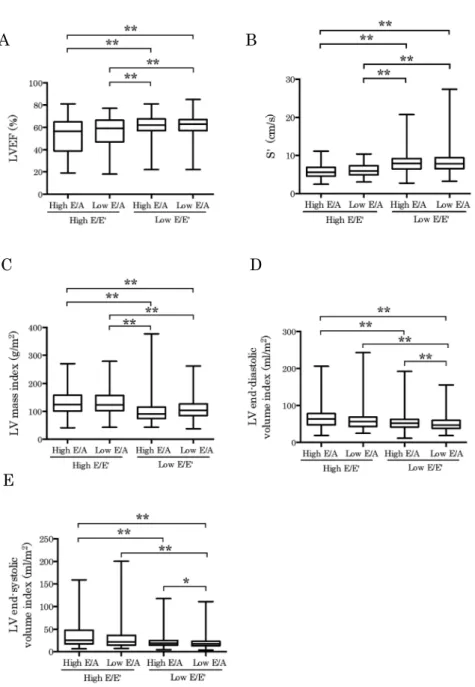
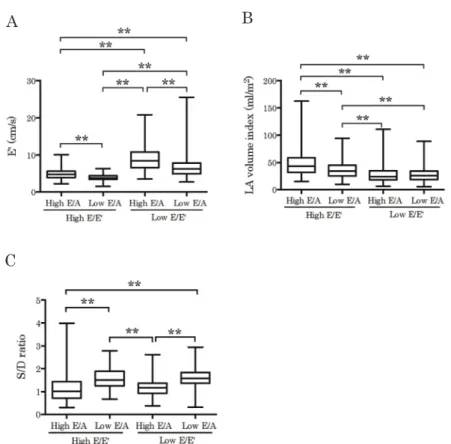
-square test revealed that the proportion of other clinical characteristics were also difference among four groups (data not shown). When we rearranged the groups as high E/E′ and low E/E′ group regardless of E/A value, high E/E′ group showed higher percent- age in all characteristics. As shown in Fig. 1, high E/E′ with both high and low E/A groups showed
Table 1. Patient characteristic
High E/E′ Low E/E′
P value High E/A
(n=136) Low E/A
(n=95) Low E/A
(n=584) High E/A
(n=451)
Age, years 69 [61
-76] 76 [68
-82]** 72 [64
-78]
†57 [43
-68]**
††‡‡<0.01
Male, n (%) 70 (51) 36 (38) 344 (59) 241 (53) <0.01
Left ventricular hypertrophy, n (%) 99 (73) 71 (75) 268 (46) 144 (32) <0.01 Valvular heart disease
Aortic stenosis, n (%) 11 (8) 12 (13) 23 (4) 8 (2) <0.01
Aortic regurgitation, n (%) 48 (35) 33 (35) 197 (34) 84 (19) <0.01
Mitral stenosis, n (%) 4 (3) 1 (1) 1 (0) 1 (0) <0.01
Mitral regurgitation, n (%) 99 (73) 42 (44) 232 (40) 176 (39) <0.01 Old myocardial infarction, n (%) 25 (18) 11 (12) 65 (11) 42 (9) <0.05
Hypertrophic cardiomyopathy, n (%) 6 (4) 3 (3) 8 (1) 4 (1) <0.05
Dilated cardiomyopathy, n (%) 8 (6) 3 (3) 12 (2) 11 (2) <0.01
Age is expressed as median with interquartile ranges. **P < 0.01 vs. high E/E′ with high E/A group.
†