Acta Med. Nagasaki 48: 55-60
Clinical Significance of Telomerase Activity and Telomere Length in Various Liver Diseases
Fumio KITAOKA, Kazuyuki TAKAYAMA, Sadayuki OKUDAIRA, Hikaru FUJIOKA, Junichiro FURUI, Takashi KANEMATSU
Second Department of Surgery, Nagasaki University School of Medicine
We investigated the clinical significance of telomerase activity and telomere length in hepatocellular carcinomas (HCCs) and chronic liver diseases. Telomerase activity was assessed quantitatively using 'Stretch PCR' assay and telomere length by Southern blotting in 24 HCCs, 2 focal nodular hyperplasia, 8 liver cirrhosis, 10 chronic hepatitis and 8 histologically normal livers. The latter were obtained from normal sections of resected specimens of cholangiocellular carcinoma, metastatic liver tumor or hemangioma. The rela- tive titers of telomerase activity (RTA) were significantly higher in HCCs (average, 54 units) than in chronic liver diseases (average, 0.6 units) (P<0.001). In comparison, RTA was less than 2 units in non-malignant liver tissues. Telomere
length in cirrhotic liver tissues was significantly shorter than in normal livers and tended to be shorter than those in chronic hepatitis. Telomere length and RTA correlated with the grading of tissue derangement in chronic liver
diseases. Our results suggest that RTA estimated by Stretch PCR assay might be clinically useful for accurate diagnosis of liver diseases, particularly HCCs. In addition, telomere length seems to having a possibility as a useful predictor for risk of hepatocarcinogenesis.
ACTA MEDICA NAGASAKIENSIA 48: 55-60, 2003
Key Words: telomerase activity, telomere length, hepatocellular carcinoma, chronic liver disease, Stretch PCR
Introduction
The 10-15 kilobases of (TTAGGG) tandem repeats onto 3' ends of each chromosome are termed telomere repeats'. Telomere repeats cap both ends of the chro-
Address Correspondence: Fumio Kitaoka, M.D.
Second Department of Surgery, Nagasaki University School of Medicine
1-7-1 Sakamoto, Nagasaki 852 Japan TEL; +81-95-849-7316 FAX; +81-95-849-7319
mosome and protect them from attacks or fusion'.
Human somatic cells lose telomere repeats in every cell division 3-5. Telomere repeats shorten during the cell cycle, and subsequent activation of the suppressor mechanism that arrests the cell cycle occurs'. On the other hand, certain enzymes such as telomerase coun- teracts the shortening of telomere in immortalized cells'.
Telomerase, a ribonucleoprotein, synthesizes telomere repeats and plays an important role in maintaining telomere length in several normal cells including germ cells and stem cells, or cancer cells8-'1.
Hepatocellular carcinoma (HCC) generally develops from hyperplastic hepatic nodules after chronic liver irritation including chronic hepatitis (CH) and/or liver cirrhosis (LC)12. In spite of recent developments in im- aging diagnosis and histological examination with needle biopsy, it is often difficult to correctly diagnose small liver nodules, particularly well differentiated HCCs. Recently, attention has been paid to telomerase activity and telomere length as molecular events that assist in establishing the correct diagnosis and predict- ing the progression of HCCs'3.'4.
Telomerase activity in human cancer cells has been successfully analyzed using qualitative or semiquantitative assay, known as telomeric repeat amplification proto- col (TRAP)"-`. Although TRAP is a simple and sensi- tive method, this semiquantitative analysis is neither always accurate nor able to differentiate HCCs from chronic liver diseases, because its PCR product de- pends on the protein content of the cell extract with Taq polymerase inhibitor. On the other hand, in the Stretch PCR assay introduced by one of the authors (K. T)18 the telomerase product is purified and polymerase inhibitors are removed as much as possible before DNA amplification. Thus, this assay directly reflects telomerase activity and provides an accurate quantifi- cation of telomerase activity.
Telomere length is important for chromosomal sta- bility and regulation of cell cycle'. Chromosomes that
have lost their telomeric DNA are highly recombinogenic.
In this regard, the telomere length in certain types of cancer cells shortens with cell cycles. Furthermore, chromosomal changes often occur in cancer cells, a process also associated with telomere shorting".
In the present study, we quantitated telomerase ac- tivity by Stretch PCR and telomere length by Southern blotting in HCCs, chronic liver diseases (LCs and CHs) and normal livers. In addition to comparing the above variables in the above tissue categories, we also exam- ined the clinical significance of these measurements.
MATERIAL AND METHODS
Patients and tissue samples
Informed consent from all patients and institutional review board approval for experimental use of sam- ples were obtained. A total of 52 liver specimens in- cluding 24 HCCs, 18 livers with chronic diseases (8 LCs and 10 CHs), 2 focal nodular hyperplasias (FNH) and 8 normal livers were obtained from 35 patients who were treated surgically. Patients included 25 males and 10 females, with a mean age of 63.0 years (range, 20 to 80 years). All 18 specimens of chronic liver diseases were obtained from non-tumorous liver parenchyma of the HCC patients. Normal liver speci- mens were obtained from patients who underwent hepatectomy for other malignant diseases and benign liver tumors including metastatic liver tumors, cholangiocellular carcinomas and hemangiomas.
Attention was paid to use the non-tumorous liver pa- renchyma which was far from the tumor, and also to use the HCC specimen which was histological active in microscopic examination at the tumor margin. All samples were cryopreserved with dry ice immediately after resection and stored at -80° C until use.
Quantitative analysis of telomerase activity
The Stretch PCR assay was performed according to the method previously described by Tatematsu et al. 18 Briefly, approximately 50 mg of the tissue sample was minced in 3 ml of washing buffer (10 mM Hepes pH 8.0, 1.5 MM MgCl2, 10 mM KC1 and 1 mM dithiothreitol) and homogenized in 900 ul of hypotonic buffer (10 mM Hepes pH 8.0, 3 mM KCI, 1 mM dithiothreitol, 0.1 mM PMSF, 1 mg/ml leupeptin, 2 mg/ml pepstatin A, 0.5 % MEGA-9 and 10 U/ml RNasin) with subsequent incubation for 20 min on ice. The supernatant was collected and 2% volume of 5 M NaC1 was added.
After incubation for 20 min at 4°C, the S-100 cell
extract was obtained following centrifugation at 10,000 X g for 60 min at 4°C and 25% volume of glyc- erol was added. Then, the S-100 extract was diluted with hypotonic buffer to a protein concentration of 0.5 mg/ml. In the next step, 20 ul of the extract (10 mg of protein content) was mixed with 2 X reaction mixture (100 mM Tris-potassium acetate; pH 8.5, 1 mM dATP, 1 mM dTTP, 1 mM dGTP, 2 mM MgCl2, 2 mM EGTA, 10 mM,8-mercaptoethanol, 0.1 mg/ml BSA, 2 mM spermidine, 0.2 mM spermine and 20 pmol dena- tured TAG-U [5'-GTAAAACGACGGCCAGTTTGGGGT- TGGGGTTGGGGTTG-3']) and incubated for 60 min at 30°C. The solution was added to proteinase K mix (10 mM Tris HCI; pH 8.0, 0.1 % SDS, 10 mM EDTA and
0.3 mg/ml proteinase K) and incubated for 15 min at 37°C. After purification through phenol/chloroform ex- traction and ethanol precipitation, DNA amplification was performed on the following conditions; 1) dilution with PCR buffer (20 mM Tris-HC1 pH 8.3, 75 mM KCI,
1.5 mM MgCl2, 0.05 % W-1, and 5 pmol of CTA-R [ 5'- CAGGAAACAGCTATGACCCCTAACCCTAACCCTTAA- CCCT-3']), 2) add 10 ml of Taq mix [9 ml of PCR buffer, 0.2 ml of dNTP mix, 0.3 ml of Taq polymerase (EX Taq, Takara Co., Tokyo) and 0.5 ml of 3000 Ci/mmol (a-32P) dCTP] which was prewarmed at 80°C, 3) PCR was performed at the thermal cycle ; 93°C, 1 min, 68°C, I min, 72°C, 2 min for 25 cycles, and fol- lowed by 72°C, 10 min. After purification, the PCR products were analyzed by electrophoresis in 1 X Tris- borate ethylenediami ne tetraacetic acid (EDTA) on de- natured 7% polyacrylamide sequencing gel. Inactivation test was performed in which each S-100 protein was treated with 0.25 mg/ml of RNase A at 30°C for 30 min before TAG-U was elongated by telomerase. The PCR products were measured by radioautography 30 min after exposure to the imaging plate using BAS- 2000 (Fuji-Film Co., Tokyo).
Telomerase activity was quantitated by the ratio of total activity to that of 5 X 10⁶ Hep G2 cells (human hepatoblastoma cell line) and was expressed as the relative titer of telomerase activity (RTA) [RTA (units)
= A/B X 100] , where A is the total radioactivity of the sample, and B is the total radioactivity of 5 X 10⁶ Hep G2 cells. Activity of < 10-2 units was considered nega- tive. If the different RTA was obserbed within the same lesion in HCCs , the highest RTA was presented as the patient's data.
Analysis of telomere length
Telomere length was measured as terminal restric- tion fragment by Southern blotting. For this purpose, 5 ,u g of isolated genomic DNA was digested for 4
Fumio Kitaoka et al : Telomerase Activity and Telomere Length in Liver Disease
hours at 37°C with 15 U of Hinf I. After purification through phenol/chloroform extraction and ethanol precipitation, the digested DNA was loaded and blotted onto membranes, and was then probed with radiolabeled (TTAGGG)4. The DNA fragment length was calculated from the peak density of the hybridizing signal and compared to the molecular size marker.
Data processing and statistical analysis
Correlations between telomerase activity/telomere length and clinicopathological features of HCCs, chroni- cally diseased livers and normal livers were analyzed.
Classification of pathological differentiation and the clinical stage of HCCs were based on the General Rules of Liver Cancer Study Group of Japan". The scoring of portal inflammation and grading of chronic liver disease were based on the Histological Activity Index (HAI) scoring system"'. The grading represented the total score of necrosis and inflammation. Differences in the percentages of tissues exhibiting telomerase ac- tivity in each group were analyzed by the Fisher exact test. Differences in RTA, telomere length and age of patients were analyzed by the Mann-Whitney U test. A p value < 0.05 denoted the presence of a sta- tistically significant difference.
Cell Numbers (log 10)
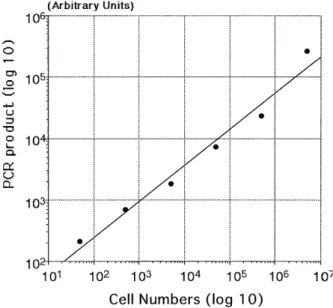
Figure 1. Relationship between telomerase activity measured in HepG2 cell extract and PCRa product. A good dose-response relationship was observed with extracts containing equivalents from 50 up to 5 X 10⁶ HepG2b cells. PCR products are expressed in arbitrary units (r=0.98, P<0.01).
Abbreviations; a. PCR, polymerase chain reaction; b.Hep G2, human hepatoblastoma cell line
RESULTS
Data processing and statistical analysis
We first evaluated quantitatively the accuracy of the Stretch PCR assay by the 10-fold serial dilution test using S-100 cell extract of 5 X 10⁶ Hep G2 cells with and without pretermination by RNase. A close dose-dependent relationship was observed with ex- tracts containing equivalents from 50 cells up to 5 X 10⁶ of Hep G2 cells. ( r=0.98, p<0.01, Figs. 1 and 2)
Telomerase activity in HCCs, chronically diseased livers and normal livers
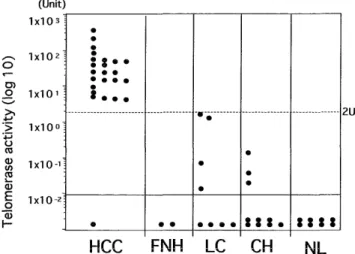
Telomerase activity was noted in 23 of the 24 HCCs (96%) but only in 7 of 18 chronically diseased livers (38.9%). The percentage of tissues exhibiting telomerase activity was higher in HCCs than in chronically dis- eased livers (p<0.01). In contrast, none of FNHs and normal liver tisues exhibit such activity. Further analysis showed that the RTA values of HCC samples were significantly higher (excluding a single negative case, range, 4.5 to 360 units, average, 54 units) than those of chronically diseased livers (excluding negative
Figure 2. Detection of PCRa products in HepG2b, HCCs`, LCs' and NLse by Stretch PCR . HCCs showed a strong telomerase activity (lane 1). LCs showed a weakly positive (lane 3) activ- ity while no activity was noted in normal livers (lane 5).
Each sample was pretreated with RNase (lanes 2, 4 and 6).
lanes 7-11: S-100 samples of 5 X 10⁶ cells of Hep G2 cell ex- tracts, 1:10 dilution, 1:100 dilution, pretreatment with RNase and omission of S 100 sample as control, respectively.
Abbreviations; a. PCR, polymerase chain reaction; b.Hep G2, human hepatoblastoma cell line; c. HCC, hepatocellular carci- noma; d. LC, liver cirrhosis; d. NL, normal liver.
cases, range, 0.02 to 1.7 units, average, 0.6 units) (p<0.001, Fig. 3). In livers with chronic diseases, only, one of 9 (11%) showed telomerase activity in cases with no or mild portal inflammation whereas 6 of 9 (67%) cases with severe portal inflammation exhibited telomerase activity. In addition, the values of RTA in cases with severe portal inflammation were signifi- cantly higher than those with mild portal inflamma- tion. (P<0.01, Fig. 4).
We also examined the correlation between RTA and telomere length and various clinicopathological pa- rameters, including histological subtype, tumor size and microscopic finding in HCCs. However, no signifi- cant correlation was observed (Table 1).
Telomere length in HCCs, chronically diseased livers and normal livers
The telomere length in LCs, HCCs and CHs was sig-
Table 1. Relationship between RTAa, telomere length and various clinicopathological parameters in HCCsb.
HCC FNH LC CH NL
Figure 3. RTAa in HCCsb, LCs`, CHs' and NLs°. RTA in HCCs was significantly higher than in chronic liver diseases (p<0.001), but there were no significant differences between LCs and CHs. No activity was detected in FNHs` and normal livers.
Abbreviations; a. RTA, relative titers of telomerase activity;
b. HCC, hepatocellular carcinoma; c. LC, liver cirrhosis; d. CH, chronic hepatitis; e. NL, normal livers. f. FNH, focal nodular hyperplasia.
Variable n RTA (units) Telomere length (Kb)`
-_- -- ---..---.---.---...--- ---..---.---...-..
Histological differentiation N.Sd.
well 3 26.2±26.1 8.20±1.73
moderately 17 67.0±94.8 6.54±1.64
poorly 3 14.5±9.81 7.37±3.32
combined 1 21.0 5.8
Tumor size N.S.
± 5 cm 18 65.3±92.3 6.86±1.60
> 5 cm 6 24.2±15.0 6.72±2.70
Microscopic intrahepatic metastasis N.S.
positive 9 74.9±117.1 6.41±1.72
negative 15 46.5±53.0 7.08±1.96
Microscopic portal involvement N.S.
positive 4 110.5±167.0 5.82±2.54
negative 20 44.2±55.4 7.02±1.72
Data present the mean±SD, except one negative RTA.
a. RTA, relative titers of telomerase activity; b.HCC, hepatocellular carcinoma;
c.Kb, kilobase; n, number of samples; d.N.S., not significant.
Table 2. Telomere length in HCCs', LCsb, CHs` and normal livers
Portal inflammation score
Figure 4. Differences in RTAa in chronic liver disease. Eighteen samples of chronic liver diseases from non-tumorous part of HCCb were analyzed. Note the positive correlation between portal inflammation and RTA (p<0.01). Mild: grade 0 or 1 of portal inflammation, severe: grade 3 or 4. (/) LC` patient. (•) CH' patient.
Abbreviations; a. RTA, relative titers of telomerase activity;
b. HCC, hepatocellular carcinoma; c. LC, liver cirrhosis; d. CH chronic hepatitis.
Tissues n Telomere length (Kb)' Age
--- --- --- _ ..-- ... ....---...-.
HCC 24 6.94±1.89° 63.0±11.8
LC 8 6.23±1.25` 66.0±6.09
CH 10 7.50±1.64` 63.2±7.70
Normal liver 8 9.49±2.02 60.8±10.2
Data represent the mean±SD. Age was not significantly different in the four groups.
Abbreviations;a. HCC, hepatocellular carcinoma; b. LC, liver cirrhosis; c. CH.
chronic hepatitis; d.Kb, kilobase; e. p<0.005 vs. normal livers; f.p<0.05 vs. normal livers.
Fumio Kitaoka et al : Telomerase Activity and Telomere Length in Liver Disease
nificantly shorter than in normal livers (p<0.005, p<0.005 and p<0.05, respectively). Patient's age did not significantly influence teleomere length in all four tis- sue groups (Table 2). A close correlation was observed between telomere length and grading of chronic liver disease (r=-0.49, p<0.05, Fig. 5).
Figure 5. Relationship between telomere length and grading scores in chronic liver diseases. Telomere length of 18 liver samples of chronic liver diseases from non-tumorous part of HCCa was analyzed. The grading score represented the total score of necrosis and inflammation in HAIb scoring system.
Telomere length correlated with the grading score in HAI (r=-0.49, p<0.01). (•) LCc patient. (•) CHd patient.
Abbreviations; a. HCC, hepatocellular carcinoma; b. HAI, his- tology activity index; c. LC, liver cirrhosis; d. CH, chronic hepatitis.
DISCUSSION
Several studies have examined telomerase activity, using TRAP assay, and telomere length in various liver diseases"-'". However, in these studies the activity was unexpectedly detected even in non-malignant tissues, especially chronic hepatitis. Furthermore, it was diffi- cult to accurately distinguish between chronic and/or premalignant lesions from HCCs. Thus, more sensitive assays are necessary to accurately differentiate be- tween liver tumors and benign chronic diseases or to predict cancerous lesions in chronic liver diseases"'.
In the present study, telomerase activity was de- tected in most HCC specimens (95%). Such frequency was higher than those reported in other studies using TRAP assay (80-85%)']2324. Unexpectedly, a single case of HCC showed no telomerase activity. One possible reason for this finding is that several cancer cells may keep their telomere length without telomerase activity22.
However, we can not rule out a possible degradation of essential telomerase template RNA during sampling
and/or storage. In non-malignant liver lesions, neither FNHs nor normal livers showed any activity, whereas 7 of 18 cases (38.9%) with CHs and LCs showed a weak activity. Thus, the percentage of tissues showing telomerase activity does not seem to be a good parameter to differentiate these chronic liver diseases from HCCs.
These results were consistent with the previous re- ports using TRAP assay"•23.24. In contrast, no case of chronic liver disease with more than 2 units of RTA was observed in our study, indicating that it might be possible to differentiate these suspicious lesions from HCCs by quantification of RTA in the Stretch PCR assay. Another advantage of this assay is that it re- quires only a small volume of tissue sample which can usually be obtained by needle biopsy 13 . Thus, the
Stretch PCR assay might enhance the diagnosis of liver lesions.
There are several explanations for the weak telomerase activity in some liver samples with chronic diseases. First, frequent damage and regeneration of hepatocytes occurs in chronic liver diseases associated with excessive division of hepatocytes, which is be- yond the normal senescence checkpoints, subsequently causing the expression of telomerase activity25-27. Second, infiltrating lymphocytes might possibly be the source of this activity, since these cells are known to exhibity telomerase activity'°. In fact, the RTA values in our study correlated well with the extent of lymphocyte infiltration present in portal inflammation in HAI scor- ing.
Our results showed no significant correlation between telomerase activity and various clinicopathological pa- rameters in HCCs. Previous studies, however, have re- ported a high telomerase activity in poorly differenti- ated HCCs than well differentiated HCCs232". It is possible that differences in the sensitivity of the Stretch PCR and TRAP assay may explain the different results.
Telomere length in HCCs was not shorter than in LCs, though it was shorter than that of normal livers.
These results suggest that telomere length in HCC cells is regulated or elongated to a certain level by telomerase, and this is subsequently followed by immortalization of HCC cells. Telomere length of LCs was shortest among non-cancerous liver diseases in the present study, and correlated with the grade of HAI score, which represented the extent of inflammation and tis- sue necrosis in liver diseases. These results support the notion that senescence of hepatocytes occurs fol- lowing tissue derangement and subsequent regenera- tion, especially in chronic hepatitis induced by hepati- tis C virus and that the incidence of HCC increases with the advancement of the stage of the disease23,28.
Considered together, our results suggest that telomere
Fumio Kitaoka et al : Telomerase Activity and Telomere Length in Liver Disease
length might be one of the parameter for predicting the risk of hepatocarcinogenesis in hepatic tissues.
In conclusion, we demonstrated in the present study clear differences in RTA and telomere length between HCCs, chronically diseased livers and normal livers. A significantly higher percentage of HCC tissues exhib- ited RTA than in non-cancerous liver tissues, even in tissues exhibiting telomerase activity. We also showed the possibility that telomere length might be a novel predictor of hepatocarcinogenesis in chronically dis- eased liver.
ACKNOWLEDGMENT
We are grateful to Tatematsu K and Ishikawa F (Dept. of life science, Tokyo Institute of Technology, Yokohama, Japan) for technical support of Stretch PCR.
References
1. Moyzys RK, Buckingham JM, Cram LS, et al. A highly conserved repetitive DNA sequence, (TTTAGGG)n, present at the telomeres
of human chromosomes. Proc. Natl. Acad. Sci. USA. 85: 6622-6626,
1998
2. Blackburn EH. Structure and function of telomeres. Nature 350:
569-573, 1991
3. Watoson JD. Origin of concatemerie T7 DNA. Nature (New Biol.) 239: 197-201, 1972
4. Levy MZ, Allsopp RC, Fucher B, Greider CW, Harley CB. Telomere end repriciation problem and cell aging. J. Mol. Biol. 225: 951-960
1992
5. Harley CB, Futcher AB, Greider CW. Telomere shorten during aging of human fibroblasts. Nature 345: 458-460, 1990
6. Allsop RC, Vaziri H, Psyyrtdon C, et al. Telomere length predicts replicative capacity of human fibroblasts. Proc. Natl. Acad. Sci.
USA. 89: 10114-10118, 1992
7. Kim NW, Piatyszek MA, Prowse KR, et al. Specific association of human telomerase activity with immortal cell and cancer. Science
266: 2011-2015, 1994
8. Lundblad V, J. W. Szostak. A mutant with a defect in telomere elongation leads to senescence in yeast. Cell 57: 633-643, 1989 9. Wright WE, Piatyszek MA, Rainey WE, Byrd W, Shay JW.
Telomerase activity in human germ line and embryonic tissues
and cells. Dev. Genet. 18: 173-179, 1996
10. Hiyama K, Hirai Y, Koizumi S, et al. Activation of telomerase in human lymphocyte and hemotopoietic progenitor cells. J. Immunol.
155:3711-3715, 1995
11. Tahara H, Nakanishi Y, Kitamoto M, et al. Telomerase activity in human liver tissues: comparison between chronic liver disease and hepatocellular carcinomas. Cancer Res. 55: 2734-2736, 1995 12. Kondo F, Ebara M, Sugiura M, et al. Histological features and
clinical course of large regenerative nodules evaluation of their
precancerous potentiality. Hepatology 12: 529-598, 1990
13. Nouso K, Urabe Y, Tsuji T, et al. Telomerase as a tool for the dif- ferential diagnosis of human hepatocellular carcinoma. Cancer 78:
232-236, 1996
14. Suda T, Isokawa 0, Aoyagi Y, et al. Quantitation of telomerase activity in hepatocellular carcinoma: A possible aid for a predic-
tion of recurrent disease in the remnant liver. Hepatology 27: 402-
406, 1998
15. Christopher MC, Hal WH, Silvia B, Calvin BH, Harley CB.
Telomere activity in human ovarian carcinoma. Proc. Natl. Acad.
Sci. USA. 91: 2900-2904, 1994
16. Tahara H, Kunimatsu H, Yokozaki H, et al. Telomerase activity in preneoplastic and neoplastic gastric and colorectal lesions. Clin.
Cancer Res. 1: 1245-1251, 1995
17. Wright WE, Shay JW, Piatyszek MA. Modification of a telomeric repeat amplification protocol (TRAP) result in increased reliability,
linearity and sensitivity. Nucleic Acids Res. 23: 3794-3795, 1996 18. Tatematsu K, Nakayama J, Danbara M, et al. A novel quantitative
'Stretch PCR assay'
, that detects a dramatic increase in telomerase activity during the progression of myeloid leukemias. Oncogene
13: 2265-2274, 1996
19. Sawyer JR, Goosen LS, Stine KC, Thomas JR. Telomere fusion as a mechanism for the progressive loss of the short arm of chromo-
some 11 in an Anaplastic Wilms' Tumor. Cancer 74: 767-773, 1994 20. The Liver Cancer Study Group in Japan. The general rules for the clinical and pathological study of primary liver cancer, 3rd. edn.
Tokyo: Kanahara, 1992
21. Knodell RG, Ishak KG, Black WC, et al. Formulation and applica- tion of a numerical scoring system for assessing histological ac-
tivity in asymptomatic chronic active hepatitis. Hepatology 1: 431-
435, 1981
22. Ishak K, Baptista A, Bianchi L, et al. Histological grading and staging of chronic hepatitis. J Hepatol 22: 696-9, 1995
23. Kojima H, Yokozuka 0, Imazeki F, Saisbo H, Omata M.
Telomerase activity and telomere length in hepatocellular carci-
noma and chronic liver disease. Gastroenterology 112: 493-500,
1997
24. Nakanishi R, Kitamoto M, Tahara H, et al. Significance of telomerase activity in the diagnosis of differentiated hepatocellular carcinoma
smaller than 3cm. Int. J. Cancer 74: 141-147, 1997
25. Ohta K, Kanamaru T, Morita Y, Hayashi Y, Ito H, Yamamoto M.
Telomerase activity in hepatocellular carcinoma as a predictor of
postoperative recurrence. J. Gastroenterol. 32: 791-796, 1997 26. Counter CM, Avilion AA, LeFeeuvre CE, et al. Telomere shorten-
ing associated with chromosome instability is arrested in normal
cells which express telomerase activity. EMBO J. 11: 1921-1929,
1992
27. Ohhashi K, Tatumi M, Nakajima Y, et al. Telomere changes in human hepatocellular carcinomas and hepatitis virus infected
noncancerous livers. Cancer 77: 1747-1751, 1996
28. Takano S, Yokosuka 0, Imazeki F, Tagawa M, Omata M. Incidence of hepatocellular carcinoma in chronic hepatitis B and C: a prospec-
tive study of 251 patients. Hepatology 21: 650-655, 1995