The Japanese Psychonomic Society
NII-Electronic Library Service
The JapanesePsychonomic Society
TheJLipangsefournalofPsychonomicScience
2ee3,Vel.22,No.1,35-36
Prizewinner's
Summary1-B-42
Visual
spatial
contexts
Tomohiro
NABETA,
transfer
to
Fuminori
ONo,
and
IIiroshima
Uitiversity*
haptic
search
Jun-ichiro
KAwAHARA
Under incidentailearningconditions spatial ]ayouts can
be
acquiredimplicitly
andfacilitate
visual search
(contextual
cueing effecO.We
examined whether thevisual contextual cueing effectis
specific tothemodality or transfersto thehapticmodality. The participantsperformed visual search trialsbased
on a typica]contcxtual cueing paradigm, followed by haptic search trialsin
which halfof thetrialshad layoutsused in
the
previous visual search trials.The
visual contcxtua] cueing effect was obtained inthe
learning
phase.More
importantly,
the effect was transferredfrom
visual tohaptic
search. This suggests a cornmonality of $patial memory toallocate focused attentionin
both
visual andhaptic
modalities.Key words: transfer
from
vision tohaptics,contextual cueing, implicitrnemorySpatial context facilitates
the
visual processes,such as a visual search.
To
examinehow
spatialcontext islcarned,
Chun
andJiang
(1998>
devised a centextual cueing paradigm. In a typical experi-ment, participants conducted visuar search foratilt-ed "T"
among rotated '`L"s
and
indicated
thedirec-tion of Lhe target. Half of the search trialshad
unique stimulus
layouts
whereas theother ha]fhadlayouts that were repeated
throughout
theexperi-menL Accordingly the participants
identificd
theorientatien of the target
faster
with the repeatedlayouts
than with the unique layouts,although theparticipantswere not able to recognise thercpcatcd
layouts.
Their
performance suggested that theylearned
the repeated spatial layouts irnplicit]yand used thisimplicit
knowledge toguide their attentiontoward thelocatienof thetarget.
Although recent studies
have
shown that spatialcontexts yield robust contextual cueing effects, the nature of the spatial memory that mediates the ef-fectsisnot clear. Spccifically,isthe memory of
spa-tial
context specific tothe visua]domain
oris
it
viable across modalities ?
We tested this possibilityin
the
present study,The experirnent consisted of 2 phases. First,the
participantsconducted visual search trialsbased on
a typicalcontextual cueing paradigm; then the
par-* Department of
Psychology,
Hiroshirna
Univer-sity, 1-1-1 Kagamiyama, Higashi-Hiroshima
739-8524
ticipantsconducted
haptic
search trials.
Method
Stimulus materials and apparatus The visual
stimuli were disp]ayed on an LCD monitor. The stimuli consistcd of one "T"
and eleven "L"s. The "T"
was the targetand was tilted
90"
tothc right or tothe left;the "L"s
were distractorsand were rotated
ee,
900.
1800,
or2700
from
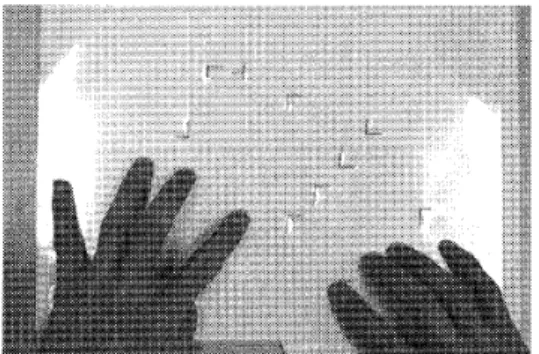
the upright orientation.In the transferphase, 12 items inahaptic search
array were raised on a plasticsheet for overhead
projection
(Figure
1).
Design
and procedureIn
the ]carning(visual
search> phase.the 2 main variables were thelayout
(old
vs. new) and epoch(1-5).
The old set of stimu]iconsisted of
8
randomly generatedlayeuts
through-out the learningphase,once per block. The repeated
layouts maintained thelocationof the itemsand the
identity of
the
distractors,
but
the
identity
of theFigure 1. The search array used in the
The Japanese Psychonomic Society
NII-Electronic Library Service
TheJapanesePsychonomic Society
36 The
Japanese
Journal
ofPsychonomic
Science
Vol.
22,
No,
1
target was changed randomly from trialtotrial.The
new set consisted of
8
different
layouts
that
were generated anewfor
each trialtoserve as a controlbaseline.Each
participant
wasgiven
20
blocks
of16
trialseach
{8
old, 8 new}, fora totalof 320 trials.Twenty blockswere grouped insets of 4intoepechs,
resulting
in
5
epochs.In the transfer
(haptic
search) phase The mainvariable was the layout
(common
vs, specific), Thecommon set consisted of
8
layouts
which werethe
same as the old layouts used inthe
previous
visualsearch trials.The specific set consisted of 8 layQuts
that were generated anew,
Eachsession consisted of2blocks of 16trialseach
(8
common,8
specific), resultingin
atotalof32
trials.The 12 naive participantssearched ferthe target
visually
(learning
phase) andhaptically
(transfer
phase), and indicated its orientation
by
pressingeither the right or left
foot
switch throughout the'expenment.
After
thehaptic
search trials,the participants im-mediately performed a hapticrecegnition testwhich consisted of 16trials,Eight were thecommonlayout
and the other
8
were fi11ersthat were generatedanew.
Results
Searchtask
The mean reaction times of thevisual search task
for
all of the correct responseswithin an epoch were calculated.
These
data
wereused for a repeated-measures ANOVA with the
layout
(old
vs. new) and epoch(1-5)
as within-subjectfactors.
The analysis revealed significant main effects of
layout,
F(1,
11)=34.63.
P<,Ol,
and epoch,F(4,
44}='='
3,02,
p<.05.
The
interaction
between
layout
andepoch was not significant,
F(4,
44>=2.34, n.s. How-ever when the analysis was restricted toepochs 1and
5
only, theinteraction
was significant, F(1,11)=6.00,p<.05.
In
the
transfer
phase,the
mean reaction times for the correct trialswere calculated for both thecom-mon and specific conditions.
Analysis
of thedata
with a t-tcst revcaled that the
haptic
search wasfasterinthe common condition than inthe specific
condition,t(11)=2.35,P<.05.
Recognition test The mean accuracy
in
therec-ognition task was 47%, The participantscorrectly classified the common layouts as old in23% of the trials
(hit
rate), and thiswas same astheirfalse-alarmrate of
23%,
t(11)=O,19,n.s.
Diseussion
In
the
present study, we obtained3
major results.First,theresult of the learningphase showed thata
visual context was obtained through visual searches: the reaction times
in
the old condition weresig-nificantly shorter than
in
thenew condition,Second,
we
found
that thehaptic
search performance wasfasterwhen the layoutswere identicaltopreviously
experienced visual search layouts than when layouts
differed
from
thoseof thevisual search,Finally,
the mean accuracy of therecognition testwas at chancelevel.
Based
onthese
resu]ts, we suggestthat
im-plicitspatial memory acquired through visual search
isalso available
for
guiding
thefocus
Qf spatial atten-tion inhapticsearch.
Our
resultsdemonstrating
thetransfer of a learned spatial contextfor
a search across visual andhaptic
modalities suggest thatthevisual memory isshared toorient multiple spatially distributedobjects.
Reference
Chun, M. M.
&
Jiang,
Y. 1998Contextual
cueing:Implicitlearning and memory of visual context
guides spatial attention. CognitiveRsycholqgy, 36,